ECU AUDI A6 2016 Owner's Guide
[x] Cancel search | Manufacturer: AUDI, Model Year: 2016, Model line: A6, Model: AUDI A6 2016Pages: 294, PDF Size: 73.88 MB
Page 178 of 294
Child safety
In order for the airbag to offer protection, it is
important that all vehicle occupants, especially
any children , who must be in the front seat be
cause of exceptional circumstances, be properly restrained and as far away from the airbag as
possible . By keeping room between the child's
body and the front of the passenger compart
ment , the airbag can inflate completely and pro
vide supplemental protection in certain frontal
collisions.
A WARNING
Not using a booster seat, using the booster
seat improperly, incorrectly installing a boos
ter seat or using the vehicle safety belt im
properly increases the risk of serious personal
injury and death in a collision or other emer
gency situation. To help reduce the risk of se
rious personal injury and/or death:
- The shoulder belt must lie as close to the
center of the child's collar bone as possible
and must lie flat and snug on the upper
body .
It must never lie across the throat or
neck. The lap belt must lie across the pelvis
and never across the stomach or abdomen .
Make sure that the belt lies flat and snug.
Pull on the belt to tighten if necessary.
- Failure to properly route safety belts over a
child's body will cause severe injuries in an
accident or other emergency situation
¢ page 134.
- The rear side of the child safety seat should
be positioned as close as possible to the
backrest on the vehicle seat.
- For adjustable head restraints: adjust or re
move the rear seat head restraint if it is dif
ficult to install the child seat with the head restraint in place
¢ page 57. Install the
head restraint again immediately once the
child seat is removed. Driving without head
restraints or with head restraints that are
not properly adjusted increases the risk of
serious or fatal neck injury dramatically.
- Children on the front seat of any car, even
with Advanced Airbags, can be seriously in
jured or even killed when an airbag inflates.
- Never let a child stand or kneel on any seat,
for example the front seat.
176
-
-Never let a child ride in the cargo area of
your vehicle.
- Always remember that a child leaning for
ward, sitting sideways or out of position in any way during an accident can be struck by
a deploying airbag. This will result in serious
personal injury or death .
- If you must install a booster seat on the
front passenger seat because of exceptional
circumstances the
PASSENGER AIR BAG
OFF
light must come on and stay on, when
ever the ignition is switched on.
- If the
PASSENGER AIR BAG OFF light does
not come on and stay on, perform the
checks described ¢
page 153, Monitoring
the Advanced Airbag System.
-Take the child restraint off the front passen
ger seat and install it properly at one of the
rear seat positions if the
PASSENGER AIR
BAG OFF
light does not stay on whenever
the ignition is switched on.
-Always read and heed all WARNINGS when
ever using a child restrained in a vehicle is being used ¢
page 134, Safety belts,
¢page 142, Airbag system
and
¢ page 166, Important information.
Securing child seats
Securing a child safety seat using a safety
belt
Safety belts for the rear seats and the front pas
senger con be locked with the convertible locking
retractor to properly secure child safety seats.
The safety belts emergency locking retractors for
the rear seats safety belts and for the front pas
senger's seat safety belt have a convertible lock
ing retractor for child restraints. The safety belt
must be locked so that belt webbing cannot un
reel. The retractor can be activated to lock the
safety belt and prevent the safety belt webbing
from loosening up during normal driving . A child
safety seat can only be properly installed when
the safety belt is locked so that the child and
child safety seat will stay in place.
Always remember : Even though your vehicle is
equipped with an Advanced Airbag system, all
Page 179 of 294
children, especially those 12 years and younger,
should always ride in the back seat properly re
stra ined for their age and size.
A WARNING
-
Improperly installed child safety seats in
crease the risk of serious personal injury and
death in a collision.
- Always make sure that the safety belt re
tractor is locked when install ing a child
safety seat . An unlocked safety belt retrac
tor cannot hold the child safety seat in place dur ing normal driving or in a crash.
- Always buckle the child safety seat firmly in
place even if a child is not sitting in it . A
loose child safety seat can fly around during
a sudden stop or in a collision.
- Always make sure that the rear seat back
rest to wh ich the center rear safety be lt* is
attached is secure ly latched whenever the
rear center safety belt is being used to se
cure a child restraint.
- If the backrest is not securely latched, the
child and the child restraint will be thrown
forward together with the backrest and will strike parts of the vehicle interior. The chi ld
can be seriously injured or killed.
- Never install rear-facing chi ld safety seats
or infant carriers on the front passenger
seat. A child will be seriously injured and can be killed when the passenger airbag in
flates.
- The inflating a irbag w ill hit the child safety
seat or infant carrier with great force and
will smash the ch ild safety seat and child
against the backrest, center armrest, door
or roof.
- Always install rear-facing child safety seats
o r infant carriers on the rear seat.
- Forward-fac ing ch ild safety seats or infant
carriers installed on the front passenger's
seat may inte rfe re with the deployment of
the a irbag and cause serious injury to the
child.
- It is safer to install a forward-fac ing ch ild
safety seat on the rear seat.
- Always read and heed all WARN INGS when
ever using a child restrained in a veh icle is
Ch ild safety
being used ¢page 166. Special precautions
apply when instal ling a child safety seat on
the front passenger seat
¢ page 143, Child
restraints on the front seat -some impor
tant things to know .
A WARNING
-Always take special precautions if you must
i nstall a forward or rearward-facing child re
stra int on the front passenger 's seat in excep
tional s ituations:
- Whenever a forward or rearward-fac ing
child restraint is installed on the front pas
senger seat, the
PAS SENGER AIR BAG OFF
light must come on and stay on whenever
the ignition is switched on .
- I f the
PASSENGER AIR BAG OFF light does
not come on and stay on, perform the
checks described
¢ page 153, Monitoring
the Advanced Airbag System.
- Take the child restraint off the front passen
ger seat and install it properly at one of the
rear seat positions if the
PA SS ENGER AIR
BAG OFF light does not stay on whenever
the ignition is switched on.
- Improper installat ion of child restraints can
reduce the ir effectiveness or even prevent
them from providing any protect ion.
- An improperly installed child restra int can
interfere with the airbag as it deploys and
serious ly injure or even kill the child .
- Always carefully follow the manufacturer's
instructions provided with the child safety
seat or carr ier .
- After checking to make sure that the child
restraint is properly installed, make certain
that the child restraint is co rrectly recog
n ized by the capacitive passenge r detection
system in the fron t passenger seat and that
the
PASSENGER AIR BAG OFF light signals
the correct front passenger frontal a irbag
stat us.
A WARNING
Forward-facing child restra ints :
-
177
Page 180 of 294
Child safety
-Always make sure the forward-facing seat
has been designed and certified by its man
ufacturer for use on a front seat with a pas
senger front and side airbag.
- Never put the forward-facing child restraint
up, against or very near the instrument pan
el.
- Always move the passenger seat into its
rearmost position in the seat's fore and aft
adjustment range, as far away from the air
bag as possible before installing the for
ward-facing child restraint. The backrest
must be adjusted to an upright position.
- Make sure that the
PASSENGER AIR BAG
OFF
light comes on and stays on all the time
whenever the ignition is switched on.
_&. WARNING
Rearward-facing child restraints:
- A child in a rearward-facing child safety seat
installed on the front passenger seat will be
seriously injured and can be killed if the
front airbag inflates -even with an Ad
vanced Airbag System.
- The inflating airbag will hit the child safety
seat or infant carrier with great force and
will smash the child safety seat and child
against the backrest, center armrest, door
or roof.
- Always be especially careful if you must in
stall a rearward facing child safety seat on
the front passenger seat in exceptional cir
cumstances.
- Make sure that the
PASSENGER AIR BAG
OFF
light comes on and stays on all the time
whenever the ignition is switched on .
- If the
PASSENGER AIR BAG OFF light does
not come on and stay on, immediately in
stall the rear-facing child safety seat in a rear seating position and have the airbag
system inspected by your Audi dealer .
178
· Activating the convertible locking retractor
Use the convertible locking retractor to secure a
child restraint.
Always heed the child safety seat manufacturer 's
instructions when installing a child restrain t in
your vehicle . To activate the convertible locking
retractor:
.. Place the child restraint on a seat, preferably
on the rear seat.
.. Slowly pull the belt
all the way out .
.. Route it around or through the child restraint
belt path
~ ,&. .
.. Push the child safety seat down with your full
weight to get the safety belt really tight.
.. Insert the belt tongue into the buckle for that
seating position.
.. Guide the safety belt back into the retractor un
til the belt lies flat and snug on the child safety
seat.
.. You should hear a "clicking" noise as the belt
winds back into the inertia reel. Test the con
vertible locking retractor by pulling on the belt.
You should no longer be able to pull the belt
out of the retractor. The convertible locking re
tractor is now activated.
.. Make sure that the red release button is facing
away from the child restraint so that it can be
unbuckled quickly.
.. Pull on the belt to make sure the safety belt is
properly tight and fastened so that the seat
cannot move forward or sideways more than
one inch (2 .5 cm) .
_&. WARNING
Using the wrong child restraint or an improp
erly installed child restraint can cause serious
personal injury or death in a crash.
- Always make sure that the safety belt re
tractor is locked when installing a child
safety seat. An unlocked safety belt retrac
tor cannot hold the child safety seat in place
during normal driving or in a crash.
- Always buckle the child safety seat firmly in place even if a child is not sitting in it. A
loose child safety seat can fly around during
a sudden stop or in a crash.
Page 181 of 294
-Always make sure the seat backrest to which
the child restraint is installed is in an up
right position and securely latched into
place and cannot fold forward. Otherwise,
the seatback with the child safety seat at
tached to it could f ly forward in the event of
an accident or other emergency situation.
- Always read and heed all WARNINGS when
ever using a child restrained in a veh icle is
being used
r=;, page 166. Specia l precaut ions
apply when installing a child safety seat on
the front passenger seat¢
page 143, Child
restraints on the front seat -some impor
tant things to know.
Deactivating the convertible locking
retractor
The convertible locking retractor for child re
straints will be deactivated automatically when
the belt is wound all the way back into the re
tractor .
~ Press the red button on the safety belt buckle.
The belt tongue will pop out of the buckle.
~ Guide the safety belt all the way back into its
stowed position .
Always let the safety belt retract completely into
its stowed position. The safety belt can now be
used as an ordinary safety belt without the con
vertible locking retractor for child restraints.
If the convertible locking retractor should be ac
tivated inadvertently, the safety belt must be un
fastened and guided completely back into its
stowed position to deact ivate this feature. If the
convert ible locking retractor is not deactivated,
the safety belt w ill gradually become tighter and
uncomfortable to wear.
_& WARNING
-
Improperly installed chi ld safety seats in
crease the risk of serious personal injury and
death in a collision.
- Never unfasten the safety belt to deactivate
the convertible locking retractor for child re
straints while the vehicle is moving . You
Child safety
would not be restrained and could be seri
ously injured in an accident.
- Always read and heed all WARNINGS when
ever using a child restrained in a vehicle is
be ing used
¢page 166. Special precautions
apply when installing a child safety seat on
the front passenger seat¢
page 143, Child
restraints on the front seat -some impor
tant things to know.
LATCH system (Lower
anchorages and tethers
for children)
Child Restraint System anchors and how
are they related to child safety
To provide a simpler and more practicab le way to
attach the child restraint on the vehicle seat,
Federal regulations require special lower ancho
rages in vehicles and devices on new child re
straints to attach to the vehicle anchorages .
In the United States, the combination of the
tether anchorages and the lower anchorages is
now generally called the LATCH system for
"Lower Anchorages and Tethers for Children". In
Canada, the terms "top tether" with "lower uni
versa l anchorages" (or "lower universal anchor
age bars") are used to descr ibe the system .
In other countries the term "ISOFIX" is used to
describe the lower anchorages .
Forward-facing child restraints manufactured af
ter September 1, 1999, are required by U.S. fed
eral regulations to comply with new child head
movement performance req uirements. These
new performance requirements make a tether
necessary on most new ch ild seats.
Installing a child restraint that requires a top
tethe r without one can seriously impair the per
formance of the child restraint and its ab ility to
protect the child in a collision. Installing a child
restra int that requi res a top tether without the
top tether may be a violation of state law.
Child restraint manufacturers offer LATCH lower
anchorages on their child seats w ith hook-on or ..,.
179
Page 182 of 294
Child safety
push-on connectors attached to adjustable
straps.
I n addition to the LATCH lower anchorages, these
chi ld restraint systems usually require the use of
tether straps to he lp keep the child restraint
firm ly in place.
A WARNING
Improper installation of child restraints will
increase the risk of injury and death in a
crash.
- Always follow the instructions provided by
the manufacturer of the child restraint you intend to install in your veh icle.
- Never install a child restraint without a properly attached top tether strap if the
child restraint manufacturer's instruct ions
requ ire the top tether strap to be used.
- Improper use of child restra int LATCH lower
anchorage points can lead to injury in a colli
s ion . The LATCH lower anchorage points are
designed to withstand on ly those loads im
posed by cor rect ly fitted child restraints .
- Never mount two child restraint systems on
one LATCH lower anchorage point.
- Never secure or attach any luggage or other
item to the LATCH lower anchorages.
Location
Fig. 171 Schem atic overv iew: LATCH ancho rage point loca
t io ns
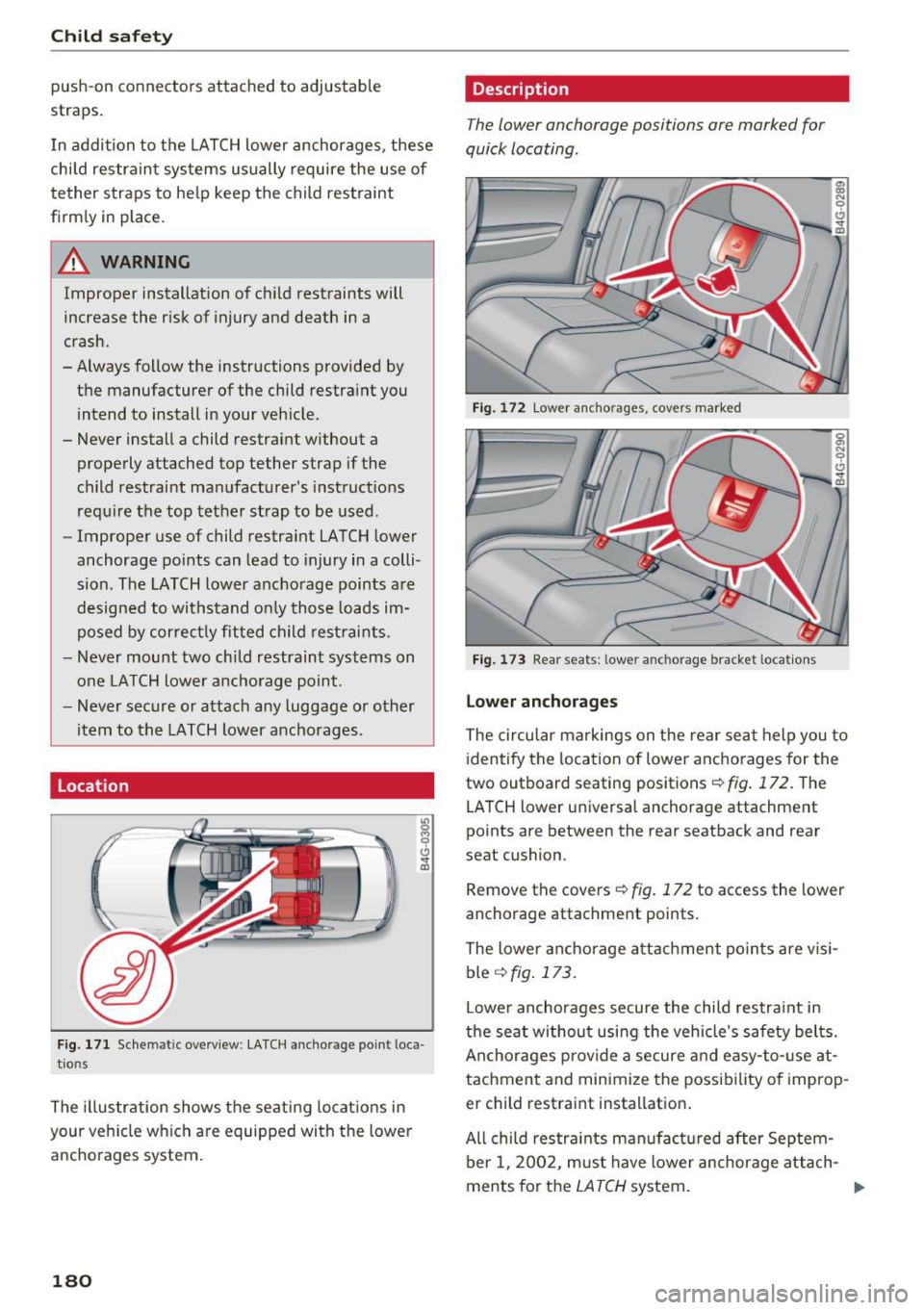
The illustration shows the seating locatio ns in
your veh icle which are equipped with the lower
anchorages system.
180
Description
The lower anchorage positions are marked for
quick locating .
Fig. 17 2 Lower ancho rages, covers marked
Fig. 173 Rear seats: lowe r anchorage bracket locations
L o wer anch ora g es
The circular markings on the rear seat help you to
identify the location of lower anc horages for the
two outboard seating positions
¢ fig . 172 . The
LATCH lower universal anchorage attachment
points are between the rear seatback and rear
seat cushion .
Remove the covers ¢
fig. 172 to access the lower
anchorage attachment points.
The lower ancho rage attac hment po ints are vis i
ble
¢ fig. 173.
Lowe r anchorages secure the child restra int in
the seat wi thou t usi ng the vehicle's safety belts.
Anchorages p rov ide a secure and easy-to-use at
tachment and minimize the possibility o f improp
er child restraint installation.
All child restra ints manufact ured after Septem
ber 1 , 2002, must have lower anchorage attach -
ments for the
LATCH system. ..,.
Page 183 of 294
Please remember that the lower anchorage
points are only intended for installation and at
tachment of child restraints specifically cert ified
for use with
LATCH lower anchorages. Child re
straints that are not equipped with the lower an
chorage attachments can still be installed in
compliance w ith the child restra int manufactur
er 's instructions on using vehicle safety belts .
.8, WARNING
Improper use of LATCH lower anchorages can
cause serious personal injury in an accident.
- Always caref ully follow the child restra ints
man ufactu rer's inst ructions for proper in
sta llation of the child restr aint and proper
u se of the lower anchorages or safety be lts
in your vehicle.
- Never secure or attach any luggage or other
items to the
LATCH lower anchorages.
- Always read and heed t he important infor
mation about child restraints in this chapter
and WARNINGS
~ page 166, Child safety .
Installing a child restraint with LATCH
lower anchorages
Whenever you install a child restraint always fol
low the child restraint manufacturer's instruc
tions.
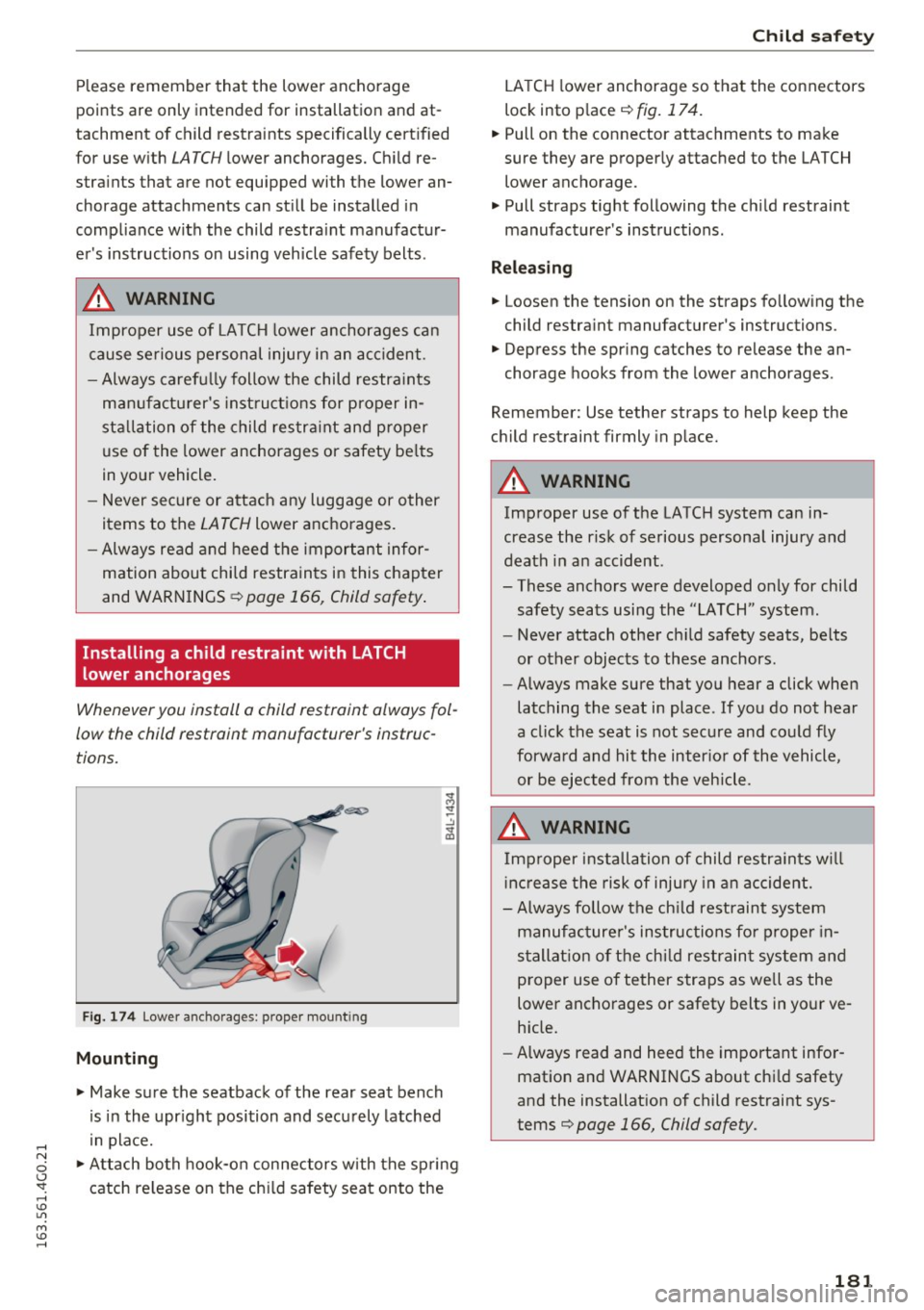
F ig . 174 Lower anchorages: proper mount ing
Mounting
.,. Make sure the seatback of the rear seat bench
is in the upr ight position and sec urely latched
i n place .
.. Attach both hook-on connectors with the spring
catch re lease on the ch ild safety seat onto the
Ch ild safety
LATCH lower anchorage so that the connectors
lock into p lace
¢ fig. 174.
.. Pull on the connector attachments to make
sure they are properly attached to the LATCH
lower anchorage.
.. Pull straps tight following the ch ild restraint
manufacturer 's instructions .
Relea sing
.. Loosen the tension on the straps fo llow ing the
child restra int manufacturer's instructions.
.. Depress the spr ing catches to release the an
chorage hooks from the lower anchorages .
Remember: Use tether straps to help keep the
child restraint firmly in p lace.
.8, WARNING "---Imp roper use of the LATCH system can in
crease the risk of serious personal injury and
death in an accident.
- These anchors were developed only for child safety seats using the "LATCH" system.
- Never attach other ch ild safety seats, belts
or other objects to these anchors.
- Always make sure that you hear a click when
latching the seat in place. If you do not hear
a click the seat is not sec ure and co uld f ly
forward and hit the inter io r of the vehicle,
or be ejected from the vehicle .
.8, WARNING
I mp roper installation of child restra ints w ill
i n cr ease the risk of inju ry in an a ccident.
- Always follow the ch ild restraint system
manufac ture r's ins tructions fo r prope r in
s tallat ion of the ch ild restrain t system and
proper use of tether straps as well as the
lower anchorages or safety belts in yo ur ve
h icle.
- Always read and heed the important infor
matio n and WARNINGS about ch ild safety
and the installat ion of child restraint sys
tems
¢ page 166, Child safety .
-
181
Page 184 of 294
Child safety
Tether anchors and tether straps
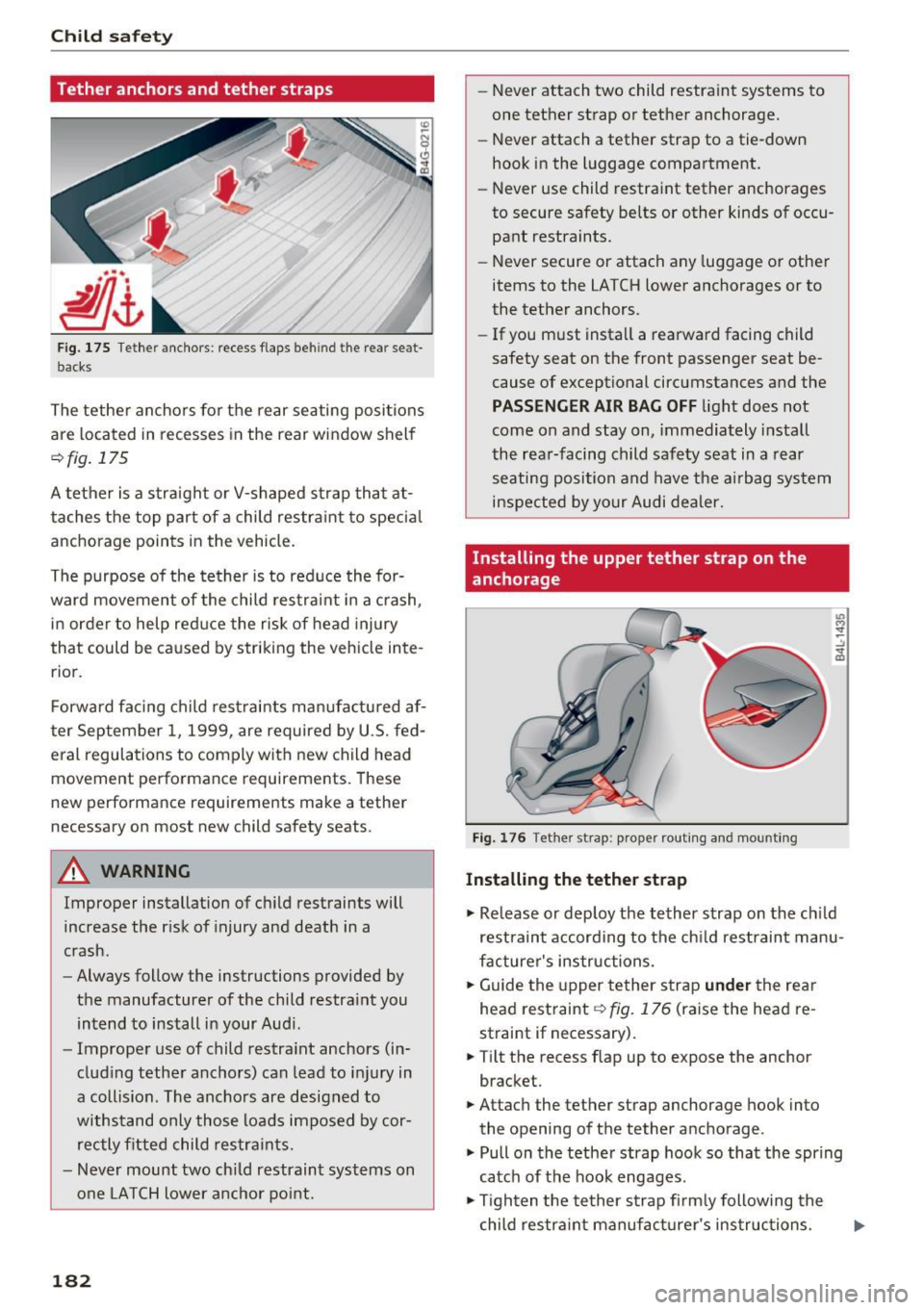
Fig. 175 Tether anchors: recess flaps behind the rear seat·
backs
The tether anchors fo r the rear seating positions
are located in recesses in the rear window shelf
~ fig.175
A tether is a stra ight or V-shaped strap tha t at
taches the top part of a child restra int to speci al
anchorage points in the vehicle.
The purpose of the tether is to red uce the for
ward movement of the child restraint in a crash,
in order to help red uce the risk of head injury
that could be caused by strik ing the vehicle inte
rior.
Forward fac ing child restraints manufactured af
ter September 1, 1999, are required by U.S. fed
eral regulations to comply with new child head
movement performance requirements. These
new perfo rmance requirements make a tethe r
necessary on most new child safety seats.
A WARNING
Improper installation of ch ild restraints will
increase the r isk of injury and death in a
crash.
- Always follow the instructions provided by
the manufacturer of the child restra int you
intend to install i n your Audi .
- Improper use of child restra int anchors (in
clud ing tether anchors) can lead to inj ury in
a collision . The ancho rs are designed to
withs tand only those loads imposed by cor
rectly fitted child restra ints.
- Never mount two chi ld restraint systems on
one LATCH lower a nchor po int.
182
- Never attach two child restraint systems to
one tether strap or tether anchorage.
- Never attach a tether strap to a tie-down
hook in the luggage compartment .
- Never use child restraint tether anchorages
to secure safety be lts or other kinds of occu
pant restraints.
- Never secure or attach any luggage or othe r
items to the LATCH lower anchorages or to
the tether anchors.
- If you must install a rearward facing child
safety seat on the front passenger seat be
cause of exceptional circumstances and the
PASSEN GER AIR BAG OFF light does not
come on and stay on, immediately install
the rea r-facing child safety seat in a rear
seating position and have the ai rbag system
inspected by yo ur Audi dea ler.
Installing the upper tether strap on the
anchorage
Fi g. 176 Tether strap: p roper rout ing and mount ing
Install ing the tether strap
.. Release or deploy the tether strap on the ch ild
restraint according to the chi ld restraint manu
facturer's instructions.
.. Guide the upper tether strap
under the rea r
head restraint ~
fig. 176 (raise the head re
straint if necessary).
.. Tilt the recess flap up to expose the anchor
bracket.
.. Attach the tether strap anchorage hook into
the opening of the tether a nchorage .
., Pull on the tether strap hook so that the spring
catc h of the hook engages .
.. Tigh ten the te ther strap f irm ly following the
c hild restra in t manufac turer's ins truc tions.
Page 201 of 294
Trailer mode Driving with a trailer
General information
Your Audi was designed primarily for passenger
transportation .
If you plan to tow a trailer, please remember that
the additional load will affect durability, econo
my and performance.
T railer tow ing not only p laces more stress on the
vehicle, it a lso calls for more concentration from
the dr iver.
F or this reason, always follow the operating and
driving instructions provided and use common
sense.
(D Note
If you are going to tow a trailer, you must ac
tivate the trai ler operation mode
¢ page 199, Operating instructions.
Technical requirements
Tr ailer hitch
Use a weight -carrying hitch conforming to the
gross tra iler weight. The h itch must be suitab le
for your vehicle and tra ile r and must be mo unted
securely on the vehicle's chassis at a
technically
sound
location . Use on ly a trailer hitch with a re
movable ba ll mou nt. Always che ck wit h the t rail
e r hitch manufac turer to make s ure that you a re
usi ng the co rrect hitch .
Do not use a bumper hitch .
The hitch must be installed in such a way that it
does not interfere with the impact -absorbing
bumper system . No mod ifica tions should be
made to the vehicle exhaust and brake systems .
Fr om time to time, chec k that all hitch mo un ting
bo lts rem ain securely fastened.
W hen you are not tow ing a trailer,
remove the
tra iler hitch ba ll mount . This prevents the hitch
from ca u sing damage s hou ld your veh icle be
struck from behind
¢ .&, .
Trailer mode
Trailer brakes
If your traile r i s equ ipped with a b raking sys tem,
c h ec k t o be sure that it con forms to a ll regu la
tions.
T he tra ile r h ydr aulic bra ke sy stem must not be
directly con nected to the vehicle's hydr aulic
brake sy stem.
Safety chains
Always use safety chains between your vehicle
and the tra iler .
Trailer lights
Trailer lights must meet all regulations. Be sure
to check w it h your Aud i dealer for correct wir ing,
swi tches and relays .
Mirrors
If you are unab le to see the traffic behind you us
ing the regular outside mirrors, then you
must in
stall extended mirrors . It is important that you
always have clear vision to the rear .
A WARNING
--
After remov ing the tra ile r hi tch, do not sto re
i t in yo ur vehicle. In case of sudde n brak ing,
t he hitch could fly fo rwa rd and injure you or
your passengers.
Operating instructions
Maximum trailer weight
A traile r for yo ur vehicle is lim ited to a typical
cla ss 1 or class 2 trailer.
Trailer load distribut ion
Be sure the load in the tra iler is held secure ly in
place to p reve nt it from shifting forward, back
ward o r sideways.
Ne ver allow a passenger to ride in a trailer¢.&.
in Driving instructions on page 201 .
Engine cooling system
Towing a tra ile r makes the engine wor k harder. It
is important that the cooling system's perform
ance is up to the additional load. Make sure that
the cool ing system has enoug h fluid . .,..
199
Page 216 of 294
Fuel and Refueling
CJ) Note
-Only use Ad Blue that conforms to the
standard ISO 22241-1. Do not mix any addi
tives with the AdBlue and do not dilute it
with water.
- Do not add Ad Blue to the diesel tank or add diesel fuel to the AdBlue tank. Mixing can
lead to damage to the engine and the Ad Bl
ue tank system .
- AdBlue attacks surfaces such as painted ve
hicle components, plastic and carpet. Re
move the fluid as quickly as poss ible with a
damp cloth and plenty of cold water . If the
Ad Blue has already crysta llized, use warm
water and a sponge. Ad Blue residue that is
not removed will crysta llize and can damage
the affected surface.
- Do not store refill bott les or canisters per
manently in the vehicle. If the container
l eaks, the escaping AdBlue could damage
the vehicle interior.
- Do not allow Ad Blue to come into contact
with clothing. If there is contact with the
fluid, flush immediately with plenty of wa
ter.
{D) Tips
Follow the Ad Blue manufacturer's instruc
tions for use and storage .
Refilling Ad Blue with a bottle
Applies to veh icles: w ith selective catalytic reduction
"' Remove the cap from the refill bottle c> A in
Filling AdB/ue on page
213, c> Q) in Filling
AdB/ue on page
214.
"' Pos ition the bottle on the filler tube and turn
the bottle clockwise until it stops turning.
"' Press lightly against the bottom of the bottle
to empty it. Continue pressing the bottom of
the bottle until it is empty or until fluid stops
flowing into the tank.
"'T urn the bott le to the left without pressing on
the bottom.
"' Close the filler neck
c> page 215, Completing
AdBlue refill .
214
(D Tips
-You can obtain refi ll bott les from an author
ized Audi dea ler or authorized Audi Service
Facility.
- A refill bottle contains approximately 0.5
gallon (1.9 liters) of AdBlue.
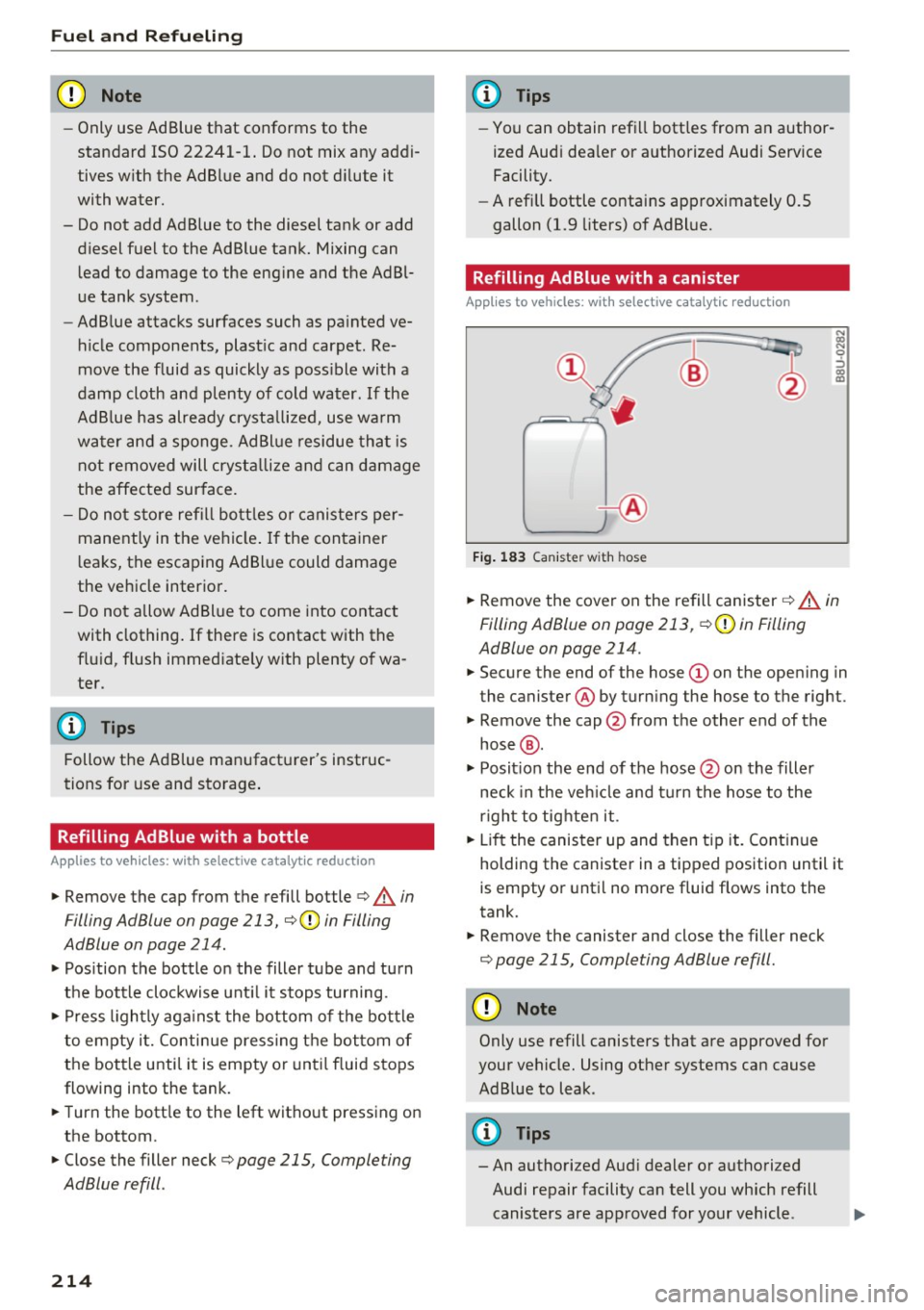
· Refilling Ad Blue with a canister
App lies to vehicles : with selective cata lyt ic r educt ion
®
+®
Fig. 183 Canis te r w ith hose
N
Filling AdBlue on page
213, c> Q) in Filling
AdBlue on page 214.
"'Secure the end of the hose (Don the opening in
the canister @by turning the hose to the right .
"' Remove the cap @from the other end of the
hose @.
"' Posit ion the end of the hose @on the filler
neck in the vehicle and turn the hose to the
r ig ht to tighten it.
"' Lift the canister up and then tip it. Continue
holding the canister in a tipped position until it
is empty or until no more fluid flows into the
tank.
"' Remove the canister and close the filler neck
c> page 215, Completing AdBlue refill.
(D Note
Only use refill canisters that are approved for
your vehicle. Using other systems can cause Ad Blue to leak .
0) Tips
-An authorized Aud i dealer or authorized
Audi repair facility can tell you which refill canisters are approved for your vehicle .
Page 219 of 294
-Do not remove the engine cover under any
circumstances. This increases the risk of
burns.
- If work on the fuel system or the electrical
system is necessary:
- Always d isconnect the battery.
- Never smoke or work near heaters or open
flames. Flu ids in the engine compartment
could start a fire.
- Keep an app roved fire ext inguisher imme
d iate ly availab le.
- To avo id electr ical shock and personal injury
wh ile the eng ine is running or being started,
never touch:
- Ignition cables
- Other components of the high voltage
electronic ignition system.
- If you must perform a check or repa ir with
the engine running:
- First, fully apply the parking brake, move
selector lever to P (Park) .
- Always use extreme caution to prevent
cloth ing, jewelry, or long hair from get
ting caught in the radiator fan, V-belts or
other mov ing parts, or from contacting
hot parts. Tie back ha ir before starti ng,
and do not wear clothi ng that will hang or
d roop into t he engine.
- Min imize exposu re to emission and chem i
cal hazards¢ .&.-
_& WARNING
California Proposition 65 Warn ing:
- E ngine exhaust, some of its constituents,
and certain vehicle components contain or
em it chem ica ls known to the St ate of C ali
f orn ia to cause cancer and bi rth de fects and
reproductive harm . In addition, certain flu
ids contained in ve hicles and certain prod
ucts of component wear contain or emit
Ch eck ing and Filling
chemicals known to the State of California
to cause cancer and birth defects or other
reproductive harm.
- Battery posts, term inals and related acces
sories contain lead and lead compounds,
chemicals known to the State of Californ ia
to cause cancer and reproductive harms.
Was h hands afte r handling .
([) Note
When adding flu ids, always make sure that
they are poured into the proper co nta iner or
fille r opening, otherwise serious damage to
vehicle systems w ill occur.
® For the sake of the environment
To detect leaks in time, inspect the veh icle
floor pan from unde rneath regularly. If you
see spots from oil or other veh icle fluids, have
your vehicle inspected by an authorized Audi
dealer.
Closing the engine hood
.,.. Pull the hood down un til the press ure from the
struts is reduced.
.,.. Let the hood
drop down and latch in p lace . Do
not try to push it shut;
it may fail to engage
¢ _& .
_& WARNING
--A hood that is not completely latched co uld
fly up and block your view while driv ing.
- When you close the engine hood, check it to
make sure the safety catch has properly en
gaged . The hood s hou ld be flush with the
sur rounding vehicle body parts.
- If you notice while driv ing that the hood is
not secured properly, stop at once and close
it.
-
217