ECU AUDI A6 2016 User Guide
[x] Cancel search | Manufacturer: AUDI, Model Year: 2016, Model line: A6, Model: AUDI A6 2016Pages: 294, PDF Size: 73.88 MB
Page 65 of 294
-Objects fal ling from the roof of a vehicle can
cause a crash and personal injury.
- Only mount the roof rack on the designated
locations on the roof
c:> fig. 67.
-The roof rack system must be installed ex
act ly according to the instructions provided .
- When driving with a roo f rack system,
changes to the center of gravity and wind
resistance can change the vehicle handling
and lead to a collision. Always adapt your
dr iv ing and your speed to the current condi
t ions.
- Your vehicle warranty does not cover any
damages to the vehicle caused by using roof
racks or mounting structures not approved
by Audi for your vehicle . The same applies to
damage result ing from incorrect roof rack
i nstallation.
-Always check the roof rack mount ings and
hardware before each t rip and dur ing a tr ip
to make sure everyt hing is securely tight
ened.
If necessary, ret igh ten the mo unt ings
and c hec k the en tire system from time to
time.
- After mounting a roof rack system, or when
you transport objects on the roof of your ve
hicle, the height of the vehicle is naturally
increased . Be careful when driving under
l ow bridges or in parking garages for exam
ple. This could cause damage to the load
and even the vehicle itself.
- Make s ure the open rear lid and the sun
roof* do not come into contact with the roof
rack.
Loading the roof rack
Always distribute loads evenly. Make sure any
thing on the roof rack is securely tied down.
~ Always distribute the loads on the roof rack
evenly .
~ Always attach items to the roof rack securely
before you drive off.
The maximum perm iss ible roof weight is
220 lb
( 100 kg ).
The roof weight is the total of the
Seat s and sto rage
weight o f the roof rack, the attachments and the
cargo you are carrying. You must a lso not exceed
the max imum load weight for the roof rack you
are using.
When using a roo f rack system which has a lower
load carrying capacity, you must not use up the
total max imum permissible load carry ing capac i
ty specified above. Instead, you should load the
roof rack system only to the maximum capacity
specified by the manufacturer of the roof rack
system .
A WARNING
= -Weak, damaged or imprope r straps used to
secure items to the roof rac k can fail d uring
hard brak ing o r in a co llision and cause seri
ous persona l injury.
- Make sure the roof r ack is installed exactly
as specified above
c:> page 62.
- Always use suitable mounting straps fo r se
cur ing items to the roof rac k to he lp prevent
items from shifting o r flying forward .
- Items on the roof rack mus t always be se
curely mounted.
- The use of a roof rack can negative ly affect
the w ay a vehicle hand les. Cargo tha t is
large, heavy, b ulk y, long or flat wi ll have a
grea ter negat ive infl uence on the vehicle's
aerodynamics, center of gravity and overa ll
handling. Always drive slowly, avoid sudden
braking and maneuvers when transporting
cargo on the roof of your vehicle.
- Never exceed the max imum permissib le
load carrying capacity of the roof of your ve
h icle, the permiss ible axle weights and the
perm iss ible total we ight of your vehicle
c:> page 2 70, Weights .
@ For the sake of the environment
As a result of the increased wind res istance
created by a roof rack, your vehicle is using
fuel unnecessarily . So remove the roof rack
after using it .
63
Page 66 of 294
Sea ts and stor age
Luggage compartment
Loading luggage compartment
Luggage items must be stowed securely.
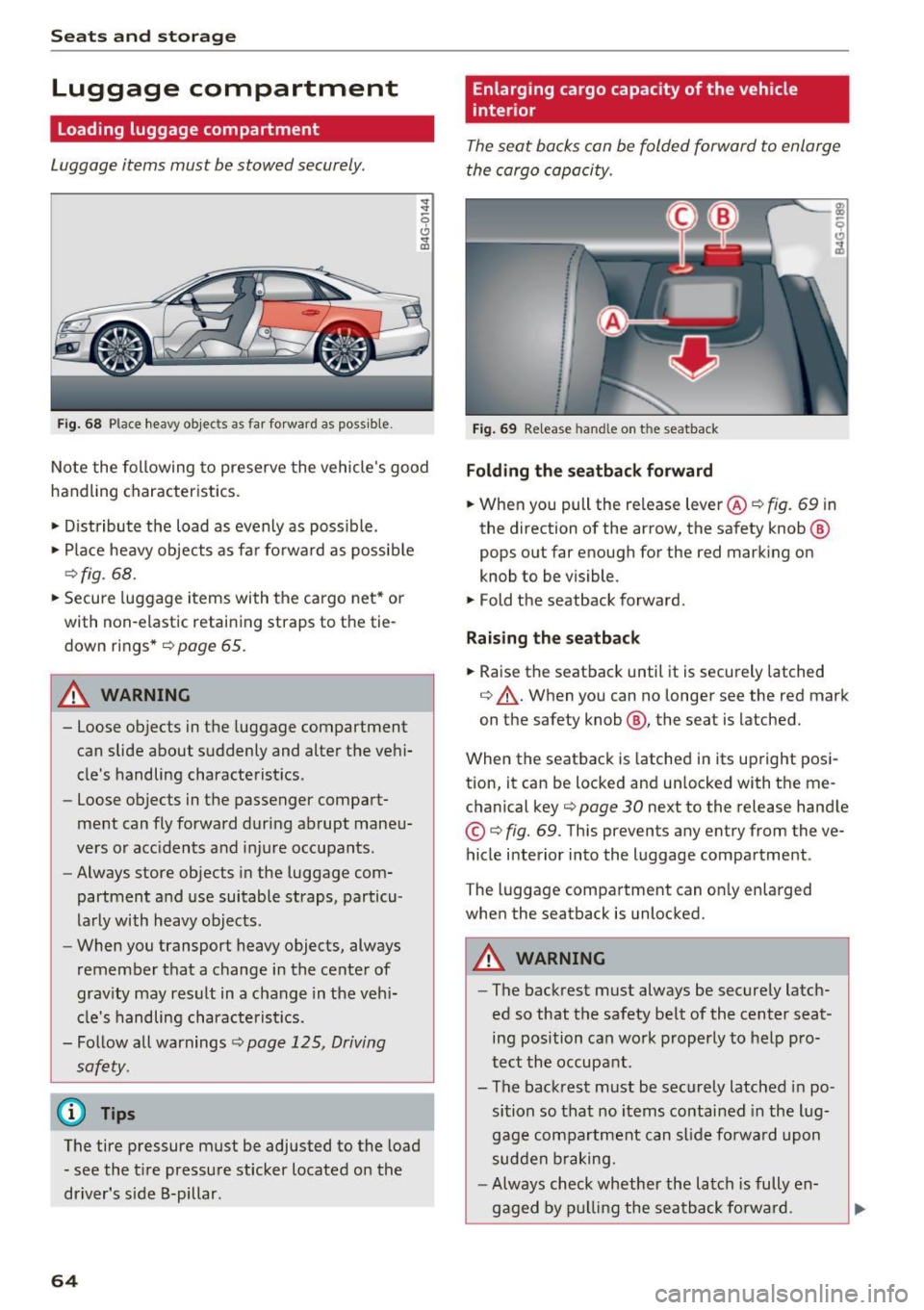
Fig . 68 Place heavy objec ts as far forward as poss ib le .
~
-0
0 ... co
No te the following to preserve the vehicle 's good
handling characteristics .
• Distribute the load as evenly as possible.
• Place heavy objects as fa r fo rward as possib le
~ fig . 68.
• Secure luggage items with the cargo net * or
with non-elastic retaining straps to the tie
down rings *
<=> page 65.
A WARNING
- Loose objects in the luggage compartment
can slide about suddenly and alter the vehi
cle's handling characte ristics.
- Loose objects in the passenger compart
ment can fly forward during abrupt maneu
vers or acc idents and injure occupants.
- Always store objects in the luggage com
partment and use suitable straps, particu
larly with heavy objects .
- When you transport heavy objects, always
remember that a change in the center of
grav ity may result in a change in the veh i
cle's handling characte ris tics.
- Follow all warnings<=>
page 125, Driving
safety.
@ Tips
The tire pressure must be adjusted to the load - see the t ire pressure sticker located on the
driver's side B-pillar.
64
Enlarg ing cargo capacity of the vehicle
interior
The seat backs can be folded forward to enlarge
the cargo capacity.
Fig . 69 Re lease hand le on t he seatback
Fold ing th e seatback forward
• When you pull the re lease lever@<=> fig. 69 in
the direction of the arrow, the safety knob @
pops out far enough for the red marking on
knob to be visible.
• Fold the seatback forward.
Rai sing th e seatback
• Raise the seatback until it is securely latched
<=> .&,. . When you can no longer see the red mark
on the safety knob @, the seat is latched.
When the seatback is latched in its up right posi
tion, it can be locked and un locked with the me
chanical key~
page 30 next to the release hand le
© <=>fig. 69. This prevents any entry from the ve
hicle interior into the luggage compartment .
The luggage compartment can on ly enlarged
when the seatback is unlocked.
A WARNING
- The backrest must always be securely latch
ed so that the safety belt of the center seat
ing position can wo rk properly to help pro
tect the occupant.
- The backrest must be securely latched in po sition so that no items contained in the lug
gage compartment can s lide fo rwa rd upon
sudden b raking.
- Always check whether the latch is fully en-
gaged by p ulling the seatback fo rwa rd.
~
Page 67 of 294
..... N
0 CJ '
-Never allow safety belts to become dam
aged by being caught in door or seat hard
ware.
- Torn or frayed safety belts can tear and
damaged belt hardware can break in a
crash. Inspect the belts periodically. Belts
showing damage to webbing, bindings,
buckles, or retractors must be replaced .
(D Note
-If you move the front seat back when the
rear seat backrest is folded forward, you
could damage the head restraints on the
rear seat.
- Slide the belt guide on the outside safety
belt all the way up before folding the back
rest back forward. Make sure the seat belt is
not pinched or damaged when the rear seat
backrest if folded back . Other objects
should be removed from the rear seat bench
to protect the seatback from damage.
Tie-downs and cargo net
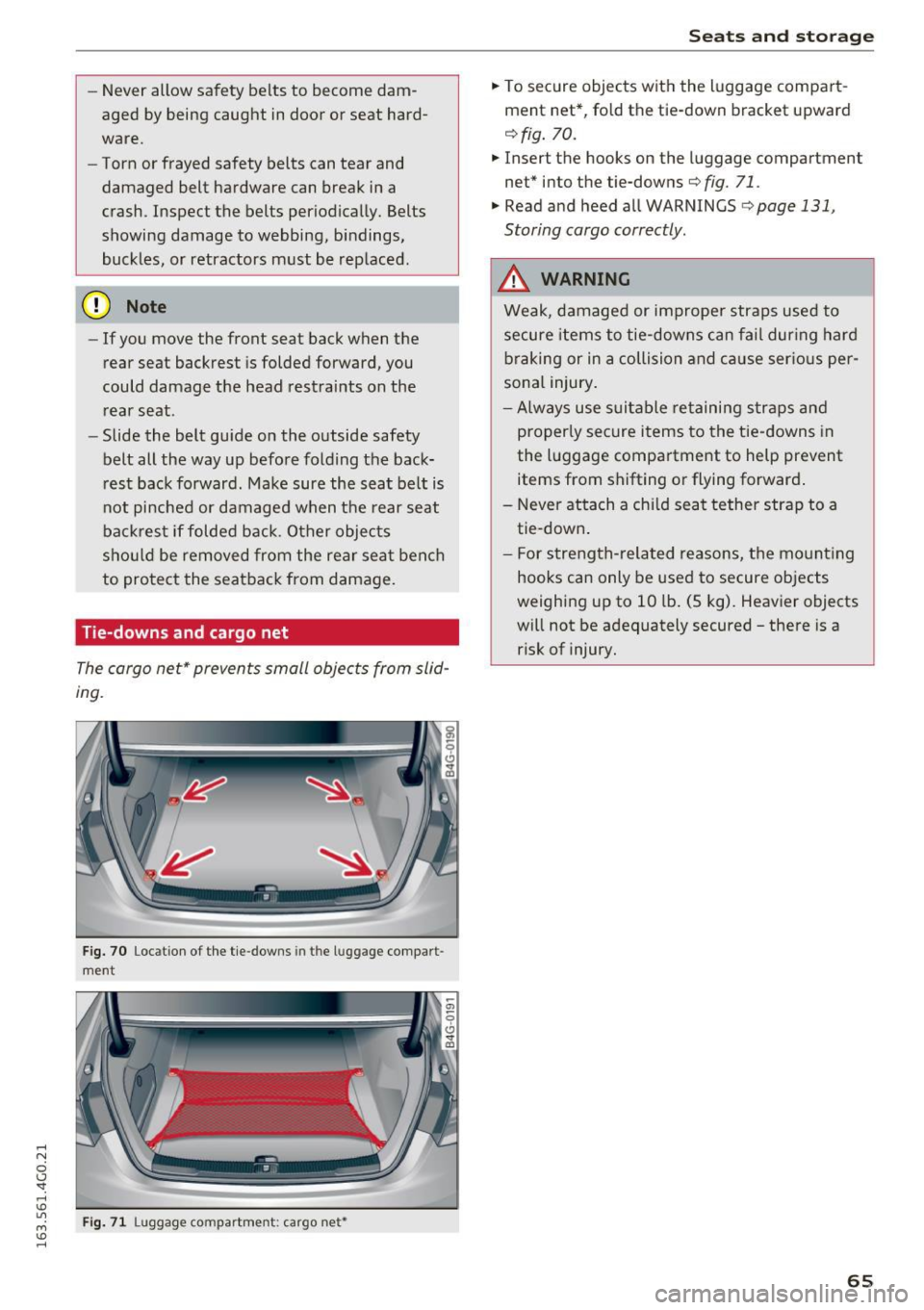
The cargo net* prevents small objects from slid
ing.
~
Fig. 70 Locat ion of the tie-downs in th e l uggage compart
ment
Fig. 71 Luggage compartment: cargo net*
Seats and storage
.,. To secure objects with the luggage compart
ment net*, fold the tie-down bracket upward
¢ fig. 70.
.,. Insert the hooks on the luggage compartment
net* into the tie-downs¢
fig. 71.
.,. Read and heed all WARNINGS ¢page 131,
Storing cargo correctly.
&, WARNING
Weak, damaged or improper straps used to
secure items to tie-downs can fai l during hard
braking or in a collision and cause serious per
sonal injury.
-Always use suitable retaining straps and
properly secure items to the tie-downs in
the luggage compartment to help prevent
items from shifting or flying forward .
- Never attach a chi ld seat tether strap to a
tie-down .
- For strength-related reasons, the mounting
hooks can only be used to secure objects
weighing up to 10 lb. (5 kg). Heavier objects
will not be adequately secured -there is a
risk of injury.
-
65
Page 68 of 294
Sea ts and stor age
Pass-through with ski
bag
Pass -through with ski sack
A pplies to veh icles: with sk i sack
Long objects such as skis con be transported in
the ski sock*.
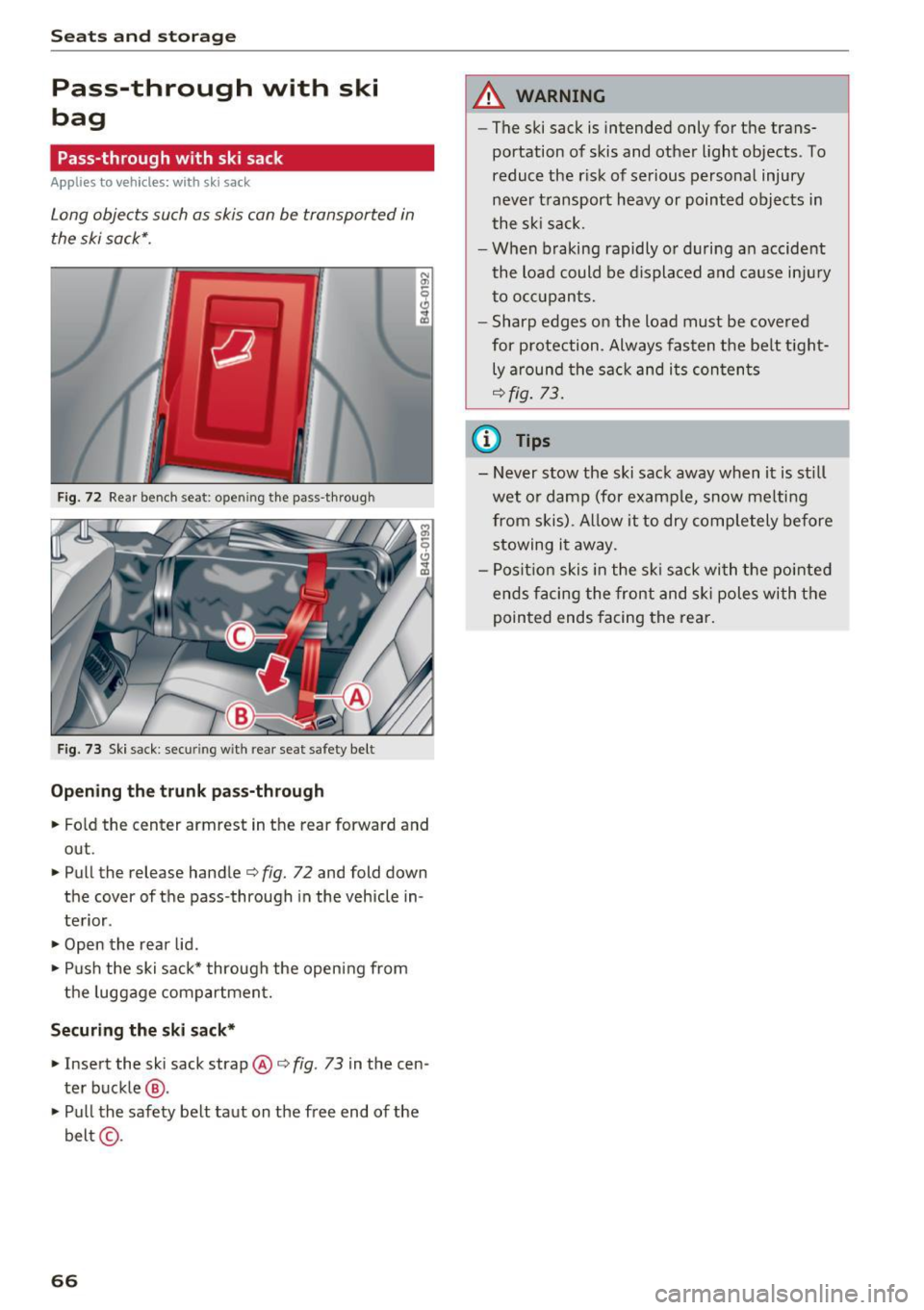
Fig. 72 Rear bench seat : ope ning the pass-through
F ig . 73 Sk i sack: securing with rear sea t safety belt
Opening the t runk p ass-through
.. Fo ld the center armrest in the rear forward and
out .
.. Pull the release handle c:>
fig. 72 and fold down
the cover of the pass -through in the vehicle in
te rior.
.,. Open the rear lid .
.. Push the ski sack* through the opening from
t he luggage compartmen t.
Secur ing the ski sack*
.. Insert the ski sack strap @c:> fig. 73 in the cen
ter buckle
@ .
• Pu ll the safety belt taut on the free end of the
belt @-
66
A WARNING
-The ski sack is intended only for the trans
portation of skis and other light objects . To
reduce the risk of serious personal injury
never t ransport heavy or pointed objects in
the s ki sack.
- When braking rapidly o r d uring a n accident
the load could be displaced and cause in ju ry
to o cc u pants.
- Sharp edges on the load must be covered
for p rotection_ Always fas ten the be lt t ight
ly around the sac k and i ts con ten ts
¢fig . 73.
(D Tips
- Never stow the ski sack away when it is st ill
wet o r damp (for examp le, snow melting
from skis). Allow it to dry comp letely before
stowing i t away.
- Posit ion skis in the ski sack wi th the pointed
ends f acing the front and sk i pole s with t he
pointed ends facing the rear.
Page 93 of 294
Audi adapt ive cruis e control and braking gua rd
de tect ion and range limits t hat may prevent
the proper detection of other veh icles.
- The radar sensor's function and range can
be reduced by rain, snow and heavy spray.
Moving veh icles up ahead may not be
promptly detected or may not be detected
at all .
- Reflective surfaces including crash barriers
or tunnel entrances may impair the funct ion
of the radar sensor.
(D Tips
- You can cancel the brak ing with increasing
force that is init iated by the system by b rak
i ng yourself, by accelerat ing noticeab ly or
by swerving .
- Braking guard error messages ¢
page 91.
-Keep in mind that braking guard can brake
unexpected ly. Always secure any cargo or
objects that you are transport ing to reduce
the risk of damage or injury .
Settings in the Infotainment system
Appl ies to vehicles: w ith Audi a daptive cruise co ntro l
~ Select: t he ICARI function button > (Car )* Sys
tems
con trol b utton > Driver assi stan ce > Audi
braking guard .
S ys tem -
Switch the braking guard On/ Off. When
you swit ch the ig nitio n on, the message
Brak ing
guard: Off
appears if the system is swi tched off .
Prewarning -The d istance and app roach warn
in gs i n the display can be switched
On/ Off.
(!) Tips
-Your settings are automatically stored and
ass igned to the remote cont rol key being
used.
- If you rest rict or sw itch off the ESC, the
braking gua rd also sw itches i tself off
¢ page 188 .
- Switch braking guard off when yo u are load
i ng t he ve hicle on to a vehicle ca rr ier, t rain,
s hi p or other type of transportation . This
c a n prevent undesired warnings from the
br aking gua rd system.
Messages
App lies to vehicles: wi th Audi ada ptive c ruise con trol
Braking guard : off
T his dr iver message appears if the system is
tu rned off via t he i nfot ainment. O therwise, if the
system is t urne d off, the information appears ev
ery time shortly after t he start o f the trip .
T he driver message a lso appea rs if the system is
not avai lab le due to a m alfu nction o r if the ES C i s
not switched on¢
page 188 . If th is is the case,
the sys tem wi ll not provide warnings abou t a
poss ib le collision .
Braking guard : a ctivated
This dr iver message appears if sharp brake pres
su re was applied due to an acu te warning .
ACC: Unava ilable!
ACC and Audi braking guard: not available
T he system cannot detec t moving vehicles up
ahe ad co rrectly and is swi tc h e d off. The senso rs
have been displaced or are not working proper ly.
T he Audi pre sense funct ions may also be affect
e d. D rive to yo ur authorized A udi deal er or au
thori zed Audi serv ice facility immediately to have
the malfunction corrected .
ACC: currently unavailable. No senso r vi sion
ACC and braking guide : current ly unavailable .
No s ensor vi sion
Th is message appears if the senso r view is ob
structed, for examp le by leaves, snow, heavy
sp ray or dirt. Clean the sensors ¢
page 84 ,
fig. 88.
ACC : Currently unavailable. Grad ient too steep
The road exceeds the maximum poss ible angle
for proper adaptive cruise co ntro l operat ion .
Adaptive cruise contro l is swi tched off .
ACC: Only available in D, Sor M
Select the D/S or M selector leve r position.
ACC : currently unavailable . Parking brake ap
plied
91
Page 103 of 294
.... N
0 CJ '
Engine sound *
The sou nd of the engine is adapted to the select
ed mode and ranges from subt le to sporty.
(D Note
- Make sure there is enough cle arance above
and below t he vehicle when parking. The
height of the vehicle can change once it is
parked due to temperature f luctuations,
changes to the load conditions and changes
to the driving modes, which can affect clear
ance.
- When transporting the vehicle on a car car
rier, tra in, ship or by other means, only t ie
the vehicle down at the running surface of
the tires, which is the outer circumference.
Securing the vehicle at the axle compo
nents, suspe ns ion struts or towing eyes is
not permitted be cause the press ure in the
air suspension struts can change dur ing
transport . The vehicle may not be secured
sufficiently if this happens .
-If yo u are going to tow a tra ile r, you m ust
activate the trailer operation mode
r:!;> page 199 .
(D Tips
-In some models, the maximum vehicle
speed can only be reached in the
Auto and
D ynami c modes.
- Se lecting the
D ynamic mode resu lts in spor
ty shifting characteristics. The S gear posi
tion engages a utomatically.
- In vehicles with spo rt d ifferen tial *, the
D y
n amic
mode is deactivated when towing a
trailer .
- In vehicles that have dynamic steering*, op
erating noise is heard when start ing or stop -
Adjusting the Individual mode
Audi driv e se lect
ping the engine. This does not indicate a
prob lem.
Selecting the driving mode
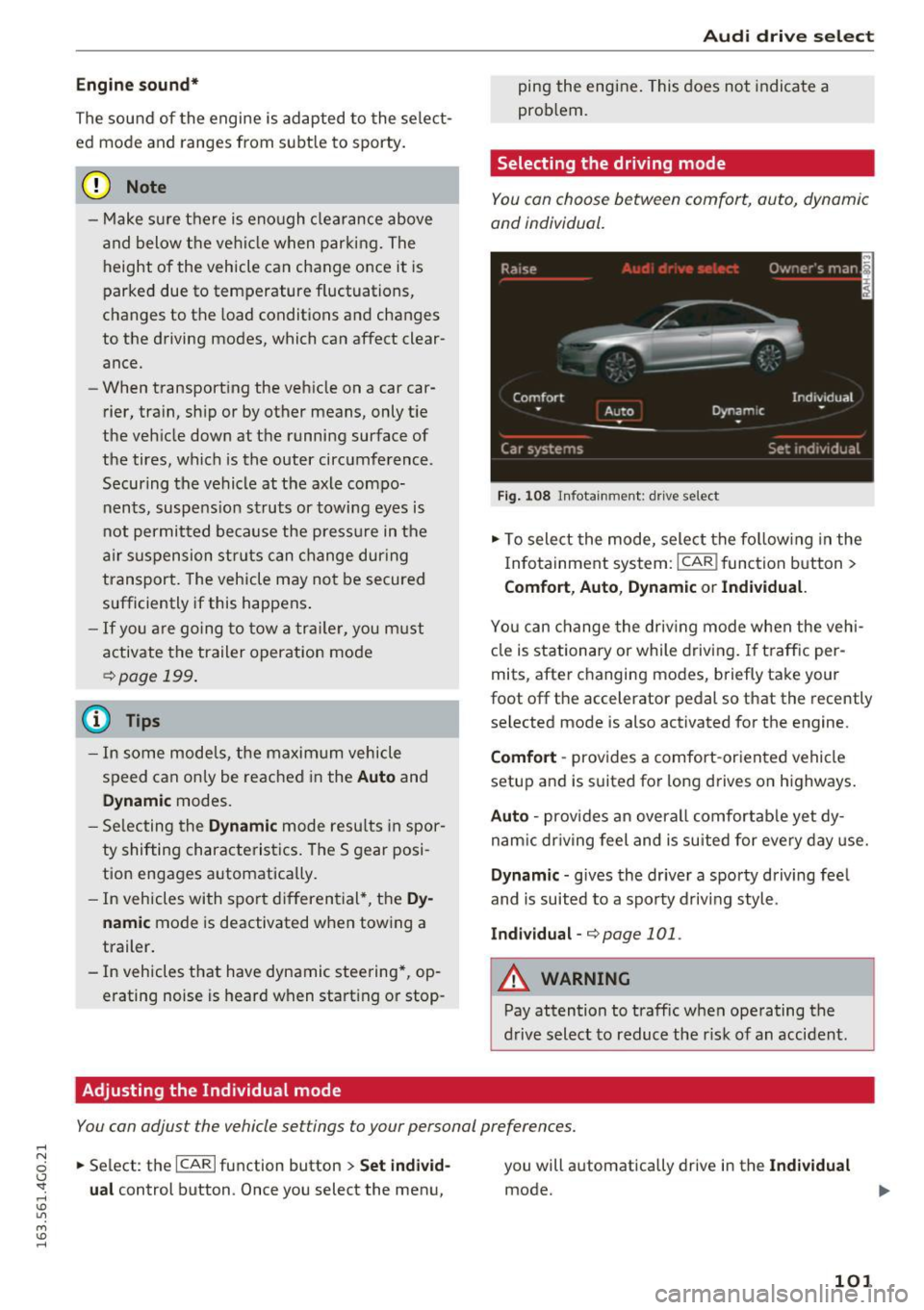
You con choose between comfort, auto, dynamic
and individual.
F ig. 1 08 In fotainment: drive select
.,. To sele ct the mode, select the fo llow ing in the
I n fotainment system:
I CAR ! function button >
Comfort , Auto , Dynam ic or Indi vidual.
Yo u can change the driv ing mode when the vehi
cle is stationary or while driving. If t raffic per
mits, after changing modes, briefly take your
foot off the accelerator pedal so that the recently selected mode is also activated for the engine.
Comfort -provides a comfort-oriented vehicle
setup and is suited for long d rives on h ighways .
Auto -provides an overa ll comfortab le yet dy
nam ic dr iving feel and is suited for every day use.
Dynamic -gives the driver a sporty driving fee l
and is suited to a sporty driv ing style.
Indi vidual -r:!;> page 101 .
A WARNING
Pay attention to traffic when operating the
d rive select to reduce the risk of an accident.
You con adjust the vehicle settings to your personal preferences .
.,. Se lect: the ICARI function button > Set indi vid
u al
control button . Once you select the menu, you will a
utomatically drive in the
Indi vidual
mode .
101
Page 111 of 294
-Before driving down a steep slope, reduce
your speed and shift into a lower gear with
"tiptronic" .
- Do not ride the brakes or press the brake
pedal too often or too long when driving
down a hill. Constant braking causes the
brakes to overheat and substantially re
duces braking performance, increases brak
ing distance or causes complete failure of
the brake system .
- To prevent the vehicle from rolling back
when stopping on inclines, always hold it in
place with the brake pedal or parking brake.
- Never hold the vehicle on an incline with a
slipping clutch. The clutch opens automati
cally when it becomes too hot from the
overload. An indicator lamp
l!] illuminates
and a driver message appears
¢ page 111
when the clutch is overloaded.
- If the engine must remain running, never
have any driving position engaged when
checking under the hood. Make sure these
lector lever has securely engaged and is
locked in P with the parking brake set
¢ page 216 . Otherwise, any increase in en
gine speed may set the vehicle in motion,
even with the parking brake applied .
(D Note
-When stopping on an incline, do not try to
hold the vehicle in place by pressing the ac
celerator pedal while a driving gear is se
lected . This can cause the transmission to
overheat and can damage it. Activate the
parking brake or press the brake pedal to
prevent the vehicle from rolling.
- Allowing the vehicle to roll when the engine
is stopped and the selector lever is in
N will
damage the transmission because it is not
lubricated under those circumstances.
(D} Tips
For safety reasons, the parking brake is re
leased automatically only when the driver's
safety belt is engaged in the buckle.
Automatic transmission
Hill descent control
Hill des cent control assists the driver when driv
ing down hills .
Hill descent control is activated when the sele c
tor lever is in the D or S posi tion and you press
the brake pedal. The transmission automatically selects a gear that is suitable for the incline. Hill
descent control tries to maintain the speed ach
ieved at the time of braking, within physical and
technical limitations . If may still be necessary to
adjust the speed with the brake pedal.
Hill descent control switches off once the hill lev
els out or you press the accelerator pedal.
On vehicles with a cruise control system*
¢ page 82, hill descent control is also activated
when the speed is set.
,&. WARNING
Hill descent control cannot overcome physical
limitations, so it may not be able
to maintain
a constant speed under all conditions. Always
be ready to apply the brakes.
109
Page 127 of 294
Driving safety
Basics
Safe driving habits
Please remember -safety first!
This chapter contains important information,
tips, instructions and warnings that you need to
read and observe for your own safety, the safety
of your passengers and others . We have summar
ized here what you need to know about safety
belts, airbags, child restraints as well as child
safety. Your safety is for us
priority number 1. Al
ways observe the information and warnings in
this section - for your own safety as well as that
of your passengers.
The information in this section applies to all
model versions of your vehicle. Some of the fea
tures descr ibed in this sections may be standard
equipment on some models, or may be optional
equipment on others. If you are not sure, ask
your authorized Audi dealer.
A WARNING
- Always make sure that you follow the in
structions and heed the WARNINGS in this
Manual. It is in your interest and in the in
terest of your passengers .
-
-Always keep the complete Owner's Litera
ture in your Audi when you lend or sell your
vehicle so that this important information
will always be available to the driver and
passengers.
- Always keep the Owner's literature handy so
that you can find it easily if you have ques
tions.
Safety equipment
The safety features are part of the occupant re
straint system and work together to help reduce the risk of injury in a wide variety of accident sit
uations.
Your safety and the safety of your passengers
should not be left to chance. Advances in tech
nology have made a var iety of features available
to help reduce the risk of injury in an accident.
Driving safety
The following is a list of just a few of the safety
features in your Audi:
- sophisticated safety belts for driver and all pas-
senger seat ing pos itions,
- safety belt pretensioners,
- safety belt force limiters for the front seats,
- safety belt height adjustment systems for the
front seats,
- front airbags,
- knee airbags for the front seats*
- side airbags in the front seats and outer rear
seats*,
- side curtain airbags with ejection mitigation
features,
- special LATCH anchorages for child restraints,
- head restraints for each seat ing position,
- adjustab le steering column.
These individual safety features, can work to gether as a system to help protect you and your
passengers in a wide range of accidents . These
features cannot work as a system if they are not
always correctly adjusted and correctly used.
Safety is everybody's responsibility!
Important things to do before driving
Safety is everybody 's job! Vehicle and occupant
safety always depends on the informed and care
ful driver .
For your safety and the safety of your passen
gers,
before driving always:
.,. Make sure that all lights and signals are operat
ing correctly .
.,. Make sure that the tire pressure is correct.
.,. Make sure that all windows are clean and afford
good visibility to the outside .
.,. Secure all luggage and other items carefully
¢ page 64, ¢ page 61 .
.,. Make sure that nothing can interfere with the
pedals.
.,. Adjust front seat, head restraint and mirrors
correctly for your height .
.,. Instruct passengers to adjust the head re
straints according to their height.
125
Page 130 of 294
Driving safety
-Passengers who are unbelted , out of posi
tion or too close to the airbag can be seri
ously injured by an airbag as it unfolds with
great force in the blink of an eye .
- Always make sure that there are at least
10 inches (25 cm) between the front pas
senger 's breastbone and the instrument
panel.
- Always make sure that there are at least
4 inches (10 cm) between the front passen ger's knees and the lower part of the instru
ment panel.
- Each passenger must always sit on a seat of
their own and properly fasten and wear the
safety belt belonging to that seat.
- Before dr iving, always adjust the front pas
senger seat properly .
- For adjustable head restraints: before driv
ing, always also adjust the head restraints
properly .
- Always keep your feet on the floor in front
of the seat. Never rest them on the seat, in
strument pane l, out of the window, etc. The
airbag system and safety be lt will not be
able to protect you properly and can even in
crease the risk of injury in a crash .
- Never dr ive with the backrest reclined or
ti lted far back! The farther the backrests are
ti lted back , the greater the risk of injury due
to incorrect positioning of the safety belt
and improper seating position.
- Children must always ride in child seats
<='> page 166. Special precautions apply
when installing a child seat on the front
passenger seat
<='> page 142.
Proper seating positions for passengers in
rear seats
Rear seat passengers must sit upright with both
feet on the floor consistent with their physical
size and be properly restrained whenever the ve
hicle is in use.
To reduce the r isk of injury caused by an incorrect
seating position in the event of a sudden braking
maneuver or an accident, you r passengers on the
rear bench seat must always observe the follow
ing:
128
.,. For adjustab le head restraints: adjust the head
restraint so the upper edge is as even as possi
ble with the top of your head. If that is not pos
sible, try to adjust the head restraint so that it
is as close to this position as possible
<='> page 128.
.,. Keep both feet flat in the footwell in front of
the rear seat .
.,. Fasten and wear safety belts properly
<='> page 137.
.,. Make sure that children are a lways properly re
strained in a child restraint that is appropriate
for their size and age
c:::> page 166.
A WARNING
Passengers who are improperly seated on the
rear seat can be seriously injured in a crash.
- Each passenger must always sit on a seat of
their own and properly fasten and wear the safety belt belonging to that seat .
- Safety belts only offer maximum protection
when the safety belts are properly posi
tioned on the body and securely latched . By
not sitting upright, a rear seat passenger in
creases the risk of personal injury from im
properly positioned safety belts!
- For adjustable head restraints: always ad
just the head restraint properly so that it
can give maximum protection.
Proper adjustment of head restraints
Applies to vehicles: with adjustable head restraints
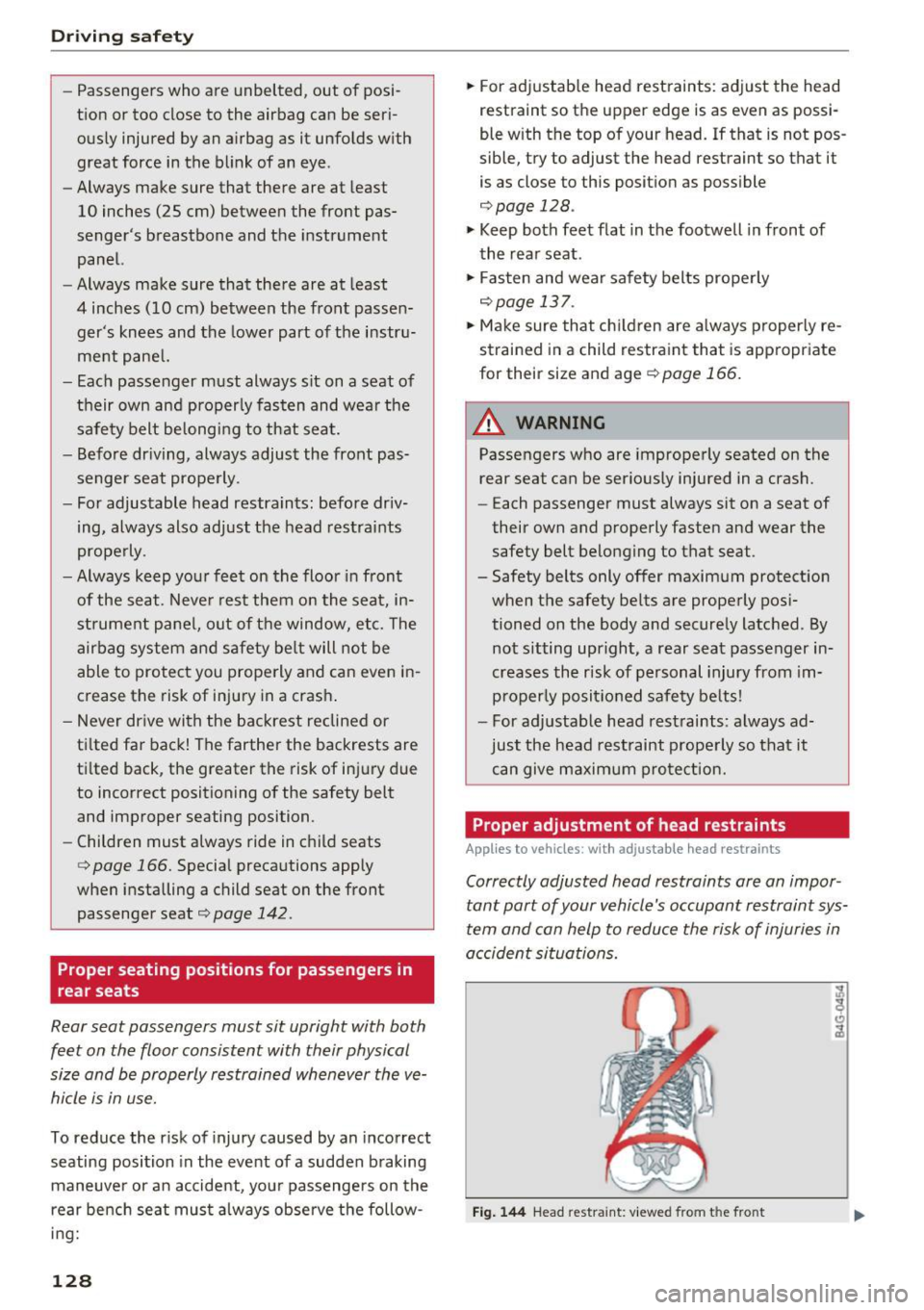
Correctly adjusted head restraints ore an impor
tant part of your vehicle's occupant restraint sys
tem and can help to reduce the risk of injuries in
accident situations.
Fig. 144 Head restraint : viewed from t he front
Page 132 of 294
Driving sa fe ty
A WARNING
Improper seating positions increase the r isk
of serious personal injury and death whenever
a vehicle is being used.
- Always make sure that all vehicle occupants
stay in a proper seat ing position and are
properly restrained whenever the vehicle is
being used.
Driver's and front
passenger's footwell
Important safety instructions
A ppl ies to veh icles : w ith knee a ir b ags
A WARNING
Alw ays ma ke sure that the knee airbag can in
flate without inter ference. Objects between
yourself and the airbag can increase the risk of injury in an acc ident by interfering with the
way the airbag deploys or by being pushed in
to you as the airbag deploys.
- No persons (children) or animals shou ld ride
in the footwell in front of the passenger
seat. If the airbag dep loys, th is can result in
serious or fatal in ju ries .
- No objects of any k ind shou ld be carried in
the footwell area in front of the driver 's or
passenger's seat. Bulky objects (shopping
bags, for example) can hamper or p revent
prope r deployment of the airbag. Small ob
jects can be th rown throug h the vehicle if
the airb ag deploys and injure you or your
passengers.
Pedal area
Pedals
The pedals must always be free to move and
must never be interfered with by a floor mat or
any other object.
Make sure that all pedals move freely without in
terference and that noth ing prevents them from
returning to the ir origina l positions.
O nly use floor mats that leave the pedal area free
and can be secured wit h floor mat fasteners .
130
If a brake circuit fails, increased brake pedal trav
el is required to bring the vehicle to a fu ll stop.
A WARNING
Pedals that cannot move freely can cause loss
of vehicle contro l and increase the r isk of seri
ous injury.
- Never p lace any objects in the drive r's foot
well. An object could get into the pedal area
and interfere with pedal funct ion. In case of
sudden braking or an acc ident, you would
no t be able to b rake o r acce le rate!
- Always make sure that nothing can fall or
move into the driver's footwell.
Floor mats on the driver side
Always use floor mats that can be securely at tached to the floor mat fasteners and do not in
terfere with the free movement of the pedals .
.,. Make sure that the floor mats are properly se
cured and cannot move and interfere w ith the
pedals¢ .&,.
Use only floor mats that leave the peda l area un
obstructed and that are firmly secured so that
they can not s lip out of position . You can obtai n
su itable floor mats from your author ized Audi
Dealer .
Floor mat fasteners are installed in your Aud i.
Floor mats used in yo ur vehicle must be attached
to these fasteners. Properly secur ing the floor
mats will prevent them from sliding into posi
tions that could inte rfere with the pedals or im
pair safe operat ion of your vehicle in other ways.
A WARNING
Pedals that ca nnot move freely can result in a
loss of vehicle contro l and increase the r is k of
serious pe rsonal injury.
- Always make sure that floo r mats are prop
erly secured.
- Never place or install floor mats or other floor coverings in the vehicle that cannot be
properly secured in place to preven t them
from s lipping and interfer ing wi th the ped
als or the ab ility to cont rol the vehicle.