lights AUDI A6 2016 Workshop Manual
[x] Cancel search | Manufacturer: AUDI, Model Year: 2016, Model line: A6, Model: AUDI A6 2016Pages: 294, PDF Size: 73.88 MB
Page 208 of 294
Care and cleaning
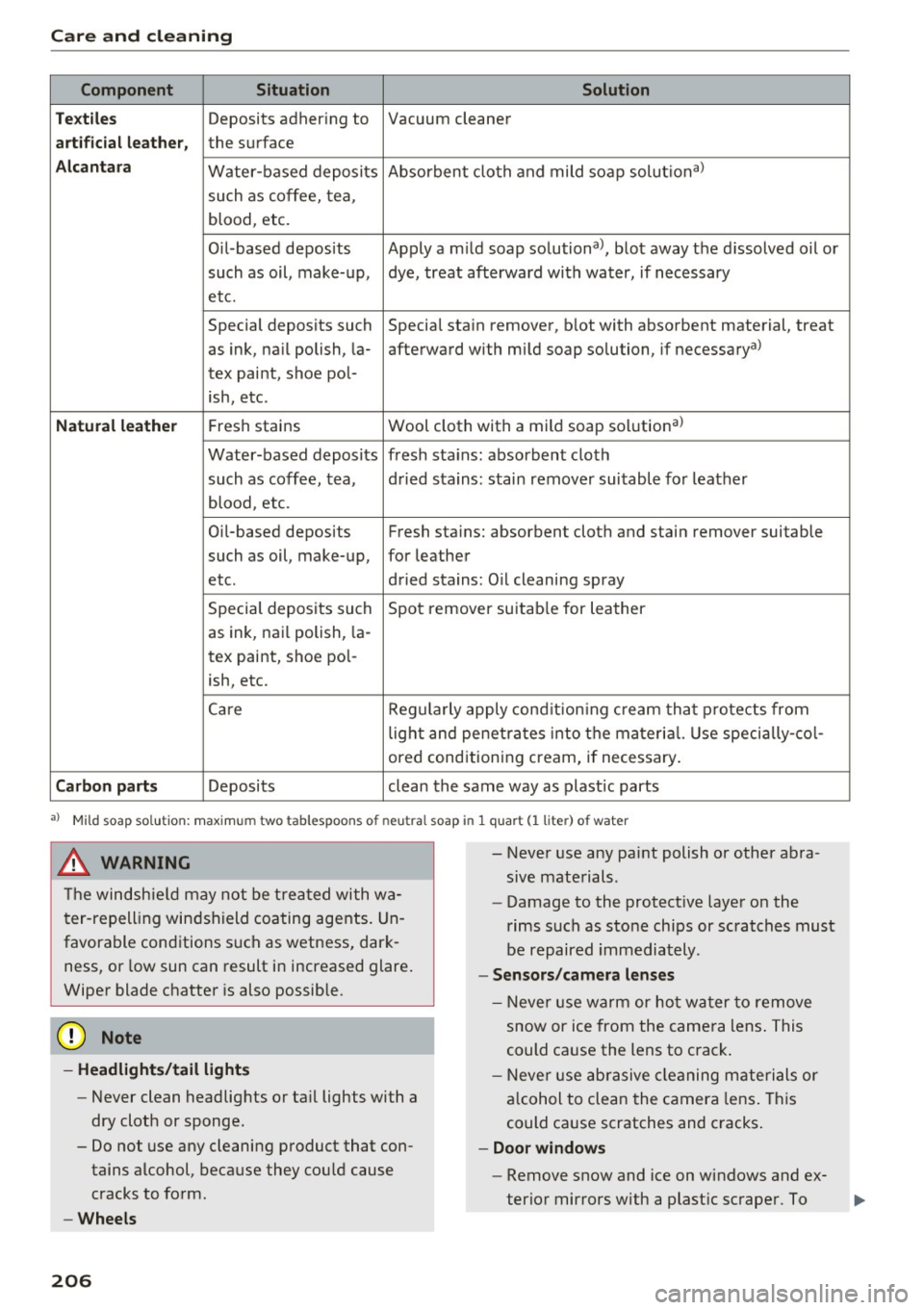
Component Situation Solution
Te xtil es
Deposits adhering to Vacuum cleaner
a rt ifici al le ather , the surface
Alcant ara Water-based deposits Absorben
t cloth and mild soap solutiona>
such as coffee, tea,
blood, etc.
O il-based deposits Apply am ild soap solutiona>, blot away the d issolved oil or
such as oil, make-up, dye, treat afterward with water, if necessary
etc.
Special deposits such Special stain remover, b lot with absorbent material, treat
as ink, na il polish, la- afterward with mild soap solution, if necessarya>
tex paint, shoe pol-
ish, etc.
Natural leather Fresh stains Wool cloth with a mild soap so
lutiona)
Water-based deposits fresh sta ins: absorbent cloth
such as coffee, tea, d ried stains: stain remover suitable for leather
blood, etc.
Oil-based deposits Fresh staiins: absorbent cloth and stain remover suitable
such as oil, make-up, for leather
etc. dried stains: Oil cleaning spray
Special deposits such Spot remover suitab le for leather
as ink, nai l polish, la -
tex paint, shoe pol-
ish, etc.
Ca re Regularly apply cond ition ing cream that protects from
light and penet rates into the materia l. Use specia lly-co l-
ored conditioning cream, if necessary.
Carbon parts Deposits clean the same way as plastic parts
a) Mild soap solution: maximum two tablesp oons of neutral soap in 1 quart (l liter) of water
_& WARNING
The windshie ld may not be trea ted with wa
ter-repelling windshield coating agents. Un
favorable conditions s uch as wetness, dark
ness, or low sun can result in increased glare .
Wiper blade chatter is also possible.
(D Note
- Headlights/tail light s
-Never clean headlights or tail lights with a
dry cloth or sponge.
- Do not use any cleaning product that con
tains alcohol, because they cou ld cause
cracks to form.
- Wheels
206
-
- Never use any paint polish or other abra
sive materials.
- Damage to the protect ive layer on the
rims such as stone chips or scratches must
be repaired immediately.
- Sensors /camera lenses
- Neve r use wa rm or ho t wa ter to remove
snow or ice from the camera lens . This
could cause the lens to crack .
- N eve r use ab rasive cleaning materials or
a lcohol to clea n the camera lens . This
could cause scratches and cracks .
-Doo r window s
-Remove snow and ice on windows and ex-
terior mirrors with a plast ic scraper. To
Page 221 of 294
....
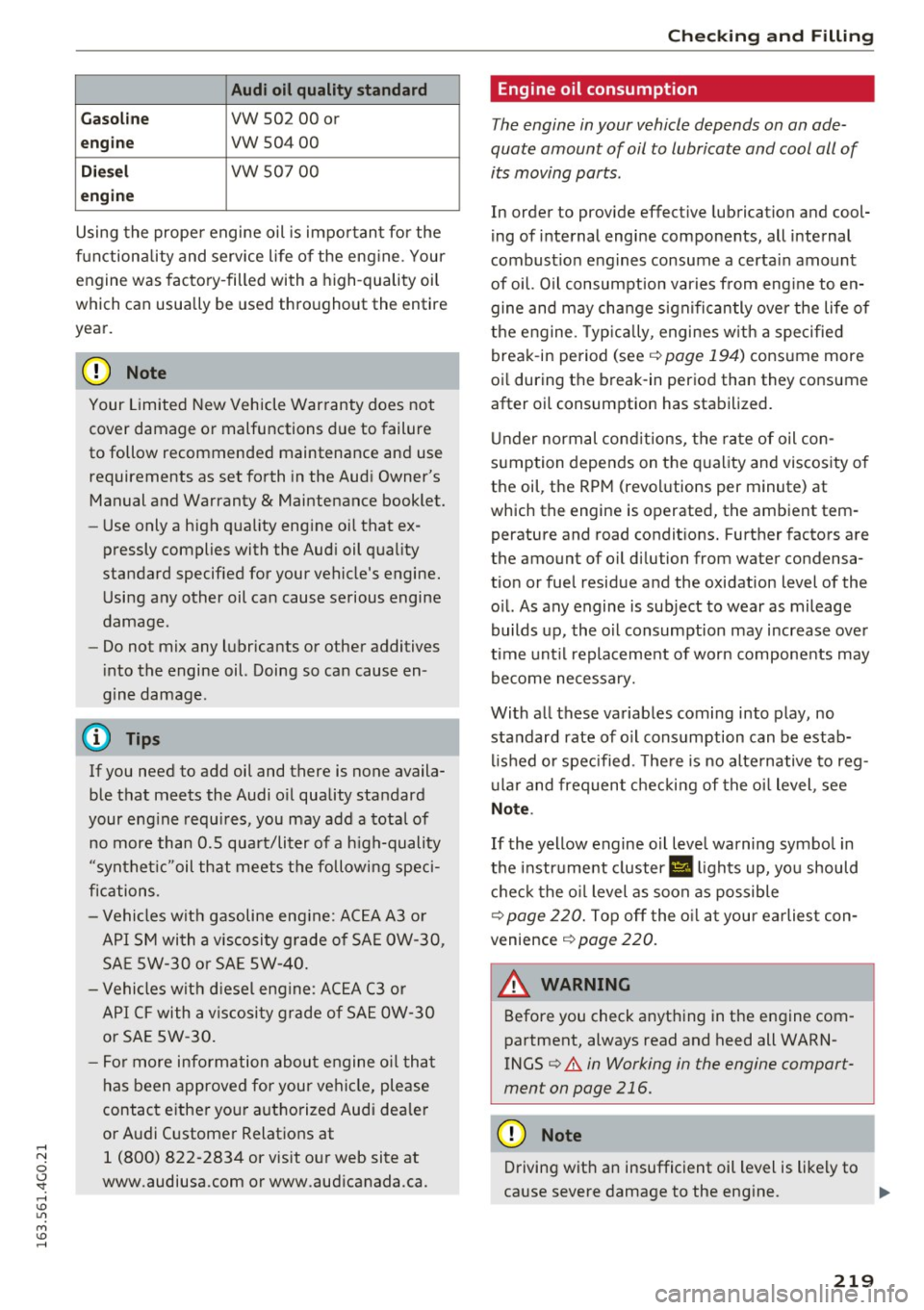
Audi oil quality standard
Gas oline
VW 502 00 or
engi ne vw 504 00
Die sel vw 507 00
en gin e
Using the prope r engine oil is important for the
functiona lity and service life of the eng ine. Your
engine was factory-filled with a high -quality oil
which can usually be used throughout the entire
year.
@ Note
Your Limited New Vehicle Warranty does not
cover damage or malfunctions due to failure
to follow recommended maintenance and use
requirements as set forth in the Audi Owner's Manual and Warranty
& Maintenance booklet.
- Use only a high quality eng ine oil that ex-
pressly complies with the Aud i oil quality
standard specified for your vehicle's engine.
Using any other oil can cause serious engine
damage .
- Do not mix any lubricants or other additives
into the engine oil. Doing so can cause en
gine damage.
(D Tips
If you need to add oil and there is none availa
ble that meets the Audi o il quality standard
your eng ine requ ires, you may add a total of
no more than 0.5 quart/liter of a h igh-quality
"synthet ic"oil that meets the followi ng speci
fications.
- Vehicles with gasoline eng ine: AC EA A3 o r
API SM wi th a viscosity g rade of SA E OW-30,
SAE SW-30 or SAE SW-40.
- Vehicles wit h diesel eng ine: ACEA C3 o r
API CF with a v iscosi ty grade of SA E OW-30
or SA E SW -30.
- Fo r more information abou t engine o il that
has been approved for your vehi cle, please
contact either you r a utho rized Audi dea ler
or A udi Customer Relations at
"' 1 (800) 822-2834 or visit our web site at
0
~ www.audiusa.com or www.aud icanada.ca.
....
Engine oil consumption
The engine in your vehicle depends on on ade
quate amount of oil to lubricate and cool oil of
its moving ports.
In order to provide effect ive lubrication and cool
i ng of internal engine components, all internal
combust ion eng ines consume a certa in amount
of oil. Oil consumption varies from eng ine to en
gine and may change s ign ificantly ove r the life of
the engine. Typ ica lly, engines w ith a specified
break-in period (see
¢ page 194) consume more
oi l during the break -in period than they consume
after oil consumption has stabilized.
Under normal cond itions, the rate of oil con
sumption depends on the q uality and viscosity o f
the oil, the RPM (revol utions per minute) at
which the engine is operated, the ambient tem
perature and road condit ions. Further factors are
the amount of oil dilution from water condensa
tion or fuel residue and the oxidation level of the o il. As any engine is subject to wear as mileage
builds up, the oil consumption may increase over
time unt il replacement of worn components may
become necessary.
With all these variables coming into play, no standard rate of o il consumption can be estab
li shed or spec ified . T he re is no alte rnative to reg
u la r and frequent checking of the oi l level , see
Note .
If the yellow engine o il leve l warning symbo l in
the instrument cluster
II lights up, yo u should
c h eck the o il level as soon as possible
¢ page 220. Top off the o il at your earlies t con
venience
¢ page 220.
A WARNING
--=-
Before you check anything in the engine com-
partment, always read and heed all WARN
INGS
¢ &. in Working in the engine comport
ment on page 216.
(D Note
Driving wit h an insufficient oil level is likely to
cause severe damage to the eng ine.
IJJ,,
219
Page 228 of 294
Check ing and F illing
@ For the sake of the environment
Because of the prob lem of proper disposal of
brake fluid as we ll as the special tools re
quired and the necessary expertise, we rec
ommend that you have the b rake fluid
changed by your author ized Audi dealer .
Battery
General information
Under normal operating conditions, the battery
in your Audi does not need any maintenance.
W ith
high outside temperat ures or long da ily
drives we recommend that you have the electro
lyte level checked by a service fac ility . The elec
trolyte level should also be chec ked eac h time
the battery is charged ¢
page 228 .
Have the battery checked when you take your ve
h icle in for service. You a re well advised to re
p lace a battery t hat is o lder than S years .
W ith certain types of a irbag dep loyment, the
battery is disconnected from the vehicle electr i
cal system for safety reasons
¢ &. in Repair, care
and disposal of the airbags on page 157 .
Disconnecting the battery terminal s
Some vehicle functions (power window reg ula
tors, for example) are lost i f th e battery termi
na ls are disconnected. These functions have to be
relearned after the battery termina ls are con
nected aga in. To prevent th is , the batte ry shou ld
only be disconnected from the vehicle e lectr ica l
sys te m when abso lutely ne cessary for repairs.
Vehicles not driven for long periods
If you do not drive your vehicle over a period of
seve ral days or weeks, electrical components a re
gradua lly cut back or sw itched off . T hi s reduces
e n ergy cons umption and ma inta ins starti ng ca
pab il ity over a longer pe riod
¢ page 192. Some
of the conve nience f unct io ns may not o pera te,
such as the inter io r lig hts or powe r seat a dju st
ment . The convenience funct ions wi ll be avai lab le
again when you switch on the ignition and start
the engine.
226
Winter operation
Dur ing the winte r mon ths, ba ttery c apacity tends
to decrease as tempe ra tu res drop . This is be
ca use mo re power is also consume d while start
i ng, and the headlights, rear window defogger,
etc., are used more often.
Avo id unne cessary powe r consum ption, pa rticu
l arly in city traffic or when traveling on ly short
distances . Let your author ized Audi dealer check
t h e capacity of the vehicle battery before winter
sets in~
page 228. A we ll charged battery will
not only p reve nt sta rting prob lems when the
weather is cold, but will also last longer.
(D Tips
If yo ur vehicle is left standing for several
weeks at extreme ly low temperatu res, the ve
hicl e battery should be re m oved a nd stor ed
where it will not freeze. This w ill preven t it
fro m bei ng damaged and hav ing to be re
p lac ed .
Working on the battery
Be e specially car eful when working on or near
t he bat tery.
The battery is loca ted in the luggage com part
ment under the floo r. Befo re yo u check anything
i n the luggage compa rtment,
read and heed all
WARNINGS ¢
.cl·
Always heed the safety warnings , when working
o n the vehicle ba tte ry o r the veh icle elect rical
system to p reve nt injury.
The following WARNINGS are very important
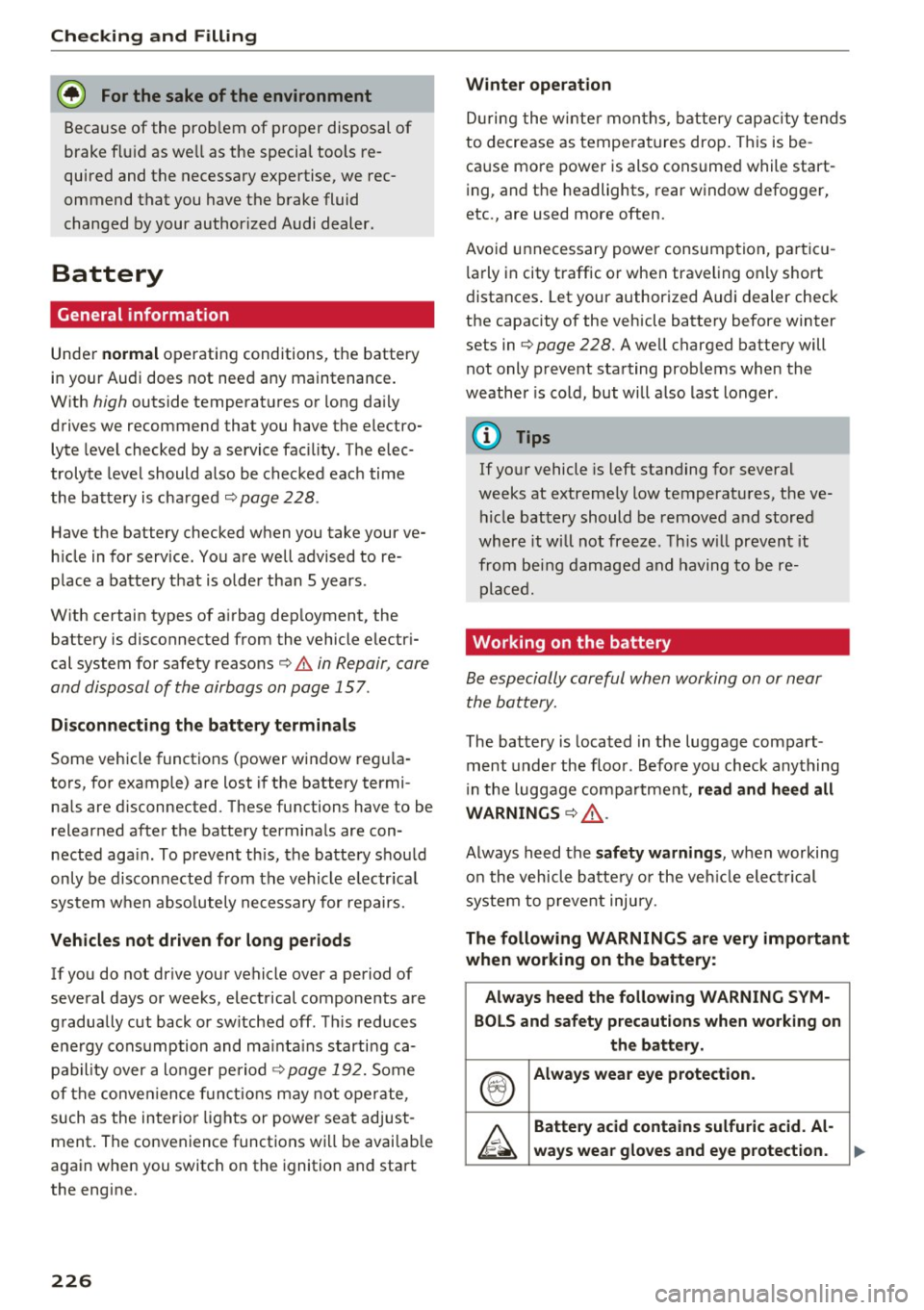
when working on the battery:
Always heed the following WARNING SYM·
BOLS and safety precautions when working on
the battery.
®
Always wear eye protection.
A
Battery acid contains sulfuric acid . Al-
ways wear gloves and eye protection.
Page 229 of 294
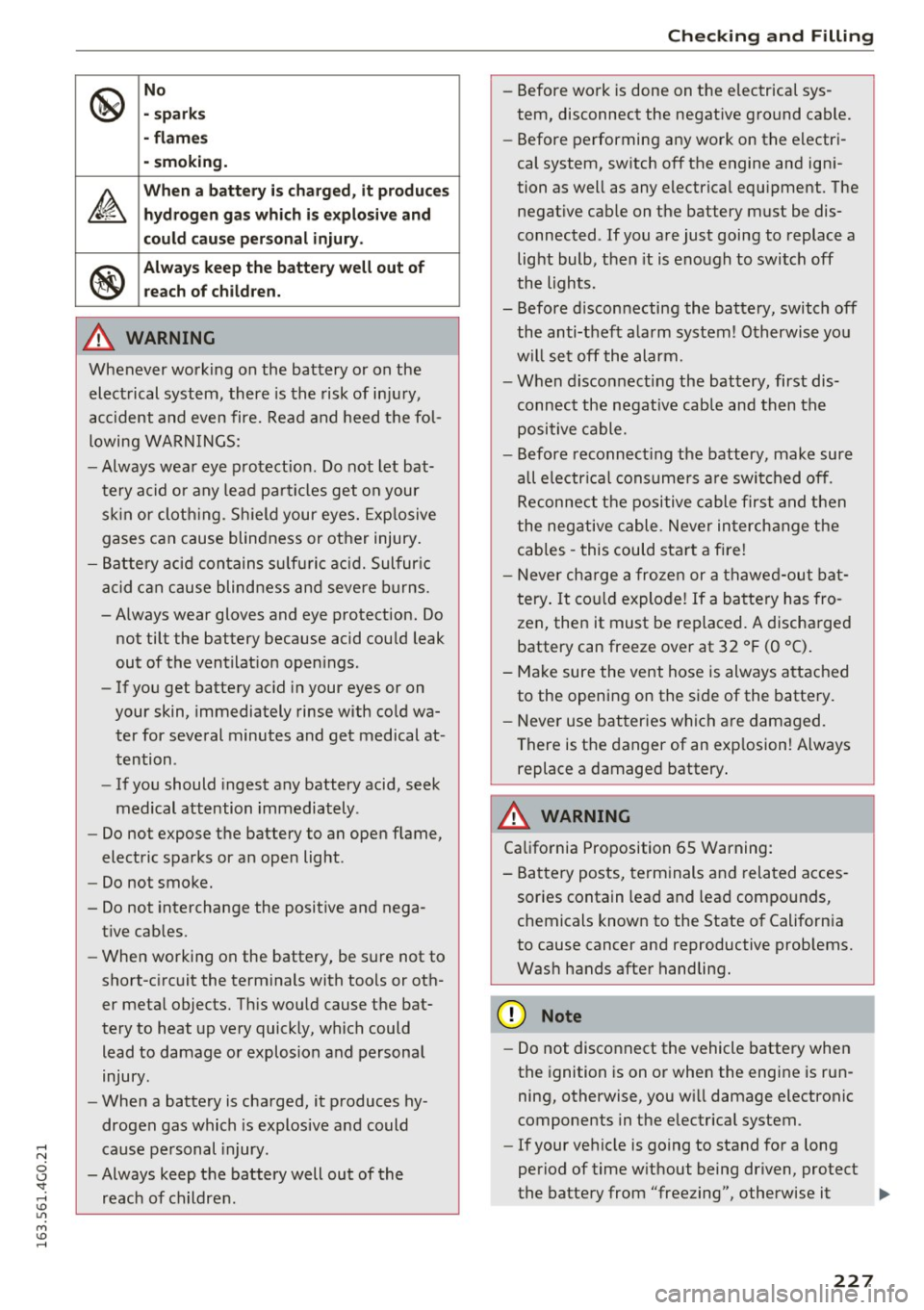
@
No
• sp ark s
• fl ame s
· sm oki ng .
&
Wh en a battery is charg ed , it produces
h yd rogen ga s which i s ex plosi ve and
c o uld c au se p ers onal injury .
®
Always keep the b atter y well out of
rea ch of child ren.
A WARNING
Whenever working on the battery or on the
electrical system, there is the risk of injury,
accident and even fire. Read and heed the fol
lowing WARN INGS:
- Always wear eye protection. Do not let bat
tery a cid or any lead pa rticles get on your
sk in or cloth ing. Sh ield your eyes. Exp losive
gases can cause blindness or other injury .
- Battery acid contains su lf ur ic ac id. Sulfur ic
acid can cause blindness and severe b urns.
-Always wear gloves and eye protection. Do
not tilt the battery because acid could leak
out of the ventilat ion open ings.
- If you get battery ac id in your eyes or on
your skin, immediately rinse with co ld wa
ter for seve ral minutes and get medical at·
tention .
- If you should ingest any battery acid, seek
medical attention immediately .
- Do not expose the battery to an open flame,
electric sparks or an open light.
- Do not smoke.
- Do not interchange the positive and nega -
tive cab les.
- When working on the battery, be sure not to
short-c ircuit the terminals with tools or oth
er meta l objects. Th is wou ld cause the bat
tery to heat up very quickly, which could
lead to damage or explosion and persona l
injury.
- When a battery is charged, it produces hy
drogen gas which is explosive and could
cause pe rsonal injury.
- Always keep the battery well out of the
reac h of ch ildren .
-
Check ing and Filling
-Before work is done on the electrical sys
tem, disconnect the negat ive ground cable.
- Before performing any work on the electri
cal system, switch off the engine and igni
tion as well as any electrical equ ipment. The
negat ive cable on the battery must be dis
connected . If you are just going to replace a
light bulb, then it is enough to switch off
the lights.
- Before d isconnecting the battery, switch off
the anti-theft a larm system! Otherwise you
will set off the alarm.
- When disconnecting the battery, first dis
connect the negat ive cable and then the
positive cable.
- Before reconnect ing the battery, make sure
all electrical consumers a re switched off.
Reconnect the positive cable first and then
the negative cable. Never in terchange the
cables -this could start a fire !
- Never cha rge a froze n or a thawed-out bat
t ery . It co uld explode! If a battery has fro
zen, then it must be replaced. A discharged
battery can freeze over at 32 °F (0 °C).
- Make sure the vent hose is always attached to the opening on the side of the battery.
- Never use batteries which are damaged.
There is the danger of an exp losion! Always
replace a damaged battery .
A WARNING ,_____
California Proposition 65 Warning:
- Ba ttery posts, term inals and related acces
sories contain lead and lead compounds,
chemicals known to the State of California
to cause cancer and reproductive prob lems.
Was h hands after handling.
(D Note
- Do not disconnect the vehicle battery when
the ignition is on or when the engine is run ning, otherwise, you w ill damage electronic
components in the electrical system.
- If your ve hicle is go ing to stand for a long
period of time w ithout being driven, protect
the battery from "freezing", otherwise it .,..
227
Page 252 of 294
Wheels
the recommended tire pressure for your vehicle
¢ page 241, fig. 196.
Tire tread circumference and vibration character
istics can change and cause a tire pressure warn
ing if:
- the tire pressure in one or more tires is too low.
- the tire has structural damage .
- the tire was replaced or the tire pressure was
changed and it was not stored¢
page 250.
-the spare tire* is installed.
Indicator lights
IE Loss of pressure in at least one tire¢&. .
Check the tires and replace or repair if necessary.
Check/correct the pressures of all four tires and
store the pressure again in the Infotainment sys
tem ¢
page 250 .
mm (Tire Pressure Monitoring System) Tire
pressure: System malfunction!.
Ifmm appears
after switching the ignition on or while driving
and the
IE indicator light in the instrument clus
ter blinks for approximately one minute and then
stays on , there is system malfunction . Try to
store the correct tire pressures¢
page 250. If
the indicator light does turn off or turns on again
after a short period of time, drive to your author
ized Audi dealer or qualified repair facility imme
diate ly to have the malfunction corrected.
A WARNING
- If the ti re pressure indicator appears in the
display, reduce your speed immediately and
avoid any hard steering or braking maneu
vers. Stop as soon as possible and check the
t ir es and their pressure .
- The driver is responsible for maintaining the
correct tire pressure. You must check the
t ir e pressure regularly.
- Under certain conditions (such as a sporty
dr iv ing style, winter cond itions or unpaved
roads), the tire pressure mon itoring system
indicator may be delayed.
- Do not use run-flat tires on your vehicle. Us
ing them when not permitted can lead to
vehicle damage or accidents.
250
(D Tips
-The tire pressure monitoring system can al
so stop working when there is an ESC mal
function.
- Using snow chains may result in a system
malfunction.
- The tires with the identification "AO" or
"RO" ¢
page 2 38 have been matched with
your Audi tire pressure monitoring system.
We recommend that you use these tires.
Storing tire pressures
If the tire pressure changes or a tire is replaced,
it mus t be confirmed in the Infotainmen t sys
tem.
... Make sure before storing that the tire pressures
of all four tires meet the specified values and
are adapted to the load ¢
page 241.
... Switch the ignition on .
... Select: the
I CARI function button > (Car)* Sys
tems
contro l button > Servicing & checks >
Tire pressure monitoring > Store tire pressures
> Yes, store now.
(D Tips
Do not sto re the tire pressures if snow chains
a re installed.
Page 262 of 294
Fuses
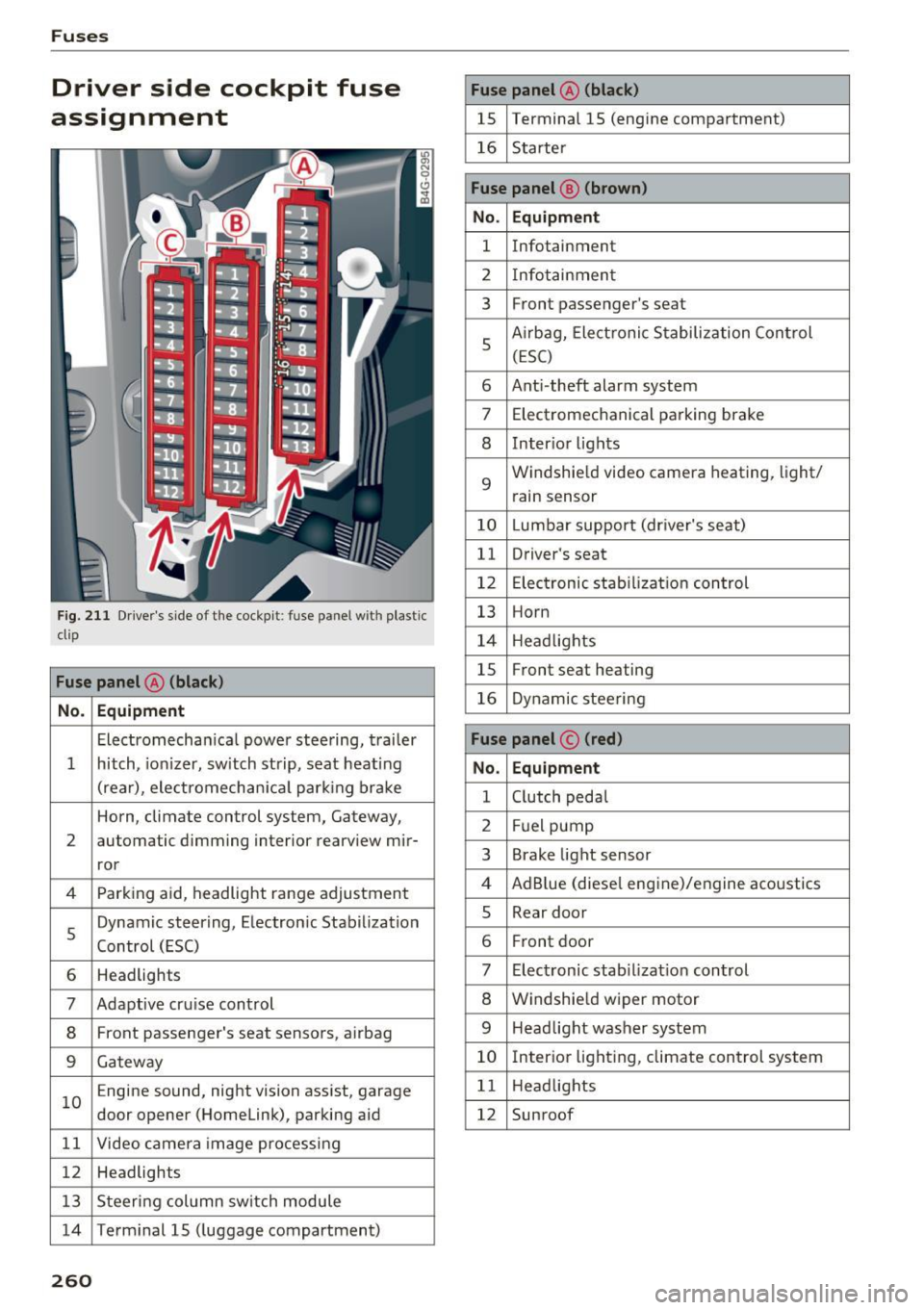
Driver side cockpit fuse
assignment
F ig. 211 Driver 's side of t he cockpit : fuse pa nel w it h plastic
clip
Fuse panel @ (black )
No . Equipment
Electromecha nica l powe r stee ring, trai ler
1 hitch, io nizer, sw itch st rip, sea t heat ing
(rear), ele ctromech an ical parking br ake
Horn, climate control system, Gateway,
2 automatic dimming interior rearv
iew mir-
ror
4 Parking aid, headlight range adjustment
5 Dynamic steering, Electron
ic Stabilization
Control (ESC)
6 Headlights
7 Adaptive cru ise control
8 Front passenger's seat senso rs, airbag
9 Gateway
1 0 E
ngine sound, night vision ass ist, garage
door opener (Homelink), parking aid
1 1 Video camera im age pro cessing
12 Headlights
1 3 Steeri ng col umn sw itch module
14 Term inal 15 ( luggage compartment)
260
Fuse panel @ (black)
15 Terminal 15 (engine compartment)
16 Starte r
Fuse panel @ (brown )
No. Equipment
1 Infotainment
2 Infotainmen t
3 F
ront passenger's seat
5 A
irbag, Elect ronic S tabiliza tion Con trol
( E SC)
6 Ant i- theft alarm system
7 Electromechanical pa rking brake
8 Inter io r li ghts
9
Windshie ld video camera heating, light/
rain sensor
10 Lumbar support (dr iver's seat)
11 Driver's seat
12 Elec tronic stab ilizati on con trol
13 Horn
1 4 H eadlights
15 Front seat heating
16 Dynamic stee ring
Fuse panel © (red)
No . Equipment
1 C lutch peda l
2 Fuel pump
3 Brake light sensor
4 AdB
lue (diese l eng ine)/engine aco ustics
5 Rear door
6 Fr
ont door
7 Electronic stab ili z at ion con trol
8 Windshie ld wiper motor
9 Headlight washer system
10 Inter
ior lig hting, climate control system
1 1 Headlights
12 Sunroof
Page 263 of 294
..... N
0 CJ '
Front passenger side
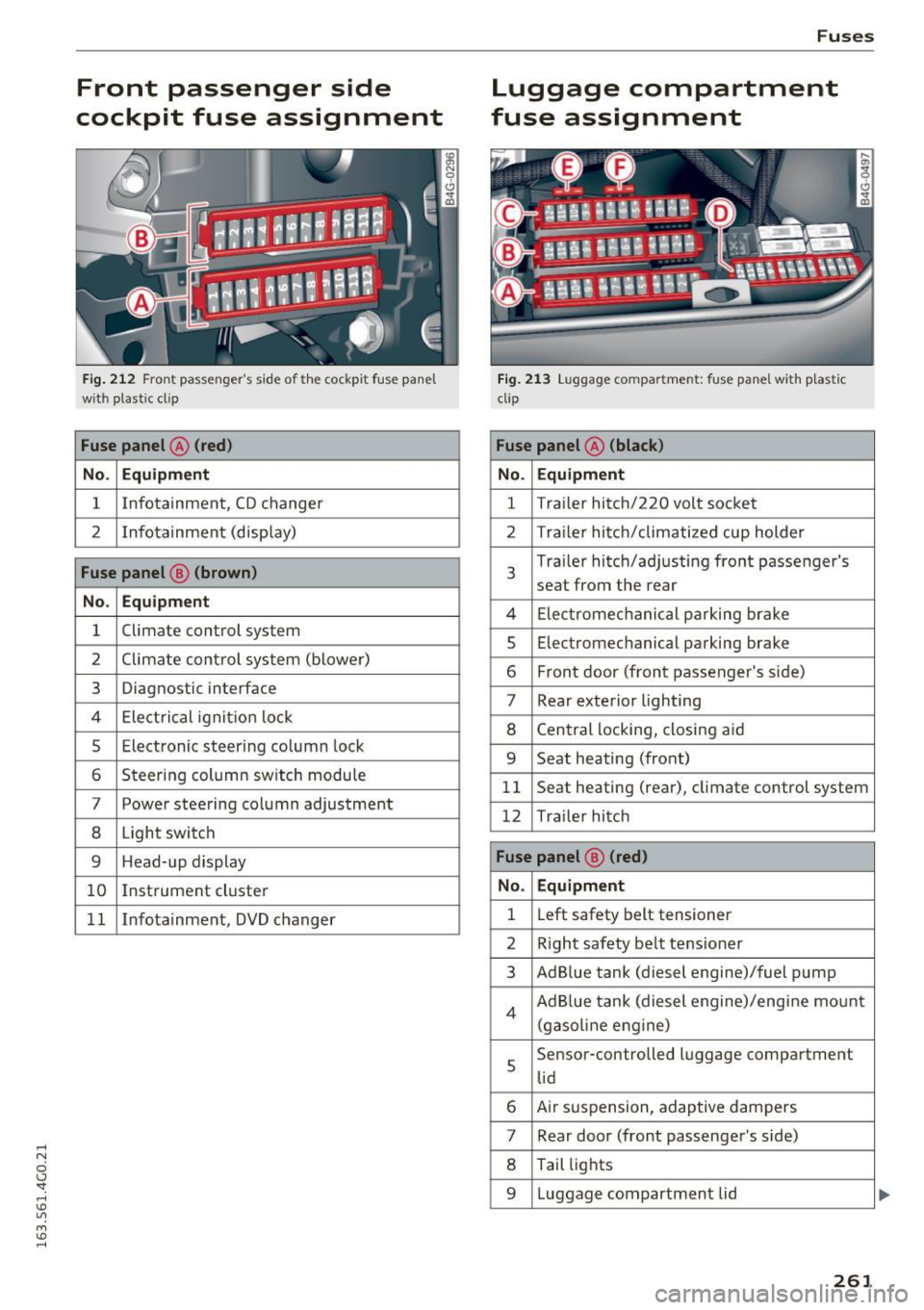
cockpit fuse assignment
Fig. 212 Front passenger's sid e of t he cockpit fuse pane l
with plastic cl ip
Fuse panel @ (red)
No. Equipment
1 Infotainment, CD changer
2 Infotainment
(display)
Fuse panel@ (brown)
No . Equipment
1 Climate
control system
2 Climate control
system (blower)
3 Diagnostic interface
4 Electrical ignition lock
5 Electronic steering column lock
6 Steering column sw itch module
7 Power steering column adjustment
8 Light switch
9 Head-up display
10 I
nst rument cluster
1 1 Infotainment, DVD changer
Fuses
Luggage compartment
fuse assignment
Fig. 213 Luggage compartment: fuse panel with plastic
clip
Fuse panel @ (black )
No. Equipment
1 Tra
iler hitch/220 volt socket
2 Tra ile r hitch/climatized cup holder
3
Tra iler hitch/adjusting front passenger's
seat from the rear
4 Elec trom echan ica l parking brake
5 Electromec hanical parking brake
6 Front door (front passenger's side)
7 Rear exterior lighting
8 Central locking, closing aid
9 Seat heating (front)
1 1 Seat heating
(rear), climate control system
12 Tra iler hitch
Fuse panel @ (red)
No . Equipment
1 Left
safety belt tensioner
2 R ight safety belt tensioner
3 Ad Blue tank (diesel engine)/fuel pump
4 Ad Blue tank (diesel engine)/engine mount
(gasoline eng ine)
s
Sensor-controlled luggage compartment
lid
6 Air suspension, adaptive dampers
7 Rear door (front passenger's side)
8 Tail lights
9 Luggage compartmen t lid
261
Page 265 of 294
Bulbs
Replacing light bulbs
For your safety, we recommend that you have
your authorized Audi dealer replace burned out
bulbs for you.
It is becoming increasingly more and more diffi
cult to replace vehicle light bulbs since in many
cases, other parts of the car must first be re
moved before you are able to get to the bulb.
This applies especially to the light bulbs in the
front of your car wh ich you can only reach
through the eng ine compartment.
Sheet metal and bulb holders can have sharp
edges that can cause serious cuts, and parts must be correctly taken apart and then properly
put back together to help prevent breakage of
parts and long term damage from water that can
ente r hous ings that have not been properly re
sea led .
F or your safety, we recommend that you have
your author ized Audi dealer replace any bu lbs for
you, s ince your dealer has the p roper tools, the
correct bulbs and the expertise.
Gas di schar ge l amp s (X enon li ghts):
Due to the high electrical voltage, have the bulbs
replaced by a qual ified technician . Headlights
w ith Xenon light can be identified by the high
voltage sticker.
LED headlights* require no maintenance. Please
contact your authorized Audi dealer if a bulb needs to be replaced.
A WARNING
Contact w ith high-voltage components of the
elect rical system a nd improper rep lacement
of gas d ischarge (Xenon) headlight b ulbs can
cause serious personal injury and death .
- Xenon bulbs are press urized and can ex
plode when be ing changed.
- Chang ing Xenon lamps requires the spec ial
t rain ing, instructions and equipment.
- Only an autho rized Aud i dea le r o r other
qualified wo rkshop s hou ld change the bulbs
in gas disc harge lamps .
Bulbs
A WARNING
There are parts with sharp edges on the open
i ngs and on the bulb holders that can cause
serious cuts.
- If you are uncertain about what to do, have
the work performed by an authorized Audi dealer or other qualified workshop. Ser ious
pe rsonal injury may result from improperly
pe rformed work.
0) Tips
- If you st ill prefer to replace the light bulbs
yourself, be aware that the engine compart ment is a hazardous area to work in
~page 216~ .&
-It is best to ask your authorized Audi dealer
w henever you need to change a bu lb.
263
Page 267 of 294
.... N
0 CJ '
When jump starting or charging the battery,
never connect the negative ground cable to
the battery negative post because the battery
manager system must be able to detect the
battery's state of charge . Always connect the
negative ground cable to the negat ive ground
post of the battery manager control unit .
Use of jumper cables
Make sure to connect the jumper cable clamps in
exactly the order described below!
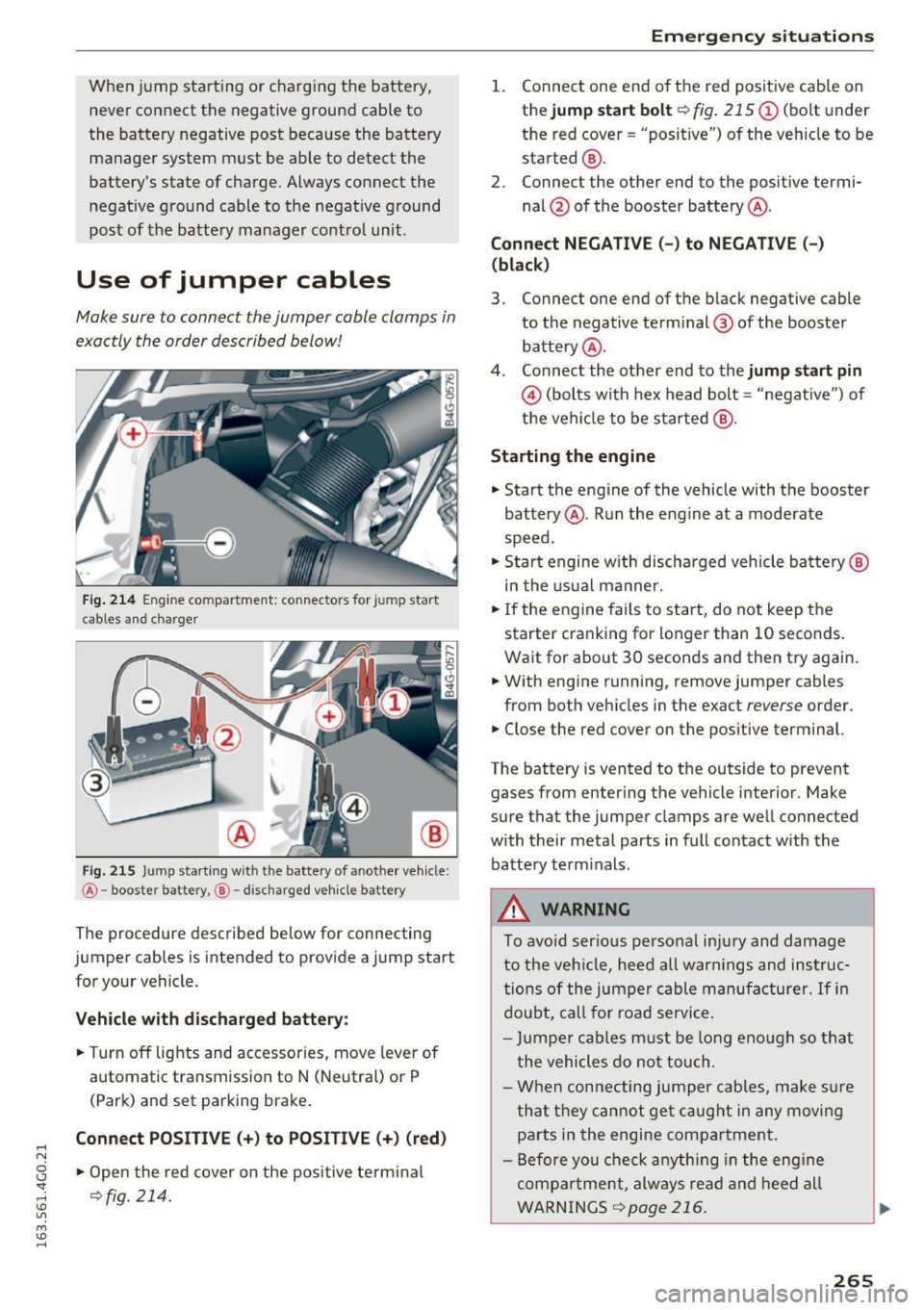
Fig. 214 Engine compa rtment: connec tor s for ju mp start
cables and cha rger
@
Fig. 215 Jump start ing with the battery of another vehicle:
@ -booste r battery ,@ -discharged vehicle battery
The procedure described below for connecting
jumper cables is intended to provide a jump start
for your vehicle.
Vehicle with discharged battery:
.. Turn off lights and accessories, move lever of
automatic transmission to N (Neutral) or P
(Park) and set parking brake .
Connect POSITIVE(+) to POSITIVE(+) (red)
.,. Open the red cover on the positive terminal
~fig. 214 .
Emergency situations
1. Connect one end of the red positive cab le on
the
jump start bolt~ fig. 215 (D (bolt under
the red cover = "posit ive") of the veh icle to be
started @.
2. Connect the other end to the posit ive termi-
nal @of the booster battery @.
Connect NEGATIVE (-) to NEGATIVE (- )
(black)
3. Connect one end of the black negative cable
to the negative terminal @ of the booster
battery @.
4 . Connect the other end to the
jump start pin
@ (bolts with hex head bolt= "negat ive") of
the vehicle to be started @.
Starting the engine
.. Start the engine of the vehicle with the booster
battery @. Run the eng ine at a moderate
speed .
.,. Start engine w ith discharged vehicle battery @
in the usual manner.
.,. If the engine fails to start, do not keep the
starter cranking for longer than 10 seconds.
Wait for about 30 seconds and then try again .
.. With engine running, remove jumper cables
from both vehicles in the exact
reverse order .
.. Close the red cover on the positive terminal.
The battery is vented to the outside to prevent gases from entering the vehicle interior . Make
sure that the jumper clamps are well connected
with their metal parts in full contact with the
battery term inals .
A WARNING
To avoid ser ious personal injury and damage
to the vehicle, heed all warnings and instruc
tions of the jumper cable manufacturer.
If in
doubt, call for road service.
- Jumpe r cables must be long enough so that
the vehicles do not touch .
- When connecting jumper cables, make su re
that they cannot get caug ht in any moving
parts in the engine compartment.
- Before you check anything in the engine
compa rtment, always read and heed all
WARNINGS
~page 216.
265
Page 279 of 294
A
A/C (fo ur-z one automatic clim ate control) . . 7 0
A/C (three -zone climate control) . . . . . . . . . . 68
Accessories .. .. .. .... .... ..... .. .. 60, 275
Active lane assist . . . . . . . . . . . . . . . . . . . . . . 93
Ad justing the vibration warn ing . . . . . . . . . 95
C leaning the camera area . . . . . . . . . . . . . 204
Driver messages . . . . . . . . . . . . . . . . . . . . . . 94
Indicator light . . . . . . . . . . . . . . . . . . . . . . . 94
switching on and off . . . . . . . . . . . . . . . . . . 94
Adapt ive a ir s uspension/sport . . . . . . . . . . . 100
Adapt ive cruise control. . . . . . . . . . . . . . . . . . 84
C leaning the sensor . . . . . . . . . . . . . . . . . . 204
M essages . . . . . . . . . . . . . . . . . . . . . . . . . . . 9 1
Request for driver i nterven tion . . . . . . . . . . 89
S top-and -go traffic . . . . . . . . . . . . . . . . . . . 88
Adapt ive Lig ht (defective) . . . . . . . . . . . . . . . 22
AdBlue .. .. .. .. .... .. .... ... .. .. .... . 212
Messages .. .. .. ............. .. .. .. . 213
Opening the tank door ................ 213
Refilling . .. .. ................. .... . 213
Adding Engine coolant . . . . . . . . . . . . . . . . . . . . . . 223
E ng ine oil . . . . . . . . . . . . . . . . . . . . . . . . . . 220
W indshield washer fluid . . . . . . . . . . . . . . 229
Addit ives
E ngine oi l . . . . . . . . . . . . . . . . . . . . . . . . . . 220
Adjusting Fr ont seats . . . . . . . . . . . . . . . . . . . . . . . . . . 54
Steer ing colum n electrically . . . . . . . . . . . . 73
S teer ing colum n manually . . . . . . . . . . . . . 73
Adjusting a ir distribution (four-zone automat -
i c climate control) . . . . . . . . . . . . . . . . . . . . . . 71
Ad justing air distribution (three- zone climate
control) . . . . . . . . . . . . . . . . . . . . . . . . . . . . . . 68
Ad justing the temperature (four-zone auto -
matic climate contro l) . . . . . . . . . . . . . . . . . . 70
Ad justi ng the tempe rature (three-zone cli-
mate con trol) . . . . . . . . . . . . . . . . . . . . . . . . . 68
advanced key
refer to Convenience key . . . . . . . . . . . . . . . 74
Ai rbag . . . . . . . . . . . . . . . . . . . . . . . . . . . . . . 142
A irbag system . . . . . . . . . . . . . . . . . . . . . . . . 162
Advanced Airbag-System . . . . . . . . . . . . . . 146
Advanced A irbag Sys tem components . . . 149
Ca re . . . . . . . . . . . . . . . . . . . . . . . . . . . . . . 15 7
Index
Children . . . . . . . . . . . . . . . . . . . . . . . . . . . 168
Child restraints . . . . . . . . . . . . . . . . . . . . . 168
Components (front airbags) . . . . . . . . . . . 149
Danger of fitting a child seat on the front
passenger seat . . . . . . . . . . . . . . . . . . . . . . 143
Disposal . . . . . . . . . . . . . . . . . . . . . . . . . . . 1S7
Front airbags . . . . . . . . . . . . . . . . . . . 1 46, 147
How do the front a irbags wor k? . . . . . . . . 151
How many a irbags does my vehicle have? 149
How the Advanced Airbag System compo-
nents work togethe r . . . . . . . . . . . . . . . . . 151
Important in formation . . . . . . . . . . . . . . . 142
Important safety instructions on the knee
airbag system . . . . . . . . . . . . . . . . . . . . . . . 160
Knee airbags. . . . . . . . . . . . . . . . . . . . . . . . 158
Monitoring . . . . . . . . . . . . . . . . . . . . . . . . . 153
PASSE NGER AIR BAG OFF light . . . . . . . . . 154
Repairs . . . . . . . . . . . . . . . . . . . . . . . . . . . . 157
Safety instructions . . . . . . . . . . . . . . . . . . . 156
S ide a irbags . . . . . . . . . . . . . . . . . . . . . . . . 160
S ide curta in a irb ags . . . . . . . . . . . . . . . . . . 163
War ning/ indicator ligh ts . . . . . . . . . . . . . . . 18
Warn ing/Indicator lights . . . . . . . . . . . . . 153
When must t he system be inspected? 153
Aircraft Transporting your vehicle . . . . . . . . . . . . . 26 7
All season tires . . . . . . . . . . . . . . . . . . . . . . . 246
All weather lights . . . . . . . . . . . . . . . . . . . . . . 44
All wheel d rive . . . . . . . . . . . . . . . . . . . . . . . 1 91
Alternator . . . . . . . . . . . . . . . . . . . . . . . . . . . . 16
Amb ient lighting . . . . . . . . . . . . . . . . . . . . . . 4 7
Anti-freeze
refer to Eng ine coolant . . . . . . . . . . . . . . . 222
Anti- lock braking system
Indicator light . . . . . . . . . . . . . . . . . . . . . . . 18
War ning/ indicator lights . . . . . . . . . . . . . . . 19
Anti- Lock Bra king System . . . . . . . . . . . . . . 187
Anti-slip regulat io n
I n dicator lig ht . . . . . . . . . . . . . . . . . . . . . . . 18
Anti-Slip Regu lation . . . . . . . . . . . . . . . . . . . 187
Anti -theft systems
E lectronic immobilizer . . . . . . . . . . . . . . . . . 31
Asht ray . . . . . . . . . . . . . . . . . . . . . . . . . . . . . . 59
Audi drive select
refer to Drive select . . . . . . . . . . . . . . . . . . 100
Audi Se rvice Repair Manuals and Literature 273
277