transmission AUDI A6 2017 User Guide
[x] Cancel search | Manufacturer: AUDI, Model Year: 2017, Model line: A6, Model: AUDI A6 2017Pages: 280, PDF Size: 70.24 MB
Page 106 of 280
Ass is t
Switching on /off
Applies to: vehicles with night vision assist
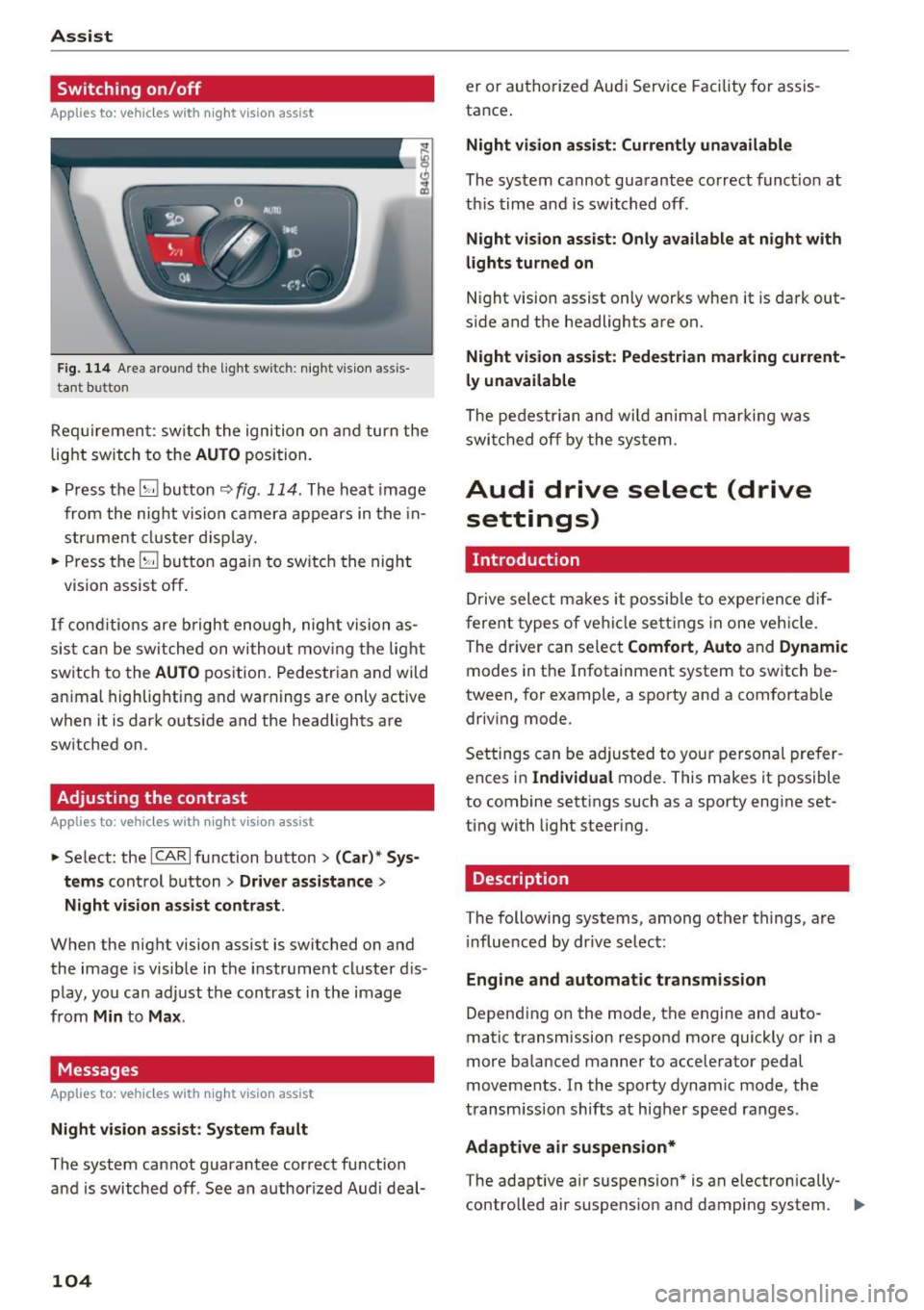
Fig. 114 Are a aro und th e light sw itc h: n ight v is ion assis
ta nt b utto n
Req uiremen t: sw itch the ignition on and turn the
light switch to the
AUTO position.
• Press the
[g button ~ fig. 114 . The heat image
from the nig ht vision camera appears in the in
strume nt cluster d isplay.
• Press the
(g button again to switch the night
vision assist off .
If conditions are b right enough, night vision as
sis t can be switched on withou t mov ing the light
switch to the
AUTO position. Pedestrian and wild
an imal highlighting and warnings are only active
when it is da rk outs ide and the headlights are
sw itched on .
Adjusting the contrast
Applies to: vehicles with night vision assist
• Select : the ICARlfunction button > (C ar)* S ys
t e ms
control button > Dri ver assistance >
Night vi sion a ssis t contrast .
When the night vision assist is switched on and
the image is visible in the instrument cluster d is
p lay, you can adjust the contrast in the image
from
Min to Ma x.
Messages
Applies to: vehicles with night vision assist
Ni ght vision assist : S ystem fau lt
The system cannot guarantee correct function
and is switched off . See an author ized Audi deal-
104
er or authori zed Aud i Service Facility for assis
tance .
Night vi sion a ssis t: Curren tly unavailable
The system cannot guarantee correct funct io n at
th is time and is switched off .
Night vis ion ass ist: O nly ava ilabl e a t n ight with
lights turned on
N ight vision assist only works when it is dark out
s ide and the headlights are on.
Night vis ion a ssist: Pede st ria n marking current
l y unavailab le
The pedestrian and wi ld animal marki ng was
swi tched off by the system .
Audi drive select (drive
settings)
Introduction
D rive select makes it possib le to exper ience dif
ferent types of ve hicle settings in one veh icle .
The dr iver can select
Comfort , Auto and Dynamic
modes in the Infotainment system to switch be
tween, for example, a sporty and a comfortab le
driv ing mode .
Settings can be adjusted to your persona l prefer
ences in
Individua l mode. This makes it possible
to combine settings such as a sporty engine set
ting with light steering.
Description
T he following systems, among other things, are
i nfluenced by dr ive select:
Eng ine and aut om atic transmi ssion
Depend ing on the mode, th e engine and auto
matic transmission respond more quickly or in a
more balanced manner to acceler ator pedal
movements. In the sporty dynamic mode, the
transm ission shifts at higher speed ranges .
Adaptive air su spen sion*
The adaptive a ir suspension * is an e lectronically
controlled air suspens ion and damping system. ..,_
Page 214 of 280
Wheel s
® Mud and snow capability
"M/5" or "M+S" indicates the tire
is sui table for driving on mud and
snow.
& indicates a winter tire.
@ Composition of the tire cord
and materials
The number of plies indicates the
number of rubberized fabric lay
ers in the t ire. In general: the
more layers, the more weight a
tire can carry . Tire manufacturers
must also specify the materials
used in the tire. These include
steel, nylon, po lyester and other
materials.
@ Maximum permitted load
This number indicates the maxi
mum load in kilograms and
pounds that the tire can carry .
@Uniform tire quality grade
standards for treadwear,
traction and temperature resist ance
Tread wear, traction and temper
ature ranges¢
page 227.
@ Running direction
The arrows indicate the running
direction of unidirectional t ires .
You must always follow the speci
fied running direction
¢page 241 .
212
@ Ma ximum permitted
inflation pressure
This number indicates the maxi
mum pressure to which a tire can
be inflated under normal operat
ing condit ions.
Glossary of tire and loading
terminology
Acces sory we ight
means the combined weight (in
excess of those standard items
which may be replaced) of auto matic transmission, power steer
ing, power brakes, power win
dows, power seats, radio, and
heater, to the extent that these
items are available as factory-in
stalled equipment (whether in
stalled or not) .
Aspect ratio
means the ratio of the height to
the width of the tire in percent .
Numbers of 55 or lower indicate a
low sidewall for improved steer
ing response and better overall
handling on dry pavement.
Bead
means the part of the tire that is
made of steel wires, wrapped or
reinforced by ply cords and that is
shaped to fit the r im . ...
Page 239 of 280
co
co
.... N
" N .... 0 0 <..:l '
The vehicle jack* in your vehicle is mainte
nance-free.
Replacing wheels
Before changing a wheel
Observe the following precautions for your own
and your passenger's safety when changing a
wheel .
.,. After you experience a tire failure, pull the car
well away from moving traffic and try to reach
level ground before you stop¢,&. .
.,. All passengers should
leave the car and move
to a safe location (for instance, beh ind the
guardrail)¢ ,&..
.. Engage the
parking brake to prevent your vehi
cle from rolling unintentionally ¢,&. .
.. Move
selector lever to position P ¢ ,&. .
.,. If you are towing a trailer, unhitch the trailer
from your vehicle.
.,. Take the
jack and the spare tire* out of the lug
gage compartment c:> page 236.
A WARNING
You or your passengers could be inju red wh ile
changing a wheel if you do not follow these
safety precautions:
- If you have a flat tire, move a safe distance
off the road. Turn off the engine, turn the
emergency flashers on and use other warn
ing devices to alert other motorists .
- Make sure that passengers wait in a safe
place away from the vehicle and well away
from the road and traffic.
- T o help prevent the vehicle from moving
sudden ly and possibly slipping off the jack,
always fully set the parking brake and block
the wheel diagonally opposite the wheel be ing changed. When one front wheel is lifted
off the ground, plac ing the Automatic
Transmission in P (Park) will
not prevent the
vehicle from mov ing.
- Before you change a wheel, be sure the
ground is level and firm. If necessary, use a
sturdy board under the jack .
Emergency assistance
-Always store the vehicle too l kit, the jack
and the replaced tire in the luggage com
partment
¢page 134.
@ Tips
Before changing the wheel, you must activate
the jacking mode, so that the automatic con
tro ls for the Adaptive Air Suspension* do not
make it more difficult to lift the vehicle with
the jack
c> page 239.
Changing a wheel
When you change a wheel, follow the sequence
described below step-by-step and in exactly that
order .
l. Activate the vehicle jack mode* ¢ page 239 .
2. Remove the decorative wheel cover* or the
wheel bolt caps* . For more details see also
¢ page 238, Decorative wheel covers or
¢ page 238, Wheels with wheel bolt caps .
3. Loosen the wheel bolts¢ page 238 .
4. Locate the proper mounting point for the
jack and align the jack below that point
¢page 239.
5. Raise the car with the jack c> page 239 .
6. Remove the wheel with the flat tire and then
install
the spare ¢ page 241.
7. Tighten all wheel bolts lightly.
8.
Lower the vehicle with the jack .
9 . Use the wheel bolt wrench and
firmly tighten
all wheel bolts
c> page 238.
10. Replace the decorative wheel cover* or the
wheel bolt caps*.
11. Deactivate the vehicle jack mode* in the
MMI:
I CARI function button > ( Car)* systems
control button > Servicing & checks > Air
susp.: jack mode > Off.
The vehicle jack mode* switches off automatica l
ly at speeds above 6 mph (10 km/h).
A WARNING
--
Always read and follow all WARNINGS and in
formation
¢ .&. in Raising the vehicle on
page 240
and c> page 242 .
237
Page 251 of 280
co
co
.... N
" N .... 0 0 <..:l '
General
This chapter is intended for trained emergency
crews and working personnel who have the nec
essary tools and equipment to perform these
ope rations.
Starting by pushing or
towing
CD Note
Veh icles with an automatic transmission can
not be started by pushing or towing.
Starting with jumper
cables
If necessary, the engine can be started by con
necting it to the battery of another vehicle.
If the engine shou ld fail to start because of a dis
charged or weak battery, the battery can be con
nected to the battery of
another vehicle, using a
pair of jumpe r cables to start the engine.
Jumper cables
Use only jumper cables of suffic iently large cross
section
to carry the starter current safely. Refer
to the manufacturer's specifications.
Use only jumper cables with
insulated term inal
clamps which are dis tinct ly marked:
plus (+) cable in most cases colored re d
minus( -) cable
in most cases colored black.
A WARNING
Batteries contain electricity, acid, and gas.
Any of these can cause very serious or fatal in
jury. Follow the instructions below for safe
handling of your vehicle's battery.
- Always shield your eyes and avo id leaning
over the battery whenever poss ible.
- A dead battery can freeze at temperatures
around 32 °F (0 °C). If the vehicle battery is
frozen, you must thaw it before connecting
the jump start cab les. If you do not, this in-
Emergency situations
creases the risk of an explosion and chemi
cal burns. After jump starting the vehicle,
drive to an authorized Aud i dealer or author
ized Audi Service Facility immediately to
have the vehicle battery checked.
- Do not allow battery ac id to contact eyes or
skin . Flush any contacted area with water
immed iately.
- Improper use of a booster battery to start a
veh icle may cause an explosion .
- Veh icle batteries generate explosive gases.
Keep sparks, flame and lighted cigarettes
away from batter ies.
- Do not try to jump start any vehicle with a
low acid level in the battery .
- The voltage of the booster battery must also
have a 12-volt rat ing . The capacity (Ah) of
the booster battery should not be lower
than that of the discharged battery. Use of
batter ies of different voltage or substantial
ly different "Ah" rating may cause an exp lo
sion and personal injury.
- Never charge a frozen battery. Gas trapped
in the ice may cause an explosion.
- Never charge or use a battery that has been
frozen . T he battery case may have be weak
ened.
- Use of batteries of different voltage or sub
stantially different capacity (Ah) rating may
cause an exp losion and injury . The capacity
(Ah) of the booster battery should not be
lower than that of the discharged battery.
- Before you check anything in the engine
compartment, always read and heed all
WARNINGS
qpage 198.
CD Note
-App lying a higher voltage booster battery
wi ll ca use expensive damage to sensitive
electronic components, such as control
units, relays, radio, etc.
- There must be no electrical contact between
the vehicles as otherwise current could al
ready start to flow as soon as the positive
(+) terminals are connected.
249
Page 252 of 280
Emergency situations
@ Tips
The discharged battery must be properly con
nected to the vehicle's electrical system .
When jump starting or charging the battery,
never connect the negative ground cable to
the battery negative post because the battery
manager system must be able to detect the
battery's state of charge . Always connect the
negat ive ground cable to the negative ground
pos t of the battery manager control unit.
Use of jumper cables
Make sure to connect the jumper cable clamps in
exactly the order described below!
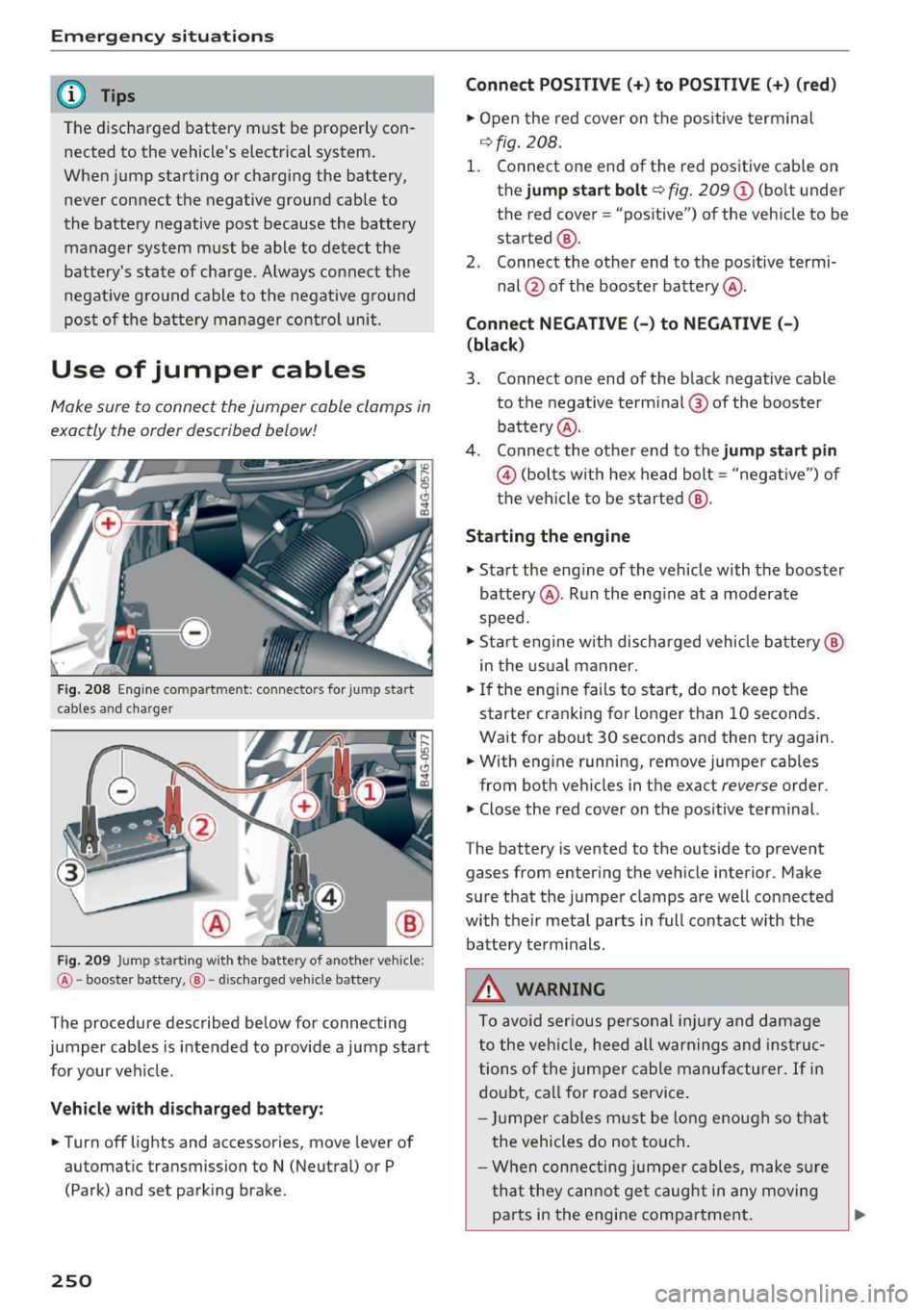
Fig. 208 Engine compartmen t: connecto rs for ju mp start
cables a nd charger
@
Fig. 209 Ju mp starting w ith the battery of another vehicle :
@-booster battery, @- discharged vehicle batte ry
The procedure described below for connecting
jumper cables is intended to provide a jump start
for your veh icle.
Vehicle with discharged battery:
.. Turn
off lights and accessories, move lever of
automatic transmission to
N (Neutral) or P
(Park) and set park ing brake .
250
Connect POSITIVE(+) to POSITIVE (+) (red)
.. Open the red cover on the positive terminal
o::> fig.
208.
1. Connect one end of the red positive cable on
the jump start bolt
Q fig. 209 (i) (bolt under
the red cover= "positive") of the vehicle to be
started @.
2. Connect the other end to the positive termi-
nal@ of the booster battery @.
Connect NEGATIVE(-) to NEGATIVE(-)
(black)
3. Connect one end of the black negative cable to the negative terminal ® of the booster
battery @.
4. Connect the other end to the jump start pin
© (bolts with hex head bolt= "negat ive") of
the vehicle to be started @.
Starting the engine
"' Start the eng ine of the vehicle with the booster
battery @. Run the eng ine at a moderate
speed.
"' Start engine w ith discharged vehicle battery@
in the usual manner.
"' If the engine fails to start, do not keep the
starter cranking for longer than 10 seconds.
Wait for about 30 seconds and then try again.
"' With engine running, remove jumper cables
from both vehicles in the exact
reverse order.
"' Close the red cover on the positive terminal.
The battery is vented to the outside to prevent gases from entering the vehicle interior . Make
sure that the jumper clamps are well connected
with their metal parts in full contact w ith the
batte ry terminals.
A WARNING
To avoid serious personal inju ry and damage
to the veh icle, heed all warnings and instruc
tions of the jumper cable manufacturer.
If in
doubt, call for road service.
- Jumper cables must be long enough so that
the vehicles do not touch .
- When connecting jumper cables, make sur e
that they cannot get caug ht in any moving
pa rts in the engine compartment. ..,.
Page 253 of 280
-Before you check anything in the engine
compartment, always read and heed all
WARNINGS
o page 198.
(D Note
Improper hook-up of jumper cables can ruin
the generator.
-Always connect POSITIVE( +) to POSITIVE
(+), and NEGATIVE(-) to NEGATIVE(-)
ground post of the battery manager control
unit.
- Check that all screw plugs on the battery
cells are screwed in firmly. If not, t ighten
plugs prior to connecting clamp on negative
battery terminal.
- Please note that the procedure for connect
ing a jumper cable as described above ap
plies specifically to the case of your vehicle
being jump started. When you are giv ing a
ju mp start to another vehicle, do
not con
ne ct the negative( -) cab le to the negative
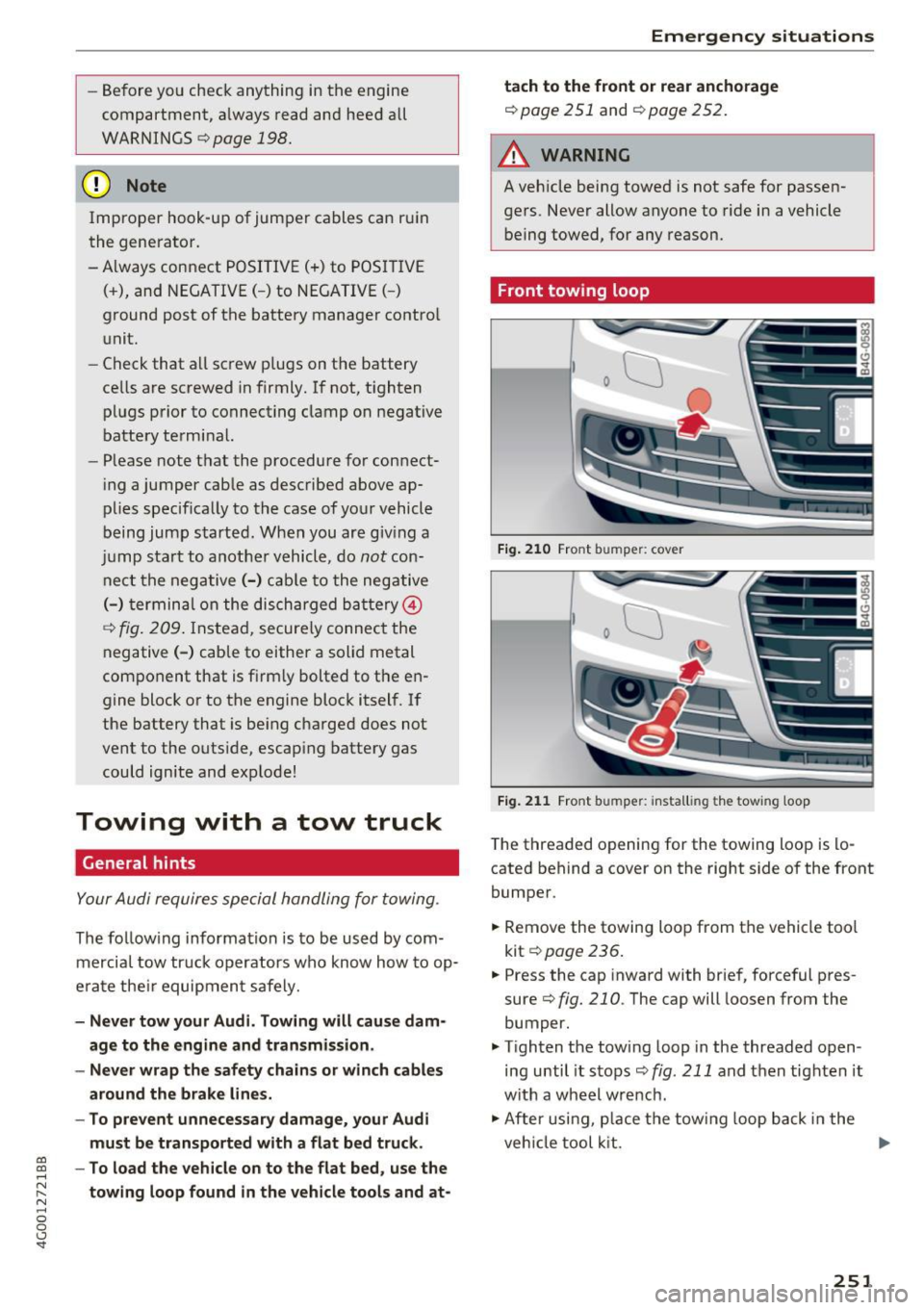
(-) terminal on the discharged ba ttery @
o fig. 209. Instead, securely connec t the
negative (-) cable to either a solid metal
component that is firm ly bolted to the en
gine block or to the engine block itself. If
the battery that is be ing charged does not
vent to the outs ide, escaping battery gas
could ignite and explode!
Towing with a tow truck
General hints
Your Audi requires special handling for towing .
The following information is to be used by com
mercial tow truck operators who know how to op
erate the ir equipment safely.
-Never tow your Audi. Towing will cause dam
age to the engine and transmission .
- Never wrap the safety chains or winch cables
around the brake lines.
- To prevent unnecessary damage, your Audi
must be transported with a flat bed truck .
co
co -To load the vehicle on to the flat bed, use the ....
~ towing loop found in the vehicle tools and at-N .... 0 0 <.,;) 'SI"
Emergency situations
tach to the front or rear anchorage
opage251 and opage252.
.&_ WARNING
-
A vehicle being towed is not safe for passen-
gers. Never allow anyone to ride in a vehicle
being towed, for any reason.
Front towing loop
Fig. 210 Front bumper: cover
Fig. 211 Front bu mper: insta lling t he towing loop
The threaded open ing for the towing loop is lo
cated behind a cover on the right side of the front
bumper .
.,. Remove the towing loop from the vehicle too l
kit
c:::, page 236.
.,. Press the cap inward with brief, forceful pres
sure
o fig. 210 . The cap will loosen from the
bumper.
., Tighten the towing loop in the threaded open
ing until it stops
r:';> fig. 211 and then tighten it
w ith a wheel wrench .
.,. After usi ng, p lace the towing loop back in the
veh icle tool kit . "'
251
Page 255 of 280
co
co
.... N
" N .... 0 0 <.,;) 'SI"
Raising the vehicle
Lifting with workshop hoist and with floor
jack
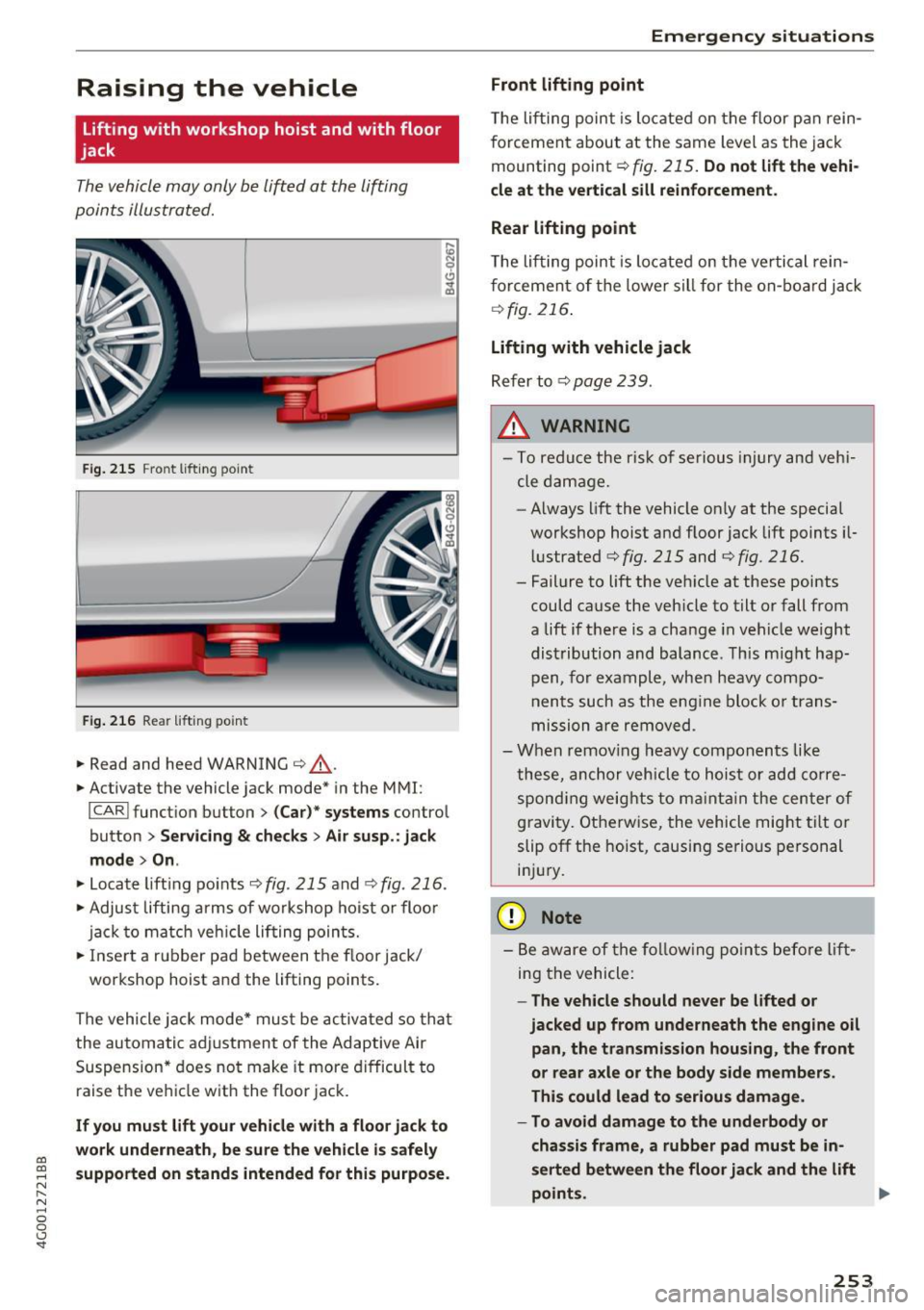
The vehicle may only b e li~ ed at the lifting
points illustra ted.
F ig. 215 Front lift ing po int
F ig. 216 Rea r lift ing po int
.,. Read and heed WARNING c:> &_ .
.. Activate the vehicle jack mode* in the MMI:
I CAR I funct ion button> (Car) * systems contro l
button >
Servicing & checks > Air susp.: jack
mode > On .
.. Loca te lift ing po ints c:> fig . 215 and c:> fig . 216 .
.. Adju st lifting arms of wo rkshop ho ist o r floo r
j ac k t o ma tch vehicl e lifting poin ts.
.. In se rt a rub ber pa d between the f loor jack/
wor kshop hoist a nd the lifting points .
T he vehicle ja ck mode* mus t be activa ted so th at
the au tomatic a djustment of the Adaptive Air
Suspension * does not make it more d ifficult to
raise the ve hicle w it h the floo r jack.
If you must lift your vehicle with a floor jack to
work underneath , be sure the vehicle is safely
supported on stands intended for this purpose .
Emergency situations
Front lifting point
The li fting poin t is lo cate d on the floor p an rein
f orceme nt ab out at the same level as the ja ck
mounting point
c:> fig . 215 . Do not lift the vehi
cle at the vertical sill reinforcement.
Rear lifting point
T he lifting point is lo cated on the ver tic al rein
f orcement o f the lower s ill for the on- bo ar d jac k
<=>fig. 216.
Lifting with vehicle jack
Refer to c:> pag e 239 .
A WARNING
- To reduce the r is k of se rious inju ry and vehi
cle damag e.
- Always lift the vehicle on ly at the special
workshop h oist a nd floor jack lift points
il
lustrated c:>fig. 215 and c:>fig. 216.
-Failure to lift t he veh icle at these points
could cause t he veh icle to tilt o r fall from
a lift i f th ere is a change in vehicle weight
dist ribution and balance . This might hap
pen, fo r example, when heavy compo
n en ts such as the eng ine block o r tran s
mis sio n a re re moved .
- Whe n re mov ing heavy co m ponents like
these, an ch or vehicle t o hois t or ad d co rre
spon ding weig hts t o m aintai n the cen ter of
g ravi ty . Ot herw ise, the vehicle mig ht tilt or
slip off t he hoist, caus ing se rious pe rsonal
i njur y .
(D Note
-Be aw are of the fo llow ing points b efor e lift
ing the vehicle:
-The vehicle should never be lifted or
jacked up from underneath the engine oil
pan, the transmission housing, the front
or rear axle or the body side members.
This could lead to serious damage .
- To avoid damage to the underbody or
chassis frame, a rubber pad must be in
serted between the floor jack and the lift
points . .,.
253
Page 257 of 280
co
co
.... N
" N .... 0 0 <.,;) 'SI'
Technical data
Vehicle specifications
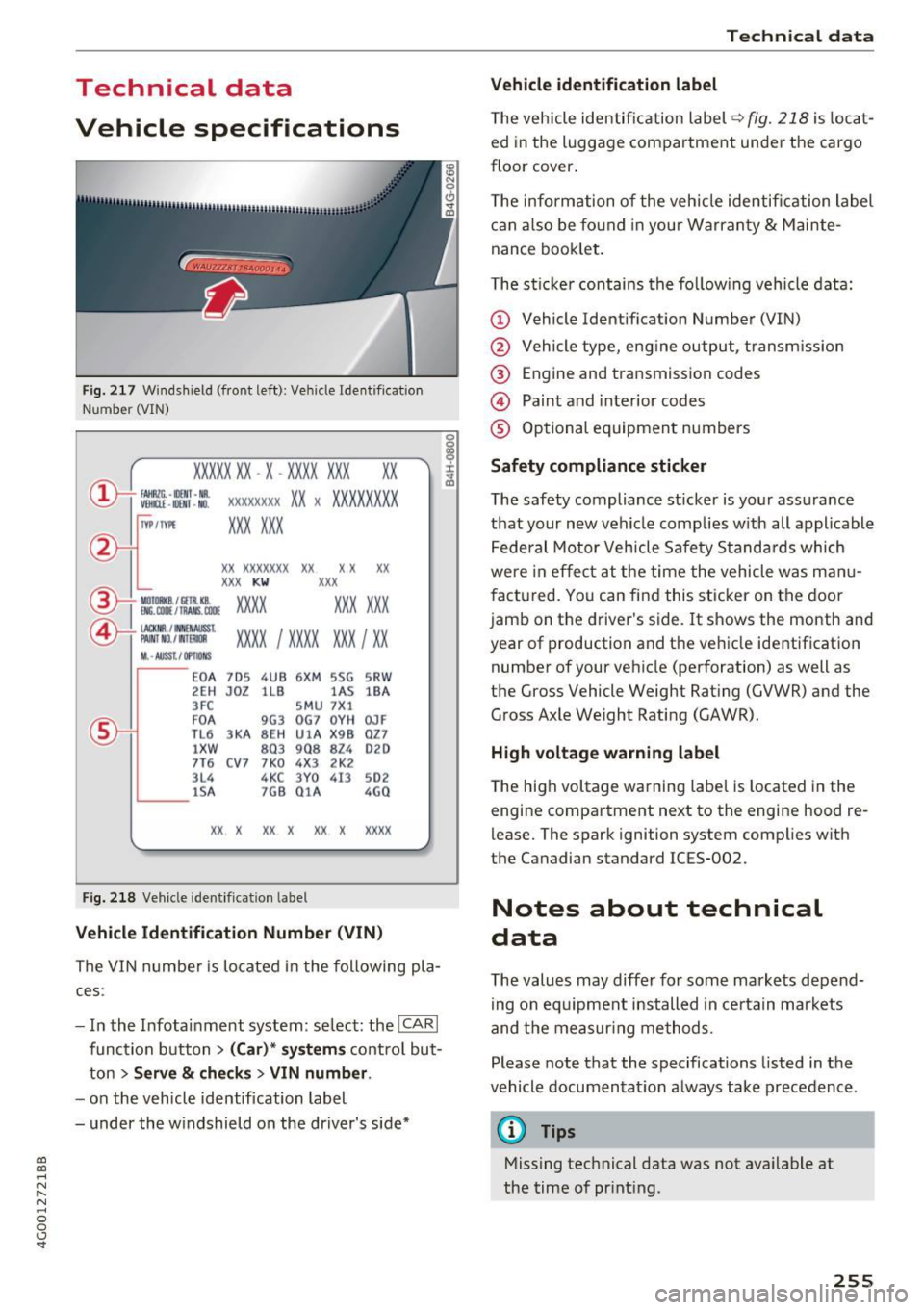
F ig. 2 17 W indshield (front left) : Ve hicl e Iden tificat ion
N umber ( VIN)
XXXXX XX -X -XXXX XXX XX
CD+ ~t :1:: xxxxxxxx xx x xxxxxxxx
TVP/fffl XXX XXX
XX XXXXXXX XX X X XX
XXX
KW XXX
®i ~:J ·f lfils~~ XXXX XXX XXX
®-+ ~N:a=i~ l xxxx ; xxxx xxx ; xx
11. • AUSS, I OPTIONS
E0A
7D5 4UB 6XM 5SG 5RW
2EH J0Z lLB l
A S lB A
3FC SMU 7Xl
F0A 9G3 0G7 0YH 0JF
TL6 3KA 8EH Ul A X98 QZ7
lX W 803 908 824 020
7T6 CV7 7K0 4X3 2K2
3L4
4KC 3 Y0 413
502
lSA 7GB 01A 4G0
XX. X XX X XX X xxxx
Fig. 218 Vehi cle identifica tion la b el
Vehicle Identification Number (VIN)
The VIN number is located in the following pla
ces :
- In the Infotainment system : select: the
!CARI
function button > (Car) * systems control but
ton
> Serve & checks> VIN number .
-on the vehicle identification label
- under the windshield on the driver's side*
Technical data
Vehicle identification label
The vehicle identification label ¢ fig. 218 is locat
ed in the luggage compartment under the cargo
floor cover .
T he information of the vehicle identification label
can also be found in your Warranty
& Mainte
nance booklet.
The sticker contains the follow ing vehicle data:
(D Vehicle Iden tification Number (V IN)
@ Vehicle type, eng ine output , transm ission
@ Eng ine and transmission codes
@ Paint and interior codes
® Optional equipment numbers
Safety compliance sticker
The safety compliance sticker is your assurance
that your new vehicle complies w ith all applicable
Federal Motor Vehicle Safety Standards which
were in effect at the time the vehicle was manu
factured. You can find this sticker on the door
jamb on the driver 's side. It shows the month and
year of production and the vehicle identification number of your vehicle (perforation) as well as
the G ross Vehicle Weight Rating (GVWR) and the
Gross Axle Weight Rating (GAWR).
High voltage warning label
The high voltage warn ing label is located in the
engine compartment next to the engine hood re
lease. The spark ignition system complies with
the Canadian standard ICES-002.
Notes about technical
data
The values may differ for some markets depend
ing on eq uipment installed in certain markets
and the measur ing methods.
Please note that the specifications listed in the
vehicle documentation always take precedence .
@ Tips
Missing technical data was not available at
the time of printing .
255
Page 262 of 280
Consumer information
scope of maintenance and repairs which can be
carried out by vehicle owners.
Also, safety and
environmental
concerns place very strict limits
on the nature of repairs and adjustments to en
gine and transmission parts which an owner can
perform .
Maintenance, adjustments and repairs usually re
quire special tools, testing devices and other
equipment available to specially trained work
shop personnel in order to assure proper per
formance, reliability and safety of the vehicle and
its many systems .
Improper maintenance, adjustments and repairs
can impair the operation and reliability of your
vehicle and even void your vehicle warranty.
Therefore, proof of servicing in accordance with
the maintenance schedule may be a condition for
upholding a possible warranty claim made within
the warranty period.
Above all, operational safety can be adversely af
fected, creating unnecessary risks for you and
your passengers.
If in doubt about any servicing, have it done by
your authorized Audi dealer or any other properly
equ ipped and qualified workshop. We strongly
urge you to give your authorized Audi dealer the
opportunity to perform all scheduled mainte
nance and necessary repairs. Your dealer has the
facilities, original parts and trained specialists to keep your vehicle running properly.
Performing limited maintenance yourself
The following pages describe a limited number of procedures which can be performed on your vehi
cle with ordinary tools, should the need arise and
trained personnel be unavailable. Before per
forming any of these procedures, always thor
oughly read all of the applicable text and careful
ly follow the instructions given. Always rigorously
observe the
WARNINGS provided.
Before you check anything in the engine com
partment, always read and heed all WARNINGS
c> & and c> & in Working in the engine compart
ment on page 198.
260
A WARNING
-
-Serious personal injury may occur as a result
of improperly performed maintenance, ad
justments or repairs .
- Always be extremely careful when working
on the vehicle. Always follow commonly ac
cepted safety practices and general com
mon sense. Never risk personal injury.
- Do not attempt any of the maintenance,
checks or repairs described on the following pages if you are not fully familiar with these
or other procedures with respect to the ve hicle, or are uncertain how to proceed.
- Do not do any work without the proper tools
and equipment. Have the necessary work
done by your authorized Audi dealer or an
other properly equipped and qualified work
shop.
- The engine compartment of any motor vehi
cle is a potentially hazardous area. Never
reach into the area around or touch the radi
ator fan. It is temperature controlled and
can switch on suddenly - even when the en
gine is off. The radiator fan switches on au
tomatically when the coolant reaches a cer
tain temperature and will continue to run
until the coolant temperature drops.
- Always switch off the ignition before anyone
gets under the vehicle.
- Always support your vehicle with safety
stands if it is necessary to work underneath
the vehicle. The jack supplied with the vehi
cle is not adequate for this purpose and
could collapse causing serious personal in
Jury.
- If you must work underneath the vehicle
with the wheels on the ground, always make
sure the vehicle is on level ground, that the
wheels are always securely blocked and that
the engine cannot be started.
- Always make sure the transmission selector
lever (automatic transmission) is in P (Park
position) and the park brake is applied. ..,
Page 267 of 280
co
co
.... N
" N .... 0 0 <..:l '
Sunroof. . . . . . . . . . . . . . . . . . . . . . . . . . . . . 37
Ceram ic brake rotors
New brake pads . . . . . . . . . . . . . . . . . . . . . 122
Certification . . . . . . . . . . . . . . . . . . . . . . . . . 262
Changing engine oil . . . . . . . . . . . . . . . . . . . 204
Child restraints Danger of using child restraints in the front
seat. .. .. .. .. ............... .. .. .. . 148
Where can I get additional information
about child restraints and their use? . . . . 189
Ch ild restraint system anchors . . . . . . . . . . 185
Child safety .. .. ............... .. .... . 171
Important safety instructions for using child
safety seats . . . . . . . . . . . . . . . . . . . . . . . . 17 5
Important things to know when driv ing with
children . . . . . . . . . . . . . . . . . . . . . . . . . . . 171
Tether anchors . . . . . . . . . . . . . . . . . . . . . . 188
Tether straps . . . . . . . . . . . . . . . . . . . . . . . 188
Child safety lock Power windows . . . . . . . . . . . . . . . . . . . . . . 36
Rear doors . . . . . . . . . . . . . . . . . . . . . . . . . . 36
Child safety seats
Booster seats . . . . . . . . . . . . . . . . . . . . . . . 181
Convertible child seats . . . . . . . . . . . . . . . 179
Convertible locking retractor . . . . . . . . . . 184
H ow do I properly install a child safety seat
in my vehicle? . . . . . . . . . . . . . . . . . . . . . . . 175
I nfant seats .. .. ............. .. .. .. . 177
I nstall ing a chi ld restraint using the LA TC H
system . . . . . . . . . . . . . . . . . . . . . . . . . . . . 187
LATCH system . . . . . . . . . . . . . . . . . . . . . . 187
Lower anchorages . . . . . . . . . . . . . . . . . . . 186
Mounting and releasing the anchorage
hook . . . . . . . . . . . . . . . . . . . . . . . . . . . . . . 187
Safety instructions . . . . . . . . . . . . . . . . . . . 17 5
Unused safety belts on the rear seat . . . . 177
Child seats .. .. ................ ..... . 177
Securing . . . . . . . . . . . . . . . . . . . . . . . . . . . 182
C igarette lighter . . . . . . . . . . . . . . . . . . . . . . . 54
Cleaning . . . . . . . . . . . . . . . . . . . . . . . . . . . . 231
Cleaning/removing ice from windows . . . . . 233
C leaning Alcantara . . . . . . . . . . . . . . . . . . . . 234
Cleaning artificial leather . . . . . . . . . . . . . . . 234
C leaning carbon parts . . . . . . . . . . . . . 233, 234
Cleaning controls . . . . . . . . . . . . . . . . . . . . . 233
Cleaning decorative parts/trim . . . . . . . . . . 233
Index
Cleaning displays . . . . . . . . . . . . . . . . . . . . . 233
Cleaning exhaust tail pipes . . . . . . . . . . . . . 232
Cleaning plastic parts . . . . . . . . . . . . . . . . . . 233
Cleaning rims . . . . . . . . . . . . . . . . . . . . . . . . 232
Cleaning textiles . . . . . . . . . . . . . . . . . . . . . . 234
Climate contro l system . . . . . . . . . . . . . . . . . 60
Automatic auxiliary heater . . . . . . . . . . . . . 64
Automatic recirculation . . . . . . . . . . . . . . . . 64
Basic settings . . . . . . . . . . . . . . . . . . . . . . . . 64
Drive select . . . . . . . . . . . . . . . . . . . . . . . . . 104
Closing Hood . . . . . . . . . . . . . . . . . . . . . . . . . . . . . . 200
Sunroof. . . . . . . . . . . . . . . . . . . . . . . . . . . . . 38
Windows . .. .. . ... ............... .. . 37
Closing/opening By remote control . . . . . . . . . . . . . . . . . . . . 30
With the central locking switch . . . . . . . . . 31
With the convenience key . . . . . . . . . . . . . . 30
Closing aid (doors) . . . . . . . . . . . . . . . . . . . . . 27
Closing and opening With the door lock . . . . . . . . . . . . . . . . . . . . 32
Clutch (manual transmission) Indicator light . . . . . . . . . . . . . . . . . . . . . . . 16
Cockpit (overview) . . . . . . . . . . . . . . . . . . . . . . 6
Color code . . . . . . . . . . . . . . . . . . . . . . . . . . . 255
Coming home . . . . . . . . . . . . . . . . . . . . . . . . . 43
Compartments . . . . . . . . . . . . . . . . . . . . . . . . 55
Compliance . . . . . . . . . . . . . . . . . . . . . . . . . . 262
Consumer information . . . . . . . . . . . . . . . . . 259
Consumer Information . . . . . . . . . . . . . . . . . 135
Consumption (fuel) . . . . . . . . . . . . . . . . . . . . 22
Contacting NHTSA . . . . . . . . . . . . . . . . . . . . 135
Convenience key Start ing the eng ine (START ENGINE STOP
button) . . . . . . . . . . . . . . . . . . . . . . . . . . . . . 70
Stopping the eng ine (STAR T ENGINE STOP
button) . . . . . . . . . . . . . . . . . . . . . . . . . . . . . 71
Switching the ignition on . . . . . . . . . . . . . . 70
Unlocking/locking . . . . . . . . . . . . . . . . . . . . 30
Convenience opening . . . . . . . . . . . . . . . . . . . 37
Convertible child safety seats . . . . . . . . . . . 179
Convertible locking retractor
Activating . . . . . . . . . . . . . . . . . . . . . . . . . . 184
Deactivating . . . . . . . . . . . . . . . . . . . . . . . . 185
Using to secure a child safety seat . . . . . . 184
Cooling down . . . . . . . . . . . . . . . . . . . . . . . . . 66
265