fuel AUDI A6 2017 Owner's Manual
[x] Cancel search | Manufacturer: AUDI, Model Year: 2017, Model line: A6, Model: AUDI A6 2017Pages: 280, PDF Size: 70.24 MB
Page 199 of 280
co
co
.... N
" N .... 0 0 <..:l -
tank .
.,. Remove the canister and close the fi ller tube
c:> page 197 , Comple ting AdBlue refill .
CD Note
Only use refi ll canisters that are approved for
your vehicle. Us ing other systems can cause
Ad Blue to leak.
(D Tips
- An authorized Audi dealer or authorized
Audi repair facility can tell you which ref ill
canisters are approved for your vehicle.
- A permitted refill canister conta ins approxi
mately 1.3 gallons (5 liters) of AdBlue.
Completing AdBlue refill
Applies to: vehicles with selective catalytic reduction
Clo sing the filler nec k
.,. Tu rn the cap on the filler neck to the right with
the wheel wrench until the cap clicks into place.
This t ightens the cap to the specification c::> .&.
in Filling AdBlue on page 196, c:> 0 in Filling
AdBlue on page 196.
.,. The n press on the left side of the tank doo r un-
t il it latches .
After filling
The vehicle must be dr iven so that the system
recognizes that the Ad Bl ue was refilled . Th is can
take severa l m inutes.
.,. If there was no Ad Blue left in the tank and a
range of O mi (0 km) was shown in the display,
switch the ign ition on for about 30 seconds be
fore starting the engine.
(D Tips
Ad Blue can freeze at very low temperatures.
If th is happens , the system will not detect
that the Ad Blue was refilled and it will contin
ue to inform yo u of the low Ad B lue level. The
message turns off as soon as the tank thaws
out again .
Ch eck ing and Filling
Catalytic converter
Applies to: vehicles with gasoline engine
It is very important that your emission control
system (cataly tic converter) is functioning prop
erly to ensure that your vehicle is running in an
environmentally sound manner.
.,. Always use lead-free gasoline c:> page 190 , Fuel
supply.
.,. Never run the tank down all the way to empty .
.,. Never put too much motor o il in your engine
c:> page 203, Adding engine oil.
.,. Never try to push- or tow-start your vehicle.
The catalytic co nverter is an efficient "clean -up"
device built into the exhaust system of the ve hi
cle. The catalyt ic converter b urns many of the
po llutants in the exhaust gas before they are re
leased into the atmosphere.
The exclusive use of un leaded fuel is cr itically im
portant for the life of the catalytic converte r and
prope r funct ion ing of the eng ine .
_&. WARNING
The tempera ture of t he exhaus t sys tem is
h igh, bot h when driv ing and a fter stopping
the engine .
- Never tou ch the exhaust tail pipes once they
have become hot. This cou ld resu lt in burns.
- Do not park or operate the vehicle in ar eas
where the hot exhaus t sys tem may come in
contact with dry grass, b rush, fuel spill or
other material which can ca use a fire.
- Do not app ly additiona l undercoating or
r u stp roofing on or near the exhaust mani
fold, exha ust pipes, cata lytic converter or
heat shields . D uring driving, the substance
used for undercoat ing could overheat and
cause a fire.
CD Note
- Be aware that just one tank fi lling with
leaded fuel w ill already seriously degrade
the performance of the catalytic converter .
- Do not exceed the correct engine oil leve l
c:> page 203.
197
Page 200 of 280
Check ing and F illing
- Do not drive until the fuel tank becomes
complete ly empty . The engine cou ld mis
fire . Unburned fuel could also get into the
exhaust system and this cou ld cause the
catalytic converter to overheat.
- Do not sw itch off the ignition while the vehi
cle is moving .
- Do not continue to operate your vehicle un
der these cond itions, as otherwise fuel can
reach the catalytic converter . This could re
su lt in overheating of the converter, requ ir
i ng its replacement .
- To assure efficient operation of the Emis
sion Control System :
- Have your ve hicle main tained pro perly and
in accordance with the service recommen
dations in your Wa rranty & Maintenance
book let.
- Lac k of proper maintenance as well as im
proper use of the vehicle will impair the
function of the emission cont rol system
and could lead to damage.
@ For the sake of the environment
Even when the Emission Control System is op
erat ing properly, the exhaust gas can have a
sulfur-like exhaust gas smell under some op
erat ing states . This depends on the su lfur
content of the fuel be ing used . Using a differ
ent brand of fue l may he lp, or filling the tan k
w ith lead-free super grade gasoline.
Diesel particulate filter
A ppl ies to: ve hicles w ith diesel e ng in e
The diesel particulate fi lter filters nearly all of
the soot particles out of the ex haust. The f ilter
cleans i tse lf automatically under normal d riv ing
conditions. If the filte r ca nnot clean itse lf (for e x
a mple , beca u se you are only driving sho rt distan
ces), the fi lter becomes clo gged with soot and
the . symbo l for the diesel particulate fi lter il
lum inates
c:> page 18.
A WARNING
- Do not park you r vehicle over flammable
materials such as grass or leaves because
198 -
the high temperature of the diesel particu
late filte r could sta rt a fire .
- Do not apply an underbody protectant in the
exhaust system area or a fire could sta rt.
Engine compartment
· Working in the engine compartment
Special care is required if you are working in the
engine compartment
For work in the engine compartment, such as
checking and fill ing fluids , the re is a risk of in
jury, scalding, accidents , and burns. For this
reason, follow all the warnings and general
safety precaut ions provided in the following in ·
formation . The engine compartment is a dan
gerous area on the vehicle.
c:> .&, .
A WARNING
-Turn the engine off.
- S witch t he igni tion off.
- Set the park ing bra ke .
- Select the P s elector lever position.
-Let the eng ine cool down .
- Never open the hood when there is steam o r
coo lant escaping from the engine compart
ment, because there is a risk that you could
be burned . Wait unt il no steam or coolant is
escaping .
- Keep children away from the eng ine com
pa rtment .
- Never sp ill fluids on a hot eng ine. These flu
ids (such as the freeze protection contained
in the coolant) ca n ca tch fire .
- Avoid short c ircuits in the electrical system .
- When working in the engine compa rtment,
remember that the radiator fan can switch
on even if the ignition is switched off, wh ich
increases the r is k of p ersona l injury.
- Never ope n the cap on the coolant expan
sion tank when the engine is warm . The
coo ling system is under p ressure .
- To protect your face, hands, and arms from ho t steam or coolant, cover the cap with a
large cloth wh en opening .
~
Page 201 of 280
co
co
.... N
" N .... 0 0 <..:l '
circumstances . This increases the risk of
burns.
- If tests need to be performed with the en
gine running, there is additional danger due
to moving components (such as the ribbed belt, alternator and radiator fan) and from
the high voltage ignition system.
- Do not under any circumstances give gas in
advertently (for example, by hand from the
engine compartment) if the vehicle is sta
tionary but the engine is running and a gear
is engaged. Otherwise, the vehicle will start
to move immediately and this could result
in an accident.
- Pay attention to the following warnings list
ed when work on the fuel system or on the
electrical equipment is required.
- Do not smoke .
- Never work near open flames.
- Always have a working fire extinguisher
nearby
- All work on the battery or electrical system
in your vehicle can result in injuries, chemi•
cal burns, accidents or burns. Because of
this, all work must be performed
only by an
authorized Audi dealer or authorized Audi
Service Facility.
- To reduce the risk of electric shock and in
jury, never touch the following components when the engine is running or is being start
ed :
- Ignition cable
- Other components in the electronic high-
voltage ignition system
- If you must check or perform work on the
engine while it is running:
- Set the parking brake and place the selec
tor lever in the P (park) position first .
- Always proceed with extreme caution so
that clothing, jewelry or long hair do not
become caught in the radiator fan, fan
belt or other moving components or do not come into contact with hot compo
nents. Tie back long hair before beginning
work and do not wear clothing that can
hang down into the engine .
Checking and Filling
-Limit your exposure to exhaust and chemi
cals to as short a time as possible
c:> A .
A WARNING
-California Proposition 65 Warning:
- Engine exhaust, some of its constituents,
and certain vehicle components contain or
emit chemicals known to the State of Cali
fornia to cause cancer and birth defects and
reproductive harm . In addition, certain flu
ids contained in vehicles and certain prod
ucts of component wear contain or emit
chemicals known to the State of California
to cause cancer and birth defects or other
reproductive harm.
- Battery posts, terminals and related acces
sories contain lead and lead compounds,
chemicals known to the State of California
to cause cancer and reproductive harms. Wash hands after handling.
(D Note
When filling fluids, be sure not to mix the flu
ids up. Otherwise severe malfunctions and en
gine damage will occur.
@ For the sake of the environment
You should regularly check the ground under
your vehicle in order to detect leaks quickly. If
there are visible spots from oil or other fluids, bring your vehicle to an authorized Audi deal
er or authorized Audi Service Facility to be
checked.
199
Page 204 of 280
Check ing and F illing
Using the proper engine oil is impo rtant for the
functionality and service life of the engine. Your
engine was facto ry-filled with a h igh-quality oi l
which can usually be used throughout the entire
year.
@) Note
Your Limited New Vehicle War ranty does not
cover damage or malfunctions due to failure
to follow recommended maintenance and use
requirements as set forth in the Audi Owner's
Manual and Warran ty
& Maintenance booklet.
- Use only a high quality eng ine oil t hat ex-
p ressly complies with the Audi oil qua lity
standard specified for your vehicle's engine.
Using a ny o ther oil can cause serious engine
d am age.
- D o not mix any lubricants o r other addit ives
i nto the engine oil. Doing so ca n cause en
g ine damage.
(D Tips
I f you need to add oil and there is none availa
ble t hat meets the Audi o il quality standard
your eng ine requi res, you m ay ad d a tot al of
no more than 0.5 q t (0.5
l) of a h igh-quali ty
"synthe tic"oil that meets t he following speci
fications.
- Applies to: gasoline engine: ACEA A3 or
API SM with a viscosity g rade of SAE 0W-30,
SAE SW -30 or SAE SW-40.
- Applies to: diesel engine: ACEA C3 or API C F
with a viscosity grade of SAE 0W-30 or
SAE SW-30.
- Fo r more information about engine o il that
has been approve d for your ve hicle, please
contact either you r authorized Audi dea ler
or Audi C ustome r Relat ions at
1 (800) 822-2834 or visit our web site at
www.audiusa.com or www .aud icanada .ca.
Engine oil consumption
The engine in your vehicle depends on an ade
quate amount of oil to lubricate and cool all of
its moving parts .
In order to provide effective lubr ication and cool
ing of internal engine components, a ll inter nal
202
combust ion engines consume a certa in amo unt
of oil. Oil consumption varies from engine to en
gine and may change signi ficantly over the life of
the engine. Typically, engines w ith a specified
break-in period (see
c:::;, page 66) consume more
o il dur ing the break-in per iod than they consume
af ter o il consumption has stab ilized .
Under normal cond itions, the rate of oil con
sumption depends on the quality and viscos ity of
the oil, the RPM (revo lutions per m inute) at
wh ich the engine is operated, the amb ient tem
perature and road condit ions. Furt her facto rs a re
the amo unt of o il di lution from wate r condensa
t ion or fue l resid ue an d the oxidation level of the
o il. As any engine is sub je ct to wear as mileage
builds up, the oi l cons umption may increase ove r
time unt il replacement of worn components may
become necessary.
With a ll these va riab les coming into p lay, no
standard rate of oil consumption can be estab
li shed or spec ified. The re is no alte rnative to reg
ul ar and freq uent checking of the oi l level, see
Note .
If the yellow engine oi l level warning symbo l in
the instr ument cluster
El lights up, yo u should
check the o il level as soon as possible
c:::;, page 203. Top off the o il at your ea rliest con
venience
c:::;, page 203.
A WARNING
Before you check a nyth ing in the e ng ine com
par tment, always read and heed all WARN
IN GS
c:::;, .&. in Working in the engin e compart
ment on page 198.
(D Note
Drivi ng w it h an insuff ic ient oil level is likely to
cause severe damage to the eng ine.
(D Tips
- The oil pressure warn ing d isplay. is not
an indicator of the oil level. Do not rely on
it. Instead, check the oil level in your en
gine at regular intervals, preferably each
time you refuel, and alway s before going
on a long trip .
Page 206 of 280
Checking and Filling
system the next time the ignition is
switched on.
- The engine oil consumption may be up to
0.5 quart/600 miles (0.5 liter/1 ,000 km),
depending on driving style and operating
conditions . Consumption may be higher
during the first 3,000 miles (5,000 km). Be
cause of this, the engine oil level must be
checked regularly .
It would be best to check
each time you refuel your vehicle and before
long drives .
Changing the engine oil
We recommend that have your oil changed by an
authorized Audi dealer or a qualified service sta
tion.
Before you check anything in the engine compart
ment ,
always read and heed all WARNINGS q .&.
in Working in the engine compartment on
page 198.
The engine oil must be changed according to the
intervals specified in your Warranty
& Mainte
nance booklet. This is very important because the
lubricating properties of oil diminish gradually
during normal vehicle use.
Under some circumstances the engine oil should
be changed more frequently . Change oil more of
ten if you drive mostly short distances , operate
the vehicle in dusty areas or under predominantly
stop-and-go traffic conditions, or have your vehi
cle where temperatures remain below freezing
for extended periods.
Detergent additives in the oil will make fresh oil
look dark after the engine has been running for a
short time. This is normal and is not a reason to
chang e the oil more often than recommended.
Because of the problem of proper disposal, along
with the special tools and necessary expertise re
quired, we strongly recommend that you have
your oil changed by an authorized
Audi dealer or
a qualified service station .
If you choose to change your oil yourself, please
note the following important information:
204
A WARNING
-
To reduce the risk of personal injury if you
must change the engine oil in your vehicle
yourself:
- Wear eye protection.
- To reduce the risk of burns from hot engine
-
oil, let the engine cool down to the touch .
- When removing the oil drain plug with your
fingers, stay as far away as possible. Always keep your forearm parallel to the ground to
help prevent hot oil from running down your
arm .
- Drain the oil into a container designed for
this purpose, one large enough to hold at
least the total amount of oil in your engine.
- Engine oil is poisonous . Keep it well out of
the reach of children.
- Continuous contact with used engine oil is
harmful to your skin . Always protect your
skin by washing oil off thoroughly with soap
and water.
(D Note
Never mix oil additives with your engine oil.
These additives can damage your engine and
adversely affect your Audi Limited New Vehi
cle Warranty.
@ For the sake of the environment
- Before changing your oil, first make sure you know where you can properly dispose of
the used oil.
- Always dispose of used engine oil properly .
Do not dump it on garden soil, wooded
areas, into open streams or down sewage
drains.
- Recycle used engine oil by taking it to a used
engine oil collection facility in your area, or
contact a service station .
Cooling system
Coolant
The engine cooling system is filled with a mixture
of purified water and coolant additive at the fac-
tory. This coolant must not be not changed. ..,.
Page 212 of 280
Wheels
Wheels
Wheels and Ti res
General information
.,. Check your tires regularly for
damage (punctures, cuts, cracks
and bulges). Remove foreign ob
jects from the tire tread.
.,. If driving over curbs or similar
obstacles, drive slowly and ap proach the curb at an angle.
.,.Have faulty tires or rims re
placed immediately.
.,.Protect your tires from oil,
grease and fuel.
.,.Mark tires before removing
them so that the same running
direction can be maintained if
they are reinstalled .
.,. Lay tires flat when storing and
store them in a cool, dry location
with as little exposure to light as
possible.
(D N ote
-Please note that summer and
winter tires are designed for
the conditions that are typical in those seasons . Audi recom
mends using winter tires dur
ing the winter months . Low
temperatures significantly de crease the elasticity of summ
er tires, which affects traction
2 10
and b raking ability. If summer
tires are used in very cold
temperatures, cracks can form
on the tread bars, resulting in permanent tire damage that
can cause loud driving noise
and unbalanced tires.
-Burnished, polished or chromed rims must not be used in winter driving condi
tions. The surface of the rims
does not have sufficient corro
sion protection for this and
could be permanently dam
aged by road salt or similar
substances.
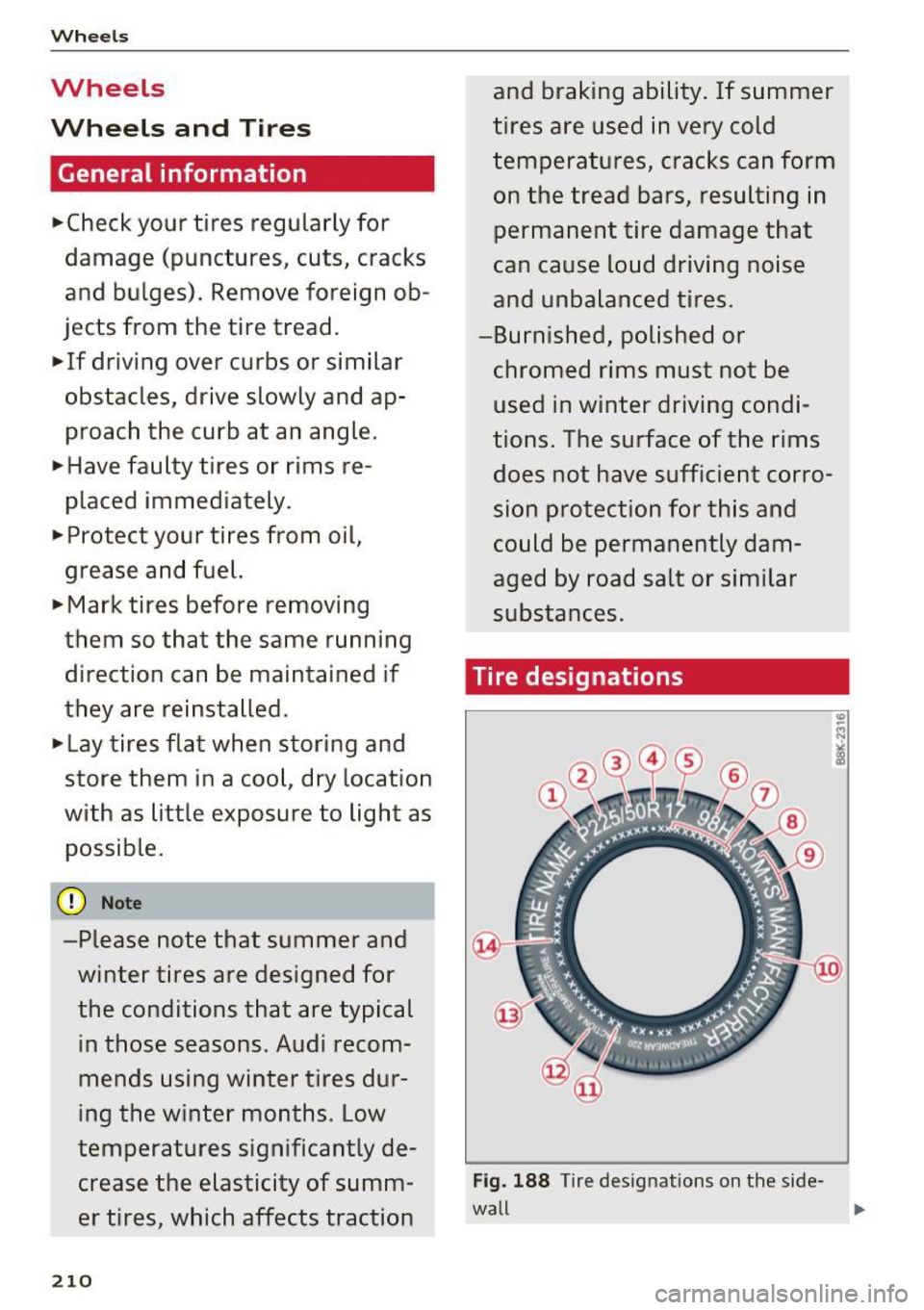
Tire designations
F ig. 188 Tire des ignat ions on the side-
wall II>
Page 215 of 280
Bead separa tion
means a breakdown of the bond
between components in the bead.
Cord
means the strands forming the
plies in the tire .
Cold tire inflation pressure
means the tire pressure recom
mended by the vehicle manufac
turer for a tire of a designated size that has not been driven for
more than a couple of miles (kilo
meters) at low speeds in the
three hour period before the tire
pressure is measured or adjusted .
Curb weight
means the weight of a motor ve
hicle with standard equipment in
cluding the maximum capac ity of
fuel, oi l, and coolant, a ir condi
tioning and add itional weight of
optional equipment.
E xtra load tire
means a tire designed to operate
at higher loads and at h igher in
flation pressures than the corre sponding standard tire. Extra load
tires may be identified as "XL",
~ "xl", "E XTRA LOAD" , or "RF" on .....
~ the sidewal l. ..... 0
s ..
Wheels
Gross Axle Weight Rating
(" GAWR")
means the load-carrying capacity
of a single axle system, measured
at the tire -ground interfaces.
Gross Vehicle Weight Rating
(" GVWR ")
means the max imum total loaded
weight of the vehicle.
Groove
means the space between two ad
jacent tread ribs .
Load rating (code)
means the maxim um load that a
tire is rated to carry for a given in
flat ion pressure . You may not f ind
this informat ion on all tires be
cause it is not required by law.
Maximum load rating
means the load rating for a tire at
the maximum permissible infla
tion pressure for that tire .
Maximum loaded vehicle
weight
means the sum of:
(a) Curb weight
(b) Accessory weight
(c) Vehicle capacity we ight , and
(d) Production options we ight
2 13
Page 223 of 280
-The tire must flex more if the
tire pressure is too low or if
the vehicle speed or load are
too high. This heats the tire up
too much . This increases the
risk of an accident because it
can cause the tire to burst and result in loss of vehicle con
trol.
-Incorrect tire pressure in
creases tire wear and has a
negative effect on driving and
braking behavior, which in
creases the risk of an accident .
(D Note
Replace lost valve caps to re
duce the risk of damage to the
tire valves.
Tire pressure table
Please note that the information
contained in the following table
was correct at the time of print ing, and the information is sub
ject to change. If there are differ
ences between this information
and the tire pressures specified
on the label on the driver's side B
pillar, always follow the specifica
tion on the B -pillar label
! ¢ page 220, fig. 190. N r-. N ..... 0
s ..
Wheels
'® For the sake of the environment
Tire pressure that is too low in
creases fuel consumption .
Audi recommends using the
tire pressure specified for a normal load
¢ table on
page 222
or for a full load
when the vehicle is partially loaded.
Make sure that the tire designa
tion on your tire matches the des ignation on the tire pressure label
and the tire pressure table.
The following table lists recom mended tire pressures in cold
tires according to the load and
the size of the tires installed . ..
221
Page 225 of 280
a,
a,
..... N r-. N ..... 0
s ..
Tires and vehicle load limits
There are limits to the amount of load or weight that any vehicle
and any tire can carry . A vehicle
that is overloaded will not handle
well and is more difficult to stop. Overloading can not only lead to
loss of vehicle control, but can al
so damage important parts of the
vehicle and can lead to sudden
tire failure, including a blowout
and sudden deflation that can
cause the vehicle to crash.
Your safety and that of your pas
sengers also depends on making
sure that load limits are not ex
ceeded. Vehicle load includes ev
erybody and everything in and on
the vehicle. These load limits are
technically referred to as the vehi
cle's
Gross Vehicle Weight Rat
ing
("GVWR").
The "GVWR" includes the weight
of the basic vehicle, all factory in
stalled accessories, a full tank of
fuel, oil, coolant and other fluids
plus maximum load. The maxi
mum load includes the number of
passengers that the vehicle is in
tended to carry ("seating capaci
ty") with an assumed weight of 150 lbs . (68 kg) for each passen-
Wheels
ger at a designated seating posi
tion and the total weight of any luggage in the vehicle . If you tow
a trailer, the weight of the trailer
hitch and the tongue weight of
the loaded trailer must be includ
ed as part of the vehicle load.
The
Gross Axle Weight Rating
("GAWR") is the maximum load
that can be applied at each of the
vehicle's two axles.
The fact that there is an upper limit to your vehicle's Gross Vehi
cle Weight Rating means that the
total weight of whatever is being
carried in the vehicle (including
the weight of a trailer hitch and
the tongue weight of the loaded
trailer) is limited. The more pas
sengers in the vehicle or passen
gers who are heavier than the
standard weights assumed mean
that less weight can be carried as luggage.
The Gross Vehicle Weight Rating and the Gross Axle Weight Rating
are listed on the safety compli
ance sticker label located on the
driver's side 8-pillar
¢ page 220,
fig. 190.
223
..
Page 228 of 280
Wheels
@ For the sake of the environment
Reinstall su mmer tires at the appropriate
time, because they pro vide better handling
when roads are free of snow and ice. Summer
tires cause less road noise, tire wear and fuel
consumption.
@ Tips
You can also use all season tires instead of
w inter t ires. Please note that in some coun
tries where w inter tires are required, only
w inter t ires with the
& symbol may be per
m itted .
Snow chains
Snow chains not only imp rove the dr iving in w in
ter ro ad conditions, b ut also the brak ing .
.,. Only install snow chains o n the front wheels .
T his applies also to ve hicles w ith all wheel
drive* .
.,. Check and correct the sea ting of the snow
chains a fter dr iv ing a few fee t, if necessa ry. Fo l
l ow the instructions from the manufacturer .
.,. Note th e maximum speed of 30 mph (SO km/
h). Note the loca l regulat ions.
Use of snow chains is on ly permitted with certain
rim/t ire combinations due to technical reasons .
Check with an authorized Audi dealer or author
i z ed Aud i Service Fac ility to see if you may use
snow chains.
You must remove the snow c hains on roads w it h
out snow. Otherw ise, you could impa ir dr iv ing
ab ility and damage the tires.
A WARNING
Us ing incorrect snow chains or insta lling snow
chains incorrectly can result in loss of vehicle
cont rol, which inc reases the risk of an acc i
dent .
(D Note
-Snow cha ins can damage the rims/wheel
covers* if the chains come into d irec t con
tac t wi th them . Remove the wheel cove rs*
first. Use coa ted snow chai ns.
226
- Us ing snow c hains that add more than 0. 4
inch (10.S mm) of height can severely dam
age the whee l housings and other vehicle
components .
- Do not insta ll and use snow chains if there is
a malfunction in the adapt ive a ir suspen
sion*, because the vehicle he ight will be
very low. If you drive wit h snow chains any
way, the whee l housings and other vehicle
components can be seve rely damaged .
(D Tips
When using snow chains, it may be useful to
switc h on sport mode
<=> page 121.
Low aspect ratio tires
You r A udi is factory-equ ipped with low aspect ra
tio t ires . T hese tires have bee n thoroug hly tested
a n d been sele cted specifi ca lly for your mode l for
thei r sup erb pe rformance, road fee l and han dling
u nder a var iety of driving conditions. Ask your au
thori zed Audi dea ler for more detai ls .
The low as pec t rat io o f these tires is indica ted by
a n umera l of
55 or le ss in t he t ire's si ze designa
tion . The numeral represents the ratio of the
tire's si dewa ll height in relation to its trea d width
expressed in percentage. Conventiona l tires have
a height/width ratio of 60 or more.
The performance of low-aspect-ratio tire s is par
ticularly sensitive to improper inflation pres
sure. It is the refore important that low aspect
rat io tires are inflated to the specified pressure
and that the inflation pressure is regularly
checked and maintained. Tir e pressur es should
be checked at lea st once a month and always
before a long trip
¢ page 220.
What you can do to avoid tire and rim
damage
Low aspect ratio tires can be damaged more eas i
l y by impact with potholes, curbs, gullies or
r idges on the road , particula rly if the tire is un -
der i nfla ted. .,..