airbag AUDI A6 2018 User Guide
[x] Cancel search | Manufacturer: AUDI, Model Year: 2018, Model line: A6, Model: AUDI A6 2018Pages: 266, PDF Size: 41.38 MB
Page 126 of 266

Intelligent Technology
Notice about data
recorded by the Event
Data Recorder and
vehicle control modules
Event Data Recorder
This vehicle is equipped with an Event Data Re
corder (EDR). The main purpose of an EDR is to
record, in certain crash or near crash-like situa
tions, such as an airbag deployment or hitting a road obstacle, data that will assist in understand
ing how a vehicle's systems performed. The EDR
is designed to record data related to vehicle dy
namics and safety systems for a short period of
time, typically 30 seconds or less . The EDR in this
veh icle is designed to record such data as :
-How various systems in your vehicle were oper
at ing;
-Whether or not the driver and passenger safety
belts were buckled/fastened;
-How far (if at all) the driver was depressing the
accelerator and/or brake pedal; and,
-How fast the vehicle was traveling.
These data can help provide a better understand ing of the circumstances in which crashes and in
juries occur. NOTE : EDR data are recorded by your
vehicle only if a non-trivial crash situation occurs;
no data are recorded by the EDR under normal
driving conditions and no personal data (e .g .,
name, gender, age, and crash location) are re
corded. However, other pa rties , such as law en
forcement, could combine the EDR data wit h the
type of persona lly identifying data routine ly ac
quired during a crash investigation.
To read data recorded by an EDR, specia l equip
ment is required, and access to the veh icle or the
EDR is needed. In add it ion to the vehicle manu
facturer, other parties, such as law enforcement,
that have the specia l equipment, can read the in
formation if they have access to the vehicle or the
E DR .
Some state laws restrict the retrieval or down
loading of data stored by ED Rs installed in a vehi
cle for the express purpose of retrieving data af
ter an accident or crash event without the own
er's consent.
124
Audi will not access the EDR and/or simi lar data
or give it to others
-
-un less t he ve hicle owne r (or lessee if the vehi
cle has been leased) agrees; or
-upon the offic ial request by the police; or
-upon the order of a court of law or a govern-
ment agency; or
-for the defense of a lawsuit through the jud icial
discovery process .
-Audi may also use the data for research about
veh icle operat ion and safety performance or
prov ide t he data to a third party for research
purposes without identify ing t he specific vehi
cle or information about the identity of its own
er or lessee and only after the recorded vehicle
data has been accessed.
Vehicle control modules
Your vehicle is also equ ipped with a numbe r of
electronic cont rol modules for various vehicle
systems, such as engine management, em iss ion
contro l, airbags, and safety be lts.
These elect ronic control modules record data
during normal vehicle operation t hat may be
needed by trained technic ia ns for diagnostic and
repair purposes. The recording capability of these
modules is limited to data (no sound is record
ed). Only a sma ll amount of data is actually re
corded over a very limited period of time, or stor
ed when a system fault is detected by a control
module . Some of the data stored may relate to
vehicle speed, d irection, or braking, as well as re
straint system use and performance in the event
of a crash. Stored data can also only be read a nd
down loaded w ith specia l equipment that is di
rectly connected to the vehicle.
(D Tips
Your vehicle may be equipped w ith Aud i con
nect. Your use of certain Audi connect fea
tures requires wire less services that are pro
vided by a third party wireless telecommuni
cations provider. For details regarding how in
formation obtained through Audi connect is
collected, processed, transmitted, used, and
shared, please see your contract with the
wireless telecommun ications provider .
Page 127 of 266

a co .... N
" N .... 0 0 \.J '
Basics
Safe driving habits
Please remember -safety first!
The individual safety features of your vehicle can
work together as a system to help protect you
and your passengers in a wide range of accidents.
These features cannot work as a system if they
are not always correctly adjusted and correctly
used .
This chapter contains important informat ion,
tips, instructions and warnings that you need to
read and observe for your own safety, the safety
of your passengers and others . We have summar
iz ed here what you need to know about safety
belts, airbags, child restraints as well as child
safety. Your safety is for us priority number 1. Al
ways observe the information and warnings in
this section -for your own safety as well as that
of your passengers.
The informa tion in t his section applies to all
model versions of your vehicle. Some of the fea
tures described in this sections may be standard
eq uip ment on some models, or may be optional
equ ipment on others. If you are not sure, ask
your author ized Audi dealer.
A WARNING
-Always make sure that you follow the in
struct ions and heed the WARNINGS in this
Manual. It is in your i nterest and in the in
terest of your passengers .
-
-Always keep the complete Owner's Litera
ture in your Audi when you lend or sell yo ur
vehicle so that this important information
w ill always be available to the driver and
passengers.
-Always keep the Owner's literature handy so
that you can find it easily if you have ques
tions .
Driving safety
Important things to do before driving
Safety is everybody 's job ! Vehicle and occupant
safety always depends on the informed and care
ful driver .
For your safety and the safety of your passen
gers,
before driving always:
.. Make sure that a ll lights and signals are operat
ing correctly.
.. Make sure tha t the tire pressure is correct .
.. Make sure that all w indows are clean and afford
good vis ibility to the outs ide.
.. Secure all luggage and othe r items ca refully
¢ page 54, ¢page 53 .
.. Make sure that nothing can interfere with the
peda ls .
.. Adjust front seat, head restraint and mirrors
correct ly for your height.
.. Instruct passengers to adjust the head re
straints according to their height.
.. Make sure to use the right child restraint cor
rectly to protect children
¢ page 166, Child
safety .
.. Sit properly in your seat and make sure t hat
your passengers do the
same¢ page 47, Seats
and storage.
.. Fasten your safety belt and wear it properly. Al
so instruct your passengers to fasten their safe
ty belts
properly ¢ page 134 .
What impairs driving safety?
Safe driving is directly related to the condition of
the vehicle , the driver as well as the driver 's abili
ty to concentrate on the road without being dis
tracted.
The driver is responsible for the safety of the ve
hicle and a ll of its occupants. If your ability to
drive is impa ired, safety risks for everybody in the
vehicle increase and you a lso become a hazard to
everyone else on the road
¢ &_ . Therefore:
.. Do not let yourse lf be distracted by passengers
or by using a cellular telephone .
.. NEVER drive when your driving abi lity is im
pa ired (by med ications, alcohol, drugs, etc .) .
.. Observe all traffic laws, rules of the road and
speed lim its and plain common sense .
125
Page 128 of 266

Driving sa fety
,.. ALWAYS adjust your speed to road, traffic and
weather conditions.
,.. Take frequent breaks on long trips. Do not drive
for more than two hours at a stretch.
,.. Do NOT drive when you are tired, under pres
sure or whe n you are stressed .
A WARNING
Impaired driv ing safety inc reases the risk of
ser ious persona l inju ry and death whenever a
vehicle is being used.
Correct passenger
seating positions
Proper seating position for the driver
The proper driver sea ting po sition is impor tan t
for safe, relaxed driving .
Fig. 138 Correc t seat ing posit ion
F or your own safety and to reduce the risk of in
jury in the event of an accident, we recommend
that you adjust the driver 's seat to the following
position :
,.. Adjust the dr iver's seat so tha t you can easily
push the pedals all the way to the floor whi le
keeping your knee(s) s light ly
bent ¢ ,A.
,.. Adjust the angle of the seatback so that it is in
an upright position so that your back comes in
full contact with it when you drive.
"' Adjust the steering wheel so that there is a dis
tance of at least 10 inches (25 cm ) between the
stee ring wheel and your breast
bone ¢ fig. 138 .
If not possib le, see you r autho rized Aud i dea l
ersh ip about adaptive equipment .
126
,.. Adjust the steering wheel so that the steering
wh eel and airbag cover points at your chest and
not at your face.
"' Grasp the top of the steering wheel with your
elbow(s) slightly bent.
"' F or ad justab le head rest raints: Adjust the head
restraint so t he upper edge is as even as possi
ble with the top of your head . If that is not pos
sible, t ry to adjust the head restraint so tha t it
is a s close to this pos it ion as poss ible . M ove the
he ad restraint so tha t it is as close to the back
o f the head as possible.
"' Fasten and wear safety belts correctly
¢ page 137 .
"'Always keep both feet in the footwell so that
you are in contro l of the veh icle at all times .
Fo r detail ed information on how to adjust the
dr iver's seat,
see ¢ page 47.
A WARNING
Drivers who are unbelted , out of position or
too close to the airbag can be seriously in-
jured by an airbag as it unfo lds . To help re-
duce the risk of serio us pe rsonal i njury:
-Always adjust the driver's seat and the steer ing whee l so that there are at least
10 inches (25 cm) between you r breastbone
and the steering wheel.
- Always ad just the driver's seat and the
steer ing whee l so that the re are at least
4 inch es (10 cm) between the knees a nd the
lower part of the ins trumen t panel.
-Always hold t he s teering wheel on the out
side of t he steering wheel r im with yo ur
hands at the 9 o'clock and 3 o'clock posi
tions to help reduce the risk of personal in
jury if the dr iver 's airbag inflates.
-Never hold the stee ring wheel at the
12 o'clock position or with you r hands at
other positions inside the steer ing whee l
rim o r on the steering wheel hub. Holding
the steering wheel the wrong way can cause
serious injuries to the hands, arms and head
-
if the driver's airbag inflates . .,_
Page 129 of 266

a co .... N
" N .... 0 0 \,;J '
face decreases the ability of the supplemen
tal driver's airbag to protect you in a colli sion .
- Always sit in an upright position and never
lean against or place any part of your body
too close to the area where the airbags are
located .
- Before driving, always adjust the front seats
properly and make sure that all passengers
are properly restrained .
- For adjustable head restraints : before driv
ing, always also adjust the head restraints
properly .
- Never adjust the seats while the vehicle is moving . Your seat may move unexpectedly
and you could lose control of the vehicle.
- Never drive with the backrest reclined or
tilted far back! The farther the backrests are
tilted back, the greater the risk of injury due
to incorrect positioning of the safety belt
and improper seating position.
- Children must always ride in child seats
~ page 166. Special precautions apply
when installing a child seat on the front
passenger
seat ¢ page 142 .
Proper seating position for the front
passenger
The proper front passenger seating position is
important for safe, r elaxed driving.
For your own safety and to reduce the risk of in
jury in the event of an accident, we recommend that you adjust th e seat for the front passenger
to the following position:
.. Adjust the angle of the seatback so that it is in
an upright position and your back comes in full
contact with it wh enever the vehicle is moving.
.. For adjustable head restraints: adjust the head
restraint so the upper edge is as even as possi
ble with the top of your head. If that is not pos
sible , try to adjust the head restraint so that it
is as close to this position as possible
~ page 128. Move the head restraint so that it
is as close to the back of the head as possible.
Driving safety
.. Keep both feet flat on the floor in front of the
front passeng er seat.
.. Fasten and wear safety belts correctly
¢ page 137 .
For detailed information on how to adjust the
front pass enger's s eat, see
¢ pag e 47.
A WARNING
= -
Front seat passengers who are unbelted, out
of position or too close to the airbag can be
seriously injured or killed by the airbag as it
unfolds . To help reduce the risk of serious
personal injury:
- Passengers must always sit in an upright po
sition and never lean against or place any part of their body too close to the area
where the airbags are located.
- Passengers who are unbelted, out of posi
tion or too close to the airbag can be seri
ously injured by an airbag as it unfolds with
g reat force in the blink of an eye.
- Always make sure that there are at least
10 inches (25 cm) between the front pas
senger's breastbone and the instrument panel.
- Always make sure that there are at least
4 inches (10 cm) between the front passen
ger's knees and the lower part of the instru
ment panel.
- Each passenger must always sit on a seat of
their own and properly fasten and wear the
safety belt belonging to that seat .
- Before driving, always adjust the front pas
senger seat properly.
- For adjustable head restraints: before driv
ing, always also adjust the head restraints
properly .
- Always keep your feet on the floor in front
of the seat. Never rest them on the seat, in
strument panel, out of the window, etc. The
airbag system and safety belt will not be
able to protect you properly and can even in
crease the risk of injury in a crash .
- Never drive with the backrest reclined or
tilted far back! The farther the backrests are
tilted back, the greater the risk of injury due
~
127
Page 131 of 266

a co .... N
" N .... 0 0 \.J '
properly adjusts their head restraint. Adjust
the head restra int so the upper edge is as
even as possible w ith the top of your head .
If that is not possible, try to adjust the head
restra int so that it is as close to th is position
as possib le. Move the head restra in t so that
it is as close to t he b ack of the he ad as pos
sible.
- Never attempt to adjust head restra int
w hil e d riving. If you have dr iven off and
must adjust the dr ive r headrest for any rea
son, first stop the vehicle safely before at
tempting to adjust the head restraint .
- Children must a lways be proper ly restrained
in a chi ld restraint that is appropriate for
their age and size
r=) page 166.
Examples of improper seating positions
Th e occupant r estraint syst em con only r educ e
the risk of injury if vehicle occupants ore properly
seated.
I mp roper seating posi tions can cause se rious in
jury or death . Safety belts can only work when
they ar e properly positioned on the body. Im
prope r seating positions reduce the effectiveness
of safe ty belts and w ill even increase the r isk of
injury and death by moving the s afety belt to crit
ical areas of the body . Improper seating posit ions
also increase the risk of ser ious injury and death
when an airbag deploys and strikes an occupant
who is not i n the prope r seat ing pos ition. A d rive r
i s respons ible for the safety of a ll vehicle occu
pants and especia lly fo r children . There fore:
"' Never allow anyone to assume an inco rrect
seat ing pos it ion w hen t he ve hicle is being used
r=) & .
The follow ing bulletins list only some sample po
sitions that will increase the risk of serious inju ry
and dea th. O ur hope is that these examp les w ill
make you more aware of seat ing pos it ions tha t
are dangerous .
Therefore, wh enever th e vehicle is moving:
- never stand up in the veh icle
- never stand on the seats
Dri ving saf ety
- never kneel on the seats
- neve r ride wit h the seatback recl ined
- neve r lie down on the seats
- neve r lean up against the instrument panel
- never s it on the edge of the seat
- never s it sideways
- never lean out the window
- never put your feet out the window
- neve r put your feet on t he instr ument pane l
- neve r rest your feet on the seat cushion or back
of the seat
- neve r ride in the footwell
- never ride in the cargo area
A WARNING
-
Imp roper seating positions inc rease the risk
of ser ious perso nal in jury and death whenever
a ve hicl e is being u sed .
- Always make sure that all ve hicle occupants
stay in a p roper seating posit ion and a re
p roperly restra ined whe never the veh icle is
be ing used.
Driver's and front
passenger's footwell
Important safety instructions
Applies to: vehicles with knee airbags
A WARNING
= -
A lways make s ure t hat the knee airbag can in
flate w ithout interference. Objects between
yourself and the airbag can increase the risk
of injury in an accide nt by interfering with the
way t he a irbag dep loys or by be ing pushed in
to you as the a irbag dep loys .
- No persons (ch ildren) or animals should ride
in the footwell in front of the passenger
seat . If the a irbag deploys, this can res ult in
ser io us or fatal injur ies.
- N o objects of a ny kind should be ca rr ied in
the footwell a rea in front of the dr ive r's or
p a sse nger's seat. B ulky objects (shopp ing
b ags, for exam ple) can h amper o r preven t
proper dep loymen t of the airbag . Sma ll ob
jects can be thrown thro ugh the vehicle if
129
Page 132 of 266
Drivin g saf ety
the airbag deploys and injure you or your
passengers.
Pedal area
Pedals
The pedals must always be free to move and
must never be interfered with by a floor mat or
any other object.
Make sure that all pedals move freely without in
terference and that noth ing prevents them from
returning to the ir original positions .
Only use floor mats that leave the pedal area free
and can be secured with floor mat fasteners.
If a brake circuit fails, increased brake peda l trav
el is required to bring the vehicle to a full stop.
A WARNING
Peda ls that cannot move free ly can cause loss
of vehicle control and increase the risk of seri
ous injury .
- Never place any objects in the driver's foot
well. An object could get into the pedal area
and interfere w ith pedal function . In case of
sudden brak ing or an accident, you would
not be able to brake or accelerate!
- Always make sure that nothing can fa ll or
move into the dr iver's footwell.
Floor mats on the driver side
Always use floor mats that can be securely at
tached to the floor mat fasteners and do not in
terfere with the free movement of the pedals .
"'Make sure that the floor mats are properly se-
cured and cannot move and interfere with the
peda ls ~ ,& .
Use only floor mats that leave the pedal area un
obstructed and that are firmly secured so that
they cannot slip out of pos ition . You can obtain
suitable floor mats from your authorized Aud i
Dea le r.
Floor mat fasteners are installed in your Audi.
130
Floor mats used in your vehicle must be attached
to thes e fasten ers. Properly securing the floor
mats will prevent them from sliding into posi
tions that could interfere with the pedals or im pair safe operation of your vehicle in o ther ways.
A WARNING
Pedals that cannot move freely can result in a
loss of vehicle control and increase the r isk of
serious pe rsonal injury .
- Always make sure that floor mats are prop erly secured .
- Never place or install floor mats or other
floor coverings in the vehicle that cannot be
properly secured in place to prevent them
from s lipping and interfer ing with the ped
als or the ab ility to cont rol the vehicle.
- Never p lace or install floor mats o r other
floor coverings on top of al ready installed
floor mats . Addi tion al floor mats and other
cover ings will reduce the size o f the pedal
area and interfere with the pedals.
- Always properly re install and secure floo r
mats that have been taken out for cleaning.
- Always make sure that objects canno t fall
into the driver footwell while the vehicle is
moving. Objects can become trapped under
the brake pedal and accelerator pedal caus ing a loss of vehicle control.
Storing cargo correctly
Loading the luggage compartment
All luggage and other objects must be properly stowed and secured in the luggage compart
ment.
Loose items in the luggage compartment can
shift suddenly , changing vehicle handling charac
te rist ics . Loose items can also inc rease the risk of
se rious persona l injury in a sudden veh icle ma
neuver or in a collision .
"' Distribute the load evenly in the luggage com
partment .
"'Always place and prope rly secure heavy items in
the l uggage compa rtment as fa r fo rwa rd as
possible .
.,.
Page 138 of 266
Safe ty belts
Never rely on airbags alone for protection . Even
when they deploy, airbags provide only additiona l
protection. Airbags are not supposed to dep loy in
all kinds of accidents. A lthough your Audi is
equipped w ith airbags, all vehicle occupants, in
cluding the dr iver, must wear safety belts cor
rectly in order to minimize the risk of severe in
jury or death in a crash .
Remember too, that airbags will deploy only
once and that your safety belts are always there
to offer protect ion in those accidents in w hich
airbags are not supposed to deploy or when they
have a lready deployed. Unbel ted occupants can
a lso be thrown o ut of the ve hicle where eve n
mo re severe or fatal injur ies can occur .
It is also important for the rear passenge rs to
wear safety belts co rrectly. Unbel ted passengers
i n t he re ar seats endanger no t on ly themse lves
but also the drive r and other passengers
c::> fig . 144 . In a frontal collision they will be
thrown forward violently, where they can hit and
in jure the driver and/or front seat passenger .
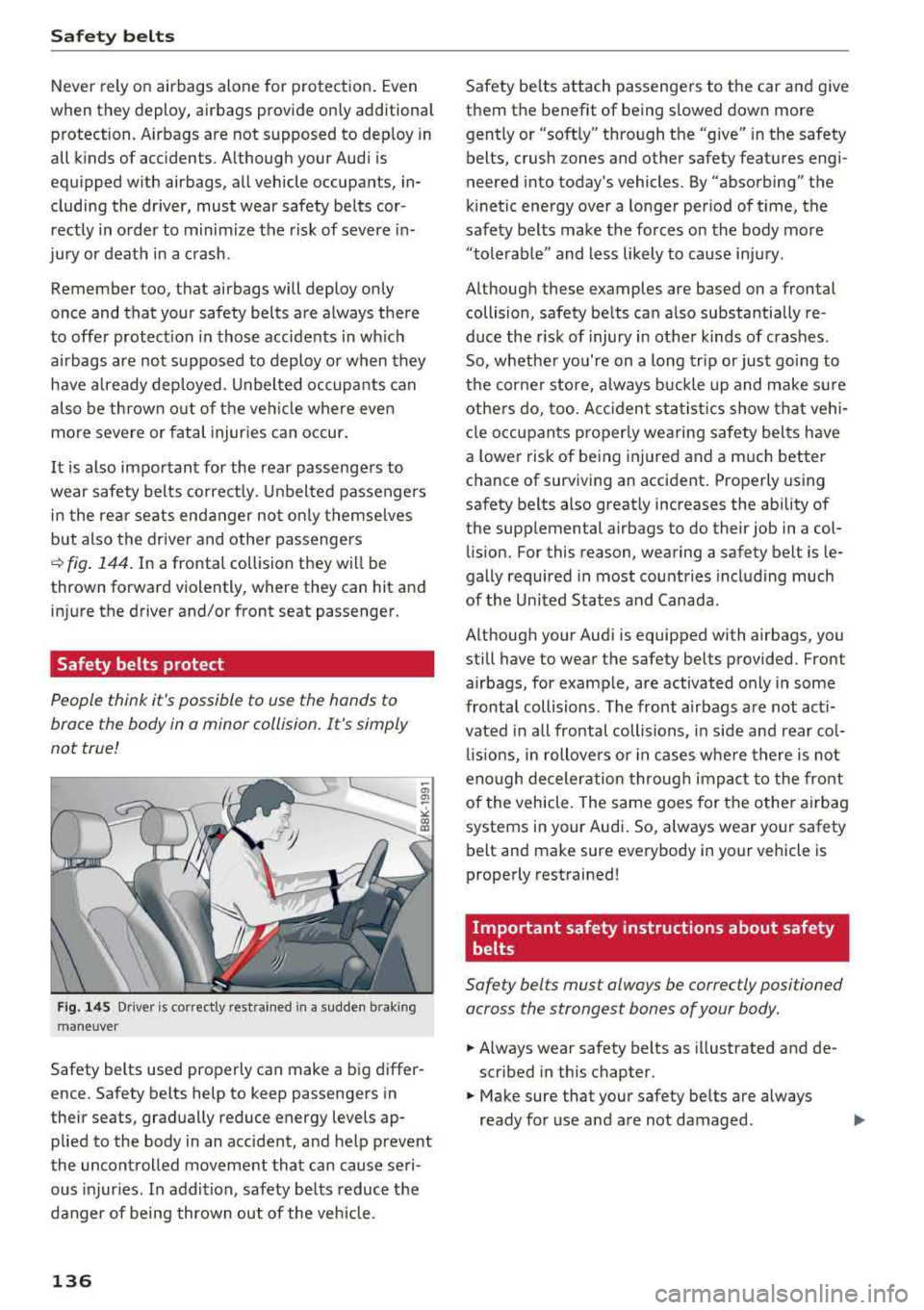
Safety belts protect
People think it's possible to use the hands to
brace the body in a minor collision . It's simply
not true!
F ig . 14 5 Driver is co rrectly restrai ned in a sudde n brak ing
m aneuver
Safety belts used properly can make a b ig d iffer
ence. Safety belts help to keep passengers in
their seats, gradually reduce energy levels ap
plied to the body in an accident, and he lp prevent
the uncont rolled moveme nt that can cause seri
ous injur ies. In addition, safety be lts reduce the
danger of being thrown out of the vehicle .
136
Safety belts attach passengers to the car and g ive
them the benefit of being s lowed down more
gently or "soft ly" thro ugh the "give" in the safety
belts, crush zones and other safety feat ures engi
neered into today 's vehicles. By "absorbing" the
k inet ic energy over a longe r per iod of t ime, the
safety belts make the forces on the body more "tole rab le" and less likely to cause inju ry .
Although these examples are based on a frontal
collision, safety be lts ca n also substantially re
duce the r isk o f injury in ot her kinds of crashes.
So, whethe r you're on a long trip or just going to
the cor ne r store, a lways b uckle up and make s ure
othe rs do, too. Ac ciden t st at ist ics show that veh i
cl e occupants prope rly wearing safety bel ts have
a lowe r risk of be ing injured and a m uch better
chance of surviving an acc ident . Properly using
safety be lts also great ly increases the ability of
the supp lemental airbags to do their job in a col
li sion. For this reason, wearing a safety belt is le
gally required in most countries including much
of the United States and Canada.
Although your Aud i is equipped with airbags, you
still have to wear the safety belts provided. Front
airbags, for examp le, are activated only in some
frontal collisions. The front airbags are not act i
vated in all frontal collisions, in side and rear co l
li sio ns, in rollovers or in cases whe re there is not
eno ugh deceler ation throug h impa ct to the front
of the vehicle . The same goes for the other a irbag
systems in your Audi. So, always wear your safety belt and make sure everybody in your vehicle is
properly rest rained!
Important safety instructions about safety
belts
Safety belts must always be correctly positioned
across the strongest bones of your body.
.,. Always wear safety belts as illustrated and de
scribed in this chapter.
.,. Make sure that your safety be lts are always
ready fo r use a nd a re not damaged .
Page 142 of 266
Safe ty belt s
~ Push the loop -around fittings up ¢ fig. 150 @,
or
~ squeeze together the (D button, and push the
loop-around fittings
do wn@ .
~ Pull the belt to make sure that the upper at
tachment is properly engaged .
A WARNING
Always read and heed all WARNINGS and oth
er impo rtant informat io n
¢page 136.
(D Tips
With the front seats, the height adjustment
of the seat can also be used to adjust the po
sition of the safety belts .
Improperly worn safety belts
Incorrectly positioned safety belts can cause se
vere injuries .
Wearing safety belts improperly can cause seri
ous injury or death. Safety belts can only work
when they are correctly pos itioned on the body .
Imp roper seating posit ions reduce the effect ive
ness of safety be lts and will even inc rease the
risk of injury a nd deat h by mov ing the safety bel t
t o cr it ica l areas of the body. Imp roper sea ting
positions a lso increase the risk of serio us inj ury
and death when an airbag deploys and strikes an
occupant who is not in the correct seating posi
tion. A driver is responsible for the safety of all
ve hicle occupants and especia lly for children.
Therefore:
~ Never permit anyone to ass ume an inco rrect
s itting position in the vehicle wh ile trave ling
¢A .
A WARNING
Improperly wor n safety be lts increase the risk
of se rious personal injury a nd death wheneve r
a vehicle is be ing used.
- Always make sure that a ll vehicle occupa nts
are co rrect ly restra ined and stay i n a co rrect
sea ting pos it ion wheneve r the veh icle is be
ing used.
140
- Always read and heed all WARNI NGS and
other impo rtant
informat ion¢ page 136.
Belt tensioners
How safety belt pretensioners work
Reversible safety belt tensioners*
The following functions a re availab le when safety
belts w ith reversib le safety belt tensioners a re
fastened:
- Automatic tens ioners: at the start of a drive,
the safety belts automat ica lly adjust to t he
passenger after a ce rtain time per iod or ve hicle
speed. To switch t he a utomat ic tens ioners off,
select the follow ing in t he M MI :
!CARI function
button
> ( Car )* sy stem s > Vehicle settings >
Seats > Driver 's seat or Passenger' s seat > Au
tomatic belt tensione r
> Off.
-In certain driving situations, the safety belts
may tighten wit h a reversib le tensioning func
tion
c> page 94.
- The safety be lts may also tighten with this re -
vers ible tension ing funct ion in m inor collisions.
Pyrotechnic safety belt pretensioners
Seat bel ts with py rotechnic safety be lt p reten
s ione rs are tensioned automati cally in severe col
li sions, depending on the circumstances . This
helps to reduce the forwa rd motion of the occu
pants.
A WARNING
- It is possible for the pretensioners to dep loy
incorrect ly.
- Any work on the tens ioner system or remov
al and installation of system components
for other repairs m ust be performed by a
qua lified workshop.
- The pyrotechnic system can only provide
protection for one collis ion. If t he py rotech
n ic pretens ione rs deploy, the pretensioning
system must be rep laced.
Page 143 of 266
a co .... N
" N .... 0 0 \.J '
-A fine dust is released when the pyrotechnic
safety be lt pretens ioners deploy . This is nor
mal and is not caused by a fire in the vehi
cle.
- The re levant safety requirements must be
observed when the veh icle or components
of the system are scrapped. A qualif ied
dealersh ip is familiar w ith these regulations
and will be pleased to pass on the informa
tion to you.
Service and disposal of safety belt preten
sioner
The safety be lt pretensioners are parts of the
safety belts on your Audi. Installing, removing,
servicing or repa iring of belt pretensioners can
damage the safety belt system and prevent it
from work ing correctly in a collision .
There are some important things you have to know to make sure that the effectiveness of the
system w ill not be impaired and that discarded
components do not cause injury or pollute the
env ironment.
A WARNING
-
Improper care, serv icing and repa ir proce
dures can increase the r is k of personal injury
and death by preventing a safety be lt preten
sioner from activating when needed or acti
vating it unexpectedly:
- T he be lt pretensione r system can be act ivat
ed only once . If belt pretensione rs have
been activated, the system must be re
placed.
- Never repair, adjust, or change any parts of the safety be lt system .
- Safety belt systems including safety belt
pretensioners cannot be repaired. Specia l
procedures are required for removal, insta l
lation and disposal of this system.
- For any work on the safety belt system, we
strongly recommend that you see your au
thorized Aud i dea ler or qualified technician
who has an Audi approved repair manual,
train ing and spec ial equ ipment necessary .
Safety be lts
{® For the sa ke of the environment
Undeployed airbag modules and pretension
ers might be classif ied as Perchlorate Materi
al -special handling may apply, see
www.dtsc.ca.gov/hazardouswaste/perchlo rate . When the vehicle or parts of the re
straint system including airbag modules safe
ty belts with pretensioners are scrapped, all
applicable laws and regu lations must be ob
se rved. Your authorized Audi dealer is familiar
with these requirements and we recommend
that you have your dealer perform this service
for you .
141
Page 144 of 266
Airbag system
Airbag system
Important information
Importance of wearing safety belts and
sitting properly
Airbags are only supplemental restraints . For
airbags to do their job, occupants must always
properly wear their safety belts and be in a prop er seating position.
For your safety and the safety of your passen
gers, before driving off, always:
.,. Adjust the dr iver's seat and steering wheel
properly~ page 126,
.,. Adjust the front passenge r's seat properly
~page 47 ,
.,. Wear safety belts p roperly ~page 136,
.. Always properly use the proper child restraint
to protect chi ldren
~page 166 .
In a coll is ion, airbags must inflate within the
blink of an eye and with considerable force. The
supp lemental airbags can cause injuries if the
driver or the front seat passenger is not seated
properly. Therefore in order to he lp the airbag to
do its job, it is important, both as a dr iver and as
a passenger to sit properly at all t imes.
By keeping room between your body and the
steering whee l and the front of the passenger
compartment, the air bag can inflate fully and
completely and provide supplemental protect ion
in certain frontal
coll isions¢ page 126, Correct
passenger seating positions .
For details on the
operation of the seat adjustment controls
¢ page 47.
It's especially important that children are proper
ly restrained
¢pag e 166.
There is a lot that the driver and the passengers
can and must do to help the ind iv idual safety fea
tures installed in your Audi work together as a
system.
Proper seating posit ion is important so that the
front airbag on the driver side can do its job. If
you have a physical impairment or cond ition that
prevents you from s itting properly on the driver
seat with the safety be lt properly fastened and
142
reaching the pedals, or if you have concerns with
regard to the function or operation of the Ad
vanced Airbag System, please contact your au
thorized Audi dea ler or qualified workshop, or
ca ll Audi Customer Relations at 1-800-822-2834
for poss ible modifications to your vehicle .
When the airbag system dep loys, a gas generator
will fill the airbags, break open the padded cov ers, and infla te between the steering wheel and
the driver and between the instrument panel and
the front passenger. The a irbags w ill deflate im
med iate ly after deployment so that the front oc
cupants can see through the windsh ield aga in
without interruption.
All of th is takes place in the blink of an eye, so
fast that many people don't even realize that the
a irbags have deployed. The airbags also inflate
with a great deal of force and nothing should be
in the ir way when they deploy. Front airbags in
combination with properly worn safety belts slow
down and limit the occupant's forward move
ment. Together they help to prevent the driver
and front seat passenger from hitting parts of
the ins ide of the vehicle while reduc ing the forces
acting on the occupant dur ing the crash . In th is
way they help to reduce the risk of injury to the
head and upper body in the crash . Airbags do not
protect the arms or the lower parts of the body.
Both front airbags will not inflate in all frontal
collisions. The triggering of t he a irbag system de
pends on the veh icle deceleration rate caused by
the collis ion and registered by the electronic con
trol unit. If this rate is be low the refe rence value
programmed into the control unit, the airbags
will not be triggered, even tho ugh t he car may be
badly damaged as a resu lt of the co llision . V ehi
cle damage, repair costs or even the lack of vehi
cle damage is not necessarily an indication of
whether an a irbag should inflate or not.
Since the circumstances wi ll vary considerab ly
between one co llision and another, it is not possi
ble to define a range of veh icle speeds that will
cover every poss ible kind and angle of impact
that w ill always trigger the airbags. Important
factors include, for example, the nature (hard or
soft) of the object which the ca r hits, the angle of
im pact, vehicle speed, etc. The front airbags will
..,.