break AUDI A6 2018 User Guide
[x] Cancel search | Manufacturer: AUDI, Model Year: 2018, Model line: A6, Model: AUDI A6 2018Pages: 266, PDF Size: 41.38 MB
Page 144 of 266
Airbag system
Airbag system
Important information
Importance of wearing safety belts and
sitting properly
Airbags are only supplemental restraints . For
airbags to do their job, occupants must always
properly wear their safety belts and be in a prop er seating position.
For your safety and the safety of your passen
gers, before driving off, always:
.,. Adjust the dr iver's seat and steering wheel
properly~ page 126,
.,. Adjust the front passenge r's seat properly
~page 47 ,
.,. Wear safety belts p roperly ~page 136,
.. Always properly use the proper child restraint
to protect chi ldren
~page 166 .
In a coll is ion, airbags must inflate within the
blink of an eye and with considerable force. The
supp lemental airbags can cause injuries if the
driver or the front seat passenger is not seated
properly. Therefore in order to he lp the airbag to
do its job, it is important, both as a dr iver and as
a passenger to sit properly at all t imes.
By keeping room between your body and the
steering whee l and the front of the passenger
compartment, the air bag can inflate fully and
completely and provide supplemental protect ion
in certain frontal
coll isions¢ page 126, Correct
passenger seating positions .
For details on the
operation of the seat adjustment controls
¢ page 47.
It's especially important that children are proper
ly restrained
¢pag e 166.
There is a lot that the driver and the passengers
can and must do to help the ind iv idual safety fea
tures installed in your Audi work together as a
system.
Proper seating posit ion is important so that the
front airbag on the driver side can do its job. If
you have a physical impairment or cond ition that
prevents you from s itting properly on the driver
seat with the safety be lt properly fastened and
142
reaching the pedals, or if you have concerns with
regard to the function or operation of the Ad
vanced Airbag System, please contact your au
thorized Audi dea ler or qualified workshop, or
ca ll Audi Customer Relations at 1-800-822-2834
for poss ible modifications to your vehicle .
When the airbag system dep loys, a gas generator
will fill the airbags, break open the padded cov ers, and infla te between the steering wheel and
the driver and between the instrument panel and
the front passenger. The a irbags w ill deflate im
med iate ly after deployment so that the front oc
cupants can see through the windsh ield aga in
without interruption.
All of th is takes place in the blink of an eye, so
fast that many people don't even realize that the
a irbags have deployed. The airbags also inflate
with a great deal of force and nothing should be
in the ir way when they deploy. Front airbags in
combination with properly worn safety belts slow
down and limit the occupant's forward move
ment. Together they help to prevent the driver
and front seat passenger from hitting parts of
the ins ide of the vehicle while reduc ing the forces
acting on the occupant dur ing the crash . In th is
way they help to reduce the risk of injury to the
head and upper body in the crash . Airbags do not
protect the arms or the lower parts of the body.
Both front airbags will not inflate in all frontal
collisions. The triggering of t he a irbag system de
pends on the veh icle deceleration rate caused by
the collis ion and registered by the electronic con
trol unit. If this rate is be low the refe rence value
programmed into the control unit, the airbags
will not be triggered, even tho ugh t he car may be
badly damaged as a resu lt of the co llision . V ehi
cle damage, repair costs or even the lack of vehi
cle damage is not necessarily an indication of
whether an a irbag should inflate or not.
Since the circumstances wi ll vary considerab ly
between one co llision and another, it is not possi
ble to define a range of veh icle speeds that will
cover every poss ible kind and angle of impact
that w ill always trigger the airbags. Important
factors include, for example, the nature (hard or
soft) of the object which the ca r hits, the angle of
im pact, vehicle speed, etc. The front airbags will
..,.
Page 149 of 266
a co .... N
" N .... 0 0 \,;J '
o'clock position or with your hands any
where inside the steering wheel or on the steering wheel hub . Holding the steering
wheel the wrong way increases the risk of severe injury to the arms, hands, and head if
the driver airbag deploys.
A WARNING
Objects between you and the airbag will in
crease the risk of injury in a crash by interfer
ing with the way the airbag unfolds and/or by
being pushed into you as the airbag inflates.
- Always make sure nothing is in the front air-
bag deployment zone that could be struck
by the airbag when it inflates.
-
- Objects in the zone of a deploying airbag
can become projectiles when the airbag de
ploys and cause serious personal injury.
- Never hold things in your hands or on your
lap when the vehicle is in use.
- Never place accessories or other objects
(such as cup holders, telephone brackets,
note pads, navigation systems, or things
that are large, heavy, or bulky) on the doors;
never attach then to the doors or the wind
shield; never place them over or near or at
tach them to the area marked
,,AIRBAG" on
the steering wheel, instrument panel or the seat backrests; never place them between
these areas and you or any other person in
the vehicle.
- Never attach objects to the windshield
above the passenger front airbag, such as
accessory GPS navigation units or music
players. Such objects could cause serious in
jury in a collision, especially when the air bags inflate.
- Never recline the front passenger seat to
transport objects. Items can also move into
the deployment area of the side airbags or
the front airbag during breaking or in a sud den maneuver. Objects near the airbags can
fly dangerously through the passenger com partment and cause injury, particularly
when the seat is reclined and the airbags in
flate.
Airbag system
A WARNING
r--
A person on the front passenger seat, espe-
cially infants and small children, will receive
serious injuries and can even be killed by be ing too close to the airbag when it inflates .
- Although the Advanced Airbag System in your vehicle is designed to turn off the front
passenger airbag if an infant or a small child
is on the front passenger seat, nobody can
absolutely guarantee that deployment un
der these special conditions is impossible in
all conceivable situations that may happen
during the useful life of your vehicle.
- The Advanced Airbag System can deploy in accordance with the
.,low risk" option for 3-
and 6-year-old children under the U.S. Fed
eral Standard if a child with electrical capac itance greater than the combined capaci
tance of a typical one-year old infant re
strained in one of the forward facing or rear
ward-facing child seats with which your ve hicle was certified is on the front passenger
seat and the other conditions for airbag de-
ployment are met.
- Accident statistics have shown that children
are generally safer in the rear seat area than
in the front seating position.
- For their own safety, all children, especially
12 years and younger, should always ride in
the back properly restrained for their age
and size.
Advanced front airbag system
Your vehicle is equipped with a front Advanced
Airbag System in compliance with United States Federal Motor Vehicle Safety Standard 208, as
well as Canada Motor Vehicle Safety Standard (CMVSS) 208 as applicable at the time your vehi
cle was manufactured.
The front Advanced Airbag System supplements
the safety belts to provide additional protection
for the driver's and front passenger's heads and
upper bodies in frontal crashes . The airbags in
flate only in frontal impacts when the vehicle de-
celeration is high enough.
.,.
147
Page 164 of 266
Airbag system
~ WARNING
-Safety belts and the a irbag system will only
provide protection when occupants are in
the proper seating position
¢ page 162 .
-If the airbag indicator light¢ page 16
comes when the vehicle is being used, have
the system inspected immediate ly by your
authorized Audi dealer. It is possible that
the airbag will inflate when it is not sup
posed to, or will not inflate when it should.
How supplemental side airbags work
Side airbags deploy instantly and can help re
duce the risk of upper torso injuries for occu
pants who are properly restrained .
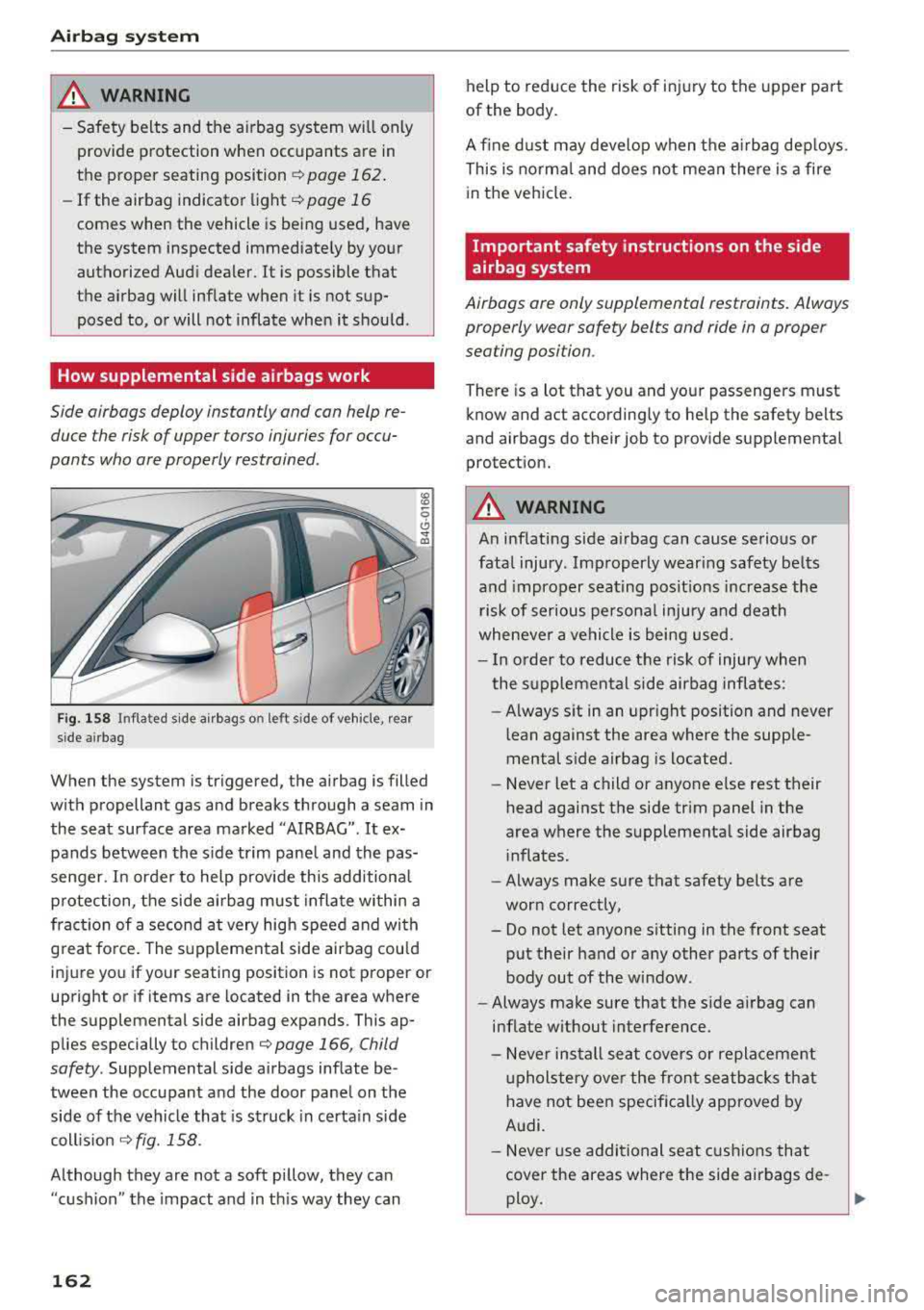
Fig. 158 Inflated side airbags on left side of veh icle , rear
side a irbag
When the system is triggered, the airbag is filled
with propellant gas and breaks through a seam in
the seat surface area marked "AIRBAG" . It ex
pands between the side trim panel and the pas
senger . In order to help provide this additional
protection, the side airbag must inflate within a
fraction of a second at very high speed and with
great force. The supplemental side airbag could
injure you if your seating position is not proper or
upright or if items are located in the area where
the supplemental side airbag expands. This ap
plies especially to children
¢ page 166, Child
safety .
Supplemental side airbags inflate be
tween the occupant and the door pane l on the
side of the vehicle that is struck in certain side
coll is ion ¢ fig. 158.
Although they are not a soft pillow, they can
"cushion" the impact and in this way they can
162
help to reduce the risk of injury to the upper part
of the body.
A fine d ust may develop when the a irbag deploys.
This is norma l and does not mean the re is a fire
in the vehicle.
Important safety instructions on the side
airbag system
Airbags are only supplemental restraints. Always
properly wear safety belts and ride in a proper
seating position .
There is a lot that you and your passengers must
know and act according ly to help the safety belts
and airbags do their job to provide supplemental protection.
A WARNING
An inflating side airbag can cause serious or
fatal injury . Improperly wearing safety belts
and improper seating positions increase the
risk of serious personal injury and death
whenever a vehicle is being used.
-In order to reduce the risk of injury when
the supplemental side airbag inflates:
- Always s it in an upright position and never
lean against the area where the supple-
mental side airbag is located.
-Never let a child or anyone e lse rest their
head against the side trim panel in the
area where the supplemental side airbag inflates.
- Always make sure that safety belts are
worn correctly,
-Do not let anyone s itting in the front seat
put their hand or any other parts of their
body out of the window .
- Always make sure that the side airbag can
inflate without interference.
-Never install seat covers or replacement
upholstery over the front seatbacks that
have not been specifical ly approved by
Audi.
-Never use additional seat cushions that
cover the areas where the side airbags de-
ploy.
~
Page 167 of 266
a co .... N
" N .... 0 0 \,;J '
cupant and the windows on the side of the vehi
cle that is struck in a side collis ion
¢ fig . 160.
When the system is tr iggered, t he side curta in
ai rbag is filled with propellant gas and breaks
through a seam above the front and rear side
windows identif ied by the AIRBAG labe l. In order
to help provide this addit ional protection, the
side curtain airbag must inflate within the blink
of an eye at very h igh speed and with great force .
The s ide curta in a irbag could injure you if your
seating position is not proper or upright or if
items are loca ted in the a rea whe re t he supp le
mental side curta in air bag inflates . T his applies
espec ia lly to children
¢ page 166 .
Although they a re not a soft p illow, side curtain
a ir bags can "cushion " the impact and in this way
they can help to red uce the risk of inj ury to the
h ead and t he upper part of t he body .
A fi ne dust may deve lop when the airbag deploys .
This is quite normal and does not mean there is a
fi re in t he ve hicl e.
Important safety instructions on the side
curtain airbag system
Airbags are only supplemental restraints . Always
properly wear safety belts and ride in a proper
seating position .
There is a lot th at yo u and your passengers m ust
know and do to he lp the safety be lts and airbags
do their job to provide supp lemental protection .
A WARNING
Improperly wearing safety belts and improper
seating posit ions increase the risk of serious
personal injury and death whenever a vehicle
is being used .
- Never let occ upants p lace any parts of the ir
bodies in the area from which the side cur
ta in a irbag inflate .
- Always make sure that the side curtain air
bags can inflate witho ut interference .
- Use the built- in coat hooks on ly for light
we ight cloth ing. Never leave any heavy or
sharp-edged objects in the pockets that may
Airbag syste m
inter fere with a irbag deployment and can
cause persona l injury in a co llision.
- Never use hangers to hang clot hes on t he
hooks.
- On ly use factory-insta lled sun shades or, if
shades installed after the vehicle leaves the
factory, use on ly gen uine A udi su n shades.
- Never swing the su n visors over to the side
windows if things s uch as pens, garage door
openers, hands-free speakers, etc. are at
tached to the sun v isors. They could come
loose and cause ser ious injury if the s ide c ur
tain airbag inflates .
- A dep loying airbag inflates in a fract ion of a
second and w ith great force .
- Never attach ob jects to the cover or i n the
deployment zone of a s ide curtain airbag .
- The a irbag deployment zones must be kept
clear at all t imes . Make s ure there are no
objects, pets, o r other persons in the space
between any vehicle occupant and any air
bag at any t ime .
- Do not attac h any accessories to the doors .
A WARNING
-
-The a irbag sys tem can dep loy o nly once . If
the airbag has been trigge red, the system
mu st be rep laced by an au thor ized A udi
de aler or q ualified wo rks hop .
- Always have wo rk invo lv ing t he side curtai n
air bag sy stem, remova l an d installa tion of
t he airbag componen ts, or o ther repairs
performed by a q ualified dea lership . Other
wise the airbag system may not work cor
rectly.
- Neve r attempt to modify any components of
the airbag system i n any way .
165
Page 195 of 266
a co .... N
" N .... 0 0 \,;J '
~ Castrot /lftlg;'f.E@t Frtrrr.::--.~lri,'lAl.
A ud i recomm ends using the Lo ng Life h igh
perfo rm ance eng ine oil from Aud i Genu ine
Parts .
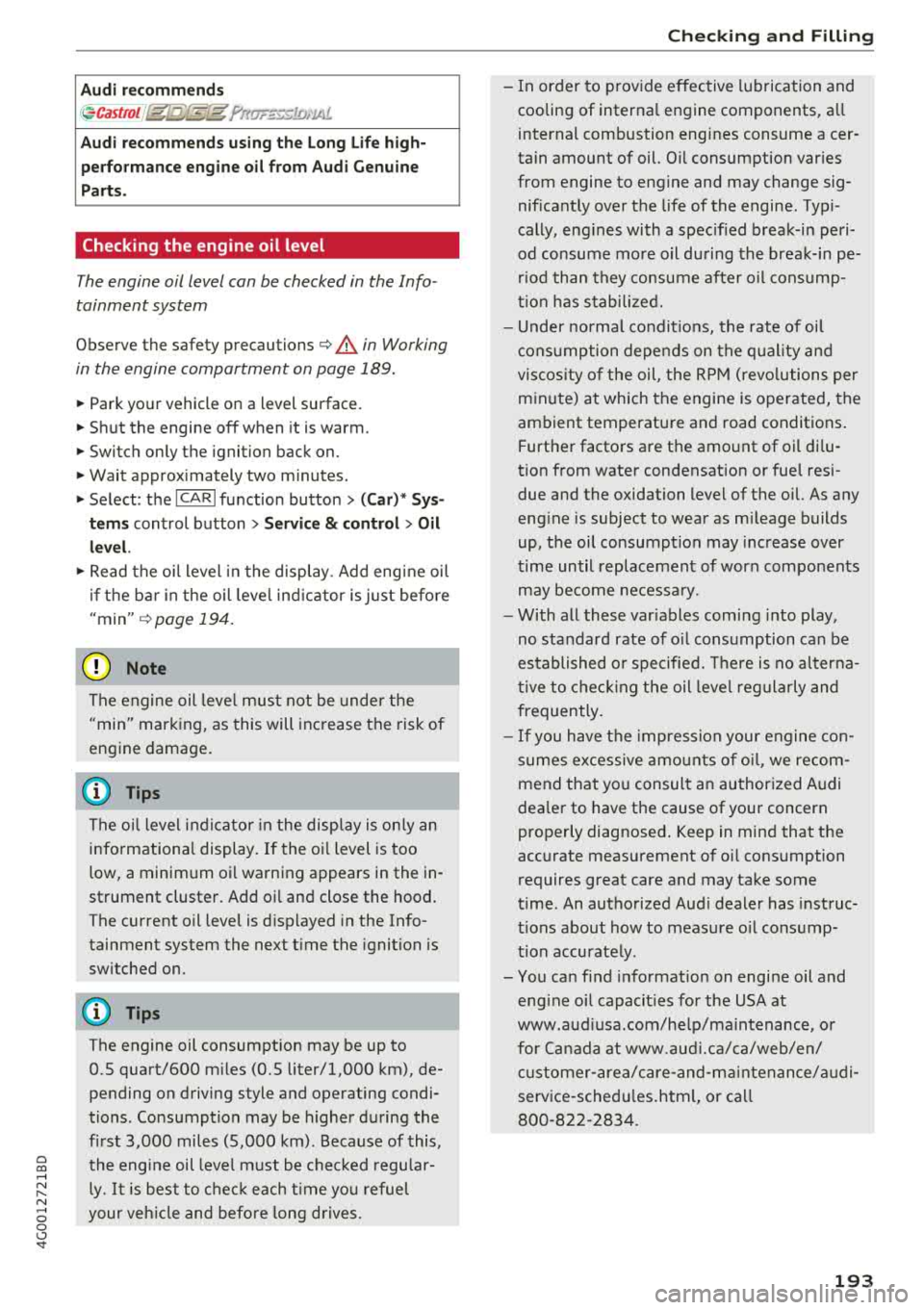
Checking the engine oil level
The engine oil level can be checked in the Info
tainment system
Observe the safety precautions ¢ A in Working
in the engine compartment on page 189.
~ Park your vehicle on a level surface.
~ Shut the engine off when it is warm .
~ Switch only the ignition back on.
~ Wait approx imately two minutes.
~ Select : the ICARI function button > (C ar)* Sys
tem s
control button > Service & control > O il
l e v el.
~ Read the o il level in the display. Add eng ine oil
i f t he ba r in the oil leve l ind icator is just before
"min" ¢ page 194.
(UJ) Note
The engine oil leve l mus t not be unde r the
"min" mark ing, as this will increase the risk of
engine damage.
(D Tips
The o il level indica tor in the disp lay is on ly an
informationa l display. If the o il level is too
low, a minimum oi l warning appears in the in
strument cluster. Add oil and close the hood.
The current oil level is d isplayed in the Info
tainment system the next t ime the ignition is
sw itched on.
(D Tips
The engine oil consumption may be up to
0.5 quart/600 m iles (0.S liter/1,000 km), de
pending on driving style and operating condi
tions. Consumpt ion may be h igher during the
first 3,000 miles (5,000 km). Because of this,
the eng ine oil level m ust be checked regu lar
ly. I t is best to chec k each t ime yo u refuel
your veh icle and befo re long d rives .
Ch eck ing and F illing
-In order to prov ide effective lubrication and
cooling of interna l engine components, a ll
internal comb ustion engines consume acer
tain amount of oil. Oi l consumption var ies
from engine to engine and may change sig
nificantly over the life of the engine . Typi
cally, eng ines with a specified break-in peri
od consume mo re o il du ring the break-in pe
r iod than they consume afte r oil cons ump
t ion has s tabilized.
-Under norma l co ndit io ns, the rate of oil
cons umption depe nds on the q ual ity and
vis cos ity of the oil , the R PM (revo lutions per
m inute) a t which the engine is operated, the
ambient temperature and road conditions .
Further factors are the amount of oi l di lu
tion from water condensat ion or fue l resi
due and the oxidation level of the oil. As any
eng ine is subject to wear as m ileage builds
up, the oil consumption may increase over
t ime until replacement of worn components
may become necessa ry.
-With all these var iables com ing into play,
no sta ndard rate of o il consumption can be
established o r specified. There is no a lter na
ti ve to c hec king the oil leve l reg ularly and
frequently.
-If you have the impress ion your e ngine co n
sumes excessive amo unts o f oil, we recom
mend that you consult an author ized Audi
dea ler to have the cause of your concern
properly diagnosed . Keep in mind that t he
acc urate measurement of o il cons umption
requires great care and may take some
time . An authorized Aud i dealer has instruc
tions about how to measu re o il consump
tion accurate ly.
-You can find informat ion on engine oil and
eng ine o il capacit ies for the USA at
www.aud iusa.com/he lp/ma intenance, o r
for Ca nada at www.aud i.ca/ ca/web/en/
cu stomer -area/ ca re -and -m a i ntena nee/ a u di
serv i ce -sched u les. htm l, or ca ll
800 -822-2834 .
193
Page 206 of 266
Wheel s
Glossary of tire and loading
terminology
Accessory weight
means the combined weight (in
excess of those standard items
which may be replaced) of auto matic transmission, power steer
ing , power brakes , power win
dows , power seats, radio, and
heater, to the extent that these
items are available as factory-in
stalled equipment (whether in
stalled or not).
Aspect ratio
means the ratio of the height to
the width of the tire in percent. Numbers of 55 or lower indicate a
low sidewall for improved steer
ing response and better overall
handling on dry pavement .
Bead
means the part of the tire that is
made of steel wires, wrapped or
reinforced by ply cords and that is
shaped to fit the rim.
Bead separation
means a breakdown of the bond
between components in the bead.
20 4
Cord
means the strands forming the
plies in the tire.
Cold tire inflation pressure
means the t ire pressure recom
mended by the vehicle manufac
turer for a tire of a designated
size that has not been driven for
more than a couple of miles (kilo
meters) at low speeds in the
three hour period before the tire pressure is measured or adjusted.
Curb weight
means the weight of a motor ve
hicle w ith standard equipment in
cluding the maximum capacity of
fuel, oil, and coolant, ai r condi
tioning and additional weight of
optional equipment.
E x tra load ti re
means a tire designed to operate
at higher loads and at higher in
flation pressures than the corre
sponding standard tire. Extra load
tires may be identified as "X L",
"
l" "EXTRA LOAD" or "RF" on X I I
the sidewall. .,.
Page 228 of 266

Emergency assistance
Emergency assistance
General information
.,. Park the vehicle as far as possible from moving
traffic in the event of a breakdown. In the event
of a flat tire, park the vehicle on a level surface .
It you are on a steep hill, be especially careful.
.,. Set the parking brake .
.,. Switch the emergency flashers on .
.,. Set up the warning triangle r=;,page 226 .
.,. Have the passengers exit the vehicle . They
should move to a safe place, for example be
hind a guard rail.
A WARNING
Follow the steps given above. This is for your
protection and the for the safety of other driv
ers.
Equipment
Warning triangle
A pplies to: ve hicles w ith warning triangle
Fig. 190 Luggage compa rtment lid : wa rnin g triangle
The warning triangle placed in the vehicle at the
factory is located in the luggage compartment.
.,. To remove the warning triangle, press the re-
tainer in the direction of the arrow
r:;, fig . 190
and fold the holder down.
The luggage compartment lid is only designed to
hold the warning triangle offered by the Audi
Genuine Accessories program.
226
Vehicle tool kit
Fig. 191 Luggage compartment: vehicle tool kit
The vehicle tools and vehicle jack* are stored in
the luggage compartment under the floor cover.
.,. Lift the cargo floor by the plastic handle.
.,. Hook the handle into the luggage compartment
weather strip.
.,. Turn the handle counter-clockwise and remove
the cover or the spare tire* .
.,. Unhook the cargo floor before clos ing the lug
gage compartment lid.
A WARNING
I mproper use of the veh icle jack can cause se
rious personal injuries.
- Never use the screw driver hex head to
tighten wheel bolts, since the bolts cannot
attain the necessary tightening torque if yo u
use the hex head, potentially causing an ac
cident.
- The factory-supplied jack is intended only
for your vehicle model. Under no circum
stances should it be used to lift heavy
vehicles or other loads; you risk injuring
yourself.
- Never start the engine when the vehicle is
raised, which could cause an accident .
- Support the vehicle securely with appropri ate stands if work is to be performed under
neath the vehicle; otherwise, there is a po
tential risk for injury .
- Never use the jack supplied with your Audi
on another vehicle, particularly on a heavier
one. The jack is only suitable for use on the
vehicle it came with.
Page 240 of 266
Bulbs
Bulbs
Replacing light bulbs
For your safety, we recommend that you have
your authori zed Audi dealer replace burned out
bulbs for you.
It is becoming increasingly more and more diffi
cult to replace vehicle light bulbs since in many
cases, other parts of the car must first be re moved before you are able to get to the bulb.
This applies espec ially to the light bulbs in the
front of your car wh ich you can only reach
through the eng ine compartment.
Sheet metal and bulb holders can have sharp
edges that can cause ser ious cuts, and parts
must be correctly taken apart and then properly
put back together to help prevent breakage of
parts and long term damage from water that ca n
ente r housings that have not been properly re
sealed.
For your safety, we recommend that you have
your author ized Audi dealer replace any bulbs for
you, s ince your dealer has the proper tools, th e
correct bulbs and the expertise .
Gas discharge lamps (Xenon lights):
Due to the high electrical voltage, have the bulbs
replaced by a qualified technic ian . Headlights
with Xenon light can be identified by the high
voltage sticker.
LED headlights*
LED headlights require no maintenance. Please
contact your authorized Audi dealer if a bulb needs to be replaced.
A WARNING
Contact w ith high-voltage components of the
electrical system and improper replacement
of gas d ischarge (Xenon) headl ight bulbs can
cause se rious personal injury and death.
- Xenon bulbs are pressurized and can ex
plode when be ing changed .
- Chang ing Xenon lamps requires the spec ial
train ing, instructions and equipment .
238
-On ly an authorized Audi dealer or other
qualif ied workshop should change the bu lbs
in gas discharge lamps.
A WARNING
There are parts with sharp edges on the open
ings and on the bulb holders that can cause
serious cuts .
- If you are uncertain about what to do, have
the work performed by an author ized Audi
dealer or other qualified workshop . Ser ious
pe rsonal injury may res ult from improperly
pe rformed wor k.
(D Tips
- If you still prefer to replace the light bulbs
yourself, be aware that the engine compart
ment is a hazardous area to wo rk in
~page 189 ~.&.
-It is best to ask your authorized Audi dea ler
w henever you need to change a bulb.
Page 254 of 266
Index
Audi Service Repair Manuals and Literature 24 7
AUTO 4-zone deluxe automatic climate cont rol . . 61
Automatic headlights . . . . . . . . . . . . . . . . . 38
D eluxe automatic climate control . . . . . . . . 59
Auto Lock (central locking) . . . . . . . . . . . . . . 24
Automatic belt retractor . . . . . . . . . . . . . . . 13 7
Automatic climate control . . . . . . . . . . . . . . . 58
Key recogn ition . . . . . . . . . . . . . . . . . . . . . . 58
Operation . . . . . . . . . . . . . . . . . . . . . . . . . . . 59
Automatic key . . . . . . . . . . . . . . . . . . . . . . . . . 25
Automatic post-collision braking system . . 119
Autom atic transmission . . . . . . . . . . . . . . . . . 74
Em ergency mode . . . . . . . . . . . . . . . . . . . . . 79
H ill descent control . . . . . . . . . . . . . . . . . . . 77
Kick-down . . . . . . . . . . . . . . . . . . . . . . . . . . . 78
Selector lever emergency re lease . . . . . . . . 80
Selector lever pos itions . . . . . . . . . . . . . . . . 7 5
Shifting manually . . . . . . . . . . . . . . . . . . . . 78
Steer ing whee l with shift paddles . . . . . . . . 78
tiptronic mode . . . . . . . . . . . . . . . . . . . . . . . 78
Automatic wipe/wash system . . . . . . . . . . . .
44
Auto Safety Hotline . . . . . . . . . . . . . . . . . . . 132
Average consumption . . . . . . . . . . . . . . . . . . .
20
Average speed . . . . . . . . . . . . . . . . . . . . . . . . 20
B
Battery
Ju mp starting ...... .......... .. .. .. .
also refer to Vehicl e battery .......... .
Before driving
Belt tensioner 239
19 7
125
Drive select . . . . . . . . . . . . . . . . . . . . . . . . . 104
Belt tensioners . . . . . . . . . . . . . . . . . . . . . . . 140
Blended gasoline . . . . . . . . . . . . . . . . . . . . . 185
Blower (4-zone deluxe automatic climate con-
trol) . . . . . . . . . . . . . . . . . . . . . . . . . . . . . . . . . 61
Blower (deluxe automatic climate control) . . 59
Booster seats . . . . . . . . . . . . . . . . . . . . . . . . 176
Brakes . . . . . . . . . . . . . . . . . . . . . . . . . . . . . . 120
Brake assist .. .. ............. .... .. . 119
Brake booster . . . . . . . . . . . . . . . . . . . . . . . 120
Brake fluid . . . . . . . . . . . . . . . . . . . . . . . . . 197
Ceram ic brake rotors . . . . . . . . . . . . . . . . . 120
E lect romechan ical park ing brake . . . . . . . . 72
252
Emergency braking function . . . . . . . . . . . . 73
Indicator light . . . . . . . . . . . . . . . . . . . . 12, 17
New brake pads . . . . . . . . . . . . . . . . . . . . . 120
Worn brake pads . . . . . . . . . . . . . . . . . . . . . 16
Braking guard ..... .. .. ............. ... 91
93
Messages
Settings ............................ 93
Break-in security featu re . . . . . . . . . . . . . . . . 30
Breaking in New brake pads . . . . . . . . . . . . . . . . . . . . . 120
N . ew engine . . . . . . . . . . . . . . . . . . . . . . . . . 64
New tires . . . . . . . . . . . . . . . . . . . . . . . . . . 208
Bu lbs . . . . . . . . . . . . . . . . . . . . . . . . . . . . . . . 238
C
California Proposition 65 Warning . . . . . . . 190
Battery specific . . . . . . . . . . . . . . . . . . . . . 197
Capacities Fuel tank. . . . . . . . . . . . . . . . . . . . . . . . . . . 245
Washer fluid reservoir . . . . . . . . . . . . . . . . 245
Cargo area . . . . . . . . . . . . . . . . . . . . . . . . . . . 130
Cata lytic converter . . . . . . . . . . . . . . . . . . . . 188
Central locking . . . . . . . . . . . . . . . . . . . . . . . . 24
C . k onvernence ey . . . . . . . . . . . . . . . . . . . . . . 2 7
Luggage compartment lid . . . . . . . . . . . . . . 30
Mechanically locking . . . . . . . . . . . . . . . . . . 29
Panorama glass roof . . . . . . . . . . . . . . . . . . 34
Power windows . . . . . . . . . . . . . . . . . . . . . . 34
Remote control key . . . . . . . . . . . . . . . . . . . 2 7
Setting . . . . . . . . . . . . . . . . . . . . . . . . . . . . . 29
Su nroof . . . . . . . . . . . . . . . . . . . . . . . . . . . . . 34
C entra l locking switch . . . . . . . . . . . . . . . . . . 28
Ceramic brake rotors
New brake pads . . . . . . . . . . . . . . . . . . . . . 1 20
Certification . . . . . . . . . . . . . . . . . . . . . . . . . 250
Changing engine oil . . . . . . . . . . . . . . . . . . . 194
Child res tra ints
Danger of using child res traints in the front
seat............................... 143
Where can I get additiona l information
abo ut child restraints and their use? . . . . 184
Child res traint system anchors . . . . . . . . . . 180