flat tire AUDI A6 2018 User Guide
[x] Cancel search | Manufacturer: AUDI, Model Year: 2018, Model line: A6, Model: AUDI A6 2018Pages: 266, PDF Size: 41.38 MB
Page 212 of 266
Wheels
-Only use tires that are more than six years old when absolutely necessary and drive
carefully when doing so.
-Do not use run-flat tires on your vehicle. Using them when not permitted can lead to
ve
hicle damage or accidents.
-If you install wheel covers on the vehicle, make sure they allow enough a ir circulation to
cool the brake system. If they
do not, this could increase the risk of an accident.
Tire wear/damage
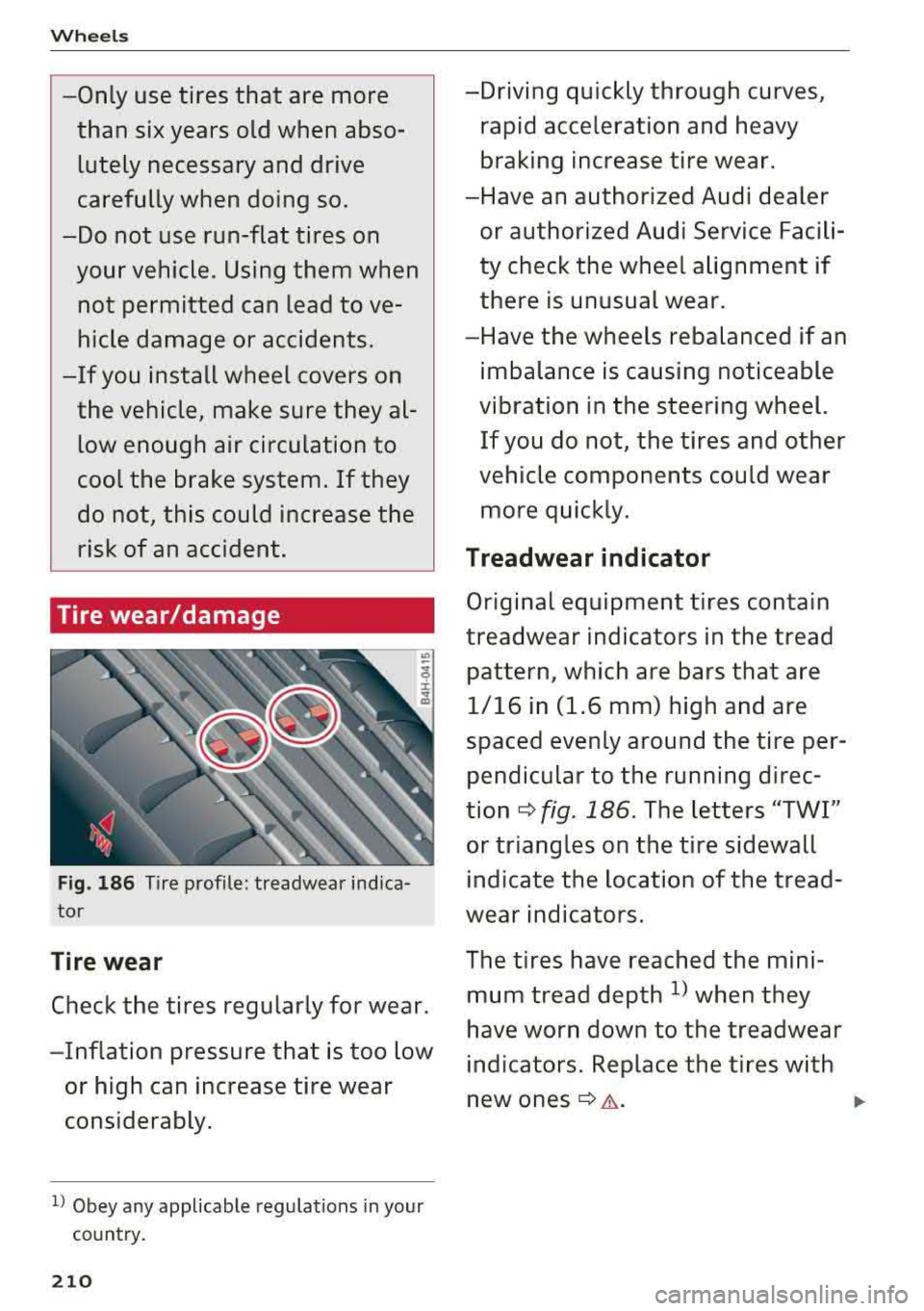
Fig. 186 Tire profile: trea dwear indica
tor
Tire wear
Check the tires regularly for wear.
-Inflation pressure that is too low
or high can increase tire wear
considerably.
l) Obey any applicable regulations in your
country.
210
-Driving qu ickly through curves,
rapid acceleration and heavy
braking increase tire wear.
-Have an authorized Audi dealer or authorized Audi Service Facili
ty check the wheel alignment if
there is unusual wear.
-Have the wheels rebalanced if an imbalance is causing noticeable
vibration in the steering wheel. If you do not, the tires and other
vehicle components could wear more quick ly.
Treadwear indicator
Original equipment tires contain
treadwear indicators in the tread pattern, which are bars that are 1/16 in (1.6 mm) high and are
spaced evenly around the tire per pendicular to the running direc
tion
c> fig . 186. The letters "TWI"
or triangles on the tire sidewall indicate the location of the tread
wear indicators.
The t ires have reached the mini
mum tread depth
l) when they
have worn down to the treadwear
indicators. Replace the tires with
new ones
c> A . "'
Page 216 of 266
Wheels
Tires and vehicle load limits
There are limits to the amount of
load or weight that any vehicle
and any tire can carry. A vehicle
that is overloaded will not handle
well and is more difficult to stop. Overloading can not only lead to loss of vehicle control, but can al
so damage important parts of the
vehicle and can lead to sudden tire failure, including a blowout
and sudden deflation that can
cause the vehicle to crash.
Your safety and that of your pas sengers also depends on making
sure that load limits are not ex
ceeded. Vehicle load includes ev
erybody and everything in and on
the vehicle. These load limits are
technically referred to as the vehi
cle's
Gross Vehicle Weight Rat
ing
("GVWR").
The "GVWR" includes the weight
of the basic vehicle, all factory in
stalled accessories, a full tank of
fuel, oil, coolant and other fluids plus maximum load. The maxi
mum load includes the number of
passengers that the vehicle is in
tended to carry ("seating capaci
ty") with an assumed weight of 150 lbs. (68 kg) for each passen-
214
ger at a designated seating posi
tion and the total weight of any luggage in the vehicle. If you tow
a trailer, the weight of the trailer
hitch and the tongue weight of
the loaded trailer must be includ
ed as part of the vehicle load.
The
Gross Axle Weight Rating
("GAWR") is the maximum load
that can be applied at each of the
vehicle's two axles.
The fact that there is an upper limit to your vehicle's Gross Vehi
cle Weight Rating means that the
total weight of whatever is being
carried in the vehicle (including
the weight of a trailer hitch and
the tongue weight of the loaded
trailer) is limited. The more pas
sengers in the vehicle or passen
gers who are heavier than the
standard weights assumed mean
that less weight can be carried as
luggage.
The Gross Vehicle Weight Rating
and the Gross Axle Weight Rating
are listed on the safety compli
ance sticker label located on the
driver's side B-pillar.
Page 217 of 266
0 0)
A WARNING
Overloading a vehicle can cause
loss of vehicle control, a crash
or other accident, serious per
sonal injury, and even death .
- Carrying more weight than
your vehicle was designed to
carry will prevent the vehicle
from handling properly and
increase the risk of the loss of
vehicle control.
- The brakes on a vehicle that has been overloaded may not
be able to stop the vehicle
within a safe distance .
- Tires on a vehicle that has
been overloaded can fail sud
denly, including a blowout and
sudden deflation, causing loss
of control and a crash .
- Always make su re that the to
tal load being transported - inc lud ing the weight of a trail
er hitch and the tongue
weight of a loaded trailer -
does not make the vehicle
heavier than the vehicle's
Gross Vehicle We ight Rating.
Determining correct load
limit
~ Use the example below to calcu-
"' 8 late the total weight of the pass ..
Wheels
sengers and luggage or other
things that you plan to transport so that you can make sure that
your vehicle will not be overload
ed .
Steps for Determining Correct
Load Limit
1 . L ocate the statement "THE
COMB INED WEIGH T OF OCCU
P ANTS AND CARGO S HOU LD
N EVER EXCEED XXX KG OR XXX
L BS " on your vehicle's placard
(tire inflation pressure label)
<=> page 211, fig. 187.
2. Determine the combined
weight of the driver and pas
sengers that will be riding in
your vehicle .
3 . Subtract the combined weight
of the driver and passengers
from
"XXX" kilograms or "XXX"
pounds shown on the sticker
<=> page 211, fig . 187 .
4. The resulting figure equals the
available amount of cargo and
luggage load capacity . For ex
ample, if the "XXX" amount
equa ls 1400 lbs. and there will
be five 150 lbs. passengers in
your vehicle, the amount of available cargo and luggage load capacity is 650 lbs.
.,.
2 15
Page 220 of 266
Wheels
For example: Tr ead wea r 200, Traction AA, Tem
pe rature
A .
All passenge r ca r tires m ust conform to Federa l
Safety Requi rements in addition to these g rades.
Tread wear
The tread wear grade is a comparat ive rat ing
based on the wear rate of the t ire when tested
unde r contro ll ed conditions o n a specified gov
e rnmen t test co urse.
For example, a tire graded 150 would wear one
and one ha lf ( 11/2) t imes as well on the gove rn
ment course as a tire g raded 1 00.
The relative performance of t ires depends upon
the actual condi tions of their use, howeve r, and
may depart s ignificant ly from the norm d ue to
va ria tions in driving hab its, service pra ctices and
d ifferences in road ch aract eris tics and clim ate.
Traction
The traction grades, from highest to lowest, are
AA, A, Band
C. T hose grades represent the t ire's
ab ility to stop on wet pavement as meas ured un
de r contro lled condi tions o n specified gove rn
men t tes t su rfa ces of asp ha lt and conc re te. A tire
mar ked C m ay have poor trac tion pe rforma nce
q _&. ,
Temperature
The temperature grades a re A (t he highest), B,
and C, rep resent ing the tire' s resistan ce to t he
gener ation o f heat and it s abili ty to d iss ipate
heat when tested unde r controlled condi tions on
a specified in door laboratory test whee l.
Susta ined hig h tem perature can cause t he ma te
r ial of the t ire to dege nerate and re duce tire life,
an d excess ive temperatu re can lead to sudden
tire fai lure
q .&. .
The gr ade C co rresponds to a leve l of perfor m
a nce wh ich all passenge r car tir es mus t mee t un
der t he Fede ra l Mo tor Vehicle Safety Standar d
No . 109 . Grades Band A represent higher leve ls
of perfo rmance on the labo rato ry test w heel than
the min imum required by law.
218
A WARNING -
The tract io n grade assigned to this t ire is
based on straight-a head braking traction
tes ts, a nd does no t in clude acceleration, cor
ne ring, hy droplaning or pea k traction cha rac
teris tics.
A WARNING
The tem perat ure grade fo r thi s tire is estab
lishe d fo r a t ire th at is p roperl y infl ated and
n ot overloaded . Excessive s peed, under infla
tion, o r excessive loa ding, either separate ly or
i n comb inat io n, can cause heat bu ildup and
possib le t ire fai lure.
A WARNING
-
-
Tempe rature grades app ly to t ires that are
proper ly inflated a nd not over or under inflat
ed .
Tire pressure monitoring
system
ill General notes
Each tire, including the spare (if prov ided),
shou ld be checked monthly when cold and inflat
ed to the i nflat ion press ure recommended by the
vehicle manufacture r on the veh icle placard or
ti re infla tion p ressure labe l. (If your ve hicle has
t ir es of a diffe rent size t han the si ze ind icated on
t h e ve hicle placard or tire i nflat io n press ure la
bel, you sho uld dete rm ine the proper tire in fla
tion press ure for those tires) .
As a n ad ded safety featu re, you r vehicle has been
equipped wi th a t ire p ress ure mon itor ing system
(TPMS) t hat ill umi nates a low tire p ressure tell
ta le w hen one or mo re of your tires is s ignificant
l y under -inflated. According ly, w hen the low ti re
pressure telltale illum inates, you sho uld stop and
c h eck your t ires as soon as possible, and inflate
them to the proper pressure. Dr iv ing on a sign ifi
cant ly under -inflated t ire ca uses the t ire to over
heat and ca n lead to tire fa ilu re . U nder-inflation
also red uces fue l eff ic iency a nd tire tread life,
and may affect t he ve hicl e's handling a nd s top-
ping ability.
II>-
Page 228 of 266

Emergency assistance
Emergency assistance
General information
.,. Park the vehicle as far as possible from moving
traffic in the event of a breakdown. In the event
of a flat tire, park the vehicle on a level surface .
It you are on a steep hill, be especially careful.
.,. Set the parking brake .
.,. Switch the emergency flashers on .
.,. Set up the warning triangle r=;,page 226 .
.,. Have the passengers exit the vehicle . They
should move to a safe place, for example be
hind a guard rail.
A WARNING
Follow the steps given above. This is for your
protection and the for the safety of other driv
ers.
Equipment
Warning triangle
A pplies to: ve hicles w ith warning triangle
Fig. 190 Luggage compa rtment lid : wa rnin g triangle
The warning triangle placed in the vehicle at the
factory is located in the luggage compartment.
.,. To remove the warning triangle, press the re-
tainer in the direction of the arrow
r:;, fig . 190
and fold the holder down.
The luggage compartment lid is only designed to
hold the warning triangle offered by the Audi
Genuine Accessories program.
226
Vehicle tool kit
Fig. 191 Luggage compartment: vehicle tool kit
The vehicle tools and vehicle jack* are stored in
the luggage compartment under the floor cover.
.,. Lift the cargo floor by the plastic handle.
.,. Hook the handle into the luggage compartment
weather strip.
.,. Turn the handle counter-clockwise and remove
the cover or the spare tire* .
.,. Unhook the cargo floor before clos ing the lug
gage compartment lid.
A WARNING
I mproper use of the veh icle jack can cause se
rious personal injuries.
- Never use the screw driver hex head to
tighten wheel bolts, since the bolts cannot
attain the necessary tightening torque if yo u
use the hex head, potentially causing an ac
cident.
- The factory-supplied jack is intended only
for your vehicle model. Under no circum
stances should it be used to lift heavy
vehicles or other loads; you risk injuring
yourself.
- Never start the engine when the vehicle is
raised, which could cause an accident .
- Support the vehicle securely with appropri ate stands if work is to be performed under
neath the vehicle; otherwise, there is a po
tential risk for injury .
- Never use the jack supplied with your Audi
on another vehicle, particularly on a heavier
one. The jack is only suitable for use on the
vehicle it came with.
Page 229 of 266
a co .... N
" N .... 0 0 \.J '
The vehicle jack* in your vehicle is mainte
na nee-free.
Replacing wheels
Before changing a wheel
Observe the following precautions for your own
and your passenger's safety when changing a
wheel .
'"After you experience a tire failure, pull the car
well away from moving traff ic and try to reach
le ve l ground before you stop ¢,&. .
'"All passe ngers should le ave the car and move
to a safe location (for instance, be hind the
guardra il) ¢ ,&. .
.. Engage the parkin g brake to p revent your vehi
cle from rolling
unintentionally ¢,&. .
'"Move selecto r lev er to p osition P ¢ ,&. .
'"If you are towing a trailer, unh itch the trailer
from your veh icle.
'" Take the jac k and the sp are tir e* out of the lug
gage compartment
i::> page 226 .
A WARNING
You or your passengers cou ld be inju red w hile
chang ing a wheel if you do not follow these
safety precautions :
- If you have a flat t ire, move a safe distance
off t he road. Tur n off the engine, t urn the
emergency flashers on and use other warn
ing devices to alert other motorists .
- Make s ure tha t pa ssengers w ait in a sa fe
place away from the vehicle and we ll away
from the road and traffic.
- T o help prevent the vehicle from moving
sudden ly and possibly slipping o ff th e jack,
always fully set the parking brake and b lock
the front and back of the wheel diagonally opposite the wheel be ing changed. When
one front whee l is lifted off the ground,
placing the Automatic Transm ission in P
(Park) w ill
not prevent the veh icle from
moving.
Em ergenc y ass is tanc e
-Before you change a whee l, be sure the
ground is level and firm . If necessary, use a
sturdy board under the jack.
- Always store the vehicle too l kit, the jack
and the replaced tire in the luggage com
partment
¢ page 130.
(D Tips
Before changing the wheel, you must activate
the jacking mode, so that the automatic con
tro ls for the Adaptive Air Suspension* do not
make it more difficult to lift the vehicle with
the
jack ¢ page 229 .
Changing a wheel
When you change a wheel , follow the sequence
described below step-by-step and in exactly that
order .
l. Activate the vehicle jack mode* ¢ page 229.
2. Remove the deco rati ve wheel co ver* or the
wheel bolt c aps *. For more details see also
¢ page 228, Decorative wheel covers or
¢ page 228, Wheels with wheel bolt caps .
3. Loosen the wheel bolt s ¢page 229.
4. Locate t he p roper mount ing point for the
jack and align the jack be low that poin t
¢page 229 .
S. R ais e the car with the jack ¢ page 229 .
6. Remove the wheel with the fl at tir e and then
install
the spare ¢ page 231.
7. Tig hte n all wheel bolts lightly .
8 .
Lower the vehicle with the jack .
9 . Use the wheel bolt wrench and
firml y tighten
all wheel
bo lts ¢ page 229.
10. Replace t he decorat ive wh eel cover * or the
wheel bolt cap s*.
11. Deactivate the vehicle jack mode* in t he
MMI :
ICAR I function button > (Car )* sys tem s
contro l button > Ser vicing & che cks > Air
s usp.: jack mod e> Off.
The vehicle jack mode * switches off automatica l-
ly at speeds abov e 6 mph (10 km/h).
.,.
227
Page 230 of 266
Emergency assistance
A WARNING
Always read and follow all WARNINGS and in
formation
c:> & in Raising the vehicle on
page 230
and c:> page 232.
After changing a wheel
A wheel change is not complete without the do
ing the following .
.. Always store the vehicle tool kit, the jack* and
the replaced tire in the luggage compartment
c:> page 130 .
.. Check the tire pressure on the spare wheel im
med iate ly after mount ing it .
.. As soon as possible, have the tightening tor
ques
on all wheel bolts checked with a torque
wrench. The correct tightening torque is 90 ft
lb s (120 Nm) .
.. Have the flat tire replaced as soon as possible.
@ Tips
-If you notice that the wheel bolts are cor
roded and difficu lt to turn while changing a
tire, they should be replaced before you
check the tightening torque.
-Drive at reduced speed until you have the
tightening torques checked.
-After changing a wheel, the tire pressure in
a ll four tires must be checked/corrected and
the tire pressure monitoring indicator must
be stored in the MMI
<=> page 220.
Decorative wheel covers
App lies to: vehicl es w ith decorative wheel covers
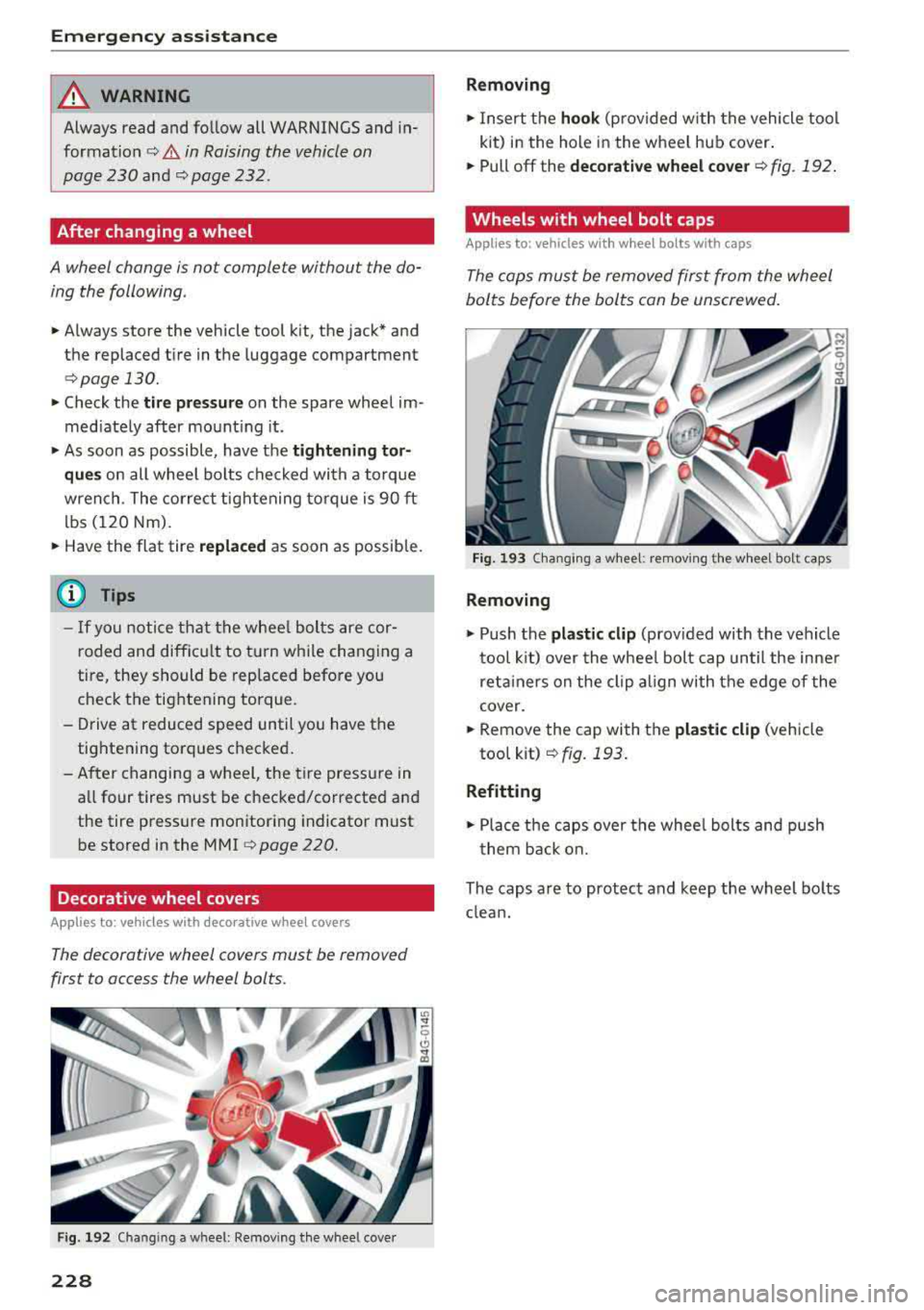
The decorative wheel covers must be removed
first to access the wheel bolts.
Fig. 192 Changing a wheel: Remov in g the whee l cove r
228
Removing
.,. Insert the hook (provided w ith the vehicle tool
kit) in the hole in the wheel hub cover.
.. Pull off the decorative wheel cover c:> fig. 192 .
Wheels with wheel bolt caps
Applies to: vehicles with wheel bolts with caps
The caps must be removed first from the wheel
bolts before the bolts can be unscrewed .
Fig. 193 C hanging a wheel: remov ing the w heel bolt caps
Removing
.,. Push the plastic clip (provided with the vehicle
tool kit) over the whee l bolt cap until the inner
reta iners on the clip align with the edge of the
cover.
.. Remove the cap with the plastic clip (vehicle
tool kit)
c:> fig. 193.
Refitting
.,. Place the caps over the whee l bolts and push
them back on.
The caps are to protect and keep the wheel bo lts
clean.
Page 232 of 266
Emergency assistance
sill and the movable base @ lies flat on the
ground . The base @ must be
vertical under the
lifting point @ .
.. Wind the jack up further until the flat tire
comes off the ground
¢ .&_ .
Position the vehicle jack only under the designat
ed lifting points on the sill
¢ fig. 195. There is ex
actly
one location for each wheel. The jack must
not be positioned at any other
location ¢ £¢(D .
An unstable surface under the jack can cause the
vehicle to slip off the jack . Always provide a firm
base for the jack on the ground. If necessary
place a sturdy board or similar support under the
jack . On
hard, slippery surfaces (such as tiles)
use a rubber mat or similar to prevent the jack
from
slipping ¢& .
,&. WARNING
-
-Yo u or your passengers could be injured
wh ile chang ing a wheel if you do not follow
these safety precautions:
- Position the vehicle jack only at the desig
nated lifting points and align the jack .
Otherw ise, the vehicle jack could slip and
cause an injury if it does not have suffi
cient hold on the vehicle.
- A soft or unstable surface under the jack
may cause the vehicle to slip off the jack.
Always provide a firm base for the jack on
the ground.
If necessary, use a sturdy
board under the jack .
- On hard, s lippery surface (such as tiles)
use a rubber mat or similar to prevent the
jack from slipping.
- T o help prevent injury to yourself and yo ur
passengers:
- Do not raise the vehicle until you are sure
the jack is securely engaged .
- Passengers must not remain in the vehicle
when it is jacked up.
- Make sure that passengers wait in a safe
place away from the vehicle and well away
from the road and traff ic.
- Make sure jack position is correct, adjust as necessary and then cont inue to raise
the jack.
230
- Changes in temperature or load can affect
the height of the vehicle.
(D Note
Do not lift the veh icle by the si ll. Position the
vehicle jack only at the designated lifting
points on the sill. Otherwise, your vehicle will
be damaged.
(D Tips
The vehicle jack mode * switches off automati
cally at speeds above 6 mph (10 km/h).
Removing and installing the sill extension
cover
App lies to: vehicles with sill extension
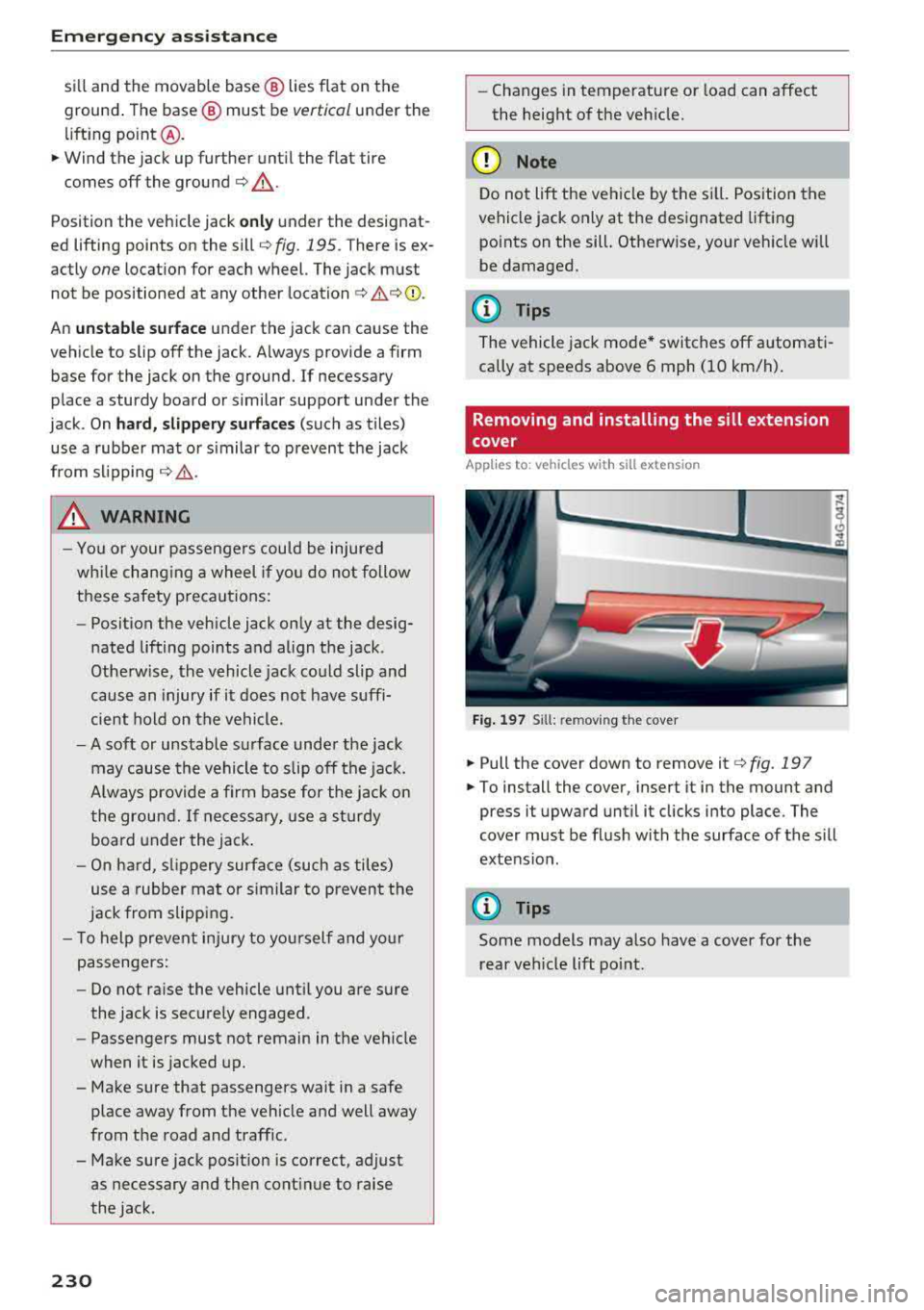
Fig. 197 Sill : re m ov ing the cover
.. Pull the cover down to remove it ¢ fig. 197
.. To install the cover, insert it in the mount and
press it upward until it clicks into place. The
cover must be flush with the surface of the sill
extens ion .
@ Tips
Some models may also have a cover for the
rear vehicle lift point.
Page 234 of 266
Emergency assistance
-If the spare tire has to be installed in the incor
rect direction, use the spare tire only tempora
rily s ince the tire w ill not be able to achieve its
optimum performance character istics with re
gard to aquaplaning, noise and wear.
- We recommend that you pay particular atten tion to this fact during wet weather and that
you ad just your speed to match road condi
tions .
-Replace the f lat t ire with a new one and have it
installed on yo ur vehicle as soon as possible to
restore the handling advantages of a unidirec
tiona l tire .
Notes on wheel changing
Please read the info rm at ion ~ page 208, New
t ires or wheels
if you are going to use a spare tire
whi ch is d ifferent from the tires on yo ur vehicle.
Afte r you change a tire:
-Check the tire pressure on the spare tire im
mediately after installation.
-Have the wheel bolt tightening torque
checked with a torque wrench as soon as pos
sible by your authorized Audi dealer or a
qualified service station .
-With steel and alloy wheel rims, the wheel
bolts are correctly tightened at a torque of 90
ft lbs (120 Nm) .
-If you notice that the whe el bolts are corroded
and difficult to turn while changing a tire,
they should be replaced before you check the
tightening torque.
-Replace the flat tire with a new one and have
it installed on your vehicle as soon as po ssi
ble. Remount the wheel cover.
Until then, drive with extra care and at reduced
speeds .
_& WARNING
-If you a re g oin g to equip your ve hicle wit h
tir es o r rims w hich dif fer from t hose whi ch
were fa ctory inst alled, t hen be s ure t o re ad
t h e informat ion
~ page 2 08, New tires or
wheels .
232
-Always make sure the damage d wheel or
even a flat tire and the jack and tool kit are
proper ly secured in the luggage compart
ment a nd are not loose in the passenger
compartment .
-In an accident or sudd en maneuver they
could f ly forward, i njuring anyo ne i n the ve
h icl e.
-Always sto re damaged w hee l, jack and tools
secure ly in the luggage co mpart men t. Ot h
erwise, in an acciden t or sudden maneuve r
they cou ld fly forw ard , causing i nju ry t o p as
s en gers i n the veh icle.
Spare tire
Space-saving spare tire
App lies to: vehicles wit h spare tire
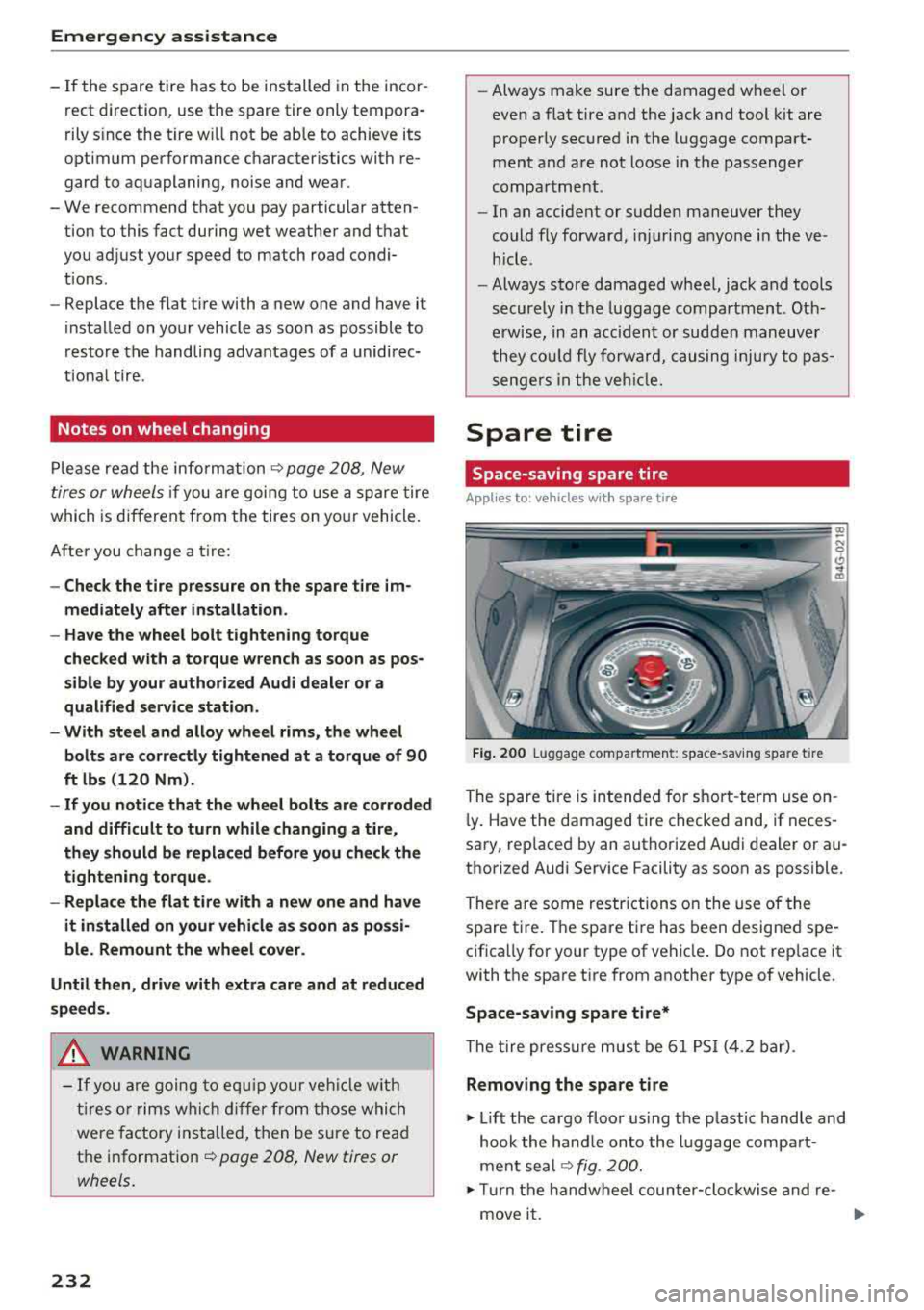
Fig. 200 L uggage com part ment: space-sav ing spa re tire
The sp are tire is in ten ded for short -term use on
l y . Have the damaged tire checked and, if neces
sary, rep laced by an authorized A udi d ealer or au
thorized Audi Serv ice Facility as soon as possible.
There are some restr ictions o n the use of the
spare t ire . Th e spa re t ire has been designed spe
cifica lly for your type of vehicle . Do not rep lace it
with t he spa re t ire from another type of vehicle .
Space-saving spare tire*
The tire press ure mus t be 61 PS I (4.2 bar).
Removing the spare tire
"" Lift the cargo floor us ing the p lastic handle and
hoo k the han dle on to the l uggage comp art
ment sea l
~fig . 200.
""Tur n the han dw heel coun ter-clo ckwise and re
move it.