height AUDI A6 2018 User Guide
[x] Cancel search | Manufacturer: AUDI, Model Year: 2018, Model line: A6, Model: AUDI A6 2018Pages: 266, PDF Size: 41.38 MB
Page 160 of 266
Airbag system
must be performed by qualified workshops
only. Make sure that any airbag service ac
tion is entered in your Audi Warranty
&
Maintenance booklet under AIRBAG RE·
PLACEMENT RECORD .
-For safety reasons in severe accidents, the
alternator and starter are separated from
the vehicle battery with a pyrotechn ic circuit
interrupter.
- Work on the pyrotechnic circuit interrupt
er must only be performed by a qualified
technicians who have the experience, in
formation and special tools necessary to
perform the work safely.
- If the vehicle or the circuit interrupter is
scrapped, all applicable safety precautions
must be followed .
@ For the sake of the environment
Undeployed airbag modules and pretension
ers might be classified as Perchlorate Materi
al
-special handling may apply , see
www .dtsc.ca.gov/hazardouswaste/perchlo
rate . When the vehicle or parts of the re
straint system including airbag modules and
safety belts w ith pretensioners are scrapped,
all applicable laws and regulations must be
observed . Your authorized Audi dealer is fa
miliar with these requirements and we recom
mend that you have your dealer perform this
service for you.
Other things that can affect Advanced
Airbag performance
Changing the vehicle's suspension system can
change the way that the Advanced Airbag System
performs in a crash. For example, using tire-rim
comb inations not approved by Audi, lower ing the
vehicle, chang ing the stiffness of the suspension,
including the springs, suspension struts , shock
absorb ers etc . can change the forces that are
measured by the airbag sensors and sent to the
electronic control unit . Some suspension changes
can, for example, increase the force levels meas
ured by the sensors and make the airbag system
deploy in crashes in which it would not deploy if
the changes had not been made. Other kinds of
158
changes may reduce the force levels measured by
the sensors and prevent the airbag from deploy
i ng when it should .
& WARNING
Changing the vehicle's suspension including
use of unapproved tire-rim combinations can
change Advanced Airbag performance and in
crease the risk of serious personal injury in a
crash .
- Never install suspension components that do not have the same performance charac
teristics as the components origina lly instal
led on your vehicle.
- Never use tire-rim combinations that have
not been approved by Aud i.
Knee airbags
Description of knee airbags
Applies to: vehicles with knee airbags
The knee airbag system can provide supplemen
tal protection to properly restrained front seat
occupants.
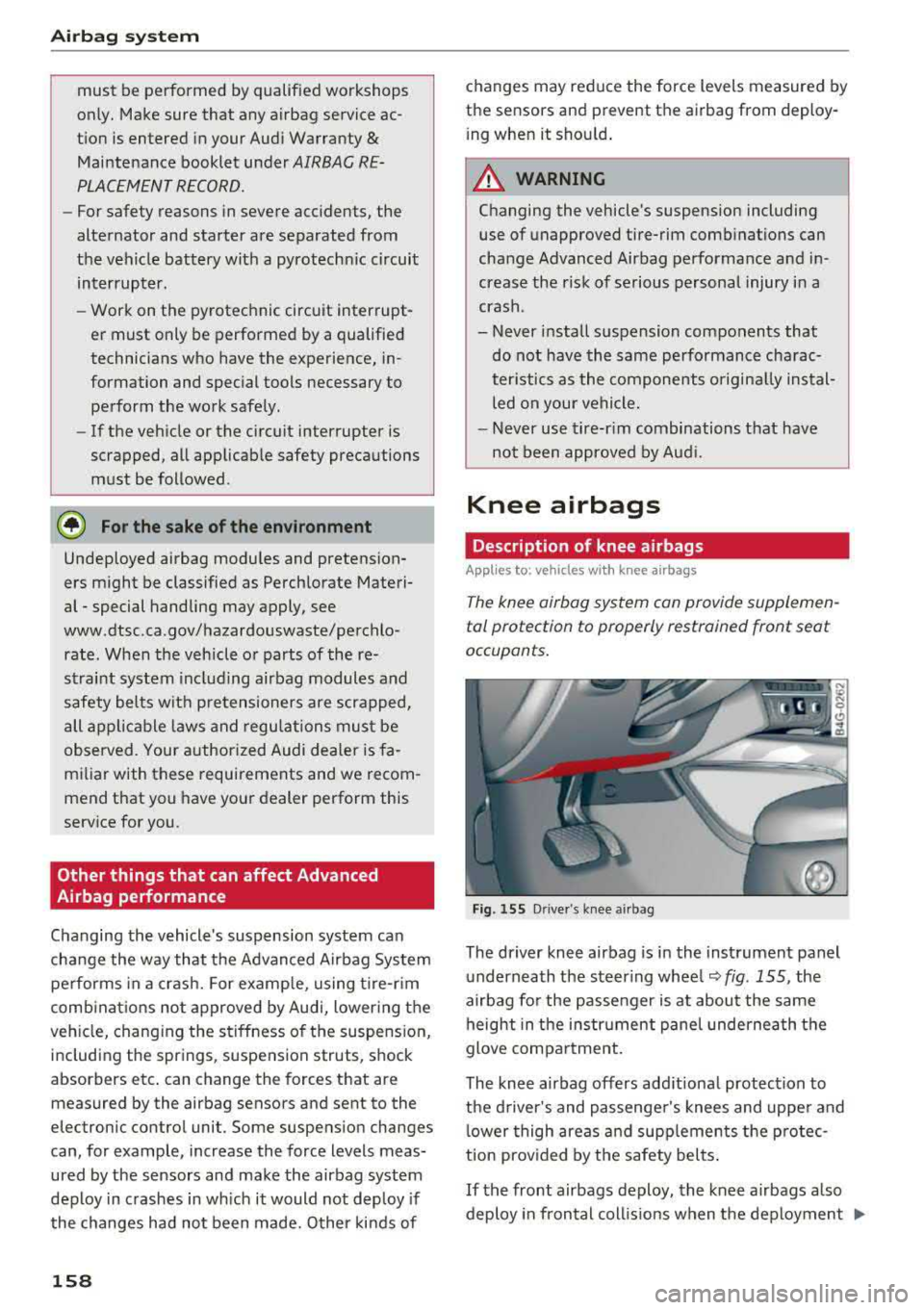
Fig . 155 Driver 's knee airbag
The driver knee airbag is in the instrument panel
underneath the steering wheel ¢
fig. 155, the
airbag for the passenger is at about the same height in the instrument panel underneath the
glove compartment.
The knee airbag offers add itional protect ion to
the driver's and passenger's knees and upper and lower thigh areas and supplements the protec
tion prov ided by the safety belts .
If the front airbags deploy, the knee airbags also
deploy in frontal coll is ions when the deployment
..,.
Page 178 of 266
Child safety
Booster seats and safety belts
Properly used booster seats can help protect
children weighing between about 40 lbs . and 80
lbs. (18 kg and 36 kg) who are less than 4
ft. 9
in. (57 inches/1.45 meters) tall .
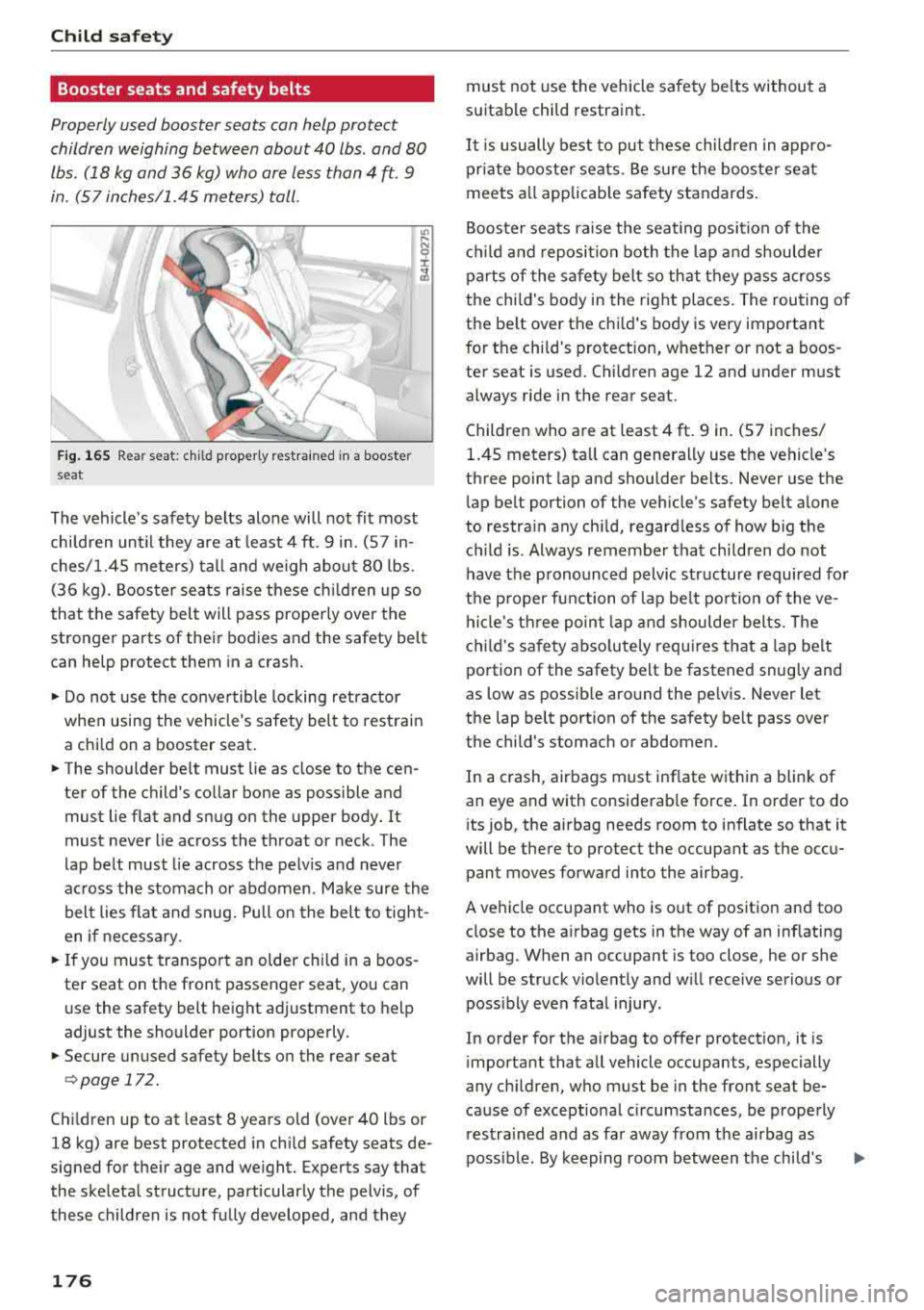
Fig. 165 Rear seat: child properly restrained in a booster
seat
The vehicle's safety belts alone will not fit most
children until they are at least 4
ft. 9 in. (57 in
ches/1.45 meters) tall and weigh about 80 lbs.
(36 kg). Booster seats raise these chi ldren up so
that the safety belt will pass properly
over the
stronger parts of their bodies and the safety belt
can help protect them in a crash.
.. Do not use the convertible locking retractor
when using the vehicle's safety belt to restrain
a child on a booster seat .
.. The shoulder belt must lie as close to the cen
ter of the child's collar bone as possible and must lie flat and snug on the upper body. It
must never lie across the throat or neck . The
lap belt must lie across the pelvis and never
across the stomach or abdomen . Make sure the
belt lies flat and snug. Pull on the belt to tight
en if necessary .
.. If you must transport an older child in a boos
ter seat on the front passenger seat, you can use the safety belt height adjustment to help
adjust the shoulder portion properly .
.. Secure unused safety belts on the rear seat
c>page 172.
Children up to at least 8 years old (over 40 lbs or
18 kg) are best protected in child safety seats de
signed for their age and weight. Experts say that
the skeletal structure, particularly the pelvis, of
these children is not fully developed, and they
176
must not use the vehicle safety belts without a
suitable child restraint .
It is usually best to put these children in appro
priate booster seats. Be sure the booster seat
meets all applicable safety standards.
Booster seats raise the seating position of the
child and reposition both the lap and shoulder
parts of the safety belt so that they pass across
the child's body in the right places. The routing of
the be lt over the child's body is
very important
for the child's protection, whether or not a boos
ter seat is used. Children age 12 and under must
always ride in the rear seat.
Children who are at least 4
ft. 9 in. (57 inches/
1.45 meters) tall can generally use the vehicle 's
three point lap and shoulder belts. Never use the
lap belt portion of the vehicle's safety belt alone
to restrain any child, regardless of how big the
c hi ld is. Always remember that children do not
have the pronounced pelvic structure required for
the proper function of lap belt portion of the
ve
hicle's three point lap and shoulder belts. The
child's safety absolutely requires that a lap belt
portion of the safety belt be fastened snugly and
as low as possible around the pelvis. Never let
the lap belt portion of the safety belt pass over
the child's stomach or abdomen.
In a crash, airbags must inflate within a blink of
an eye and with considerable force. In order to do its job, the airbag needs room to inflate so that it
will be there to protect the occupant as the occu pant
moves forward into the airbag .
A vehicle occupant who is out of position and too close to the airbag gets in the way of an inflating
airbag. When an occupant is too close, he or she
will be struck violently and will receive serious or possibly even fatal injury .
In order for the airbag to offer protection, it is
important that all vehicle occupants, especially
any children, who must be in the front seat be
cause of exceptional circumstances, be properly
restrained and as far away from the a irbag as
possible. By keeping room between the child's
.,..
Page 204 of 266
Wheels
Tire designations
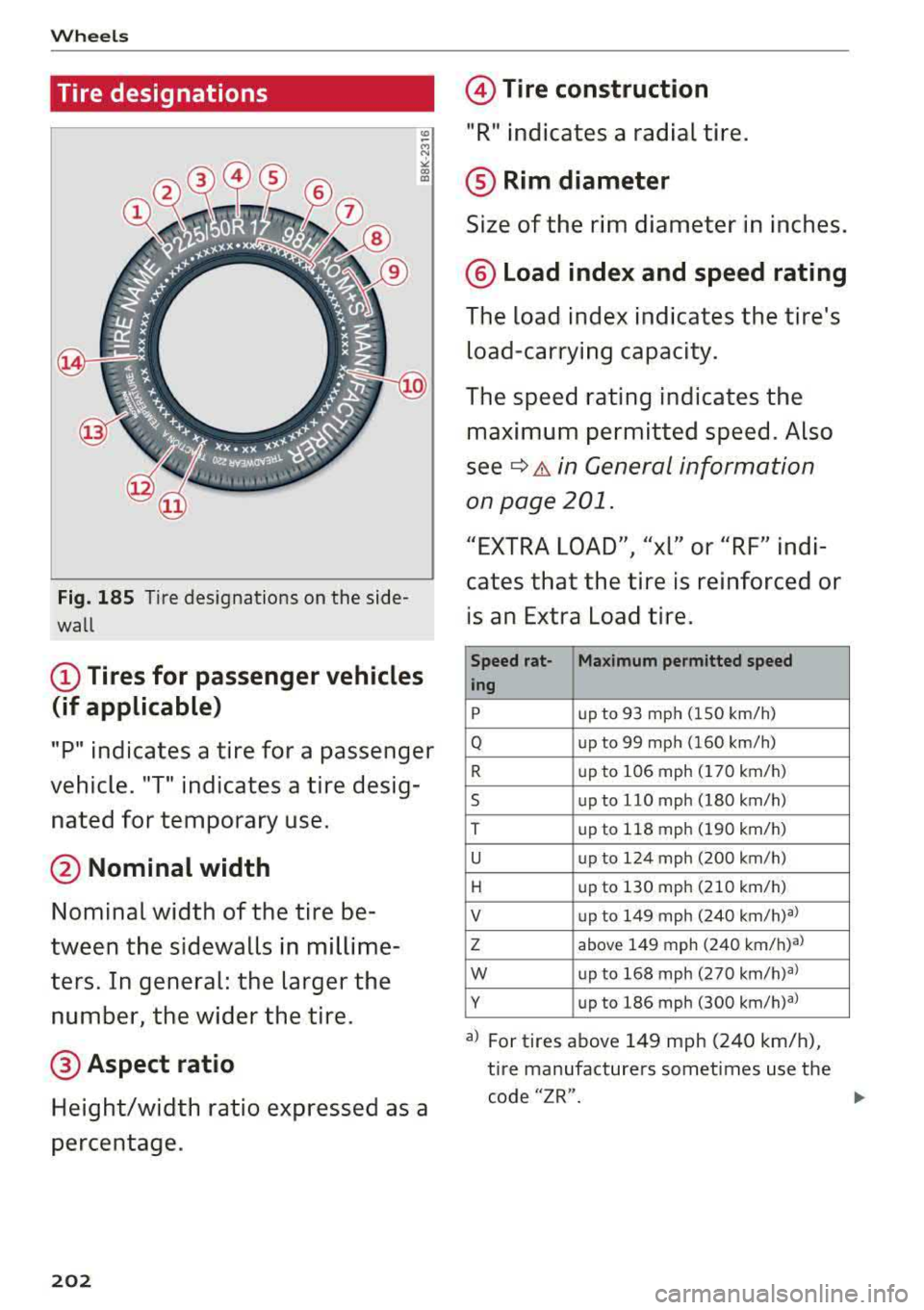
Fig. 185 Tire designations on the side
wall
(D Tires for passenger vehicles
(if applicable)
"P" indicates a tire for a passenger
vehicle. "T" indicates a tire desig
nated for temporary use.
@ Nominal width
Nominal width of the tire be
tween the sidewalls in millime
ters. In general: the larger the
number, the wider the tire.
@ Aspect ratio
Height/width ratio expressed as a
percentage.
202
@ Tire construction
"R" indicates a radial tire.
® Rim diameter
Size of the rim diameter in inches.
® Load index and speed rating
The load index indicates the tire's
load-carrying capacity.
The speed rating indicates the maximum permitted speed. Also
see
¢ A in General information
on page 201.
"EXTRA LOAD", "xl" or "RF" indi
cates that the tire is reinforced or
is an Extra Load tire.
Speed rat-
Maximum permitted speed
ing
p
up to 93 mph (150 km/h )
Q up to 99 m ph (1 60 km/h)
R up to 106 mph (170 km /h)
5 up to 11 0 mph (180 km/h)
T up to 118 mph (190 km/h)
u up to 124 mph (200 km /h)
H up to 130 mph (210 km/h)
V up to 149 mph (240 km /h)al
z a bov e 149 mph (240 km/h) al
w up to 168 mph (270 km /h) al
y up to 186 mph (300 km /h) al
a ) For tires above 149 mph (240 km/h),
tire manufacturers sometimes use the
code "ZR" .
Page 206 of 266
Wheel s
Glossary of tire and loading
terminology
Accessory weight
means the combined weight (in
excess of those standard items
which may be replaced) of auto matic transmission, power steer
ing , power brakes , power win
dows , power seats, radio, and
heater, to the extent that these
items are available as factory-in
stalled equipment (whether in
stalled or not).
Aspect ratio
means the ratio of the height to
the width of the tire in percent. Numbers of 55 or lower indicate a
low sidewall for improved steer
ing response and better overall
handling on dry pavement .
Bead
means the part of the tire that is
made of steel wires, wrapped or
reinforced by ply cords and that is
shaped to fit the rim.
Bead separation
means a breakdown of the bond
between components in the bead.
20 4
Cord
means the strands forming the
plies in the tire.
Cold tire inflation pressure
means the t ire pressure recom
mended by the vehicle manufac
turer for a tire of a designated
size that has not been driven for
more than a couple of miles (kilo
meters) at low speeds in the
three hour period before the tire pressure is measured or adjusted.
Curb weight
means the weight of a motor ve
hicle w ith standard equipment in
cluding the maximum capacity of
fuel, oil, and coolant, ai r condi
tioning and additional weight of
optional equipment.
E x tra load ti re
means a tire designed to operate
at higher loads and at higher in
flation pressures than the corre
sponding standard tire. Extra load
tires may be identified as "X L",
"
l" "EXTRA LOAD" or "RF" on X I I
the sidewall. .,.
Page 219 of 266
a co .... N
" N .... 0 0 \,;J '
You can also use all season tires instead of
winter tires . Please note that in some coun
tries where winter tires are required, only
winter tires with
the ~ symbol may be per
mitted.
Snow chains
Snow chains not only improve the driving in win
ter road conditions, but also the braking .
.. Only install snow chains on the front wheels.
This applies also to vehicles with all wheel
drive* .
.. Check and correct the seating of the snow
chains after dr iv in g a few feet, if necessary . Fol
low the instructions from the manufacturer .
.. Note the maximum speed of 30 mph (SO km/
h). Note the loca l regulations.
Use of snow chains is only perm itted with certain
rim/tire combinations due to technical reasons.
Check with an authorized Audi dealer or author
ized Audi Service
Facility to see if you may use
snow chains.
You must remove the snow chains on roads with
out snow. Otherwise, you could impair driving
ability and damage the tires.
A WARNING
Using incorrect snow chains or installing snow
chains incorrectly can result in loss of vehicle
control, which increases the risk of an acci
dent .
{[J) Note
- Snow chains can damage the rims/wheel
covers* if the chains come into direct con
tact with them . Remove the wheel covers*
first . Use coated snow chains.
- Using snow chains that add more than 0.4
inch (10.5 mm) of height can severely dam
age the wheel housings and other vehicle
components.
- Do not install and use snow chains if there is
a malfunction in the air suspension*, be
cause the vehicle height will be very low. If
Wheels
you drive with snow chains anyway, the
wheel housings and other vehicle compo
nents can be severely damaged.
(D Tips
When using snow chains, it may be useful to
switch on sport
mode¢ page 120.
Low-profile tires
Applies to: vehicles with low-profile tires
Compared to other tire/rim combinations, low
profile tires offer a wider tread surface and a
larger rim diameter with shorter tire sidewalls.
This results in an agile driving style . However, it
may reduce the level of comfort and increase
road noise when driving on roads in poor condi
tion.
Low -profile tires can become damaged more
quickly than standard tires when driving over
large bumps, potholes, manhole covers , and
curbs . Therefore, it is particularly important to
maintain the correct tir e pressure
¢ page 211.
To reduce the risk of damage to the tires and
rims, drive very carefully on poor roads.
Check your wheels regularly every 2,000 mi
(3,000 km) for damage . For example, check for
bulges/cracks on the tires or deformations/
cracks on the rims.
After a heavy impact or damage, have the tires
and rims inspected or replaced immediately by
an authorized Audi dealer or authorized Audi
Service Facility.
Low-profile tires can wear out faster than stand
ard tires .
Uniform tire quality grading
-Tread wear
- Traction AA ABC
- Temperature ABC
Quality grades can be found where applicable on
the tire side wall between tread shoulder and maximum section width
¢ page 202, fig. 185 .
217
Page 232 of 266
Emergency assistance
sill and the movable base @ lies flat on the
ground . The base @ must be
vertical under the
lifting point @ .
.. Wind the jack up further until the flat tire
comes off the ground
¢ .&_ .
Position the vehicle jack only under the designat
ed lifting points on the sill
¢ fig. 195. There is ex
actly
one location for each wheel. The jack must
not be positioned at any other
location ¢ £¢(D .
An unstable surface under the jack can cause the
vehicle to slip off the jack . Always provide a firm
base for the jack on the ground. If necessary
place a sturdy board or similar support under the
jack . On
hard, slippery surfaces (such as tiles)
use a rubber mat or similar to prevent the jack
from
slipping ¢& .
,&. WARNING
-
-Yo u or your passengers could be injured
wh ile chang ing a wheel if you do not follow
these safety precautions:
- Position the vehicle jack only at the desig
nated lifting points and align the jack .
Otherw ise, the vehicle jack could slip and
cause an injury if it does not have suffi
cient hold on the vehicle.
- A soft or unstable surface under the jack
may cause the vehicle to slip off the jack.
Always provide a firm base for the jack on
the ground.
If necessary, use a sturdy
board under the jack .
- On hard, s lippery surface (such as tiles)
use a rubber mat or similar to prevent the
jack from slipping.
- T o help prevent injury to yourself and yo ur
passengers:
- Do not raise the vehicle until you are sure
the jack is securely engaged .
- Passengers must not remain in the vehicle
when it is jacked up.
- Make sure that passengers wait in a safe
place away from the vehicle and well away
from the road and traff ic.
- Make sure jack position is correct, adjust as necessary and then cont inue to raise
the jack.
230
- Changes in temperature or load can affect
the height of the vehicle.
(D Note
Do not lift the veh icle by the si ll. Position the
vehicle jack only at the designated lifting
points on the sill. Otherwise, your vehicle will
be damaged.
(D Tips
The vehicle jack mode * switches off automati
cally at speeds above 6 mph (10 km/h).
Removing and installing the sill extension
cover
App lies to: vehicles with sill extension
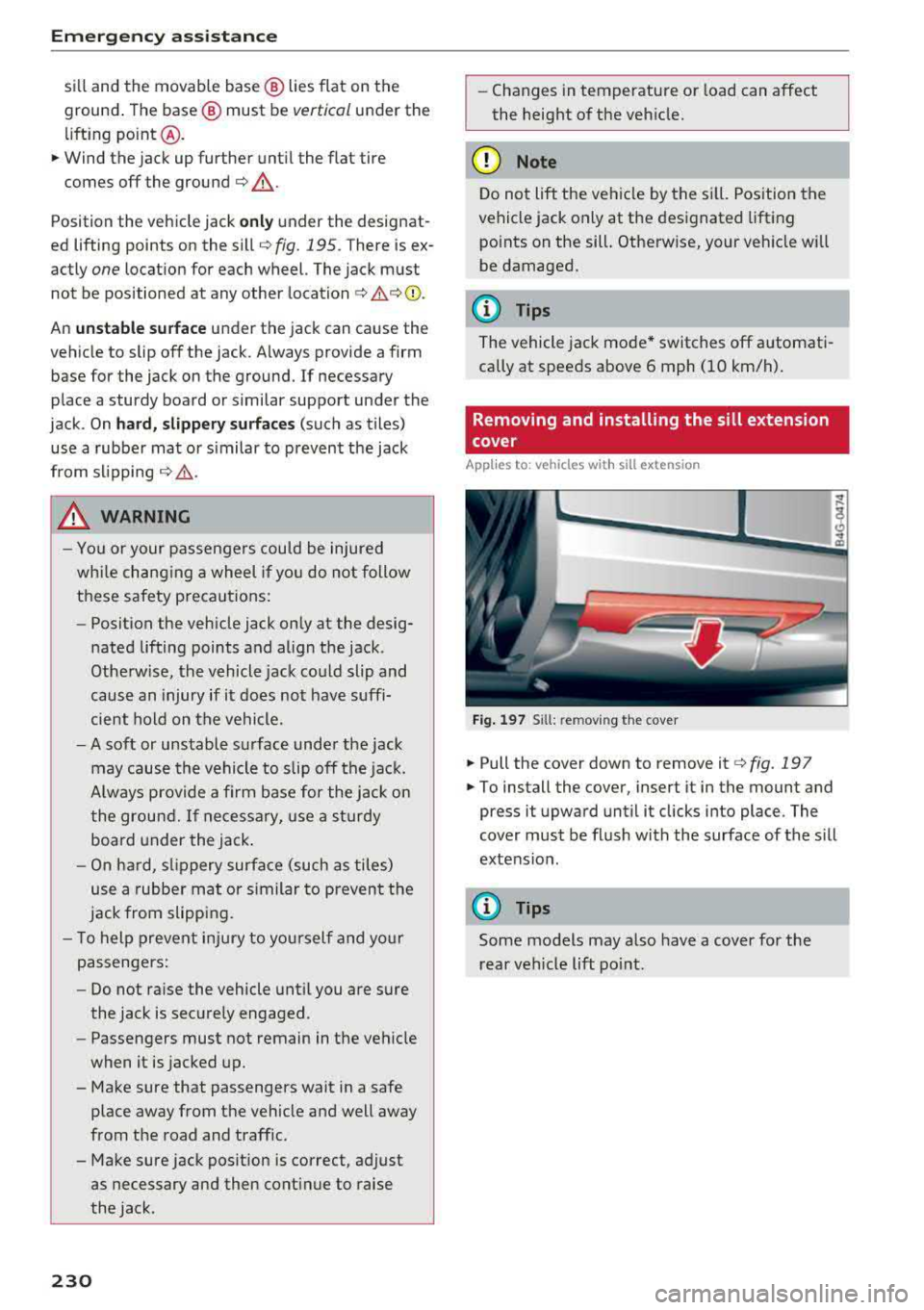
Fig. 197 Sill : re m ov ing the cover
.. Pull the cover down to remove it ¢ fig. 197
.. To install the cover, insert it in the mount and
press it upward until it clicks into place. The
cover must be flush with the surface of the sill
extens ion .
@ Tips
Some models may also have a cover for the
rear vehicle lift point.
Page 247 of 266
a co ,...,
N
" N ,...,
0 0 \,;J "
Vehicle specifications
XXXXX XX -X -XXXX XXX XX
®-+ : ::::::. XXXXXXXX XX X XX XXX XXX
IYP /lffl XXX XXX
XX XXXXXXX XX X X XX
XXX KW XXX
®i ~=-:~~ XXXX XXX XXX
©+ ~ rur:i~ xxxx I xxxx XXX I xx
II. · AIJSlit I OPTIONS
EOA 7D 5 4U B 6XM SSG SR W
2 EH JO Z 1LB 1AS 1BA
3FC SM U 7Xl
F O A 9G3 OG7 O YH OJF
TL 6 3 KA 8EH UlA X 9B OZ7
l XW
803
908 8Z4 020
7 T6 CV7
71<0 4X3 21< 2
3L4 4 KC 3YO 413 5 02
1S A 7GB
01A 4GQ
XX . X XX X XX X XXXX
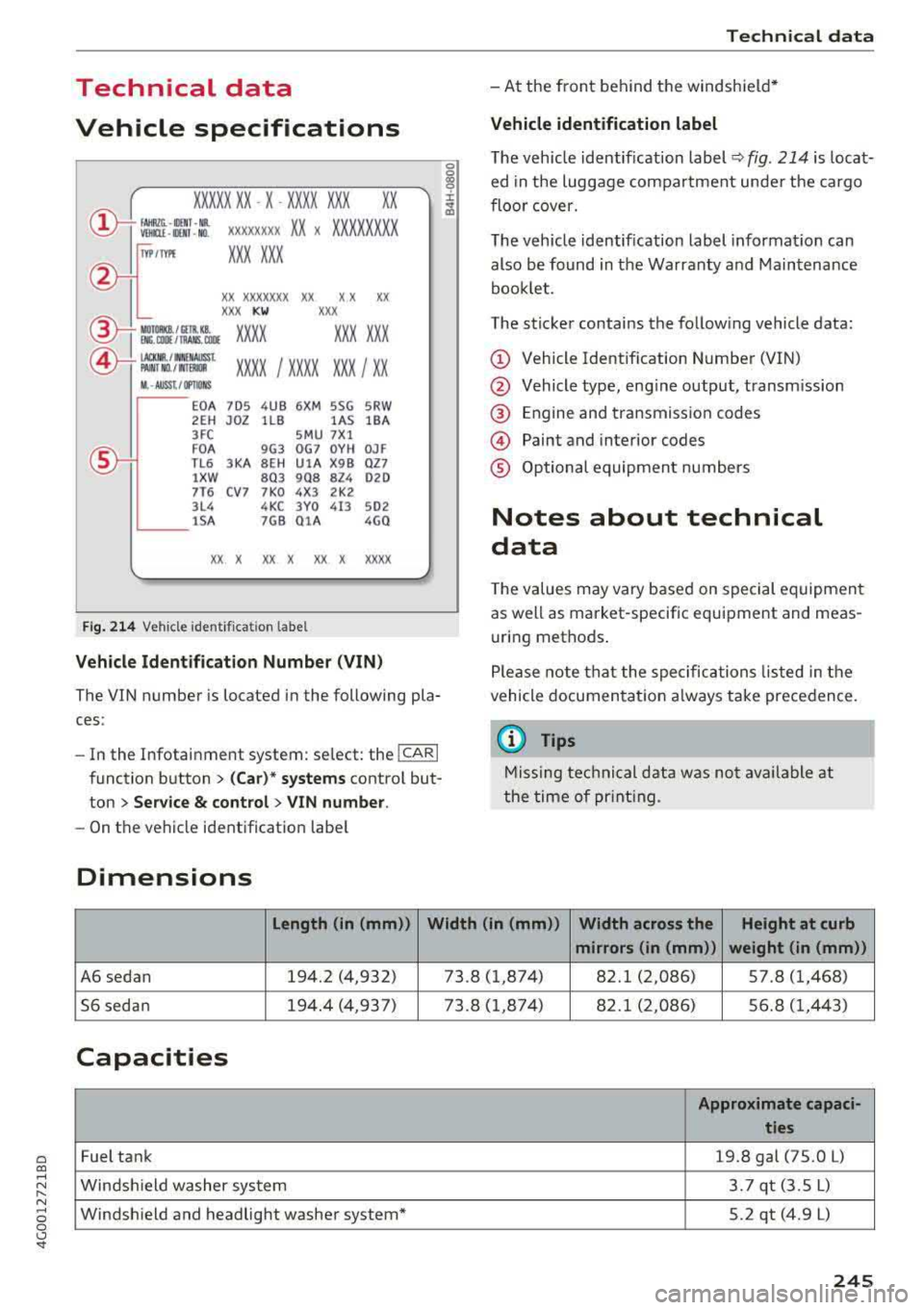
Fig. 21 4 Vehicle ident ifica tion labe l
Vehicle Ident ifi cation Number (VIN )
The VIN number is located in the following pla
ces :
-In the Infotainment system: select: the !CARI
function button > (C ar) * systems contro l but
ton
> Se rvice & control > VIN numbe r.
-On the vehicle identification label
Dimensions
0
0
~ :x:
-At the front behind the windshield *
Vehicle identification label
The vehicle identif ication label ~ fig. 214 is loca t·
ed in the luggage compartment unde r the cargo
floor cover.
The veh icle identification label informat ion can
also be found in the Warranty and Maintenance
booklet .
The sticker contains the follow ing vehicle data :
© Vehicle Identification Number (VIN)
@ Vehicle type, eng ine output, transm ission
@ Engine and transmission codes
@ Paint and interior codes
® Optional equipment numbers
Notes about technical
data
T he values may vary based on special equipment
as well as market-specif ic equipment and meas
uring methods .
Please note that the specific ations listed in the
vehicle documen tat ion a lways take precedence.
{I) Tips
Missing techni cal data was not ava ilable at
the time of pr int ing.
Length (in (mm )) Width (in (mm ))
Width across the Height at curb
mirrors (in (mm )) weight (in (mm))
A6 sedan 194.2 (4,932) 73.8 (1,874) 82.1 (2,086) 5 7 .8 (1,468)
56 sedan 194.4 (4,937) 73 .8
(1 ,874) 82.1 (2,086) 56.8 (1,443)
Capacities
Approximate capaci -
ties
Fuel tank 19.8 gal (75.0 L)
Windsh ield washer system 3.7 qt (3.5 L)
Windsh ield and headlight washer system* 5.2 qt (4.9 L)
245
Page 261 of 266

a co .... N
" N .... 0 0 \,;J '
Rear window defogger (4-zone deluxe auto
matic climate control) . . . . . . . . . . . . . . . . . . 62
Rear window defogger (deluxe automatic cli
mate control) . . . . . . . . . . . . . . . . . . . . . . . . . 60
Rear window shade . . . . . . . . . . . . . . . . . . 43, 44
Recirculation mode (4-zone deluxe automatic
climate control) . . . . . . . . . . . . . . . . . . . . . . . 61
Recirculation mode (deluxe automatic climate
control) . . . . . . . . . . . . . . . . . . . . . . . . . . . . . . 59
Recuperation . . . . . . . . . . . . . . . . . . . . . . . . . 20
Refueling . . . . . . . . . . . . . . . . . . . . . . . . . . . . 186
Fuel filler door emergency release . . . . . . 188
Remote control
refer to Remote control key . . . . . . . . . . . . 25
Remote control key . . . . . . . . . . . . . . . . . . . . 25
LED . . . . . . . . . . . . . . . . . . . . . . . . . . . . . . . . 26
Personali zing . . . . . . . . . . . . . . . . . . . . . . . . 25
Replacing the battery . . . . . . . . . . . . . . . . . 26
Unlocking/locking . . . . . . . . . . . . . . . . . . . . 27
Remote control operation
Garage door opener (Homelink) . . . . . . . . . 36
Removing the side tr im panel in the luggage
compartment . . . . . . . . . . . . . . . . . . . . . . . . 188
Repair manuals . . . . . . . . . . . . . . . . . . . . . . . 247
Repairs Airbag system . . . . . . . . . . . . . . . . . . . . . . 157
Replacement key . . . . . . . . . . . . . . . . . . . . . . 25
Replacing Light bulbs . . . . . . . . . . . . . . . . . . . . . . . . . 238
Replacing windshield wiper b lades . . . . . . . . 45
Reporting Safety Defects . . . . . . . . . . . 132 , 133
Reset button (trip odometer) . . . . . . . . . . . . 22
Resetting the trip odometer . . . . . . . . . . . . . 22
Residual heat (4-zone deluxe automatic cli-
mate control) . . . . . . . . . . . . . . . . . . . . . . . . . 62
Retractor . . . . . . . . . . . . . . . . . . . . . . . . . . . . 13 7
Reverse gear (automatic transmission) ..... 75
Rims . . . . . . . . . . . . . . . . . . . . . . . . . . . . . . . 216
Road carrier . . . . . . . . . . . . . . . . . . . . . . . . . 244
Roof load . . . . . . . . . . . . . . . . . . . . . . . . . S4, 246
Roof rack . . . . . . . . . . . . . . . . . . . . . . . . . . . . . 54
also refer to Roof rack . . . . . . . . . . . . . . . . . 54
Index
s
Safe driving habits . . . . . . . . . . . . . . . . . . . . 125
Safety . . . . . . . . . . . . . . . . . . . . . . . . . . . . . . 12S
Airbag system . . . . . . . . . . . . . . . . . . . . . . 142
Belts . . . . . . . . . . . . . . . . . . . . . . . . . . . . . . 134
Cargo . . . . . . . . . . . . . . . . . . . . . . . . . . . . . 130
Correct seating position . . . . . . . . . . . . . . 126
Pedal area . . . . . . . . . . . . . . . . . . . . . . . . . . 130
Safety belt position . . . . . . . . . . . . . . . . . . . 138
Safety belt height adjustment . . . . . . . . . 139
Safety belts worn by pregnant women . . . 139
Safety belt pretensioner Service and disposal . . . . . . . . . . . . . . . . . . 141
Saf ety be lts ...................... 134, 137
Cleaning . . . . . . . . . . . . . . . . . . . . . . . . . . . 223
Danger to passengers who do not wear a
safety belt . . . . . . . . . . . . . . . . . . . . . . . . . 135
Fastening . . . . . . . . . . . . . . . . . . . . . . . . . . 137
Height adjustment . . . . . . . . . . . . . . . . . . . 139
Improperly worn . . . . . . . . . . . . . . . . . . . . 140
Indicator light (front) . . . . . . . . . . . . . . . . . 14
Not worn . . . . . . . . . . . . . . . . . . . . . . . . . . 13S
Safety belt position . . . . . . . . . . . . . . . . . . 138
Safety instructions . . . . . . . . . . . . . . . . . . . 136
Securing child safety seats . . . . . . . . . . . . 177
Special considerations for pregnant wom- en . . . . . . . . . . . . . . . . . . . . . . . . . . . . . . . . 139
Unfastening . . . . . . . . . . . . . . . . . . . . . . . . 139
Warning/indicator light . . . . . . . . . . . . . . 134
Worn properly . . . . . . . . . . . . . . . . . . . . . . 136
Safety be lt warning light . . . . . . . . . . . . . . . 134
Safety instructions
for side curtain airbags . . . . . . . . . . . . . . . 165
for using child safety seats . . . . . . . . . . . . 170
for using safety belts . . . . . . . . . . . . . . . . . 136
Monitoring the Advanced Airbag System 156
Saving fuel Cylinder on demand system . . . . . . . . . . . . 20
Efficiency program . . . . . . . . . . . . . . . . . . . . 21
Recuperation . . . . . . . . . . . . . . . . . . . . . . . . 20
Screwdriver . . . . . . . . . . . . . . . . . . . . . . . . . . 226
Seat adjustment Head restraints . . . . . . . . . . . . . . . . . . . . . 128
Seat heating (4-zone deluxe automatic cli-
mate control) . . . . . . . . . . . . . . . . . . . . . . . . . 61
Seat heating (deluxe automatic climate con-
trol) . . . . . . . . . . . . . . . . . . . . . . . . . . . . . . . . . 60
259