weight AUDI A6 2018 User Guide
[x] Cancel search | Manufacturer: AUDI, Model Year: 2018, Model line: A6, Model: AUDI A6 2018Pages: 266, PDF Size: 41.38 MB
Page 150 of 266
Airbag syste m
The front Advanced Airbag System for the front
seat occupants is not a substitute for your safety
be lts. Rather, it is part of the overa ll occupant re
stra int system in your vehicle. Always remember
that the airbag system can on ly help to protect
you, if you are sitting upr ight, wearing your safe
ty belt and wearing it properly . This is why you
and your passengers must always be properly re
stra ined, not just because the law requ ires you to
be.
The Advanced Airbag System in your veh icle has
been cert ified to meet the " low r isk" requ ire
ments for 3 and 6 yea r-o ld children o n the pas
senge r side and very sma ll adul ts on the d river
side . The low r isk dep loymen t cr iteria are intend
ed to he lp reduce t he risk of injury through inter
action with the front airbag that can occur, for
examp le, by being too close to the steering wheel
and instrument panel when the airbag inflates .
I n addition, the system has been certified to
comp ly with the "suppression" requirements of
the Safety Standard, to turn off the front airbag
for infants 12 months old and younger who are
restrained on the front passenger seat in ch ild re
stra ints that are listed in the Standard
c::> page 168, Child restraints and Advanced front
airbag system.
"Suppression" requ ires the front a irbag on the
passenger side to be turned off if:
- a chi ld up to about one year of age is restra ined
on the front passenger seat in one of the rear
facing or forward-facing infant restraints listed
in Federal Motor Vehicle Safety Standard 208
with wh ich the Advanced Airbag System in your
vehicle was ce rt ified . For a listing of the ch ild
r estra ints tha t were used to certify your veh i
cle's compl ian ce with the US Safety Standard
c::> page 168,
-When a person is detected on the fron t passen
ger seat th at has an electr ica l capacitance t hat
is mo re than the tota l electrical capac itance of
a chi ld that is about 1 year old restrained in one
of the rear -facing or forward-facing infant re
straints (listed in Federal Motor Vehicle Safety Standard 208 with w hich the Advanced A irbag
System in your veh icle was certified) , the front
148
airbag on the passenger side may or may not
dep loy.
The
PASSENGER AIR BAG OFF lig ht comes o n
whe n the ele ct ronic control unit detec ts a t otal
e lectrica l capacitance on the front passenger seat
that requires the front airbag to be turned off. If
t h e
PASSENGER AIR BAG OFF light does not
come on, the front airbag on the passenger side
has not been turned off by the contro l unit and
can deploy if the contro l unit senses an impact
that meets the cond itions stored in its memory .
If the total e lectr ica l capacitance registered on
the front passenger seat is more than that of a
typ ica l 1 year-old, but less than the weight of a
small adult, the front a irbag on the passenger
s ide may deploy (the
PASSENGER AIR BAG OFF
li ght does not come on).
For e xample, th e airb ag may deploy if :
- a small ch ild that is heav ier than a typica l 1
year-old child is on the front passenger seat (regard less of whether the child is i n one of the
child seats listed
c::> page 168),
-a child who has outgrown c hild restraints is on
the front passenger seat .
If the front passenger airbag is turned off, the
PAS SENGER AIR BAG O FF light in the center of
the instrument panel will come on and stay on.
If the front passenger airbag dep loys, the Feder
al Standard requires the airbag to meet the "low
risk" dep loyment criteria to help reduce the r isk
of injury t hrough interaction with the airbag.
"Low risk" deployment occurs in those crashes
that take p lace at lower decelerations as defined
i n the elect ronic co ntrol unit
c::> page 154 .
Always remember : Even though your vehicle is
equipped with Advanced Airbags, the safest place
for ch ildre n is properly restra ined on the back
seat. Please be su re to read the impo rtant info r
mation in the sect ions that fo llow and be sure to
heed all of the WARNINGS.
_&. WARNING
T o redu ce the r is k of injury when an air ba g i n-
flates, always wear safety be lts prope rly.
II)>
Page 158 of 266
Airbag syste m
If the PA SSENGE R AIR BAG light still do es
not c om e on ...
If the PASSENGER AIR B AG OFF light still does
not come on and does not stay on continuously
(when the ignition is switched on),
- take the child restraint off t he front passenger
seat and install it properly at one of the rear
seat positions. Have the airbag system inspect ed by your Audi dealer immediately .
- move the chi ld to a rear seat position and make
sure that the child is properly restra ined in a
child restraint that is appropriate for its size
and age .
The PASSENG ER AIR BAG light should NOT
come on ...
The PA SSENGER AIR B AG OFF light shou ld NOT
come on whe n the ignition is on and an adult is
sitt ing in a proper seating position on the front
passenger seat . If the
PASSENGER AIR BAG OFF
light comes on and stays on or flashes for about
S seconds wh ile d riving, under these circ umstan
ces, make s ure that:
- the adult on the front passenger seat is proper
ly seated on the center of the seat cushion with
his or her back up ag ainst the ba ckrest and the
ba ckrest is not re clined,
- the adu lt is not ta king weig ht off t he seat by
hold ing on to the passenger assist handle
above the front passenger door or s upporting
their weight on the armrest,
- the safety be lt is be ing p roperly wo rn and that
the re is not a lot of slack in the sa fety be lt web
bing,
- the re are no aftermarket seat covers or cush
ions or other things (such as blankets) on the
front passenger seat that might cause the ca
pacitive passenger detection system to miscal
cu late electrical capacitance.
Important safety instructions on
monitoring the Advanced Airbag System
A WARNING
- If the status of the Adv a need Airbag System
has changed while the vehicle is moving, the
PA SSENGER AIR BAG OFF light blinks for
156
about S seconds to catch the driver's atten
tion. If this happens, always stop as soon as it is safe to do so and check the steps descri
bed above .
- If the
PA SS EN GER AIR BAG OFF light does
not go off when an adult who is not very
small is sitting on the front passenger seat
after taking the steps described above, make sure the adu lt is properly seated and
restrained at one of the rear seating posi
tions. Have the a irbag system inspected by
your author ized Audi dealer befo re trans
porting anyone on the front passenger seat .
A WARNING
An airbag system that is not functioning prop
erly cannot provide supplemental protection in a fronta l crash.
- If the airbag indicator light ¢
page 16
comes when the vehicle is being used, have
the system inspected immediately by your
author ized Audi dealer.
It is possib le that
the airbag will inflate when it is not sup
posed to, or will not inflate when it should.
A WARNING
If the front a irbag inflates, a ch ild without a
chi ld restraint, or in a rea rwa rd-facing child
safety seat, or in a forward-fac ing ch ild re
stra int that has not been prope rly insta lled
will be ser iously injured and can be killed.
- Even tho ugh you r vehicle is equipped with
an Advanced A irbag System, make certain
that a ll children, espec ia lly 12 years and
younger, always ride on the back seat prop erly rest rained for thei r age and size.
-Always install forward or rear -facing child
seats on the rear seat -even with an Ad
vanced Airbag System.
- If you must install a rearward-facing child
seat on the front passenger seat because of
except ional circumstances and the
PA SSEN
GER AIR BAG OFF
light does not appear and
stay on, immediate ly install the rear-facing
child seat in a rear seat ing pos ition and have
the airbag system inspected by your Audi
dea le r.
II)-
Page 165 of 266
a co ,...,
N
" N ,...,
0 0 \,;J '
the seam in the area of the side airbag module must always be repaired immedi
ately by an authorized Audi dealer.
- Objects between you and the airbag can in
crease the risk of injury in an accident by in
terfering with the way the airbag unfolds or
by being pushed into you as the airbag in
flates.
- Never place or attach accessories or other
objects (such as cup holders, telephone
brackets, or even large, bulky objects) on
the doors, over or near the area marked
"AIRBAG" on the seat backrests.
- Such objects and accessories can become
dangerous projectiles and cause injury
when the supplemental side airbag de
ploys .
- Never carry any objects or pets in the de
ployment space between them and the
airbags or allow children or other passen
gers to travel in this position.
- Always use the built-in coat hooks only for
lightweight clothing . Never leave any heavy
or sharp-edged objects in the pockets that
may interfere with side airbag deployment
and can cause personal injury in an accident.
- Always prevent the side airbags from being
damaged by heavy objects knocking against
or hitting the sides of the seatbacks.
- The airbag system can only be triggered
once. If the airbag has been triggered, the
system must be replaced by an authorized
Audi dealership.
- Damage (cracks, deep scratches etc.) to the
original seat covers or to the seam in the
area of the side airbag module must always
be repaired immediately by an authorized
Audi dealer.
- If children are seated improperly, their risk
of injury increases in the case of an accident
Q page 166, Child safety.
- Never attempt to modify any components of
the airbag system in any way.
- In a side collision, side airbags will not func
tion properly if sensors cannot correctly measure increasing air pressure inside the
Airbag system
doors when air escapes through larger, un
closed openings in the door panel.
- Never drive with interior door trim panels
removed.
- Never drive when parts have been re
moved from the inside door panel and the
openings they leave have not been proper
ly closed.
- Never drive when loudspeakers in the
doors have been removed unless the
speaker holes have been properly closed.
- Always make certain that openings are
covered or filled if additional speakers or
othe r equipment is installed in the inside
door panels.
- Always have work on the doors done by an
authorized Audi dealer or qualified work
shop.
Side curtain airbags
Description of side curtain airbags
The side curtain airbag system can provide sup
plemental protection to properly restrained oc
cupants .
.....
6
"' a,
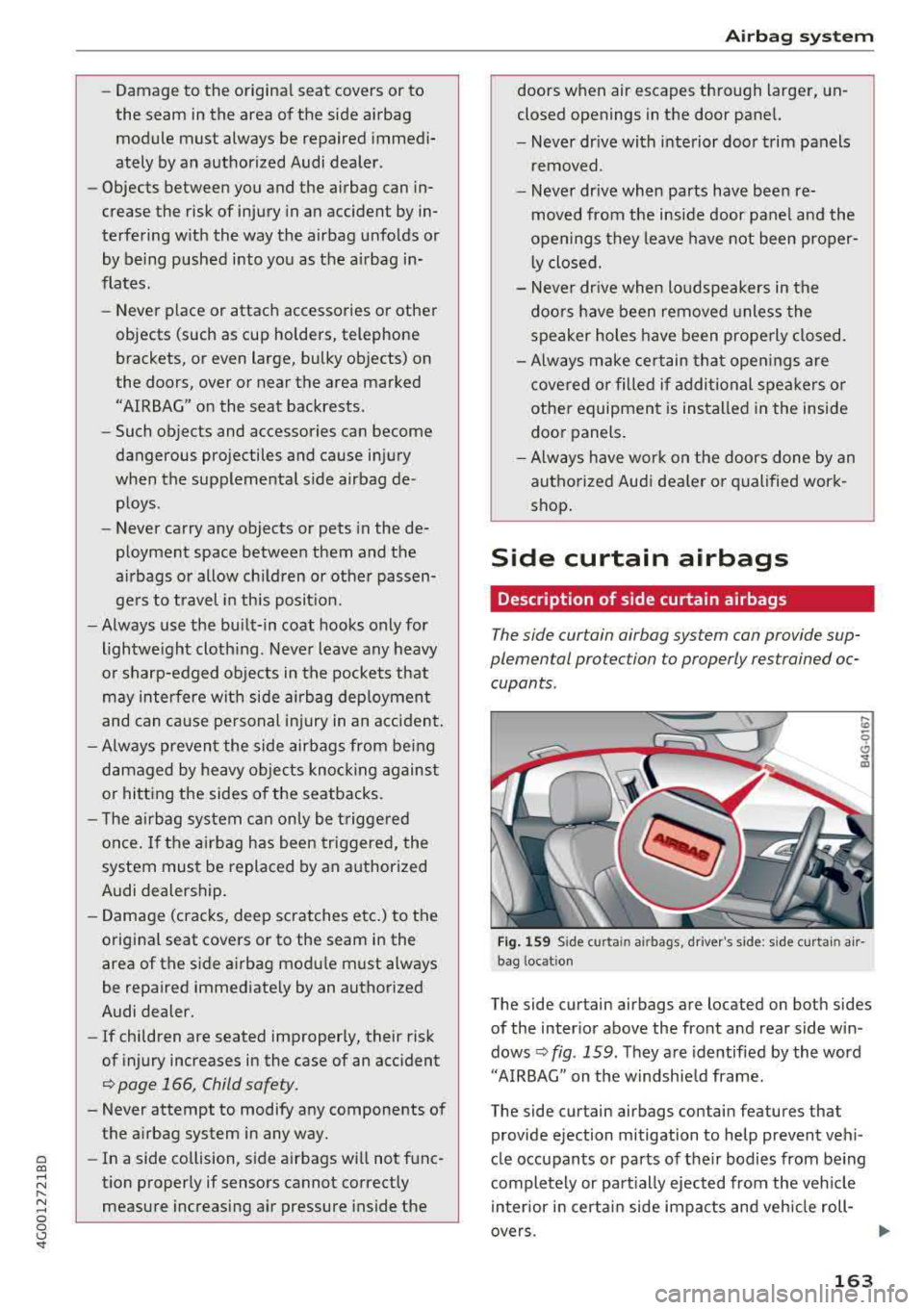
Fig. 159 Side curta in airbags, driver's side: s ide curtain air
bag locat ion
The side curtain airbags are located on both sides
of the interior above the front and rear side win
dows
Q fig . 159. They are identified by the word
"AIRBAG" on the windshield frame.
The side curtain airbags contain features that
provide ejection mitigation to help prevent vehi
cle occupants or parts of their bodies from being
completely or partially ejected from the vehicle
inter ior in certain side impacts and veh icle roll-
overs.
.,_
163
Page 168 of 266
Child safety
Child safety
Important information
Introduction
The rear seat is generally the safest place in a
collision .
The physical principles of what happens when
your vehicle is in a crash apply also to children
¢ page 135, What happens to occupants not
wearing safety belts? .
But unlike adults and
teenagers, their muscles and bones are not fully
developed. In many respects children are at
g reater r isk of serious injury in crashes than
adults .
Because children's bodies are not fully devel
oped, they require restraint systems especially
designed for their size, weight, and body struc
ture. Many countries and all states of the United
States and provinces of Canada have laws requir
ing the use of approved child restraint systems
for infants and small children .
I n a frontal crash at a speed of 20-35 mph
(30 -56 km/h) the forces acting on a 13-pound
(6 kg) infant will be more than 20 times the
weight of the child. This means the weight of the
child would suddenly be more than 260 pounds
(120 kg) . Under these conditions, only an appro
priate child restraint properly used can reduce
the risk of serious injury. Child restraints, like
adu lt safety belts, must be used properly to be
effect ive. Used improperly, they can increase the
risk of serious injury in an accident.
All ch ildren, especially those 12 years and young
er must always ride in the back seat properly re
strained for their age and size. If you must insta ll
a child restra int on the front passenger seat in
exceptional circumstances, be sure to read and
heed the important information and warnings
¢ page 143. Infants and other chi ldren who are
properly restrained in an appropriate child re
straint that is for their si ze and age can benefit
from the protection that supplemental side air
bags provide in some kinds of crashes .
For more information please see information
provided by the:
166
- National Highway Traffic Safety Administration
(NHTSA), currently at: http://
www.safercar .gov (for the USA)
- Tr ansport Canada Information Centre, current-
ly at: http ://www.tc .gc.ca (for Canada)
Consult the child safety seat manufacturer's in
structions in o rder to be sure the seat is right fo r
your c hild's
size ¢ page 170, Important safety
instructions for using child safety seats .
Please
be sure to read and heed all of the important in
format ion and WARNINGS about child safety,
Advanced Airbags, and the installation of child
restraints in this chapter .
T here is a lot you need to know about the Ad
vanced Airbags in your veh icle and how they work
when infants and children in child res traints are
on the front passenger seat . Because of the large
amount of important informat ion, we cannot re
peat it all he re . We urge you to read the detailed
info rmat ion in this owner's manual about airbags
and the Advanced Airbag System in your vehicle
and the very important information about trans
porting children on the front passenger seat.
P lease be sure to heed the WARNINGS -they are
extremely important for your safety and the safe
ty of your passengers, especially infants and
small children .
A WARNING
-Accident statistics have shown that children
are generally safer in the rear seat area than
in the front seating position. Always restrain
any child age 12 and under in the rear.
- All vehicle occupants and especially children
must be restrained properly whenever riding
in a vehicle. An unrestrained or improperly
restrained child could be injured by striking
the interior or by being ejected from the ve
hicle during a sudden maneuver or impact.
An unrestrained or improperly restrained
child is a lso at greater r isk of injury or death
through contact w ith an inflating airbag.
- A suitable ch ild restraint properly installed
and used at one of the rear seating positions
provides the highest degree of protection
for infants and small children in most acci
dent situat ions.
Page 171 of 266
a co .... N
" N .... 0 0 \,;J '
one of the rear seating positions . If in exception
a l circumstances you must use it on the front
passenger seat, carefully read all of the informa
tion on chi ld safety and Advanced Airbags and
heed all of the applicable WARNINGS . Make cer
tain that the child and ch ild restraint are correct
l y recogn ized by the capacitive passenger detec
tion system in the front passenge r seat, that the
front passenger airbag is turned off, and t hat the
airbag status is always cor rectly signaled by the
PASSENGER AIR BAG OFF light.
M any types and models of ch ild rest rai nts have
been available ove r th e yea rs , new mode ls are in
trod uced regular ly incorporat ing new and im
proved designs and older mode ls are taken out o f
production . Chi ld restraints are not standardized .
Ch ild restraints of the same type typica lly have
d ifferent weights and s izes and different "foot
prints", the size and shape of the bottom of the
child restraint that sits on the seat, when they
are installed on a vehicle seat . T hese differences
make it virtually impossible to certify compliance
w ith the requirements fo r advanced airbags with
e ach and eve ry c hild rest raint t hat has ever been
sold in the past o r will be sold over t he course o f
the useful life of your vehicle.
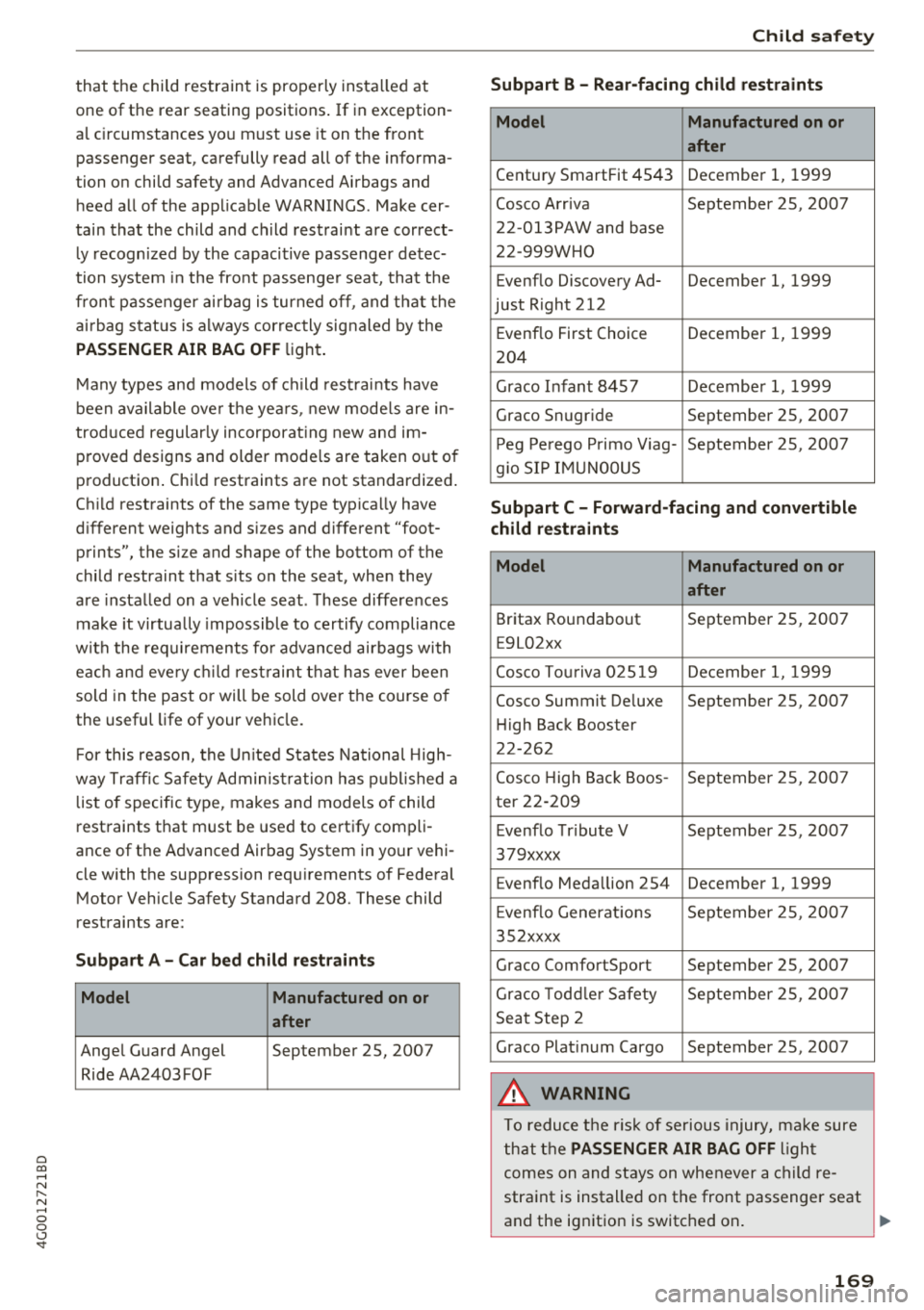
F or this reason, the U nited States National High
way Tr affic Safety Adminis tration has p ublished a
lis t of specific type, makes and models of child
restraints that must be used to certify compli
ance of th e Advanced Airbag System in your vehi
cle with the suppression requirements of Federal
Motor Vehicle Safety Standard 208. These child
restraints are:
Subpart A -Car bed child re straint s
Model Manufactured on or
after
Ange l Guard Angel September 25, 2007
Ride AA2403FOF
Ch ild saf ety
Subpart B -Rear-facing child restraints
Model Manufactured on or
after
Century SmartFit 4543 December 1, 1999
Cosco Arr iva September 25, 2007
22-013PAW and base
22 -999WHO
Evenflo Discovery
Ad-December 1, 1999
just Right 212
E venflo First Choice December 1, 1999
204
Graco Infant 8457 December 1, 1999
Graco Snug ride September 25, 2007
P eg Pe rego P rimo Viag- September 25, 2007
g io SI P IM UNOOUS
Subpart C -Forward -facing and convertible
child restraints
Model Manufactured on or
after
Britax Roundabout September 25, 2007
E9L02xx
Cosco Tou riva 025 19 Decembe r 1, 1999
Cosco Summit De luxe September 25, 2007
H igh Back Booster
22-262
Cosco High Back Boos -September 25, 2007
ter 22 -209
E venflo Tr ibute V September 25, 2007
379xxxx
Evenflo Medallion 254 December 1, 1999
E venflo Generat io ns September 25, 200 7
352xxxx
Graco ComfortSport September 25, 2007
Graco Todd le r Safety September 25, 200 7
Seat Step 2
Graco Platinum Cargo September 25, 2007
A WARNING
To reduce the r isk of serious injury, ma ke sure
that the
PASSENGER AIR BAG OFF l ight
comes on and stays on whenever a chil d re
straint is installed on the front passenger seat
and the ignition is switched on .
169
Page 172 of 266
Child sa fety
- Take the chi ld restraint off the front passen
ger seat and insta ll it proper ly at one of the
rear seat positions if the
PA SSEN GER AIR
BA G OFF
light does not stay on.
- Have the airbag system inspected by your
authorized Aud i dealer immediately.
(D Tips
The chi ld seats listed in categories A to C have
been statica lly tested by Aud i only for the Ad
vanced Airbag function.
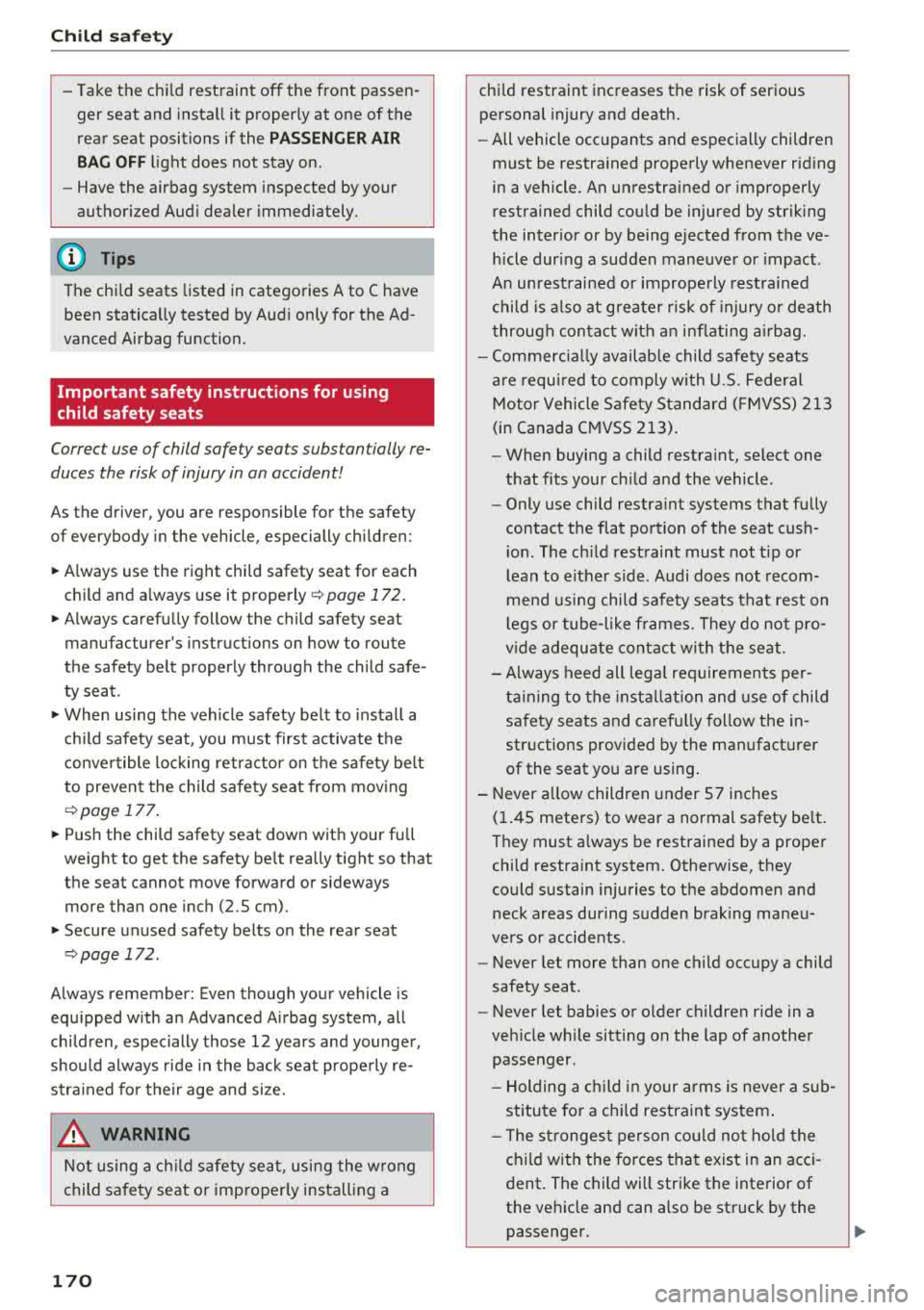
Important safety instructions for using
child safety seats
Correct use of child safety seats substantially re
duces the risk of injury in an accident!
As the driver, you are responsible for the safety
of everybody in the vehicle, especially chi ldren:
~ A lways use the right chi ld safety seat for each
c h ild and a lways use it properly
¢ page 172.
~ Always carefully follow the child safety seat
manufacturer's instructions on how to route
the safety belt properly through the child safe
ty seat .
~ When using the vehicle safety be lt to insta ll a
c hi ld safety seat , you must first activate the
conve rtible locking retractor on the safety be lt
to prevent the child safety seat from mov ing
¢ page 177 .
~ Push the child safety seat down wit h your fu ll
weight to get the safety be lt really tight so that
the seat cannot move forward or sideways
more than one inch (2.5 cm).
~ Secure unused safety belts on the rear seat
¢ page 172 .
Always remember: Even though your vehicle is
equ ipped w ith an Advanced Airbag system, all
children, especially those 12 years and younger,
should always r ide in the back seat prope rly re
stra ined fo r th eir age and size.
_& WARNING
N ot using a c hild safety seat, usi ng the w rong
c hild safety seat or imp roper ly installing a
170
chi ld restraint increases t he risk of serious
personal injury and death.
- All vehicle occ upants and especially children
must be restra ined properly whenever rid ing
in a vehicle. An unrestrained or improperly
restrained child cou ld be injured by strik ing
the inter ior or by being ejected from the ve
h icle dur ing a sudden maneuve r o r i mpact.
An unrest rained or imprope rly rest rai ned
child is a lso at g rea ter r is k of inj ury o r death
through con ta ct w it h an infl ati ng a irbag.
- Commerc ia lly availab le child safety seats
a re requ ired to comply with U.S. Federal
Motor Vehicle S afety Standard ( FMVSS) 2 13
(in Canada CMVSS 213).
- When buying a child restra int, select one
that fits your chi ld and the vehicle .
- Only use child restra int systems that fully
contact the flat port ion of the seat cush
i o n. The ch ild restraint must not tip or
lean to e ither side . Audi does not recom
mend using child safety seats that rest on
l egs or tube -like frames. They do not p ro
v ide adequate cont act wi th t he seat.
- Always heed all lega l req uirements per
ta in ing to the inst allation and use of child
sa fe ty seats and caref ully follow the in
str uctions provided by the manufact urer
of the seat you are using .
- Never a llow children under 5 7 inc hes
( 1. 45 meters) to wear a normal safety be lt.
They must a lways be restrained by a proper
child restraint system. Otherwise, they
could sustain injuries to t he abdomen and
neck areas dur ing sudden brak ing maneu
vers or accidents .
- Never let more than one c hild occupy a chi ld
safety seat.
- Never let babies or o lder ch ildren ride in a
ve hicle w hile sitting on the lap of a nother
passenger.
- Holding a c hild in your a rms is never a s ub
stitute fo r a ch ild restraint system .
- The s tronges t person cou ld no t hold the
c hil d with the forces tha t exist in an acc i
dent. The c hild will strike the inte rior of
the ve hicle and can also be struck by the
passenger.
Page 174 of 266
Child safety
-Take the child restraint off the front passenger seat and install it properly at one of the
rear seat positions if the
PASSENGER AIR
BAG OFF
light does not stay on.
-Have the airbag system inspected by your
authorized Audi dealer immediately.
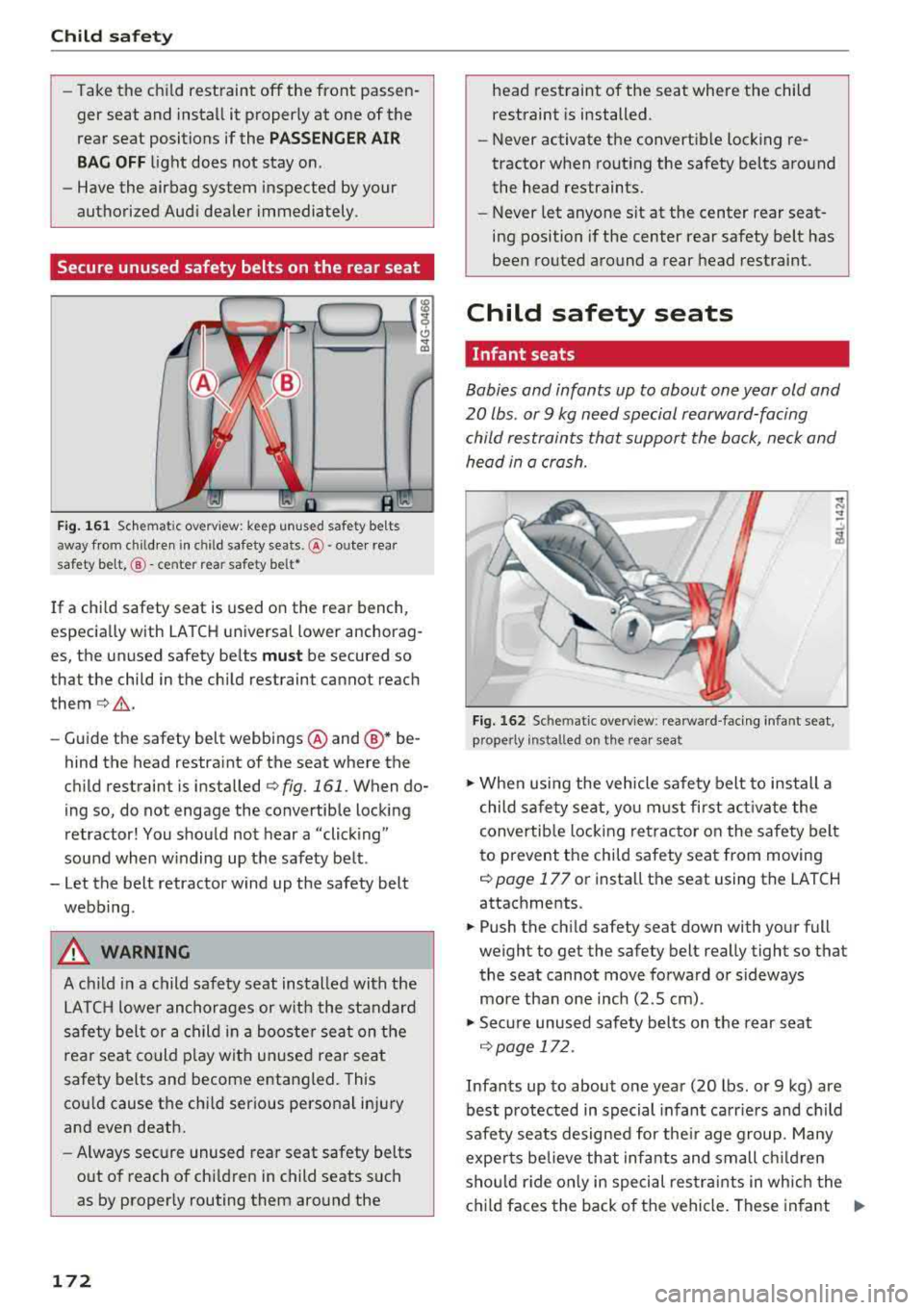
Secure unused safety belts on the rear seat
l8 , ,.,_ _ g
---0
Fig. 161 Schematic overv iew: keep unu sed safety belts
away from chi ldren in chil d safety seats. @-outer rear
safety belt,@- center rear safety belt*
~
If a child safety seat is used on the rear bench,
especially with LATCH universal lower anchorag
es, the unused safety belts
must be secured so
that the child in the child restraint cannot reach
them
c::> ,&. .
-Guide the safety belt webbings @and ®* be
hind the head restraint of the seat where the
c hild restraint is installed
c::>fig. 161. When do
ing so, do not engage the convertible locking
retractor! You should not hear a "clicking"
sound when winding up the safety belt .
-Let the belt retractor wind up the safety belt
webbing .
A WARNING
A child in a child safety seat installed with the
LATCH lower anchorages or with the standard
safety belt or a child in a booster seat on the
rear seat could play with unused rear seat
safety belts and become entangled. This
could cause the child serious personal injury
and even death.
-Always secure unused rear seat safety belts out of reach of children in child seats such
as by properly routing them around the
172
head restraint of the seat where the child
restraint is installed .
- Never activate the convertible locking re
tractor when routing the safety belts around
the head restraints.
-Never let anyone sit at the center rear seat
ing position if the center rear safety belt has
been routed around a rear head restrain t.
Child safety seats
Infant seats
Babies and infants up to about one year old and
20 lbs . or
9 kg need special rearward-facing
child restraints that support the back, neck and
head in a crash.
Fig. 162 Schema tic overview : rearward-facing infa nt seat,
prope rly installed on the rear seat
.. When using the vehicle safety belt to install a
child safety seat, you must first activate the
convertib le locking retractor on the safety belt
to prevent the child safety seat from moving
c::> page 177 or install the seat using the LATCH
attachments .
.. Push the child safety seat down with your full
weight to get the safety belt really tight so that
the seat cannot move forward or sideways
more than one inch (2 .5 cm).
.. Secure unused safety belts on the rear seat
c::> page 172 .
Infants up to about one year (20 lbs. or 9 kg) are
best protected in special infant carriers and child
safety seats designed for their age group. Many
experts believe that infants and small children
should ride only in special restraints in which the
child faces the back of the vehicle. These infant
II>
Page 176 of 266
Child safety
Convertible child safety seats
Properly used convertible child safety seats can
help protect toddlers and children over age one
who weigh between 20 and 40 lbs. (9 and 18 kg)
in a crash.
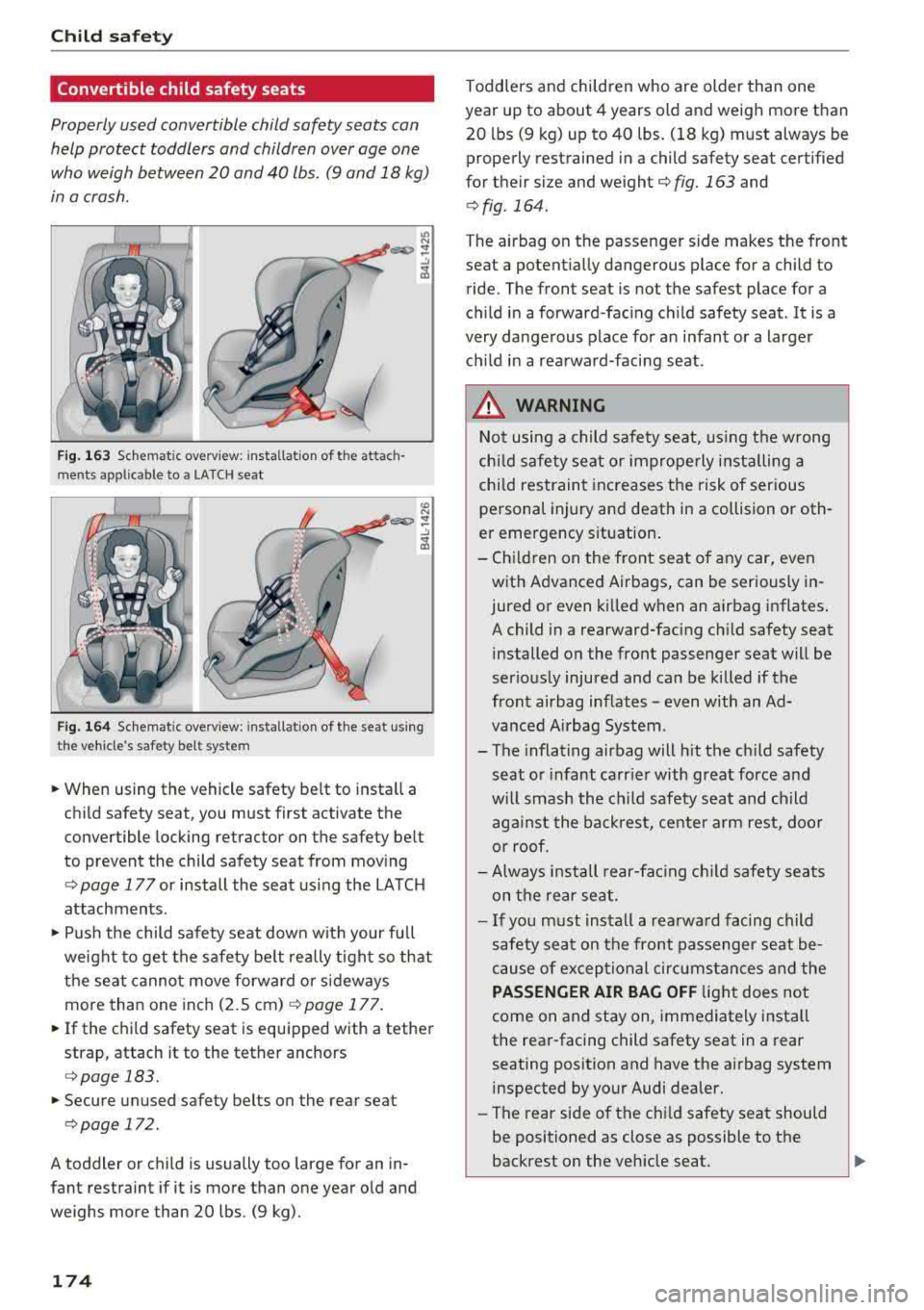
Fig. 163 Schematic overview: installat ion of the attach
ments app licable to
a LATCH seat
Fig. 164 Schematic overview: installat ion of the seat using
the vehicle 's safety belt system
... When using the vehicle safety belt to install a
child safety seat, you must first activate the
convertible locking retractor on the safety belt
to prevent the child safety seat from moving
c:> page 177 or install the seat using the LATCH
attachments .
... Push the child safety seat down with your full
weight to get the safety belt really tight so that
the seat cannot move forward or sideways more than one inch (2.5 cm)
c:>page 177.
... If the child safety seat is equipped with a tether
strap, attach it to the tether anchors
r::>page 183.
... Secure unused safety belts on the rear seat
r::>page 172 .
A toddler or child is usually too large for an in
fant restraint if it is more than one year old and
weighs more than 20 lbs. (9 kg).
174
Toddlers and children who are older than one
year up to about 4 years old and weigh more than
20 lbs (9 kg) up to 40 lbs. (18 kg) must always be
properly restrained in a child safety seat certified
for their size and weight
c> fig. 163 and
c:>fig. 164.
The airbag on the passenger side makes the front
seat a potentially dangerous place for a child to
ride. The front seat is not the safest place for a
child in a forward-facing child safety seat . It is a
very dangerous place for an infant or a larger
child in a rearward-facing seat .
.&_ WARNING
Not using a child safety seat, using the wrong
child safety seat or improperly installing a
child restraint increases the risk of serious
personal injury and death in a collision or oth
er emergency situation.
-Children on the front seat of any car, even
with Advanced Airbags, can be seriously in
jured or even killed when an airbag inflates. A child in a rearward-facing child safety seat
installed on the front passenger seat will be
seriously injured and can be killed if the
front airbag inflates -even with an Ad
vanced Airbag System .
-The inflating airbag will hit the child safety
seat or infant carrier with great force and
will smash the child safety seat and child
against the backrest, center arm rest, door
or roof.
-Always install rear-facing child safety seats
on the rear seat.
-If you must install a rearward facing child
safety seat on the front passenger seat be
cause of exceptional circumstances and the
PASSENGER AIR BAG OFF light does not
come on and stay on, immediately install
the rear-facing child safety seat in a rear seating position and have the airbag system
inspected by your Audi dealer .
- The rear side of the child safety seat should
be positioned as close as possible to the
backrest on the vehicle seat.
~
Page 178 of 266
Child safety
Booster seats and safety belts
Properly used booster seats can help protect
children weighing between about 40 lbs . and 80
lbs. (18 kg and 36 kg) who are less than 4
ft. 9
in. (57 inches/1.45 meters) tall .
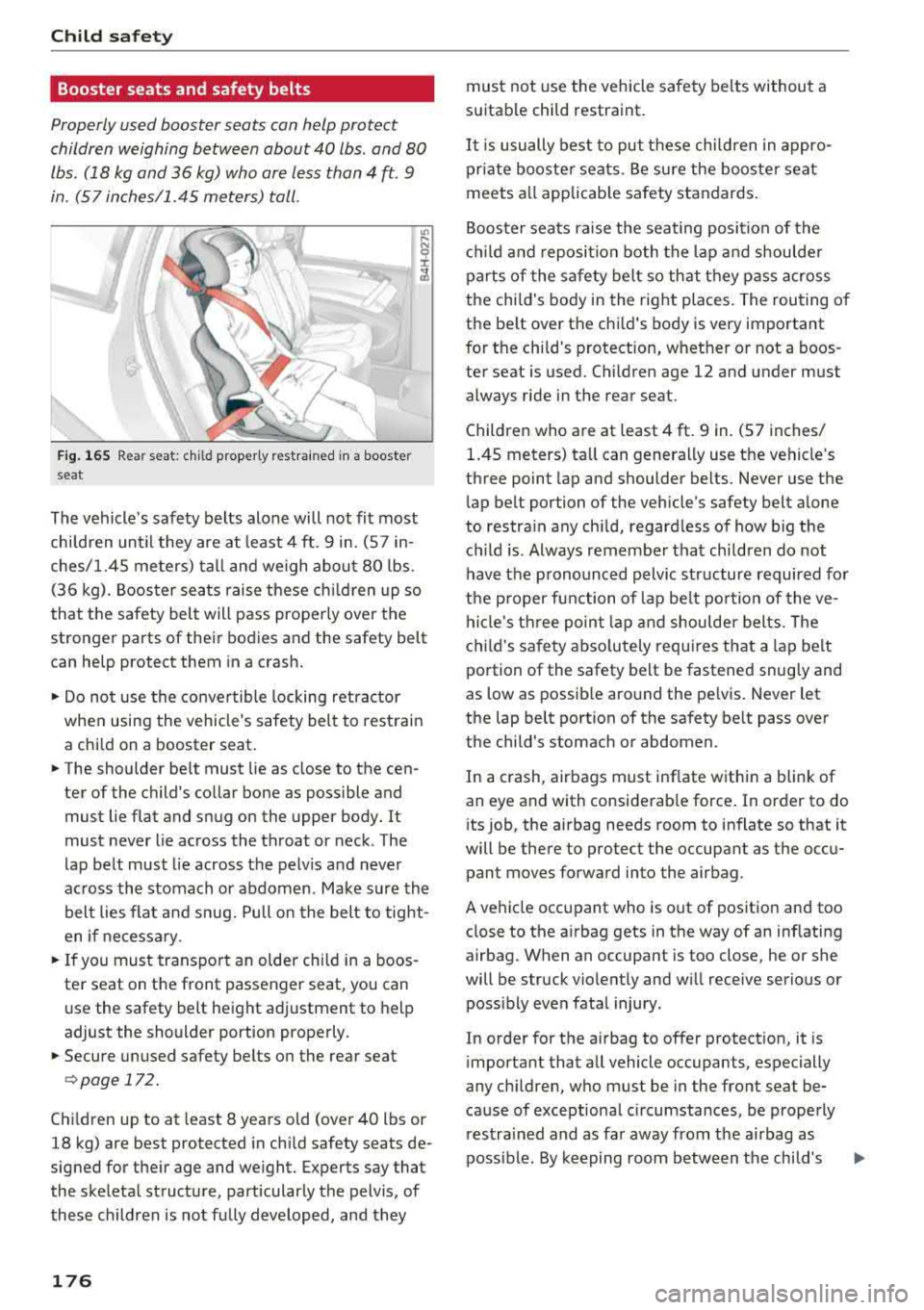
Fig. 165 Rear seat: child properly restrained in a booster
seat
The vehicle's safety belts alone will not fit most
children until they are at least 4
ft. 9 in. (57 in
ches/1.45 meters) tall and weigh about 80 lbs.
(36 kg). Booster seats raise these chi ldren up so
that the safety belt will pass properly
over the
stronger parts of their bodies and the safety belt
can help protect them in a crash.
.. Do not use the convertible locking retractor
when using the vehicle's safety belt to restrain
a child on a booster seat .
.. The shoulder belt must lie as close to the cen
ter of the child's collar bone as possible and must lie flat and snug on the upper body. It
must never lie across the throat or neck . The
lap belt must lie across the pelvis and never
across the stomach or abdomen . Make sure the
belt lies flat and snug. Pull on the belt to tight
en if necessary .
.. If you must transport an older child in a boos
ter seat on the front passenger seat, you can use the safety belt height adjustment to help
adjust the shoulder portion properly .
.. Secure unused safety belts on the rear seat
c>page 172.
Children up to at least 8 years old (over 40 lbs or
18 kg) are best protected in child safety seats de
signed for their age and weight. Experts say that
the skeletal structure, particularly the pelvis, of
these children is not fully developed, and they
176
must not use the vehicle safety belts without a
suitable child restraint .
It is usually best to put these children in appro
priate booster seats. Be sure the booster seat
meets all applicable safety standards.
Booster seats raise the seating position of the
child and reposition both the lap and shoulder
parts of the safety belt so that they pass across
the child's body in the right places. The routing of
the be lt over the child's body is
very important
for the child's protection, whether or not a boos
ter seat is used. Children age 12 and under must
always ride in the rear seat.
Children who are at least 4
ft. 9 in. (57 inches/
1.45 meters) tall can generally use the vehicle 's
three point lap and shoulder belts. Never use the
lap belt portion of the vehicle's safety belt alone
to restrain any child, regardless of how big the
c hi ld is. Always remember that children do not
have the pronounced pelvic structure required for
the proper function of lap belt portion of the
ve
hicle's three point lap and shoulder belts. The
child's safety absolutely requires that a lap belt
portion of the safety belt be fastened snugly and
as low as possible around the pelvis. Never let
the lap belt portion of the safety belt pass over
the child's stomach or abdomen.
In a crash, airbags must inflate within a blink of
an eye and with considerable force. In order to do its job, the airbag needs room to inflate so that it
will be there to protect the occupant as the occu pant
moves forward into the airbag .
A vehicle occupant who is out of position and too close to the airbag gets in the way of an inflating
airbag. When an occupant is too close, he or she
will be struck violently and will receive serious or possibly even fatal injury .
In order for the airbag to offer protection, it is
important that all vehicle occupants, especially
any children, who must be in the front seat be
cause of exceptional circumstances, be properly
restrained and as far away from the a irbag as
possible. By keeping room between the child's
.,..
Page 206 of 266
Wheel s
Glossary of tire and loading
terminology
Accessory weight
means the combined weight (in
excess of those standard items
which may be replaced) of auto matic transmission, power steer
ing , power brakes , power win
dows , power seats, radio, and
heater, to the extent that these
items are available as factory-in
stalled equipment (whether in
stalled or not).
Aspect ratio
means the ratio of the height to
the width of the tire in percent. Numbers of 55 or lower indicate a
low sidewall for improved steer
ing response and better overall
handling on dry pavement .
Bead
means the part of the tire that is
made of steel wires, wrapped or
reinforced by ply cords and that is
shaped to fit the rim.
Bead separation
means a breakdown of the bond
between components in the bead.
20 4
Cord
means the strands forming the
plies in the tire.
Cold tire inflation pressure
means the t ire pressure recom
mended by the vehicle manufac
turer for a tire of a designated
size that has not been driven for
more than a couple of miles (kilo
meters) at low speeds in the
three hour period before the tire pressure is measured or adjusted.
Curb weight
means the weight of a motor ve
hicle w ith standard equipment in
cluding the maximum capacity of
fuel, oil, and coolant, ai r condi
tioning and additional weight of
optional equipment.
E x tra load ti re
means a tire designed to operate
at higher loads and at higher in
flation pressures than the corre
sponding standard tire. Extra load
tires may be identified as "X L",
"
l" "EXTRA LOAD" or "RF" on X I I
the sidewall. .,.