door lock AUDI A6 2018 Owner's Manual
[x] Cancel search | Manufacturer: AUDI, Model Year: 2018, Model line: A6, Model: AUDI A6 2018Pages: 266, PDF Size: 41.38 MB
Page 73 of 266
a co .... N
" N .... 0 0 \.J '
tachometer also moves into the
READ Y posi
t ion
ll .
~ The eng ine starts aga in when you take your
foot off the brake pedal. The ind icator light
turns off.
Additional inf ormation
The engine stops in the P, N and D se lector lever
positions.
I f you select the R pos ition dur ing a stop phase,
the engine will start again .
Shift to P q uickl y to p revent t he engine from
starti ng u ninten tiona lly w hen s hift ing t hrough R .
You can determ ine for yourself if the eng ine will
stop or not by reducing or increas ing the amount
of force you use to press the bra ke pedal. For ex
ample, if you only lig htly press on t he b rake ped
a l in stop-and -go traff ic or w hen tu rning, the en
gine will not switch
off when the vehicle is sta
tionary . As soon as yo u press the brake down
harder, the eng ine will switch off.
(D Tips
-Press the b rake pedal during a Stop p hase
to keep the ve hicle from rolling.
-The ignition wi ll tu rn off if you press the
I START E NGINE STOP ! button during a stop
phase . The need le in the tachomete r moves
i nto the
OFF position.
General information
App lies to: ve hicles with Start/Stop system
The standard Start/Stop mode can be canceled
for various system-related reasons.
Engine does not switch off
B efore and d urin g e ach stop phase , the system
checks if certa in con ditions have been me t. If the
@j indicator light appears in the instrument cl us
ter disp lay, the engine will not be stopped, for
examp le in the fo llow ing s ituations:
ll Ma rket -specific
Driving
-The engine has not reached the minim um re
quired temperature for Sta rt/Stop mode.
-The interior temperature selec ted by the cli -
mate control system has not been reached .
-The outside tempe ra ture is ex tremely high/low.
-The winds hield is bei ng defros ted® .
-The parking system * is sw itched on .
-The vehicle battery charge level is too low .
-The steering wheel is tu rned at a sharp angle o r
is moving.
-After engaging the reverse gear.
-On sharp inclines .
Engine automatically restarts
The standard Start/S top mode w ill be can celed
dur ing a stop phase in the followi ng si tuatio ns.
T he eng ine restarts wi thout any action by the
driver .
-The vehi cle ro lls, fo r example whi le on a slope .
-The inte rior tempe rature d iffers from t he tem-
pe ra ture selected in the A/C system.
-The winds hield is bei ng defrosted® .
-The brake peda l is pressed severa l times in a
row .
-The vehicle battery charge level is too low.
-Power consumption is high.
T he eng ine can turn off aga in when the cond i
tions for Start/Stop mode are met.
Ignition is switched off automatically
T o p reve nt the vehicle battery from dra ining, the
i gni tion will switc h off
automaticall y under the
f o llow ing co nditions:
-The vehicle has already been dr iven .
-The Start/Stop system has stopped the engine .
-The driver's door is opened .
-The driver's safety belt is unbuckled.
-The brake peda l is not pressed .
-The vehicle is stat ion ary.
In this case, the activated low beam is replaced
by the pa rk ing light. The par kin g lights wi ll
swi tch off afte r approx imately 30 m inutes o r
whe n you lock t he ve hicle.
71
Page 75 of 266
a co .... N
" N .... 0 0 \,;J '
Requirement: the driver's door must be closed,
the driver's safety belt must be latched and the
parking brake must be set.
.,. To start driving and release the parking brake
automatically, press the accelerator pedal as
usual.
In addition to releasing the parking brake auto
matically, other convenience and safety functions
are available when you start driving
¢page 74,
Starting to drive.
Preventing the automatic parking brake
release
The vehicle could begin rolling unintentionally,
depending on the hill or if towing a trailer.
.,. To prevent the parking brake from releasing au
tomatically, pull and hold
the(®) switch and
press the accelerator pedal. The parking brake
remains set and prevents the vehicle from roll
ing backward.
.,. You can release the C®l switch again once you
are sure that you are giving enough driving
force to the wheels by pressing the accelerator pedal.
Emergency braking function
You can use the emergency braking function in an
emergency situation, or if the standard brake op
eration malfunctions or is disabled.
.,. Pull and hold the®) switch.
.,. As soon as you release the (®) switch or acceler-
ate, the braking stops.
Pulling and holding the
C®) switch while driving
the vehicle activates the emergency braking func
tion. The vehicle is braked at all four wheels by
activating the hydraulic brake system. The brak ing effect is similar to heavy
braking¢&_ .
To reduce the risk of activating the emergency
braking by mistake, a warning tone (buzzer)
sounds when
the®> switch is pulled. Emergency
braking stops as soon as
the®) switch is released
or the accelerator pedal is pressed.
Parking
.,. Press the brake pedal to stop the vehicle.
Driving
.,. Pull the®> switch to set the parking brake .
.,. Place the selector lever in the P position.
.,. Turn the engine off¢&_ .
.,. Turn the steering wheel when parking on in
clines so that the wheels will roll into the curb
if the vehicle starts moving.
A WARNING
-
- Do not press the accelerator pedal inadver
tently if a gear is selected when the vehicle
is stationary and the engine is running. Oth
erwise, the vehicle will start to move imme
diately and this could result in an accident.
- Emergency braking should only be used in
an emergency, when the normal brake pedal
has failed or the brake pedal is obstructed.
During emergency braking, your vehicle will
brake similar to heavy braking. ESC and the
associated components (ABS, ASR, EDL)
cannot overcome the laws of physics . In cor
ners and when road or weather conditions
are bad, a full brake application can cause
the vehicle to skid or the rear end to swerve,
which
increases the risk of an accident.
- If the power supply fails , you cannot set the
parking brake if it is released . In this case,
park the vehicle on level ground and secure
it by placing the selector lever in the P posi
tion. See an authorized Audi dealer or au
thorized Audi Service Facility for assistance.
- If you leave the vehicle, switch the ignition
off and take the vehicle key with you. This
applies particularly when children remain in
the vehicle. Otherwise children could start
the engine, release the parking brake or op
erate electrical equipment such as power
windows, which increases the risk of an acci
dent.
- No one should remain in the vehicle when it
is locked - especially children . Locked doors
make it more difficult for emergency work
ers to get into the vehicle, which puts lives
at risk.
(D Tips
When stopping at a traffic signal or stopping
in city traffic, you can set the parking brake
manually . The vehicle does not have to be
73
Page 79 of 266
a co .... N
" N .... 0 0 \.J '
If t he se lecto r lever is not in t he P posi tion when
you open the driver 's door, the vehicle could rol l.
The message
V ehicle ma y roll! Selector le ver not
in P
appears . A warning tone will a lso sound .
.,. Press and hold the brake pedal¢.&_ .
.,. Set the parking brake.
.,. Se lect the P selector lever position.
Unde r ce rtain c ircumstances, s uch as dr iv ing in
the mountains, i t may be useful to switch tempo
rari ly to the manua l shift program in order to
manually adjust the gears to the driving condi
tions
¢ page 78.
On inclines, activate the park ing brake fi rst and
then move the selector lever to the P position
¢ page 72 . Th is prevents the locking mechanism
from being loaded too heavi ly and wi ll make it
eas ier to move the se lector lever out of the P po
sition .
A WARNING
-The veh icle can roll even if the ignition is
switched off .
-Never leave your vehicle with the engine
runn ing wh ile in gear .
-Do not press the accelerator pedal when
changing the selector lever pos ition wh ile
the vehicle is stationary and the engine is
ru nning .
-
-Please note that a sma ll amount of power is
t ransmitted if the vehicle is stopped tempo
ra rily while in t he D/S or R selector lever po
s iti on. To redu ce the r isk of an accident, yo u
mus t continue press ing firmly on the brake
peda l w hil e the vehicle is stopped so that it
does not roll.
-Never engage the R o r P se lec to r level posi
tions while driving .
It could cause a crash.
-Be fore dr iv ing dow n a steep s lope, red uce
yo ur speed and shift in to a lower gear with
"ti ptro n i c" .
-Do not ride the brakes o r press the brake
peda l too often or too long w hen driving
down hill. Constant braking causes the
brakes to overheat and substantially re
duces braking performance, increases brak-
Driving
ing distance or causes comp lete fai lure of
the brake system.
-If you m ust stop on an incline, a lways ho ld
the vehicle in place wit h the foot brake or
parking brake to prevent it from rolling
back .
-Never hold the vehicle on an incline with a
slipp ing clutch. The clutch opens automati
cally when it becomes too hot from the
overload .
The@] indicator light turns on
a nd a message
appears~ page 79 when
the clutch is overloaded .
@ Note
-When stopping on an incl ine, do not try to
hold the ve hicle in place by pressing the ac
celerator peda l wh ile a d riving gear is se
lected. This ca n cause t he transmission to
over heat a nd can damage it. Se t the park ing
bra ke or p ress the brake pedal to p revent
t he vehicle from rolling.
-Allowing the vehicle to roll when t he engine
is stopped will damage the transmission be
cause it is not lubricated.
(D Tips
Fo r sa fety reasons, the park ing bra ke is re
l eased a utomatica lly on ly when t he driver 's
safety be lt is fastened.
Hill descent control
The hill descent control system assists the driver
when driving down hills .
Hill descent control is act ivated when the selec
tor leve r is in the D or S position and yo u press
the brake peda l. The transmission a utomatica lly
selects a gear that is suitable for the hi ll. Hill de
scent control tries to maintain the speed ach
ieved at the time of braking, w ith in physical and
technical lim itations . If may still be necessary to
adjust the speed w ith the brake pedal.
Hi ll descent control switches off once the hill lev-
els out or you press the accelerator pedal.
.,..
77
Page 149 of 266
a co .... N
" N .... 0 0 \,;J '
o'clock position or with your hands any
where inside the steering wheel or on the steering wheel hub . Holding the steering
wheel the wrong way increases the risk of severe injury to the arms, hands, and head if
the driver airbag deploys.
A WARNING
Objects between you and the airbag will in
crease the risk of injury in a crash by interfer
ing with the way the airbag unfolds and/or by
being pushed into you as the airbag inflates.
- Always make sure nothing is in the front air-
bag deployment zone that could be struck
by the airbag when it inflates.
-
- Objects in the zone of a deploying airbag
can become projectiles when the airbag de
ploys and cause serious personal injury.
- Never hold things in your hands or on your
lap when the vehicle is in use.
- Never place accessories or other objects
(such as cup holders, telephone brackets,
note pads, navigation systems, or things
that are large, heavy, or bulky) on the doors;
never attach then to the doors or the wind
shield; never place them over or near or at
tach them to the area marked
,,AIRBAG" on
the steering wheel, instrument panel or the seat backrests; never place them between
these areas and you or any other person in
the vehicle.
- Never attach objects to the windshield
above the passenger front airbag, such as
accessory GPS navigation units or music
players. Such objects could cause serious in
jury in a collision, especially when the air bags inflate.
- Never recline the front passenger seat to
transport objects. Items can also move into
the deployment area of the side airbags or
the front airbag during breaking or in a sud den maneuver. Objects near the airbags can
fly dangerously through the passenger com partment and cause injury, particularly
when the seat is reclined and the airbags in
flate.
Airbag system
A WARNING
r--
A person on the front passenger seat, espe-
cially infants and small children, will receive
serious injuries and can even be killed by be ing too close to the airbag when it inflates .
- Although the Advanced Airbag System in your vehicle is designed to turn off the front
passenger airbag if an infant or a small child
is on the front passenger seat, nobody can
absolutely guarantee that deployment un
der these special conditions is impossible in
all conceivable situations that may happen
during the useful life of your vehicle.
- The Advanced Airbag System can deploy in accordance with the
.,low risk" option for 3-
and 6-year-old children under the U.S. Fed
eral Standard if a child with electrical capac itance greater than the combined capaci
tance of a typical one-year old infant re
strained in one of the forward facing or rear
ward-facing child seats with which your ve hicle was certified is on the front passenger
seat and the other conditions for airbag de-
ployment are met.
- Accident statistics have shown that children
are generally safer in the rear seat area than
in the front seating position.
- For their own safety, all children, especially
12 years and younger, should always ride in
the back properly restrained for their age
and size.
Advanced front airbag system
Your vehicle is equipped with a front Advanced
Airbag System in compliance with United States Federal Motor Vehicle Safety Standard 208, as
well as Canada Motor Vehicle Safety Standard (CMVSS) 208 as applicable at the time your vehi
cle was manufactured.
The front Advanced Airbag System supplements
the safety belts to provide additional protection
for the driver's and front passenger's heads and
upper bodies in frontal crashes . The airbags in
flate only in frontal impacts when the vehicle de-
celeration is high enough.
.,.
147
Page 176 of 266
Child safety
Convertible child safety seats
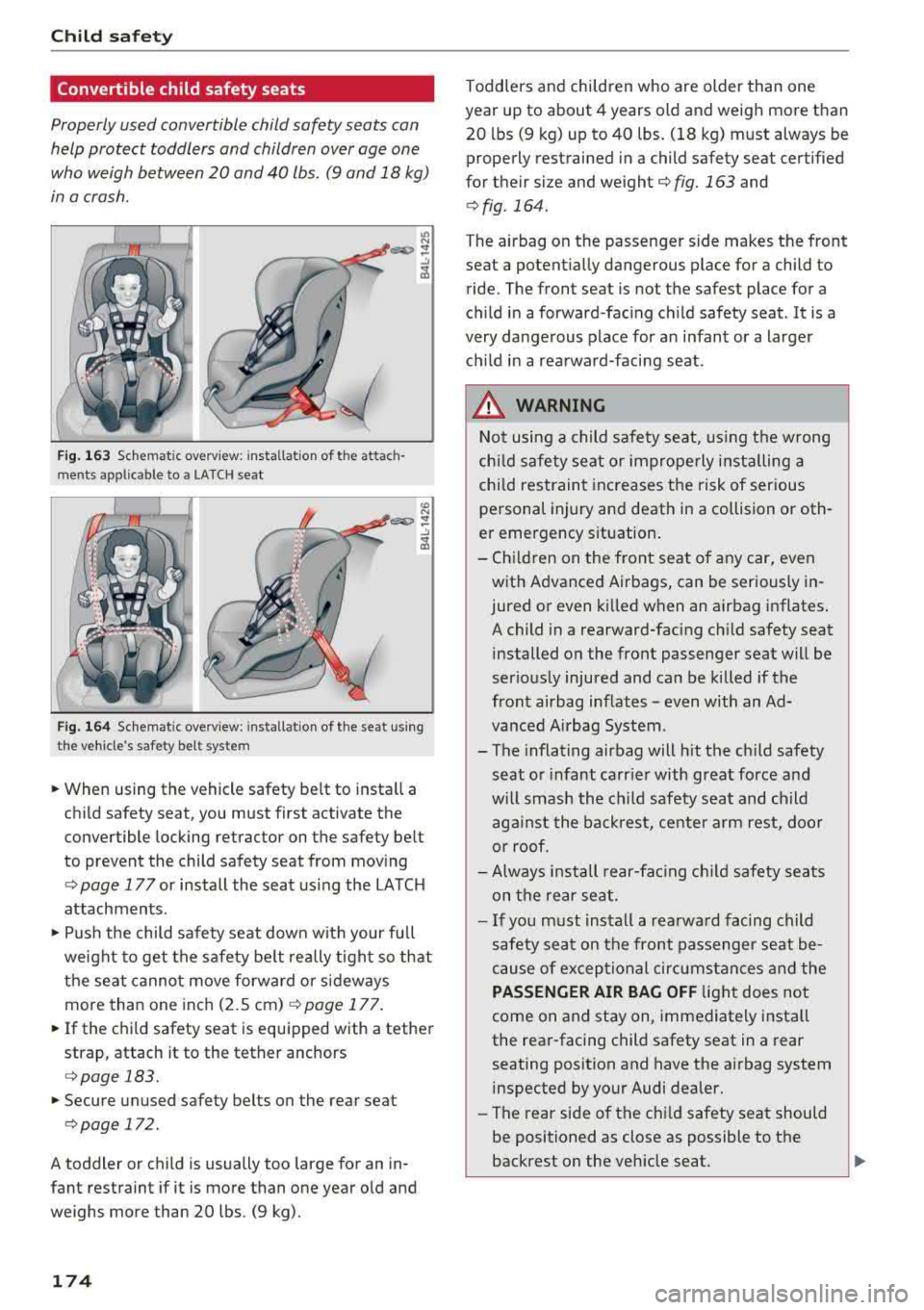
Properly used convertible child safety seats can
help protect toddlers and children over age one
who weigh between 20 and 40 lbs. (9 and 18 kg)
in a crash.
Fig. 163 Schematic overview: installat ion of the attach
ments app licable to
a LATCH seat
Fig. 164 Schematic overview: installat ion of the seat using
the vehicle 's safety belt system
... When using the vehicle safety belt to install a
child safety seat, you must first activate the
convertible locking retractor on the safety belt
to prevent the child safety seat from moving
c:> page 177 or install the seat using the LATCH
attachments .
... Push the child safety seat down with your full
weight to get the safety belt really tight so that
the seat cannot move forward or sideways more than one inch (2.5 cm)
c:>page 177.
... If the child safety seat is equipped with a tether
strap, attach it to the tether anchors
r::>page 183.
... Secure unused safety belts on the rear seat
r::>page 172 .
A toddler or child is usually too large for an in
fant restraint if it is more than one year old and
weighs more than 20 lbs. (9 kg).
174
Toddlers and children who are older than one
year up to about 4 years old and weigh more than
20 lbs (9 kg) up to 40 lbs. (18 kg) must always be
properly restrained in a child safety seat certified
for their size and weight
c> fig. 163 and
c:>fig. 164.
The airbag on the passenger side makes the front
seat a potentially dangerous place for a child to
ride. The front seat is not the safest place for a
child in a forward-facing child safety seat . It is a
very dangerous place for an infant or a larger
child in a rearward-facing seat .
.&_ WARNING
Not using a child safety seat, using the wrong
child safety seat or improperly installing a
child restraint increases the risk of serious
personal injury and death in a collision or oth
er emergency situation.
-Children on the front seat of any car, even
with Advanced Airbags, can be seriously in
jured or even killed when an airbag inflates. A child in a rearward-facing child safety seat
installed on the front passenger seat will be
seriously injured and can be killed if the
front airbag inflates -even with an Ad
vanced Airbag System .
-The inflating airbag will hit the child safety
seat or infant carrier with great force and
will smash the child safety seat and child
against the backrest, center arm rest, door
or roof.
-Always install rear-facing child safety seats
on the rear seat.
-If you must install a rearward facing child
safety seat on the front passenger seat be
cause of exceptional circumstances and the
PASSENGER AIR BAG OFF light does not
come on and stay on, immediately install
the rear-facing child safety seat in a rear seating position and have the airbag system
inspected by your Audi dealer .
- The rear side of the child safety seat should
be positioned as close as possible to the
backrest on the vehicle seat.
~
Page 180 of 266
Child sa fety
should always ride in the back seat properly re
strained for their age and size.
A WARNING -
Improperly installed child safety seats in
crease the risk of serious personal injury and
death in a collision.
- Always make sure that the safety belt re tractor is locked when installing a child
safety seat. An unlocked safety belt retrac
tor cannot hold the child safety seat in place dur ing norma l driving or in a crash.
- Always buckle the child safety seat firmly in
place even if a child is not s itting in it . A
loose child safety seat can fly around during
a sudden stop or in a coll is ion.
- Always make sure that the rear seat back
rest to which the center rea r safety be lt* is
attached is securely latched whenever the
rear cente r safety belt is being used to se
c u re a chi ld restraint.
-If the backrest is not securely latched, the
child and the child restrain t will be thrown
forward together with the backrest and will
strike parts of the vehicle interior. The chi ld
can be seriously injured or killed.
- Never install rear-facing chi ld safety seats
or infant carriers on the front passenger
seat. A child will be serious ly injured and
can be killed when the passenger airbag in
flates.
-The inflating a irbag w ill hit the child safety
seat or infant carrier with great force and
will smash the child safety seat and child
against the backrest, center armrest, door
or roof .
- Always install rear-facing child safety seats or infant carr iers on the rear seat.
- Forward -facing ch ild safety seats or infant
carr iers installed on the front passenger 's
seat may interfere with the deployment of
the a irbag and cause serious injury to the
c hild.
- It is safe r to install a forward-facing ch ild
safety seat on the rear seat.
- Always read and heed all WARN INGS when
ever using a child restrained in a veh icle is
being used
¢ page 166 . Special pre ca utions
178
apply when installing a child safety seat on
the front passenger
seat ¢ page 143, Child
restraints on the front seat -some impor
tant things to know .
A WARNING
Always take special precautions if you must
install a forward or rearward-facing child re
stra int on the front passenger's seat in excep
tional s ituations:
- Whenever a forward or rearward-fac ing
child restraint is installed on the front pas
senger seat, the
PASSENGER AIR BAG OFF
light mus t come on and stay on whenever
the ignition is switched on .
- If the
PASSENGER AIR BAG OFF light does
no t come on and stay on, perform the
checks
described ¢ page 154, Monitoring
the Advanced Airbag System.
- Take the child restra int off the front passen
ger seat and install it properly at one of the rear seat positions if the
PASSENGER AIR
BAG OFF
light does not stay on whenever
the ignition is switched on.
- Improper installat ion of child restraints can
reduce the ir effectiveness or even prevent
them from provid ing any protect ion.
- An improperly installed child restra int can
interfere with the airbag as it deploys and
serious ly injure or even kill the child.
- Always carefully follow the manufacturer's instructions provided with the child safety
seat or carrier .
- After checking to make sure that the ch ild
restraint is properly installed, make certain
that the child restraint is correctly recog
nized by the capacitive passenge r detection
system in the front passenger seat and that
the
PASSENGER AIR BAG OFF light signals
the co rrect front passenger fron tal air bag
stat us.
A WARNING
Forward- facing child restra ints:
-
Page 181 of 266
a co .... N
" N .... 0 0 \,;J '
has been designed and certified by its man
ufacturer for use on a fr ont seat with a
passenger front and s ide airbag.
- Never put the forward-facing child restraint
up, against or v ery near the instrument pan
el.
- Always move the front passenger seat to
the highest position in the up an d down ad
justment range and move it back to the
rea rmost position in the seat's fore and aft
adjustment range, as fa r away from the air
bag as possib le, before insta lling the for
wa rd- facing child restr aint.
- Always ma ke sure that the safety bel t upper
anchor age is beh ind the child res train t and
not next to or in front o f the chi ld restrain t
so that the safety belt will be properly posi
tioned.
- Make sure that the
PASSENGER AIR BAG
OFF
light comes on and stays on all the time
whenever the ignition is switched on .
A WARNING
Rearward-facing child restraints:
- A ch ild in a rearward-facing child safety seat
installed on the front passenger seat will be
seriously injured and can be killed if the
front airbag inflates - even with an Ad
vanced Airbag System.
- The inflating a irbag w ill hit the child safety
seat or infant carrier with great force and
will smash the ch ild safety seat and chi ld
against the backrest, cen ter armrest, door
o r roof.
- Always be especially careful if you must in
stall a rearward facing child safety seat on
the fron t passenger sea t in exceptional c ir
c u ms tan ces.
- Make sure tha t the
PASSENGER AIR BAG
OFF
light comes on and s tays on all t he ti me
whenever the ignition is switched on.
- If the PASSENGER AIR BAG OFF light does
not come on and st ay on, immedia tely in
st al l the re a r-fa cing ch ild saf ety se at in a
rear seat ing pos ition and have the airbag
system inspected by your Aud i dealer .
Child saf ety
Activating the convertible locking retractor
Use the convertible locking retractor to secure a
child restraint.
Always heed the c hild safety seat manufacturer's
i nstruct io ns when instal ling a child restra int i n
your vehicle. To activate the convertib le locking
r etractor:
.,. Place the child restraint on a seat, preferably
on the rear seat .
.,. Slowly pull the belt all the way out .
.,. Route it arou nd or through the child restra int
be lt
path~ ,&..
.,. Push the c hild safety sea t down with yo ur full
weigh t to ge t the safe ty belt really tight.
.,. Insert t he be lt tong ue into the b uckl e for tha t
seating position .
.,. Guide the safety be lt back into t he ret ractor un
til the be lt lies flat and sn ug on the c hild safety
seat .
.,. You s hou ld hea r a "cl icking" noise as the belt
w inds bac k into the ine rtia reel. Test the con
vert ib le lock ing retractor by pull ing on the bel t.
You s hou ld no lo nger be able to pull the belt
ou t of the re tra cto r. T he convertib le lo ckin g re
t ra cto r is now activated.
.,. Ma ke sure that t he red release bu tton is facing
away from the c hild rest raint so that it can be
unb uc kled quickly .
.,. Pull on the belt to make sure the safety belt is
properly t ight and fastened so that the seat
cannot move forward or sideways more t han
one inch (2 .5 cm) .
A WARNING
Using the wro ng ch ild rest raint o r an impro p
e rly instal led child restr aint can cause se rious
person al injury or de ath in a crash.
- Always make sure th at t he s afety be lt re
tr act or is locked when installing a c hild
safety sea t. An un locked safe ty be lt retra c
tor cannot hold the ch ild safety seat in p lace
du ring norma l drivin g or in a c rash.
- Always buckle the child safety seat fi rm ly in
p lace even if a ch ild is not sitt ing in it . A
loose child safety seat can fly around dur ing
a sudden stop or in a crash.
~
179
Page 188 of 266
Checking and Filling
-If you a re unable to determine whether or
not a particular fuel blend meets the speci
fications, ask your service station or its fuel
supplier.
- Do not use fuel for which the contents can
not be identified.
- Fuel system damage and performance prob
lems resulting from the use of fuels differ
ent from those specified a re not the respon
sibility of Audi and are not covered under
the New Vehicle or the Emission Control System Warranties.
- If you experience a loss of fuel economy or
driveability and performance problems due
to the use of one of these fuel blends , we
recommend that you switch to unblended
fuel.
Gasoline additives
A major concern among many auto manufactur
ers is carbon deposit build-up caused by the type
of gasoline you use.
Although gasoline grades differ from one manu
facturer to another, they have certain things in
common. All gasoline grades contain substances
that can cause deposits to collect on vital engin e
parts, such as fuel injectors and intake valves. Al
though most gasoline brands include additives to keep engine and fuel systems clean, they are not
equally effective .
Audi recommends using TOP TI ER Dete rgent Gas
oline. For more information on TOP TIER Deter
gent Gasoline , please go to the official website
(www .toptiergas .com) .
After an extended per iod of us ing inadequate
fuels, carbon deposit build-ups can rob your
en
gine of peak performance.
(D Note
Damage or malfunction due to poor fuel qual
ity is not covered by the Audi New Vehicle Limited Warranty.
186
Refueling
Fueling procedure
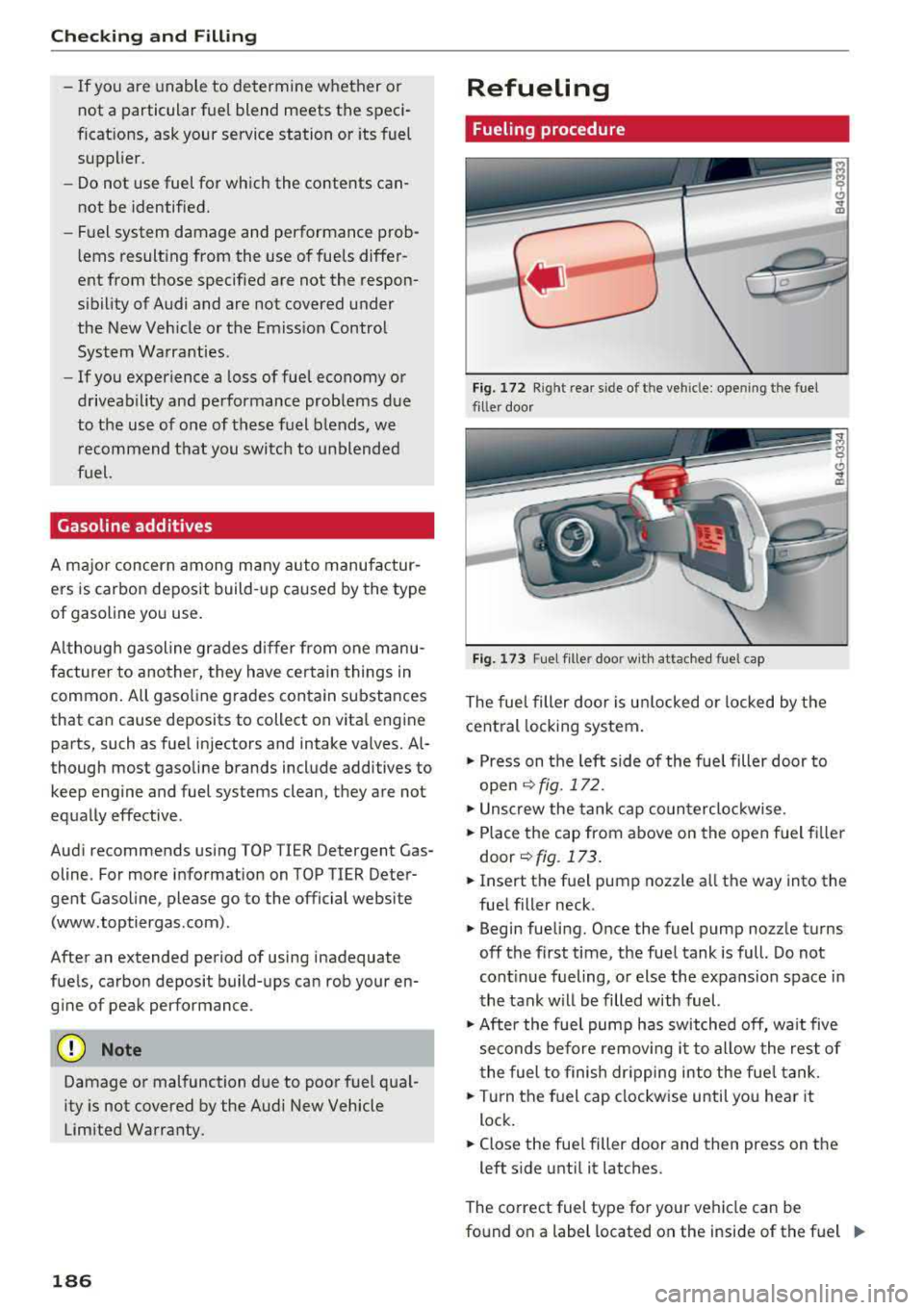
Fig. 172 R ig ht re ar sid e o f th e ve hicle: o penin g th e fu el
filler door
Fig. 173 F uel fille r doo r with at tached fuel cap
The fuel filler door is unlocked or locked by the
central locking system.
.,. Press on the left side of the fuel filler door to
open
~ fig. 172.
.,. Unscrew the tank cap counterclockwise .
.,. Place the cap from above on the open fuel filler
door
~ fig.173.
.,. Insert the fuel pump nozzle all the way into the
fuel filler neck .
.,. Begin fueling. Once the fuel pump nozzle turns
off the first time, the fuel tank is full. Do not
continue fueling, or else the expansion space in
the tank will be filled with fuel.
.,. After the fuel pump has switched off, wait five
seconds before removing it to allow the rest of
the fuel to finish dripping into the fue l tank.
.,. Turn the fuel cap clockwise until you hear it
lock.
.,. Close the fuel filler door and then press on the
left side until it latches.
The correct fuel type for your vehicle can be
found on a label located on the inside of the fuel
.,.
Page 189 of 266
a co .... N
" N .... 0 0 \.J '
see
r=;, page 185.
F or the tank capac ity in yo ur vehicle , refer to t he
Technical Data
r=;, page 245 .
To reduce the r isk of fuel leak ing out or vapors
escap ing, make su re t hat the fuel ta nk is closed
correct ly. O therwise
t he-¢..ij indicator light will
turn on.
I f the central lock ing system malfunct ions, the
fuel filler door may emergency release
r=;, page 188.
_& WARNING
An improper f uel ing p rocedure and improper
hand ling of fue l can lead to exp losions, fires,
severe b urns and other injuries .
- Do not smoke and keep away from open
flames .
- T he ig nition m ust be switched off whe n re
f ueling .
- Cell pho nes, radio devices and o ther radio
equipment s hou ld always be switched off
w hen refueling . Electromagnetic rays cou ld
cause sparks and start a fire .
- If you do not insert the fuel pump nozzle a ll
the way into the filler tube, then fue l can
leak out. Spilled fue l can ignite and start a
fire.
- Never get into the vehicle when refueling. If
there is an exceptional s ituation where the
vehicle must be entered, close the door and
touch a metal surface before touching the
fuel pump nozzle aga in . This will reduce the
r isk of electrostat ic d ischarge that can cause
flying sparks . Sparks can start a fire when
ref uel ing .
_& WARNING
We recommend that you do not t ransport any
fue l co nta iners in t he veh icle. Fue l cou ld leak
out of the containe r and ignite, espe cially dur
ing an accident. This can cause exp losions,
fires and injuries .
- If you must transport fuel in a fue l contain
er, please note the following:
Ch eck ing and F illing
- Always place a fue l container on the
ground before filling . Never fill the fue l
container with fuel while it is in or on the
vehicle . Electrostatic charge can occur
wh ile refueling and the fuel vapors could
i gnite .
- For fuel containers made of metal, the fuel p ump nozzle must always maintai n
contact with the conta iner to reduce the
r isk of s tat ic charge.
- Insert the fuel pump nozz le as far as pos
s ible into the fi lle r opening w hile refuel
ing .
-Fo llow lega l requ irements when using,
stor ing and t ransporti ng f uel conta iners.
- Make su re that the fuel containe r meets
t h e in dust ry standa rds, for example ANS I
o r ASTM F8S2 -86.
@ Note
- Remove fuel that has overflowed onto any
veh icle components immediately to reduce
the risk of damage to the vehicle.
- Never drive unt il the fuel
tank is completely
empty. The irregula r supply of fue l that re
sults from that can cause eng ine misfi res.
U nc ombus ted fuel will ente r th e exhaus t
system and increase the risk of damage to
the cata lytic converter.
@ For the sake of the environment
Do not overfill the fuel tank, otherwise f uel
ca n leak o ut w hen the ve hicle is warming up.
(D Tips
The fuel filler doo r on your ve hicle does not
l ock if you lock t he ve hicle from t he i nside us
i ng t he centra l loc king switc h.
18 7
Page 190 of 266
Checking and Filling
Fuel filler door emergency release
If the central locking system is faulty, the fuel
filler door can be unlocked manually.
Fig . 17 4 Right side trim in the luggage co mpartme nt: re
mov ing the tr im
F ig. 175 Luggage compa rtment: fuel fille r doo r eme rgency
r elease
The emergency opening mechanism is located
behind the right side trim pane l in the luggage
compartment.
Removing th e side trim
• To remove the right side trim, first remove the
retaine r from the mounts @¢
fig. 174.
• Turn both locking mechanisms 90° to the left
us ing a coin or a similar object and remove the
locking mechanisms.
• Tilt the reta iner upward and pull the trim out .
Lay the trim down on its side, because there is
an electrical w ire for the socket* on the back .
Fuel filler d oor em ergenc y relea se
• Loosen the strap from its bracket and pu ll on it
¢ fig. 175 ¢(D. The filler door is released.
• Presson the left side of the fuel f iller door to
open it
¢page 186, fig. 172.
188
(D Note
Only pu ll on the loop until you feel resistance .
You will not hear it re lease . Otherwise you
could damage the emergency release mecha nism.
Emissions control
system
Cat alytic converter
The vehicle may only be driven w ith unleaded
gaso line , otherwise the catalytic converte r will be
dest royed .
Never dr ive until the tank is completely empty.
The irregular supply of fuel that results from that can cause engine misfires. Uncombusted fuel will
enter the exhaust system, which can cause over
heating and damage to the catalytic converter .
&_ WARNING
The temperature of the exhaust system is
h igh, both when driving and a fter stopp ing
the engine.
-
- Never tou ch the exhaust tail pipes once they
have become hot. This cou ld resu lt in burns.
- Do not park your vehicle over flammable
materials s uch as grass or leaves because
the high temperature of the emissions con
trol system could start a fire .
- Do not apply unde rbody protectant in the
exhaust system area, beca use this increases
the risk of fire.