play AUDI A6 2018 Workshop Manual
[x] Cancel search | Manufacturer: AUDI, Model Year: 2018, Model line: A6, Model: AUDI A6 2018Pages: 266, PDF Size: 41.38 MB
Page 147 of 266
a co .... N
" N .... 0 0 \.J '
insta lled on the front seat may be struck and
knocked out of position by the rapidly inflating
passenger's a irbag in a frontal collision . The air
bag could greatly reduce the effectiveness of the
child restraint and even seriously i njure the ch ild
during inflation .
For this reason, and because the back seat is the
safest place for children - when properly restra in
ed according to the ir age and size
-we strongly
recommend that children always sit in t he back
seat
¢ page 166, Child safety.
.&_ WARNING
A child in a rearward-facing chi ld seat insta l
led on the front passenger seat will be ser i
ously in jured and can be k illed if the front air
bag inflates -even with an Advanced Airbag
System.
- The inflating a irbag w ill hit the child sea t or
infant carrier with great force and will
smash the child seat and child against the
backrest, cente r arm rest, door or roof.
- Always install rear-facin g child seats on t he
rea r seat.
- If you must install a rearward facing chil d
seat on the front passenger seat because of
exceptiona l circumstances and the
PASSEN
GER AIR BAG OFF
light does not come on
and stay on, immediately insta ll the rear
facing child seat in a rea r seat ing position
and have the airbag system inspected by
yo ur Audi dealer.
- Forward-fac ing ch ild seats installed on the
front passenge r's seat may interfere with
t h e deployment of the airbag and cause se
rious person al injury to the child.
.&_ WARNING
If, in e xcept ional circumstan ces, you mus t in
stall a forward-facing chi ld restraint on the
front passenger's seat:
- Always ma ke sure the forwar d-f a ci ng seat
has been designed and ce rtified by its man
ufact urer for use on a front seat with a pas
senger front and s ide air bag .
Airbag syste m
- Never put the fo rwa rd-facing child restraint
up aga inst or very nea r the instr ument pan
el.
- Always move the front passenger seat to
the highest posit ion in the up and down ad
justment range and move it back to the
rearmost posit ion in the seat's fore and aft
ad justmen t range , as far away from the air
bag as possible, before installing the for
ward-fa cing ch ild restraint.
- Always make sure that the safety be lt upper
anchorage is behind the c hild rest raint and
not next to o r in front of the child res tra int
so th at the s afety be lt will be p roperly posi
tioned.
- Make sure th at the
PASSENGER AIR BAG
OFF
li ght comes on and stays on all the time
wheneve r the ignit ion is switched on .
.&_ WARNING
= -
To reduce the risk of serious injury, make sure
that the
PASSENGER AIR BAG OFF light will
be d isplayed whenever a child rest raint is in
stalled on the front passenger seat and the i gnition is switched on.
- If the
PASSENGER AIR BAG OFF light does
not stay on, perform the checks described
¢ page 154, Monitoring the Advanced Air
bag System.
- Take the child restra int off the front passen
ge r seat and install it properly at one of the
rear sea t positions if the
PASSENGER AIR
BAG OFF
light does no t stay o n.
- Have the ai rbag system inspected by your
Au di deale r immediately.
- Always carefully follow ins tructions from
child restrain t manufacture rs when instal
ling child restra ints .
.&_ WARNING
-
If, in exceptional c ircums tances, you must in
st all a forw ard or re arw ard-fa cing child re
stra int on t he fron t passenger 's seat:
- I mp roper installat ion of child res traints can
reduce the ir effectiveness or even preven t
them from provi ding any pro tect ion .
145
Page 149 of 266
a co .... N
" N .... 0 0 \,;J '
o'clock position or with your hands any
where inside the steering wheel or on the steering wheel hub . Holding the steering
wheel the wrong way increases the risk of severe injury to the arms, hands, and head if
the driver airbag deploys.
A WARNING
Objects between you and the airbag will in
crease the risk of injury in a crash by interfer
ing with the way the airbag unfolds and/or by
being pushed into you as the airbag inflates.
- Always make sure nothing is in the front air-
bag deployment zone that could be struck
by the airbag when it inflates.
-
- Objects in the zone of a deploying airbag
can become projectiles when the airbag de
ploys and cause serious personal injury.
- Never hold things in your hands or on your
lap when the vehicle is in use.
- Never place accessories or other objects
(such as cup holders, telephone brackets,
note pads, navigation systems, or things
that are large, heavy, or bulky) on the doors;
never attach then to the doors or the wind
shield; never place them over or near or at
tach them to the area marked
,,AIRBAG" on
the steering wheel, instrument panel or the seat backrests; never place them between
these areas and you or any other person in
the vehicle.
- Never attach objects to the windshield
above the passenger front airbag, such as
accessory GPS navigation units or music
players. Such objects could cause serious in
jury in a collision, especially when the air bags inflate.
- Never recline the front passenger seat to
transport objects. Items can also move into
the deployment area of the side airbags or
the front airbag during breaking or in a sud den maneuver. Objects near the airbags can
fly dangerously through the passenger com partment and cause injury, particularly
when the seat is reclined and the airbags in
flate.
Airbag system
A WARNING
r--
A person on the front passenger seat, espe-
cially infants and small children, will receive
serious injuries and can even be killed by be ing too close to the airbag when it inflates .
- Although the Advanced Airbag System in your vehicle is designed to turn off the front
passenger airbag if an infant or a small child
is on the front passenger seat, nobody can
absolutely guarantee that deployment un
der these special conditions is impossible in
all conceivable situations that may happen
during the useful life of your vehicle.
- The Advanced Airbag System can deploy in accordance with the
.,low risk" option for 3-
and 6-year-old children under the U.S. Fed
eral Standard if a child with electrical capac itance greater than the combined capaci
tance of a typical one-year old infant re
strained in one of the forward facing or rear
ward-facing child seats with which your ve hicle was certified is on the front passenger
seat and the other conditions for airbag de-
ployment are met.
- Accident statistics have shown that children
are generally safer in the rear seat area than
in the front seating position.
- For their own safety, all children, especially
12 years and younger, should always ride in
the back properly restrained for their age
and size.
Advanced front airbag system
Your vehicle is equipped with a front Advanced
Airbag System in compliance with United States Federal Motor Vehicle Safety Standard 208, as
well as Canada Motor Vehicle Safety Standard (CMVSS) 208 as applicable at the time your vehi
cle was manufactured.
The front Advanced Airbag System supplements
the safety belts to provide additional protection
for the driver's and front passenger's heads and
upper bodies in frontal crashes . The airbags in
flate only in frontal impacts when the vehicle de-
celeration is high enough.
.,.
147
Page 153 of 266
a co .... N
" N .... 0 0 \,;J '
measu ring the ca pac itance of t he ch ild safe
ty seat and/or the perso n on the seat and
t h us ke ep the Advanc ed Airbag Syst em fr om
working properly .
- Never place or use any electrical device
(suc h as a laptop, CD player, electronic
games dev ice, power inverte r or seat heater
for child seats) on the front passenger seat
if the devi ce is conne cted to the 12-volt
socket o r the cigarette lighter socket. Such
devices can in fluence the capacitance regis
tered by the capacitive passenger detection system, so that incorrect information is pro
vided to the airbag control unit.
- If you must use a child restraint on the front
passenge r seat and the child restraint man
ufact urer 's instructions require the use of a
towel, foam cushion or something else to
properly pos ition the ch ild restraint, make
certain tha t the
PASSENGER AIR BAG OFF
ligh t comes on and stays on whenever the
c h ild restraint is installed on the front pas
senger seat.
- If the PASSENGER AIR BAG OFF light does
not come on and st ay on, immedia tely in
st all child res traint in a re a r se ating position
and have the airbag system inspected by
yo ur Audi dealer .
A WARNING
If the front passenger seat gets wet, dry it im
mediately .
- If liquid soaks into the front passenger seat,
this can keep the airbag system from work
ing properly and may, for instance, deact i
vate the passenger frontal airbag. If this
happens, the
PASSENGER AIR BAG OFF
light will come on and stay on togethe r with
the a irbag indicator light
II (USA models)/
El (Canada models) in the instrument clus
ter.
- If liquid is poo led on the seat, bu t has not
soa ked in, this may also keep the airbag sys
tem from wo rking pro perly and ca use the
passenge r frontal airb ag to be enabled
(tu rned on), even though the re is a properly
Airbag syste m
installed child restraint system on the seat .
Wet towels or other wet things on the seat
cushion can have the same effect. If the
front passenger fronta l airbag is turned on,
the
PASSENGER AIR BAG OFF light will
turn off.
How the Advanced Airbag System
components work together
T he front Advance d Airb ag Sys tem and the side
airbags supp lement the protection offered by the
front t hree-point safety be lts and the adjustable
head restraints * to help red uce the risk of in jury
i n a w ide range of accident and c rash situat ions.
Be sure to read the important information about
safety and heed the WARNINGS in this chapte r.
Deployment of the Advanced A irbag System and
the activation of the safety belt pretensioners de
pend on the dece leration measured by the crash
senso rs and reg istered by the electronic co ntro l
u nit . Crash severity depe nds on speed and dece l
eration as well as the mass and stiffness of the
vehicle or object involved in the cras h.
On the passenger side, regard less of safety be lt
u se, the front passenge r frontal a irbag will be
tu rned off if the e lectr ica l capacitance measured
by the capacitive passenge r detect ion sys tem on
t h e fron t passenger se at is less th an the amou nt
programmed in t he e lectronic contro l unit . The
front passenge r frontal airbag wi ll also be turned
off if the capacitance measured by the system for
the front passenger seat equals that of an infant
of about one year of age in one of the chi ld seats
that was used to certify the Advanced Airbag Sys
tem under Federa l Motor Vehicle Safety Standard
208 . The
PASSENGER AIR BAG OFF lig ht comes
o n and stays o n to tell you when the front Ad
vanced Airbag Sys tem on t he passenger side has
been turned off
q page 154 .
To reduce the risk of injury when an air bag in
flates, always wear safety belts properly.
- If you are un res tra ined, leaning forwar d, si t
ting sideways or out of position in any way,
your r is k of injury is much higher .
~
151
Page 169 of 266
a co .... N
" N .... 0 0 \,;J '
Children on the front seat of any car even with
Advanced Airbags can be seriously injured or
even killed when an airbag inflates. A child in
a rearward-facing child safety seat installed
on the front passenger seat will be serious ly
injured and can be killed if the front airbag i n
flates.
- The inflating a irbag w ill hit the child safety
seat or infant carrier with great force and
will smash the ch ild safety seat and child
against the backrest, center armrest, or
door.
- Always install rear-facing child safety seats
on the rear seat.
- If you must install a rearward fac ing ch ild
safety seat on the front passenger seat in
exceptiona l circumstances and the
PASSEN
GER AIR BAG OFF
light does not come on
and stay on, immediately insta ll the rear
facing child safety seat in a rear seating po sition and have the airbag system inspected
immediately by your Audi dealer.
A WARNING
- Forward-fac ing ch ild seats installed on the
front passenger seat may interfere with the
deployment of the a irbag and cause serious
personal injury to the child.
- If except ional circumstances require the use
of a forward-facing child restraint on the
front passenger's seat, the child's safety
and well-being require the following special
precautions to be taken:
- Always make sure that the forward-facing
seat has been designed and cert ified by its
manufacturer for use on a front passenger
seat with a front and s ide a irbag.
- Always care fully follow the manufacturer's
instructions provided with the child seat
or infant carrier.
- Never install a chi ld restraint without a
proper ly attached top tether strap if the
child restraint manufacturer's instructions
require the top tether strap to be used .
Child saf ety
- Never put the forward-fac ing child re
straint up against or very near the instru
ment panel.
- Always set the safety belt upper anchor
age to the adjustment pos ition that per
mits proper installation in accordance
with the chi ld restraint manufacturer's in
structions .
- Always move the front passenger seat to
the h ighest position in the up and down
adjustment range and move it back to the
rearmost position in the seat's fore and
af t adju stmen t range, as far away from
the a irbag as poss ible, befo re installing
the forward -facing child restra int .
- Alw ays make sure tha t the safety belt up
per anchorage is behind the ch ild restraint
and not next to or in front of the child re
straint so that the safety belt will be prop
erly pos it ioned.
- Always make sure that nothing p revents
the front passenger's seat from being moved to the rearmost position in its fore
and aft adjustment range.
- Never place objects on the seat (such as a
laptop, CD player, electronic games de
vice, power inverter or seat heater for
ch ild seats) . These may influence the elec
trical capacitance measu red by the capac i
tive passenger detection system and can also fly around in an acc iden t and c ause
serious personal injury.
- Never place or use any elect rical devi ce
(such as a laptop, CD player, ele ctronic
games device, powe r inverter or se at heat
er for child seats) on the front passenger
seat if the device is connected to the 12-
vo lt socket or the cigarette lighter socket.
- If a seat heate r has been retrofitted or
othe rw ise ad ded to the front passenger
seat, neve r insta ll any child restraint sys
tem on this seat.
- Make su re that there a re no wet objects
(such as a wet towe l) and no water or oth
er liquids on the front passenger seat
cush ion .
- Always make sure that the
PASSENGER
AIR BAG OFF
light comes on and stays on
167
Page 173 of 266
a co .... N
" N .... 0 0 \,;J '
jure each other in an accident .
- Never install rear-facing child safety seats
or infant carriers on the front passenger
seat. A child will be seriously injured and can be killed when the passenger airbag in
flates - even with an Advanced Airbag Sys
tem .
- The inflating airbag will hit the child safety
seat or infant carrier with great force and
will smash the child safety seat and child against the backrest, center armrest, door
or roof.
- Always install rear-facing child safety seats
or infant carriers on the rear seat.
- Make sure there is enough space in front of
the child in the child seat. If necessary, ad
just the angle and position of the seat in
front of the child seat.
- Forward-facing child safety seats installed
on the front passenger's seat can interfere
with the airbag when it inflates and cause
serious injury to the child. Always install for
ward-facing child safety seats on the rear
seat.
- If exceptional circumstances require the use
of a forward-facing child restraint on the
front passenger's seat, the child's safety
and well-being require that the following
special precautions be taken:
- Make sure the forward-facing seat has
been designed and certified by its manu
facturer for use on a front seat with a pas
senger front and side airbag.
- Always carefully follow the manufacturer's
instructions provided with the child safety
seat or carrier.
- Always move the front passenger seat to the highest position in the up and down
adjustment range and move it back to the rearmost position in the seat's fore and
aft adjustment range, as far away from
the airbag as possible, before installing
the forward-facing child restraint .
- Always make sure that the safety belt up
per anchorage is behind the child restraint
and not next to or in front of the child re-
Child safety
straint so that the safety belt will be prop
erly positioned.
- Always make sure that nothing prevents
the front passenger's seat from being moved to the rearmost position in its fore
and aft adjustment range.
- Always make sure that the backrest is in the upright position.
- Never place or use any electrical device
(such as a laptop, CD player, electronic
games device, power inverter or seat heat
er for child seats) on the front passenger
seat if the device is connected to the 12-
volt socket or the cigarette lighter socket.
- If a seat heater has been retrofitted or
otherwise added to the front passenger seat, never install any child restraint sys
tem on this seat.
- Make sure that there are no wet objects
(such as a wet towel) and no water or oth
er liquids on the front passenger seat
cushion.
- Never place objects on the seat (such as a
laptop, CD player, electronic games de
vice, power inverter or seat heater for child seats). These may influence the elec
trical capacitance measured by the capaci
tive passenger detection system and can
also fly around in an accident and cause
serious personal injury.
- Always buckle the child safety seat firmly in
place even if a child is not sitting in it. A
loose child safety seat can fly around during
a sudden stop or in a collision .
- Always read and heed all WARNINGS when
ever using a child restrained in a vehicle is
being used<=;>
page 134, Safety belts,
~page 142, Airbag system and
~ page 166, Child safety.
_&. WARNING
To reduce the risk of serious injury, make sure
that the
PASSENGER AIR BAG OFF light
comes on and stays on whenever a child re
straint is installed on the front passenger seat
and the ignition is switched on.
~
171
Page 174 of 266
Child safety
-Take the child restraint off the front passenger seat and install it properly at one of the
rear seat positions if the
PASSENGER AIR
BAG OFF
light does not stay on.
-Have the airbag system inspected by your
authorized Audi dealer immediately.
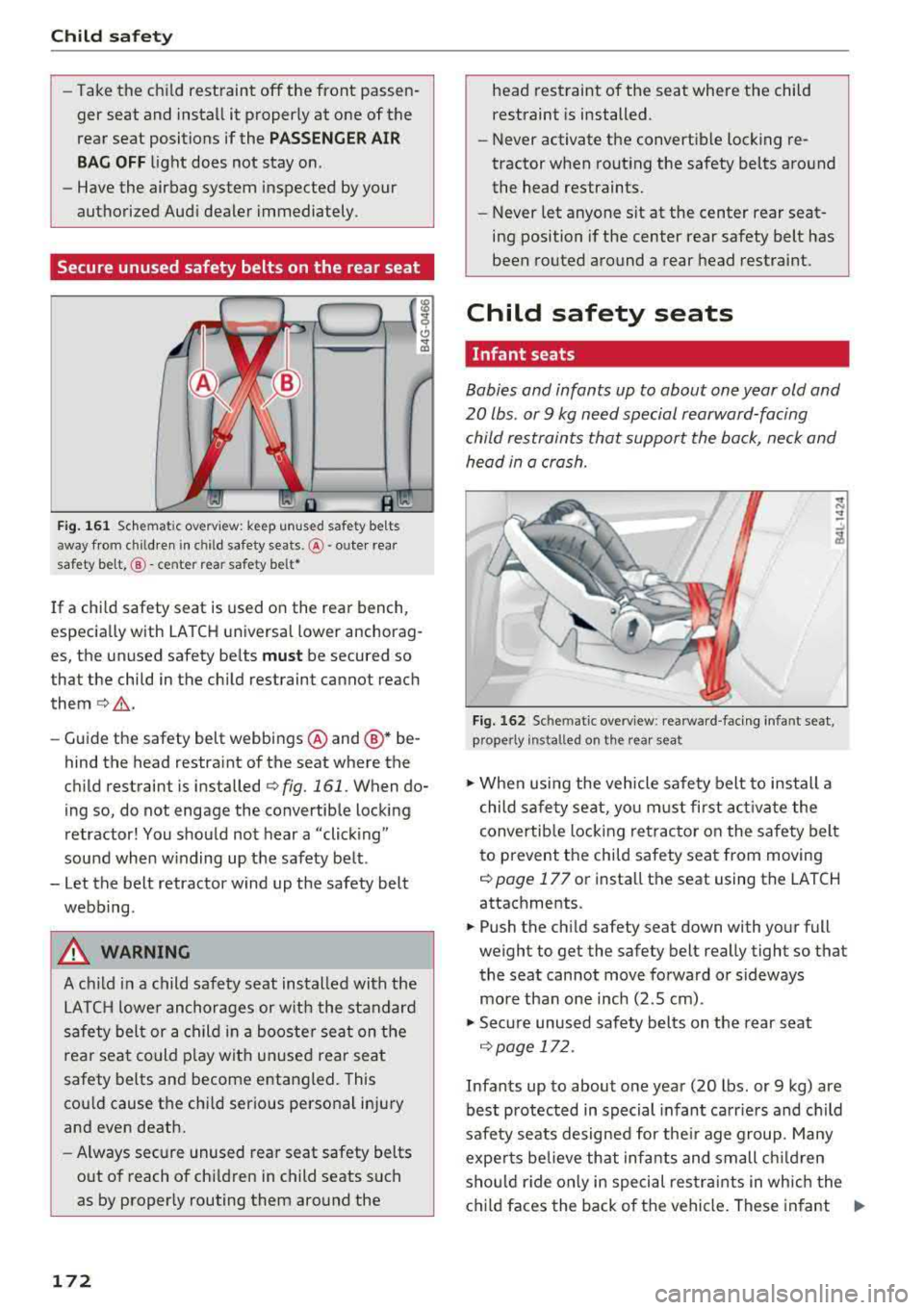
Secure unused safety belts on the rear seat
l8 , ,.,_ _ g
---0
Fig. 161 Schematic overv iew: keep unu sed safety belts
away from chi ldren in chil d safety seats. @-outer rear
safety belt,@- center rear safety belt*
~
If a child safety seat is used on the rear bench,
especially with LATCH universal lower anchorag
es, the unused safety belts
must be secured so
that the child in the child restraint cannot reach
them
c::> ,&. .
-Guide the safety belt webbings @and ®* be
hind the head restraint of the seat where the
c hild restraint is installed
c::>fig. 161. When do
ing so, do not engage the convertible locking
retractor! You should not hear a "clicking"
sound when winding up the safety belt .
-Let the belt retractor wind up the safety belt
webbing .
A WARNING
A child in a child safety seat installed with the
LATCH lower anchorages or with the standard
safety belt or a child in a booster seat on the
rear seat could play with unused rear seat
safety belts and become entangled. This
could cause the child serious personal injury
and even death.
-Always secure unused rear seat safety belts out of reach of children in child seats such
as by properly routing them around the
172
head restraint of the seat where the child
restraint is installed .
- Never activate the convertible locking re
tractor when routing the safety belts around
the head restraints.
-Never let anyone sit at the center rear seat
ing position if the center rear safety belt has
been routed around a rear head restrain t.
Child safety seats
Infant seats
Babies and infants up to about one year old and
20 lbs . or
9 kg need special rearward-facing
child restraints that support the back, neck and
head in a crash.
Fig. 162 Schema tic overview : rearward-facing infa nt seat,
prope rly installed on the rear seat
.. When using the vehicle safety belt to install a
child safety seat, you must first activate the
convertib le locking retractor on the safety belt
to prevent the child safety seat from moving
c::> page 177 or install the seat using the LATCH
attachments .
.. Push the child safety seat down with your full
weight to get the safety belt really tight so that
the seat cannot move forward or sideways
more than one inch (2 .5 cm).
.. Secure unused safety belts on the rear seat
c::> page 172 .
Infants up to about one year (20 lbs. or 9 kg) are
best protected in special infant carriers and child
safety seats designed for their age group. Many
experts believe that infants and small children
should ride only in special restraints in which the
child faces the back of the vehicle. These infant
II>
Page 175 of 266
a co .... N
" N .... 0 0 \,;J '
cras h
¢ fig. 16 2.
The a irbag on the passenger s ide makes the front
seat a potentia lly dange rous p lace for a ch ild to
ride. The front seat is not the safest place for a
chi ld in a forward-facing chi ld seat . It is a very
dangerous place for an infant or a larger child in
a rearward-facing seat.
A WARNING
Not using a ch ild safety seat, using the wrong
child safety seat or improperly installing a
child restra int increases the r isk of serious
personal in ju ry and death in a crash.
- Never install rear -facing chi ld safety seats
o r infant carriers on the front passenger
seat - even with an Advanced Airbag System.
A ch ild will be ser iously injured and can be
kille d when the infla ting air bag hits the
child safety seat o r infant carr ier with great
force and smashes the child safety seat and child against the backrest, center armrest,
doo r or r oof
c> page 143, Child restraints on
the front seat -some important things to
know .
-Always install rear-facing child safety seats
o r infant carriers on the rear seat.
- Never install a rear-facing child restra int in
the forward-facing direct ion. Such restraints
are designed for the spec ial needs of infants
and very small children and cannot protect
them properly if the seat is forward-facing .
- If you must install a rearward fac ing ch ild
safety seat on the front passenger seat be
cause of exceptiona l circumstances and the
PASSENGER AIR BAG OFF light does not
c ome on and stay on, imme diate ly install
the rear-fac ing ch ild safety sea t in a rear
seating pos it ion and have the airbag system
inspected by you r A udi dealer.
- Never place o r use any elec trical device
(s uch as a la ptop, CD player, electronic
games dev ice, power inverte r o r seat heater
f or child seats) on the front passenger seat
if the device is connected to the 12-volt
socket or the cigarette lighter socket.
Ch ild saf ety
- If a seat heater has been ret rofitted or oth
erwise added to the front passenger seat, never install any child restra int system on
this seat .
- Make sure that there are no wet objects
(such as a wet towel) and no water or other
liquids on the fron t passenger seat cush ion .
- Never p lace objects on the seat (such as a
laptop, CD p layer, electronic games device,
power inverter o r seat heater fo r ch ild
seats) . These may influence the elect rical
capacitance measu red by the capacitive pas
senger de te ct io n s ystem and can al so fly
aro und in an accident an d cause serious per
sonal injury .
- Always read and hee d all WARNING S when
ever using a child restrained in a vehicle is
be ing
u sed ¢ page 134, Safety belts,
¢ poge 142, Airbag system and
c> page 166, Important information.
173
Page 177 of 266
a co .... N
" N .... 0 0 \,;J '
move the rear seat head restraint if it is dif
ficult to install the child seat with the head restraint in place
c> page 49 . Install the
head restraint again immediately once the
child seat is removed. Driving without head
restraints or with head restraints that are
not properly adjusted increases the risk of
serious or fatal neck injury dramatically.
- Always read and heed all WARNINGS when
ever using a child restrained in a vehicle is
being used
c> page 134, Safety belts,
c> page 142, Airbag system and
c> page 166, Important information.
A WARNING
If exceptional circumstances require the use
of a forward-facing child restraint on the
front passenger's seat, the child's safety and
well-being require that the following special
precautions be taken:
- Make sure the forward-facing seat has been
designed and certified by its manufacturer
for use on a front seat with a passenger
front and side airbag .
- Always follow the manufacturer's instruc tions provided with the child safety seat or
infant carrier.
- Always move the front passenger seat to
the highest position in the up and down ad
justment range and move it back to the
rearmost position in the seat's fore and aft
adjustment range, as far away from the air
bag as possible, before installing the for
ward-facing child restraint.
- Always make sure that the safety belt upper
anchorage is behind the child restraint and
not next to or in front of the child restraint
so that the safety belt will be properly posi
tioned.
- Always make sure that nothing prevents the
front passenger's seat from being moved to
the rearmost position in its fore and aft ad
justment range.
- Always make sure the backrest is in an up
right position.
Child safety
-Never place or use any electrical device
(such as a laptop, CD player, electronic
games device, power inverter or seat heater
for child seats) on the front passenger seat
if the device is connected to the 12-volt
socket or the cigarette lighter socket.
- If a seat heater has been retrofitted or oth erwise added to the front passenger seat, never install any child restraint system on
this seat.
- Make sure that there are no wet objects
(such as a wet towel) and no water or other
liquids on the front passenger seat cushion.
- Never place objects on the seat (such as a
laptop, CD player, electronic games device,
power inverter or seat heater for child
seats). These may influence the electrical
capacitance measured by the capacitive pas
senger detection system and can also fly
around in an accident and cause serious per
sonal injury.
- Make sure that the
PASSENGER AIR BAG
OFF
light comes on and stays on all the time
whenever the ignition is switched on.
- If the
PASSENGER AIR BAG OFF light does
not come on and stay on, immediately in
stall the forward-facing child seat at a seat ing position on the rear seat and have the
airbag system inspected by your authorized
Audi dealer .
- Take the child restraint off the front passen
ger seat and install it properly at one of the
rear seat positions if the
PASSENGER AIR
BAG OFF
light does not stay on whenever
the ignition is switched on.
175
Page 195 of 266
a co .... N
" N .... 0 0 \,;J '
~ Castrot /lftlg;'f.E@t Frtrrr.::--.~lri,'lAl.
A ud i recomm ends using the Lo ng Life h igh
perfo rm ance eng ine oil from Aud i Genu ine
Parts .
Checking the engine oil level
The engine oil level can be checked in the Info
tainment system
Observe the safety precautions ¢ A in Working
in the engine compartment on page 189.
~ Park your vehicle on a level surface.
~ Shut the engine off when it is warm .
~ Switch only the ignition back on.
~ Wait approx imately two minutes.
~ Select : the ICARI function button > (C ar)* Sys
tem s
control button > Service & control > O il
l e v el.
~ Read the o il level in the display. Add eng ine oil
i f t he ba r in the oil leve l ind icator is just before
"min" ¢ page 194.
(UJ) Note
The engine oil leve l mus t not be unde r the
"min" mark ing, as this will increase the risk of
engine damage.
(D Tips
The o il level indica tor in the disp lay is on ly an
informationa l display. If the o il level is too
low, a minimum oi l warning appears in the in
strument cluster. Add oil and close the hood.
The current oil level is d isplayed in the Info
tainment system the next t ime the ignition is
sw itched on.
(D Tips
The engine oil consumption may be up to
0.5 quart/600 m iles (0.S liter/1,000 km), de
pending on driving style and operating condi
tions. Consumpt ion may be h igher during the
first 3,000 miles (5,000 km). Because of this,
the eng ine oil level m ust be checked regu lar
ly. I t is best to chec k each t ime yo u refuel
your veh icle and befo re long d rives .
Ch eck ing and F illing
-In order to prov ide effective lubrication and
cooling of interna l engine components, a ll
internal comb ustion engines consume acer
tain amount of oil. Oi l consumption var ies
from engine to engine and may change sig
nificantly over the life of the engine . Typi
cally, eng ines with a specified break-in peri
od consume mo re o il du ring the break-in pe
r iod than they consume afte r oil cons ump
t ion has s tabilized.
-Under norma l co ndit io ns, the rate of oil
cons umption depe nds on the q ual ity and
vis cos ity of the oil , the R PM (revo lutions per
m inute) a t which the engine is operated, the
ambient temperature and road conditions .
Further factors are the amount of oi l di lu
tion from water condensat ion or fue l resi
due and the oxidation level of the oil. As any
eng ine is subject to wear as m ileage builds
up, the oil consumption may increase over
t ime until replacement of worn components
may become necessa ry.
-With all these var iables com ing into play,
no sta ndard rate of o il consumption can be
established o r specified. There is no a lter na
ti ve to c hec king the oil leve l reg ularly and
frequently.
-If you have the impress ion your e ngine co n
sumes excessive amo unts o f oil, we recom
mend that you consult an author ized Audi
dea ler to have the cause of your concern
properly diagnosed . Keep in mind that t he
acc urate measurement of o il cons umption
requires great care and may take some
time . An authorized Aud i dealer has instruc
tions about how to measu re o il consump
tion accurate ly.
-You can find informat ion on engine oil and
eng ine o il capacit ies for the USA at
www.aud iusa.com/he lp/ma intenance, o r
for Ca nada at www.aud i.ca/ ca/web/en/
cu stomer -area/ ca re -and -m a i ntena nee/ a u di
serv i ce -sched u les. htm l, or ca ll
800 -822-2834 .
193
Page 201 of 266
a co .... N
" N .... 0 0 \,;J '
thorized Aud i Serv ice Facility for more infor
mation.
- Do not connect or disconnect the charging
cable while charg ing because this increases
the risk of an explosion.
(D Tips
-Only charge the vehicle battery through the
connections in the engine compartment.
- Read all of the manufacturer's instructions
for the charger before charging the ve hicle
battery.
Windshield washer system
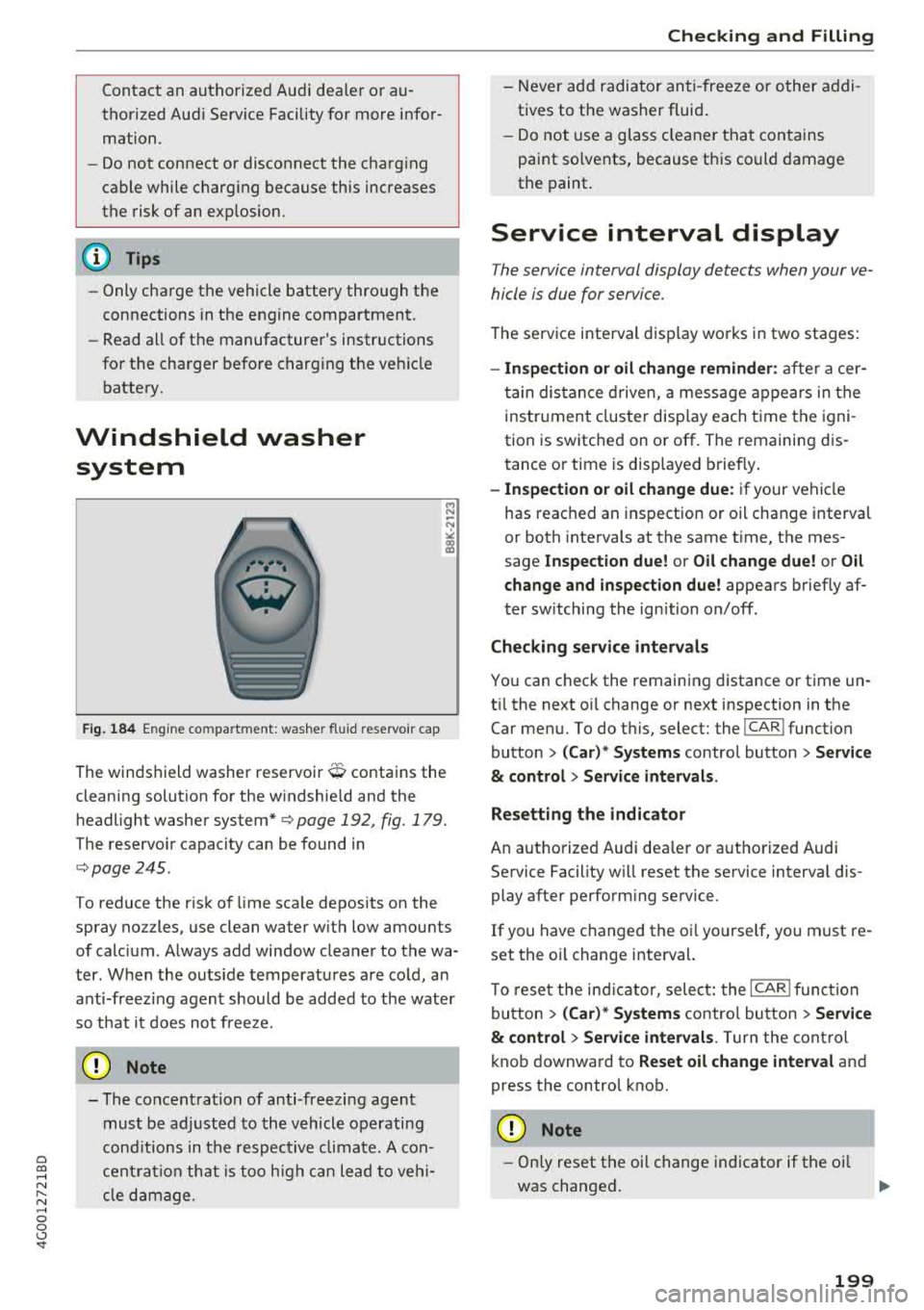
F ig. 184 Eng ine co mpartment: washer flu id reservoir cap
M N ~ N
"' a, a,
The winds hield washer reservoir O contains the
cleaning solution for the windshield and the
headlight washer system*
c::;,page 192 , fig . 179.
The reservoir capacity can be found in
c::;, page 245 .
To reduce the risk of lime sca le deposits on the
spray nozzles, use clean water w ith low amounts
of calc ium . Always add window cleaner to the wa
ter . When the outs ide temperatures are cold, an
anti-freez ing agent should be added to the water
so that it does not freeze.
0 Note
- The concentration of anti-freezing agent
must be adjusted to the vehicle operating
cond itions in the respect ive climate. A con
centration that is too high can lead to vehi
cl e damage.
Checking and Filling
- Never add radiato r anti -freeze or other addi
tives to the washer fluid .
- Do not use a glass cleaner that contains
paint solvents, because this could damage
the paint.
Service interval display
The service interval display detects when your ve
hicle is due for service .
The service interval display works in two stages:
-Inspection or oil change reminder : after a cer-
tain distance driven, a message appears in the
instrument cluster display each time the igni
tion is switched on or off. The remaining dis
tance or time is disp layed briefly.
-Inspection or oil change due: if your vehicle
has reached an inspection or oil change interval
or both intervals at the same time, the mes
sage
Inspection due! or Oil change due! or Oil
change and inspection due!
appears briefly af
ter switching the ignition on/off .
Checking service intervals
You can check the remaining distance or time un
til the next oi l change or next inspection in the
Car menu. To do this, select: the
I CAR I function
button
> (Car)* Systems control button > Service
& control > Service intervals .
Resetting the indicator
An authorized Audi dea ler or authorized Audi
Service Facility w ill reset the service interval dis
play after perform ing service .
If you have changed the oi l yourse lf, you must re
set the oil change interval.
To r eset the indicat or, select: the
I CARI function
button
> (Car)* Systems control button > Service
& control > Service intervals . Turn the control
knob downward to
Reset oil change interval and
press the control knob.
@ Note
- Only reset the oi l change indicator if the oi l
was changed.
199