child seat AUDI A7 2012 Workshop Manual
[x] Cancel search | Manufacturer: AUDI, Model Year: 2012, Model line: A7, Model: AUDI A7 2012Pages: 294, PDF Size: 73.33 MB
Page 179 of 294
into place and canno t fold forward. Oth
erwise, the seatback w ith the ch ild safety
seat attached to it could fly forward in
the event of an acc ident or other emer
gency situation .
- Always read and heed all WARNINGS
whenever using a child rest rained in ave
hicle is being used
<=:> page 163 . Special
precautions apply when installing a ch ild
safety sea t on the front passenge r seat
<=:> page 139, Child restraints on the front
seat -some important things to know.
Deactivating the convertible locking
retractor
The convertible locking retractor for child re
straints will be deactivated automatically when the belt is wound all the way back into the retractor.
~ Press the red button on the safety be lt
buck le . The belt tongue will pop out of the
buck le.
ii-G ui de the safety belt all the way back into
its stowed posit ion.
Always let the safety belt retract comp lete ly
i nto its stowed posit ion. The safety belt can
now be used as an ordinary safety belt with
out the convert ib le lock ing retractor for ch ild
restra ints .
If the c onvertible locking retractor shou ld be
activated inadvertently, the safety belt must be unfastened and guided completely back in
to its stowed position to deactivate th is fea
ture .
If the convertib le locking retractor is not
dea ctivated, the safety belt will g radua lly be
come tighter a nd uncomfo rt a b le to wear .
_& WARNING
Improperly installed chil d sa fe ty se ats in
crease the risk of ser ious personal inju ry
and death in a collision.
- Never unfasten the sa fe ty belt to deac ti
vate the convert ible lock ing retractor for
child restraints while the veh icle is mov-
Child Sa fet y 177
ing. You would not be restrained and
could be serious ly injured in an accident.
- Always rea d and heed all WAR NIN GS
whenever us ing a child restrained in ave
hicle is being used ¢
page 163. Special
precautions apply when insta lling a child
safety seat o n the fron t passenger seat
<=:> page 139, Child restraints on the front
seat -some important things to know.
LATCH Lower
anchorages and tethers
for children
Child Restraint System anchors and how
are they related to child safety
T o provi de a simp ler and more practicable way
to attach the c hild restra int on the vehicle
seat, Federal regulat ions req uire spec ial lower
anchorages in vehicles and devices on new
c h ild restra ints to attach to the veh icle ancho
r ages .
The combinat ion of the tether anchorages and
the lower anchorages is now generally called
the
LATCH system for " Lower Anchorages and
T ethers for Chil d ren."
Fo rward-facing chi ld restraints manufactured
after September 1, 1999, are requ ired by U.S.
federa l regu lations to comply with new child
head movement performa nce re quirements .
T hese new pe rfo rmance requ ir e ments ma ke a
tethe r ne cessary on most new c hild sea ts.
Installing a ch ild restra int that requires a top
tethe r without one can seriously impa ir the
p erfo rman ce of the c hild restra int and its abil
ity to p rotect the child in a coll is io n. Insta lli ng
a ch ild res tra in t that re quires a top tethe r
withou t the to p tether may be a violat ion o f
state law.
Child res train t manufacturers offer LA T CH
l ower anchor ages on t heir child seats w ith
hook -on or push -on connectors a ttached to
adjustable straps.
In add ition to the LA TCH lower anchorages,
th ese chi ld res tra int systems usu ally require .,. •
•
Page 180 of 294
1 78 Child Safety
the use of tether straps to help keep the child
restraint firmly in place.
.&_ WARNING
Improper installation of child restraints
will increase the risk of injury and death in
a crash.
- Always follow the instructions provided
by the manufacturer of the child re
straint you intend to install in your vehi
cle.
- Never install a child restraint without a
properly attached top tether strap if the
child restraint manufacturer's instruc
tions require the top tether strap to be
used.
- Improper use of child restraint LATCH
lower anchorage points can lead to injury
in a collision. The LATCH lower anchorage
points are designed to withstand only
those loads imposed by correctly fitted
child restraints.
- Never mount two child restraint systems
on one LATCH lower anchorage point.
- Never secure or attach any luggage or
other item to the LATCH lower anchorag
es.
(j) Tips
- In Canada, the terms "top tether" with
"lower universal anchorages" (or "lower
universal anchorage bars") are used to
describe the system.
- In other countries, the term "ISOFIX" is
used to describe the lower anchorages.
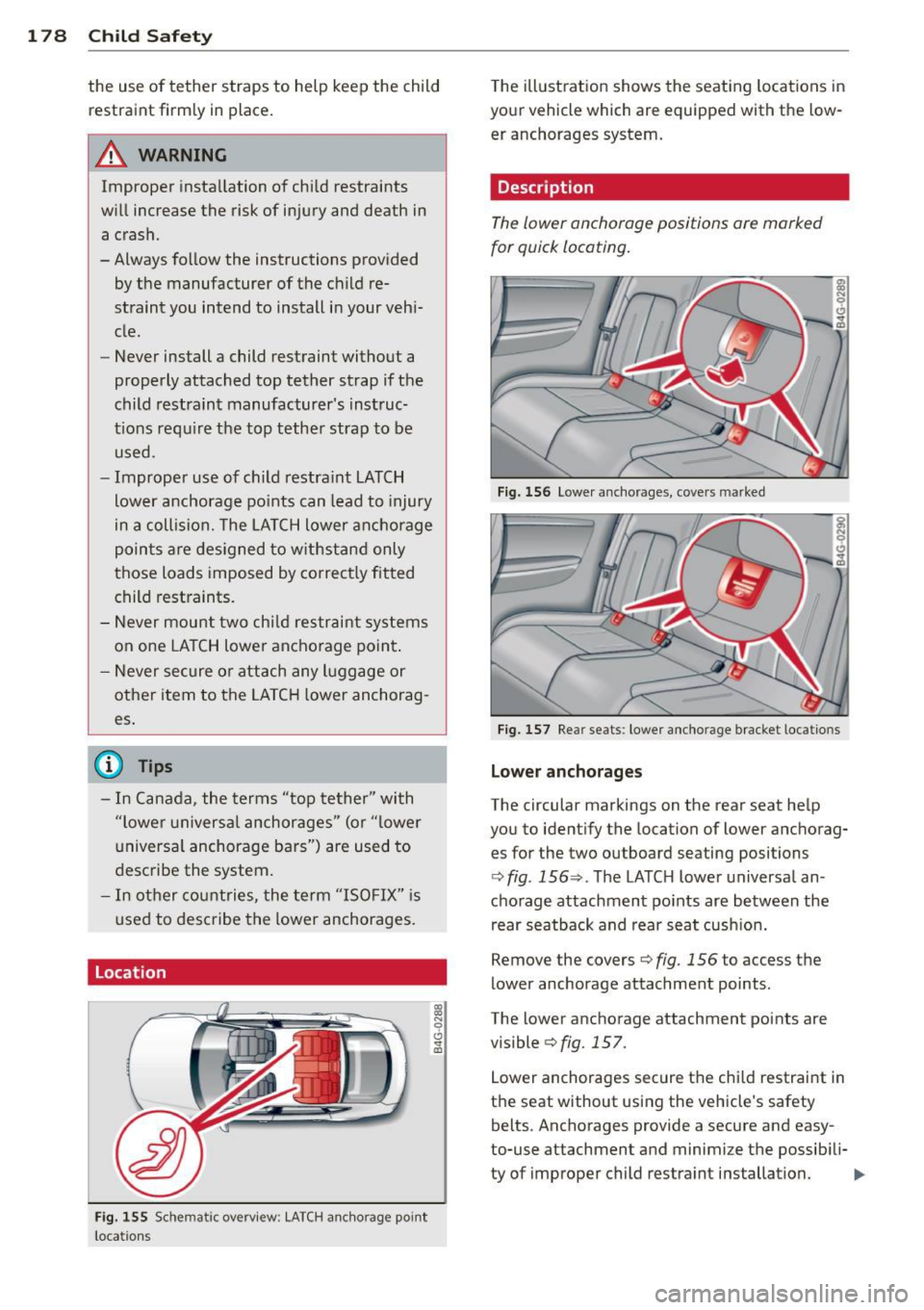
Location
Fig. 155 Schematic overvi ew: LATCH ancho rage point
locat ions
ill N 0 6 ... (0
The illustration shows the seating locations in
your vehicle which are equipped with the low
er anchorages system .
Description
The lower anchorage positions are marked
for quick locating.
Fig. 156 Lower anchorages, cove rs m arked
Fig. 157 Rea r seats: lower ancho rage bracket locations
Lower anchorages
The circular markings on the rear seat help
you to identify the location of lower anchorag
es for the two outboard seating positions
¢ fig . 156 ~. The LATCH lower universal an
chorage attachment points are between the
rear seatback and rear seat cushion.
Remove the covers
c:> fig . 156 to access the
lower anchorage attachment points .
The lower anchorage attachment points are
visible
c:> fig. 157 .
Lower anchorages secure the child restraint in
the seat without using the vehicle's safety
belts. Anchorages provide a secure and easy
to-use attachment and minimi ze the possibili-
ty of improper child restraint installation. .,.
Page 181 of 294
All child restraints manufactured after Sep
tember 1, 2002, must have lower anchorage
attachments for the
LATCH system.
Please remember that the lower anchorage
points are only intended for installation and
attachment of child restraints specifically cer
tified for use w ith
LATCH lower anchorages.
Child restraints that are not equipped with the
lower anchorage attachments can still be in
stalled in compliance with the child restraint
manufacturer's instructions on using vehicle
safety belts .
A WARNING
Improper use of LATCH lower anchorages
can cause serious personal injury i n an ac
cident.
- Always carefully follow the child re
straints manufacturer's instructions for
proper installation of the child restraint
and proper use of the lower anchorages
or safety belts in your vehicle .
- Never secure or attach any l uggage or
other items to t he
LATCH lower ancho
rages.
- Always read and heed the important in
formation about child restraints in this
chapter and WARNINGS
¢page 163,
Child Safety.
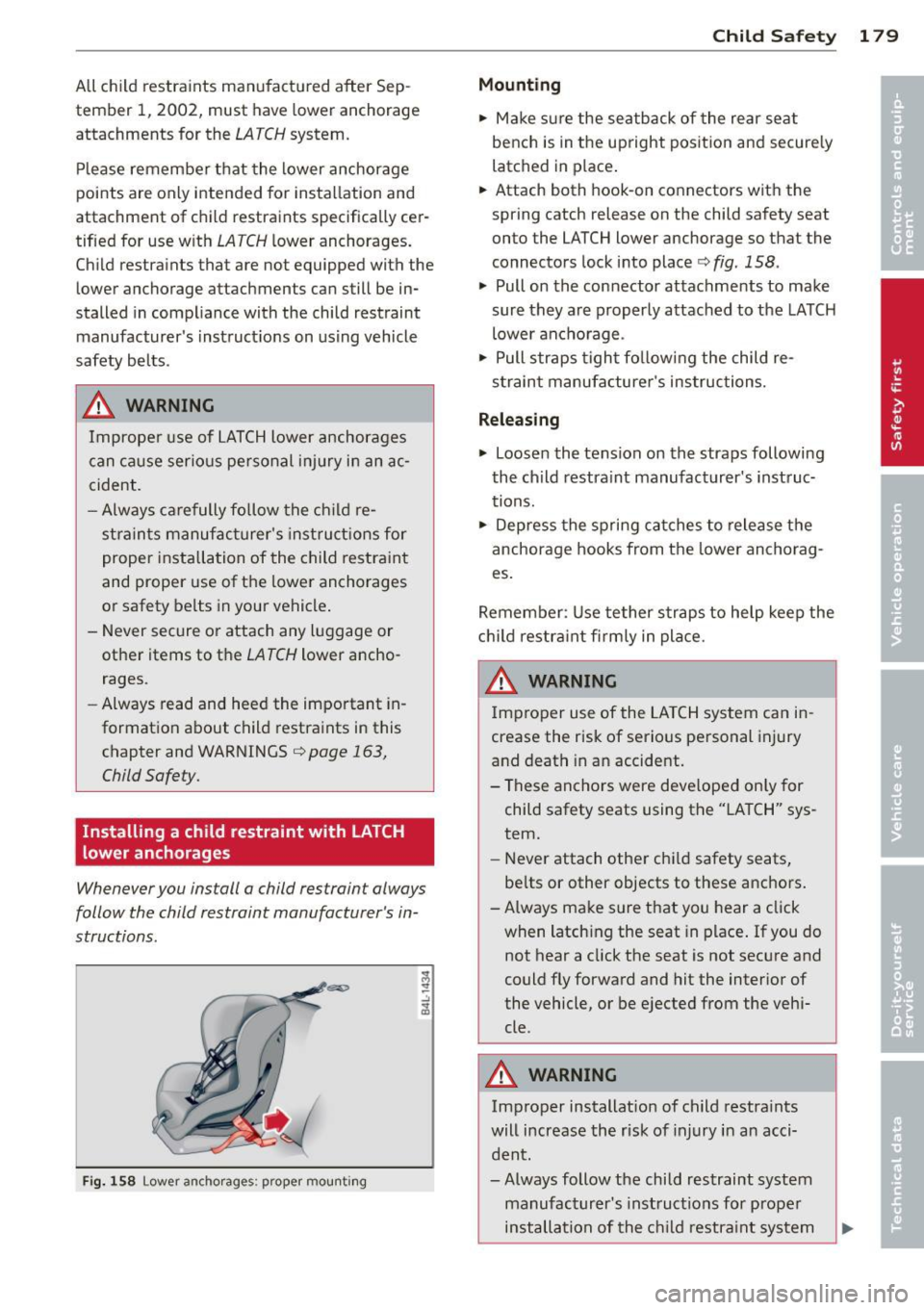
Installing a child restraint with LATCH
lower anchorages
Whenever you install a child restraint always
follow the child restraint manufacturer's in
structions.
Fig. 158 Lower anchorages: proper mount ing
Child Safety 1 79
Mounting
.,. Make sure the seatback of the rear seat
bench is in the upright position and securely
latched in place.
.,. Attach both hook-on connectors with the
spring catch release on the child safety seat
onto the LATCH lower anchorage so that the
connectors lock into place
¢fig. 158 .
.,. Pull on the connector attachments to make
sure they are properly attached to the LATCH
lowe r anchorage .
.,. Pull straps tight follo wing the child re
straint manufacture r's instruc tions.
Releasing
.,. Loosen the tension on the straps following
the child restraint manufacturer's instruc
t ions.
.,. Depress the spring catches to release the
anchorage hooks from the lower anchorag
es .
Remember: Use tether straps to help keep the
child restraint firmly in place.
A WARNING
-
Improper use of the LATCH system can in
crease the risk of serious personal injury
and death in an accident.
- These anchors were developed only for
child safety seats using the "LATCH" sys
tem.
- Never attach other chi ld safety seats,
be lts or other objects to these anchors.
-A lways make sure that you hear a click
when latching the seat in place. If you do
not hear a click the seat is not secure and
could fly forward and hit the interior of
the vehicle, or be ejected from the vehi
cle.
A WARNING
Improper installat ion of child restraints
will increase the risk of injury i n an acci
dent.
- Always follow the child restraint system
manufacturer's inst ruct ions for proper
installation of the child restra int system
-
Page 182 of 294
180 Child Safety
and proper use of tether straps as well as
the lower anchorages or safety belts in
your vehicle .
- Always read and heed the important in
formation and WARNINGS about child
safety and the installation of child re
straint systems
c:> page 163, Child Safe
ty.
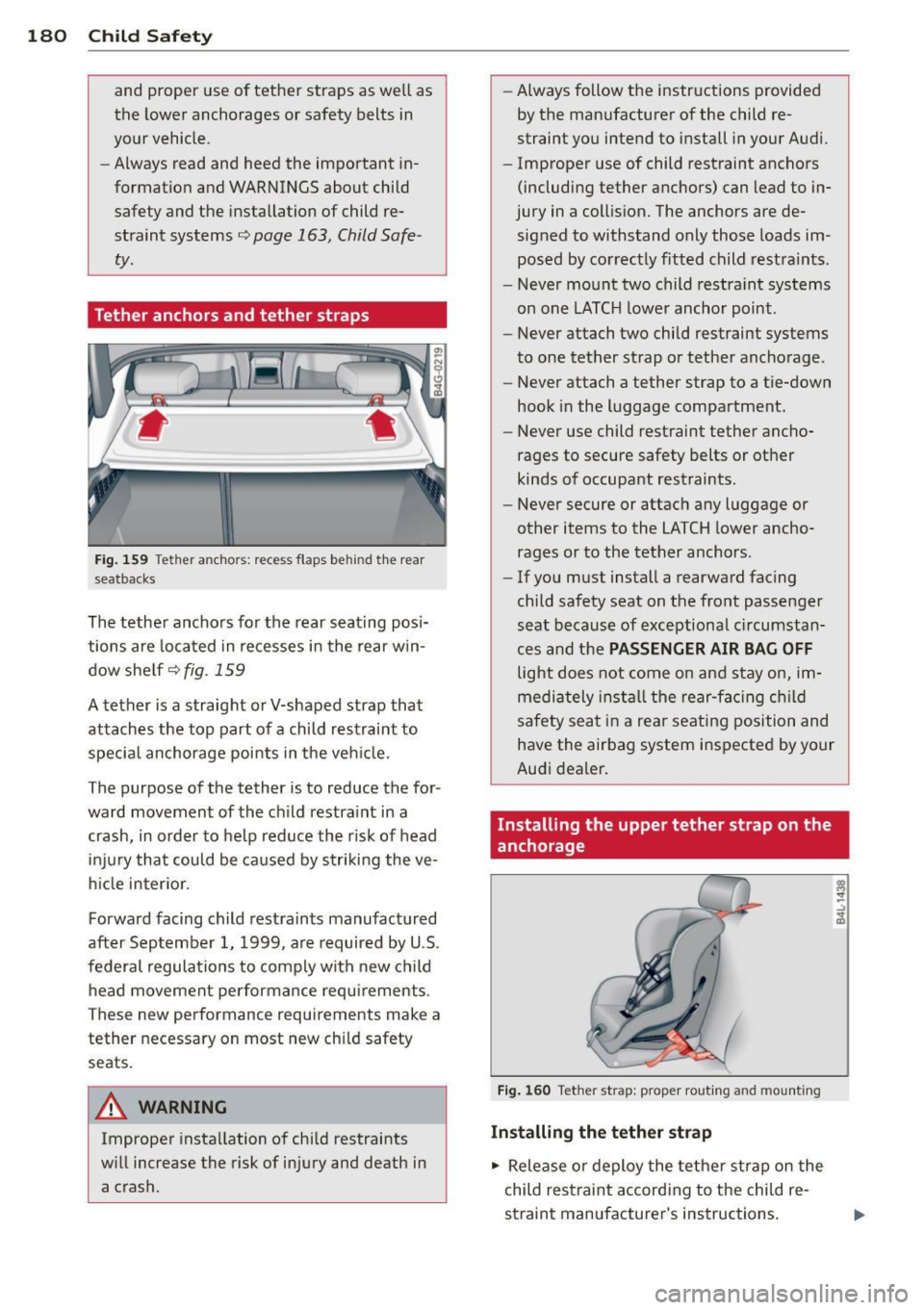
Tether anchors and tether straps
Fig. 159 Te the r ancho rs: recess fl aps be hind the rear
sea tback s
The tether anchors for the rear seating posi
tions are located in recesses in the rear win
dow shelf
c:> fig. 159
A tether is a straight or V-shaped strap that
attaches the top part of a child restraint to
special anchorage points in the vehicle.
T he purpose of the tether is to reduce the for
ward movement of the child restraint in a crash, in order to help reduce the risk of head
injury that could be caused by striking the ve
hicle interior.
Forward facing child restraints manufactured
after September 1, 1999, are required by U.S .
federal regulations to comply with new child head movement performance requirements.
These new performance requirements make a
tether necessary on most new child safety
seats.
A WARNING
Improper installation of child restraints
will increase the risk of injury and death in
a crash . -
Always follow the instructions provided
by the manufacturer of the child re
straint you intend to install in your Audi.
- Improper use of child restraint anchors
(including tether anchors) can lead to in
jury in a collision. The anchors are de
signed to withstand only those loads im
posed by correctly fitted child restraints.
- Never mount two child restraint systems
on one LATCH lower anchor point.
- Never attach two child restraint systems
to one tether strap or tether anchorage .
- Never attach a tether strap to a tie-down
hook in the luggage compartment.
- Never use child restraint tether ancho
rages to secure safety belts or other
kinds of occupant restraints.
- Never secure or attach any luggage or
other items to the LATCH lower ancho
rages or to the tether anchors .
- If you must install a rearward facing
child safety seat on the front passenger
seat because of exceptional circumstan
ces and the
PASSENGER AIR BAG OFF
light does not come on and stay on, im
mediately install the rear-facing child
safety seat in a rear seating position and
have the airbag system inspected by your
Audi dealer.
Installing the upper tether strap on the
anchorage
Fig. 160 T eth er st rap: prop er rou ting and mounting
Installing the tether strap
.,. Release or deploy the tether strap on the
child restraint according to the child re
stra int manufacturer's instructions.
Page 183 of 294
~ Guide the upper tether strap und er the rear
head restraint ¢
fig. 160 (raise the head re
stra int if necessary).
~ Attach the tether strap anchorage hook into
the tethe r anchorage .
~ Pull on the tether strap hook so that the
spring catch of the hook engages.
~ Tighten the tether strap firmly following
the chi ld restraint manufacturer's instruc
tions .
Rele asing the tether str ap
~ Loosen the tension following the ch ild re
stra int manufacturer 's instructions .
~ Depress the spring catch on the hook and
release it from the anchorage.
{[) Note
If you leave the child restraint with the
tether strap firmly insta lled for severa l
days , th is co uld leave a mar k on the up
holstery on the seat c ushion and bac krest
in the area whe re the tether st rap was in
stalled. The upholstery wo uld a lso be per
manently stretched around the tether
strap. This applies especially to leather
seats.
Using tether straps on rearward -facing
child restraints
Currently , few rear-facing child res traint sys
tems come with a tether . P lease read and
heed the child restraint system manufactur
er's instructions carefully to determine how to properly insta ll th e tether .
A WARNING
-
A child in a rearward-facing child safety
seat installed on the front passenger seat
w ill be seriously injured and can be k illed if
the front a irbag inflates -even with an Ad
vanced Airbag System .
- The inflating a irbag w ill hit the child
safety seat or infant carrier w it h great
force and w ill smash the ch ild safety seat
and child against the backrest, cente r
armrest, or door .
Child Safet y 181
-If you must insta ll a rearward fac ing
child safety seat on the front passenger
seat because of exceptional circumstan
ces and the
PASSENGER AIR BAG OFF
light does not come on and stay on, im
mediately insta ll the rear-fac ing ch ild
safety seat i n a rear seating position and
h ave the airbag system i nspe cted by yo ur
Aud i dea le r.
Additional Information
Sources of information about child
restraints and their use
The re a re a number of sources of add itiona l
information about child rest raint se lection , in
stalla tion and use:
NH TSA advises that the best child safety seat
i s the one that fits your ch ild and fits in you r
vehicle , and that you will use correct ly and
consistently .
T ry before you buy !
U.S Na tional Highway Traffic Safety Admin
istration
Tel.: 1 -888 -327 -4236 (TI Y: 1-800 -424 -9153)
www .nhtsa .gov
National SAFE KIDS Campaign
Tel.: (202) 662-0600
www .safek ids .org
Safet y BeltSafe U.S.A
Tel.: (800) 7 45-SAFE ( English)
Tel.: (800) 747-SANO (Span ish)
www .carseat .org
T ransport Can ada Info rmation Cent re
Tel.: 1 (800) 333-0371 or call
1 (613) 998-8616 if you are in the Ot tawa
area
www .tc.gc.ca/roadsafety
Audi Custome r CARE
Tel.: (800) 822-2834 •
•
Page 209 of 294
grease or dye must be patted off using ab
sorbent material. It may be necessary to re
treat the areas with detergent paste and wa
ter.
In the case of general soiling of the uphols
tery and cover material, we recommend hiring
a specialist that has the equipment to clean
the seat covers and other fabric surfaces by
shampooing and spray extraction.
A WARNING
Always read and heed all WARNINGS and
the information
Q page 200.
Open Velcro fasteners on your clothing can
damage the seat cover. Please make sure
that Velcro fasteners are closed.
Plastic parts and instrument panel
Always use a clean cloth moistened in clear
water to clean these areas. For persistent dirt
use an Audi approved
solvent-free plastic
cleaner/protectant.
A WARNING
Solvents can change the properties of
some plastics and make it harde r for the
airbag to deploy.
- Never clean the instrument panel or the
surface of airbag modules with cleaning
products that contain solvents.
- Products containing solvents will make
the surface of this part porous.
- Serious injuries can result if plastic parts
come loose when the airbag is deployed.
- Always read and heed all WARNINGS and other information~
page 200.
(D Note
Cleaning agents containing solvents will
attack the material and can change the
way it behaves.
Cleaning and protection 207
Trim and molding
Trim and molding in the vehicle interior can
be cleaned with a dry microfiber cloth. To pre
vent scratches, do not use any cleaning solu
tions.
Natural leather
Appl ies to vehicles: with natural leather
Audi makes great efforts to maintain the
properties, natural look and feel of interior
leather.
General
We offer many different types of leathe r on
our vehicles. Most are different types of nappa l eather, which has a smooth surface and
comes in various colors.
Th e intensity of the color determines the visu
al characteristics and appearance. If the sur
face of the leather has a typical natural look,
then the leather is a nap pa leather that has
been left in a relatively natural condition. This
leather offers particularly good comfort and
breathes well. Fine veins, closed grains, insect
bites, skin folds, and subt le variations in color
remain visible. These characteristics demon
strate that the material is natural.
Natural nappa leather is not covered by a col
or finish. It is therefore more sensit ive to soil
ing and wear, which is something you need to
consider if children, animals or other factors
might prove to be particularly hard on the
leather .
By contrast, leather types that are covered by
a colored finish layer are more durable. This
has a positive effect on the leather 's resist
ance to wear and soiling in daily use. On the
other hand, the typical characteristics of natu
ral leather are barely or not apparent. Howev
er, this does not mean that the leather itself
is of inferior quality. •
•
Page 229 of 294
Have the battery checked when you take your
vehicle in for service. Yo u are well advised to
replace a battery that is older than 5 years.
W ith certa in types o f airbag deployment, the
battery is disconnec ted from the vehicle elec
trica l system for safety reasons
c::> &. in Re
pair, care and disposal of the airbags on
page 153.
Di sconn ecting the battery t erminal s
Some vehicle functions (power w indow regu
l ators, for example) are lost if the battery ter
minals are disconnected . These functions have
to be re learned after the battery terminals are
connec ted again. To prevent this, the battery
should only be disconnected from the vehicle
e lectrical system when absolutely necessary
for repairs .
Vehicl es not driven for long p eriod s
If you do not drive your vehicle over a period
of several days or weeks, electrical compo
nents are gradually cu t back or switched off .
This reduces energy consumption and main
tains starting capability over a longer per iod
c::> page 190. Some of the convenience func
tions may not operate, s uch as the inte rior
lights o r power seat adjus tme nt. The conven
ience functions will be ava ilable again when
you switch on the ignition and start the en gine.
Winter operation
During the winter months, ba ttery capaci ty
t ends to decrease as tempe rat ures d rop . This
is because more powe r is also consumed while
starting , and the headlights, rear window de
fogger, etc., are used more often.
Avoid unnecessary power cons umption, par
ticularly in c ity t ra ff ic or when t raveling on ly
short distances. Let your a uthorized Audi
dealer check the capac ity of the vehicle bat
tery before winter sets in
c> page 229. A well
charged battery w ill not only prevent starting
problems whe n the weather is cold, but will
also last longer .
Checkin g and fillin g 22 7
(D Tips
If your vehicle is left standing for seve ral
weeks at extremely low temperatures, the
vehicle battery shou ld be removed and
stored where it w ill not freeze. This will
prevent it from be ing damaged and having
to be replaced .
Working on the battery
Be especially careful when working on or near
the battery.
The battery is located in the l uggage compart
ment under the floor. Before you check any
th ing in the luggage compartment,
read and
h eed all WARNINGS
c> &_ .
Always heed the safety warnings , when work
ing on the vehicle battery or the vehicle e lec
trical system to prevent injury.
The following WARNINGS are very
important when working on the battery:
Al way s heed the follo wing WARNING SYM
BOLS and safety precautions when working on the battery.
@
®
Always wear eye protection.
Battery acid contains sulfuric acid.
Always w ear glove s and eye prot ec
tion .
No
- sparks
-flames
- smoking .
When a battery i s charged, it produ
ce s hydrogen gas wh ich i s ex plosive
and could cause per sonal injury .
Always keep the battery well out of ]
reach of children .
_& WARNING ~
Whenever working on the battery o r on
the electrical system, there is the risk of injury, accident and even fire . Read and
heed the following WARNINGS:
•
•
Page 280 of 294

278 Index
A
Accessories ... .. .. ..... ... .. .. .... . 275
AC (automatic cl imate control) ... .. .. . . 67
AC (climate contro l) . . . . . . . . . . . . . . . . . . 65
Adapt ive cr uise control . . . . . . . . . . . . . . . . 79
C le a ning sensors/cameras .. .. .. .. .. . 202
M essages . . . . . . . . . . . . . . . . . . . . . . . . . 86
Request for driver intervention . . . . . . . . 83
Stop-and-go traffic . . . . . . . . . . . . . . . . . 82
Adapt ive Lig ht (defe ctive) . .. .. .. .. .. . . 21
Adding Eng ine coolant .............. ... ... 224
Eng ine o il .. .......... ...... ... .. . 22 1
W indshie ld washer fluid . .. .. .. .. .. . 230
Addit ives
Eng ine oil .... ........... .... .... . 221
Ad justing
Ai r dist ribution (automatic climate con-
trol) . .. .. .. ............. .. .. .. ... . 68
a ir distribution (climate control) . .. .. . . 65
Front seats . . . . . . . . . . . . . . . . . . . . . . . . 50
Instrumen t illum inat ion .... ... .. .. .. 44
Steer ing column e lectrically .. .. .. .. . . 70
Steer ing column manually . .. .. .. ... . 70
T empe ratu re (a utoma tic climate co ntrol) 68
T empe ratu re (climate con trol) .. .... .. 65
A irbag system . . . . . . . . . . . . . . . . . 137, 158
Advanced Airbag System . ...... .. .. . 141
Advanced Airbag System components . 1 45
Ca re . .. .. ... ............ .. .. .. .. . 153
C hi ldren . .. ... .......... .. .. .. .. . 16 5
Ch ild restra ints . .. ..... ... .. .. .... . 165
Components (front airbags) . ... .. ... 145
Danger of fitting a child seat on t he front
passenger seat ........... .. .. .... . 139
Disposal . ............... .. .. .. .. . 153
Front airbags . . . . . . . . . . . . . . . . 141, 143
H ow do the front airbags wo rk? . .. .. . 147
H ow ma ny airbags does my vehicle
h ave? . .. .... ........... .. .. .. .. . 145
H ow t he Advan ced Airbag Sys tem com-
po nents work toge ther .... .. .. .. .. . 147
I mportant safety instructions on the
knee airbag system .. ... .. .. .. .... . 156
Important things to know . ... .. .... . 137
Knee airbags .. ........... .. .. .... . 154
Mo nitor ing .............. .. .. .. .. . 149 PASS
ENG ER A IR BAG OF F light .... . .. 15 0
Repairs ... .... .. .. ... .. ..... ... .. 153
Safety instr uctions . .. .. ..... ... .. .. 152
S ide a irbags ... .. ............. .... 157
S ide curtain airbags ............ .... 160
Warning/ind icator lights ........... .. 17
Wa rning/Indicato r lights . .. .. .. .. .. 149
When must the system be inspected? . 149
All-wheel drive .. .. ... .......... .... 189
Winter tires ... ... ................ 246
Alloy w heels .... .. .. ... ..... ... .. .. 2 05
Alterna to r ... ... .. .......... ...... .. 16
Amb ience lighting ................ .. . 44
An ti-free ze
refer to E ng ine coolan t ...... ... .. .. 2 23
An ti-lock b rak ing system . .. ... ..... .. 184
Warning/ind icator lights ........... .. 18
Anti-slip reg ulation .. ........... .. .. 184
An ti- theft systems
El ectronic immob ilizer .. ..... ... .. .. . 30
Asht ray ..... ... .. .. ... ........... .. 54
Audi braking guard
refer to brak ing guard .......... .... . 79
Audi dr ive selec t
refer to drive select .... ..... ... .. .. . 96
Audi Se rv ice Repair Manuals and Litera-
tu re ....... .. .. .. .. ........... .... 273
A UTO
automatic climate control . . . . . . . . . . . . 68
Automa tic head lights ....... ...... .. 41
cli mate control . .. .......... ...... .. 65
Auto Lock . . . . . . . . . . . . . . . . . . . . . . . . . . 31
A uto mat ic be lt retractor ......... .. .. 131
Automat ic car wash .......... ...... . 201
A utomatic climate contro l
Air vents .. .... .. ............. .... . 68
Automat ic recirc ulation ......... .. .. . 69
Operation . . . . . . . . . . . . . . . . . . . . . . . . . 67
Setup ........ .. .. ... ........... .. 69
synchronizi ng . . . . . . . . . . . . . . . . . . . . . . 68
A utomat ic transm iss ion ... .... ... .. .. 102
Automat ic Shift Lock (ASL) ...... .... 104
Driving ... .. .. .. ............. .. .. 102
Dynam ic shift program . .. ... ..... .. 105
Emergency mode . ................ . 106
Emergency re le a se .......... ...... . 107
Kic k-down . .. .. .. ... .......... .... 104
Page 281 of 294

Manual shift program . . . . . . . . . . . . . . 105
Selector lever .................. ... 103
Shift buttons . . . . . . . . . . . . . . . . . . . . . 106
Steering wheel with tiptronic . .. .. .. . 106
Automatic wipers .......... .. .. .. .... 45
Auto Safety Hotline ............ ... .. 126
Average consumption .......... ... .. .. 23
Average speed . . . . . . . . . . . . . . . . . . . . . . . 23
Avoid damaging the vehicle .. .. .. .. .. . 193
B
Battery ... .. .. ............. .. .. ... 226
Charging . .. ............. .... .. ... 229
Important warnings ...... .. .. .. .. . 227
Jump starting ............... ... ... 264
Location ... ... .. .. ...... .. .. .. .. . 227
l ow . .. .. .. .. ... .. ..... ... .. .. .. . 190
Replacing the battery ..... .. .. .. .. . 230
State of charge ........... .... .. ... 190
Winter operation ............ ... .. . 226
Working on the battery ....... ... .. . 227
Before driving . . . . . . . . . . . . . . . . . . . . . . 118
Blended gasoline .......... .... .. .. . 211
Blower (automatic climate control) . . . . . . 68
Blower (climate control) . . . . . . . . . . . . . . . 65
Body cavity sealing ............ ... .. . 205
Booster seats ............. .. .. .. .. . 172
Brake fluid Changing the brake fluid ....... ... .. 226
Checking the brake fluid level ... ... .. 225
What is the correct brake fluid level? .. 225
What should I do if the brake fluid warn-
ing light comes on? ....... .. .. .. .. . 225
Brake system Anti-lock braking system . ......... ... 18
Brake assist system .......... .... .. 184
Brake booster ............ .... .. .. . 188
Brake fluid .............. .... .. .. . 225
Brake fluid specifications for refill and re-
placement ................. ... ... 226
Brake light defective ......... ... .. .. 20
Brake pads . ............. .... .. ... 192
Electromechanical parking brake .. .. .. 74
Fluid reservoir ........... .... .. .. . 225
How does moisture or road salt affect the
brakes? .. ............ ...... .... .. 187
Index 279
Warning/indicator lights ............. 14
Worn brake pads symbol ............. 19
braking guard . . . . . . . . . . . . . . . . . . . . . . . 79
Messages . .. .. .. .... ........... .. . 86
Settings .. .. .. .. ................. . 86
Break-in period .. .... .. .. ...... ..... 192
Brake pads ...... .. ............... 192
T ires ... .. .. .. .. ... .. .......... .. 192
Bulbs .... .. .. .. .. .. ............... 263
C
California Proposition 65 Warning ..... 217
Battery specific .. .... ............. 228
Capacities .. .. .. .. .... ........... .. 272
Engine oil ........................ 218
Car care .. .. .. .. .. .. . .. .... ........ 200
Exterior ... .. .. .... ... .. ..... ..... 200
Interior . .. .... .. .. . .............. 206
Cargo area . . . . . . . . . . . . . . . . . . . . . . . . . 124
Cargo net . . . . . . . . . . . . . . . . . . . . . . . . . . . 61
Catalytic converter ................. . 193
Center armrest Cockpi t ..... .. ................... .
Sl
Central locking . . . . . . . . . . . . . . . . . . . . . . 31
Emergency locking . ............... .. 35
Certification ...... .. ............... 276
Changing a wheel .. ............. .. .. 254
Changi ng engine oil .... ............. 222
Chassis (undercoating) ............... 205
Checking Engine coolant level ............ .... 223
Tire pressure . .. .. ................. 237
Child restraints Danger of using child restraints in the
front seat ........................ 139
Where can I get additional information
about child restraints and their use? .. 181
Child restraint system anchors ....... . 177
Child safety ....... .. ..... .......... 163
Convertib le locking retractor ......... 17 4
Important safety instructions for using
child safety seats . .. ........... .... 167
Important things to know when driving
with children .. .... ............... 163
Tether anchors ..... .............. . 180
Tether straps .. .. ................. 180
•
•
Page 282 of 294

280 Index
Child safety lock Rear doors .... .... ...... .. .. .... ..
37
C hild safety seats .......... .... .... . 169
Booster seats .......... .. .. .. .. .. . 172
Conve rtible child seats .... .. .. .... . 170
Conve rtible locking retractor . ..... .. .
How do I properly install a child safety
. h. l ? seat in my ve 1c e. . ............... .
Infant seats .. ........... .. .. .... .
Installing .. ............... .. .... .
Installing a child restraint using the
LATCH system .. .... ...... .. .. .. .. .
174
167
169
174
179
L ATC H system ............. ... .. ... 179
Lower anchorages ............ .... . 178
Mounting and releasing the anchorage
hook .. .. .. ... .... ......... ..... .
179
Safety instructions ......... ... .... . 167
Cigarette lighter . . . . . . . . . . . . . . . . . . . . . 54
Cleaning and protection ..... .. .. .... .
200
Alcantara (synthetic suede) . .. .. .. .. . 209
Eng ine compartment .... .. .. .. .... . 210
Exhaust tail pipes .......... ... .. .. . 206
Fabrics and fabr ic coverings .. .. .. .. . 206
Instrument panel ......... .. .. .... . 207
Inter ior .. .. ............. .. .. .. .. . 206
Lea ther .. .... ........... .... .... . 208
MMI display/controls ............... 206
Plastic and vinyl ................... 203
Plastic parts .. .......... ... .. .. .. . 207
Safety belts ............. .... .... . 209
trim strips 204
Trim str ips .... .. .. ... ... .. .. .. .. . 203
Climate control
Air vents ... .......... ..... .. .... .. 66
C limate controls . . . . . . . . . . . . . . . . . . . . .
64
Climate control (four-zone)
Operation .. ................ ... .. ..
67
Climate control (three-zone)
Operation . . . . . . . . . . . . . . . . . . . . . . . . . 65
C lock ... .. .. ............. .. .. .. .. .. 25
Closing Rear lid .. .. ................ ... ... . 35
Sliding/tilting sunroof ...... ..... .. ..
39
Cold tire inflation pressure ..... .. .... . 235
Com ing home ............. .. .. .... ..
43
Compact spare tire ...... .... ... .. .. . 253
Compartments .. ........ .. .. .. .... .. 55 Compliance
..... .. ... .. ........ .. ..
276
Consumer Information . . . . . . . . . . 126, 273
Consumption (fuel) ... .......... .. .. . 23
Contacting NHTSA
Convenience key ... ................ . . 126
33
Starting the engine ............. ... . 71
Stopping the engine (START ENG INE
STOP button) . . . . . . . . . . . . . . . . . . . . . .
73
Switching the ignition on ....... .. .. . 71
U nlocking and locking vehicle ...... .. . 33
Co nvertible child safety seats ... .. .. .. 170
Convertib le locking retractor
Activating . .... .. .. ........... ....
176
Deact ivat ing ... ... .............. .. 177
Using to secure a child safety seat 1.74, 176
Coolant
refer to Engine coolant ............. 223
Cooling mode (automat ic climate control) 67
Cooling mode (climate control) . . . . . . . . . 65
Cornering light .... ... .......... .. .. .
96
Cruise contro l
Changing speed .. ............. .... .
77
Presetting your speed .......... .. .. . 78
Switching off . . . . . . . . . . . . . . . . . . . . . . 78
Switching on . . . . . . . . . . . . . . . . . . . . . . . 77
Warning/ind icator lights .......... .. . 21
(upholder .... .. .. .. ........... .... . 55
D
Data ........ ... .. .. ... ........... . 272
Data recorder ... .. .. ........... .. .. 184
Date display .. .. .. ............. .... . 25
Daytime running lights ... ..... ... .. .. .
41
Declaration of compliance
Adaptive cruise control ........... ..
276
Audi s ide assist .. ............. .. .. 276
Cell phone package . ........... .. .. 276
Convenience key ... ................ 276
Electronic immob ilizer ....... ...... . 276
Homelink ® un iversal remote control .. 276
Remote control key
DEF What does this mean when it appears in 276
the tr ip odometer display? ....... ... . 25
Defective light bulb warning ...........
20