lock AUDI A7 2012 Manual PDF
[x] Cancel search | Manufacturer: AUDI, Model Year: 2012, Model line: A7, Model: AUDI A7 2012Pages: 294, PDF Size: 73.33 MB
Page 240 of 294

238 Tire s and whee ls
Remember that the vehicle manufacturer, not
the tire manufacturer, determines the correct
tire pressure for the t ires on your vehicle.
I t is important to check the tire pressu re when
the tires are cold.
- Read the requ ired t ire pressure from the tire
pressure label. The tire pressure labe l is lo
cated on the drive r's side 8-p illar.
- T urn the valve stem cap counter-clockwise
to remove it from the tire valve.
- Place the air pressu re gauge on the valve.
- The tire pressures should only be checked
and adjusted when the tires are cold. The
sl ightly raised p ressures of warm tires must
not be reduced.
- Adjust the tire pressure to the load you are
carrying.
- Re install the va lve stem cap on the valve .
When should I check the ti re pres sure ?
The correct tire pressure is especially impor
tant at high speeds. The pressure should
therefore be checked at least once a month
and always before start ing a jou rney. Do not
fo rget to check the tire pressure for the spare
wheel
<=? page 253.
When should I adju st the tire p re ss ure s?
Adjust the tire pressure to the load you are
carry ing . After changing a wheel
or replacing
wheels you have to adjust the tire pressures
on all wheels. In addition, you must then
sto re t he new ti re press ures in the t ire pres
sure mon itor ing system* ~
page 249.
_8 WARNING
Incorrect tire pressures and/or underinf la
tion can lead sudden tire failure, loss of
contro l, collision, ser ious persona l injury
or even death.
- When the warning symbo l
RI] appears in
the instrument cluster, stop and inspect
the tires .
- Incorrect tire pressure and/or underinfla
t ion can cause increased t ire wear and
can affect the handling of the veh icle and
stopp ing ability. -
Incorrect tire pressures and/or underin
f lation can a lso lead to s udden t ire fail
ure, including a blowout and sudden de
flation, caus ing loss of veh icle control.
- The driver is responsible for the correct
tire pressures for all tires on the veh icle.
The applicable pressure values are locat ed on a sticker on the dr iver's s ide 8-pil
lar.
- Only when all tires on the vehicle are fil led to the correct pressure, the t ire pres
sure mon itor ing* system can work cor
rectly.
- The use of incorrect t ire pressure va lues
can lead to acc idents or other damage.
Therefore it is essential that the drive r
observe the spec ified tire pressure values
for the tires and the correct pressures for
the function of the ti re press ure monitor
ing system*.
- Always inflate tires to the recommended
and correct tire press ure before driving
off.
- Driving with underinflated tires bend
more, letting them get too hot resulting
in tread separation, sudden tire failure
and loss of control.
- Excessive speed and/overloading can cause heat build-up, sudden tire failure
and loss of control.
- If the tire pressure is too low or too high,
the t ires will wear prematurely and the
veh icle w ill not handle well.
- If the tire is not flat and you do not have
to change a wheel immediately, drive at
reduced speed to the nearest service sta
tion to check the t ire p ress ure and add
air as req uired .
Q) Note
Driving without valve stem caps can cause
damage to the tire valves. To prevent this,
always make sure that factory insta lled
valve stem caps o n all whee ls are sec urely
mounted on the valve.
Page 247 of 294

Driving with different tires reduces vehi
cle handling and can lead to a loss of
control.
- If the spare tire is not the same as the
tires that are mounted on the vehicle -
for example with winter tires -only use
the spare tire for a short period of time
and drive with extra care. Refit the nor
mal road wheel as soon as safely possi
ble.
- Never drive faster than the maximum
speed for which the tires on your vehicle
are rated because tires that are driven
faster than their rated speed can fail
suddenly.
- Overloading tires cause heat build-up,
sudden tire failure, including a blowout
and sudden deflation and loss of control.
- Temperature grades apply to tires that
are properly inflated and not over or un
deri nflated.
- For technical reasons it is not always
possible to use wheels from other vehi
des -in some cases not even wheels
from the same vehicle model.
- If you install wheel trim discs on the ve
hicle wheels, make sure that the air flow
to the brakes is not blocked. Reduced air
flow to the brakes can them to overheat, increasing stopping distances and caus
ing a collision.
- Run flat tires may only be used on vehi
cles that were equipped with them at the
factory. The vehicle must have a chassis designed for run flat tires . Incorrect use
of run flat tires can lead to vehicle dam
age or accidents. Check with an author
ized Audi dealer or tire specialist to see if
your vehicle can be equipped with run flat tires. If run flat tires are used, they
must be installed on all four wheels. Mix
ing tire types is not permitted.
- For technical reasons, it is not generally
possible to use the wheel rims from oth
er vehicles. This can hold true for wheels
of the same vehicle type.
Tires and wheels 245
- If the spare tire is different from the
tires that you have mounted on your ve
hicle (for example winter tires or wide
profile tires), then use the spare tire for a
short period of time only and drive with
extra care. Replace the flat tire with the
tire matching the others on your vehicle
as soon as possible .
- Never drive without the valve stem cap .
The valves could get damaged.
@) For the sake of the environment
Dispose of old tires in accordance with the
local requirements.
' Uniform tire quality grading
-Tread wear
- Traction AA A B C
- Temperature ABC
Quality grades can be found where applicable
on the tire side wall between tread shoulder
and maximum section width
c:> page 242,
fig. 180.
For example: Tread wear 200, Traction AA,
Temperature A.
All passenger car tires must conform to Feder
al Safety Requirements in addition to these
grades.
Tread wear
The tread wear grade is a comparative rating
based on the wear rate of the tire when tested
under controlled conditions on a specified
government test course.
For example, a tire graded 1S0 would wear
one and one half (11/2) times as well on the
government course as a tire graded 100.
The relative performance of tires depends
upon the actual conditions of their use, how
ever, and may depart significantly from the
norm due to variations in driving habits, serv
ice practices and differences in road character-
istics and climate. .,.. •
•
Page 249 of 294

The speed rating letter code (c::> page 233) is
on the side wall of the tire
c::> page 242 .
A WARNING
Winter tires have maximum speed limits
that may be lower than your vehicle's max
imum speed . Always know the maximum
speed before driving off. Never drive faster
than the speed permitted for your specific
winter tires . This will cause damage to the
tires leading to an accident and serious
personal injury to you and your passen
gers.
A WARNING
Driving faster than the maximum speed
for which the winter tires on your vehicle
were designed can cause tire failure in cluding a blowout and sudden deflation,
loss of control, crashes and serious per
sonal injuries . Have worn or damaged tires
replaced immediately.
- Winter tires have maximum speed rating
that may be lower than your vehicle's
maximum speed .
- Never drive faster than the speed for
which the winter or other tires installed
on your vehicle are rated .
A WARNING
Always adjust your driving to the road and
traffic conditions. Never let the good ac
celeration of the winter tires and all-wheel
drive tempt you into taking extra risks . Al
ways remember :
- When braking, an all-wheel drive vehicle
handles in the same way as a front drive
vehicle.
- Drive carefully and reduce your speed on
icy and slippery roads, even winter tires
cannot help under black ice conditions.
@l For the sake of the environment
Use summer tires when weather condi
tions permit. They are quieter, do not wear
as quickly and reduce fuel consumption.
-
Tires and wheels
Snow chains
Snow chains may be fitted only to the front
wheels , and only to certain tire sizes. Ask your
authorized Audi dealer on which tire sizes
snow chains can be used.
If you are going to use snow chains, then you
must install them on the front wheels at
least.
The snow chains must have low-profile links
and must not be thicker than 0.4 inch
(10,S mm) , including the lock.
Remove wheel center covers and trim discs
before putting snow chains on your vehicle
c::> (]) . For safety reasons cover caps must then
be fitted over the wheel bolts. These are avail
able from authorized Audi dealers.
A WARNING ,..__
Using the wrong snow chains for your vehi
cle or installing them incorrectly can in
crease the risk of loss of control leading to
serious personal injury.
- Snow chains are available in different
sizes . Always make sure to follow the in
structions provided by the snow chain manufacturer .
- When driving with snow chains never
drive faster than the speed permitted for
your specific snow chains .
- Always observe local regulations.
(D Note
- Remove snow chains before driving on
roads not covered with snow to avoid
damaging tires and wearing the snow
chains down unnecessarily.
- Snow chains, which come into direct con
tact with the wheel rim, can scratch or
damage it. Therefore, make sure that the
snow chains are suitably covered . Check
the position of the snow chains after
driving a few yards and correct if neces
sary. Follow the instructions from the
snow chain manufacturer when doing so. ..,.
247
•
•
Page 254 of 294
252 What do I do n ow ?
What do I do now?
Emergency warning
triangle
App lies to vehicles: with emerge ncy warning triangle
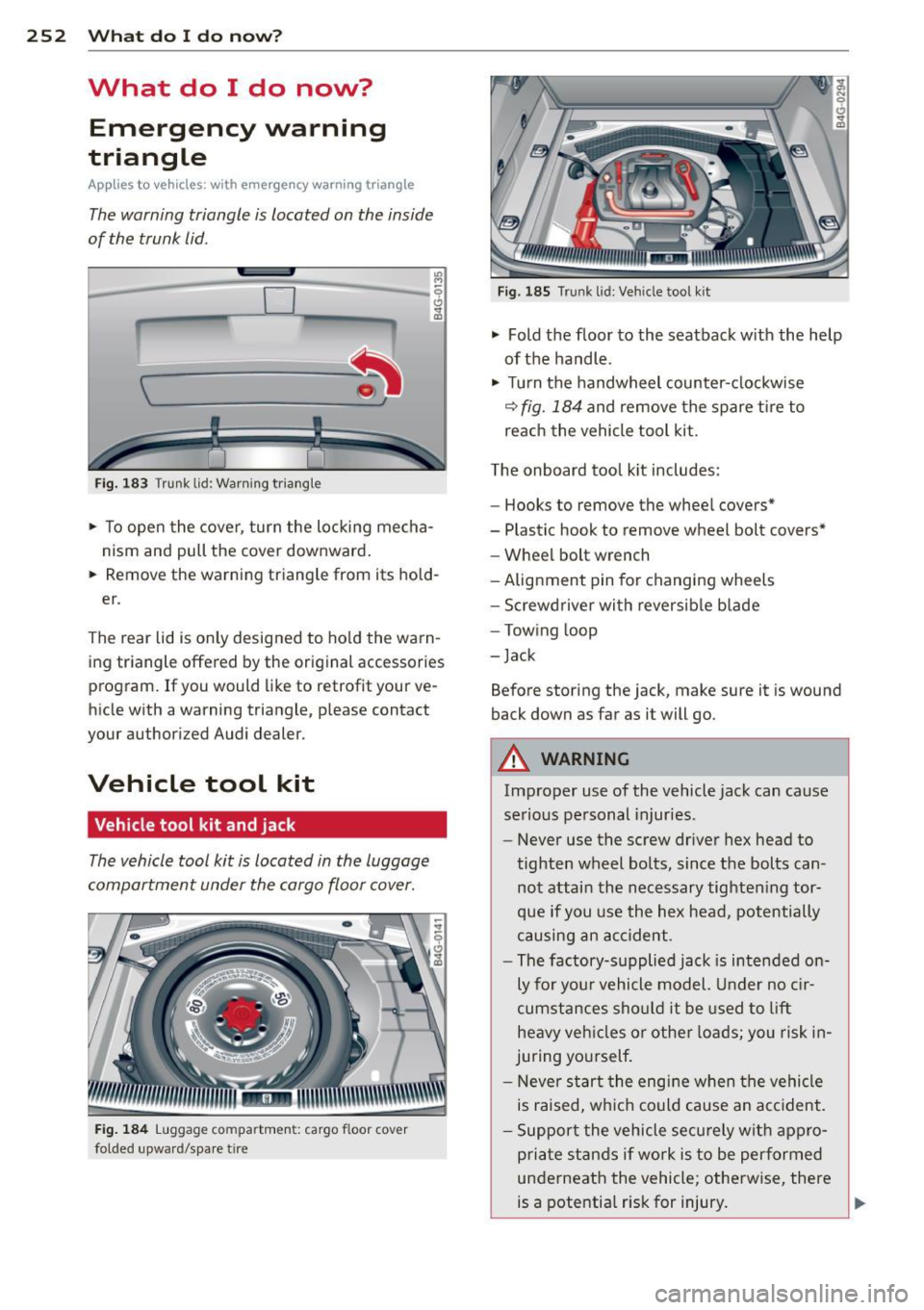
The warning triangle is located on the inside
of the trunk lid .
-
"' M ~ 0 6
~ ~
Fig. 183 Trunk lid: Warning triang le
.,. To open the cover, turn the locking mecha
nism and pull the cover downward .
" m
.,. Remove the warning triangle from its hold
er.
The rear lid is only designed to hold the warn
ing triangle offered by the original accessories
program. If you would like to retrofit your ve
hicle with a warning triangle, p lease contact
your authorized Audi dealer.
Vehicle tool kit
Vehicle tool kit and jack
The vehicle tool kit is located in the luggage
compartment under the cargo floor cover.
Fig . 184 Luggage compartment: cargo floor cover
folded upward/spa re t ire
Fig. 185 Trunk lid: Veh icle tool kit
.,. Fold the floor to the seatback with the help
of the handle .
.,. Tu rn the handwheel counter-clockwise
~ fig. 184 and remove the spare t ire to
reach the vehicle tool kit.
The onboard tool k it includes:
- Hooks to remove the wheel covers*
- Plastic hook to remove wheel bolt covers*
- Wheel bolt wrench
-Alignment pin for changing wheels
- Screwdriver with reversib le b lade
- Towing loop
-Jack
Before storing the jack, make sure it is wound
back down as far as it will go.
A WARNING
Improper use of the vehicle jack can cause
serious pe rsonal injuries.
- Never use the screw driver hex head to
tighten wheel bolts, since the bolts can
not attain the necessary tighten ing tor
que if you use the hex head, potentially
causing an acc ident.
- The factory-supplied jack is intended on
ly for your vehicle model. Under no c ir
cumstances sho uld it be used to
lift
heavy veh icles or other loads; you risk in
juring yo urself.
- Never start the engine when the vehicle
is raised, which could cause an accident.
- Support the vehicle securely with appro priate stands if work is to be performed
underneath the vehicle; otherwise, there
is a potentia l risk for injury. .,.
Page 255 of 294

-Never use the jack s upplied with your Au
di on another vehicle, particularly on a
heavier one. The jack is only suitable for
use on the vehicle it came w ith.
(D Tips
- Some of the on board items listed above
are provided on certain mode ls only or
are optional extras.
- Before you can raise your vehicle using
the jack, you must activate the jack ing
mode
¢ page 256.
Space-saving spare tire (compact spare
tire)
The spare tire/wheel is located in the luggage
compartment under the cargo floor cover . It
is intended for short-term use only.
Taking out the sp are tire
... Fo ld the floor to the seatback with the help
of the handle.
... Turn the large sc rew
¢ page 2 52, fig. 184
counter-clockw ise .
.,. Take out the spare tire .
Securing the replaced tire
.,. The fault wheel will not fit ins ide the spare
wheel well. Store it in the luggage compart
ment and secure it so that it does not slide
¢ page 59 .
Using the spa re tire (compact spare tire )
The compact spare tire is only intended for
emergencies until you can reach a repair shop.
Replace it as quickly as poss ible with a stand
ard wheel and t ire .
There are some restrictions on the use of the
compact spare t ire. The compact spare t ire
has been des igned specifically for your type of
vehicle.
It must not be swapped with a com
pact spare t ire from another type of veh icle .
Snow chain s
For technical reasons, the use of snow chains
on the compact spare tire is
not perm itted .
What do I do now? 253
If you do have to drive with snow chains and a
front tire fails, mount the spare wheel with
tire instead of a rear tire. Install the snow
chains on the rear tire and use it to rep lace
the defect ive front tire.
A WARNING
- Never use the spare t ire if it is damaged
or if it is worn down to the tread wear in
dicators .
- If the spare tire is more than 6 years old,
use it only in an emergency and with ex
treme caution and careful driv ing.
- The spare tire is intended only for tem
porary and short-term use.
It should be
replaced as soon as poss ible wi th the
normal whee l and tire.
- After mounting the compact spare t ire,
the t ire pressure must be checked as
soon as possible. T he tire pressure of the
compact spare tire must be 4 .2 bar; oth
erwise, you risk having an accident.
- Do not dr ive faste r than 50 mph (80 km/
h). You ris k having an accident.
- Avoid full-thrott le accelera tion, heavy
braking, and fast cornering . You risk hav
ing an accident.
- Never drive using more than one spare
wheel and tire . You risk having an acci
dent .
- Normal summer or winter t ires must not
be mounted on the compact spare wheel
rim.
- For technical reasons, the use of tire chains on the spare tire is not permitted.
If it is necessary to drive with t ire chains,
the spare wheel must be mounted on the
front axle in the event of a flat in a rear
tire. The newly available front wheel must then be installed in place of the
rea r whee l w ith the flat tire . Installing
the t ire cha in before mounting the whee l
and tire is re commended.
- Loose items in the passenger compart
men t can cause se rious personal injury
during hard brak ing or in an accident. •
•
Page 256 of 294

254 What do I do now?
-Never st ore the inflatable spare tire or
jack and tools in the passenger com
partm ent.
- Always s tore a ll jacking equipment,
too ls, and the inflatable spare tire in
the luggage compartment.
- Tighten the knurled retaining screw for
the inflatable spare tire securely.
Changing a wheel
Before changing a wheel
Observe the following precautions for your
own and your passenger's safety when chang
ing a wheel .
" After you experience a tire fa ilure, pull t he
ca r well away from moving traffic and try to
r each
level gro und before you stop c::> ,&. .
" All passengers sho uld leave the car and
move to a safe loca tion (fo r inst ance, behind
the g uardrail)
c::> ,&. .
" Engage the parking brake to prevent your
vehicle from ro lling unintentionally
c::> ,&. .
" Move selecto r lever to pos ition Pc::> ,&. .
" If you are tow ing a trailer, unh itch the tra il
er from your veh icle .
" Take the
jack and the spare tire out of the
l uggage compartment
c::> page 252 ,
c::> page 253.
.&_ WARNING
You or your p assengers cou ld be injured
while changing a whee l if you do not fol
low t hese safety preca utions:
- If you have a fl at t ire, move a safe dis
tance off the road . Tur n off the engine,
t ur n the emergency flas hers o n and use
other warning dev ices to alert other mo
torists .
- Make su re that passengers wait in a safe
place away from the vehicle and well
away from the road and traff ic.
- To help p revent the veh icle from mov ing
sudden ly and possibly slipping off the
jack, always fully set the parking brake and block th e whee l diago na lly opposite
-
the wheel be ing changed . When one
front wheel is lifted off the ground, plac ing the Automatic Transmission in "P"
(Park) will
not prevent the vehicle from
mov ing .
- Before you change a wheel, be sure t he
ground is level and firm. If necessary, use a sturdy board under the jack .
- After insta lling the spare wheel, make
sure tha t you replace the fla t tire/wheel
i n its storage area prope rly and tighten
the knurled retain ing screw secu rely.
Changing a wheel
When you change a wheel , follow these
quence described below step-by-step and in
exactly that order.
1. Remove the decorative wheel cover* . For
more details see also
c::> page 255, Deco
rative wheel covers
or c::> page 255,
Wheels with wheel bolt caps.
2 . Loosen the wheel bolt s c::>page 255.
3. Loc ate the p roper moun ting poin t for th e
jac k an d align the jack be low that poin t
c::>page 256 .
4. Raise the car with the jack c::> page 256.
5. Remove the wheel with the flat tire and
then insta ll
the spare c::> page 257.
6. Tig hte n all whee l bolts lightly .
7.
Lower the vehicle wi th the jack .
8 . Use the wheel bolt w rench and
firmly
t ig ht en al l w heel bo lts c::> page 25 5.
9. Re place the decora tive wheel cover* .
A WARNING
Always read and fo llow all WA RNINGS and
i nformat io n
c::> & in Raising the vehicle on
page 257
and c::> page 258 .
After changing a wheel
A wheel change is not complete withou t the
doing the following .
" Replace the too ls and the jac k in their prop-
er lo cat io n. .,.
Page 258 of 294
256 What do I do now ?
Loo sening
.,. Slide the wheel wr ench onto the wheel bolt
as far as it will go .
.,. Take tight hold of the
end of the wrench
hand le and turn the wheel bolts
co unter
clock wise
about one single turn in the direc
t ion of arrow
c:;, fig. 188.
Tighten ing
.,. Slide the wheel wrench onto the whee l bolt
as far as it will go .
.,. Take tight hold of the
end of the wrench
hand le and turn each wheel bolt
clock wise
until it is seated.
_& WARNING
- Do not use force or hurry when changi ng
a whee l - you can cause the vehicle to slip
off the jack and cause ser ious persona l
injuries.
- Do not loosen the wheel bolts more than
one turn
before you raise the veh icle with
the jack. -You r isk an injury.
@ Tips
- Never use the hexagonal socket in the
handle of the screwdrive r to loosen or
tighten the wheel bo lts.
- If a wheel bolt is very tight, you may find
i t easier to loosen by ca refully p ush ing
down on the end of the wheel bolt
wrench w ith
one foot only. As yo u do so,
ho ld on to the car to keep your ba lance
and take care not to slip .
Raising the vehicle
The vehicle must be lifted with the jock first
before the wheel can be removed .
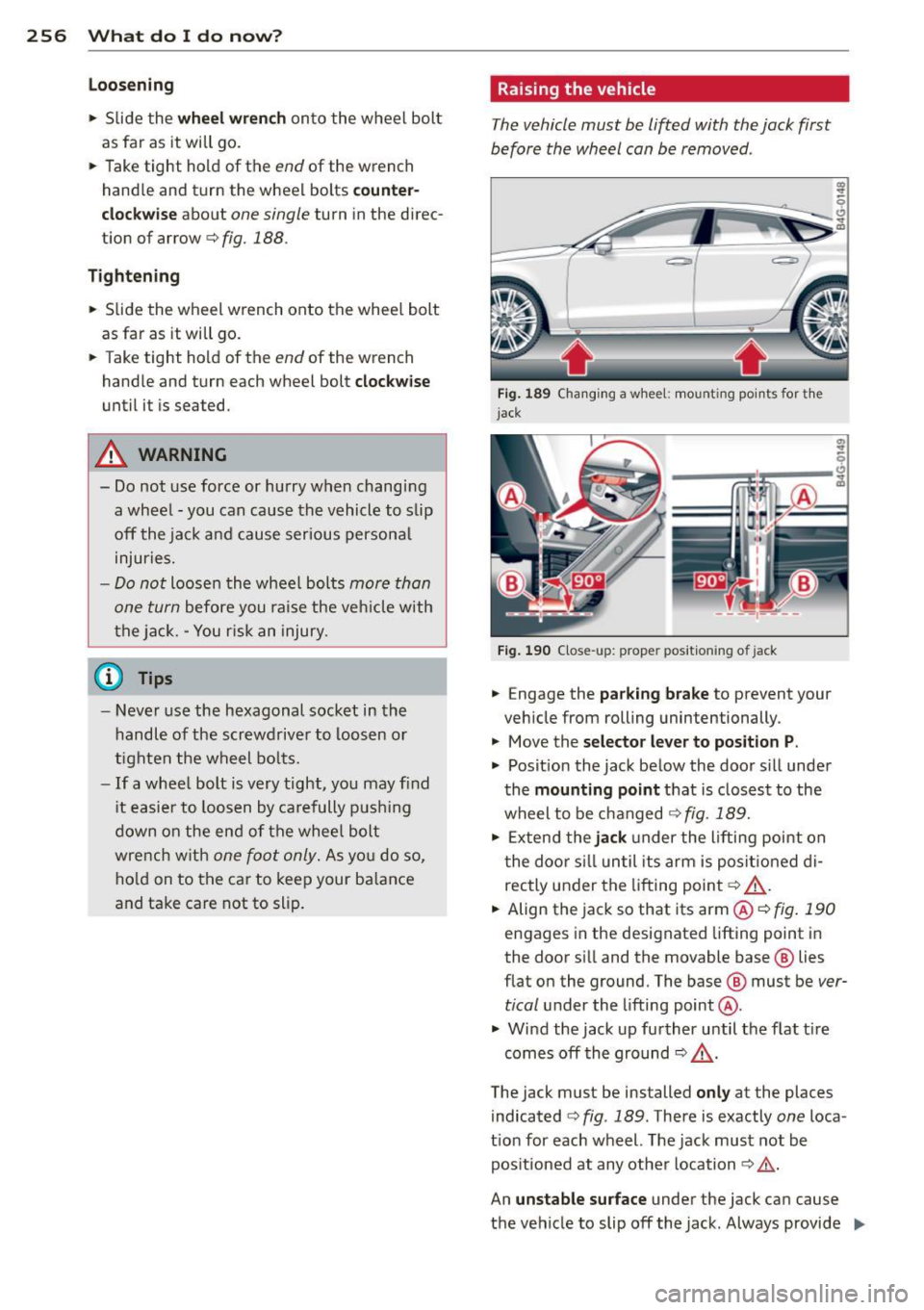
Fig . 1 89 C hang ing a whee l: moun ting po in ts for th e
j ack
Fi g. 1 90 Close -up: prope r posit io ni ng o f jack
.,. Engage the p ar king brak e to prevent your
veh icle from rolling unintentionally .
.,. Move the
select or lever to p osition P .
.,. Posit ion the jack below the door s ill under
the
mounting point that is closest to the
wheel to be changed
c:;, fig . 189.
.,. Extend the ja ck u nder the lifting point on
t he door s ill until its arm is pos it ioned di
rectly under the lifting point
c:;, &_ .
.,. Align the jack so that its arm @ c:;, fig. 190
engages in the designated lifting point in
the door s ill and the movable base @ lies
flat on the ground . The base @ must be
ver
tical
under the lifting point @ .
.,. Wind the jack up further until the flat t ire
comes off the ground
c:;, ,& .
The jack must be installed only at the places
indicated
c:;, fig . 189 . There is exactly one loca
t ion for each wheel. The jack must not be
positioned at any other location
c:;, ,&. .
An
unstab le surface under the jack can cause
the vehicle to slip off the jack . Always provide
II>-
Page 260 of 294

258 What do I do no w?
• Use the hexagonal socket in the screwdriver
hand le to screw in and tighten all wheel
bolts
slightly .
• Remove the alignment pin and insert and
t ighten the remaining wheel bolt slightly
Like the rest .
• Turn the jack handle counter-clockw ise to
lower the vehicle unt il the jack is fully re
leased .
• Use the whee l bolt wrench to t ighten al l
wheel bolts firmly¢
page 255 . Tighten
them
crosswise, from one bolt to the (ap
proximate ly) opposite one, to keep the
whee l centered.
@ Note
When removing or installing the wheel,
the rim could hit the brake rotor and dam
age the rotor. Work carefully and have a
second person help you.
@ Tips
Never use the hexagonal socket in the han
dle of the screwdriver to loosen or tighten
the wheel bolts .
- Pull the reversible b lade from the screw
driver before you use the hexagonal
socket in the handle to turn the whee l
bo lts.
- When mounting tires with
unid irectional
t re ad design
make sure the tread pat
tern is pointed the right way
~ page 258.
- The wheel bolts should be clean and easy
to turn . Check for d irt and corrosion on
the mat ing surfaces of both the whee l
and the hub. Remove all dirt from these
s ur faces before remo unt ing the wheel.
Tires with unidirectional tread design
Tires with unidirectional tread design must be
mounted with their tread pattern pointed in the right direction .
Using a sp are t ire w ith a tre ad pattern
intended for use in a specific direction
When using a spare t ire with a tread patter n
intended for use in a spec ific d irection , please
note the following :
- The direct ion of rotation is marked by an ar
row on the side of the ti re .
- If the spare tire has to be installed in the in
correct direct ion, use the spare tire only
temporarily s ince the tire will not be able to
achieve its optim um performance cha racter
is tic s wit h regard to aquap la ni ng, no ise and
wear .
- We recommend that you pay part icu la r at
t en tion to th is fact d uring wet wea ther and
t ha t you adjust you r speed to match road
conditions .
- Replace the fl at tir e with a new o ne an d
have it insta lled on you r vehicle as soon as
possible to restore the handling advantages
of a u nidirectional tire .
Notes on wheel changing
Please read the information ¢ page 242, New
tires and replacing tires and wheels
if you a re
going to use a spare tire which is different
from the ti res on your vehicle .
After you change a tire:
- Check the tire pre ssure on the spare imme
diately after install ation.
- Have th e whe el bolt tight ening torqu e
c hecked with a torque wrench as soon a s
possible by your author ized Audi dealer or
a qualified service stat ion.
- With steel and alloy wheel rims, the wheel
bolt s are cor re ctl y tightened at a torque of
90 ft lb (120 Nm ).
- If you noti ce that the wheel bolts are cor
roded and diffi cult to turn while changing
a ti re , they should be replaced before you
check the t ightening torque. .,..
Page 264 of 294

262 Fuses and bulb s
Fuse panel @ (black )
No . Equ ipment Amps
=
8
Headlight range adjustment/
5/7,5
adaptive lighting system
10 Left headlight (headlight with
7,5
adaptive light)
Fuse panel
@ ( brown )
No .II Equ ipm ent
II Amp s
1 Climate control 10
2 Climate control system blower 40
3 Diagnostic connector 10
4 Electrical ignition lock 5
5 Power steering column adjust-
ment
5
Steering column switch module 10
7 Power steer
ing column adjust-
ment 25
8 Light switch
Luggage compartment fuse assignment
Fig. 196 Luggage compartment: fuse panel with plas·
tic bracket
Fuse panel @ (bl ack )
No. II Equipment
I[ Amp s
4 E lectromechanical parking brake 30
5 Electromechanical parking brake 30
6 Front door (front passenger's
35
side)
7 Rear exterior lighting Rear sun shade, closing aid, lug
s gage compartment lock, con
venience key, START ENGINE
STOP, fuel filler door 30
20
-Fuse pane
l@ (blac k) I
No. Equipm ent Amps
=· 9 Power seat adjustment 15
10 Parking system
s
30
Fus e pane l
B (red)
No . Equipment Amps
1 Left belt tensioner
25
Right belt tensioner 25
3 Socket 20
20
Electromechanical parking brake
5
adaptive air suspension 15
7 Rear door (front passenger's
35
side)
Rear exterior lighting 30
9
Luggage compartment lid con-
30
t rol module
10 Telephone 5
11 Sound amp lifier 30
12 Rear spoiler 20
Fuse pane l c (b rown )
No. Equipment Amps
1 Rad
io receiver, Sound amplif ier/
30/20
MMI unit/dr ives
2 Tank leak detection system 5
AEM control module/battery 15/
4
module 7,5
6 Battery fan 35
Rad io receiver
7,5
7,5
9
Automatic dimming interior
5/15
rearview mirror/battery module
Parking system 5
Fu se panel o (gre en)
No. Equipment Amps
1 Audi pre sense 5
2 Electromechanical parking brake 5
3 adaptive a
ir suspension
5
Automatic transmission 7,5
...
Page 268 of 294

266 Emergency situations
-When connecting jumper cables, make
sure that they cannot get caught in any
moving parts in the engine compart
ment .
- Before you check anything in the engine
compartment, always read and heed all
WARNINGS
<=) page 210, Engine com
partment.
(D Note
Improper hook-up of jumper cables can ru
in the generator.
-Always connect POSITIVE(+) to POSI TIVE(+), and NEGATIVE( -) to NEGATIVE
( - ) ground post of the battery manager
control unit.
- Check that all screw plugs on the battery
cells are screwed in firmly . If not, tighten
plugs prior to connecting clamp on nega
tive battery terminal.
- Please note that the procedure for con
nect ing a jumper cable as described
above applies spec ifically to the case of
you r vehicle being jump started. When
you are giving a jump start to another ve
hicle, do
not connect the negative(-) ca
ble to the negative(-) terminal on the
discharged battery@<=)
fig. 198. In
stead, securely connect the negative(-)
cable to either a solid metal component
that is firmly bolted to the engine block
or to the engine block itself. If the bat
tery that is being charged does not vent
to the outside, escaping battery gas
could ignite and explode!
Emergency towing
with commercial tow
truck
General hints
Your Audi requires special handling for tow
tng.
The following information is to be used by
commercia l tow truck operators who know
how to operate their equipment safely.
- Never tow your Audi. Towing will cause
damage to the engine and transmission .
- Never wrap the safety chains or winch ca
bles around the brake lines.
- To prevent unne cessary damage, your Audi
must be transported with a flat bed truck.
- To load the vehicle on to the flat bed, use
the towing loop found in the vehicle tools
and attach to the front or rear anchorage
r=) page 266 and ¢ page 267.
.&_ WARNING
=
A vehicle being towed is not safe for pas-
-
sengers. Never allow anyone to ride in a
vehicle being towed, for any reason.
Front towing loop
Only install the front towing loop when it is
needed.
Fig. 199 Fro nt bumpe r: cove r
Fig. 200 Front bumper: installing the towing loop
There are threads located behind the right
s ide of the front bumper where a towing loop
can be installed. The threads are located be
hind a cover.
.,. Remove the tow ing loop from the vehicle
tool kit .