lock AUDI A7 2012 Workshop Manual
[x] Cancel search | Manufacturer: AUDI, Model Year: 2012, Model line: A7, Model: AUDI A7 2012Pages: 294, PDF Size: 73.33 MB
Page 171 of 294
standard safety belt on the rear seat may
play with unused rear seat safety belts and
become entangled resulting in serious per
sonal injury and even death .
- Always buck le unused rear seat safety
belts out of reach of chi ldren in ch ild
seats a nd properly act ivate the converti
ble locking retractor so that the child
cannot unreel the safety belt from the
retra cto r.
Child safety seats
Infant seats
Babies and infants up to about one year old
and 20 lbs . or 9 kg need special rearward-fac
ing child restraints that support the back ,
neck and head in a crash.
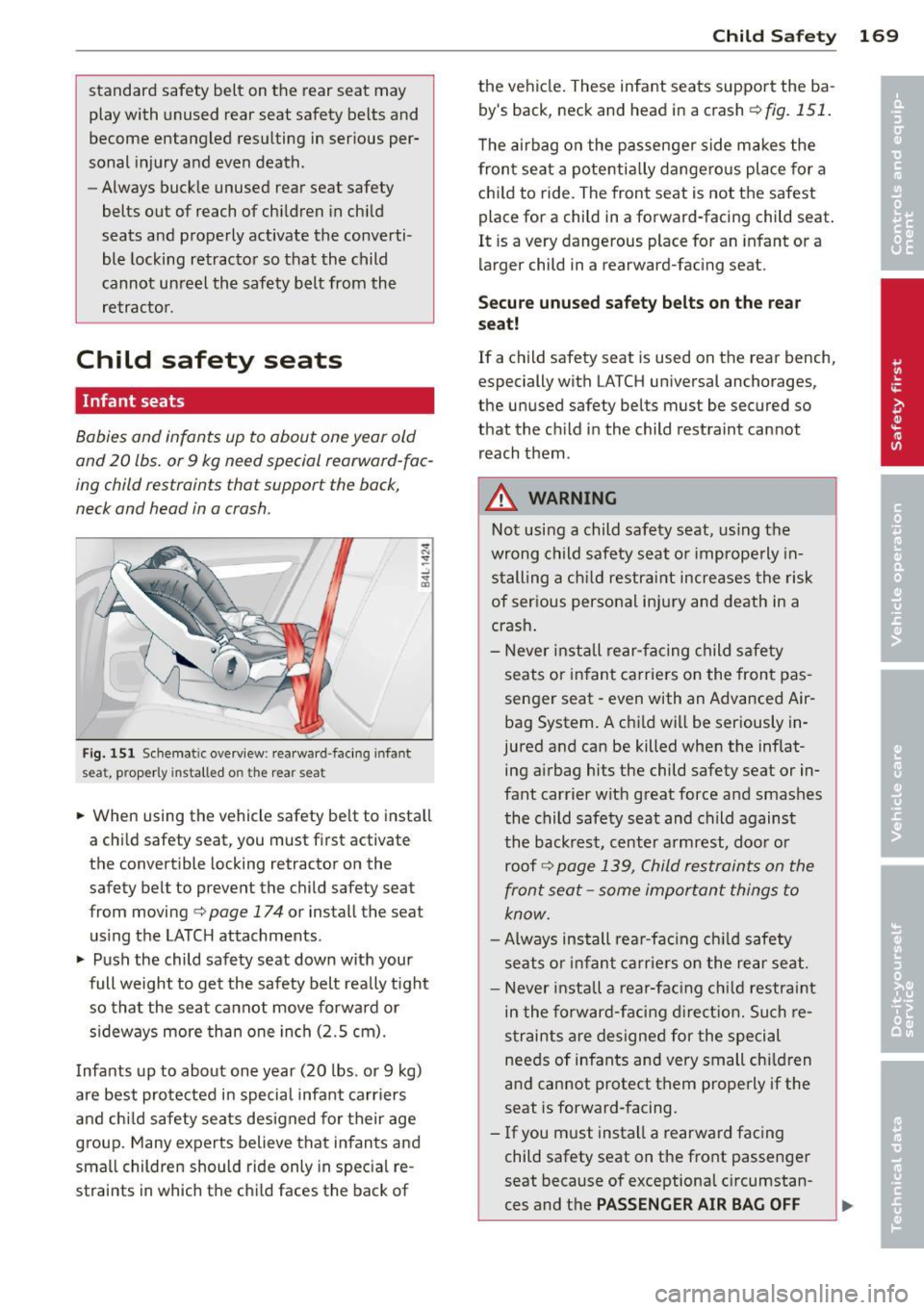
F ig. 151 Schemat ic overv iew : rea rwa rd -fa cing infa nt
s ea t, p rope rly in stalled o n the re ar sea t
... <'< ...
-.:, ... m
.,. When using the vehicle safety be lt to insta ll
a ch ild safety seat, you must first activate
the convertible locking retractor on the
safety belt to prevent the c hild safety seat
from moving
c:> page 174 or install the sea t
us ing the LATCH attachments .
.,. Push the child safety seat down with your
full weight to get the safety belt rea lly t ight
so tha t the sea t ca nnot move forward or
s ideways more than one inch (2.5 cm).
I nfants up to about one year (20 lbs . or 9 kg)
a re best pro tected i n specia l infa nt carriers
and chi ld safety seats des igned for their age
g roup . Many experts believe that infants and
sma ll children should ride only in spec ial re
straints in which the chi ld faces the back of
Child S afety 169
the vehicle . These infant seats support the ba
by's back, neck and head i n a c rash
c:> fig. 151 .
The airbag on the p assenger side makes the
fron t seat a potentia lly dangero us place for a
ch ild to ride. The front seat is not the safest
place for a child in a forward -facing child seat.
It is a very dangerous place for an in fant or a
larger child in a rearward-fac ing seat.
Secure unused saf ety belts on the rear
s eat!
If a child safety seat is used on the rear bench,
especially with LATCH universal anchorages,
the unu sed safety belt s must be secured so
that the c hild in the child restra int cannot
reach them .
A WARNING
--
Not using a child safety seat, us ing the
wrong c hild safety seat o r imprope rly in
stalling a ch ild restraint increases the risk
of ser ious persona l injury and death in a
crash .
- Never install rear- fa cing child safety
seats or in fant ca rrie rs on the front pas
senger seat - even with an Advanced Air bag System. A chi ld will be seriously in
jured and can be killed when the inflat ing airbag hits the child safety seat or in
fant carrier wit h great force and smashes
the child safety seat and child against
the backrest, center armrest, doo r o r
roof
c:> page 139, Child restraints o n the
front seat -
some important thing s to
know.
- Always install rear-fac ing ch ild safety
se ats or inf ant c arrie rs on the rear sea t.
- Never install a rea r-fac ing chi ld restrai nt
in the forward-fac ing direct io n. Su ch re
s traints a re designe d for the special
needs of infants and very small chi ld ren
a nd cannot protect them properly if the
seat is forward- facing.
- If you must install a rearward facing
child safety seat on the front passenger
seat because of exceptiona l circumstan
ces and the
PASSENGER AIR BAG OFF
Page 172 of 294

1 70 Child Safety
light does not come on and stay on, im
mediately install the rear-facing child
safety seat in a rear seating position and have the airbag system inspected by your
Audi dealer.
- Never place or use any electrical device
(such as a laptop, CD player, electronic
games device or power inverter) on the
front passenger seat if the device is con
nected to the 12-volt socket or the ciga
rette lighter socket.
- If a seat heater has been retrofitted or
otherwise added to the front passenger
seat, never install any child restraint sys
tem on this seat.
- Make sure that there are no wet objects
(such as a wet towel) and no water or
other liquids on the front passenger seat
cushion.
- Never place objects on the seat (such as
a laptop , CD player, electronic games de
vice or power inverter). These may influ
ence the electrical capacitance measured by the capacitive passenger detection
system and can also fly around in an acci
dent and cause serious personal injury.
- Always read and heed all WARNINGS
whenever using a child restrained in
ave
hicle is being used c:::> page 128, Safety
belts,
c:::> page 13 7, Airbag system and
c:::> page 163, Important things to know.
A WARNING
A child in a child restraint installed with
the LATCH lower universal anchorages or
with the standard safety belt on the rear
seat may play with unused rear seat safety
belts and become entangled resulting in
serious personal injury and
even death.
- Always secure unused rear seat safety
belts out of reach of children in child
seats such as by properly routing them around the head restraint for the seating
position where the child restraint is in
stalled.
-
- Never activate the switchable locking re
tractor when routing the safety belts
around the head restraints.
- Never let anyone sit at the center rear
seating position if the center rear safety
belt has been routed around a rear head
restraint.
- A child restrained in the child safety seat
on the rear bench can be fatally injured
when playing with unused lockable safe
ty belts.
- Always secure unused lockable safety belts on the rear bench.
Convertible child safety seats
Properly used convertible child safety seats
can help protect toddlers and children over
age one who weigh between 20 and 40 lbs . (9
and
18 kg) in a crash .
Fig. 152 Schematic overview: installat ion of the at
tachments applicable to a LATCH seat
Fig. 153 Schematic overview : installat ion of the seat
u sing the vehicte ·s safety belt system
.. When using the vehicle safety belt to install
a child safety seat, you must first activate
th e convertible locking feature on the safety
belt to prevent the child safety seat from
moving
¢ page 174 or install the seat using
the LATCH attachments.
II>
Page 174 of 294

172 Child Safety
-Never place or use any electrical device
(such as a laptop, CD player, electronic
games device or power inverter) on the
front passenger seat if the device is con nected to the 12-volt socket or the ciga
rette lighter socket.
- If a seat heater has been retrofitted or
otherwise added to the front passenger
seat, never install any child restraint sys
tem on this seat.
- Make sure that there are no wet objects
(such as a wet towel) and no water or
other liquids on the front passenger seat
cushion.
- Never place objects on the seat (such as
a laptop, CD player, electronic games de
vice or power inverter). These may influ
ence the electrical capacitance measured
by the capacitive passenger detection
system and can also fly around in an acci
dent and cause serious personal injury.
- Make sure that the
PASSENGER AIR BAG
OFF
light comes on and stays on all the
time whenever the ignition is switched
on.
- If the
PASSENGER AIR BAG OFF light
does not come on and stay on, immedi
ately install the forward-facing child seat
at a seating position on the rear seat and
have the airbag system inspected by your
authorized Audi dealer.
- Take the child restraint off the front pas
senger seat and install it properly at one
of the rear seat positions if the
PASSEN
GER AIR BAG OFF
light does not stay on
whenever the ignition is switched on.
8_ WARNING
A child in a child restraint installed with
the LATCH lower universal anchorages or
with the standard safety belt on the rear
seat may play with unused rear seat safety
belts and become entangled resulting in
serious personal injury and even death.
- Always secure unused rear seat safety
belts out of reach of children in child
seats such as by properly routing them
-
around the head restraint for the seating
position where the child restraint is in
stalled.
- Never activate the switchable locking re
tractor when routing the safety belts around the head restraints.
-A child restrained in the child safety seat on the rear bench can be fatally injured
when playing with unused lockable safe
ty belts.
Booster seats and safety belts
Properly used booster seats can help protect
children weighing between about 40 lbs. and
80 lbs . (18 kg and 36 kg) who are less than 4
ft. 9 in . (57 inches/1.45 meters) tall.
Fig. 154 Rea r seat : child p roperly rest rained in a boos
te r se at
The vehicle 's safety belts alone will not fit
most children until they are at least 4
ft . 9 in .
(57 inches/1.45 meters) tall and weigh about
80 lbs . (36 kg) . Booster seats raise these chil
dren up so that the safety belt will pass prop
erly over the stronger parts of their bodies
and the safety belt can help protect them in a
crash.
• Do not use the convertible locking retractor
when using the vehicle's safety belt to re
strain a child on a booster seat.
.. Always position the shoulder portion of the
safety belt midway over the child's shoulder .
If you must transport an older child in a
booster seat on the front passenger seat,
you can use the safety belt height adjust
ment to help adjust the shoulder portion
properly .
Page 176 of 294
174 Child Saf ety
the head restraint again immediately
once the child seat is removed. Dr iving
without head restraints or with head re
straints that are not properly adjusted
increases the risk of ser ious or fatal neck
injury dramat ica lly .
- Children on the front seat of any car, even w ith Advanced A irbags, can be seri
ously injured or even killed when an a ir
bag inflates.
- Never let a child stand or knee l on any
seat, for example the front seat.
- Never let a child ride in the cargo area of
your vehicle.
-Always remember that a ch ild lean ing
forward, sitt ing s ideways or out of posi
t ion in any way during an acc ident can be
struck by a deploying airbag. This will re
sult in serious personal injury or death.
- If you must install a booster seat on the
front passenger seat because of excep
tional circumstances the
PASSENGER
AIR BAG OFF
light must come on and
stay on, whenever the ignition is switch
ed on.
- If the
PASSENGER AIR BAG OFF light
does not come on and stay on, perform
the checks described
<=> page 149, Moni
toring the Advanced Airbag System.
- Take the child restraint off the front pas
senger seat and install it properly at one
of the rear seat positions if the
PASSEN
GER AIR BAG OFF
light does not stay on
whenever the ignition is switched on .
- Always read and heed all WARNINGS
whenever using a child restrained in ave
hicle is being used
<=> page 128, Safety
belts, <=> page 137, Airbag system
and
<=> page 163, Important things to know.
_&, WARNING
A child in a booster seat installed with the
standard safety belt on the rear seat may
play with unused rear seat safety belts and
become entangled resulting in serious per
sonal injury and even death. -
Always secure unused rear seat safety
be lts out of reach of children in child
seats such as by properly rout ing them
around the head restraint for the seat ing
position where the child restraint is in
stalled.
- Never activate the switchable lock ing re
tractor when routing the safety belts
around the head restraints.
Installing a child safety
seat
Securing a child safety seat using a
safety belt
Safety belts for the rear seats and the front
passenger can be locked with the convertible locking retractor to properly secure child
safety seats.
The safety belts emergency locking retractors
for the rear seats safety belts and for the
front passenger's seat safety belt have a con
vertib le locking ret ractor for child restraints.
T he safety belt m ust be locked so that be lt
webbing cannot unreel. The retractor can be
activated to lock the safety belt and prevent
the safety belt webbing from loosening up
during normal driving . A chi ld safety seat can
only be properly installed when the safety belt
is locked so that the child and child safety
seat w ill stay in place .
Always remember: Even though your vehicle is
equipped with an Advanced Airbag system, all
children, especially those 12 years and young
er, should always r ide in the back seat proper
ly restrained for the ir age and size .
_&, WARNING
Improperly installed ch ild safety seats in
crease the risk of serious personal injury
and death in a collision.
- Always make sure that the safety belt re
tractor is lo cked when insta lling a child
safety seat . An un locked safety belt re -
tractor cannot hold the child safety seat ..,.
Page 178 of 294
176 Child Safety
-Always move the passenger seat into its
rearmost position in the seat's fore and
aft adjustment range, as far away from
the airbag as possible before installing
the forward-facing child restraint. The
backrest must be adjusted to an upright
position.
- Make sure that the
PASSENGER AIR BAG
OFF
light comes on and stays on all the
time whenever the ignition is switched
on.
A WARNING
Rearward-facing child restraints:
- A child in a rearward-facing child safety
seat installed on the front passenger
seat will be seriously injured and can be
killed if the front airbag inflates -even
with an Advanced Airbag System.
- The inflating airbag will hit the child
safety seat or infant carrier with great
force and will smash the child safety seat
and child against the backrest, center
armrest, door or roof.
- Always be especially careful if you must
install a rearward facing child safety seat
on the front passenger seat in exception
al circumstances.
- Make sure that the
PASSENGER AIR BAG
OFF
light comes on and stays on all the
time whenever the ignition is switched
on .
- If the
PASSENGER AIR BAG OFF light
does not come on and stay on, immedi
ately install the rear-facing child safety
seat in a rear seating position and have
the airbag system inspected by your Audi
dealer.
Activating the convertible locking retractor
Use the convertible locking retractor to se
cure a child restraint.
Always heed the child safety seat manufactur
er's instructions when installing a child re- straint in your vehicle. To activate the conver
tible locking retractor:
.,. Place the child restraint on a seat, prefera
bly on the rear seat.
.,. Slowly pull the belt
all the way out.
.,. Route it around or through the child re
straint belt path
¢ A -
.,. Push the child safety seat down with your
full weight to get the safety belt really tight .
.,. Insert the belt tongue into the buckle for
that seating position .
.,. Guide the safety belt back into the retractor
until the belt lies flat and snug on the child
safety seat.
.,. You should hear a "clicking" noise as the
belt winds back into the inertia reel. Test the
convertible locking retractor by pulling on
the belt. You should no longer be able to
pull the belt out of the retractor. The con
vertible locking retractor is now activated .
.,. Make sure that the red release button is fac
ing away from the child restraint so that it
can be unbuckled quickly.
.,. Pull on the belt to make sure the safety belt
is properly tight and fastened so that the
seat cannot move forward or sideways more
than one inch (2.5 cm).
A WARNING
Using the wrong child restraint or an im
properly installed child restraint can cause
serious personal injury or death in a crash.
- Always make sure that the safety belt re- tractor is locked when installing a child
safety seat. An unlocked safety belt re
tractor cannot hold the child safety seat in place during normal driving or in a
crash.
- Always buckle the child safety seat firmly
in place even if a child is not sitting in it.
A loose child safety seat can fly around
during a sudden stop or in a crash.
- Always make sure the seat backrest to
which the child restraint is installed is in
an upright position and securely latched
-
Page 179 of 294
into place and canno t fold forward. Oth
erwise, the seatback w ith the ch ild safety
seat attached to it could fly forward in
the event of an acc ident or other emer
gency situation .
- Always read and heed all WARNINGS
whenever using a child rest rained in ave
hicle is being used
<=:> page 163 . Special
precautions apply when installing a ch ild
safety sea t on the front passenge r seat
<=:> page 139, Child restraints on the front
seat -some important things to know.
Deactivating the convertible locking
retractor
The convertible locking retractor for child re
straints will be deactivated automatically when the belt is wound all the way back into the retractor.
~ Press the red button on the safety be lt
buck le . The belt tongue will pop out of the
buck le.
ii-G ui de the safety belt all the way back into
its stowed posit ion.
Always let the safety belt retract comp lete ly
i nto its stowed posit ion. The safety belt can
now be used as an ordinary safety belt with
out the convert ib le lock ing retractor for ch ild
restra ints .
If the c onvertible locking retractor shou ld be
activated inadvertently, the safety belt must be unfastened and guided completely back in
to its stowed position to deactivate th is fea
ture .
If the convertib le locking retractor is not
dea ctivated, the safety belt will g radua lly be
come tighter a nd uncomfo rt a b le to wear .
_& WARNING
Improperly installed chil d sa fe ty se ats in
crease the risk of ser ious personal inju ry
and death in a collision.
- Never unfasten the sa fe ty belt to deac ti
vate the convert ible lock ing retractor for
child restraints while the veh icle is mov-
Child Sa fet y 177
ing. You would not be restrained and
could be serious ly injured in an accident.
- Always rea d and heed all WAR NIN GS
whenever us ing a child restrained in ave
hicle is being used ¢
page 163. Special
precautions apply when insta lling a child
safety seat o n the fron t passenger seat
<=:> page 139, Child restraints on the front
seat -some important things to know.
LATCH Lower
anchorages and tethers
for children
Child Restraint System anchors and how
are they related to child safety
T o provi de a simp ler and more practicable way
to attach the c hild restra int on the vehicle
seat, Federal regulat ions req uire spec ial lower
anchorages in vehicles and devices on new
c h ild restra ints to attach to the veh icle ancho
r ages .
The combinat ion of the tether anchorages and
the lower anchorages is now generally called
the
LATCH system for " Lower Anchorages and
T ethers for Chil d ren."
Fo rward-facing chi ld restraints manufactured
after September 1, 1999, are requ ired by U.S.
federa l regu lations to comply with new child
head movement performa nce re quirements .
T hese new pe rfo rmance requ ir e ments ma ke a
tethe r ne cessary on most new c hild sea ts.
Installing a ch ild restra int that requires a top
tethe r without one can seriously impa ir the
p erfo rman ce of the c hild restra int and its abil
ity to p rotect the child in a coll is io n. Insta lli ng
a ch ild res tra in t that re quires a top tethe r
withou t the to p tether may be a violat ion o f
state law.
Child res train t manufacturers offer LA T CH
l ower anchor ages on t heir child seats w ith
hook -on or push -on connectors a ttached to
adjustable straps.
In add ition to the LA TCH lower anchorages,
th ese chi ld res tra int systems usu ally require .,. •
•
Page 181 of 294
All child restraints manufactured after Sep
tember 1, 2002, must have lower anchorage
attachments for the
LATCH system.
Please remember that the lower anchorage
points are only intended for installation and
attachment of child restraints specifically cer
tified for use w ith
LATCH lower anchorages.
Child restraints that are not equipped with the
lower anchorage attachments can still be in
stalled in compliance with the child restraint
manufacturer's instructions on using vehicle
safety belts .
A WARNING
Improper use of LATCH lower anchorages
can cause serious personal injury i n an ac
cident.
- Always carefully follow the child re
straints manufacturer's instructions for
proper installation of the child restraint
and proper use of the lower anchorages
or safety belts in your vehicle .
- Never secure or attach any l uggage or
other items to t he
LATCH lower ancho
rages.
- Always read and heed the important in
formation about child restraints in this
chapter and WARNINGS
¢page 163,
Child Safety.
Installing a child restraint with LATCH
lower anchorages
Whenever you install a child restraint always
follow the child restraint manufacturer's in
structions.
Fig. 158 Lower anchorages: proper mount ing
Child Safety 1 79
Mounting
.,. Make sure the seatback of the rear seat
bench is in the upright position and securely
latched in place.
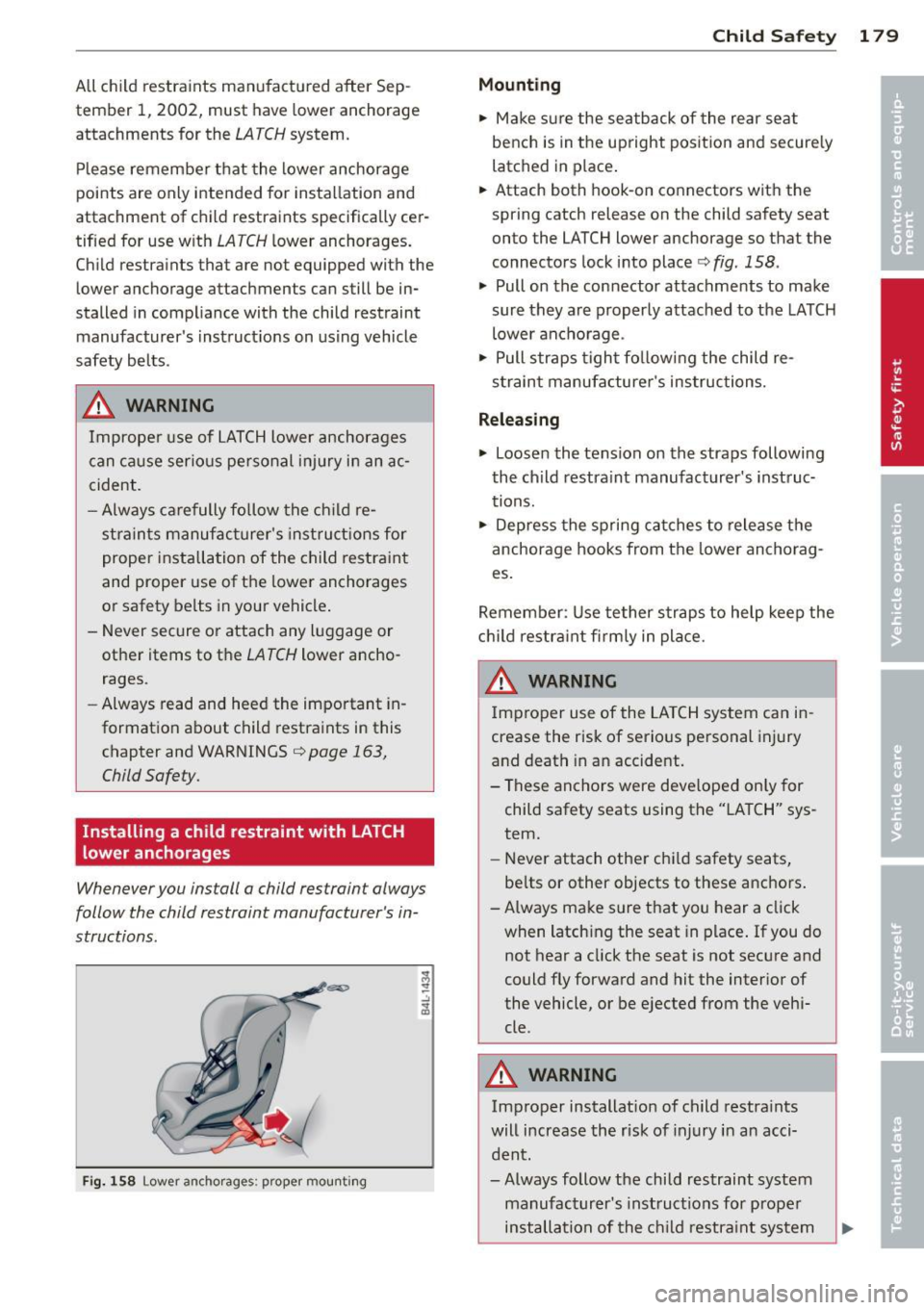
.,. Attach both hook-on connectors with the
spring catch release on the child safety seat
onto the LATCH lower anchorage so that the
connectors lock into place
¢fig. 158 .
.,. Pull on the connector attachments to make
sure they are properly attached to the LATCH
lowe r anchorage .
.,. Pull straps tight follo wing the child re
straint manufacture r's instruc tions.
Releasing
.,. Loosen the tension on the straps following
the child restraint manufacturer's instruc
t ions.
.,. Depress the spring catches to release the
anchorage hooks from the lower anchorag
es .
Remember: Use tether straps to help keep the
child restraint firmly in place.
A WARNING
-
Improper use of the LATCH system can in
crease the risk of serious personal injury
and death in an accident.
- These anchors were developed only for
child safety seats using the "LATCH" sys
tem.
- Never attach other chi ld safety seats,
be lts or other objects to these anchors.
-A lways make sure that you hear a click
when latching the seat in place. If you do
not hear a click the seat is not secure and
could fly forward and hit the interior of
the vehicle, or be ejected from the vehi
cle.
A WARNING
Improper installat ion of child restraints
will increase the risk of injury i n an acci
dent.
- Always follow the child restraint system
manufacturer's inst ruct ions for proper
installation of the child restra int system
-
Page 187 of 294

ESP includes and/or works together with the
anti-lock brake system (ABS) , brake assist sys
tem, anti -slip regulation (ASR) , e lectronic dif
ferential lock ( EDL) and e lectronic interax le
d ifferential lock* . ESP is swi tched on all the
time. In certain situat ions when you need less
traction , you can switch off ASR by pressing
the button
[ru <::;> page 186, fig . 161 . Be sure
to switch ASR on again when you no longer
n eed less t raction.
Anti-lock br aking s ystem (ABS)
ABS prevents the wheels from locking up
when braking . The veh icle can still be steered
even during hard braking . Apply steady pres
sure to the brake pedal. Do not pump the ped
a l. A puls ing in the bra ke peda l indicates that
the system is he lping you to brake the vehicle.
Brake assist system
The brake assist system can decrease brak ing
d istance.
It increases braking power when the
d river p resses the brake pedal quic kly in emer
gency situations. You must press and ho ld the
b rake peda l until the situation is over. In vehi
cles with adaptive cruise control*, the brake
assist system is more sensitive if the distance
detected to the vehicle ahead is too small.
Anti -slip regulati on (ASR )
ASR reduces engine power when the drive
wheels begin to spin and adapts the force to
the road conditions. This makes it easier to
start, accelerate and drive up hills .
Electronic differential lock (EDL )
The ED L brakes wheels that are spinn ing and
transfers the drive power to the other drive
wheel or whee ls if the vehicle is equipped with
all-whee l drive* . This function is available up
to about 75 mph (120 km/h).
I n extreme cases, ED L automat ica lly switches
off to help keep the brake on the braked whee l
from overheating . EDL will switch on again au
tomatically when conditions have returned to
normal.
Int ellig ent technolog y 185
Electronic intera xle differ ential l ock */
s el ecti ve w heel torque cont rol *
The electronic interaxle differential lock (front
whee l drive) or the se lective whee l torque
control (all-wheel dr ive) operates when dr iv
ing through curves . The front wheel on the in
s ide of the curve or both wheels on the inside
of the curve are braked selectively as needed .
T his min imizes sliding in the front wheels and
allows for more p recise d riving through
curves . T he applicable system may no t acti
vate when driv ing in wet or snowy conditions.
A WARNING
-
- ESP , ABS, ASR, EDL and the e lectronic in
teraxle diffe rential lock function* cannot
overcome the laws of physics. This is es
pecially important on slippery or wet
roads . If the systems begin acting to sta
bilize your veh icle, you shou ld immedi
ately change you r speed to match the
road and traffic cond itions. Do not let
the increased safety provided by these
systems tempt you to take risks. Do ing
so will increase the risk o f a loss of vehi
cle control, collision and serious persona l
inju ries.
-A lways adapt your speed to road, traffic
and weather conditions . The risk of los
ing control of the vehicle increases when
driving too fast, espec ially through
curves and on slippery or wet roads, and
when dr iv ing too close to vehicles up
ahead . ESP, ABS, the brake ass ist system,
EDL, ASR and the e lectronic interax le dif
fe rential lock fu nction* cannot prevent
coll is ions .
- Always accelerate with spec ial care on
even, smooth su rfaces such as those that
are wet or covered with ice and snow.
The drive wheels can spin even with these assistance systems that cannot al
ways he lp to red uce the risk of loss of ve -
hicle control. .,.
•
•
Page 201 of 294
different weight distribution. Safety, perform
ance and economy wi ll greatly depend on how
carefu lly you load your trailer and operate
your rig.
Before you actua lly tow your trailer, practice
turning, stopping and backing up in an area
away from traffic. Keep practicing until you
have become comp letely fam iliar with the way
your vehicle- trailer combination behaves and
responds .
Backing up is d ifficult and requires practice.
Backing up with a trai ler generally requires
steering action opposite to that when backing up your vehicle without a trailer .
Maintain a greater distance between your ve
hicle and the one in front of you. You will need
more room to stop. To compensate for the
trailer, you will need a larger than normal
turn ing radius.
When passing, remember that you cannot ac
celerate as fast as you normally would be
cause of the added load. Make sure you have
enough room to pass . After passing, allow
p lenty of room for your tra iler before chang
ing lanes again.
Avoid jerky starts, sharp turns or rapid lane
changes.
(D Tips
- Do not tow a trailer during the break- in
period of your vehicle.
- If you tow a trailer, your Audi may re
quire more frequent maintenance due to
the extra load
¢ page 2 73 .
Parking on a slope
Do not park on a slope with a trailer. If i t can
not be avoided, do so only after doing the fol
lowing:
When parking:
.. Apply the foot brake .
.. Have someone place chocks under both the
vehicle and the trailer wheels.
Trailer towing 199
.. With chocks in place, slowly release the
brakes until the wheel chocks absorb the
load .
.. Turn the wheels towards the curb .
.. Apply the parking brake.
.. Select the
P selector lever position .
When restarting after parking:
.. App ly the foot brake.
.. Start the engine .
.. Select the
D/S selector lever position.
.. Release the parking brake and slowly pull
out and away from the wheel chocks .
.. Stop and have someone retr ieve the wheel
chocks.
(D Tips
If you move the selector lever of the auto
matic transmission to
P before applying
the pa rking brake and before blocking the
whee ls, you may have to use more force
lat er to move the lever out of the
P posi
tion.
•
•
Page 204 of 294

202 Cleaning and protec tio n
directly at locks, or at door or hatch
openings -they can freeze shut.
- Never use sponges designed to remove insects, or any kitchen scouring sponges
or similar products . They can damage
your paint finish.
- Never use a dry cloth or sponge to clean
the headlights . Only use wet cloths or
sponges to prevent scratches. It is best
to use soapy water.
- You should remove debris (such as in
sects) from the headl ight lenses on a
regular basis, for example when refuel
i ng your vehicle. Never clean the head
li ghts w ith a dry cloth or sponge. Use a
wet cloth or sponge.
It is best to use
soapy wa ter.
@ For the sake of the environment
In the interest of the envi ronment, the ve
hicle sho uld only be washed i n special
was h bays.
Washing your vehicle with a power
washer
Cleaning the exterior of your car with a high
pressure power washer is safe as long as you
observe a few simple rules.
.. Befo re using the power washer , make sure
yo u have read and understood the WARN
INGS¢
A in General information on
page 200.
.. Always fo llow the operating instructions for
the power washer .
.. Make sure that the jet o n the spray hose
produces a "fan shaped spray" .
.. Do
not hold the spray nozzle too close to
soft materia ls .
When cleaning the veh icle with a power wash
er
always follow the operating instructions .
This applies particularly to the
op erating
pr essure
a nd the s pray ing di stance . Keep a
d ista nce from soft materials such as rubber
hoses o r insulat ing ma ter ial as well as sensors
and camera lenses . Do not use a jet which sprays water in a
d
ir ect
stream
or one t hat has a rotating jet .
Water temper ature sho uld not ex ceed 140 °F
(60 °().
A WARNING ~ -
Neve r wash tires with a jet that sprays wa
ter i n a direct stream. This could cause in
vis ib le damage to the t ires and weaken
them, even if the spray is from a re lative ly
l ong distance and for a short time. Dam
aged and weakened tires can fail and cause
accidents and personal inj ury.
'
([) Note
To avoid damaging your vehicle, a lways
make sure that there is suffic ient d istance
between the spray head and soft materia ls
like rubber hoses, plast ic pa rts and sound
deaden ing mater ials as w ell as sensors
and camera lenses. Neve r aim t he sp ray
head at the same point for a long time.
This also applies to cleaning headligh ts
and painted bumpers. Remembe r: the
closer the nozzle is to the surface of the
materia l, the greater the stress on the ma
terial.
Sensors and camera lenses
- Remove snow with a hand br ush and remove
ice with a de- ic ing spray that does not con
tain so lvents .
- Clea n the sensors (adaptive cruise control*,
pa rk ing system*) w ith a cleaning so lution
that does not contain so lvents and a soft
cloth .
- The camera lens or the area in front of the
came ra le ns is no rmally cleaned by the
w indshie ld w ipers o r he adlig ht wipers (night
vision system *).
If the lens or the area is ex
ceptionally di rty, clean the area wit h glass
cleaner and a soft, dry cloth .
(D Note
-If you was h your veh icle with a pres sure
washer,