wheel AUDI A7 2012 Manual PDF
[x] Cancel search | Manufacturer: AUDI, Model Year: 2012, Model line: A7, Model: AUDI A7 2012Pages: 294, PDF Size: 73.33 MB
Page 254 of 294
252 What do I do n ow ?
What do I do now?
Emergency warning
triangle
App lies to vehicles: with emerge ncy warning triangle
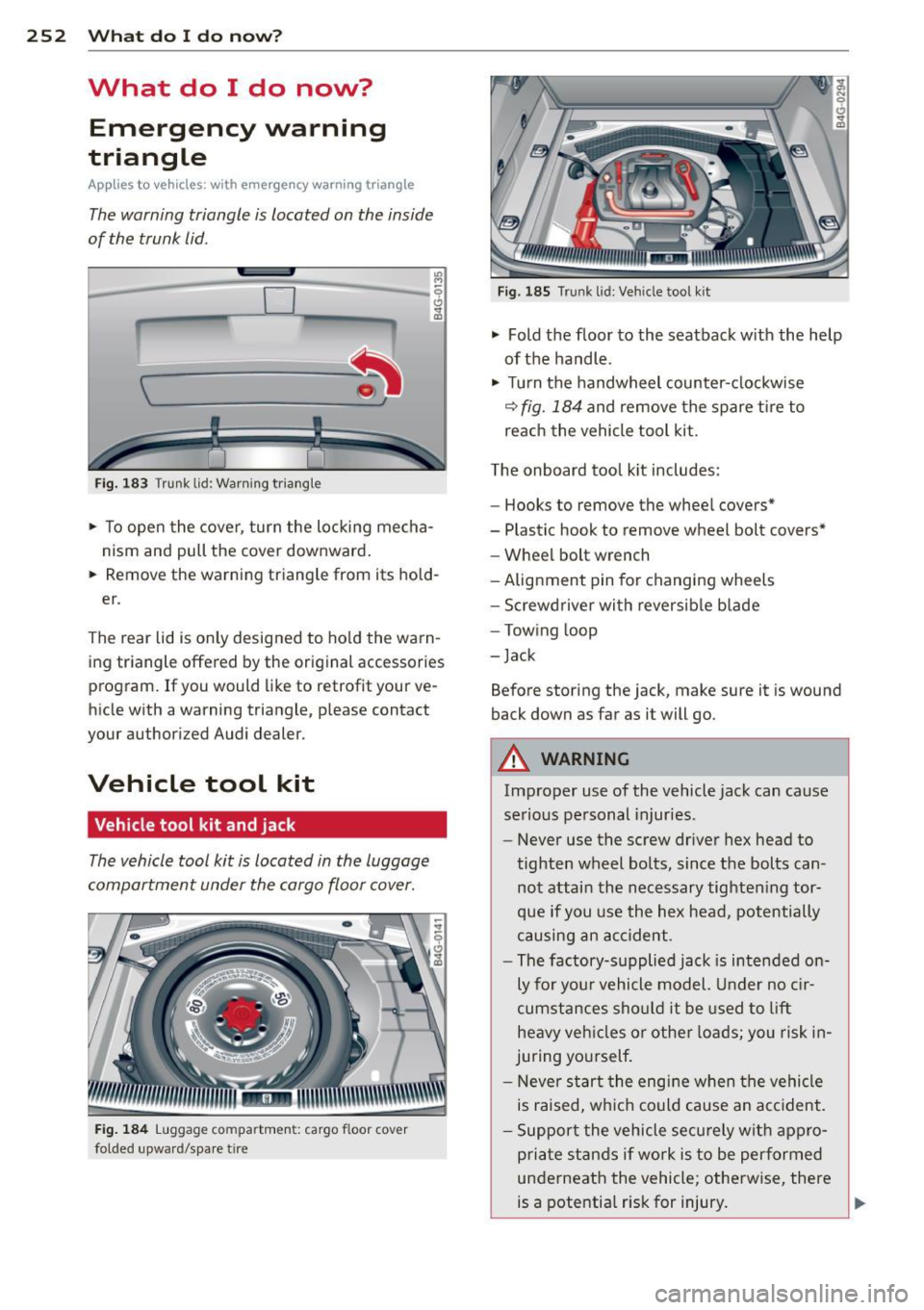
The warning triangle is located on the inside
of the trunk lid .
-
"' M ~ 0 6
~ ~
Fig. 183 Trunk lid: Warning triang le
.,. To open the cover, turn the locking mecha
nism and pull the cover downward .
" m
.,. Remove the warning triangle from its hold
er.
The rear lid is only designed to hold the warn
ing triangle offered by the original accessories
program. If you would like to retrofit your ve
hicle with a warning triangle, p lease contact
your authorized Audi dealer.
Vehicle tool kit
Vehicle tool kit and jack
The vehicle tool kit is located in the luggage
compartment under the cargo floor cover.
Fig . 184 Luggage compartment: cargo floor cover
folded upward/spa re t ire
Fig. 185 Trunk lid: Veh icle tool kit
.,. Fold the floor to the seatback with the help
of the handle .
.,. Tu rn the handwheel counter-clockwise
~ fig. 184 and remove the spare t ire to
reach the vehicle tool kit.
The onboard tool k it includes:
- Hooks to remove the wheel covers*
- Plastic hook to remove wheel bolt covers*
- Wheel bolt wrench
-Alignment pin for changing wheels
- Screwdriver with reversib le b lade
- Towing loop
-Jack
Before storing the jack, make sure it is wound
back down as far as it will go.
A WARNING
Improper use of the vehicle jack can cause
serious pe rsonal injuries.
- Never use the screw driver hex head to
tighten wheel bolts, since the bolts can
not attain the necessary tighten ing tor
que if you use the hex head, potentially
causing an acc ident.
- The factory-supplied jack is intended on
ly for your vehicle model. Under no c ir
cumstances sho uld it be used to
lift
heavy veh icles or other loads; you risk in
juring yo urself.
- Never start the engine when the vehicle
is raised, which could cause an accident.
- Support the vehicle securely with appro priate stands if work is to be performed
underneath the vehicle; otherwise, there
is a potentia l risk for injury. .,.
Page 255 of 294

-Never use the jack s upplied with your Au
di on another vehicle, particularly on a
heavier one. The jack is only suitable for
use on the vehicle it came w ith.
(D Tips
- Some of the on board items listed above
are provided on certain mode ls only or
are optional extras.
- Before you can raise your vehicle using
the jack, you must activate the jack ing
mode
¢ page 256.
Space-saving spare tire (compact spare
tire)
The spare tire/wheel is located in the luggage
compartment under the cargo floor cover . It
is intended for short-term use only.
Taking out the sp are tire
... Fo ld the floor to the seatback with the help
of the handle.
... Turn the large sc rew
¢ page 2 52, fig. 184
counter-clockw ise .
.,. Take out the spare tire .
Securing the replaced tire
.,. The fault wheel will not fit ins ide the spare
wheel well. Store it in the luggage compart
ment and secure it so that it does not slide
¢ page 59 .
Using the spa re tire (compact spare tire )
The compact spare tire is only intended for
emergencies until you can reach a repair shop.
Replace it as quickly as poss ible with a stand
ard wheel and t ire .
There are some restrictions on the use of the
compact spare t ire. The compact spare t ire
has been des igned specifically for your type of
vehicle.
It must not be swapped with a com
pact spare t ire from another type of veh icle .
Snow chain s
For technical reasons, the use of snow chains
on the compact spare tire is
not perm itted .
What do I do now? 253
If you do have to drive with snow chains and a
front tire fails, mount the spare wheel with
tire instead of a rear tire. Install the snow
chains on the rear tire and use it to rep lace
the defect ive front tire.
A WARNING
- Never use the spare t ire if it is damaged
or if it is worn down to the tread wear in
dicators .
- If the spare tire is more than 6 years old,
use it only in an emergency and with ex
treme caution and careful driv ing.
- The spare tire is intended only for tem
porary and short-term use.
It should be
replaced as soon as poss ible wi th the
normal whee l and tire.
- After mounting the compact spare t ire,
the t ire pressure must be checked as
soon as possible. T he tire pressure of the
compact spare tire must be 4 .2 bar; oth
erwise, you risk having an accident.
- Do not dr ive faste r than 50 mph (80 km/
h). You ris k having an accident.
- Avoid full-thrott le accelera tion, heavy
braking, and fast cornering . You risk hav
ing an accident.
- Never drive using more than one spare
wheel and tire . You risk having an acci
dent .
- Normal summer or winter t ires must not
be mounted on the compact spare wheel
rim.
- For technical reasons, the use of tire chains on the spare tire is not permitted.
If it is necessary to drive with t ire chains,
the spare wheel must be mounted on the
front axle in the event of a flat in a rear
tire. The newly available front wheel must then be installed in place of the
rea r whee l w ith the flat tire . Installing
the t ire cha in before mounting the whee l
and tire is re commended.
- Loose items in the passenger compart
men t can cause se rious personal injury
during hard brak ing or in an accident. •
•
Page 256 of 294

254 What do I do now?
-Never st ore the inflatable spare tire or
jack and tools in the passenger com
partm ent.
- Always s tore a ll jacking equipment,
too ls, and the inflatable spare tire in
the luggage compartment.
- Tighten the knurled retaining screw for
the inflatable spare tire securely.
Changing a wheel
Before changing a wheel
Observe the following precautions for your
own and your passenger's safety when chang
ing a wheel .
" After you experience a tire fa ilure, pull t he
ca r well away from moving traffic and try to
r each
level gro und before you stop c::> ,&. .
" All passengers sho uld leave the car and
move to a safe loca tion (fo r inst ance, behind
the g uardrail)
c::> ,&. .
" Engage the parking brake to prevent your
vehicle from ro lling unintentionally
c::> ,&. .
" Move selecto r lever to pos ition Pc::> ,&. .
" If you are tow ing a trailer, unh itch the tra il
er from your veh icle .
" Take the
jack and the spare tire out of the
l uggage compartment
c::> page 252 ,
c::> page 253.
.&_ WARNING
You or your p assengers cou ld be injured
while changing a whee l if you do not fol
low t hese safety preca utions:
- If you have a fl at t ire, move a safe dis
tance off the road . Tur n off the engine,
t ur n the emergency flas hers o n and use
other warning dev ices to alert other mo
torists .
- Make su re that passengers wait in a safe
place away from the vehicle and well
away from the road and traff ic.
- To help p revent the veh icle from mov ing
sudden ly and possibly slipping off the
jack, always fully set the parking brake and block th e whee l diago na lly opposite
-
the wheel be ing changed . When one
front wheel is lifted off the ground, plac ing the Automatic Transmission in "P"
(Park) will
not prevent the vehicle from
mov ing .
- Before you change a wheel, be sure t he
ground is level and firm. If necessary, use a sturdy board under the jack .
- After insta lling the spare wheel, make
sure tha t you replace the fla t tire/wheel
i n its storage area prope rly and tighten
the knurled retain ing screw secu rely.
Changing a wheel
When you change a wheel , follow these
quence described below step-by-step and in
exactly that order.
1. Remove the decorative wheel cover* . For
more details see also
c::> page 255, Deco
rative wheel covers
or c::> page 255,
Wheels with wheel bolt caps.
2 . Loosen the wheel bolt s c::>page 255.
3. Loc ate the p roper moun ting poin t for th e
jac k an d align the jack be low that poin t
c::>page 256 .
4. Raise the car with the jack c::> page 256.
5. Remove the wheel with the flat tire and
then insta ll
the spare c::> page 257.
6. Tig hte n all whee l bolts lightly .
7.
Lower the vehicle wi th the jack .
8 . Use the wheel bolt w rench and
firmly
t ig ht en al l w heel bo lts c::> page 25 5.
9. Re place the decora tive wheel cover* .
A WARNING
Always read and fo llow all WA RNINGS and
i nformat io n
c::> & in Raising the vehicle on
page 257
and c::> page 258 .
After changing a wheel
A wheel change is not complete withou t the
doing the following .
" Replace the too ls and the jac k in their prop-
er lo cat io n. .,.
Page 257 of 294
.. The fault wheel will not fit ins ide the spa re
whee l wel l. Store it in the luggage compart
ment and secure it so that it does not slide
r=> page 59 .
.. Check the tire pres sure on the spare wheel
immediately after mounting it .
.. As soon as possible, have the
tightening
t o rqu es
on a ll wheel bolts checked with a
torque wrench . The correct tightening tor
que is 90 ft lb ( 120 Nm) .
.. Have the flat tire
re pl ac ed as soon as possi
ble.
(D Tips
- If you notice that the whee l bolts are
corroded and difficult to t urn w hile
changing a tire, they should be replaced
before you check the tightening torque .
- Drive at reduced speed until you have the
tightening torques checked .
- After changing a wheel, the tire pressure
in a ll four tires must be checked/cor rect
ed and the tire pressure monitoring indi
cator must be stored in the MMI
r=> page 251.
Decorative wheel covers
App lies to vehicles: with deco rat ive wheel cove rs
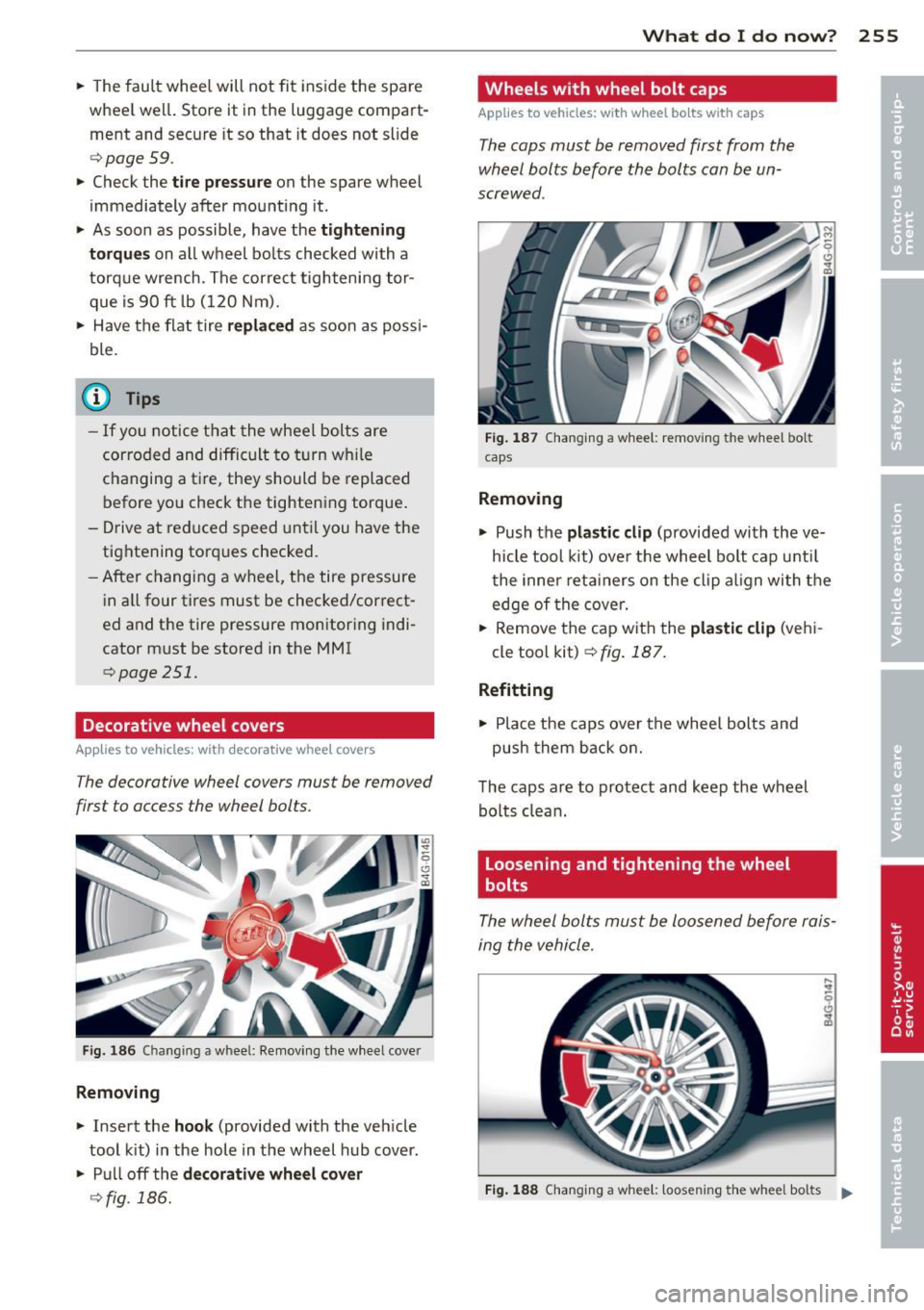
T h e decorativ e whe el covers must b e re moved
firs t to access the wheel bol ts.
Fi g. 186 Ch ang ing a w hee l: Remov ing the wheel cove r
Removing
.. Insert the hook (provided with the vehicle
tool kit) in the hole in the wheel hub cover .
.. Pu ll off the
dec orativ e whe el c over
r=> fig . 186.
What do I d o now ? 255
Wheels with wheel bolt caps
Applies to vehicles: wit h wheel bo lts with caps
T he cops must be removed first from the
wheel bolts before the bolts con be un
screwed .
Fig . 1 87 Changin g a whee l: r emovi ng th e wheel bolt
c ap s
Removing
.. Push the pla stic clip (provided with the ve
hicle tool kit) over the wheel bolt cap unt il
the inner reta iners on the clip align with the
edge of the cove r.
.. Remove the cap w it h the
pl as tic clip (veh i
cle too l kit)
r::!:> fig . 187.
Refitting
.. Place the caps over the wheel bolts and
push them back on.
The caps are to protect and keep the wheel bolts clean.
Loosening and tightening the wheel
bolts
The wheel bolts must be loosened before rais
ing the vehicle .
Fig. 188 Changing a whee l: loosening t he w hee l bo lts ..
Page 258 of 294
256 What do I do now ?
Loo sening
.,. Slide the wheel wr ench onto the wheel bolt
as far as it will go .
.,. Take tight hold of the
end of the wrench
hand le and turn the wheel bolts
co unter
clock wise
about one single turn in the direc
t ion of arrow
c:;, fig. 188.
Tighten ing
.,. Slide the wheel wrench onto the whee l bolt
as far as it will go .
.,. Take tight hold of the
end of the wrench
hand le and turn each wheel bolt
clock wise
until it is seated.
_& WARNING
- Do not use force or hurry when changi ng
a whee l - you can cause the vehicle to slip
off the jack and cause ser ious persona l
injuries.
- Do not loosen the wheel bolts more than
one turn
before you raise the veh icle with
the jack. -You r isk an injury.
@ Tips
- Never use the hexagonal socket in the
handle of the screwdrive r to loosen or
tighten the wheel bo lts.
- If a wheel bolt is very tight, you may find
i t easier to loosen by ca refully p ush ing
down on the end of the wheel bolt
wrench w ith
one foot only. As yo u do so,
ho ld on to the car to keep your ba lance
and take care not to slip .
Raising the vehicle
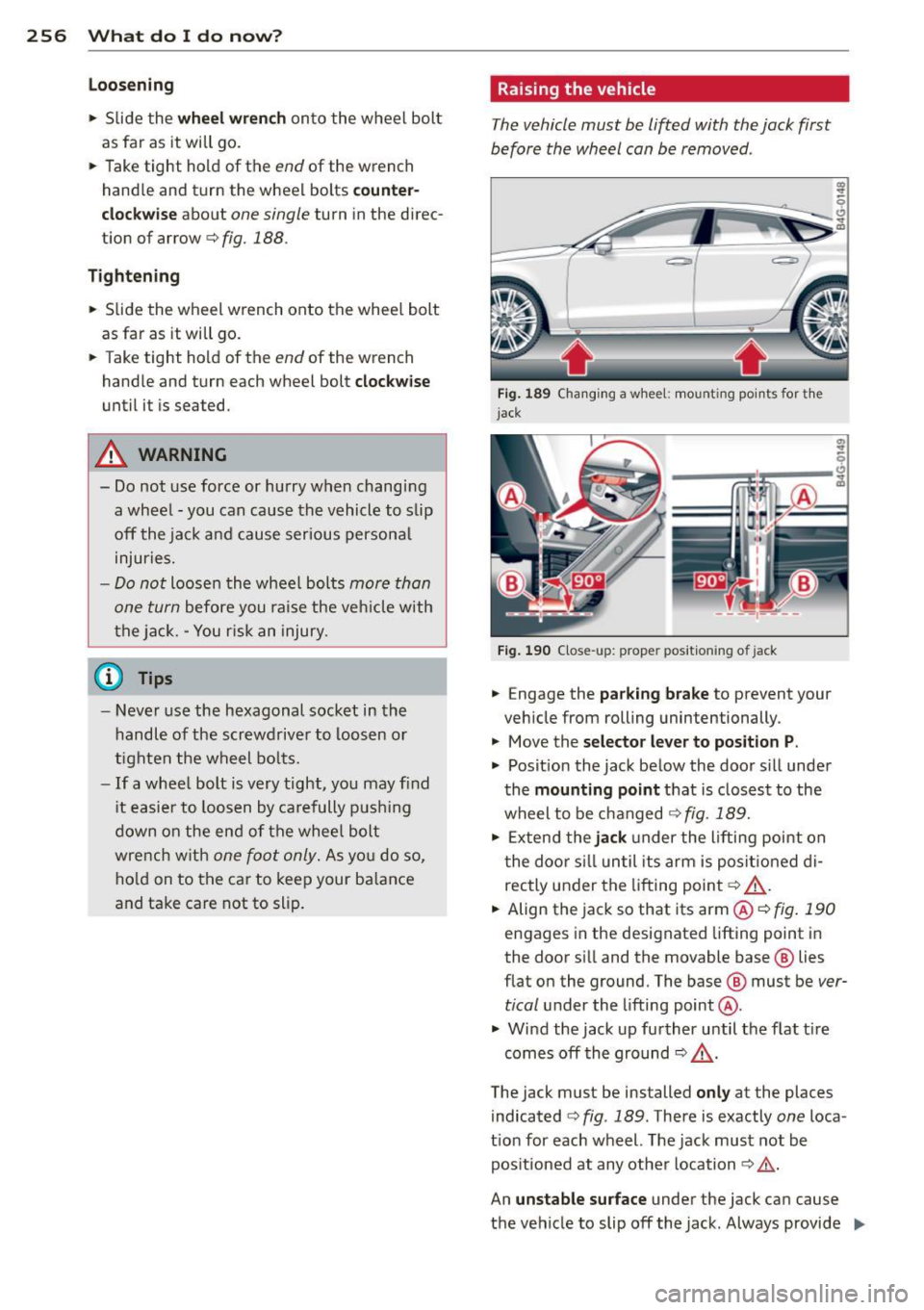
The vehicle must be lifted with the jock first
before the wheel can be removed .
Fig . 1 89 C hang ing a whee l: moun ting po in ts for th e
j ack
Fi g. 1 90 Close -up: prope r posit io ni ng o f jack
.,. Engage the p ar king brak e to prevent your
veh icle from rolling unintentionally .
.,. Move the
select or lever to p osition P .
.,. Posit ion the jack below the door s ill under
the
mounting point that is closest to the
wheel to be changed
c:;, fig . 189.
.,. Extend the ja ck u nder the lifting point on
t he door s ill until its arm is pos it ioned di
rectly under the lifting point
c:;, &_ .
.,. Align the jack so that its arm @ c:;, fig. 190
engages in the designated lifting point in
the door s ill and the movable base @ lies
flat on the ground . The base @ must be
ver
tical
under the lifting point @ .
.,. Wind the jack up further until the flat t ire
comes off the ground
c:;, ,& .
The jack must be installed only at the places
indicated
c:;, fig . 189 . There is exactly one loca
t ion for each wheel. The jack must not be
positioned at any other location
c:;, ,&. .
An
unstab le surface under the jack can cause
the vehicle to slip off the jack . Always provide
II>-
Page 259 of 294
a firm base for the jack on the ground. If nec
essary place a sturdy board or similar support
under the jack. On
hard, slippery surfaces
(such as tiles) use a rubber mat or sim ilar to
prevent the jack from slipping¢ .&.
A WARNING
-You or your passengers could be injured
wh ile chang ing a wheel if you do not fol
low these safety precautions:
- Positioning the jack under the vehicle
at any other place than those indicated
above may damage the vehicle or may
result in personal injuries.
-A soft or unstab le surface under the
jack may cause the vehicle to slip off the jack. Always provide a firm base for
the jack on the ground. If necessary, use a sturdy board under the jack.
- On hard, slippery surface (such as tiles)
use a rubber mat or similar to prevent
the jack from slipping.
- To help prevent injury to yourself and
your passengers:
- Do not raise the vehicle until you are
sure the jack is securely engaged.
- Pa ssenge rs must not remain in the
ve
hicle when it is jacked up.
- Make sure that passengers wait in a
safe place away from the vehicle and
well away from the road and traffic.
- Make sure jack position is correct , ad
just as necessary and then continue to
raise the jack .
- Changes in temperature or load can af
fect the height of the vehicle .
What do I do now? 257
Taking the wheel off /installing the spare
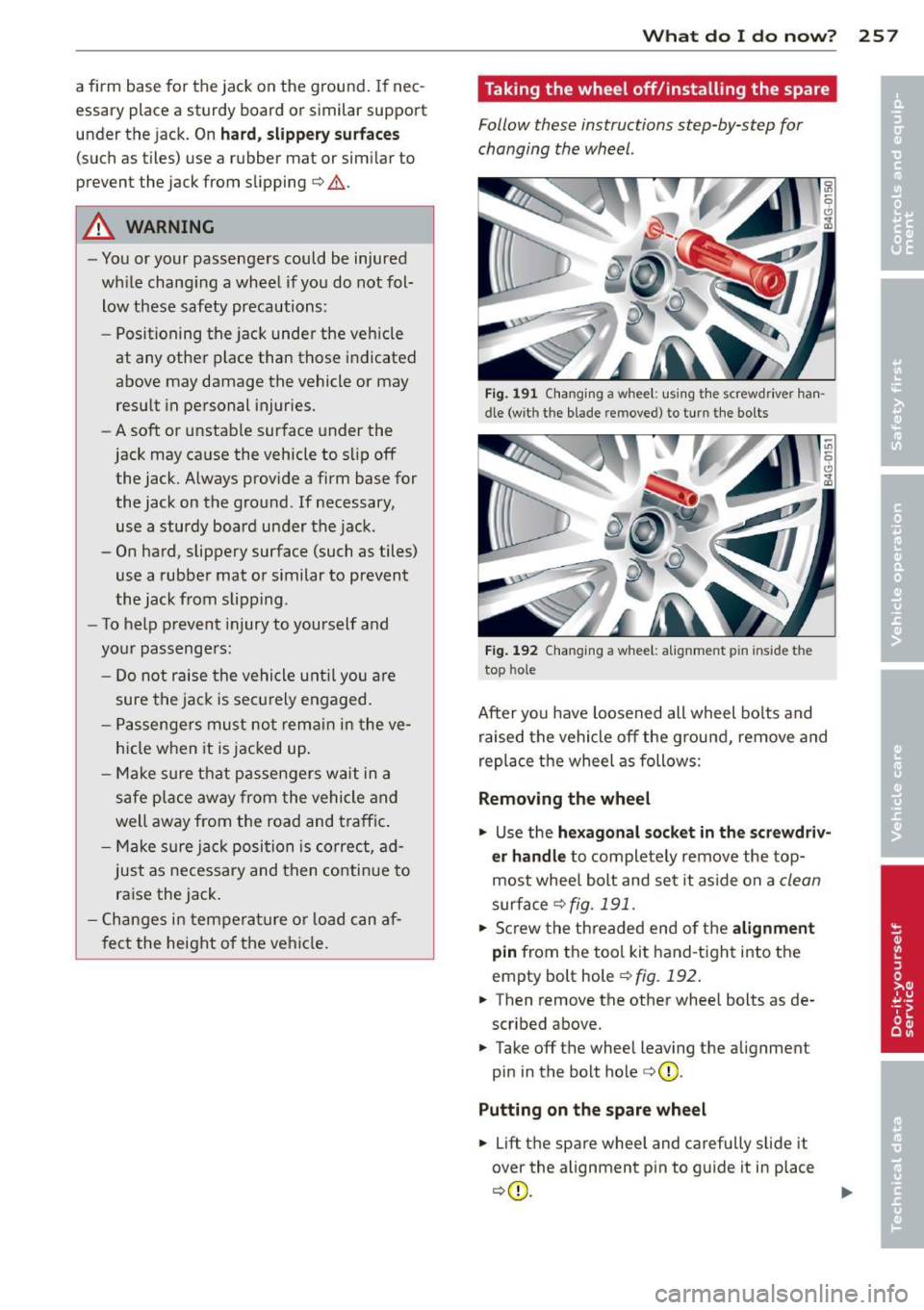
Follow these instructions step-by-step for
changing the wheel.
F ig . 191 Changing a wheel: u sin g the screwd river han
dle (with the blade removed) to turn the bolts
Fig. 192 Changing a whee l: alignment pin inside the
top ho le
After you have loosened all wheel bolts and
raised the vehicle off the ground, remove and
replace the wheel as follows:
Removing the wheel
.., Use the hexagonal socket in the screwdriv
er handle
to completely remove the top·
most wheel bolt and set it aside on a
clean
surface ¢fig. 191.
.., Screw the threaded end of the alignment
pin
from the tool kit hand-t ight into the
empty bolt hole
¢fig. 192 .
.., Then remove the other wheel bolts as de
scribed above .
.., Take off the wheel leaving the alignment
pin in the bolt hole ¢(D.
Putting on the spare wheel
.., Lift the spare wheel and carefully slide it
over the alignment pin to guide it in place
¢(D.
Page 260 of 294

258 What do I do no w?
• Use the hexagonal socket in the screwdriver
hand le to screw in and tighten all wheel
bolts
slightly .
• Remove the alignment pin and insert and
t ighten the remaining wheel bolt slightly
Like the rest .
• Turn the jack handle counter-clockw ise to
lower the vehicle unt il the jack is fully re
leased .
• Use the whee l bolt wrench to t ighten al l
wheel bolts firmly¢
page 255 . Tighten
them
crosswise, from one bolt to the (ap
proximate ly) opposite one, to keep the
whee l centered.
@ Note
When removing or installing the wheel,
the rim could hit the brake rotor and dam
age the rotor. Work carefully and have a
second person help you.
@ Tips
Never use the hexagonal socket in the han
dle of the screwdriver to loosen or tighten
the wheel bolts .
- Pull the reversible b lade from the screw
driver before you use the hexagonal
socket in the handle to turn the whee l
bo lts.
- When mounting tires with
unid irectional
t re ad design
make sure the tread pat
tern is pointed the right way
~ page 258.
- The wheel bolts should be clean and easy
to turn . Check for d irt and corrosion on
the mat ing surfaces of both the whee l
and the hub. Remove all dirt from these
s ur faces before remo unt ing the wheel.
Tires with unidirectional tread design
Tires with unidirectional tread design must be
mounted with their tread pattern pointed in the right direction .
Using a sp are t ire w ith a tre ad pattern
intended for use in a specific direction
When using a spare t ire with a tread patter n
intended for use in a spec ific d irection , please
note the following :
- The direct ion of rotation is marked by an ar
row on the side of the ti re .
- If the spare tire has to be installed in the in
correct direct ion, use the spare tire only
temporarily s ince the tire will not be able to
achieve its optim um performance cha racter
is tic s wit h regard to aquap la ni ng, no ise and
wear .
- We recommend that you pay part icu la r at
t en tion to th is fact d uring wet wea ther and
t ha t you adjust you r speed to match road
conditions .
- Replace the fl at tir e with a new o ne an d
have it insta lled on you r vehicle as soon as
possible to restore the handling advantages
of a u nidirectional tire .
Notes on wheel changing
Please read the information ¢ page 242, New
tires and replacing tires and wheels
if you a re
going to use a spare tire which is different
from the ti res on your vehicle .
After you change a tire:
- Check the tire pre ssure on the spare imme
diately after install ation.
- Have th e whe el bolt tight ening torqu e
c hecked with a torque wrench as soon a s
possible by your author ized Audi dealer or
a qualified service stat ion.
- With steel and alloy wheel rims, the wheel
bolt s are cor re ctl y tightened at a torque of
90 ft lb (120 Nm ).
- If you noti ce that the wheel bolts are cor
roded and diffi cult to turn while changing
a ti re , they should be replaced before you
check the t ightening torque. .,..
Page 261 of 294
-Replace the flat tire with a new one and
have it installed on your vehicle a s soon as
possible. Remount the wheel co ve r.
U ntil th en, driv e with extr a car e and at re
du ced speeds .
~ WARNING
-
-If you are going to equip your vehicle
with t ires or rims wh ich differ from those
wh ich were factory installed, then be
sure to read the informat ion
c:> page 242,
New tires and replacing tires and
wheels.
- Always make sure the damaged wheel or
even a flat tire and the jack and tool k it
are properly secured in th e luggage com·
partment and are not loose in the pas·
senger compartment.
- In an accident o r sudden maneuver they
c ou ld fly forward, inju ring anyone in the
vehicle .
- Always store damaged w heel, jac k and
tools secure ly in the luggage compart
ment. Otherw ise, in an acc iden t or sud
den maneuver they cou ld fly forward,
causing injury to passenge rs i n the vehi·
cle .
What do I do now? 259
•
•
Page 272 of 294

2 70 General information
General information
Explanation of
technical data
Some of the technical data listed in this man
ual requires further explanation .
The technical data for your vehicle is listed in
the charts starting on
r:::>page 27 2. This sec ·
tion provides general information, notes and restrictions which apply to this data .
Vehicle identification
The key data is given on the vehicle identifica·
tion number (VIN) plate and the vehicle data
sticker.
Fig. 206 Veh icle Ide ntific atio n Number (VlN) p late: lo
cation on driver 's sid e das h panel
Fig. 207 Th e vehicle identi fication label -inside the
luggage co mpa rtmen t
The Vehicle Identification Number (VIN)
is located on the driver's side so that it is visi
b le from the outside through the windshield
r:::> fig . 206. You can also display the Vehicle
Identification Number of your vehicle in the
MMI. Select: Function button
ICAR ! > Car sys
tems
> VIN number . The
vehicle identification label
is located in the luggage compartment in the
spare wheel wel l.
The label¢
fig. 207 shows the following vehi
cle data :
(D Production control No .
@ Vehicle identification No.
® Type code number
@ Type designation/engine output in Kilo·
watts
® Engine and transmission code letter
@ Paint No./Interior
(f) Optional equipment No.'s
Vehicle data 2 to 7 are also found in your War·
ranty
& Maintenance booklet.
The safety compliance sticker
is you r assurance that your new vehicle com
plies with all applicable Federal Motor Vehicle
Safety Standards which were in effect at the
time the vehicle was manufactured . You can
find this sticker on the left door jamb.
It
shows the month and year of production and
the ve hicle ident ification number of your vehi ·
cle (perforation) as well as the Gross Vehicle
Weight Rating (GVWR) and the Gross Axle
Weight Rating (GAWR) .
The high voltage warning label
is located on the lock carr ier .
The spark ignition system complies with
the Canadian standard ICES-002.
Weights
Gross Vehicle Weight Rating
The Gross Vehicle Weight Rating (GVWR), and
the Gross Axle Weight Rating (GAWR) for
front and rear are Listed on a sticker on the
left door jamb.
The Gross Vehicle Weight Rating includes the
weight of the basic vehicle plus full fuel tank,
oi l and coolant, plus maximum load, wh ich in·
eludes passenger weight (lSO lbs/68 kg per
Ill>
Page 274 of 294

272 Data
Data
310 hp, 3.0 liter 6-cylinder engine
Applies to vehicles: with 3 .0 liter 6-cylinder engine and all-wheel drive
Engine data
Ma ximum output SAE ne t
M aximum torque SAE net
No . of cylinders
Displacement
Stroke
Bo re
C ompress ion ratio
Fuel
Dimensions (approx .)
Leng th (w it h li cense pl ate bracket)
Width (across mirrors) He igh t (unloaded) hp@rp
m
lb-ft@ rpm
CID (cm
3 )
in (mm)
in (mm)
__ _, ,
310@ 5500 -6500
325 @ 2900- 4500
6
182 (2995)
3.50 (89 .0)
3 .33 (84.5)
10 .3: 1
Premium unleaded (91 AKI) Recommended for maxi
mum engine performance. Further details¢
page 211,
Gasoline
in (mm) 1 95 .6 (4 969)
in (mm) 84.2 (2139)
in (mm) 55.9 (1 420)
Turning circle diameter (curb to curb) ft. (m) 39.0 (11.9)
Capacities (appro x.)
Fuel tank
- Total capacity
- Reserve (o f to tal capacity)
Windshield fluid container
Windshield and headlight wa sher
fluid container *
Engine oil with filter c hange gal (li
ters)
19 .8 (75 .0)
ga l (li ters) 2.6 (1 0 .0 )
quarts (liters) 3.7 (3 .5)
qu arts ( li1ters) 5 .2 (4 .9)
quarts (li ters) 7 .2 (6 .8)