ESP AUDI A7 2012 Manual Online
[x] Cancel search | Manufacturer: AUDI, Model Year: 2012, Model line: A7, Model: AUDI A7 2012Pages: 294, PDF Size: 73.33 MB
Page 234 of 294
232 Tire s and wheel s
-Never mount used tires on yo ur vehicle if
you are not sure of their "previous histo
ry." Old used tires may have been dam
aged even though the damage cannot be
seen that can lead to sudden tire failure
and loss of vehicle control.
Glossary of tire and loading terminology
Accessory weight
means the comb ined we ight (in excess of
those standard items which may be rep laced)
of automa tic tra nsmission, power steer ing,
power br akes, power windows, power seats,
radio, and heater, to the extent that these
items are availab le as factory -installed equip
ment (whether installed or not) .
Aspect ratio
means the ratio of the height to the w idt h of
the tire in percent. Numbers of 55 or lower in
dicate a low sidewall fo r improved steer ing re
sponse and better overall handling on dry
pavement.
Bead
means t he pa rt of the tire that is made of
steel wires, wrapped o r reinforced by ply cords
and that is shaped to fit the r im.
Bead s eparation
means a b reakdown of the bond between
components in the bead.
Cord
means the strands forming the plies in the
tire.
Cold tire inflatio n pre ssure
means the tire pressure recommended by the
ve hicle manufacturer for a tire of a designated
size that has not been dr iven for more than a
couple of miles (kilometers) at low speeds in
the three hour period before the tire pressure i s measu red or adjusted. -
If you notice unusual vibration or if the
veh icle pulls to one side when driv ing, a l
ways stop as soon as it is safe to do so and check the wheels and tires for dam
age.
Curb weight
means the weight of a motor ve hicle w ith
standard equipment including t he maximum
capa city of fuel, o il, and coola nt, a ir cond i
tion ing and additional weig ht o f option al
equipment .
Extra load tire
means a tire design to operate at h igher loads
and at h igher inflation pressures than the cor
respondi ng standa rd tire. Extra load tires may
be identified as "X L", "xl", "EXTRA LOA D", o r
"R F" on the sidewall .
Gross Axle Weight Rating ( "GAWR ")
means the load-carrying capacity of a s ingle
axle system, measured at the tire-ground in
te rfaces .
Gross Vehicle Weight Rating ( "GVWR ")
means the maximum total loaded we ight of
t h e ve hicle.
Groove
means the space between two adjacent tread
ribs .
Load rat ing (code )
means the maximum load that a tire is rated
to carry for a given inflation press ure. Yo u
may not find this information on all tires be
ca use it is not required by law.
Maximum load rating
me ans the lo ad r ating for a tire a t the m axi
mum pe rm issib le inflation pressure for that
t ir e.
Page 235 of 294

Maximum loaded vehicle weight
means the sum of:
(a) Curb weight
(b) Accessory weight
(c) Vehicle capacity weight, and
(d) Production options weight
Maximum (permissible) inflation pressure
means the maximum cold inflation pressure
to which a tire may be inflated. Also called
"maximum inflation pressu re."
Normal occupant weight
means 150 lbs . (68 k ilograms) times the
number of occupants seated in the vehicle up
to the total seating capacity of your vehicle .
Occupant distribution
means distribution of occupants in a vehicle .
Outer diameter means the overall diameter of an inflated new
tire.
Overall width
means the linear distance between the exteri
ors of the sidewalls of an inflated tire, includ
ing e levations due to labeling, decorations, or
protective bands or ribs.
Ply
means a layer of rubber-coated para llel cords.
Production options weight
means the comb ined weight of those installed
regular production options weighing over 5
lbs . (2 .3 kg) in excess of those standard items
which they replace, not previously considered
in curb weight or accessory weight, including
heavy duty brakes, r ide leve lers, roof rack,
heavy duty battery, and specia l trim .
Radial ply tire
means a pneumatic t ire in which the p ly cords
that extend to the beads are laid at substan
tially 90 degrees to the centerline of the
tread.
Tires and wheels 233
Recommended inflation pressure
see~
page 232, Cold tire inflation pressure.
Reinforced tire
means a t ire design to operate at higher loads
and at higher inflation pressures than the cor
responding standard tire. Reinforced tires
may be identified as "XL" , "x l", " EXTRA LOAD",
o r "R F" on the sidewall.
Rim
means a metal support for a tire or a t ire and
tube assembly upon which the tire beads are
seated.
Rim diameter
means nom inal d iameter of the bead seat. If
you change your wheel s ize, you w ill have to
purchase new tires to match the new r im di
ameter.
Rim size designation
means r im diameter and width.
Rim width
means nom inal distance between rim fla nges.
Sidewall
means that portion of a tire between the
tread and bead.
Speed rating (letter code)
means the speed at which a tire is designed to
be driven for extended periods of time. The
ratings range from 93 mph (150 km/h) to
186 mph (298 km/h)
~ page 243 . You may
not find this information on all tires because
it is not requ ired by law.
The speed rating letter code, where applica
ble, is molded on the tire sidewall and indi
cates the max imum pe rm issib le road speeds
~ .&. in Winter tires on page 247 .
Tire pressure monitoring system*
means a system that detects when one or
more of a veh icle's tires are underinflated and
illuminates a low tire pressure warning tell
tale.
•
•
Page 237 of 294
Tires and wheels 235
Cold tire inflation pressure
Tire pressure affects the overall handling, performance and safety of a vehicle .
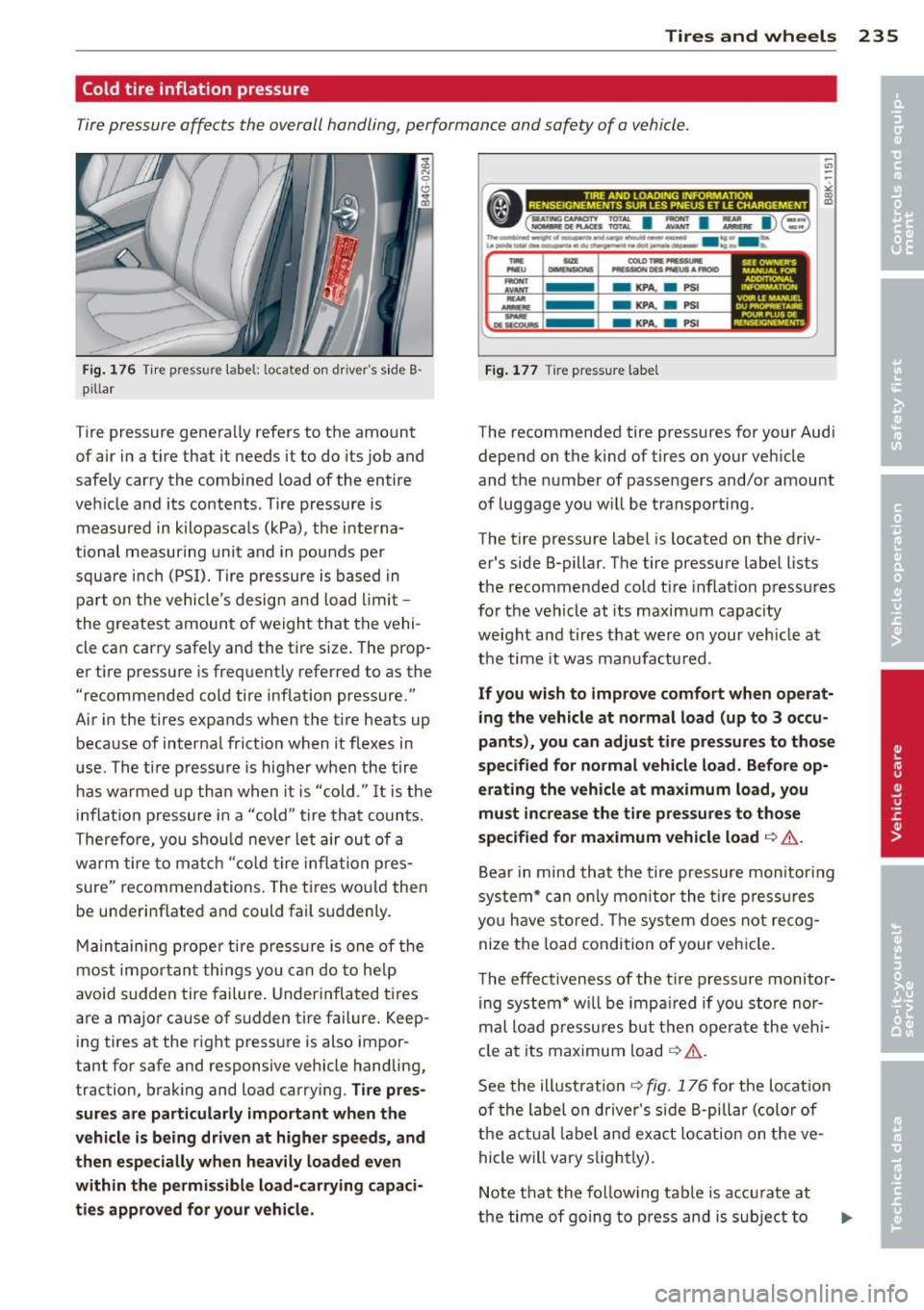
Fig . 17 6 Tir e pr essur e labe l: located on drive r's s ide B ·
p ill ar
Tire pressu re genera lly refers to the amount
of air in a t ire tha t it needs it to do its job and
safely carry the combined load of the entire
vehicle and its contents . Tire pressure is
measured in kilopasca ls (kPa), the i nterna
tional measuring unit and in pounds pe r
square inc h (PSI). Tire pressure is based in
p ar t o n the vehicle's desig n an d load limit
the greatest amount of weight that the vehi
cle can carry safe ly and the ti re size . The prop
er tire pressure is freq uent ly referred to as the
"recommended cold tire inf lation pressure ."
Air in the tires expands when the tire heats up
because of interna l frict io n when it flexes in
use . The ti re p ressu re is higher when the tire
has warmed up than when it is "cold ." It is the
i nflat io n pressure i n a "cold" tire that counts.
Therefo re, you s ho ul d never let air ou t of a
warm tire to matc h "cold tire infla tion p res
sure" recommendations . The tires wo uld then
be underinf lated a nd could fail suddenly.
M ain taining proper t ire press ure is one of the
most impor tan t thi ngs you c an do to he lp
avoid sudden tire failure. Underinfla ted tires
are a major cause of s udden tire failure . Keep
ing tires at the r ight pressure is also impor
tant for safe and responsive vehicle handling,
traction, b rak ing and load carrying .
Tire pres
sures are part icularly important wh en th e
vehicle is being driven at higher speeds , and
then especially when h eavily loaded even
within the permi ssible load -carrying capaci
tie s approved for your vehi cle.
~
"' ~
,.------------------- ~
•(=~: I := I ~ I )§ :ll
,.,,. ........................ ...., .... ~----.... _ ... t.._.. .... _..,.. .... ......,... .. ~--......... ·- ..
- KPA. . PSI
- KPA. . PSI
- KPA. . PSI
Fig. 17 7 Tir e pressu re labe l
The recommended tire pressures for your Audi
depe nd on the kind of tires on your ve hicle
and t he number of passe ngers and/or amount
of luggage you w ill be t ransporting .
The tire pressure label is located on the driv
er's side 8-pillar . The tire pressure labe l lists
the recommended cold t ire inflat io n pressures
for the veh icle at its maximum capac ity
weight and tires that we re o n your veh icle at
t h e time it was manufactu red.
If you wish to improve comfort when op erat
ing the ve hicle at normal load (up to 3 occu
pant s), you can adju st tire pres sures to those
spe cified for normal vehi cle load . Before op
erating the vehicle at maximum load, you
must increase the tire pressure s to those
speci fied for maximum vehicle load
¢ .&.
Bear in mind that the tire pressure mon itor ing
system* can on ly mon itor the tire p ress ures
yo u have sto red. The sys tem does not recog
nize the load condi tion of your veh icle.
T he effectiveness of the t ire p ress ure monitor
ing system * w ill be impa ired i f you s to re no r
m al load pressures but t hen opera te the veh i
cle a t its maximum load
¢ .& .
See the ill ustration 9 fig. 176 fo r the lo cat ion
of the label o n driver's s ide B-pillar (color of
the actu al label a nd exact lo cat ion on the ve
hicle will vary s light ly).
Note t hat the follow ing table is accu rate at
the time of going to press and is s ubject to
Page 238 of 294
236 Tires and wheels
change. In the event of discrepancies, the tire
pressure labe l is located on the driver's side B
p ill ar a lways takes precedence.
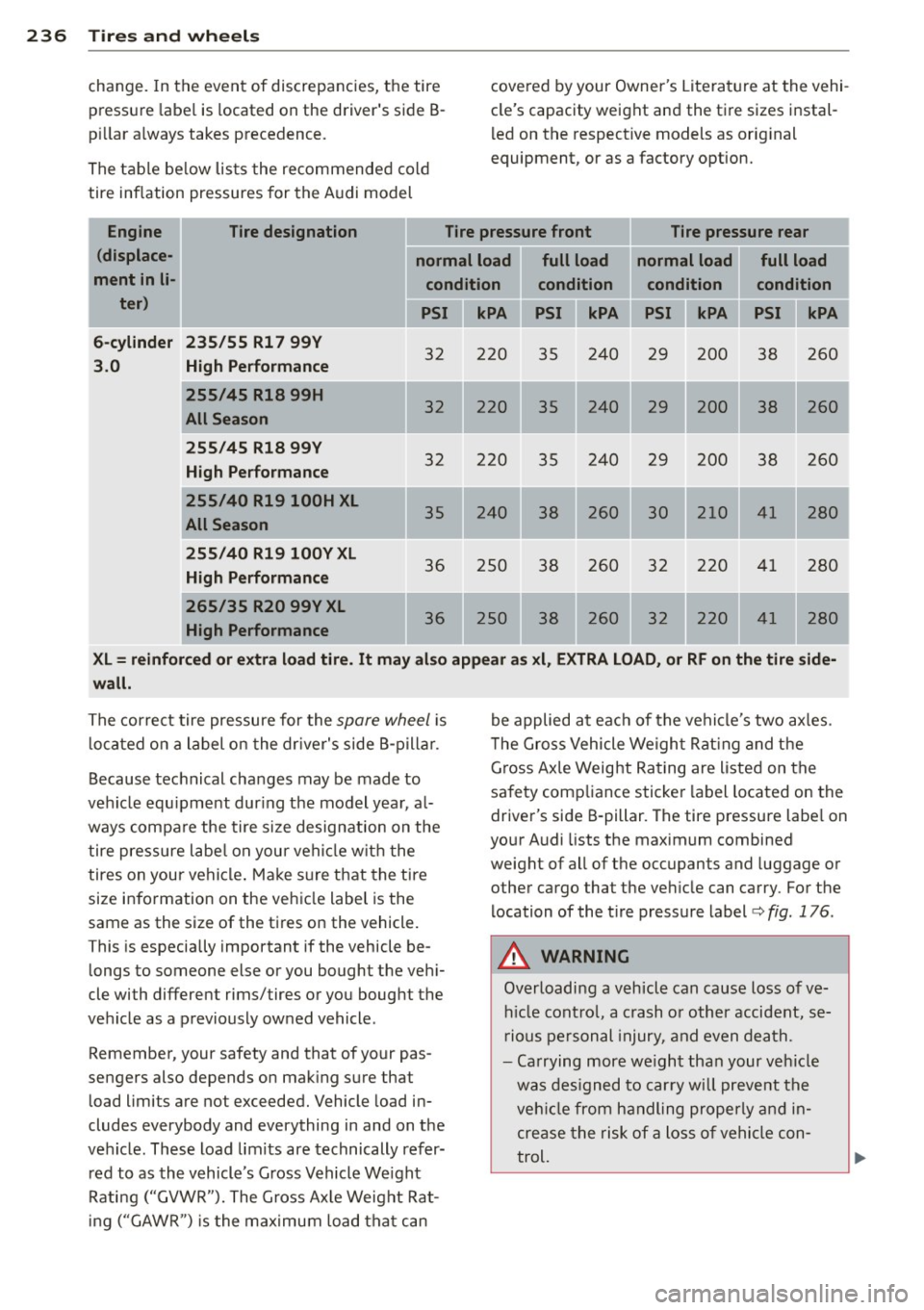
The table below lis ts the recommended cold
tire inflation pressures for the Audi model covered
by your Owner's Literature at the vehi
cle's capacity weight and the tire sizes instal
l ed on the respective models as orig inal
equipment, or as a factory option.
I Engine Tire designation
Tire pressure front Tire pressure rear I
(displace-
normal load full load normal load full load
ment in
li-condition condition condition condition
I
ter) PSI II kPA PSI JI kPA PSI II kPA PSI II kPA :
6-cylinder 235/55
Rl 7 99Y
3.0 High Performance 32
220
35 240 29 200
38 260
255/45 Rl8 99H '
32 220 35
240
29 200 38 260 All Season I
255/45 Rl8 99Y
32 220 35 240 29 200 38 260
High Performance
255/40 Rl9100H XL
35 240
38 260
30 2 10 41
280 All Season
255/40
Rl9100YXL
36 250 38 260 32 220 41 280
High Performance
265/35 R20 99Y XL '
36 250 38 260 32 220 41 280
High Performance .. • .. .. .. .. ..
XL= reinforced or extra load tire. It may also appear as xl, EXTRA LOAD, or RF on the tire side
wall.
The correct tire pressure for the spore wheel is
loc ated on a label on the driver's side B-pillar.
Because technical changes may be made to
vehicle equ ipment dur ing the model year, a l
ways compare the tire size designation on the
tire pressure labe l on your vehicle w ith the
tires on your vehicle . Make sure that the tire
size information on the vehicle label is the
same as the size of the ti res on the vehicle.
This is especially important if the vehicle be
longs to someone else or you bought the vehi
cle with different rims/tires or you bought the
vehicle as a previously owned vehicle.
Remember, your safety and that of your pas
sengers also depends on making sure that load limits are not exceeded. Vehicle load in
cludes everybody and everything in and on the
vehicle . These load limits are technically refer
red to as the vehicle's Gross Vehicle We ight
Rating ("GVWR"). The Gross Ax le Weight Rat
ing ("GAWR") is the maximum load that can be applied at each
of the vehicle's two ax les .
T he Gross Vehicle Weight Rat ing and the
Gross Axle Weight Rating are listed on the
safety compliance sticke r label located on the
driver's side B-pillar. The tire pressure labe l on
your Audi lists the maximum combined
weight of all of the occupants and luggage or
other cargo that the vehicle can carry . For the
location of the tire pressure label
¢fig. 176 .
A WARNING
-Overloading a vehicle can cause loss of ve-
hicle control, a crash or other accident, se
r ious personal injury, and even death.
- Carrying more weight than your veh icle
was designed to carry will prevent the
vehicle from handling properly and in
crease the risk of a loss of vehicle con
trol.
Page 240 of 294

238 Tire s and whee ls
Remember that the vehicle manufacturer, not
the tire manufacturer, determines the correct
tire pressure for the t ires on your vehicle.
I t is important to check the tire pressu re when
the tires are cold.
- Read the requ ired t ire pressure from the tire
pressure label. The tire pressure labe l is lo
cated on the drive r's side 8-p illar.
- T urn the valve stem cap counter-clockwise
to remove it from the tire valve.
- Place the air pressu re gauge on the valve.
- The tire pressures should only be checked
and adjusted when the tires are cold. The
sl ightly raised p ressures of warm tires must
not be reduced.
- Adjust the tire pressure to the load you are
carrying.
- Re install the va lve stem cap on the valve .
When should I check the ti re pres sure ?
The correct tire pressure is especially impor
tant at high speeds. The pressure should
therefore be checked at least once a month
and always before start ing a jou rney. Do not
fo rget to check the tire pressure for the spare
wheel
<=? page 253.
When should I adju st the tire p re ss ure s?
Adjust the tire pressure to the load you are
carry ing . After changing a wheel
or replacing
wheels you have to adjust the tire pressures
on all wheels. In addition, you must then
sto re t he new ti re press ures in the t ire pres
sure mon itor ing system* ~
page 249.
_8 WARNING
Incorrect tire pressures and/or underinf la
tion can lead sudden tire failure, loss of
contro l, collision, ser ious persona l injury
or even death.
- When the warning symbo l
RI] appears in
the instrument cluster, stop and inspect
the tires .
- Incorrect tire pressure and/or underinfla
t ion can cause increased t ire wear and
can affect the handling of the veh icle and
stopp ing ability. -
Incorrect tire pressures and/or underin
f lation can a lso lead to s udden t ire fail
ure, including a blowout and sudden de
flation, caus ing loss of veh icle control.
- The driver is responsible for the correct
tire pressures for all tires on the veh icle.
The applicable pressure values are locat ed on a sticker on the dr iver's s ide 8-pil
lar.
- Only when all tires on the vehicle are fil led to the correct pressure, the t ire pres
sure mon itor ing* system can work cor
rectly.
- The use of incorrect t ire pressure va lues
can lead to acc idents or other damage.
Therefore it is essential that the drive r
observe the spec ified tire pressure values
for the tires and the correct pressures for
the function of the ti re press ure monitor
ing system*.
- Always inflate tires to the recommended
and correct tire press ure before driving
off.
- Driving with underinflated tires bend
more, letting them get too hot resulting
in tread separation, sudden tire failure
and loss of control.
- Excessive speed and/overloading can cause heat build-up, sudden tire failure
and loss of control.
- If the tire pressure is too low or too high,
the t ires will wear prematurely and the
veh icle w ill not handle well.
- If the tire is not flat and you do not have
to change a wheel immediately, drive at
reduced speed to the nearest service sta
tion to check the t ire p ress ure and add
air as req uired .
Q) Note
Driving without valve stem caps can cause
damage to the tire valves. To prevent this,
always make sure that factory insta lled
valve stem caps o n all whee ls are sec urely
mounted on the valve.
Page 244 of 294

242 Tires and wheels
& WARNING
Sudden tire failure can lead to loss of con
trol, a crash and serious personal injury!
- Never drive a vehicle when the tread on
any tire is worn down to the wear indica
tors.
- Worn tires are a safety hazard, they do
not grip well on wet roads and increase
your risk of "hydroplaning" and loss of control.
- Always keep chemicals that can cause tire damage, such as grease, oil, gasoline
and brake fluid away from tires.
- Tires age even if they are not be ing used
and can fail suddenly, especially at high
speeds. Tires that are more than 6 years
old can only be used in an emergency
and then with special care and at lower
speeds.
- Never mount used tires on your vehicle if
you are not sure of their "previous histo
ry." Old used tires may have been dam
aged even though the damage cannot be
seen that can lead to sudden tire failure
and loss of vehicle control.
New tires and replacing tires and wheels
New tires and wheels have to be broken in .
Fig. 180 Tir e specificat ion codes on the s idewall of a
t ire
No. Description
(!) Passenger car tire (where applicable)
@ Nominal width of t ire in millimeters
@ Ratio of height to width (aspect ratio)
© Rad ial
® Rim diameter code
@ L oad index and speed rating
(J) U.S. DOT tire identification number
@ Audi Original tire
@ Sever snow conditions
@ T ire ply composition and materials
used
Maximum load rating
Treadwear, traction and temperature
grades
Maximum permissible inflation pres
sure
T he tires and rims are essential parts of the
vehicle 's design . The tires and rims approved
by Audi are spec ially matched to the charac
teristics of the vehicle and can make a major .,..
Page 246 of 294

24 4 T ire s and wheel s
T up to 118 mph (190 km/h)
U up to 124 mph (200 km/h)
H up to 130 mph (210 km/ h)
V up to 149 mph (240 km/h)
1l
Z over 149 mph (240 km/h)ll
W up to 168 mph (270 km/h)ll
Y up to 186 mph (298 km/h)l)
Your veh icle is norma lly fac to ry equipped with
tires , which possess excellent driving charac
teristics and give yo ur Audi opt imum driving
comfort . An e lectronic speed limit er
c:> page 28 wi ll normally prevent your vehicle
from go ing faster th an the tire speed rating
c:> & .
U.S . DOT Tir e Identification Numb er (TIN )
a nd tire manufacture d ate
This is the t ire's "serial number". It begins
with the letters "DOT" and indicates that the
tire meets all federal standards . The next two
numbers or letters indicate the p lant whe re it
was manufactured, and the last four numbers r epresent the week and year of manufacture.
F or example, the numbers 2211 mean the ti re
was p roduced in the 22nd week of 2011. The
other numbers are marketing codes that may
or may not be used by the ti re manufacturer .
T his informat ion is used to contact consumers
if a tire defect requires a recall.
Aud i Original tire
Tires wi th the ident ification "AO" or "RO" have
been specially matched with your Audi . We
recommend using only these tires because
they meet the highest standards regard ing
safety and driving character istics when used
correctly . Your authorized Audi dealer will
gladly prov ide you with more information .
Tire ply composition and materials u sed
The number of p lies ind icates the number of
layers of rubber-coated fabric in the t ire. In
general, the greater the number of plies, the mo re weight a tire can support . Tire manufac -
ll F t· "t h . or ires w 1 a m ax im um s pee d ca pabil ity ove r
1 4 9 mp h (240 k m/h) , tir e man ufactur ers somet imes
use the letters " ZR."
turers also must indicate the materials in the
tire, which include stee l, nylon, po lyester, and
others .
Maximum Load Rating
Th is number ind icates the maximum load in
k ilograms and po unds that can be carr ied by
the tire .
Tire quality grading for treadwear,
traction , and temperature resistance
Tre ad wear, traction and tempera ture grades
c:> page 245 .
Maximum Permissible Inflation Pressure
This number is the greatest amount of a ir
pressure tha t should ever be put in the tire
u nder norm al driv ing cond it ions .
_& WARNING
= -
-Using incorrect or unmatched tires and/
or wheels or improper tire and wheel
combinations can lead to loss of control
coll is ion and serio us personal in jury.
'
- Always use ti res, rims and whee l bolts
that meet the specifications of original factory-insta lled tires or other comb ina
tions that have been specifically ap proved by the vehicle manufacturer.
- Tires age even if they are not being used
and can fai l sudden ly, especially at hig h
speeds . Tires that are more than 6 years
old can only be used in an emergency
and then w ith specia l care and at lower
speeds.
- Ne ver mo unt used tir es on your veh icle if
you are not sure of the ir "p revio us histo
ry." O ld used tires may have been dam
aged even though the damage cannot be
seen that can lead to sudden tire fa ilure
and loss of vehicle control.
- All fo ur whee ls must be fitted with radial
tires of the same type, size (rolling cir cumference) an d the same tread pattern . ..,_
Page 248 of 294
24 6 T ire s and whee ls
Tra ction
The traction grades, from highest to lowest,
are AA, A, Band
C. T hose grades represent the
tire's ability to stop on wet pavement as measured under controlled conditions on
specified government test surfaces of asphalt
and concrete. A tire marked C may have poor
traction performance
c:> .&. .
Te mp eratu re
The temperature grades are A (the highest),
B, and
C, representing the t ire's resistance to
the generation of heat and its ability to dissi
pate heat when tested under con trolled condi
tions on a specified i ndoor laboratory test
wheel.
Sustained high temperature can cause the
material of the tire to degenerate and reduce
tire life, and excessive temperature can lead
to sudden tire failure
c:> ,& .
The grade C corresponds to a level of perform
ance which all passenger car tires must meet under the Federal Motor Veh icle Safety Stand
ard No .
109 . Grades Band A represent h igher
l eve ls of performance on the laboratory test
wheel than the m inimum required by law.
.&_ WARNING
T he traction grade assigned to this t ire is
based on straight-ahead braking traction
tests, and does not include acceleration,
cornering, hydrop laning o r peak traction
characteristics.
A WARNING
The temperature grade for this tire is es
tablished for a t ire that is properly inflated
and not overloaded. Excessive speed, un
derinflation, or excessive loading, either
separately or in combination, can cause
heat buildup and possible tire fa ilu re.
-
Winter tires
Winter tires can improve vehicle handling on
snow and ice . At temperatures below 45 °F
(7 °C) we recommend changing to winter
tires.
In some heavy snow areas, local governments
may require true w inter o r "snow" t ires, those
with very deeply cut tread . T hese tires should
o n ly be used in pairs and be installed on a ll
f o ur wheels . Make sure you purchase snow
ti res that are the same size and construction
type as the othe r tires on yo ur vehicle.
If your vehicle is equ ipped w ith all-whee l
drive*, t his w ill improve traction during win ter
driv ing, even with the standard tires . Howev
er, we strongly recommend that you always
equip all four wheels on your vehicle w ith cor
rect ly fitted winter tires or all-season t ires,
when winter road condit ions are expected.
This also improves the veh icle 's brak ing per
formance and reduces stopping d istances .
Summer tires provide less grip on ice and
snow.
Winter tires (snow tires) must always be fitted on all fo ur whee ls .
Ask your au thorized A udi dealer or qualified
workshop for permit ted
winter ti re size s. Use
only radial winter tires .
Winter tires lose their effec tivenes s whe n the
tread is wo rn down to a depth o f
0.157 inch
(4 mm) .
Only d rive w ith w inter t ires under w inte r co n
ditions. S umme r tir es handle bette r whe n
there is no snow o r ice on the roads and the
temperature is above 45 °F (7 °C) .
If you have a flat ti re, see notes on spare
whee l
c:> page 242 .
Please always remember that winter tires may
have a lowe r speed rating than the tires o rigi
nally i nstalled on your vehi cle at the time it
was ma nufactu red. P lease see
c:> page 243,
Speed rating (Letter code)
for a lis ting o f the
speed rating lette r codes and the max imum
speed at which the tires can be driven . ..,.
Page 251 of 294

In o rder to minimize the occurrence o f impact
damage to the tires of your vehicle, we recom mend that you observe the following precau
tions :
- Always maintain recommended inflation
pressures. Check your tire pressure every
2,000 miles (3,000 km) and add a ir if neces
sary.
- Drive carefu lly on roads with potholes, deep
gullies or ridges. The impact from driving
through or over such obstacles can damage
your tires. Impact with a curb may also cause damage to your tires .
- After any impact, immediately inspect your
tires or have them inspected by the nearest
authorized Aud i dealer . Replace a damaged
t ire as soon as poss ible .
- In spect your t ires every 2,000 miles (3,000
km) for damage and wear . Damage is not al
ways easy to see. Damage can lead to loss of
air and unde rinflation, wh ic h could eventu
ally cause ti re fail ure.
If yo u be lieve that a
ti re may have been damaged , replace the
tire as soon as possible.
- These tires may wear more quick ly than oth
ers.
- Please a lso remembe r that, whi le these t ires
deliver respons ive handling, they may ride
less comfortably and make more noise than
other c hoices.
Reduced p erformance in winter /cold
s ea son condit ion s
All ti res are designed for certain purposes .
The low aspect ratio, ultra hig h performance
tires originally installed on your veh icle are in
tended for max imum dry and wet road per
formance and handling . They are not suitable
for cold, snowy or icy weather cond it ions . If
you dr ive under those circumstances, you
should equip your vehicle with all-season or
winter tires, whi ch offe r better traction under
those cond it ions . We suggest you use the rec
ommended snow or all -season tires specified
for your ve hicle, or their equiva lent .
Refe r to ~
page 246 for mo re deta iled info r
mat io n regarding w in ter t ires.
Tire s an d wheel s 249
Tire pressure
monitoring system
ill General notes
App lies to vehicles : wi th tire p ress ure mo nito rin g system
Each tire, incl uding the spare (if provided),
shou ld be checked monthly when co ld and in
flated to the inflation pressure recommended
by the veh icle manufacturer on the veh icle
placard or tire inflation pressure label. (If your
vehicle has tires of a d ifferent size than the
s iz e indicated on the vehicle placard or tire in
flat io n pressu re labe l, you shou ld dete rmine
the p roper t ire inflation p ress ure fo r those
t i r es).
As an added safety feature, your veh icle has
been equipped with a tire pressure monitoring
system ( TPMS) that illum inates a low ti re
pressure te lltale whe n one or more o f your
ti res is significant ly under -inflated . According
ly, when the low tire pressure te lltale i llumi
nates, you shou ld stop and check your tires as
soon as possib le, and inflate them to the
proper pressure. Driving on a sign ificantly un
der- inflated t ire causes the tire to overheat
and can lead to tire fa ilure . Under-inflation al
so reduces fuel effic iency and tire tread life,
and may affect the vehicle 's hand ling and
stopp ing abil ity.
Please note that the TPMS is not a subst itute
fo r proper tire ma intenanc e, and it is the d riv
er's respo nsibility to maintain co rrect tire
pressure, even if under-inflation has not
reached the leve l to tr igger illum inat ion of the
T PMS low ti re p ressu re tellta le .
You r vehicle has also been equipped with a
T PMS ma lf u nction indicator to ind icate w hen
the sys tem is not operating prope rly . T he
T PMS ma lfunction indicator is combined w ith
the low tire pressure te lltale. When the sys
tem detects a malfunction, the telltale wi ll
flash for approximate ly one min ute and then
rema in con tinuously i llum inated . T hi s se
quence will continue upon subsequent vehicle
start-ups as long as the malfunct ion exists . ..,.
•
•
Page 253 of 294

impair the vehicle's handling and stop
ping ability.
- The driver is responsible for maintaining
the correct tire pressures. You must
check the t ire pressures regularly.
- Under certain conditions (such as a spor
ty driving style, w inter condit ions or un
paved roads), the pressure monitor ind i
cator may be de layed.
- Ask your authorized Audi dealer if run
flat tires may be used on your veh icle.
Your vehicle registrat ion becomes invalid
if you use these tires when not permit
ted. Damage to your veh icle or acc idents
cou ld also resu lt.
(0 Tips
- The t ire pressure monitoring system
stops working when there is an ESP/ABS malfunction.
- Using snow chains may result in a system malfunction .
- To ensure a proper TPMS function use
AUDI Origina l Tires wh ich are marked
with "AO" or "RO" on the tire sidewall.
¢page 242.
- The t ire pressure monitoring sys tem on
you r A udi was syntoni zed using tires w ith
the "AO" or "RO" identific ation. We rec
omme nd using these tires.
Reset tire pressure monitoring system
Applies to vehicles: with tire pressure monito ring system
If the tire pressure is adjusted, wheels are ro
tated or changed, the T PMS must be reset via
MMI .
"' Switc h on the igni tion.
"' Se lect in the M MI: !CAR !func tion button>
Car system s contro l button > Servi cing &
checks > Ti re pre ssure mon itoring > Store
tire press ures> Ye s, store now .
@ Tips
Before reset ting the TPMS, the current
pressures of all four tires must correspond
to the specified values. Adjust the t ire
Tire s an d wheel s 251
pressure and reset the pressure in the ti re
pressure monitoring system according to
the load you are car ry ing
c::!;> page 235 .
-Do not store the tire p ressu res if you are
driving with snow chains . Othe rwise, a
system malfunction may occur.
•
•