four wheel drive AUDI A7 2012 Owners Manual
[x] Cancel search | Manufacturer: AUDI, Model Year: 2012, Model line: A7, Model: AUDI A7 2012Pages: 294, PDF Size: 73.33 MB
Page 4 of 294
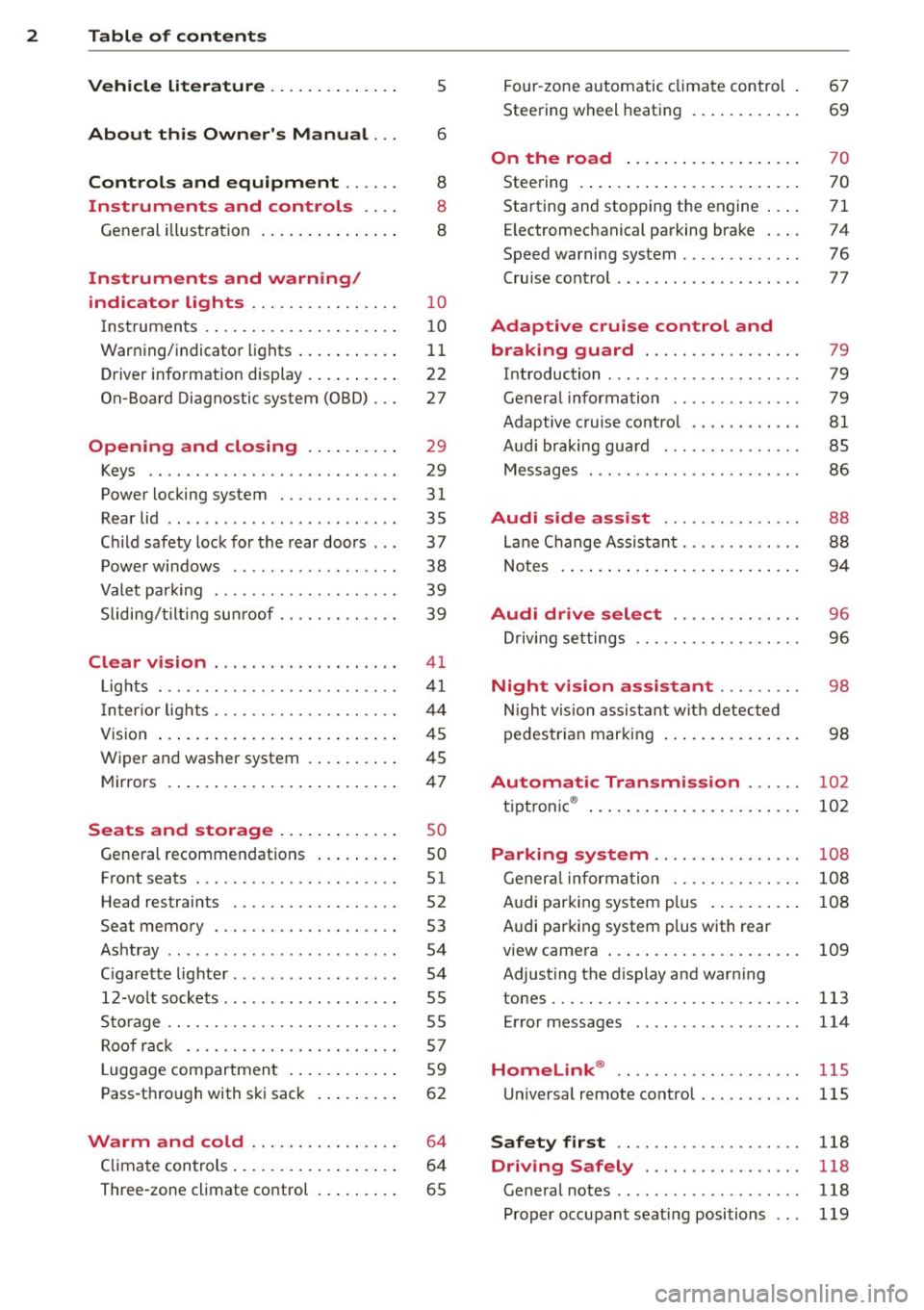
2 Table of content s
Vehicle lite ratu re .. .. .. .. .. ... .
5
About thi s Owner' s Manual . . . 6
C ontr ols and equi pm ent .. ... .
Ins truments and controls .. . .
General illustration ...... ... .. ... .
Instruments and warning /
indicator lights ........ .. .. .. . .
Instruments ............ ... .. ... .
Warning/indicator lights .. ... ... .. .
Driver information display .... .. ... .
On-Board Diagnostic system (OBD) . . .
Opening and closing .. .. .... . .
Keys .. ...... ........... .. .. ... .
Power locking system ..... .. .. .. . .
Rear lid .. .. ........ ........ .... .
Child safety lock for the rear doors .. .
Power windows ............... .. .
Valet park ing . ........... .. .. ... .
Sliding/tilting sun roof ... .. .. .. .. . .
Clear vi sion ................... .
Lights . .. .. .. . .......... .. .. .. . .
I nter ior lights ............ .. .. .. . .
V1s 1on .......... ......... ... ... .
Wiper and washer system ... .... .. .
Mirrors .... .............. ... ... .
Seats and storage ...... ... ... .
General recommendations ... .... . .
Front seats ... ........... .. .. ... .
Head restraints .............. ... .
Seat memory . ........... .... ... .
Ashtray .. .. ... .... ...... .. .. .. . .
C igarette lighter .............. .. . .
12-vo lt sockets ............ ... .. . .
Sto rage ................. .. .. ... .
Roof rack ............... .. .. .. . .
L uggage compartment ... ... ... .. .
Pass-through with ski sack ... .. ... .
Warm and cold ............ ... .
C limate controls ......... ... .. ... .
Three-zone climate control ... .. ... .
8
8
8
10
10
11
22
27
29
29
31
35
37
38
39
39
41
41
44
45
45
47
so
so
51
52
53
54
54
55
55
57
59
62
64
64
65 Four
-zone automatic climate control .
Steering wheel heating ...... ... .. .
On the road ... ... ....... ... .. .
Steering . ..... .. ... ....... ..... .
Starting and stopping the engine .. . .
E lectromechanical parking brake . .. . 67
69
70
70
71
74
Speed warning system . . . . . . . . . . . . . 76
Cru ise control . . . . . . . . . . . . . . . . . . . . 77
Adaptive crui se control and
braking guard . . . . . . . . . . . . . . . . .
79
Introduction . . . . . . . . . . . . . . . . . . . . . 79
General information . . . . . . . . . . . . . . 79
Adaptive cruise control . . . . . . . . . . . . 81
Audi braking gua rd . . . . . . . . . . . . . . . 85
Messages . . . . . . . . . . . . . . . . . . . . . . . 86
Audi side assist . . . . . . . . . . . . . . . 88
Lane Change Assistant. . . . . . . . . . . . . 88
Notes . . . . . . . . . . . . . . . . . . . . . . . . . . 94
Audi drive select . . . . . . . . . . . . . . 96
Driv ing set tings . . . . . . . . . . . . . . . . . . 96
Night vision a ssistant . . . . . . . . . 98
N ight vision assistant with detec ted
pedestrian marking . . . . . . . . . . . . . . . 98
Automatic Transmission . . . . . . 102
t. t
. ® 1p ronic ..... .. ... .. ..... ... .. . 102
Parking system . . . . . . . . . . . . . . . . 108
Genera l informa tion . . . . . . . . . . . . . . 108
Audi parking system p lus . . . . . . . . . . 108
Audi parking system plus with rear
view camera . . . . . . . . . . . . . . . . . . . . . 109
Adjusting the d isplay and warn ing
tones. .... .... .. ............. ... 113
Error messages 114
Homelink® . . . . . . . . . . . . . . . . . . . . 115
Universal remote control. .......... 115
Safet y first . . . . . . . . . . . . . . . . . . . . 118
Driving Safely . . . . . . . . . . . . . . . . . 118
General notes . . . . . . . . . . . . . . . . . . . . 118
Proper occupant seating positions . . . 119
Page 11 of 294
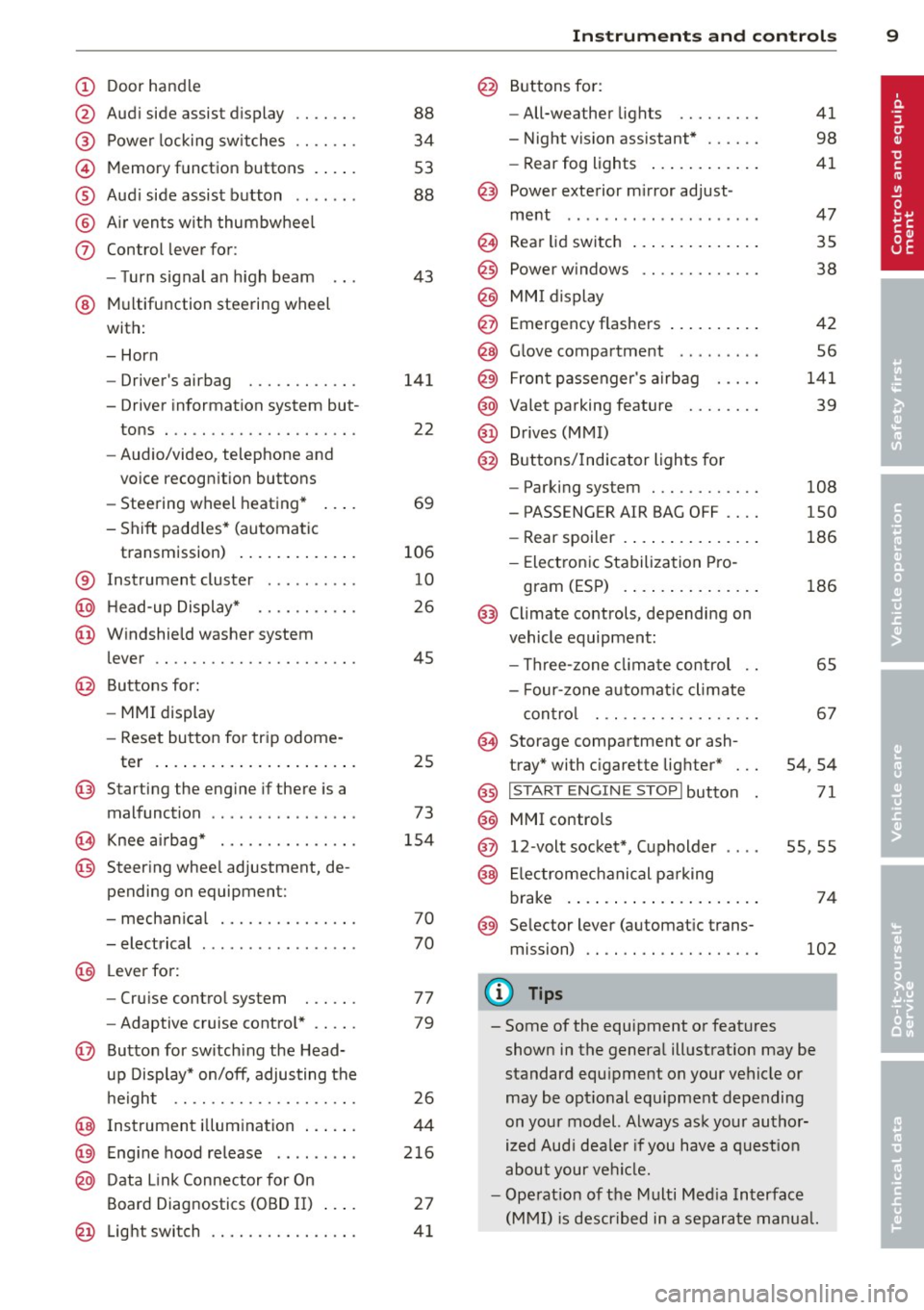
(!) Door handle
@
®
©
®
®
(j)
Audi side assist d isplay
Power locking sw itches
Memory function buttons . ... .
Aud i side assist button .. .. .. .
A ir vents with thumbwheel
Control lever for :
- T urn signal an h igh beam
@ Multifunction steering wheel
with:
- Horn
- Driver's airbag
- Driver information system but-
tons . .. ............. .... .
- Audio/video, telephone and
vo ice recogn ition buttons
- Steering wheel heating* ... .
- Shift padd les* (automatic
transmission) ..... ... .. .. .
® Instrument cluster ..... .. .. .
@ H ead-up Display* ...... .. .. .
@ Windshield washer system
lever .. .. ............. .... .
@ Buttons for:
-MMI display
- Reset button for trip odome -
ter .... .. ... ..... ... .. .. .
@ Starting the eng ine if there is a
malfunct ion ............ ... .
0 Knee airbag* .......... .... .
@ Steer ing whee l adjustment, de
pending on equipment:
- mecha nical .......... .... .
- electrical ............. ... .
@ Lever fo r:
- Cru ise contro l system
- Adaptive cruise contro l* .. .. .
@ Button for switch ing the Head
up Disp lay* on/off, adjusting the
h eight .. ............. .... .
@ Instrument i llumination ... .. .
@ Eng ine hood release ........ .
@ D ata Link Connector for On
Board Diagnostics (OBD II)
@ Lig ht swi tch ........... .... .
88
34
53
88
43
141
22
69
106
10
26
45
25
73
1 54
70
70
77
79
26
44
2 16
27
41
In strument s and control s 9
@ Buttons for :
- All-weather lights
- Night vision assistant* ..... .
- Rear fog lights .. .. .. ..... .
@ Power exterior m irror ad just -
ment .. .. .. .... .......... .
@ Rear lid switch ... . .. .. ..... .
@
@
@ Power w indows
MM I display
Emergency flashers
@ G love compartment . .. .. ... .
@ Fron t passenger's a irb ag .... .
@ Valet parking feature ....... .
@ Drives (MMI)
@ Buttons /Indicator lights for
- Parking system ........... .
- PASS ENG ER AIR BAG OFF ... .
- Rear spoiler .. .. . ... ...... .
- Elect ron ic Stabilization Pro-
gram (ESP) .... . .. .. ..... .
@ Climate controls, depending on
vehicle equipment:
- Three -zone clima te control ..
- Four-zone au tomat ic climate
con tro l ... .. ............ .
@ Storage compartment or ash-
tray* with c igarette lig hter* ...
@) I S TART ENGI NE STOPI button
@ MMI controls
@ 12-volt socket*, (upholder
@ Elec tromec hanical p arking
brake . ... .... ... .. .. ..... .
@ Selector lever (automat ic trans
mission)
(!) Tips
41
98
41
47
35
38
42
56
141
39
108
150
186
186
65
67
54 ,54
71
55,55
74
102
- Some of the equipment or features
shown in the genera l ill ustration may be
standard equ ipment on your vehicle or
may be opt ional equ ipment depending
on your model. Always ask your author
ized Aud i dea le r i f you have a quest io n
abou t your ve hicl e.
- Ope rat ion of t he Mu lti Med ia Interface
(M MI) is described in a separate manua l.
Page 78 of 294
76 On the road
Emergency braking
In the event that the conventional brake sys
tem fails or locks .
.,. In an emergency, pull the switch(®) and
continue to pull it to slow your vehicle down
with the parking brake .
... As soon as you release the sw itch <®> or ac-
cele rate , the braking process stops.
If you pull the switch <®> and hold it above a
speed of about 5 mph (8 km/h), the emergen
cy braking function is in itiated . The vehicle is
b raked at all four wheels by activating the hy
dra ulic bra ke system. The b ra ke performance
i s simi lar to making an emergency stop ¢
A.
In order not to activate the emergency brak
ing by mistake, an audible wa rning tone (b uz
z e r) sounds when the switch<®> is pulled. As
soon as the switch(®) is released, or the accel
erator pedal is depressed , emergency braking
stops .
&_ WARNING
Emergency braking shou ld only be used in
an emergency, when the normal foot brake
has failed or the brake pedal is obstructed.
Using the parking brake to perform emer
gency braking will slow you r vehicle down
as if you had made a fu ll brake application.
The laws of physics cannot be s uspended
even w ith ESP and its associated compo
nents (ABS, ASR, ED L). In corners and
when road or weather conditions are bad,
a full b rake application can cause the vehi
cle to skid or the rear end to break away -
r isking an accident.
Speed warning system
Introduction
The speed warning system helps you to stay
under a specified maximum speed.
The speed warning system warns you if you
are exceeding the max imum speed that you
have set . You w ill hear a warn ing tone when
your speed exceeds the stored va lue by ap- proximate
ly 3 mph (3 km/h) . An ind icator
light . (USA
models) ;a (Canada models) in
the instr ument cluster d isp lay also turns on at
the same time. The indicator light./.
turns off when the speed decreases be low the
stored maximum speed .
Setting a threshold is recommended if you
would like to be rem inded when you reach a
certain maximum speed. S ituations where you
may wa nt to do so include driv ing in a country
with a general speed limit or if there is a
specified maximum speed for winter tires .
(D Tips
Even though your vehicle is equipped w ith
a speed warn ing system, you should still
watch the speedometer to ma ke sure you
a re not dr iv ing faster than the speed limit.
Setting the threshold
You can set, change and delete the threshold
in the MMI.
.,. Select: !CAR ! function button> Car sy stems
cont rol button > Driver a ssist > Sp eed warn
ing .
You can set any threshold between 20 mph
(30 km/h) and 150 mph (240 km/h) . Sett ings
can each be adjusted in increments of 5 mph
(10 km/h).
Page 188 of 294

186 Intelligent technology
@ Tips
- ABS and ASR on ly work correctly when
all four wheels are equipped w ith identi
ca l tires. Different tire si zes can lead to a
reduct ion in engine power.
- You may hear noises when the systems described are working.
- If the indicato r light
DJ or m!l:?J (USA
models) ;fil (Canada models) appears,
there may be a malfunction¢
page 18,
¢ page 18.
Switching on and off
ESP turns on automa tic ally when you start
t he engine.
F ig . 16 1 Cen te r con sol e w it h ESP OF F but ton
Switching sport mode on
Press the I~ OF F I button c::> fig . 161 . The ac
tions taken by the ESP system to stabilize the
ve hicl e are lim ited. In vehicles with front
wheel dr ive, the anti -s lip reg ulation (ASR) is
lim ited . In vehicles with a ll-wheel drive, the
ASR is switched off. The
fl ESP indicator light
turns on and the message
C a ution! Limited
stabil ity ! ¢ A appears in the driver informa
tion system display.
The fo llowing examples are un usu al situa
tions wher e it may make sense to switch sport
mode on in order to a llow the whee ls to spin:
- Rocking the vehicle back and forth when it is
stuck
- Driv ing in deep s now or on loose ground
- Driving with s now cha ins
Switching sport mode off
Press the 1.$ O FF I button again. The I indica
tor light t urns off and the message
Stability
program on appears in the driver information
system display .
A WARNING
-
-Drive whee ls can spin and you can lose
control of the vehicle more easily when
ASR and ESP are in sport mode, especial
ly when the road is slippe ry .
- Sw itch to sport mode only whe n your
driving skills, traffic and weather condi
tions perm it.
@ Tips
- You cannot switch sport mode on when
adaptive cru ise contro l* is working .
-
- If the rear spoi ler system malfunct ions,
sport mode may not switc h on or it may
switch off agai n automatically .
Rear spoiler
The rear spoiler improves vehicle handling
and enhances driver control.
Fig . 162 Center co n so le: Sw it c h for rea r s poile r
The rea r spoi le r deploys and retracts. Spoiler
operation can be se t fo r automat ic or ma nual
operation.
Automatic mode (normal operation)
- Au tomatic deployment : At a speed of about
8 0 mph (130 km/h), the rea r spo ile r deploys
au tomatically.
- Automati c retr act ion: When speed drops be
low abou t 50 mph (80 km/h), the rear spoil-
er retracts a utomat ica lly. ..,.
Page 191 of 294

Electro-mechanical
power assist
The electro-mechanical power assist helps
the driver when steering .
Power steering adapts electronically based on
the vehicle speed .
Indicator lights and messages
• Steering defective! Stop the vehicle
If th is ind icat or light turns on and stays on
and this message appears, the power steering
may have failed.
Do
not continue driving. See you r authorized
Aud i dealer or other qualified repair fac ility
for assistance.
t :r- fl Steering: System malfunction! You may
continue driving
If the indicator lig ht turns on and the mes
sage appears, the steer ing may be more diffi
cult to
move or more sensitive than usual.
Drive slowly to your authorized Audi dealer or
qualified workshop to have the malfunction
corrected.
(D Tips
If the . or t:r- fl ind icator light only stays
on for a short time, you may continue driv
ing.
Driving with your
quattro ®
Appl ies to vehicles : wit h all- wheel d rive
With all-wheel drive, all four wheels are driv
en.
General information
With all-whee l dr ive, power is distributed to
all four wheels. This happens automatically
depending on your driving sty le and the road
conditions at the time . See also
c!.> page 184.
The all-wheel drive concept is designed fo r
high engine power. Your vehicle is exception
ally powerful and has exce llent driving charac-
Intelligent technology 189
teristics both under normal driving conditions
and on snow and ice. Always read and follow
safety precaut ions ¢&. .
Winter tires
When driving in the winter, your vehicle with
all-wheel drive has an advantage,
even with
regular tires. In winter road conditions it may
be advisable to mount winter tires (or all-sea
son tires) for improved driveability and brak
ing : these tires must be mounted on
all four
wheels.
See also ¢ page 246, Winter tires.
Tire chains
Where tire chains are mandatory on certain
roads, this normally also applies to vehicles
with all-wheel drive¢
page 247, Snow
chains.
Replacing wheels/tires
Vehicles with all-wheel drive must always
have tires of the same size. A lso avoid tires
with different tread depths . For detai ls see
page
c:> page 242, New tires and replacing
tires and wheels.
Off-Road driving?
You r Audi does not have enough ground clear
ance to be used as an off-road vehicle . It is
therefore best to avoid rough tracks and un
even terrain as much as possib le. Also refer to
c:> page 193.
A WARNING
Always adjust your driving to road and traf
fic conditions. Do not let the extra safety
afforded by all-wheel drive tempt you into
taking extra risks.
- Although the all-wheel drive is very ef
fective, always remember that braking
capacity is lim ited by tire traction. You
should therefore not drive at excessive
speeds on icy or slippe ry road surfaces.
- On wet road surfaces, be careful not to
drive too fast because the front wheels
could begin to slide on top of the water
(aquaplaning) . If this should occur, you
will have no warning from a sudden
•
•
Page 236 of 294
234 Tires and wheels
Tread
means that portion of a tire that comes into
contact with the road.
Tread separation
means pull ing away of the tread from the tire
carcass .
Treadwear indicators (TWI)
means the projections within the principal
grooves designed to give a visual ind ication of
the degrees of wear of the tread . See
~ page 241, Tread Wear Indicator (TWI) for
more informat ion on measuring tire wear.
Uniform Tire Quality Grading
is a tire information system developed by the
United States Nat ional Highway Traffic Safety
Administration (NH TSA) that is designed to
help buyers make relative comparisons among
tires. The UTQG is not a safety rating and not a
guarantee that a tir e will last fo r a prescribed
number of miles (kilometers) or perform in a
certain way. It simply gives tire buyers addi
tional information to combine with other con
siderat ions, such as price, brand loyalty and
dealer recommendations. Under UTQG, tires
are graded by the tire manufacturers in three
areas: treadwear, tract ion, and temperature
res istance. The UTQG information on the tires,
mo lded into the sidewalls.
U.S. DOT Tire Identification Number (TIN)
This is the tire's "serial number". It begins
with the letters "DOT" and indicates that the ti
re meets a ll federal standards. The next two
numbers or letters indicate the plant where it
was manufactured, and the last four numbers
represent the week and year of manufacture.
For example,
DOT . .. 2211 ...
means that the tire was produced in the 22nd
week of 2011. The other numbers are market
ing codes that may or may not be used by the
tire manufacturer . This information is used to
contact consumers if a tire defect requires a
recall.
Vehicle capacity weight
means the rated cargo and luggage load plus
150 lbs. (68 kilograms) times the vehicle's to
ta l seating capacity as listed on the label lo
cated on the driver's side B-pillar.
Vehicle maximum load on the tire
means that load on an individua l tire that is
determined by distributing to each axle its
share of the maximum loaded vehicle weight
and dividing by two.
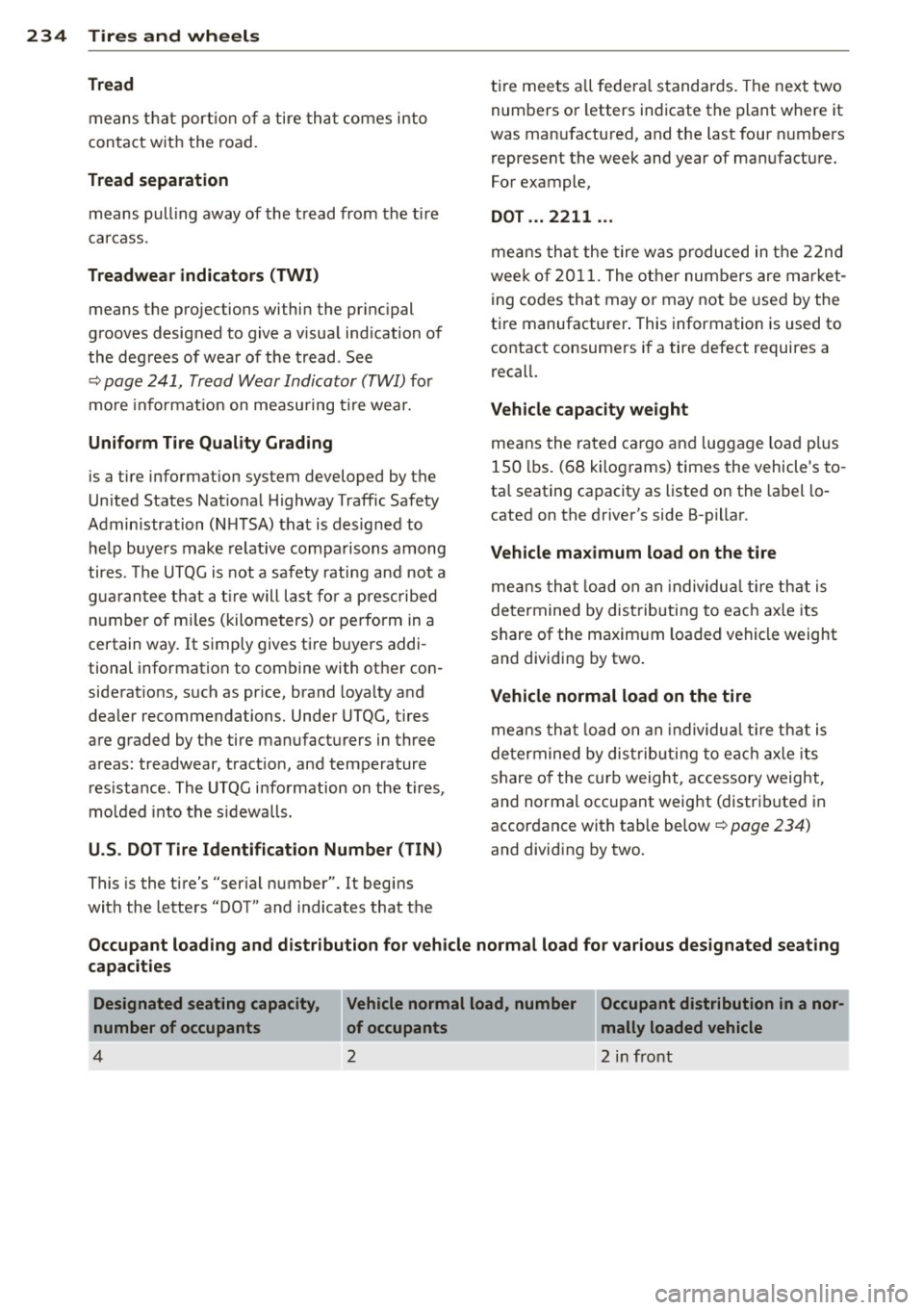
Vehicle normal load on the tire
means that load on an individua l tire that is
determined by distributing to eac h axle its
share of the curb weight , accessory weight,
and normal occupant weight (distributed in
accordance with tab le below ~
page 234)
and dividing by two.
Occupant loading and distribution for vehicle normal load for various designated seating
capacities
Designated seating capacity,
number of occupants
4
Vehicle normal load, number Occupant distribution in a nor-
of occupants _____ malty loaded vehicle
2 2 in front
Page 243 of 294

Tire service life
The service life of tires depends on a lot of
different things including proper installation
and balancing, correct tire pressure and driv
ing style.
F ig. 178 Tire tread: tread wea r ind ica tors (TWI)
Fi g. 179 Rotat ing t ires fo r m ore even wea r
Tread Wear Indicator (TWI)
The origina l tires on your veh icle have
1/16 in ch (1.6 mm) high "wear ind icators"
r::!;> fig . 178 run ning across the tread. Depend
ing on the make, there will be six to eight of
them evenly p laced around the t ire . Marks on
the t ire s idewall (for example "TWI" or other
symbols) indicate the positions of the tread
wear ind icators . Worn t ires must be replaced.
Different fig ures may apply in other countries
r::!) & .
Tir e pressure
Incorrect tire pressure causes premat ure wear
and can cause sudden tire blow-out . For th is
reason, tire pressure must be checked at least
once a month
r::!;> page 23 7.
Dri ving sty le
Driving fast around curves , heavy acceleration
and hard braking increase tire wear. Tires and wheels 241
Rotating tires for more even wear
For all four tires on your ve
hicl e to have the
same service life, we recomme nd that the
front and rear tires are rotated according to
the tire manufacturer 's suggested tire rota
tion inte rvals. Please remember the follow
ing :
- Tire rotation intervals may differ from the
veh icle service inte rva ls o utlined in your
Warranty & Maintenance booklet.
- The longer one tire is used in one location
on the vehicle, the more it wears at certain
points ; therefore, we recommend that you
follow the tire manufactu rer 's suggested
tire rotation intervals .
- Vehicles w ith front-wheel dr ive exper ience
more tread wear on the front wheels com
pared to all -wheel d rive (quattro ®).
- Please rotate tires as shown
r::!;> fig. 179.
-Extra care must be taken when rotat ing di-
rection-specific tires
r::!;> page 258 .
Wheel balancing
The wheels on new veh icles are balanced .
However, various situations during everyday
driving can cause them to become unba l
anced, resulting in vibrat ions you can usually
feel through the steer ing wheel.
Unbalanced wheels must be rebalanced to
avoid excessive wear on steering, s uspension
and t ires. A whee l must also be reba lanced
when a new tire is insta lled.
Inco rrect wheel alignment
Incorrect wheel alignment can cause exces
sive tire wear, impair ing the safety of the vehi
cle . If tires show excessive wear, have the
whee l alignment checked by an authori zed
Audi dealer or qualified workshop.
All-whe el drive
Vehicles wi th quattro ® mus t always have tires
of the same size, construction and tread type. For details see
r::!;> page 189.
Page 247 of 294

Driving with different tires reduces vehi
cle handling and can lead to a loss of
control.
- If the spare tire is not the same as the
tires that are mounted on the vehicle -
for example with winter tires -only use
the spare tire for a short period of time
and drive with extra care. Refit the nor
mal road wheel as soon as safely possi
ble.
- Never drive faster than the maximum
speed for which the tires on your vehicle
are rated because tires that are driven
faster than their rated speed can fail
suddenly.
- Overloading tires cause heat build-up,
sudden tire failure, including a blowout
and sudden deflation and loss of control.
- Temperature grades apply to tires that
are properly inflated and not over or un
deri nflated.
- For technical reasons it is not always
possible to use wheels from other vehi
des -in some cases not even wheels
from the same vehicle model.
- If you install wheel trim discs on the ve
hicle wheels, make sure that the air flow
to the brakes is not blocked. Reduced air
flow to the brakes can them to overheat, increasing stopping distances and caus
ing a collision.
- Run flat tires may only be used on vehi
cles that were equipped with them at the
factory. The vehicle must have a chassis designed for run flat tires . Incorrect use
of run flat tires can lead to vehicle dam
age or accidents. Check with an author
ized Audi dealer or tire specialist to see if
your vehicle can be equipped with run flat tires. If run flat tires are used, they
must be installed on all four wheels. Mix
ing tire types is not permitted.
- For technical reasons, it is not generally
possible to use the wheel rims from oth
er vehicles. This can hold true for wheels
of the same vehicle type.
Tires and wheels 245
- If the spare tire is different from the
tires that you have mounted on your ve
hicle (for example winter tires or wide
profile tires), then use the spare tire for a
short period of time only and drive with
extra care. Replace the flat tire with the
tire matching the others on your vehicle
as soon as possible .
- Never drive without the valve stem cap .
The valves could get damaged.
@) For the sake of the environment
Dispose of old tires in accordance with the
local requirements.
' Uniform tire quality grading
-Tread wear
- Traction AA A B C
- Temperature ABC
Quality grades can be found where applicable
on the tire side wall between tread shoulder
and maximum section width
c:> page 242,
fig. 180.
For example: Tread wear 200, Traction AA,
Temperature A.
All passenger car tires must conform to Feder
al Safety Requirements in addition to these
grades.
Tread wear
The tread wear grade is a comparative rating
based on the wear rate of the tire when tested
under controlled conditions on a specified
government test course.
For example, a tire graded 1S0 would wear
one and one half (11/2) times as well on the
government course as a tire graded 100.
The relative performance of tires depends
upon the actual conditions of their use, how
ever, and may depart significantly from the
norm due to variations in driving habits, serv
ice practices and differences in road character-
istics and climate. .,.. •
•
Page 248 of 294
24 6 T ire s and whee ls
Tra ction
The traction grades, from highest to lowest,
are AA, A, Band
C. T hose grades represent the
tire's ability to stop on wet pavement as measured under controlled conditions on
specified government test surfaces of asphalt
and concrete. A tire marked C may have poor
traction performance
c:> .&. .
Te mp eratu re
The temperature grades are A (the highest),
B, and
C, representing the t ire's resistance to
the generation of heat and its ability to dissi
pate heat when tested under con trolled condi
tions on a specified i ndoor laboratory test
wheel.
Sustained high temperature can cause the
material of the tire to degenerate and reduce
tire life, and excessive temperature can lead
to sudden tire failure
c:> ,& .
The grade C corresponds to a level of perform
ance which all passenger car tires must meet under the Federal Motor Veh icle Safety Stand
ard No .
109 . Grades Band A represent h igher
l eve ls of performance on the laboratory test
wheel than the m inimum required by law.
.&_ WARNING
T he traction grade assigned to this t ire is
based on straight-ahead braking traction
tests, and does not include acceleration,
cornering, hydrop laning o r peak traction
characteristics.
A WARNING
The temperature grade for this tire is es
tablished for a t ire that is properly inflated
and not overloaded. Excessive speed, un
derinflation, or excessive loading, either
separately or in combination, can cause
heat buildup and possible tire fa ilu re.
-
Winter tires
Winter tires can improve vehicle handling on
snow and ice . At temperatures below 45 °F
(7 °C) we recommend changing to winter
tires.
In some heavy snow areas, local governments
may require true w inter o r "snow" t ires, those
with very deeply cut tread . T hese tires should
o n ly be used in pairs and be installed on a ll
f o ur wheels . Make sure you purchase snow
ti res that are the same size and construction
type as the othe r tires on yo ur vehicle.
If your vehicle is equ ipped w ith all-whee l
drive*, t his w ill improve traction during win ter
driv ing, even with the standard tires . Howev
er, we strongly recommend that you always
equip all four wheels on your vehicle w ith cor
rect ly fitted winter tires or all-season t ires,
when winter road condit ions are expected.
This also improves the veh icle 's brak ing per
formance and reduces stopping d istances .
Summer tires provide less grip on ice and
snow.
Winter tires (snow tires) must always be fitted on all fo ur whee ls .
Ask your au thorized A udi dealer or qualified
workshop for permit ted
winter ti re size s. Use
only radial winter tires .
Winter tires lose their effec tivenes s whe n the
tread is wo rn down to a depth o f
0.157 inch
(4 mm) .
Only d rive w ith w inter t ires under w inte r co n
ditions. S umme r tir es handle bette r whe n
there is no snow o r ice on the roads and the
temperature is above 45 °F (7 °C) .
If you have a flat ti re, see notes on spare
whee l
c:> page 242 .
Please always remember that winter tires may
have a lowe r speed rating than the tires o rigi
nally i nstalled on your vehi cle at the time it
was ma nufactu red. P lease see
c:> page 243,
Speed rating (Letter code)
for a lis ting o f the
speed rating lette r codes and the max imum
speed at which the tires can be driven . ..,.
Page 252 of 294

250 Tires and wheels
When the malfunction indicator is illuminat
ed, the system may not be able to detect or
signal low tire pressure as intended . TPMS
malfunctions may occur for a variety of rea
sons, including the installation of replace ment or alternate tires or wheels on the vehi
cle that prevent the TPMS from funct ioning
properly . Always check the TPMS malfunction
telltale after replacing one or more t ires or
wheels on your veh icle to ensure that the re
p lacement or a lternate tires and wheels allow
the TPMS to continue to function properly.
Tire pressure indicator appears
Applies to vehicles: with tire p ressure mo nitoring syste m
The tire pressure indicator in the instrument
cluster informs you if the tire pressure is too
low or if there is a system malfunction.
Fig. 181 Display : underinflatio n warning
Fig. 182 Display : Syste m mal functio n
Using the ABS sensors, the tire pressure moni
toring system compares the tire tread circum
ference and vibration characteristics of the in
d ividual tires.
If the pressure decreases in one
or more tires, th is is indicated in the instru
ment cluster with a warning symbol
'9] and a
message ¢
fig . 181.
The tire pressure monitoring system must be
reset via MMI each time the pressures are ad- justed
(e.g. when switching between partial
and full load pressure) or after changing or re
placing a tire on your vehicle ¢
page 251. You
can find the recommended tire pressures for
your vehicle on the label on driver 's side B-pil
lar ¢
page 235 .
Tire tread circumference and vibration charac
teristics can change and cause a tire pressure
warning if:
- the tire pressure in one or more tires is too
low,
- the tire has structural damage,
- the tire pressure was changed, wheels rotat -
ed or replaced but the TPMS was not reset
¢page 251.
Warning symbols
'9] Loss of pressu re in at least one tir e ¢ & .
Check the tire or tires and replace or repa ir if
necessary. The indicator light
'9] in the instru
ment cluster also illuminates
¢page 11.
Check/correct the pressures of all four tires
and reset TPMS via MMI.
••MIS, ( Ti re Pressure Monitoring System) Tire
pressure! System malfunction .
If IIMIS, appears after switching the ignition
on or while driving¢
fig. 182 and the indica
tor light
'9] in the instrument cluster blinks
f or approximately one minute and then stays
on, there is a system malfunction . See your
authorized Audi dea ler as soon as possible .
A WARNING
--If the tire pressure indicator appears in
the instrument cluster display, one or more of your tires is significant ly under
inflated. Reduce you r speed immediately
and avoid any hard steer ing or braking
maneuvers. Stop as soon as possible and
check the tires and their pressures. In
flate the tire pressure to the proper pres
sure as indicated on the vehicle's tire
pressure label¢
page 235. Driving on a
significantly under- inflated tire causes
the tire to overheat and can lead to tire
failure. Under-inflation also is likely to