service AUDI A7 2013 Owner's Manual
[x] Cancel search | Manufacturer: AUDI, Model Year: 2013, Model line: A7, Model: AUDI A7 2013Pages: 310, PDF Size: 77.45 MB
Page 242 of 310
24 0 Ch eck ing and filling
The location of the brake fluid reservo ir can be
seen in the engine compartment illustration
¢ page 232.
The fl uid level may drop slightly after some
time due to the automatic adjustment of the
brake pads. This is not cause for alarm.
I f the brake fluid level falls
considerably be
low the "MIN" mark, the brake warning/ind i
cator light
1111 (U .S . models)/ . (Canadian
models) will come on¢
page 15. Do not con
tinue to operate the vehicle. The comp lete
brake system shou ld be thoroughly checked
by an au thorized Audi dealer or other quali
fied facility and the cause corrected . If the
brake fluid level is too low, the brake warn ing/
indicator light w ill illuminate . Contact an au
thor ized Audi dealer
imm ediatel y.
Changing brake fluid
Have the brake fluid changed by an experi
enced technician .
Brake fluid absorbs moisture from the a ir . If
the water content in the brake fluid is too
h igh , corros ion in the brake system may result
after a per iod of t ime . The bo iling po int of the
brake fluid w ill also decrease considerably and
dec rease braking performance.
Therefore, the brake flu id must be changed
ev ery two year s. Always use new b rake fluid
which conforms to Fede ral Motor Vehicle
Standard "FMVSS
116 DO T 4".
The brake flu id reservoir can be difficult to
r each, therefo re , we recommend that you
have the brake fl uid changed by yo ur author
ized
Audi d ealer. Your dea ler has the correct
too ls, the right brake fluid and the know -how
to do this for you .
A WARNING
-Brake fluid is poisonous . It must be stor
ed only in the closed orig inal container
out of the reach of children!
- Brake fa ilure can result from old or inap
propriate brake fluid. Observe these pre
caut ions: -
Use only brake fluid that meets SAE
specification
J 1703 and conforms to
Federa l Motor Vehicle Standard
116.
Always check with your authorized Audi
dealer to make sure you are using the
correct brake fluid . The correct type of
brake f lu id is also ind icated on the
brake flu id reservoir.
- T he brake fluid must be new. Heavy use
of the bra kes ca n cause a vapo r lock if
the b rake fluid is left in the system too
l ong . This can seriously affect the effi
c iency of the brakes as well as your
safety. This co uld resu lt in an accident.
(D Note
Bra ke fluid will damage the paint of you r
vehicle .
(® For the sake of the environment
Because of the p rob lem of p roper disposal
of b ra ke fluid as well as the spec ial too ls
r equired and the necessary expertise, we
re commend that you have the brake fluid
changed by yo ur authorized Aud i dea ler.
Battery
General information
U nder normal ope rat ing cond itions , the bat
tery in yo ur Audi does not need any ma inte
nance. With
high o utside tempe ra tu res or
l ong daily drives we recommend that you have
the e lectrolyte level checked by a service fa
cility. The electrolyte leve l should a lso be
checked each t ime the battery is charged
<=> page 243.
Have th e battery checked when yo u take your
veh icle in for service. You are well advised to
replace a battery that is o lder than S years .
With certain types of airbag deployment, the battery is disconnected from the veh icle elec
trical system for safety reasons<=>.&
in Re
pair , care and dispo sal of the airbags on
page
165.
Page 256 of 310
254 Tire s and wheel s
-The use of incorrect tire pressure values
can lead t o acci dents or other damage .
T herefore it is essential that t he driv er
o bserve the specified tire pressure values
for the ti res and the correct pressu res for
the f unct ion of the tire pressure mon itor
ing system*.
- Always inflate tires to the recommended
and co rrect tire pressure befo re d riving
off.
- Driv ing with under inflated ti res bend
more, lett ing them get too hot resu lting
in t read separation, sudden t ire fa il u re
and loss o f control.
- E xcess ive speed and/ove rloading can
c ause heat bui ld-up, sudden t ire fail ure
and loss o f control.
- If the t ire p ress ure is too low or too high,
the tires w ill wear prematu rely and the
vehicle will not hand le we ll.
- If the t ire is no t flat and you do no t have
to change a wheel immed iate ly, drive at
reduced speed to the nearest service sta
t ion to check t he tire pressure and add
air as required.
(D Note
Dr iving w ithou t va lve s tem caps can cause
damage to the tire va lves. To prevent this,
always make sure that facto ry installed
valve stem caps on all wheels are secure ly
mounted on the valve.
@ For the sake of the environment
Unde rinflated tires will a lso increase the
fue l cons umption.
Tires and vehicle load limits
There are limits to the amount of load or
weight that any vehicle and any t ire ca n car ry .
A vehicle that is overloaded w ill not handle
well and is more difficult to stop . Over load ing
can no t on ly lead to loss of veh icle contro l,
b ut can also damage impor tan t par ts of the
vehi cle and can lead to s udden tire failure, in
cluding a blowout and sudden deflation that
can cause the veh icle to crash. Your safety and that of your passengers also
depends on making sure that load limits are
not exceeded . Vehicle load includes everybody
and everything in and on the veh icle. These
load lim its are technically referred to as the
vehicle's
Gro ss Vehicle Weight Rating
("GVWR").
The "GVWR" includes t he weight of the basic
vehicle, a ll factory installed accessories, a full
tank of fuel, o il, coolant and other fluids plus
maximum load. The max imum load incl udes
the number of passengers that the vehicle is
i ntended to car ry ("seat ing capac ity") with an
ass umed we igh t of 150 lbs (68 kg) for e ach
passenge r at a designated seating posi tion
and the total weight of any luggage in the ve
hicle . If you tow a trai ler, the weight of the
trai ler hitch and the tongue weight of the
loaded tra iler must be included as part of the
vehicle load.
The
Gros s Axle Weight R ating ("GAWR") is
the maximum load that can be applied at each of the vehicle's two axles.
The Gross Vehicle Weight Rat ing and the
Gross Ax le Weight Rating are listed on the
safety comp liance sticker label located on the
driver's side B-pillar . Your Audi has 4 seat ing
pos itions, 2 in the front and 2 in the rear for
total seating capacity of 4 . In some vehicles
the re a re 5 seating pos it ions, 2 in the front
and 3 in the rear for tota l seating capacity of
5. Each seat ing position has a safety belt
¢ page 140, Safety belts .
T he fact that there is a n upper limit to yo ur
vehicle's G ross Vehicle Weight Rating means
t h at the total weig ht of whatever is bei ng car
ried in the vehicle ( in cl udi ng the weight of a
trai ler hi tch and the tongue weight of the
l oaded trai le r) is limited . The more passen
gers in the vehicle or passengers who are
heavier than the standard we ights assumed
mean that less we ight can be carried as lug
gage.
T he tire pressure label on your Audi also lists
the maximum combined weight of a ll of the
occupants and luggage or other cargo that .,..
Page 258 of 310
256 Tires and wheels
6. If your vehicle will be towing
a trailer, load from your trail
er will be transferred to your
vehi cle. Consult thi s manual
to determine how this re
duces the available car go
and luggage lo ad capacity of
yo ur vehicle .
.,. Check the tire sidewall
(9 fig . 200 ) to de termine the
de signated load rating for a
s pe cifi c tir e.
Tire service life
The s ervi ce life of tires dep ends on a lot of
different things including proper installation
and balancing, correc t tire pressu re and driv
ing style.
Fig. 198 Tire tread: tread wea r ind icators ( TWI)
Fi g. 1 99 Rotat ing t ires fo r m ore eve n wear
Tread W ear Indicator (TWI)
The o rigi na l t ires on your ve hicle have
1/16 inch (1.6 mm) high "wear indicators" ¢
fig. 198 r
u nning across the tread. Depend
ing on the make, t here will be six to eight of
them even ly placed aro und the tire. Marks on
the tire sidewall (for examp le "TWI" or other
symbols) ind icate the positions of the tread
wear indicato rs . Wor n tires must be rep laced.
D iffere nt f igures may apply in othe r countr ies
Q ,&. .
Tire pressure
Incorrect t ire pressure ca uses premature wear
and can cause sudde n tire blow-out. For this
reason, tire pressure must be checked at least
o nce a month ¢
page 2 52.
Driving style
Driving fast around c urves, heavy acce lerat ion
and hard braking increase tire wear .
Rotating tires for more even wear
Fo r all four tires on your ve hicle to have the
same service life, we recommend that the
front and rear t ires a re rotated according to
the tire manu fact urer's suggested tire rota
tion intervals. Please remember the follow
ing :
- Tire rotation intervals may differ from t he
veh icle service interva ls outlined in your
Warranty
& M aintenance booklet.
- The longer one tire is used in one location
o n t he vehicle, the more it wears at certain
points; theref ore, we recommend t hat y ou
follow the tire manufacturer's suggested
tire rotation int ervals .
- Veh icles w ith front-wheel dr ive experience
more tread wear on the fro nt wheels com
pa red to a ll-wheel drive ( quattro ®).
- Please rotate tires as shown¢
fig. 199.
- Extra care must be taken when rotating di-
rection-specific tires ¢
page 274.
Wheel balancing
The wheels on new ve hicles are balance d.
Howeve r, various s ituations during everyday
dr iv ing can cause them to become unba l
anced, resulti ng in vibrations you can usually
feel th rough the steer ing wheel.
liJJ,-
Page 276 of 310
274 What do I do now? Tires with unidirectional tread design
Tires with unidirectional tread design must be
mounted with their tread pattern pointed in the right direction .
Using a spare tire w ith a tread pattern
intended for use in a specific direction
When using a spa re tire w ith a t read patte rn
i n tended fo r use in a specific direction, please
note t he followi ng:
- The direction of rotation is marked by a n ar
r ow on the side of the tire.
- If the spare t ire has to be installed in the in
correct direction, use the spare tire only
tempora rily si nce the t ire will not be a ble to
achi eve its optimum perfo rm anc e cha racter
i st ics w ith reg ard t o aqu aplani ng, noise and
we ar.
- W e reco mmend t hat you pay pa rticular at
te nti on t o this fact d uring wet we ather and
t h at you a dju st yo ur spee d to m atc h ro ad
con ditions.
- R epl ace the fla t tire w ith a n ew one an d
have it ins talled o n your ve hicle as soon as
p oss ible to restore the handlin g ad vantages
of a uni direct io na l tire .
Notes on wheel changing
Please rea d the informati on c> page 257 , New
t ires and replacing tires and wheels
if you are
go ing t o u se a spare tire which is d ifferent
from the tires on your ve hicle.
Afte r you chan ge a t ire :
-Check the tire pressure on the spare imme
diately after installation.
- Have the wheel bolt tightening torque
checked with a torque wrench as soon as possible by your authorized Audi dealer or
a qualified service station.
- With steel and alloy wheel rims , the wheel
bolts are correctly tightened at a torque of
90 ft lb (120 Nm ).
- If you notice that the wheel bolts are cor
roded and difficult to turn while changing
a tire, they should be replaced before you
check the tightening torque . -
Replace the flat tire with a new one and
have it installed on your vehicle as soon as
possible. Remount the wheel cover .
Until then , drive with extra care and at re
duced speeds.
A WARNING
-
- If you are going to e quip your ve hicl e
with tires or rims which differ from those
which were facto ry installed, then be
sure to rea d the informati on
9 page 257,
New tir es and replacing tires and
w he els .
- Always ma ke sure the damag ed wheel o r
even a flat tire and the jack a nd tool ki t
ar e prop erly s ecu red in the luggage co m
p artm ent and are not lo ose in the pas
s e ng er c ompa rtm ent .
- I n an acci dent or sudd en man euve r they
could fly forwa rd, inju ring anyon e in the
v eh icle.
- Always store d amag ed wh eel, jack and
too ls secur ely in the lugg age c ompart
ment. Otherwi se, in an accident or su d
de n maneuve r they co uld fly forw ard,
causing inj ury to passe ngers i n the ve hi
cle.
Page 282 of 310
280 Emergency situations
@ Tips
The discharged battery must be properly
connected to the vehicle's electrical sys
tem. When jump starting or charging the
battery, never connect the negative
ground cable to the battery negative post
because the batte ry manager system must
be able to detect the battery 's state of
charge. Always connect the negative
ground cab le to the negative ground post
of the battery manager control unit.
Use of jumper cables
Make sure to connect the jumper cable
clamps in exactly the order described below!
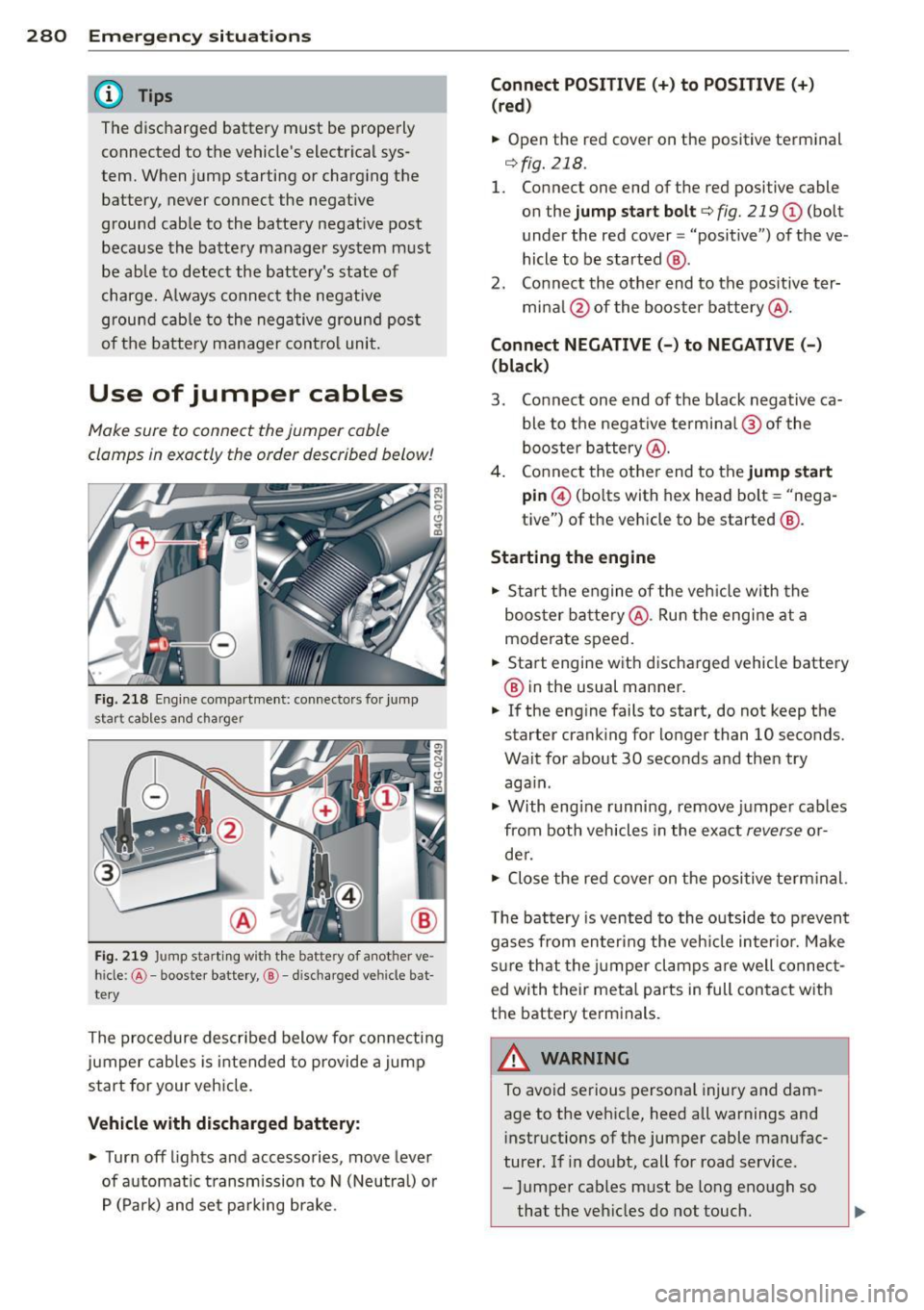
Fig. 218 Engine compartment: connecto rs for jump
start cables and charger
Fig. 219 Jump start ing with the battery of another ve·
hide: @-booster battery, @-discharged ve hicle bat
tery
The procedure described below fo r connecting
jumper cables is intended to provide a jump
start for your vehicle.
Vehicle with discharged battery:
.,. Turn off lights and accessories, move lever
of automatic transmission to N (Neutral) or
P (Park) and set parking brake.
Connect POSITIVE(+) to POSITIVE(+)
(red)
.,. Open the red cover on the positive terminal
¢fig. 218.
1. Connect one end of the red positive cable
on the
jump start bolt c::;, fig. 219 @ (bolt
under the red cover = "positive") of the ve
hicle to be started @.
2. Connect the other end to the positive ter-
mina l@ of the booster battery@.
Connect NEGATIVE (-) to NEGATIVE (-)
(black)
3. Connect one end of the black negative ca
ble to the negat ive terminal @ of the
booster battery @.
4. Connect the other end to the
jump start
pin © (bolts with hex head bolt= "nega
tive") of the vehicle to be started @.
Starting the engine
.,. Start the engine of the veh icle with the
booster battery@. Run the engine at a
moderate speed .
.,. Start engine with d ischarged vehicle battery
@ in the usual manner.
.,. If the engine fails to start, do not keep the
starter cranking for longer than 10 seconds.
Wait for about 30 seconds and then try aga in .
.,. With eng ine running,
remove jumper cables
from both vehicles in the exact
reverse o r
de r .
.,. Close the red cover on the positive term inal.
T he battery is vented to the outside to prevent
gases from entering the veh icle inter ior. Make
sure that the jumper clamps are well connect
ed with their metal parts in full contact with
the battery terminals.
_& WARNING
To avoid serious personal injury and dam
age to the vehicle, heed all warnings and
instructions of the jumper cable manufac
turer. If in doubt, call for road service .
- Jumper cables must be long enough so
that the veh icles do not touch.
-
Page 291 of 310
Consumer Information
Warranty coverages
Your Audi is covered by the following war
ranties :
- New Vehicle Limited Warranty
- Limited Warranty Against Corrosion Perfo-
ration
- Emissions Control System Warranty
- Emissions Performance Warranty
- California Emissions Con trol Warranty (USA
vehicles only)
- California Emissions Performance Warranty
(USA vehicles only)
Detailed information regarding your warran
ties can be found in your
Warranty & Mainte
nance booklet .
Operating your vehicle
outside the U.S.A. or
Canada
Government regulations in the United States
and Canada require that automobiles meet
specific emission regulations and safety
standards. Therefore, veh icles built for the
U.S.A. and Canada differ from vehicles sold in
other countries .
If you p lan to take your vehicle outside the
continental limits of the United States or Can
ada, there is the possibility that:
- unleaded fuels for vehicles with cata lytic
converter may not be available;
- fuel may have a considerably lower octane
rating . Improper fuel may cause engine
damage ;
- service may be inadequate due to lack of
proper service facilities, tools or testing
equipment ;
- replacement parts may not be readily availa
ble.
- Navigation systems for vehicles built for the
U.S.A. and Canada will not necessari ly work
in Europe, and may not work in other coun
tries outside North America .
Consumer Information 289
@ Note
Audi cannot be responsible for mechanical
damage that could result from inadequate
fuel, service or parts availab ility.
Audi Service Repair
Manuals and Literature
Audi Offic ial Factory Service Manuals and Lit
erature are published as soon as possible after
model introduction. Service manuals and lit
erat ure are available to order from the Audi
T echnical Literature Ordering Center at:
www.audi.techliterature.com
Maintenance
' General
Your vehicle has been designed to help keep
maintenance requirements to a minimum.
However, a certain amount of regular mainte
nance is still necessary to assure your vehicle's
safety, economy and reliability . For detailed
vehicle maintenance consult your Warranty
&
Maintenance booklet.
Under difficult operating conditions , for ex
ample at extremely low outside temperatures ,
in very dusty regions, when towing a tra iler
very frequently, etc., some serv ice work
shou ld be pe rformed between the intervals
specified. This applies particularly to:
- oil changes, and
- cleaning or replacing the air filter .
® For the sake of the environment
By regularly maintaining your vehicle, you
help make sure that emission standards
are maintained, thus min imizi ng adverse
effects on the environment .
Important considerations for you and
your vehicle
The increasing use of electronics , sophisticat
ed fuel injection and emission contro l sys-
tems, and the genera lly increasing technica l ..,_
•
•
Page 305 of 310

for using safety belts ..... ... .. .. .. . 143
Mo nitoring the Advanced Airbag Sys-
tem ... .. .. .. ... ....... ... .. .. .. . 164
Safety systems Warn ing/ indica to r li ghts ... .. .. .. .. .. 19
Seat adjustment Controls . . . . . . . . . . . . . . . . . . . . . . . . . . 53
Dr iver's seat ............. .... .. .. .. 52
F ront passenger's seat . . . . . . . . . . . . . . . 53
Fr ont sea ts . . . . . . . . . . . . . . . . . . . . . . . . 52
H ead rest raints . . . . . . . . . . . . . . . 55, 134
Safety guide lines . ..... ... .. .. .. .. .. 52
Seat belts Why YOU MUST wear them . .. .. .. .. . 140
Seat heating/venti lation (automatic cli-
mate control) . . . . . . . . . . . . . . . . . . . . . . . 72
Seat heating (climate control) . . . . . . . . . . 70
Seating position Driver . .. .. .... ........... .. .. ... 13 1
Fr ont passenger ....... ... .. .. .. .. . 132
How to adjus t the front seats . . . . . . . . 132
Incorrect seat position .. ... .. .. .. .. . 134
Occupants .. ............. .... .. .. . 131
Rear passengers .......... .... .. ... 133
Seat memo ry . . . . . . . . . . . . . . . . . . . . . . . 56
Seats Comfort seat side view .. ..... .... ... 57
S eat symmetry ........... .... .. .. .. 57
Seats (number) . . . . . . . . . . . . . . . . . . . . . 140
Select ive unlock feat ure .. ... .. .. .. .. .. 35
Selector leve r . . . . . . . . . . . . . . . . . . . . . . 109
Selector lever emergency release
115
Service and disposal Safety belt pre tens ioner ... .. .. .. .. . 14 7
Service interval disp lay . . . . . . . . . . . . . . . . 28
Shift buttons ..... .. .... ... .. .. .. ... 113
Ship (t ransporti ng your ve hicle) . .. .. .. . 283
Side airbags Descr ipt ion .... ........... ... ... .. 169
H owtheywork .................... 170
side assist . . . . . . . . . . . . . . . . . . . . . . . . . . 98
Ad justing the brightness ... .. .. .. .. . 100
Sensor range ............ .... .. .. .. 99
Side assist Activating and deactivating ... .. .. .. . 100
C lea ning sensors . ..... ... .. .. .. .. . 216
Inde x 303
Side curtain airbags . . . . . . . . . . . . . . . . . 172
Description . ... .... . ... ...... ... .. 172
How they wor k . . . . . . . . . . . . . . . . . . . . 173
Safety instr uctions ................. 173
S ide mar ker lights . ............. .... . 43
Ski sack ...... .. .... .......... ...... 66
also refer to Trunk pass-through ...... 67
Slid ing/tilting s unroof
Emergency clos ing .. ........... .... . 42
Open ing and closing ........... .. .. . 42
Snow chains . ..... .. . .. .. ..... ... .. 262
Socket ........ ... .. ..... ........... 58
Sources of information abo ut child re-
stra ints and their use ................ 193
Space -saving spare tire . .. ..... ... .. .. 268
Spare tire ......... .. ..... .......... 268
Speed limiter . .. .. ................. . 30
Speedometer . . . . . . . . . . . . . . . . . . . . . . . 27
Speed rat ing letter code ............. . 258
Speed warning system . .. ..... ... .. .. . 83
Sport d iffe rential .. ............. .. .. 102
Ind icator light . .. .. .. ........... .. . 23
Star button . .. .. .. ............... .. . 25
Start -S top -System .... .. ..... ... .. .. . 80
Engine does not switched off . ... .. .. . 82
Engine starts a utomat ica lly ..... .. .. . 82
Ind icator lights .. ................. . 81
Messages . .. .. .. ................. . 83
Starting/stopp ing the engine ......... 81
switching off/on .. .. . .. .. .. ... ... .. . 82
S TAR T ENGIN E STOP button ...... .. .. . 75
Star ting from res t . . . . . . . . . . . . . . . . . . . . 79
Starting off w ith a trailer . .. .. ... ... .. . 80
Starting the engine . .. .. ..... ... .. .. . 75
Steering El ectr ica lly adjus table stee ring wheel . . 74
M anu ally adjus table steering wheel . .. . 74
also refer to E lectro -mechan ica l powe r
ass ist . ... .. .... ... .. .. ..... ... .. 201
Steering wheel Easy entry fea ture ................. . 75
Ind icator lig ht . .. ................. . 18
Steering wheel heat ing . ..... ... .. .. . 73
Steering wheel column Adjusting electrically . . . . . . . . . . . . . . . . 7 4
Adjus ting manu ally ............ .. .. . 74
•
•
Page 306 of 310
304 Index
Steering whee l w ith tip tronic ... .. .... . 1 13
Steps fo r determining correct load lim it . 255
Stopping the engine . . . . . . . . . . . . . . . . . . 77
S to rage . . . . . . . . . . . . . . . . . . . . . . . . 59, 63
S tron ic transm issio n
L aunch Cont ro l Program . ....... ....
114
S tron ic® .. .. ... ... .... ... .. .. .... . 109
Sunroof . .... ............. .. .. .. .. .. 42
Sun shade . .. ... ....... ...... ... .. .. 47
Sun visors ... ... .. ..... ... .. .. .... .. 47
Symbo ls
refer to Wa rni ng/ind icator lig hts ...... 12
T
Tachometer . . . . . . . . . . . . . . . . . . . . . 1 2, 23
Tec hnical modifications ..... .... .... . 292
Tempe ratu re d isp lay .................. 23
Tether anchors ................. .... 192
Tether strap .... .. ..... ... .. .. .... . 192
The first 1,000 miles (1,500 km) and after-
wards . .. .. ................... .... .
204
Three-zone climate control ...... .... .. 69
Tie -downs 65,137
T ips fo r th e env ironment
Saving fue l ................ .. .. .. . .
tiptronic
6 2
109
tiptronic (au tomatic transmission) .... . 1 13
T ire pressure .... .... ...... ... ... .. . 252
Tire pressure monitoring system .. .. ... 264
Loss of air pressure ................ 265
Malfunct io n ...................... 265
Res ett ing t ire p ressures ......... .... 266
Tires . ..... .. ... .. ..... ... .. .. .... .
Service life .................. .... .
Speed rating letter code ... .. .. .... .
Tire man ufacturing date ....... .... .
r 'f . ire spec, 1cat1ons ......... .... ... .
Tread depth .................. ... .
246
256
258
258
258
256
Unifo rm t ir e quality g rading .. .. .. ... 260
W in te r tir es ...................... 26 1
Tires and vehicle load lim its .... .. .. .. . 254
Tires and whee ls
C hecking tire pressu re ... .. .. .... .. .
2 52
Cold t ire inflat ion pressure ... .. .. .. . 250
Dimensions . ...................... 257
General notes . . . . . . . . . . . . . . . . . . . . . 246
G lossary of tire and loading terminolo -
gy .. ... .. .. .. .. .. ... .. ..... ... . .
Low aspect ratio tires . .. ..... ... .. . .
New t ires and wheels ........... ... .
Replac ing . .... .................. .
Snow c ha ins ..................... .
T ires and veh icle load limits ... .. .. . .
Whee l bolts
. ' ............. ...... .
w· t · in er tires ... . .............. .. . .
Tire service life .................... .
T oo ls
. . .. .. .... .. .. ... ..... ... .. ..
T o rn o r frayed safety belts ........... .
247
263
257
258
262
254
263
2 61
256
2 67
143
T h . ouc -up paint ..................... 218
Towing
T ow t ruck p roced ures . .. ..... ... .. ..
2 81
T PMS
T ire pressure mon itoring system .....
265
Trailer tow ing . .... ................. 209
Operating instructions .............. 209
p
k " ar mg system ........ ........... . 127
Technical requirements . . . . . . . . 209,210
Tra ile r tow ing ti ps ................ . 211
Train (transporting your vehicle) ... .... 283
T ra nsmis sion
S tronic ® .. .... .. ... .. ..... .... . ..
109
tipt ronic . ..... .. .. .... .... ... .. .. 109
T ransmission malfunction ( indicato r
li ght) ...... .... ...................
11 4
Transport Canada ................... 138
Transporting yo ur vehicle . ... ... .. .. .. 2 83
Tread Wea r In dicator (TW I) .. ... ...... 256
Tr ip odometer .................... ... 27
What does it mean when DEF appears in
th e tr ip odometer display? ...........
27
Tru nk
refer to Luggage compartment ... .. .. . 63
Tru nk pass -through .................. 67
Turn signals . .... ................... . 45
Warning/indicator lights . .......... .. 23
u
Un dercoating . .. .. ................. 219
U nfastening sa fety belts .... ... .. .. .. 14 5
Un idirec tional tires . ................ . 246
Uniform tire quality grading . ... .. .. .. 260