ignition AUDI A7 2013 Workshop Manual
[x] Cancel search | Manufacturer: AUDI, Model Year: 2013, Model line: A7, Model: AUDI A7 2013Pages: 310, PDF Size: 77.45 MB
Page 178 of 310
176 Child Safety
-Always install rear-facing child safety
seats on the rear seat.
- If you must install a rearward facing
child safety seat on the front passenger
seat in exceptional circumstances and
the
PASSENGER AIR BAG OFF light does
not come on and stay on, immediately
install the rear-facing child safety seat in
a rear seating position and have the air
bag system inspected immediately by
your Audi dealer.
_&, WARNING
- Forward-facing child seats installed on
the front passenger seat may interfere
with the deployment of the airbag and
cause serious personal injury to the
child.
- If exceptional circumstances require the
use of a forward-facing child restraint on
the front passenger 's seat, the child's
safety and well-being require the follow ing special precautions to be taken:
- Always make sure that the forward-fac
ing seat has been designed and certi
fied by its manufacturer for use on a
front passenger seat with a front and
side airbag.
- Always carefully follow the manufac
turer's instructions provided with the
child seat or infant carrier.
- Never install a child restraint without a
properly attached top tether strap if
the child restraint manufacturer's in
structions require the top tether strap
to be used.
- Never put the forward-facing child re
straint up against or very near the in
strument panel.
- Always set the safety belt upper an
chorage to the adjustment position
that permits proper installation in ac
cordance with the child restraint manu
facturer's instructions.
-Always move the passenger seat into
its rearmost position in the seat's fore
and aft adjustment range, as far away
.
from the airbag as possible before in
stalling the child restraint. The back
rest must be adjusted to an upright po
sition .
- Always make sure that nothing pre
vents the front passenger's seat from
being moved to the rearmost position
in its fore and aft adjustment range.
- Never place objects on the seat (such
as a laptop, CD player, electronic
games device or power inverter). These
may influence the electrical capaci
tance measured by the capacitive pas
senger detection system and can also
fly around in an accident and cause se
rious personal injury.
- Never place or use any electrical device
(such as a laptop, CD player, electronic
games device or power inverter) on the
front passenger seat if the device is
connected to the 12-volt socket or the
cigarette lighter socket.
- If a seat heater has been retrofitted or
otherwise added to the front passen
ger seat, never install any child re
straint system on this seat.
- Make sure that there are no wet objects
(such as a wet towel) and no water or
other liquids on the front passenger
seat cushion .
- Always make sure that the
PASSENGER
AIR BAG OFF
light comes on and stays
on all the time whenever the ignition is
switched on.
- If the
PASSENGER AIR BAG OFF light
does not come on and stay on, immedi
ately install the forward-facing child
seat in a rear seating position and have
the airbag system inspected by your
authorized Audi dealer.
- Always buckle the child seat firmly in
place even if a child is not sitting in it.
A loose child seat can fly around during
a sudden stop or in a collision.
- Always read and heed all WARNINGS
whenever using a child restraint in ave
hicle
¢ page 140, Safety belts,
¢ page 149, Airbag system and ~
Page 182 of 310
180 Child Safety
-The child and the passenger can also
injure each other in an accident.
- Never install rear-facing child safety
seats or infant carriers on the front pas
senger seat. A child will be seriously in
jured and can be killed when the passen ger airbag inflates -even with an Ad
vanced Airbag System.
- The inflating airbag will hit the child
safety seat or infant carrier with great
force and will smash the child safety seat and child against the backrest, center
armrest, door or roof.
- Always install rear-facing child safety
seats or infant carriers on the rear seat.
- Forward-facing child safety seats instal
led on the front passenger's seat can in
terfere with the airbag when it inflates
and cause serious injury to the child. Al
ways install forward-facing child safety
seats on the rear seat.
- If exceptional circumstances require the
use of a forward-facing child restraint on
the front passenger's seat, the child's safety and well-being require that the
following special precautions be taken:
- Make sure the forward-facing seat has
been designed and certified by its man
ufacturer for use on a front seat with a
passenger front and side airbag.
- Always carefully follow the manufac
turer's instructions provided with the
child safety seat or carrier.
- Always move the front passenger seat
into the rearmost position of the pas
senger seat's fore and aft adjustment
range, and as far away from the airbag
as possible before installing the child
restraint.
- Always make sure that nothing pre
vents the front passenger's seat from
being moved to the rearmost position
in its fore and aft adjustment range.
- Always make sure that the backrest is
in the upright position .
- Never place or use any electrical device (such as a laptop, CD player, electronic
games device or power inverter) on the front passenger seat
if the device is
connected to the 12-volt socket or the
cigarette lighter socket.
- If a seat heater has been retrofitted or
otherwise added to the front passen
ger seat, never install any child re
straint system on this seat .
- Make sure that there are no wet objects
(such as a wet towel) and no water or
other liquids on the front passenger
seat cushion .
- Never place objects on the seat (such as a laptop, CD player, electronic
games device or power inverter). These
may influence the electrical capaci
tance measured by the capacitive pas
senger detection system and can also
fly around in an accident and cause se rious personal injury.
- Always buckle the child safety seat firmly in place even if a child is not sitting in it.
A loose child safety seat can fly around during a sudden stop or in a collision.
- Always read and heed all WARNINGS
whenever using a child restrained in ave
hicle is being used
r::> page 140, Safety
belts, r::> page 149, Airbag system
and
r::> page 17S, Child Safety .
A WARNING
To reduce the risk of serious injury, make
sure that the
PASSENGER AIR BAG OFF
light comes on and stays on whenever a
child restraint is installed on the front pas
senger seat and the ignition is switched
on.
- Take the child restraint off the front pas
senger seat and install it properly at one
of the rear seat positions if the
PASSEN
GER AIR BAG OFF
light does not stay on.
- Have the airbag system inspected by
your authorized Audi dealer immediate
ly.
Page 186 of 310
184 Child Safety
-Always move the front passenger seat in
to the rearmost position of the passen
ger seat's fore and aft adjustment range,
and as far away from the airbag as possi
ble before installing the child restraint .
- Always make sure that nothing prevents
the front passenger's seat from being
moved to the rearmost position in its
fore and aft adjustment range.
- Always make sure the backrest is in an
upright position .
- Never place or use any electrical device
(such as a laptop, CD player, electronic
games device or power inverter) on the
front passenger seat if the device is con
nected to the 12-volt socket or the ciga
rette lighter socket.
- If a seat heater has been retrofitted or
otherwise added to the front passenger
seat, never install any child restraint sys
tem on this seat.
- Make sure that there are no wet objects
(such as a wet towel) and no water or
other liquids on the front passenger seat
cushion.
- Never place objects on the seat (such as
a laptop, CD player, electronic games de
vice or power inverter). These may influ
ence the electrical capacitance measured by the capacitive passenger detection
system and can also fly around in an acci dent and cause serious personal injury.
- Make sure that the
PASSENGER AIR BAG
OFF
light comes on and stays on all the
time whenever the ignition is switched
on.
- If the
PASSENGER AIR BAG OFF light
does not come on and stay on, immedi
ately install the forward-facing child seat
at a seating position on the rear seat and
have the airbag system inspected by your
authorized Audi dealer.
- Take the child restraint off the front pas
senger seat and install it properly at one
of the rear seat positions if the
PASSEN
GER AIR BAG OFF
light does not stay on
whenever the ignition is switched on.
Booster seats and safety belts
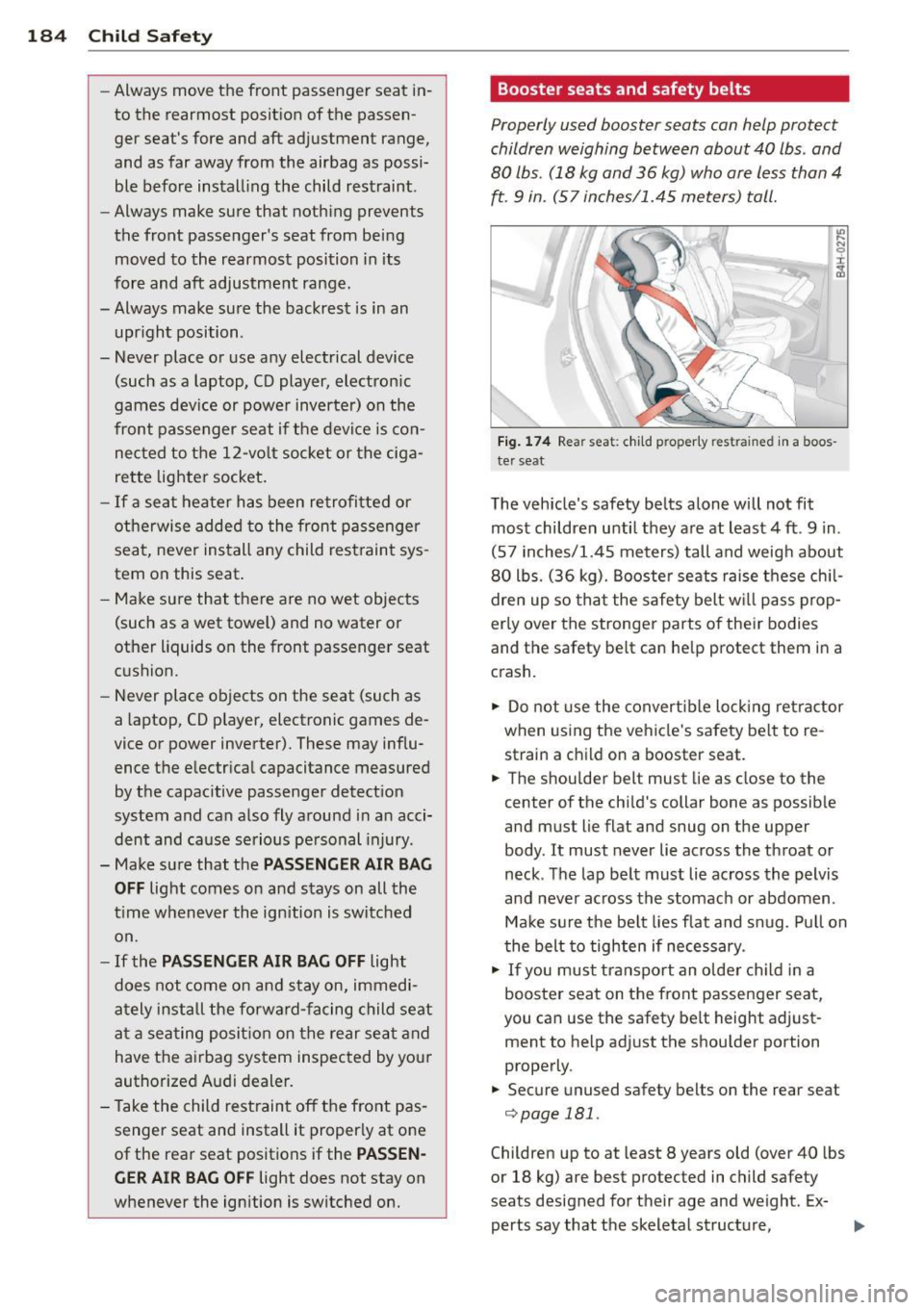
Properly used booster seats can help protect
children weighing between about 40 lbs . and
80 lbs . (18 kg and 36 kg) who are less than 4
ft. 9 in. (57 inches/1.45 meters) tall.
Fig. 174 Rea r seat : child p rop erly res trained in a boos
te r se at
The vehicle's safety belts alone will not fit
most children until they are at least 4 ft . 9 in .
(57 inches/1.45 meters) tall and weigh about
80 lbs.
(36 kg). Booster seats raise these chil
dren up so that the safety belt will pass prop
erly over the stronger parts of their bodies
and the safety belt can help protect them in a
crash.
"" Do not use the convertible locking retractor
when using the vehicle's safety belt to re
strain a child on a booster seat.
"" The shoulder belt must lie as close to th e
center of the child's collar bone as possible
and mu st lie flat and snug on the upper
body.
It must never lie across the throat or
neck . The lap belt must lie across the pelvis
and never across the stomach or abdomen .
Make sure the belt lies flat and snug . Pull on
the belt to tighten if necessary .
"" If you must transport an older child in a
booster seat on the front passenger seat,
you can use the safety belt height adjust
ment to help adjust the shoulder portion
properly .
"" Secure unused safety belts on the rear seat
c:;,page 181.
Children up to at least 8 years old (ove r 40 lbs
or 18 kg) are best protected in child safety
seats designed for their age and weight . Ex-
perts say that the skeletal structure, ..,.
Page 188 of 310
186 Child Saf ety
- Never let a child ride in the cargo area of
your vehicle .
- Always remember that a chi ld leaning
forward, sitt ing s ideways or out of posi
t ion in any way during an acc ident can be
struck by a deploying airbag . This will re
sult in serious personal injury or death .
- If you must install a booster seat on the
front passenger seat because of excep
t ional circumstances the
PASSENGER
AIR BAG OFF
light must come on and
stay on, whenever the ignition is sw itch
ed on.
- If the PASSENGER AIR BAG OFF light
does not come on and s tay on, perform
the chec ks described
¢ page 161, Moni
toring the Advanced Airbag System.
- T ake the child rest raint off the front p as
senger seat and install it properly at one
of the rea r seat positions if the
PASS EN·
GER AIR BAG OFF
light does not stay on
whenever the ignition is switched on .
- Always read and heed all WARNINGS whenever using a child rest rained in ave
hicle is being used
¢ page 140, Safety
belts,¢ page 149 , Airbag system
and
¢ page 175, Important things to know.
Installing a child safety
seat
Securing a child safety seat using a
safety belt
Safety belts for the rear seats and the front
passenger can be locked with the convertible
locking re tractor to properly secure child
safety seats.
The safety belts emergency locking retractors
for the rear seats safety belts and for the
fro nt passenger's seat safety belt have a con
vertible locking retracto r for child restra ints .
The safety belt must be locke d so that belt
webbing can not unreel. The ret ractor ca n be
activ ated to lock the safety be lt and p revent
the safety belt webbing from loosening up
d ur ing normal driv ing . A child sa fe ty seat can
on ly be proper ly installed whe n the safety belt is loc
ked so that the chi ld and child sa fety
seat wi ll stay in place.
Alw ays remember: Even tho ugh yo ur vehicle is
equipped wi th an A dvan ced Airbag system, all
c hi ldren, especially those 1 2 years and young
er, sho uld always ride in the back seat prope r
l y restra ined fo r the ir age and size.
A WARNING
Improperly installed ch ild safety seats in
crease the risk of serious personal injury
and death in a co llision.
- Always make sure that the safety belt re
tractor is locked when insta lling a child
safety seat. A n un locked safety belt re
trac to r cannot hold the child safety seat
in place dur ing norma l driving o r in a
crash.
- Always buckle the child safety seat firmly
in place even if a ch ild is not si tt ing in it.
A loose child sa fe ty se at can fly aroun d
du ring a s udden stop or in a collision .
- Always make sure that the rear seat
backres t to wh ich the center rear safety
belt * is attache d is sec urely latched
wheneve r the rea r ce nter safety belt is
be ing used to secure a child rest raint.
- If the backrest is not securely la tc h ed,
the child and the child restraint will be
thrown forward together with the back
rest and will strike parts of the vehicle
interior. The child can be seriously in
jured or killed.
- Never install rear-facing child safety
seats or infant ca rr ie rs o n the front pas
senger seat . A child will be serious ly in
jured and can be killed when the passen
ge r airbag inflates.
- The infla ting airbag will h it the ch ild
safety seat or infant carrie r w ith gr eat
for ce and will smas h the child safe ty seat
a nd child ag ai nst t he back res t, cen ter
a rmrest, doo r or roof.
- Always inst all rear-fa cing ch ild safety
se ats or in fa nt c arrie rs on the re ar se at.
Page 189 of 310
-Forward-facing child safety seats or in
fant carriers installed on the front pas
senger's seat may interfere with the de ployment of the airbag and cause serious
injury to the child.
- It is safer to install a forward-facing
child safety seat on the rear seat .
- Always read and heed all WARNINGS
whenever using a child restrained in ave
hicle is being used
c:::;,page 175. Special
precautions apply when installing a child
safety seat on the front passenger seat
c:::;, page 151, Child restraints on the front
seat -some important things to know.
A WARNING
-
Always take special precautions if you
must install a forward or rearward-facing
child restraint on the front passenger's
seat in exceptional situations:
- Whenever a forward or rearward-facing
child restraint is installed on the front
passenger seat, the
PASSENGER AIR
BAG OFF light must come on and stay on
whenever the ignition is switched on.
- If the
PASSENGER AIR BAG OFF light
does not come on and stay on, perform
the checks described
c> page 161, Moni
toring the Advanced Airbag System .
-Take the child restraint off the front pas
senger seat and install it properly at one
of the rear seat positions if the
PASSEN
GER AIR BAG OFF
light does not stay on
whenever the ignition is switched on.
- Improper installation of child restraints
can reduce their effectiveness or even
prevent them from providing any protec
tion.
- An improperly installed child restraint
can interfere with the airbag as it de
ploys and seriously injure or even kill the
child.
- Always carefully follow the manufactur
er's instructions provided with the child
safety seat or carrier.
- After checking to make sure that the
child restraint is properly installed, make
Child Safety 187
certain that the child restraint is correct
ly recognized by the capacitive passenger
detection system in the front passenger
seat and that the
PASSENGER AIR BAG
OFF
light signals the correct front pas
senger frontal airbag status .
A WARNING
Forward-facing child restraints:
-Always make sure the forward-facing seat has been designed and certified by its manufacturer for use on a front seat
with a passenger front and side airbag.
- Never put the forward-facing child re
straint up, against or very near the in
strument panel.
- Always
move the passenger seat into its
rearmost position in the seat's fore and
aft adjustment range, as far away from
the airbag as possible before installing
the forward-facing child restraint. The
backrest must be adjusted to an upright
position.
- Make sure that the PASSENGER AIR BAG
OFF light comes on and stays on all the
time whenever the ignition is switched
on .
A WARNING
Rearward-facing child restraints:
-A child in a rearward-facing child safety
seat installed on the front passenger
seat will be seriously injured and can be killed if the front airbag inflates -
even
with an Advanced Airbag System .
- The inflating airbag will hit the child
safety seat or infant carrier with great
force and will smash the child safety seat
and child against the backrest, center
armrest, door or roof.
- Always be especially careful if you must
install a rearward facing child safety seat
on the front passenger seat in exception
al circumstances.
- Make sure that the
PASSENGER AIR BAG
OFF
light comes on and stays on all the .,..
•
•
Page 190 of 310
188 Child Saf ety
time whenever the ignition is switched
on.
- If the
PASSENGER A IR BAG OFF li g ht
does not come on an d stay on, immedi
ately install the rear-facing child safety
seat in a rear seating position and have
the a irbag system inspected by your Audi
dealer .
Activating the convertible locking
retractor
Use the convertible locking retractor to se
cure a child restraint.
A lways heed the child safety seat manufactur
er's instructions when install ing a ch ild re
straint in your vehicle. To activate the conver
tib le locking retractor:
,. Place the child restraint on a seat, prefera
bly on the rear seat .
,. Slow ly pull the be lt
all the wa y out .
,. Route it around or thro ugh the ch ild re
stra int be lt path¢ &.
,. Push the child sa fety seat down wit h your
f ull weight to get the safety belt rea lly tight .
,. Inse rt the be lt tongue into the buckle for
that seating position.
,. Gu ide the safety belt back into the retractor
until the belt lies flat and snug on the child
safety seat .
,. You should hear a "click ing" noise as the
belt w inds bac k into the ine rtia reel. Test the
conve rtible locking retractor by pull ing on
the belt . Yo u should no longe r be able to
pull the belt out of the ret ractor . The con
vertib le locking retractor is now activated .
,. Make sure that the red re lease button is fac
ing away from the ch ild restra int so that it
can be unbuck led quickly .
,. Pull on the be lt to make sure the safety belt
is properly t ight and fastened so that the
seat can not move forward or sideways more
t h an one i nch (2.5 cm).
A WARNING
Using the wrong child restraint or an im
p roperly installed chi ld restraint can cause
se rious pe rsonal injury or death i n a c rash .
- Always make sure that the safety belt re-
tractor is loc ked when insta lling a child
safety seat. A n un locked safety belt re
tracto r cannot hold the child safety seat
in place dur ing no rma l driving o r in a
crash.
- Always buckle the child safe ty seat firmly
in pl ace even if a ch ild is not si tt ing in it.
A loose child safety seat can fly around
du ring a s udden stop or in a crash .
- Always make sure the se at b ackrest to
which the child res traint is installed is in
an upright pos ition and securely latche d
into place and cannot fold fo rward. Oth
erwise, the seatback with the child sa fety
seat attached to it could fly forward in
the event of a n accident or other emer
gency si tuation.
- Always read and heed all WAR NINGS
wheneve r us ing a child restrained in ave
h icle is being used
~ page 175. Special
p reca utions apply w hen insta lling a child
s afety sea t on the front passenger seat
¢ page 1 51, Child restraints on the front
seat -some important things to know.
-
Deactivating the convertible locking
retractor
The convertible locking retractor for child re
straints will be deactivated automatically when the belt is wound all the way bock into
the retractor.
,. Press the red b utton on the safety belt
buckle. The be lt tong ue will pop o ut of the
buckle.
,. Guide the safety be lt a ll the way back into
its stowed position .
Always let the safety be lt retract completely
into its stowed position. The safety belt can
now be used as an ordinary safety belt w ith
out the convertible locking retracto r fo r child
r est raints .
...
Page 218 of 310
216 Cleaning and protec tio n
Apply the product using a micr ofib er cl oth. To
avoid damaging the paint surface, do not use
too m uch pressure.
R inse the vehicle t ho roughly with water . Clean
the vehicle sta rting at the top and working to
ward the bottom using a
neutra l sh ampoo
and a soft mi crofiber cloth . Stop frequently to
rinse the cloth thoroughly.
C lean the wheels and sill panels last. Use a
clean
s pon ge on these areas .
R inse the vehicle tho roughly aga in and let it
a ir dry.
If there are any wa ter spo ts, they can
be removed using a
leather cloth .
Clean again with the spe cial clean er for matt e
finish paint
if ne cessary.
Removing stubborn d irt
B ird d ropping s or tree sap are best removed
with plenty of water and a m icrofiber cloth .
You should r inse
off ga soli ne res idue immedi
ately with plenty of water.
A WARNING
- Wash your ve hicle only when the ignition
is switched
off to reduce the risk of a
crash .
- Always read and heed all WARNINGS and othe r information
c:::> page 213.
([) Note
-Do not treat vehicle parts painted w ith
matte f inish paint us ing polish ing mate
r ials or hard wax. These products could
cause damage to the appea rance or sur
face that cannot be repaired.
- Never use p rotective wax.
It can destroy
the matte fin ish effect .
- Do not p lace any st ickers or magnetic
s igns on vehicle parts painted with
matte finish paint. The pa int could be
damaged when the st ickers or magnets
a re removed.
- To preven t pa int damage, do not wash
the veh icle in direct s unl igh t. -
To prevent damage to the pa int surface,
do not use insect remova l sponges,
rough kitchen sponges or sim ilar items .
- Yo u should remove debris (such as in
sects) from the headlight lenses on a
regu lar basis, for example when refuel
ing your vehicle. Only clean the head
lights using a wet cloth or sponge, never
a dry one. Cleaning with soapy water is
recommended.
(D Tips
For more information on special cleaning
products designed for matte finish paint,
seeyourAud idea~~
Sensors and camera lenses
- Remove snow with a hand brush and remove
ice with a de -icing spray that does not con
tain so lvents.
- Clean the senso rs (adaptive c ruise control*,
park ing system*) w ith a cleaning so lution
tha t does not contain so lvents and a soft
cloth .
- The camera lens or the area in front of the
camera lens is norma lly cleaned by the
windshield wipers (Audi active lane assist*)
or head light wipers (night vision system *).
If the lens or the area is exceptionally dirty,
clean the area with glass cleaner and a soft,
dry cloth .
(D Note
-If you wash your vehicle with a pressure
washer,
- make sure there is eno ugh distance to
sensors i n the fron t and rear bumper,
- do not clean the camera lenses and the
ar ea a round them with the p ress ure
washer.
- N ever use warm or hot wate r to remove
snow or i ce from the camera lens. This
cou ld cause the lens to crack.
- Never clean the camera lens wi th abra
sive products.
Page 226 of 310
224 Cleaning and protection
Engine compartment
Be especially careful when cleaning the en
gine compartment.
Al way s switch o ff t he ign ition b efore clean
ing the engi ne
c:> &. .
Plenum p ane l
Remove leaves from the plenum pane l in front
of the windshield under the engine compart
ment. This p revents the water drain holes
from becoming blocked, and it preven ts de
bris from enter ing the veh icle inter ior through
the heating and venti lation ducts.
Cor rosion protecti on
The engine compartment and transmission
have been corrosion-protected at the factory.
Good anti -corrosion treatment is very impor
tant, particular ly in the winter. If the vehicle
is frequent ly driven on sa lt treated roads, the
entire engine compartment and plenum panel
should be thoroughly cleaned at the end of
winter and retreated to prevent salt damage .
At the same time, the underside of the vehicle
should be washed as well.
If the engine compartment is cleaned at any
time with grease removing solut ions
1>, or if
you have the engine washed, the anti-corro
sion treatment is a lmost always removed as
well. It is therefore essential to have a long
l asting co rrosion protection reapp lied to all
surfaces, seams, joints and components in the
engine compartment .
&_ WARNING
Be aware: The engine compartment of any
motor vehicle is a potentially hazardous
area.
- Before working in the engine compart
ment, be sure to read the informat ion
c:> page 230.
- Before reaching into the front pane l, al
ways switch off the ignition. Otherwise,
1l Use o nly the co rrect cle anin g so lu ti on s. Never use gas
o lin e or d ie se l fuel.
the windshield wiper system could unin
tentionally be switched on, possibly
causing personal injury from the moving
wiper linkage .
- Never reach into the area around or
touch the rad iator fan. The auxiliary fan
is temperature controlled and can sw itch
on suddenly- even when the ignition is
off.
- Do not wash, wax or dry the eng ine with
the engine running. Mov ing or hot parts
could injure you.
- Do not clean the underside of the chas
sis, fenders, wheel covers, or other hard
to reach parts without protect ing your
hands and arms . You may cut yourself on
sharp-edged metal parts .
- Always read and heed all WARNINGS and
other info rmation
c:> page 213.
Page 229 of 310
transport fuel to use for your lawn mower,
snow blower, etc., be very careful and al
ways observe local and state laws regard
ing the use, transportation and storage of
such fuel containers. Make certain the con
tainer meets industry standards (ANSI/
ASTM F8S2 -86) .
@ Note
Never drive your vehicle until the fuel tank
is completely empty. The irregular supply
of fuel can cause misfiring. Gasoline could
enter the exhaust system and damage the
catalyt ic converter.
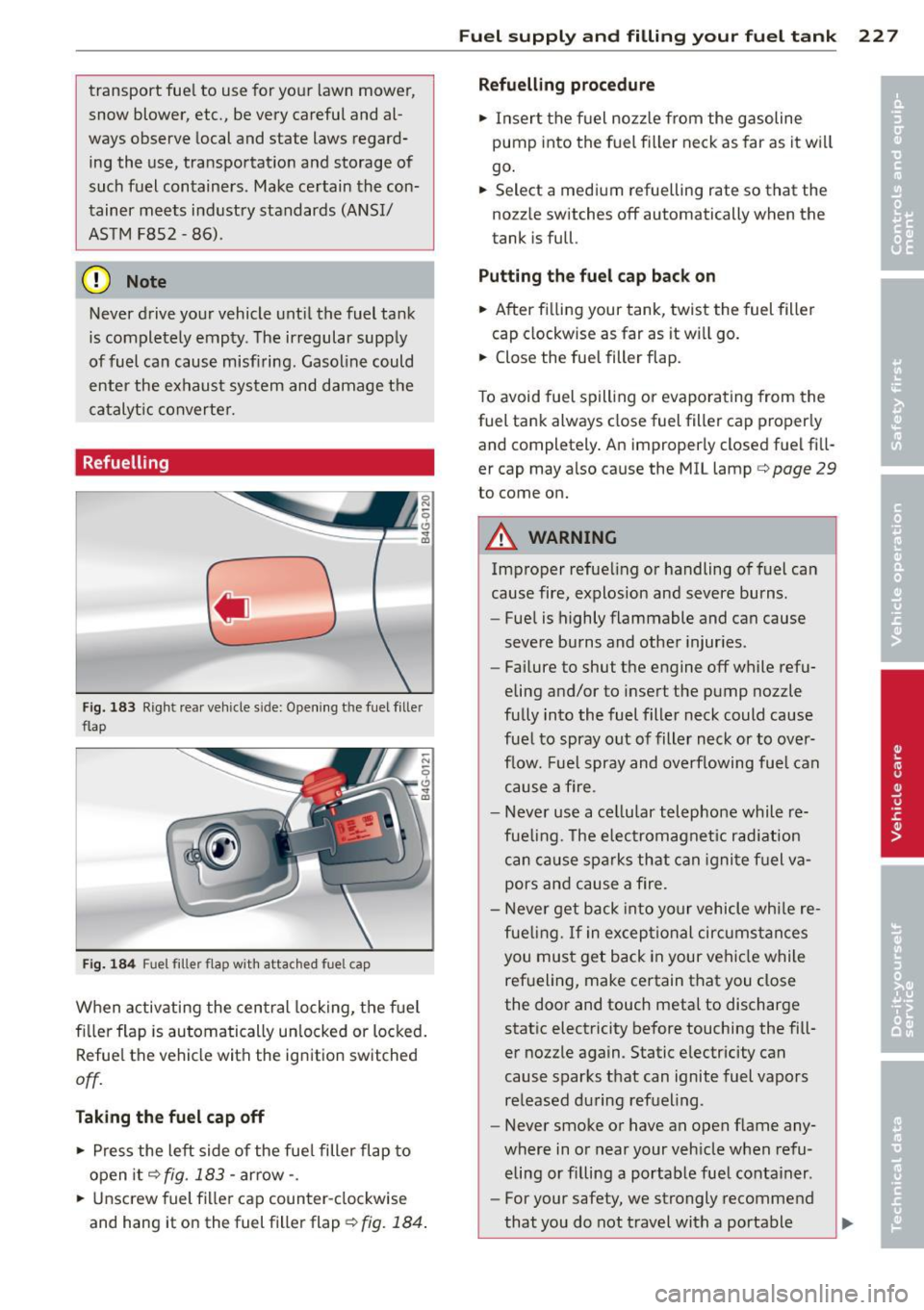
Refuelling
Fig. 183 Right rear vehicle s ide: Opening the fuel filler
flap
Fig. 184 Fuel filler flap with attached fuel cap
When activating the central locking, the fuel
f ill er flap is automatically un locked or locked.
Refuel the vehicle with the ignition switched
off.
Taking the fuel cap off
• Press the left side of the fuel filler flap to
open it¢
fig. 183 -arrow-.
• Unscrew fuel filler cap counter-clockwise
and hang it on the fuel filler flap~
fig. 184.
Fuel supply and filling your fuel tank 22 7
Refuelling procedure
• Insert the fuel nozzle from the gasoline
pump into the fuel filler neck as far as it will
go.
• Select a medium refuelling rate so that the
nozzle switches off automatically when the
tank is full.
Putting the fuel cap back on
• After filling your tank, twist the fuel filler
cap clockwise as far as it will go.
• Close the fuel filler flap.
To avoid fuel spill ing or evaporating from the
fuel tank always close fuel filler cap proper ly
and completely. An improperly closed fuel fill
er cap may also cause the MIL lamp ¢
page 29
to come on.
A WARNING
Improper refueling or handling of fuel can
cause fire, explosion and severe burns.
- Fuel is highly flammable and can cause
severe burns and other injuries.
- Failure to shut the engine off while refu
eling and/or to insert the pump nozzle
fully into the fuel filler neck could cause
fue l to spray out of filler neck or to over
flow. Fuel spray and overflowing fuel can
cause a fire.
- Never use a cellular telephone while re
fue ling. The electromagnet ic rad iation
can cause sparks that can ignite fuel va
pors and cause a fire.
- Never get back into your vehicle while re
fueling.
If in exceptional circumstances
you must get back in your vehicle while
refueling, make certain that you close
the door and touch metal to discharge static electricity before touching the fill
er nozzle again. Static electricity can
cause sparks that can ignite fuel vapors
released during refueling.
- Never smoke or have an open flame any
where in or near your vehicle when refu
eling or filling a portable fue l container.
- For your safety, we strongly recommend
that you do not travel with a portable
Page 232 of 310
230 Checking and filling
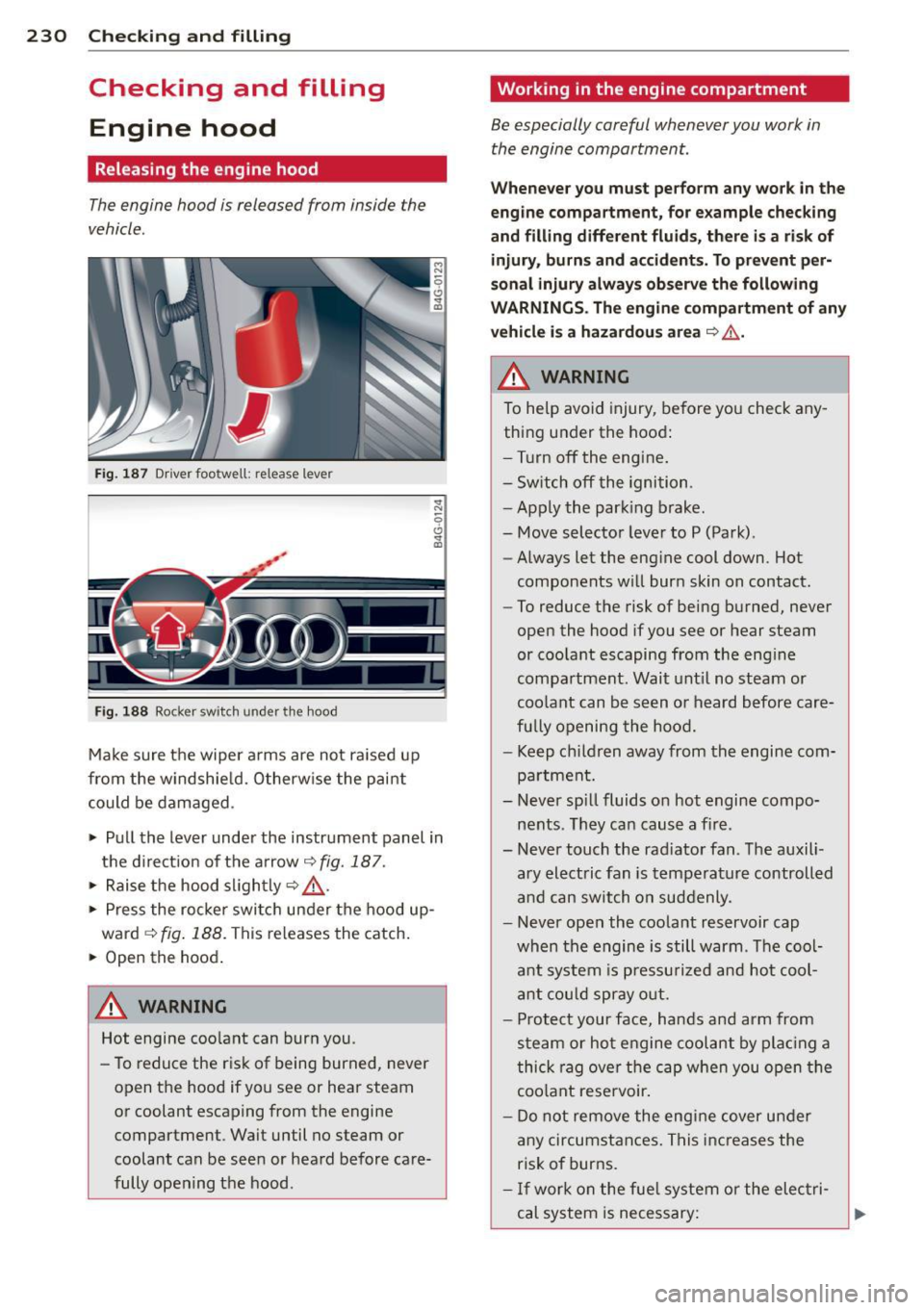
Checking and filling Engine hood
Releasing the engine hood
The engine hood is released from inside the
vehicle .
Fig. 187 Driver foo twell: release lever
Fig. 188 Rocker switch un der the hood
Make sure the wiper arms are not raised up
from the windshield. Otherwise the paint
could be damaged .
.,. Pull the lever under the instrument panel in
the direction of the arrow
~ fig. 187.
.,. Raise the hood slightly~,&. .
... Press the rocker switch under the hood up
ward
~ fig. 188. This releases th e catch.
... Open the hood.
&_ WARNING
Hot engine coolant can burn you.
- To reduce the risk of being burned, never
open the hood if you see or hear steam
or coolant escaping from the engine compartment . Wait until no steam or
coolant can be seen or heard before care
fully opening the hood .
'Working in the engine compartment
Be especially careful whenever you work in
the engine compartment.
Whenever you must perform any work in the
engine compartment, for example checking
and filling different fluids, there is a risk of injury, burns and accidents. To prevent per
sonal injury always observe the following
WARNINGS. The engine compartment of any
vehicle is a hazardous area
~ ,&. .
A WARNING
To help avoid injury, before you check any
thing under the hood:
- Turn off the engine.
- Switch off the ignition .
- Apply the parking brake.
- Move selector lever to P (Park).
- Always let the engine cool down. Hot
components will burn skin on contact.
- To reduce the risk of being burned, never
open the hood if you see or hear steam
or coolant escaping from the engine
compartment. Wait until no steam or
coolant can be seen or heard before care
fully opening the hood.
- Keep children away from the engine com
partment.
- Never spill fluids on hot engine compo
nents . They can cause a fire .
- Never touch the radiator fan. The auxili
ary electric fan is temperature controlled
and can switch on suddenly .
- Never open the coolant reservoir cap
when the engine is still warm . The cool
ant system is pressurized and hot cool
ant could spray out.
- Protect your face, hands and arm from
steam or hot engine coolant by placing a
thick rag over the cap when you open the
coolant reservoir.
- Do not remove the engine cover under
any circumstances. This increases the
risk of burns.
- If work on the fuel system or the electri
cal system is necessary: