light AUDI A7 2014 Owners Manual
[x] Cancel search | Manufacturer: AUDI, Model Year: 2014, Model line: A7, Model: AUDI A7 2014Pages: 306, PDF Size: 76.83 MB
Page 219 of 306

-Never use abrasive cleaning materials
or alcohol to clean the camera lens.
Th is could cause scratches and cracks .
-Window s
-Remove snow and ice on w indows and
exterior mirrors with a plastic scraper.
To avoid scratches, move the scraper only in one direction and not back and
forth.
- Never remove snow or ice from w in
dows and m irrors using wa rm or hot
wate r because this cou ld cause crac ks
to form.
- To avoid damage to the rear window
defogger, do not apply any stickers on
the heating wires on the inside of the
w indow .
-Dec or ati ve p arts /trim
-Never use chrome care or cleaning
products.
-Paint
-To reduce the risk of scratches, the ve-
hicle must be free of dirt and dust be
fore polishing or waxing.
- To prevent paint damage, do not polish
or wax the veh icle in direct sunlight.
- To reduce the risk of paint damage, do
no t polish away rust film .
-Di splay s
-To avoid scratches, do not use dry
cleaning methods on displays .
-Controls
- Make sure that no flu ids enter the con-
trols, because this cou ld cause dam
age .
-Safet y belts
- Do not remove the safety belts to clean
t hem.
- Never clean safety belts or their com
ponents chemically or with cor ros ive
fluids or solvents and never a llow
sharp objects to come into contact
with the safety belts . This cou ld cause
damage to the belt webbing.
- If the re is damage to the webb ing, the
connections, the retractors or the buck
les, have them rep laced by an author-
V ehicl e ca re a nd cl eanin g 217
ized A udi dealer or a qualified work
shop.
- Te xtile s/Vin yl/ Alcant ara
- Never treat Vinyl/Alcantara w ith leath-
er care products, solvents, floor polish,
shoe polish, stain remover or s imilar
p rod ucts.
- To avoid damage, have stubborn stains
removed by an authorized Aud i deale r
or a qualif ied workshop.
- Never use steam cleaners, brushes,
hard sponges, etc. when cleaning.
- Objects w ith sharp edges such as zip
pers, rivets on clothing or be lts can
cause damage to the surface.
- Open hook and loop fastene rs, for ex
ample on cloth ing, can damage seat
covers. Make sure hook and loop fas
tene rs a re closed.
- Natural leather
- Neve r treat leather w ith solvents, floor
polish, shoe polish, stain remover or
similar products.
- Objects with sharp edges such as zip·
pers, rivets on clothing or be lts can
cause damage to the surface.
- Never use steam cleaners, brushes,
hard sponges, etc. when cleaning.
- To help prevent the leather from fad
ing, do not leave the vehicle in d irect
sunlight for long per iods of t ime. If
leaving the vehicle parked for long pe
riods of time, you should cover the
leather to protect it from d irect sun
light.
(D Tips
- Insects are easier to remove from paint
that has been freshly waxed.
- Regular waxing can prevent rust film
from forming.
•
•
Page 220 of 306
218 Fuel supply and filling your fuel tank
Fuel supply and filling
your fuel tank
Gasoline
Fuel supply
Appl ies to vehicles: with gasoline engine
Using the right fuel helps keep the environ
ment clean and prevents engine damage .
Fuel recommendation
The fuel recommended for yo ur vehicle is un
l e aded premium
grade gasoline . Audi recom
mends using TO P TI ER D ete rgent Gaso line
wi th a m inimum octane ra ting o f 91 A KI ( 95
RO N). Fo r more informa tio n o n TOP TIER De
tergent Gasoline, p lease go to the o fficia l
websi te (www. topt iergas .com) .
The re commended gasoline octane rati ng for
your engine can a lso be fo und o n a label loc at
ed on the ins ide of the fuel filler flap . This ra t
ing may be specif ied as AK I or RO N.
Your veh icle may also be operated using un
l eaded regular gasoline with a minimum oc
tane rating of 87 AKI/91 RO N. However, using
87 A KI/91 RON octa ne fue l wi ll slightly re
d uce eng ine perfo rmance .
Use unleaded ga soline only. U nleaded g aso
l ine is available th rougho ut the USA, Canada,
a nd i n most E uropean countries . We recom
mend that you do not ta ke yo ur vehicle to
areas or co untries where unleaded gasoline
may not be ava ilable.
F or mo re informat io n on refue ling your ve hi
cle, see~
page 220.
Octane rating
Octane rating ind icates a gaso line's abili ty to
res ist eng ine dam ag ing "knoc k" ca use d by
premature ign ition and detona tion. Therefore,
buy ing the correct grade of gaso line is very
important to he lp prevent possible engine
damage and a loss of engine performance.
Gasoline mos t commonly used in the Unite d
States and Canada has the following octane r
atings t hat can usu a lly be found on the fi ller
pump:
- Premium Gra de: 91 -96 A KI
- Regular Grade : 87 -90 AKI
Explanation of the abbreviations:
AKI = Anti K nock In d ex = (R+M )/2 = (RON
+ MON)/2
R ON= Resear ch Octane Numb er
MON = Motor Octane Num ber .
(D Note
-Do not use a ny fue l w it h o ctane rat ings
lower tha n 87 A KI or 91 RO N othe rwise
expensive engi ne damage w ill occur.
- Do
not use leaded gasoli ne. The use of
leaded gasoline w ill severely damage
yo ur v ehicle's cata lytic co nve rter and its
ability to co ntrol exha ust em issions .
Blended gasoline
Applies to vehicles: with gasoline engine
Use of gasoline containing alcohol or
MTBE (methyl tertiary butyl ether )
You may use unleaded g asoline blende d wi th
alcohol o r MTBE (commonly referred to as
oxygenates) if the blende d mixture meets t he
f o llow ing criteria:
Blend of gasoline methanol (wood alcohol or
methyl alcohol)
- Anti -kno ck index must be 87 A KI or higher.
- Blend must contain no more t han 3% meth-
anol.
- Blend must contain more than 2% co -sol -
vents.
Blend of gasoline and ethanol (grain alcohol
or ethyl alcohol)
- Anti -knock index must be 87 AKI or higher .
- Blend must not conta in mo re tha n 10%
ethanol.
Blend of ga soline and MTBE
- Anti-knock index must be 87 AKI or higher. IJll,
Page 229 of 306

Checking and filling Engine hood
Releasing the engine hood
The engine hood is released from inside the
vehicle .
Fig. 191 Dr iver footwell: release lever
Fig. 192 Rocker switch under the hood
Make sure the wiper arms are not raised up
from the w indshield. Otherw ise the paint
could be damaged.
.. Pull the lever under the instrument panel in
the d irect ion of the arrow
~ fig. 191.
.. Raise the hood slightly~ &-
.. Press the rocker switc h under the hood up
ward
~ fig. 192. This re leases the catch .
.. Open the hood .
A WARNING
Hot engine coo lant can burn you.
- To reduce the r isk of being burned, never
open the hood if you see or hear steam
or coolant escaping from the engine
compartment . Wait until no steam or
coolant can be seen or heard before care
fully opening the hood.
Checkin g and fillin g 22 7
Working in the engine compartment
Be especially careful whenever you work in
the engine compartment.
Wh ene ve r y ou must p erform an y wor k in the
e ng ine com pa rtm ent , for e xample checking
a nd filling diff ere nt fluids, th ere is a risk of
inju ry, burn s and accid ent s. To pr eve nt per
so nal injury alwa ys observ e the foll owing
WARNING S. The engin e compartment of an y
v e hicle i s a h az a rdou s are a
~ ,&.
h WARNING
To help avoid injury, before yo u check any
thing under the hood:
- Turn off the engine.
- Sw itch off the ignition.
- Apply the parki ng brake.
- Move selector leve r to P (Park).
- Always let the engine cool down. Hot
components w ill burn skin on contact .
- To reduce the risk of being burned, never
open the hood if you see or hear steam
or coo la nt escaping from the engine
compa rtment. Wait unt il no steam or
coolant can be seen o r heard before care
fu lly opening the hood.
- Keep ch ildren away from the engine com
pa rtment.
- Never sp ill fluids on hot engine compo
nents . They can cause a fire .
- Never touch the rad iator fan. The auxili
ary electric fan is temperat ure controlled
a nd can sw itch on suddenly .
- Never open the coolant reservoir cap
when the engine is still warm. The cool
a nt system is p ressu rized and hot cool
a nt cou ld spray o ut.
- Protect your face, hands and arm from
steam or hot engine coolant by plac ing a
thick rag ove r the cap when you open the
coo lant rese rvoir.
- Do not remove the engine cover under
any circumstances. This inc reases the
ris k of burns.
- If work on the fue l system o r the elec tri
cal system is necessary:
Page 231 of 306

Checking and fillin g 229
Engine compartment
Engine compartment overview
These are the most important items that you can check.
Fig. 193 Typical l ayout for conta iners and engine o il filler cap
@ Jump start poin t(-) with hex
head screw .. ....... ... .. .. . 240, 276
@ Jump start point(+) under a cov-
®
©
®
©
er .. .. ... ..... ...... ...... 240, 276
Brake fl uid reservo ir
((0)) . . . . . 237
Engine oil filler cap
("1:::r.) . . . . . 232
Coolant expansion tank
(-L) .. .
Windshield/headlight washer
t . ('"') con ainer O ...... .... ... .
235
241
The engine oil filler neck (item@) may be lo
cated in a d ifferent a rea depend ing o n the
ver
sion of the eng ine.
Before you check anything in the engine
compartment, always read and heed all
WARNINGS
c::> &. in Working in the engine
compartment on page 227.
Engine oil
Engine oil specifications
The engine in your Audi needs the right kind
of oil.
The engine in your Audi is a sophisticated
powerplant that was built to exacting specifi
cations. This eng ine needs the right k ind of
engine oil that meets specifications regarding
quality and viscosity so that it can r un
smooth ly and reliably. Choosing the right o il
and changing oil within the t ime and mileage
intervals p rin ted in you r vehicle's Wa rranty
&
Maintenance booklet matters a lot more to
day than it did years ago . Audi has deve loped
a specia l quality sta ndard for engine oil that
will help assure that your vehicle's engine will
get the lubrication it needs for proper opera
tion.
Page 233 of 306

current list of oils (manufacturers, brand
names etc.) that conform to Audi oil standard
VW 502 00 (vehicles with gasoline engine) or
VW 507 00 (vehicles with diesel engine).
C hanging the engine oil
The engine oil and oil filter must be changed
according to the mileage (kilomete rs) and
time intervals specified in your vehicle's War
ranty
& Maintenance booklet. Do not exceed
these intervals -harmful deposits from old
engine oil can reduce engine performance and
can lead to expensive engine repairs .
Changing the oil at the recommended inter
vals is so very important because the lubricat
ing properties of oil decrease gradually during
normal vehicle use. If you are not sure when
you have your oil changed, ask your author
ized Audi Service Advisor .
Under some circumstances the engine oil
should even be changed more frequently .
Change oil more often if you drive mostly
short distances, operate the vehicle in dusty
areas or mostly under stop-and-go traffic con
ditions, or when you use your vehicle where
temperatures stay below freezing point for long periods.
Detergent addit ives in the oil will make fresh
oil look dark after the eng ine has been run
ning for a short time. This is normal and is not
a reason to change the oil more often than
recommended.
Damage or malfunctions due to lack of
maintenance
It is essential that you change your oil at the
recommended intervals using only engine oil
that complies with Audi oil standard
VW 502 00 (vehicles with gasoline engine) or
VW 507 00 (vehicles with diesel engine). Your
Limited New Vehicle Warranty does not cover
damage or malfunctions due to failure to fol
low recommended maintenance and use re
quirements as set forth in the Audi Owner's
Manual and Warranty
& Maintenance booklet.
Your dealer will have to deny warranty cover
age unless you present to the dealer proof in
Checking and filling 231
the form of Service or Repair Orders that all
scheduled maintenance was performed in a
timely manner.
Engine oil consumption
The engine in your vehicle depends on an ade
quate amount of oil to lubricate and cool all
of its moving parts.
In order to provide effective lubrication and
cooling of internal engine components, all in
ternal combustion engines consume a certain
amount of oil. Oil consumption varies from engine to engine and may change significantly
over the life of the engine. Typically, engines
with a specified break-in period (see ¢
page 204) consume more oil during the
break-in period than they consume after oil
consumption has stabilized.
Under normal conditions, the rate of oil con
sumption depends on the quality and viscosity
of the oil , the RPM (revolutions per minute) at
which the engine is operated, the ambient
temperature and road conditions . Further fac
tors are the amount of oil dilution from water
condensation or fuel residue and the oxida
tion level of the oil. As any engine is subject to
wear as mileage builds up, the oil consump
tion may increase over time until replacement
of worn components may become necessary .
With all these variables coming into play, no
standard rate of oil consumption can be es
tablished or specified. There is no alternative
to regular and frequent checking of the oil lev
el, see
Note .
If the yellow engine oil level warning symbol
in the instrument cluster
II! lights up, you
should check the oil level as soon as possible
¢
page 232. Top off the oil at your earliest
convenience
9 page 232.
.&, WARNING
Before you check anything in the engine
compartment, always read and heed all
WARNINGS ¢.&.
in Working in the engine
comportment on page 22
7.
-
•
•
Page 237 of 306

Checking the engine coolant level
The engine coolant level can be checked with
a quick glance .
Fig. 196 Eng ine compartment: cover on the coolant
expansion tank
Before you check anything in the engine com
partment,
alwa ys read and hee d all W ARN
ING S ¢.&. in Working in the engine compart
ment on page 22
7 .
.,. Park your vehicle on a level surface.
.,. Switch off the ignit ion.
.,. Read the engine coolant level from the cool
ant expansion tank¢
fig. 196, ¢ page 229 ,
fig. 193 .
With a cold engine, the coolant
level should be between the "min" and
"max" mar kings. When the engine is warm,
the leve l may be slightly above the "max"
marking.
The location of the coolant expansion tank
can be seen in the engine compartment illus
tration¢
page 229 .
To obtain an accurate read ing, the eng ine
must be switched off.
The expans ion tank in you r vehicle is equipped
with an electric coolant level sensor .
When the coolant level is too low, the warning
light in the Auto -Check System ¢
page 17 will
illum inate u ntil you add coolant a nd the level
has been restored to normal. Even though
there is an electric coolant level sensor, we
still recommend you check the coolan t leve l
from time to time.
Coolant loss
Coolant loss may indicate a leak in the cool ing
system. In the event of coolant loss, the cool-
Checkin g and fillin g 235
ing system should be inspected immediately
by your authorized Audi dealer . It is not
enough merely to add coolant.
In a
s ea led system, losses can occur on ly if
the boiling point of the coo lant is exceeded as
a result of overheating.
A WARNING
The cooling system is under pressure and
can get very hot. Reduce the risk of scald
ing from hot coolant by follow ing these
steps.
- Turn off the engine and allow it to cool
down.
- Protect your face, hands and arms from
escap ing f lu id and steam by cover ing the
cap with a la rge, th ick rag.
- Turn the cap slowly and very carefully in
a counter-clockwise d irect ion while ap
plyi ng light, downward pressure on the
top of the cap .
- To avo id being burned, do not sp ill anti
freeze or coolant on the exhaust system
or hot engine parts. Under certa in cond i
tions, the ethylene gly col in engine coo l
a nt can catch fire.
(D Note
Do not add any type of radiator leak sea L
ant to your veh icle's engine coo lant . Add
i ng radiato r repa ir flui d may adverse ly af
fect the funct io n and performa nce o f your
cooling system and could result in damage
not covered by your New Vehicle Limited
War ranty.
Adding coolant
Be very careful when adding engine coolant .
Before you che ck anyth ing in the eng ine com
partmen t,
alway s read and heed all WARN
INGS ¢.&_ in Working in the engine compart
ment on page
227 .
.,. Tur n off the engi ne.
.,. Let the engine cool down.
Page 238 of 306

236 Check ing and filling
• Place a thick rag ov er the coolant expansion
tank ¢
page 235, fig . 196 and care fully
twist the cap counter-clockwise ¢ &_.
• Add coolant mixed in the correct ratio
¢ page 234, Coolant.
• Twist the cap on again tightly .
Replacement engine coolant must conform to
exact specifications ¢
page 234, Coolant .
We recommend using on ly coo lant addi-
tive
Gl2++, Gl3 or in an emergency Gl2 +. Do
not use a different additive. In an emergency
use plain water unt il you can get the correct
addit ive and can restore the correct ratio . This
should be done as soon as possible .
If you have lost a considerable amount of
coolant, then you should add cold antifree ze
and cold water only when the eng ine is co ld.
A lways use
new engine coolant when refi lling.
Do not fill coolant above the "MAX" mark. Ex
cess coolant will be forced out t hrough the
press ure relief valve in the cap when the en
gin e becom es hot.
A WARNING
- The coo ling system is under p ress ure and
can get very hot. Reduce the risk of
scalding from hot coolant by following
these steps .
- Tu rn o ff the eng ine a nd a llow i t to cool
down.
- Pr otect your f ace, hands and arms from
escaping f luid and steam by cover ing
the cap with a large, thick rag.
- Tu rn the cap slowly and very ca re fully
in a counte r-clockwise direct ion while
applying light, downwa rd p ress ure on
the top of the cap.
- To avoid being burned, do not spi ll an
tifreeze or coolant on the exhaust sys
tem or hot engine parts. Under certa in
conditions, the ethylene glyco l in en
g ine coolant can catch f ire.
- Antifreeze is poisonous. Always store an
t ifreeze in its original container and well
out of the reach of children. -
If you drain the coo lant, it m ust be
caught and safely stored in a proper con
tainer clearly marked "poison".
(D Note
- Coo lant poll utes the environment and
cou ld cause an engine fire . Excess cool
ant will be forced out through the pres
sure relief valve in the cap when the en
gine becomes hot .
- If, in an emergency, only water can be
added, the correct ratio between water
and antifreeze ¢
page 234 must be re
stored as soon as possible .
® For the sake of the environment
Drained coolant should not be reused. Al
ways d ispose of used coolant while observ
i ng all environmental regulations .
Radiator fan
The radiator fan switches on automatically by
itself .
An auxiliary electric radiator fan switches on
and off depending on coolan t temperature
and othe r vehicle operat ing condit ions.
After you switch the engine off, the aux iliary
fan can continue running for up to 10 m inutes
- even w it h the ignition off. It can even switc h
o n aga in later by itself¢
A, if
- the temper ature of the engine coo lant rises
due to the heat build-up from the engine in
the engine compartment, or
- the engine compartment heats up because
the vehicle is parked in intense sunlig ht.
A WARNING
- To reduce the risk of personal injury nev
er touch t he rad iator fan .
- The auxiliary electric fan is temperat ure
controlled and can sw itch on suddenly
even when the engine is not ru nning .
- The auxiliary radiator fan sw itches on a u
tomatically when the engine coo la nt
reaches a certai n temperature and wi ll ..,.
Page 239 of 306
continue to run until the coolant temper
ature drops.
Brake fluid
Checking brake fluid level
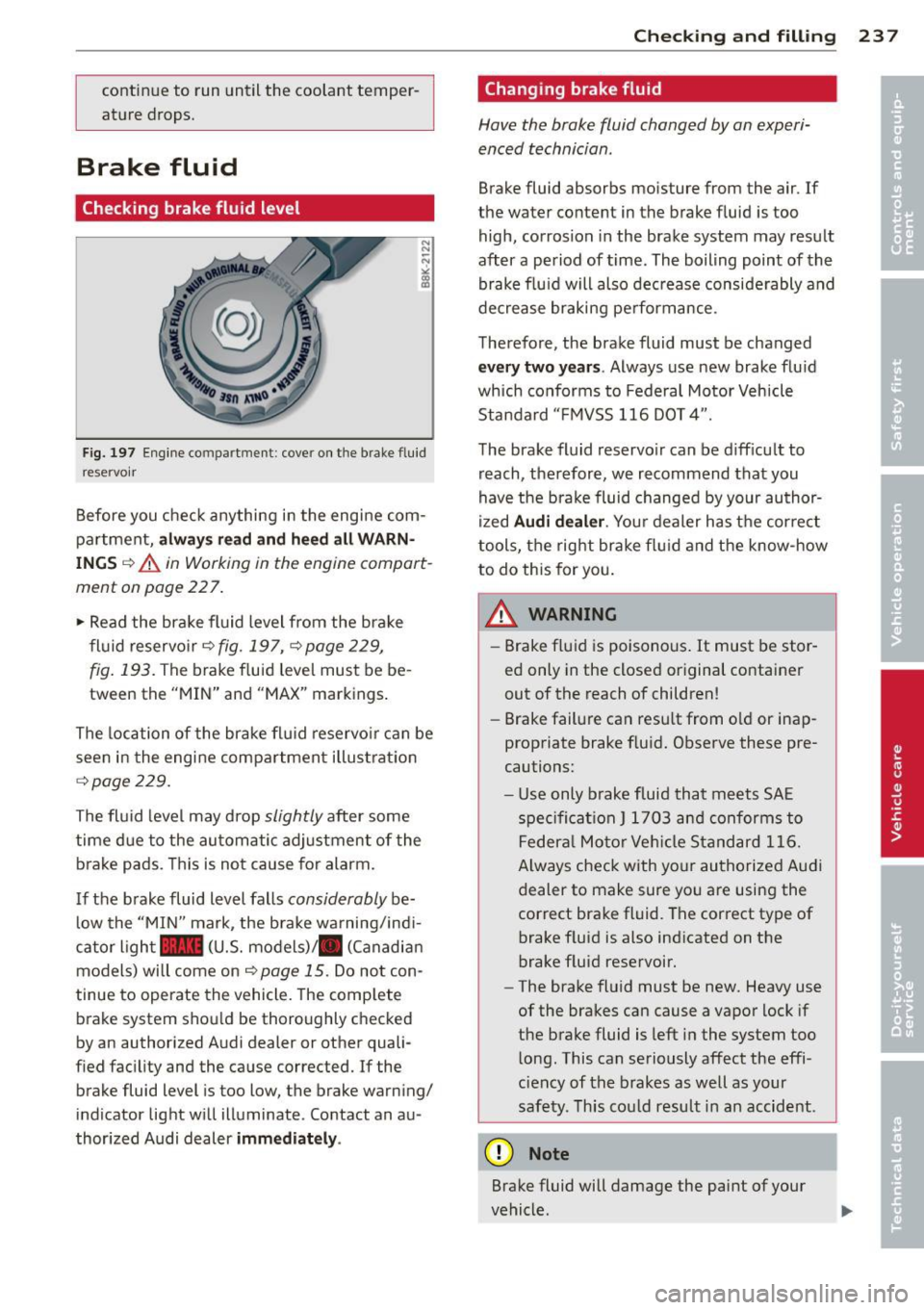
Fig. 197 E ngine co mpartment : cove r on the b rake fluid
r ese rvoir
Before you check anything i n the engine com
partment,
a lw ays read and heed all W ARN
ING S 9 A in Working in the engine compart
ment on page
22 7.
~ Read the brake fluid level from the brake
fluid reservoir
9 fig . 197, 9 page 229,
fig. 193.
The brake fluid level must be be
tween the "MIN" and "MAX" markings .
The location of the brake fl uid reservo ir can be
seen in the engine compartment illustrat ion
9 page229.
The fluid level may drop slightly after some
time due to the automatic adj ustment of the
b rake pads. This is not cause for alarm.
I f the brake fluid level falls
considerably be
l ow the "MIN " mark, the brake wa rning/indi
cator ligh t
1111 (U.S. models)/ . (Canadia n
models) will come on~
page 15 . Do not con
tinue to operate the vehicle. The comp lete
brake system shou ld be thoroughly checked
by an authorized Audi dealer or other quali
f ied fac ility and the cau se corrected.
If the
brake fluid level is too low, the brake warning/
indicator light will illuminate . Contact an au
thor ized Audi dealer
imm ediat ely .
Checkin g and fillin g 237
Changing brake fluid
Have the brake fluid changed by an experi
enced technician .
Brake fluid absorbs mois ture from the air. If
the wa ter content in the brake fluid is too
high , corrosion in the brake system may result
after a period of time . The boiling point of the
brake flu id will also dec rease considerably and
decrease braking pe rformance.
Therefore, the brake fluid must be changed
ev ery two years. Always use new brake flu id
which conforms to Federal Motor Vehicle
Standard "F MVSS 116 DOT 4 ".
The brake fluid reservo ir can be d iff icult to
reach, the refore, we recommend that you
have the brake fluid changed by your author
i zed
Audi dealer . Your dealer has t he correct
tools, the right brake fl uid and the know-how
to do this for you.
A WARNING
-
- Brake fluid is poisonous . It must be stor
ed only in the closed original container
out of the reach of children!
- Brake failure can resu lt from o ld or inap
propriate brake f luid. Observe these pre
cautions:
- Use only brake fluid that meets SAE
spec ificat ion
J 1 7 03 and conforms to
Federa l Moto r Ve hicl e Standard 116.
Always check with yo ur authorized Audi
dealer to make sure yo u are using the
correct bra ke fluid. The correct type of
brake f luid is also indicated on the
brake fluid reservoir.
- The brake fluid must be new. Heavy use
of the brakes can cause a vapor lock if
the brake fluid is left in the system too
l ong . This can seriously affect the effi
c iency of the brakes as well as your
safety. Th is cou ld resu lt in an accident .
(D Note
Brake fluid will damage the paint of your
vehicle .
.
Page 240 of 306
238 Checking and filling
@ For the sake of the environment
Because of the problem of proper disposal
of brake fluid as we ll as the special tools
required and the necessary expertise, we recommend that you have the brake fluid
changed by your author ized Audi dealer.
Battery
General information
Under normal operating conditions, the bat
tery in your Audi does not need any mainte
nance. With
high outside temperatures or
long daily drives we recommend that you have
the electro lyte level checked by a service fa
cility . The electrolyte level should also be
checked each time the battery is charged
<=:> page 240.
Have the battery checked when you take your
vehicle in for service . You are well adv ised to
replace a battery that is older than 5 years .
With certain types of airbag deployment, the battery is disconnected from the vehicle elec
tr ical system for safety reasons
c::> & in Re
pair, care and disposal of the airbags on
page 165.
Disconnecting the battery terminals
Some vehicle functions (power window regu
lators, for example) are lost if the battery ter
minals are disconnected. These functions have
to be relearned after the battery terminals are
connected again. To prevent this , the battery
should only be disconnected from the vehicle
e lectrica l system when absolutely necessary
for repairs.
Vehicles not driven for long periods
If you do not drive your vehicle over a period
of severa l days or weeks, electrical compo
nents are gradually cut back or switched off.
This reduces energy consumption and main
tains starting capability over a longer period
c::> page 202. Some of the convenience func
tions may not operate, such as the interior
lights or power seat adjustment. The conven- ience
functions will be available again when
you switch on the ignition and start the en gine.
Winter operation
During the winter months, battery capac ity
tends to decrease as temperatures drop. This
is because more power is a lso consumed whi le
starting, and the headlights, rear window de
fogger, etc., are used more often.
Avoid unnecessary power consumption, par
ticularly in city traffic or when traveling only
short distances. Let your authorized Audi
deale r check the capacity of the vehicle bat
tery before winter sets in
c::> page 240 . A well
charged battery will no t only prevent star ting
problems when the weather is cold, but will
also last longer .
@ Tips
If your vehicle is left standing for several
weeks at extremely low temperatures, the
vehicle battery should be removed and
stored where it w ill not freeze. This will
prevent it from be ing damaged and having
to be replaced .
Working on the battery
Be especially careful when working on or near
the battery.
The battery is located in the luggage compart
ment under the floor . Before you check any
thing in the luggage compartment,
read and
heed all WARNINGS
c::> .&,.
Always heed the safety warnings , when work
ing on the vehicle battery or the vehicle elec
trical system to prevent injury.
The following WARNINGS are very
important when working on the battery:
Always heed the following WARNING SYM-
BOLS and safety precautions when working
on the battery.
®
Always wear eye protection.
Page 241 of 306
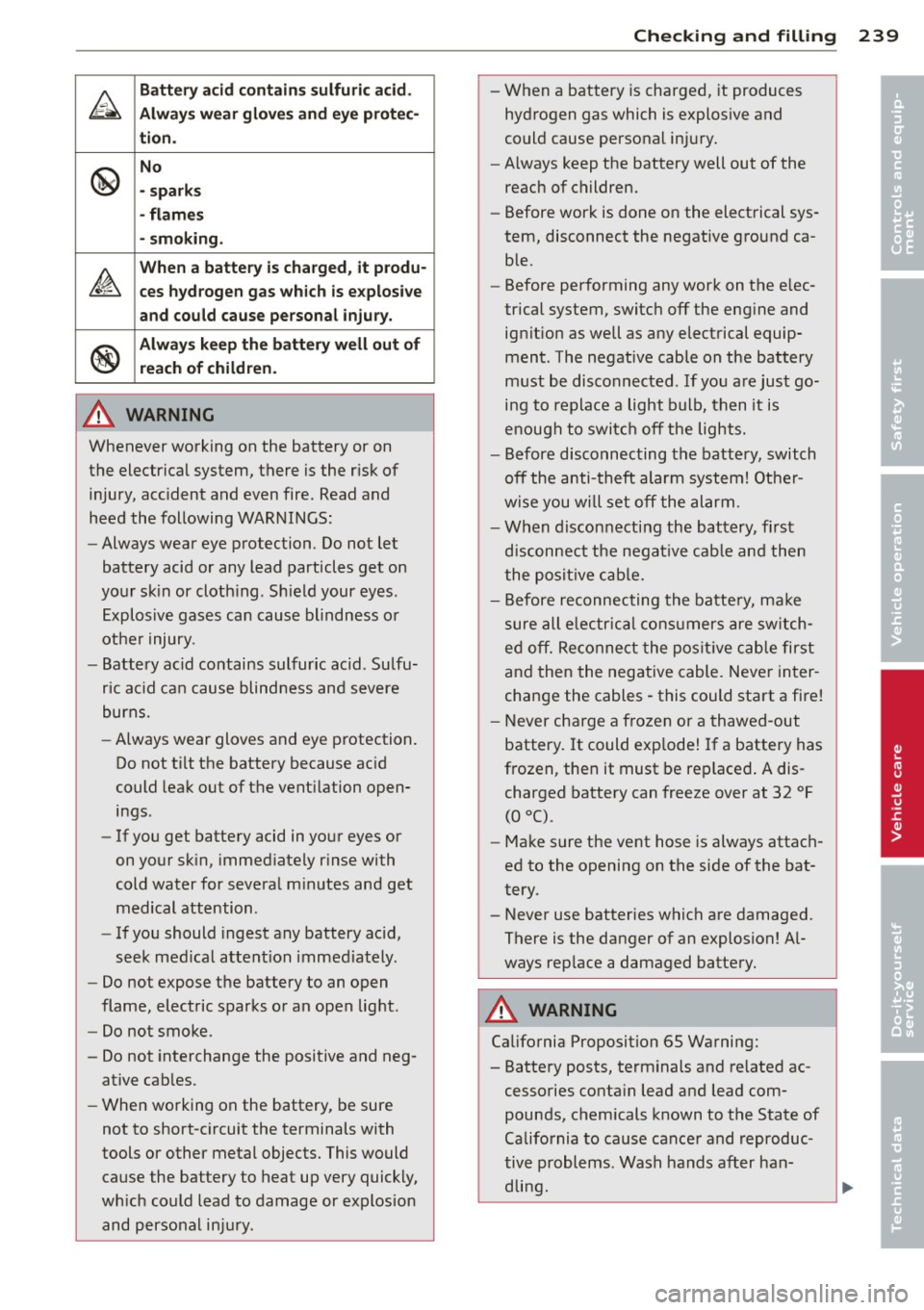
&
Batt ery acid contain s sulfuric acid.
Alw ay s w ea r g lov es and eye protec -
t io n.
@
No
-spa rk s
- flam es
- sm oking .
~
When a b atte ry is ch arged , it p rodu -
ce s hy d roge n ga s wh ich i s exp losi ve
a nd could cause pe rso nal injur y.
®
Alw ay s keep the b atter y well out of
rea ch of children.
A WARNING
Whenever working on the battery or on
the electrical system, there is the r isk of
injury, acc ident and even fire. Read and
heed the following WARNINGS:
- Always wear eye protection. Do not let
battery acid or any lead particles get on
yo ur sk in or cloth ing . Sh ield your eyes.
Explosive gases can cause blindness or
other injury.
- Battery acid contains sulfuric acid . Sulfu
ric acid can cause blindness and severe
burns.
- Always wear gloves and eye p rotection.
Do not tilt the battery because ac id
could leak out of the vent ilation open
ings.
- If you get battery acid in your eyes or
on your sk in, immed iately r inse with
cold water for severa l m inutes and get
medical attention .
- If you should ingest any battery acid,
seek med ical attention immediately.
- Do not expose the battery to an open
flame, electric sparks or an open light.
- Do not smoke.
- Do not interchange the positive and neg-
ative cab les.
- When working on the battery, be sure
not to short-c ircuit the terminals with
tools or other metal objects. This would cause the battery to heat up very quickly,
wh ich could lead to damage or explosion
and personal in jury.
Checkin g and fillin g
-When a battery is charged, it produces
hydrogen gas which is explos ive and
could cause personal injury.
- Always keep the battery well out of the
reach of children.
- Before work is done on the elect rical sys
tem, disconnect the negative ground ca ble.
- Before performing any work on the e lec
trical system, switch off the eng ine and
ignit ion as well as any electrical equip
ment . The negative cable on the battery
must be disconnected. If yo u are just go
ing to replace a light bulb, then it is
enough to switc h off the lights.
- Before disconnecting the battery, switch
off the anti-theft alarm system! Other
wise you wi ll set off the alarm.
- When disconnecting the battery, first
disconnect the negat ive cab le and then
the posit ive cab le.
- Before reconnecting the batte ry, ma ke
sure all e lectr ica l consumers are sw itch
ed off . Reconnect the pos it ive cable first
and then the negative cable. Neve r inter
change the cables - this could start a fire!
- Never cha rge a frozen or a thawed-out
battery.
It could exp lode! If a battery has
frozen, then it must be replaced . A dis
charged battery can freeze over at 32
°F
(0 oc).
- Make sure the vent hose is always attach
ed to the opening on the side of the bat
tery.
- Never use batteries which are damaged.
There is the danger of an explosion! A l
ways rep lace a damaged battery.
A WARNING
Ca lifornia Proposition 65 Warning:
- Battery posts, terminals and related ac
cessories conta in lead and lead com
pounds, chemicals known to the State of
Ca lifornia to cause cance r and reproduc
tive problems. Wash hands after han- dling.
~
239
•
•