ECO mode AUDI A7 2014 Owner's Guide
[x] Cancel search | Manufacturer: AUDI, Model Year: 2014, Model line: A7, Model: AUDI A7 2014Pages: 306, PDF Size: 76.83 MB
Page 209 of 306

@ Tips
The consumption estimates as published by ENVIRONMENTAL PROTECTION AGENCY (EPA) and Transport Canada may not corre
spond to your actual consumption on the
road, wh ic h will vary depend ing upon vehi
cle load and speed, road and weather con
ditions, tr ip length, etc.
Drive smoothly and keep a lookout
ahead
Vehicles use the most fuel when they are ac
celerating.
~ Avoid unnecessary accelerating and braking.
Vehicles use the most fuel when they are ac
celerating . If you anticipate what is go ing to
h appen next, you will need to b rake less and,
thus, accelerate less. Let the vehicle coast
wheneve r poss ible -fo r example when you see
that the nex t tr affic light is red.
Avoid full throttle
Driving at moderate speeds saves fuel and
improves your mileage.
~ T ry and keep well below your car's max imum
speed.
Accelerating gent ly reduces fuel consump
tion, engine wear, and does not dist urb the
environment.
Fuel consumption, exhaust emissions and en
g ine no ise increase d ispropo rtionately at high
speeds. If you dr ive at approxima tely three
q uarters of top speed, fue l consumption will
be red uced by one ha lf. Never dr ive faste r
than the posted speed limit and wea ther con
d itions permit.
Reducing unnecessary idling
E ven when your car is just idling it burns up
fuel.
~ S hu t the engine off when you a re not dr iv ing
t h e vehi cle.
Dri vin g and en vironm ent 207
~ Do not warm up the vehicle by lett ing the
engine run at id le .
T he id ling phase is au toma tic ally red uced for
vehicles with the Start/S top system . It is eff i
cient to switch off the engine in vehicles with
out the Start-Stop-System when stopped at
railroad crossings and long red lights. Turning
the engine off for just 30-40 seconds saves more fuel than is burned by start ing the en-
. . gme again .
It takes a long t ime for the engine to warm up
fully when it is run ning at id le. However, wear
and noxious emissions are especia lly high
when the eng ine is warm ing up. So you should
dr ive away as soon as you start the engine and
avo id running at high rpms whi le the engine is
sti ll warming up.
(L} Note
Do not leave eng ine idling unattended af
ter start ing.
If wa rni ng lights sho uld come
o n t o indi cate improper ope rat ion, t hey
wo uld go unheeded. Extended idlin g also
produces heat, wh ich could res ult in ove r
heating or other damage to the veh icle or
other p roperty .
Regular maintenance
A badly tuned engine unnecessarily wastes a
lot of fuel.
~ Have your ve hicle servi ced at reg ular i nter-
vals .
By havi ng your ve hicle regu la rly se rviced by an
Audi dealer he lps to ensu re tha t it ru ns prop
erly and economically . The condition of your
vehicle not on ly affects its safety and ability to
ho ld its va lue, it a lso affects
fuel consump
tion .
Check your oil each t ime y ou fill your tank.
The amou nt of o il used is re lated to engine
l oad and speed.
It is normal for the oil consumption of a new
engine to reac h its lowest value after a certa in
mileage has been d riven. .,..
•
•
Page 211 of 306

Trailer towing Driving with a trailer
General information
Your Audi was designed primarily for passen
ger transportation .
If you plan to tow a tra iler, p lease remember
that the addit ional load will affect durab ility,
economy and performance .
Trailer towing not on ly places more stress on
the vehicle, it also calls for more concentra
tion from the driver.
F or this reason, a lways fo llow the operating
and driving instructions provided and use
common sense.
(D Note
If you are going to tow a trai ler, you must
ac tivate the trailer operation mode
c::> page 209, Operating instructions.
Technical requirements
Traile r hitch
Use a weig ht-carrying hitch conforming to the
gross trailer we ight. The hitch must be suita
b le for your veh icle and trailer and must be
mounted securely on t he ve hicle's chassis at a
technically sound location . Use only a trail er
hi tch w ith a removab le ball moun t. A lways
check wi th t he tra ile r hi tch man ufa ctur er to
make sure that you are using the cor rect
h itch.
Do not us e a bumper hitch .
The hitch m ust be installed in such a way that
i t does not interfe re with the impac t-absorb
i ng bumper syst em. No mod ificat ions should
b e made to the vehi cle e xhaus t and br ake sys
tems . From t ime to time, check th at a ll hitc h
mo unt ing bo lts rem ain securely fas tened.
When you are not towing a trail er, remove the
tra ile r hi tch ball moun t. T h is prevents the
hi tch from causing damage sho uld your ve hi
cle be str uck from behind~ .&.
Trailer towin g 209
Trailer brakes
If your trailer is equippe d wi th a bra king sys
tem, check to be s ure that i t conforms to all
regulations .
T he trailer hyd ra u lic bra ke sys tem mus t not be
d irec tly connec ted to the vehicle's hydraulic
brake system .
Safety chains
Always use safety chains be tween your ve hicle
and t he tra ile r.
Trailer lights
Trai ler lights must meet all reg ulations. Be
su re to c heck with your Audi dea ler for correct
wir ing, switches and relays .
Mirrors
If you a re unable to see the traffic behind you
u sing the regula r outside mirrors, then you
must insta ll extended mir rors. It is important
t h at you
always have clea r vis io n to the rear.
_&. WARNING
-
Afte r removi ng the trailer hitch , do no t
s tor e i t in yo ur v ehicl e. In case of sudden
b raki ng, the hi tch co uld fly forwar d and in
j ur e you o r yo ur pass enge rs.
Operating instructions
Maximum trailer weight
A tra ile r fo r you r vehi cle is l imited to a typi cal
cla ss 1 o r class 2 tr ailer.
Trailer load distribution
Be sure the load in the tra ile r is held secure ly
in place to p revent it from shift ing fo rward,
ba ckward or sideways.
Never allow a passenger to ride in a trailer
c::> .& in Driving instructions on page 211 .
Engine cooling sy stem
Towing a t railer ma kes the engine wor k hard
er . It is impo rtant that the cooling system's
performance is up to the additional load.
•
•
Page 236 of 306

234 Check ing and filling
@ For the sake of the environment
- Before changing your oil , first make sure
you know where you can properly dispose
of the used o il.
- Always dispose of used engine oil proper
l y. Do not dump it on garden soi l, wood
ed areas, into open streams or down
sewage dra ins.
- Recycle used engine oil by taking it to a
used engine oil collection facility in your
area, or contact a service station .
Engine cooling system
Coolant
The engine coolant performs two functions: it
keeps the engine from overheating and it pro tects the engine from freezing in the winter.
The cooling system is sea led and generally re
q uir es little attention .
The cooling system has been filled at the fac
tory with a pe rmanent coolant which does not
need to be c hanged. The coolant consists of a
mixture of spec ia lly conditioned water and the
manufacturer 's glyco l-b ased coo lant add i-
tive G l3 antifreeze with ant icorrosion addi
tives (50% for USA models ; 60% for Canadian
mod els). This mixture both assures the nec es
sary frost protection and protects metal com ponents in the engine's cooling sys tem from
corrosion and scaling . It a lso raises the boil
ing point of the coolant .
Do not red uce the concentration o f the coo l
ant in the summer by adding plain water.
The
proportion of coolant add itive mu st be at
l e a st 50 % but not more than 60 %
to main
tain antifreez e protection and cooling efficien
cy . If the coolant frost prote ct ion is too low,
the coo lant cou ld freeze and damage the veh i
cle hea ting and eng ine cooling system.
For yea r-round d riving, antifreeze is added at
the fac to ry for temperatures down to:
-- 31°F( -35°C)USA
- -40 °F ( -40 °C) Canada. If
you must add coolant, use a mixture o f wa
ter and coolant additive . Mixing the coo lant
additive with distilled water is recommended.
A WARNING
-
Before you c heck anything in the engine
compartment, always read and heed a ll
WAR NINGS
c::, & in Working in the engine
compartment on page 22
7 .
(D Note
- Before winter sets in, have the coo lant
checked to see if the coolant additive in
your vehicle is sufficient to meet the cli mate conditions . This is especia lly impor
tan t if you live in a reg io n where the win
t er is ex treme ly cold. If ne cessa ry, i n
crease the pr opo rtion of coo lant add itive
t o 60%.
- Whe n adding coolant additive to yo ur
c oolin g sys tem, remembe r:
- We recommend using on ly coolant ad
d itive Gl2++ or Gl3 (check the label)
for your vehicle . This coolant additive is
ava ila ble at autho rized Aud i deale rs.
Other types of antifreeze ca n sig nifi
ca ntly reduce co rr os io n protection. The
r es ult ing co rrosion c an c ause a los s o f
coolant and serious engine damage.
- Do not add any type of rad iator leak seal
a n t to y our vehicle 's engine coolant.
Add ing radiator repai r fl uid may adverse
ly affect the function and performance of
your cooling system and co uld resu lt in
damage not covered by yo ur New Vehicle
Limited Warranty.
-
Page 239 of 306
continue to run until the coolant temper
ature drops.
Brake fluid
Checking brake fluid level
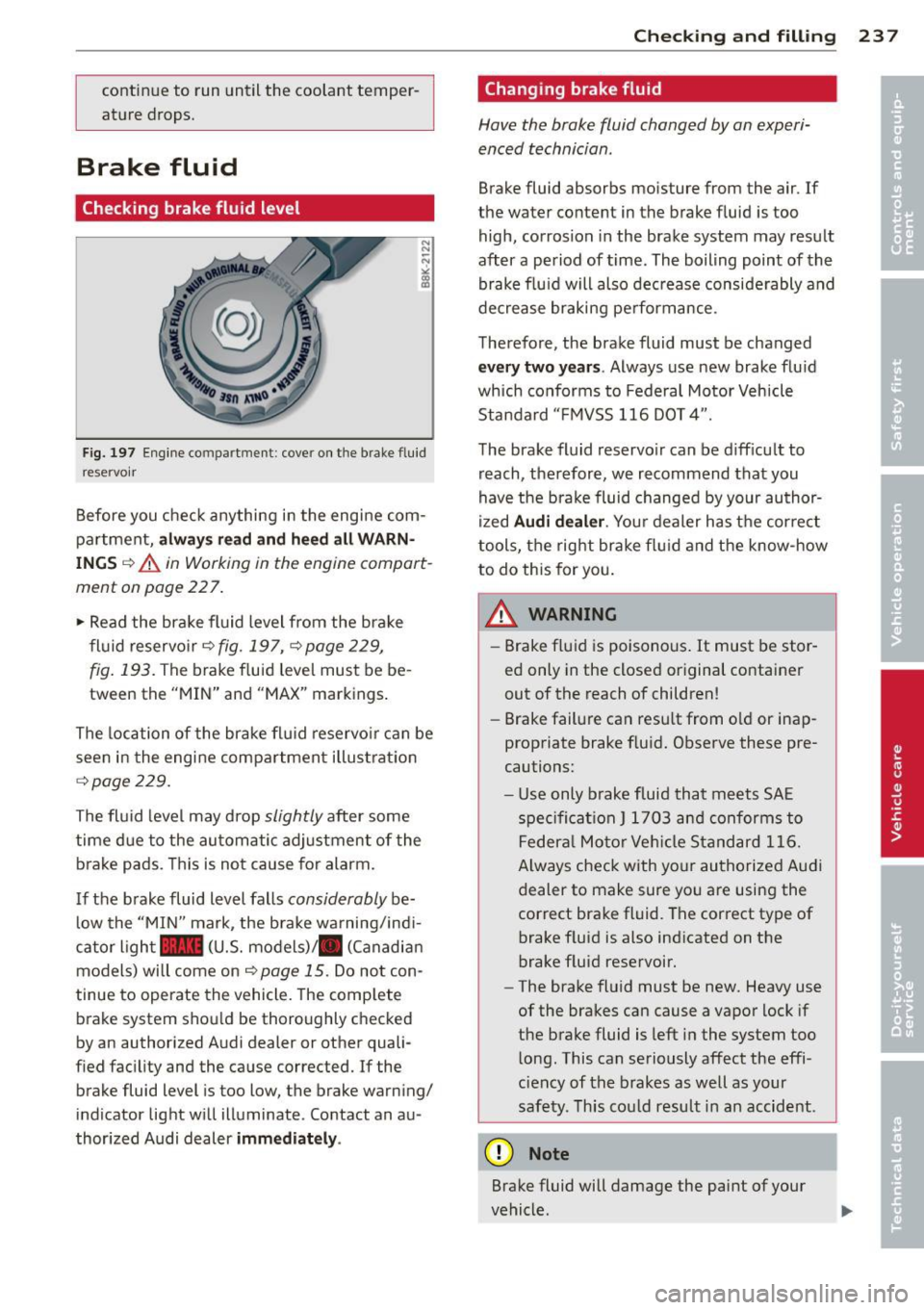
Fig. 197 E ngine co mpartment : cove r on the b rake fluid
r ese rvoir
Before you check anything i n the engine com
partment,
a lw ays read and heed all W ARN
ING S 9 A in Working in the engine compart
ment on page
22 7.
~ Read the brake fluid level from the brake
fluid reservoir
9 fig . 197, 9 page 229,
fig. 193.
The brake fluid level must be be
tween the "MIN" and "MAX" markings .
The location of the brake fl uid reservo ir can be
seen in the engine compartment illustrat ion
9 page229.
The fluid level may drop slightly after some
time due to the automatic adj ustment of the
b rake pads. This is not cause for alarm.
I f the brake fluid level falls
considerably be
l ow the "MIN " mark, the brake wa rning/indi
cator ligh t
1111 (U.S. models)/ . (Canadia n
models) will come on~
page 15 . Do not con
tinue to operate the vehicle. The comp lete
brake system shou ld be thoroughly checked
by an authorized Audi dealer or other quali
f ied fac ility and the cau se corrected.
If the
brake fluid level is too low, the brake warning/
indicator light will illuminate . Contact an au
thor ized Audi dealer
imm ediat ely .
Checkin g and fillin g 237
Changing brake fluid
Have the brake fluid changed by an experi
enced technician .
Brake fluid absorbs mois ture from the air. If
the wa ter content in the brake fluid is too
high , corrosion in the brake system may result
after a period of time . The boiling point of the
brake flu id will also dec rease considerably and
decrease braking pe rformance.
Therefore, the brake fluid must be changed
ev ery two years. Always use new brake flu id
which conforms to Federal Motor Vehicle
Standard "F MVSS 116 DOT 4 ".
The brake fluid reservo ir can be d iff icult to
reach, the refore, we recommend that you
have the brake fluid changed by your author
i zed
Audi dealer . Your dealer has t he correct
tools, the right brake fl uid and the know-how
to do this for you.
A WARNING
-
- Brake fluid is poisonous . It must be stor
ed only in the closed original container
out of the reach of children!
- Brake failure can resu lt from o ld or inap
propriate brake f luid. Observe these pre
cautions:
- Use only brake fluid that meets SAE
spec ificat ion
J 1 7 03 and conforms to
Federa l Moto r Ve hicl e Standard 116.
Always check with yo ur authorized Audi
dealer to make sure yo u are using the
correct bra ke fluid. The correct type of
brake f luid is also indicated on the
brake fluid reservoir.
- The brake fluid must be new. Heavy use
of the brakes can cause a vapor lock if
the brake fluid is left in the system too
l ong . This can seriously affect the effi
c iency of the brakes as well as your
safety. Th is cou ld resu lt in an accident .
(D Note
Brake fluid will damage the paint of your
vehicle .
.
Page 250 of 306

248 Tires and wheels
Bear in mind that the tire press ure monitoring
system* can only monitor the tire pressures
you have stored . The system does not recog
n ize the load condit ion of yo ur vehicle.
T he effectiveness of the tire p ressu re monitor
ing system * will be impaired if you store nor
mal load pressures but the n operate the vehi
cle at its max imum load
c:> &. .
See the i llustra tion c:> fig. 2 00 for the location
of the la b el on dr iver's side B-pillar (co lor of
the act ua l labe l and exact location on the ve
h icle w ill vary slig htly).
Model / Tire designation
Note that the fo llowing ta ble is acc urate at
t h e time of going to press and is s ubject to
c h ange . In the event of d iscrepancies, the t ire
pressure label is located on the d river's side B
pillar always takes precedence.
T he table below lists t he recommen ded cold
t ir e inflat ion pressu res for the Audi mode l
cove red by your Owner's Lite rat ure at the vehi
cle's capacity weig ht and the t ire sizes instal
l ed on the respective models as or ig inal
equipmen t, or as a factory opt ion.
Tire pressure
Engine normal load condition full load condition
fronta > reara
>
front rear
PSI kPA PSI kPA PSI kPA PSI kPA
A7 : 235/55 Rl 7 99Y
32 220 29 200 35 240
38 260 3.0 liter High Performance
6-cylinder 255/45 R18 99H
All Season
3 2 2 20 29 200 35 24 0 3 8 260
255/45 Rl8 99Y 32 220 29 200
35 2
4 0
38 260
High Perfo
rmance
255 /40 R19 lOOH XL
35 240 32 220 38 260 280 All Season 4 1
255/40 Rl9100YXL
36 2 50 32 220 38 260 41 280 High Performance
265/35 R20 99H XL
35 240
32 220 38 260 41
280 All Season
265 /35 R20 99Y XL
36 250 32 22 0 38 26 0 41 280 High Performance
S7: 255/40 Rl9 lOOY XL
39
270
33 230
42 290 42 290 4.0 liter High Performance
a-cylinder 265/35 R20 99V XL
High Performance
41 280 35 240 44 300 44 300
XL= reinforced or extra load tire. It may also appear as xl, EXTRA LOAD, or RF on the tire side-
wall.
al no
rm al load co ndi tio n r:::., page 24 7.
The correct tire pressure for the spare wheel is
l ocated o n a label o n the dr ive r's side B -pillar .
Because technical changes may be made to
ve hicle equ ipment dur ing the model year, a l
ways compare the tire size designation on the
tire pressure labe l on your vehicle w it h the t
ires on you r vehicle. Make sure that the tire
s ize informa tion on the vehicle labe l is the
same as the size o f the tires on the veh icle .
Page 262 of 306

260 Tire s and wheel s
chains because the vehicle will be ex
tremely low. If you do drive with snow
chains on while the vehicle is at this lev
el, the snow chains might severe ly dam
age the wheelhouse and other parts of
the veh icle.
(D} Tips
Where snow chains are mandatory oncer
tain roads, this normally also applies to
veh icles with all-wheel dr ive.
Wheel bolts
Wheel bolts must always be tightened to the
correct torque .
The design of whee l bolts is matched to the
factory installed r ims. If different rims
are fit
ted, the correct wheel bolts with the right length and correctly shaped bolt heads must
be used. This ensures that wheels are fitted
secure ly and that the brake system functions
correctly .
In certain circumstances, you may not use
wheel bolts from a different vehicle -even if it
is the same mode l
¢page 287.
_& WARNING
Imprope rly tig htened o r maintained whee l
bolts can be come loose ca using loss of
contro l, a co llision and serious persona l in
jury.
- Always keep the wheel bol ts an d the
threads in the wheel hubs clea n so the
wheel bolts can tu rn easily and be prop
er ly tightened .
- Never grease or oil the wheel bo lts and
the threads in the wheel h ubs. They can
become loose w hile driving if greased or
oiled, even if tightened to the specif ied
torque.
- Only use wheel bolts that belong to the rim being installed.
- Never use different whee ls bolts on your
vehicle.
- Always maintain the correct tighten ing
torq ue for the wheel bo lts to reduce the risk of a whee
l loss. If the tightening tor
que of the wheel bolts is too low, they
can loosen and come out when the vehi
cle is mov ing. If the tighte ning torque is
too high, the wheel bolts a nd threads
can be damaged and the whee l can be
come loose.
([) Note
The specified torque for the whee l bolts is
90 ft lb (120 Nm) with a tolerance of± 7,4
ft lb(± 10 Nm). Torque whee l bolts diago
nally. Afte r changing a whee l, the torque
must be checked as soon as possible wi th a
torque wrench -pre ferably by an au thor
ized Audi dealer or qualified workshop .
Low aspect ratio tires
Your Audi is factory-equipped with low aspect
ratio tires. These tires have been thoro ughly
tested and been se lected specifically for your
model for their superb performance, road fee l
and hand ling u nder a var iety of d riv ing condi
t ions . As k your author ized Audi dealer for
more details.
The low aspect ratio of these tires is ind icated
by a numeral of
55 or less in the tire's s ize
designation . The numeral rep resents the ratio
of the t ire's s idewa ll height in relation to its
t read width ex pressed in percentage. Conven
t iona l tires have a he igh t/w idth rat io of 60 or
more.
The performanc e of low -a sp ec t-ratio tires i s
pa rticularly sensitive to improper inflation
pre ssure . It is therefore important that low
a spect ratio tires are inflated to the specified
pre ssure and that the inflation pressure i s
regularly checked and maintained. Tire pre s
sures should be checked at least once a month and always befo re a long trip
¢ page 249, Checking tire pressure .
What you can do to avoid tire and rim
damage
Low aspect ratio tires can be damaged more
easily by impact w ith potholes, curbs, gull ies .,..
Page 267 of 306
-Never use the jack s upplied with your
Audi on another vehicle, particularly on a
heavier one. The jack is only suitable for
use on the vehicle it came w ith.
@ Tips
- Some of the on board items listed above
are provided on certain mode ls only or
are optional extras.
- Before you can raise your vehicle using
the jack, you must activate the jack ing
mode
c:> page 268.
Space-saving spare tire (compact spare
tire)
The spare tire/wheel is located in the luggage
compartment under the cargo floor cover . It
is intended for short-term use only.
Taking out the sp are tire
... Fold the floor to the seatback with the help
of the handle.
... Turn the large screw~
page 264, fig . 208
counter-clockw ise .
.,. Take out the spare tire .
.,. Always store the vehicle too l kit, the jack*
and the replaced tire in the l uggage com
partment
c::> page 136 .
Using the spare tire (compact spare tir e)
The compact spare tire is only intended for
emergenc ies until you can reach a repair shop.
Replace it as quick ly as poss ible with a stand
ard wheel and t ire.
There are some restrict ions on the use of the
compact spare t ire. The compact spare t ire
h as been des igned specifically for you r type of
veh icle. It must not be swapped wi th a com
pact spare tire from another type of vehicle .
Snow chains
For technica l reasons, the use of snow chains
on the compact spare tire is
not p ermitt ed .
If you do have to dr ive with snow chains and a
front tire fails, mount the spare wheel w ith
tire instead of a rear t ire . Install the snow
What do I do now? 265
chains on the rear tire and use it to rep lace
the defective front tire .
A WARNING
-Never use the spare t ire if it is damaged
or if it is worn down to the tread wear in
dicators.
- If the spare tire is more than 6 years old,
use it only in an emergency and with ex
treme caution and careful driv ing.
- The spare tire is intended only for tem
porary and short-term use . It should be
replaced as soon as poss ible with the
normal wheel and tire .
- After mounting the compact spare t ire,
the t ire pressure must be checked as
soon as possible . The tire pressure of the
compact spare t ire must be 4. 2 bar; oth
erwise, you risk having an a ccident.
- Do not dr ive faster than SO mph (80 km/
h). You ris k having an accident .
- Avoid full-throttle acceleration, heavy
brak ing, and fast cornering. You risk hav
ing an accident .
- Never drive using more than one spare
wheel and ti re. You r is k having an acci
dent.
- Normal summer or winter t ires must not
be mounted on the compact spare wheel
rim.
- For technical reasons, the use of tire
chains on the spa re tire is not permitted .
If i t is necessary to d rive with t ire chains,
the spare wheel must be mounted on the
front ax le in the event of a flat in a rear
tire. The newly available front whee l
must then be insta lled in place of the
rear wheel w ith the flat tire. Installing
the t ire cha in before mounting the whee l
and tire is recommended .
- Loose items in the passenger compart
ment can cause serious personal injury
during hard brak ing or in an accident.
Never store the inflatable spare tire or
jack and tools in the passenger compart ment. •
•
Page 268 of 306
266 What do I do now?
Changing a wheel
Before changing a wheel
Observe the following precautions for your
own and your passenger's safety when chang
ing a wheel .
... After you experience a tire failure, pull the
car well away from moving traffic and try to
reach
level ground before you stop o ,&.
... All passengers should leave the car and
move to a safe location (for instance, behind
the guardrail)
o A-
.. Engage the parking brake to prevent your
vehicle from rolling unintentionally
o ,&.
... Move selector lever to position Po ,& .
• If you are towing a trailer, unhitch the trailer
from your vehicle .
... Take the
jack and the spare tire out of the
luggage compartment
o page 264,
o page265.
A WARNING
You or your passengers could be injured
while changing a wheel if you do not fol
low these safety precautions:
- If you have a flat tire,
move a safe dis
tance off the road. Turn off the engine,
turn the emergency flashers on and use
other warning devices to alert other mo
torists.
- Make sure that passengers wait in a safe
place away from the vehicle and well
away from the road and traffic.
- To help prevent the vehicle from moving
sudden ly and possibly slipping off the
jack, always fully set the parking brake
and block the wheel diagonally opposite
the wheel being changed . When one
front wheel is lifted off the ground, plac
ing the Automatic Transmission in P
(Park) will
not prevent the vehicle from
moving.
- Before you change a wheel, be sure the
ground is level and firm.
If necessary,
use a sturdy board under the jack.
-
-Always store the vehicle tool kit, the jack
and the replaced tire in the luggage com
partment
opage 136.
@ Tips
Before changing the whee l, you must acti
vate the jacking mode, so that the auto
matic controls for the Adaptive Air Sus
pension* do not make it more difficult to
lift the vehicle with the jack
o page 268 .
Changing a wheel
When you change a wheel, follow these
quence described below step-by-step and in
exactly that order.
l. Activate the vehicle jack mode*
opage 268 .
2. Remove the decorative wheel cover* . For
more details see also
o page 267, Deco
rative wheel covers
or o page 267,
Wheels with wheel bolt caps.
3. Loosen the wheel bolts o page 268.
4. Locate the proper mounting point for the
jack and align the jack below that point
opage 268.
5. Raise the car with the jack o page 268.
6. Remove the wheel with the flat tire and
then install
the spare opage 270.
7. Tighten all wheel bolts lightly .
8.
Lower the vehicle with the jack .
9 . Use the wheel bolt w rench and
firmly
tighten all wheel bolts o page 268.
10. Replace the decorative wheel cover*.
11. Deactivate the vehicle jack mode * in the
MMI:
I CARI function button > (Ca r)* sys
tems
control button > Servicing & checks
> Air susp.: jack mode > Off.
The vehicle jack mode* switches off automati
ca lly at speeds above 6 mph (10 km/h) .
A WARNING ,-
Always read and follow all WARNINGS and
in format ion
o .&. in Raising the vehicle on
page 269
and opage 271.
Page 274 of 306

272 Fuses and bulbs
Fuses and bulbs
Fuses
Replacing fuses
Fuses that have blown will have metal strips
that have burned through.
Fig. 218 Dr iver side of the cockpit: fuse panel cover
The fuses are located at the front left and
right of the cockpit and behi nd the trim on
the right side of the luggage compartment.
• Switch the ign ition and the affected electri
c al equ ipment off.
• Check the following table to see which fuse
belongs to the consumer.
• Remove the cover ¢
fig. 218 or¢ page 223,
Opening the side trim.
• To remove the purple plast ic clip if necessa
ry
ll, hold onto it at the small side and pull
i t out of the fuse panel
c:> page 2 72 ,
fig. 219 .
• Remove the clamp from the rea r side of the
fusecover <>fig.
218.
• Remove the fuse using the cla mp and re
pla ce the blown fuse w ith an ident ical new
one.
A WARNING
Do not repair fuses and never rep lace a
blown fuse with one that has a higher amp
rating. This can cause damage to the e lec
trical system and a fi re.
ll You can dis pose of the plastic clip after removing it.
(D Note
If a new fuse burns out again after shortly
have you have installed it, have the electri
ca l system checked by yo ur authorized
Audi dealer.
(D Tips
- The following table does not list fuse lo
cations that are not used .
- Some of the equipment items listed are
optional or only available on certain
model configurations.
Driver side cockpit fuse assignment
Fig . 219 Dr iver side cockpit: fuse pa nel w ith plast ic
bracket
Fuse panel ® (blac k)
No. Equipment Amps
Switch panel, electromechan ica l
1 parking brake, seat heating, 5
starting assist, control module
2 Automatic d imm ing in terior
5 rea rview mirro r, horn
3 Exhaust system (diesel engine) 10
Page 279 of 306
@ Tips
The disc harged battery must be properly
connected to the vehicle's electrical sys
tem. When jump starting or charg ing the
battery, never connect the negative
ground cable to the battery negat ive post
because the ba ttery manager system must
be ab le to detect the battery's state of
charge. Always connect the negative
g round cab le to the negative ground pos t
of t he battery manager cont ro l unit.
Use of jumper cables
Make sure to connect the jumper coble
clomps in exactly the order described below!
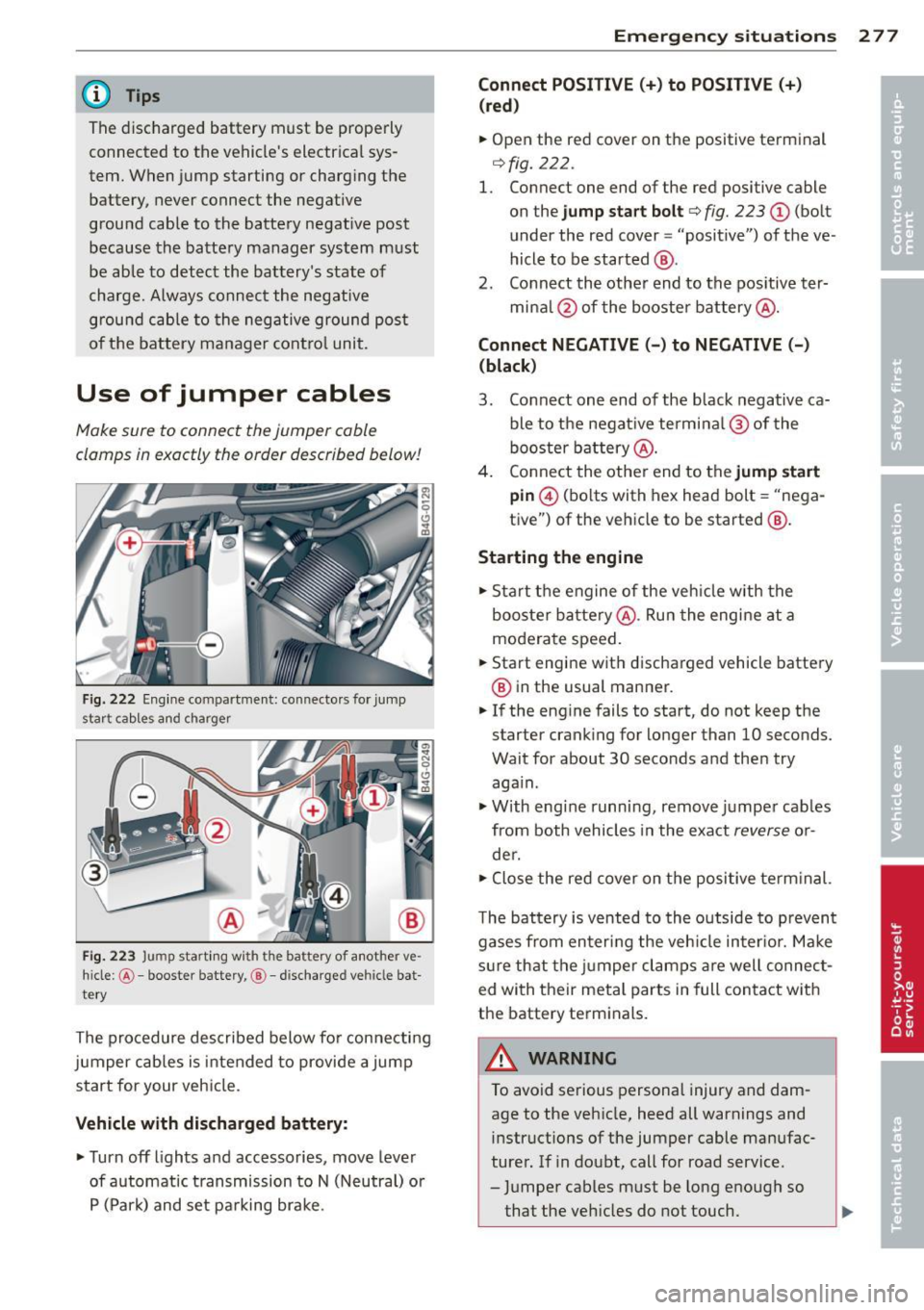
Fi g. 222 Eng ine compar tment: connecto rs for jum p
start cables and charger
F ig. 223 Jump starting w ith the battery of a nother ve ·
hicle:
@ -booster battery, ®-discharged veh icle bat
te ry
The procedure described below fo r connecting
jumper cables is intended to provide a jump
start for your veh icle.
Vehicle with discharged battery :
• Turnoff lights and accessories, move lever
of automatic t ransmission to N (Neutral) o r
P ( Par k) and set pa rking brake.
Emergenc y situ ation s 2 77
Connect POSI TIVE(+) to POSITIVE(+)
(red )
• Open the red cover on the positive te rminal
¢fig. 222.
1. Connect one end of the red positive cable
on the jump sta rt bolt ¢
fig. 223 (D (bolt
under the red cover = "positive") of the ve
hicle to be started @.
2. Co nnect th e othe r end to the pos itive ter-
mi na l@ of the booster battery @.
Connect NEGATIVE( -) to NEGATIVE(-)
(black )
3. Connect one end of the black negative ca ble to the negat ive termi na l@ of the
booster b attery @.
4. Connect the othe r end to the jump start
pin @ (bo lts with hex head bolt = "nega
tive") of the vehicle to be started @.
Starting the engine • Sta rt the engine of the veh icle w ith the
booste r ba tte ry @ . Ru n the engine at a
moderate speed.
• Start engine wit h discharged vehicle battery
@ in the usual manner.
• If the eng ine fails to start, do not keep the
starter cranking for longer than 10 seconds.
Wait for about 30 seco nds a nd the n try
aga in .
• With eng ine runni ng,
remove ju mpe r cab les
from both vehicles in the exact
reverse o r
de r.
• Close the re d
cover on the positive te rm inal.
T he battery is v ented to th e outside to p rev ent
gases from en ter ing the veh icle in ter io r. Ma ke
s ur e th at the j umper clamps are well connec t
ed with their meta l parts in full con ta ct w ith
the battery term inals.
,8. WARNING
To avoid se rious personal injury and dam
age to the veh icle, heed all warnings and
instructions of the jumper cable man ufac
ture r. If in doubt, call for road service.
- Ju mpe r cables m ust be long enough so
that the veh icles d o not touch.
-