seats AUDI A7 2014 Workshop Manual
[x] Cancel search | Manufacturer: AUDI, Model Year: 2014, Model line: A7, Model: AUDI A7 2014Pages: 306, PDF Size: 76.83 MB
Page 189 of 306
and child against the backrest, center
armrest, door or roof.
- Always install rear-facing child safety
seats or infant carriers on the rear seat.
- Forward-facing child safety seats or in
fant carriers installed on the front pas
senger's seat may interfere with the de
ployment of the airbag and cause serious
injury to the child.
- It is safer to install a forward-facing
child safety seat on the rear seat .
- Always read and heed all WARNINGS whenever using a child restrained in ave
hicle is being used¢
page 175. Special
precautions apply when installing a child
safety seat on the front passenger seat
¢ page 151, Child restraints on the front
seat -some important things to know.
A WARNING
Always take special precautions if you
must install a forward or rearward-facing
child restraint on the front passenger's
seat in exceptional situations:
-Whenever a forward or rearward-facing
child restraint is installed on the front
passenger seat, the
PASSENGER AIR
BAG OFF
light must come on and stay on
whenever the ignition is switched on.
- If the
PASSENGER AIR BAG OFF light
does not come on and stay on, perform
the checks described ¢
page 161, Moni
toring the Advanced Airbag System.
- Take the child restraint off the front pas
senger seat and install it properly at one
of the rear seat positions if the
PASSEN
GER AIR BAG OFF
light does not stay on
whenever the ignition is switched on.
- Improper installation of child restraints
can reduce their effectiveness or even
prevent them from providing any protec
tion.
- An improperly installed child restraint
can interfere with the airbag as it de
ploys and seriously injure or even kill the
child.
Child Safety 187
- Always carefully follow the manufactur
er's instructions provided with the child
safety seat or carrier.
- After checking to make sure that the
child restraint is properly installed, make
certain that the child restraint is correct ly recognized by the capacitive passenger
detection system in the front passenger
seat and that the
PASSENGER AIR BAG
OFF
light signals the correct front pas
senger frontal airbag status.
A WARNING
Forward-facing child restraints:
- Always make sure the forward-facing
seat has been designed and certified by
its manufacturer for use on a front seat
with a passenger front and side airbag.
- Never put the forward-facing child re
straint up, against or very near the in
strument panel.
- Always move the passenger seat into its
rearmost position in the seat's fore and
aft adjustment range, as far away from
the airbag as possible before installing
the forward-facing child restraint. The
backrest must be adjusted to an upright
position .
- Make sure that the
PASSENGER AIR BAG
OFF
light comes on and stays on all the
time whenever the ignition is switched
on .
.8. WARNING
Rearward-facing child restraints:
- A child in a rearward -facing child safety
seat installed on the front passenger
seat will be seriously injured and can be killed if the front airbag inflates -even
with an Advanced Airbag System .
- The inflating airbag will hit the child
safety seat or infant carrier with great
force and will smash the child safety seat
and child against the backrest, center
armrest, door or roof.
•
•
Page 191 of 306
now be used as an ordinary safety belt with
out the convertible locking retractor for child
restra ints.
I f the convertible locking retractor shou ld be
activated inadvertently, the safety belt must
be unfastened and guided completely back in
to its stowed position to deactivate this fea
ture.
If the convertib le locking retractor is not
deactivated, the safety belt will gradually be
come tighter and uncomfortable to wear .
A WARNING
Improperly installed child safety seats in
crease the risk of ser ious personal injury
and death in a collision.
- Never unfasten the safety belt to deacti
vate the convert ible lock ing ret ractor for
c hild restraints while the veh icle is mov
ing. You would not be restrained and
cou ld be ser iously injured in an accident.
- Always read and heed all WARN INGS
whenever using a child rest rained in ave
hicle is being used
¢page 175. Special
precautions apply when installing a chi ld
safety seat on the front passenger seat
¢ page 151, Child restraints on the front
seat -some important things to know.
LATCH Lower
anchorages and tethers
for children
Child Restraint System anchors and how
are they related to child safety
To provide a s imp le r and more pract icable way
to attach the ch ild res traint on the veh icle
seat, Federa l regu lations require specia l lower
anchorages in vehicles and devices on new
chi ld restraints to attach to the vehicle ancho
rages.
The combination of the tether anchorages and
the lower anchorages is now generally called
the
LA TCH system for "Lower Anchorages and
T ethers for Children."
F orward- facing child restraints manufactured
after September 1, 1999, are required by U.S.
Child Sa fet y 189
federa l reg ulations to comply with new child
head movement performance requirements.
These new performance requirements make a
tether necessary on most new child seats.
Installing a ch ild restra int that requires a top
tethe r without one can seriously impair the
performance of the c hild restra int and its abil
ity to protect the child in a collis ion. Insta lling
a child restraint that requires a top tether
without the top tether may be a violat ion of
state law.
Child restraint manufacturers offer LATCH
lower anchorages on their child seats with
hook-on or push-on connectors attached to
adjustable straps.
In add ition to the LATCH lower anchorages,
these child restraint systems usually require
the use of tether straps to help keep the ch ild
restraint firmly in place.
A WARNING
Imp roper installat ion of child restra ints
will increase the r isk of injury a nd death in
a cr ash.
- Always follow the instr uctions provided
by the manufa cture r of the child re
s traint yo u intend to install in your vehi
cle.
- Never inst all a child restraint withou t a
properly attached top tether strap if the
child restraint manufacturer's instruc
tions require the top tether strap to be
used.
- Improper use of child rest raint LATCH
lowe r ancho rage points can lead to injury
in a collision. The LATCH lower anchorage
points are designed to withstand on ly
those loads imposed by correctly fitted
child restraints.
- Never mount two child restra int systems
on one LATCH lower anchorage point.
- Never secure or attach any luggage or
other item to the LATCH lower anchorag-
-
es. Ill-
•
•
Page 192 of 306
190 Child Safety
@ Tips
-In Canada, the terms "top tether" with
"lower universal anchorages" (or "lower
universal anchorage bars") are used to
describe the system.
- In other countries, the term "ISO FIX" is
used to describe the lower anchorages.
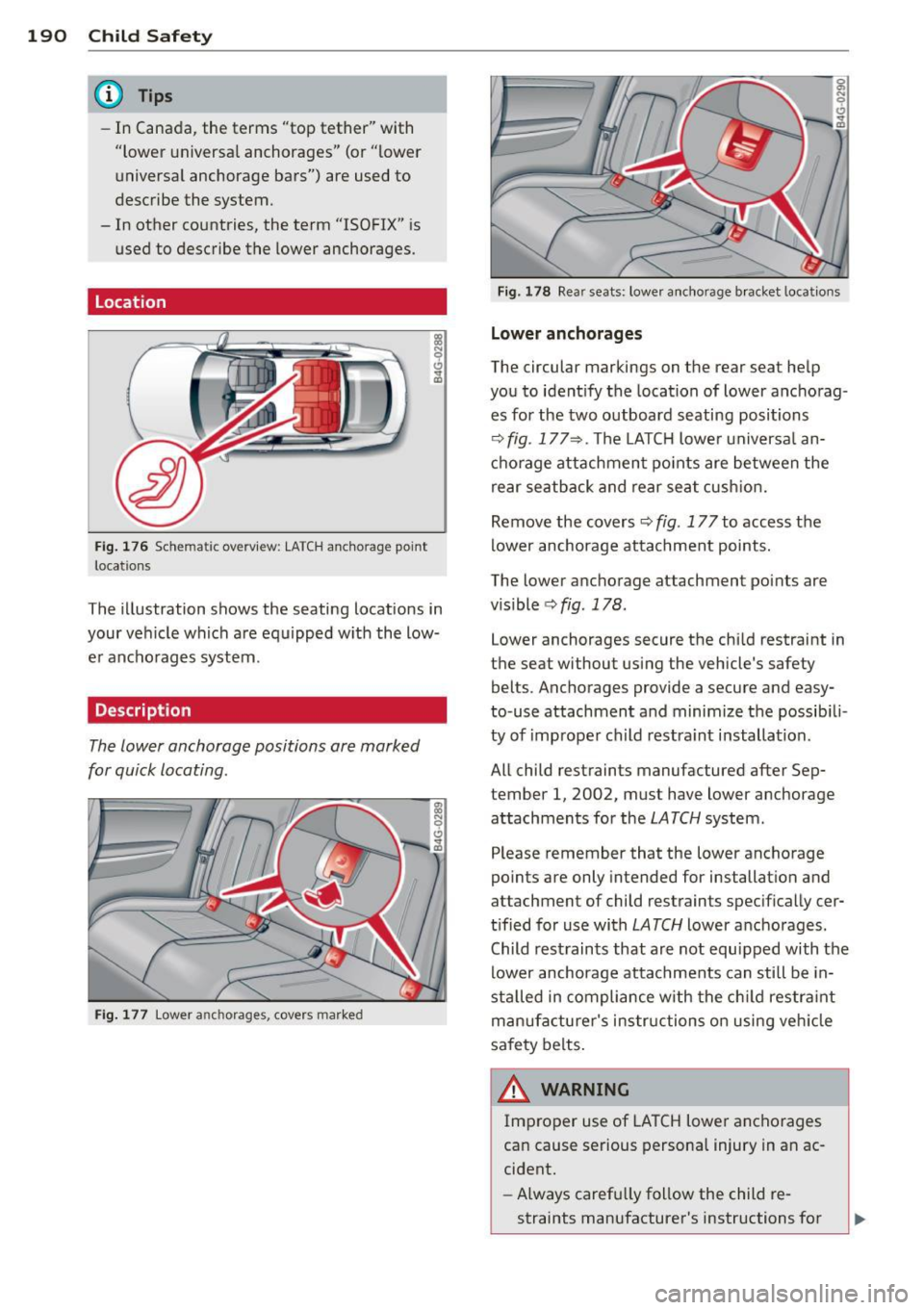
Location
Fig. 176 Schemat ic overview: LA TCH ancho rage point
l ocat ions
The illustration shows the seating locations in
your veh icle which are equipped with the low
e r anchorages system.
Description
The lower anchorage positions are marked
for quick locating .
Fig. 177 Lower a nch orages, covers marked
Fig. 178 Rear seats: lower anchorage bracket locations
Lower anchorages
The circular markings on the rear seat help
you to ident ify the location of lower anchorag
es for the two outboard seating positions
~ fig . 177-=* . The LAT CH lowe r universa l an
chorage attachmen t points are between the
rear seatback and rear seat cushion.
Remove the covers ~
fig. 177 to access the
lower anchorage attachment points.
The lower anchorage attachment points are
visible
c:> fig . 178.
Lower anchorages secure the chi ld restraint in
the seat without using the vehicle 's safety
belts. Anchorages provide a secure and easy
to -use attachment and minimize the possib ili
ty of improper child restraint installation .
All child restraints manufactured after Sep
tember 1, 2002, must have lower anchorage
attachments for the
LATCH system .
Please remember that the lower anchorage
po ints are only intended for installat ion and
attachment of child restraints spec ifically cer
tified for use with
LATCH lower anchorages .
Child restraints that are not equipped with the
lower anchorage attachments can still be in
sta lled in compliance w ith th e child restra int
manufactu rer's instr uctions on using veh icle
safety belts.
A WARNING
-
Improper use of LATCH lower anchorages
can cause serious personal injury in an ac
cident.
- Always carefully follow the child re
straints manufacturer's instructions for
Page 193 of 306
proper installation of the child restraint
and proper use of the lower anchorages
or safety belts in your vehicle.
- Never secure or attach any luggage or
other items to the LATCH lower ancho
rages.
- Always read and heed the important in formation about child restraints in this chapter and WARNINGS ¢
page 175,
Child Safety.
Installing a child restraint with LATCH
lower anchorages
Whenever you install a child restraint always
follow the child restraint manufacturer's in
structions.
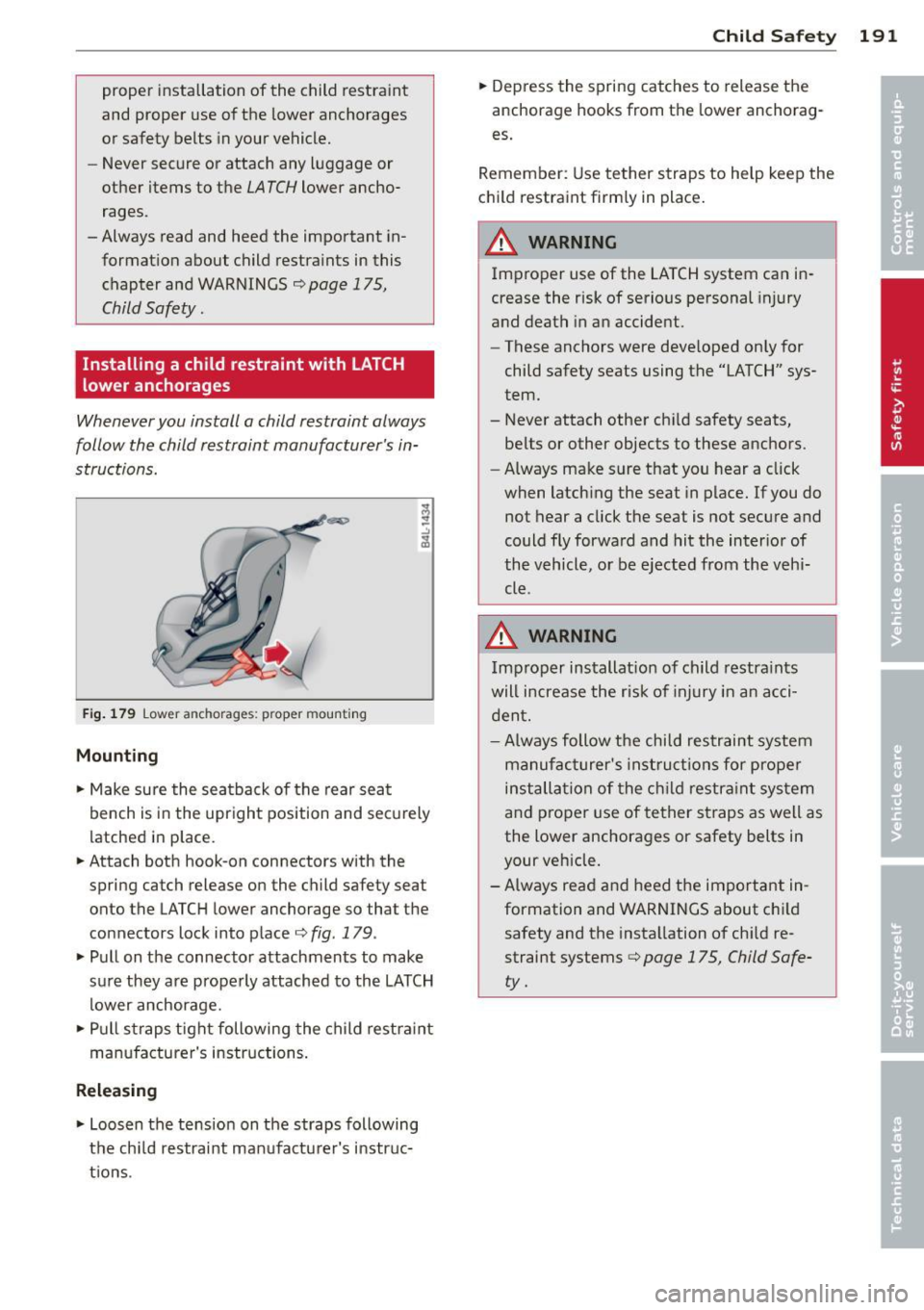
F ig . 179 Lower anchorages: p roper mount ing
Mounting
.. Make sure the sea tback of the rear sea t
bench is in the upr ight position and sec urely
latched i n place.
.. Attach both hook -on connectors with the
spring catch release on the ch ild safety seat
onto the LATC H lower anchorage so that the
connectors lock into p lace¢
fig . 179 .
.. Pull on the connector attachments to make
s u re they a re properly attached to the LATCH
lower anchorage .
.. Pull straps tight following the child restra int
manufacturer's instructions .
Releasing
.. Loosen the tension on the straps following
the ch ild restrai nt manufactu rer's instruc
tions .
Child S afety 191
.. Depress the spring catches to release the
anchorage hooks from the lower anchorag
es.
Remember: Use tether straps to help keep the
c h ild restra int firmly in place .
& WARNING ~
Improper use of the LATCH system can in-
crease the risk of serious personal injury
and death in an accident.
- These anchors were deve loped only for
child safety seats using the "LATCH" sys
tem.
- Never attach other ch ild safety seats ,
be lts or other objects to these anchors.
- Always make sure that you hear a click
when latch ing the seat in place. If you do
not hear a click the seat
is not secure and
could fly forwa rd and hit the interior of
the vehicle, or be e jected from the veh i
cle .
& WARNING
Imp roper installat io n of ch ild restra ints
will increase the risk of injury in an acci
dent.
- Always follow the child restraint system
manufac turer's in st ruc tions for prope r
installa tion of the c hild restr aint system
a nd p roper use of te ther s traps as well as
the lower anchorages or safety belts in
your veh icle .
-Always read and heed the important in formation and WARNINGS about chi ld
safety and the insta llation of ch ild re
straint systems¢
page 175, Child Safe
ty.
-
Page 194 of 306
192 Child Safe ty
Tether anchors and tether straps
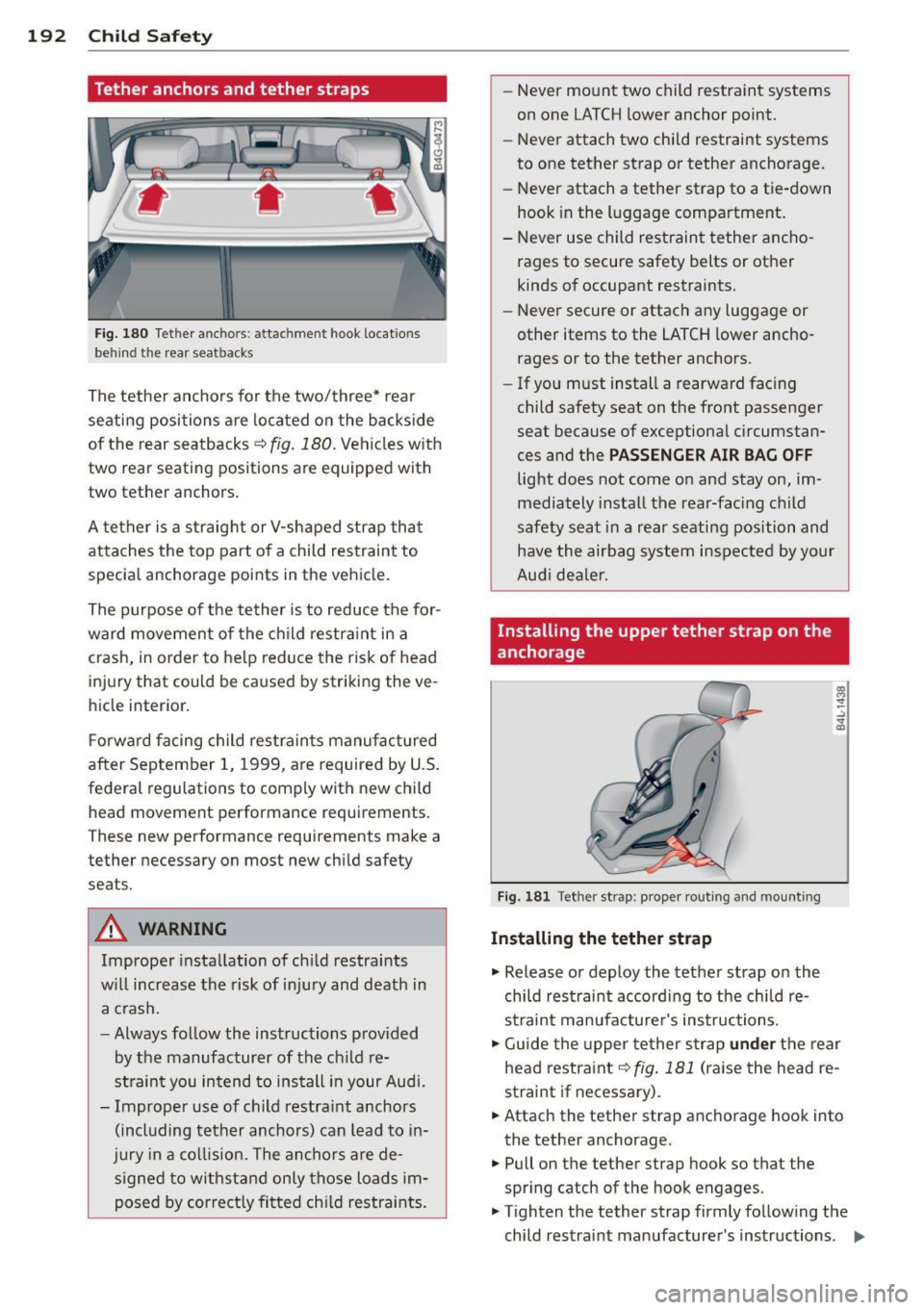
Fig. 180 Tether ancho rs: attachment hook locations
behind the rear seatbacks
The tether anchors for the two/three* rear
seating positions are located o n the backside
of the rear seatbacks ¢
fig. 180. Vehicles with
two rear seating positions are equipped with
two tether anchors.
A tether is a straight or V-shaped strap that attaches the top part o f a child restraint to
specia l anchorage points in the veh icle.
The purpose of t he tether is to reduce the for
ward movemen t of the ch ild restra int in a
crash, in order to help reduce the risk of head
injury that could be caused by striking the ve
hicle interior.
F orward facing child rest ra ints manufactured
after September 1, 1999, are required by U.S.
federal regulations to comply with new child
head movement performance requirements .
These new performance requirements make a
tether necessary on most new child safety
seats.
A WARNING
Improper insta llation of chi ld restraints
w ill increase the risk of inju ry and death in
a crash.
- Always follow the instructions prov ided
by the manufacturer of the ch ild re
st rain t you intend to install in your Audi.
- Improper use of ch ild restra int anchors
(including tether anchors) can lead to in
jury in a co llision. The anchors are de
signed to w ithstand on ly those loads im
posed by corre ctly fitted ch ild restraints. -
Never mount two child restraint systems
on one LATCH lower anchor point.
- Never attach two child restraint systems
to one tether strap or tether anchorage.
- Never attach a tether strap to a tie-down
hook in the luggage compa rtment .
- Never use child restraint tether ancho
rages to secure safety belts or other
kinds o f occupant restraints.
- Never secure or attach any luggage or
other items to the LATCH lower ancho
rages or to the tether anchors.
- If you must install a rearward fac ing
child safety seat on the front passenger
seat because of exceptiona l circumstan
ces and t he
PA SSENGER AIR BAG OFF
light does not come o n and stay on, im
mediately install the rear-fac ing ch ild
safety seat in a rear seating position and
have the airbag system i nspe cted by your
Aud i deale r.
Installing the upper tether strap on the
anchorage
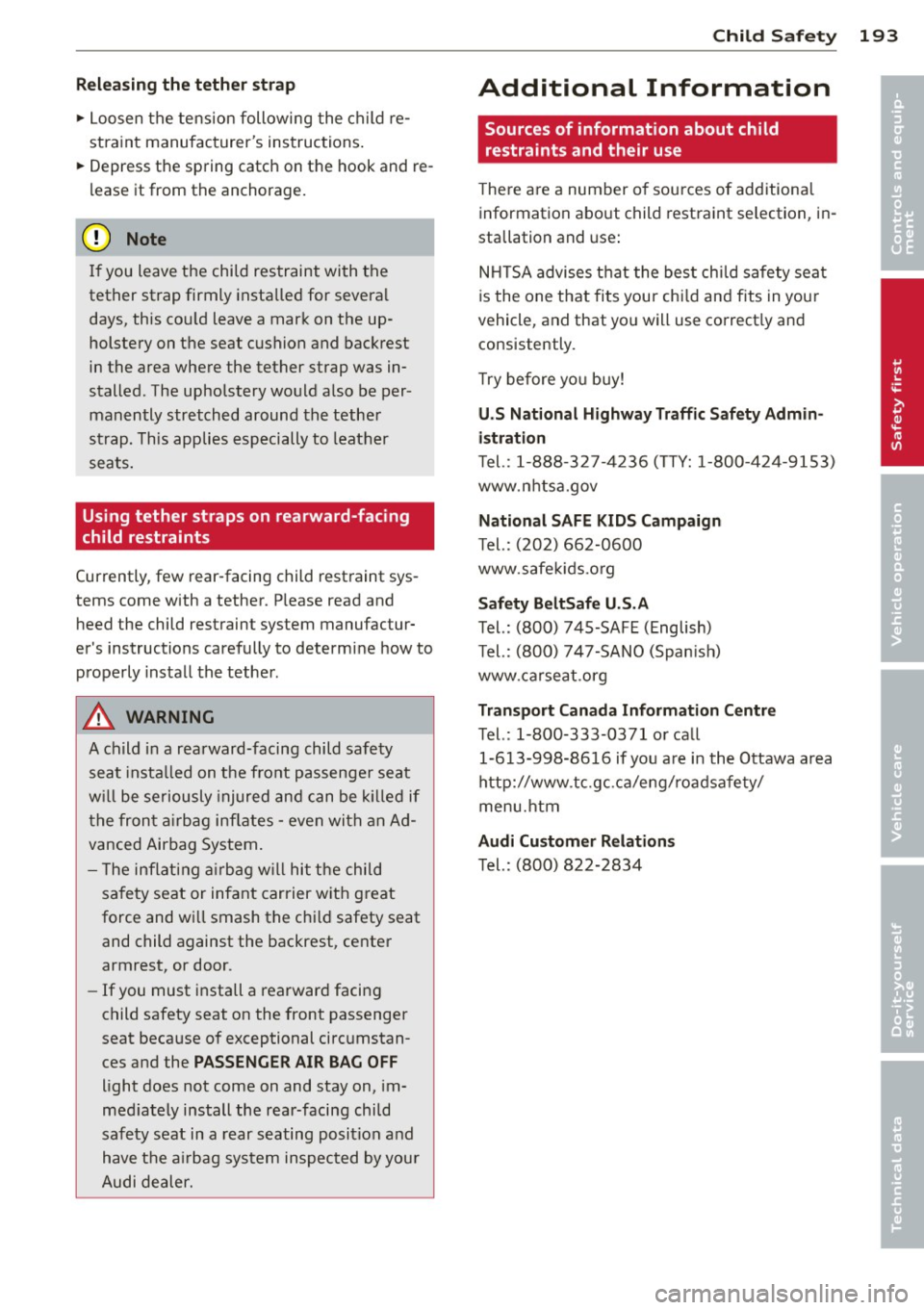
F ig. 181 Tether strap: proper routing and mou nting
Installing the tether st rap
• Release or deploy the tether strap on the
child restraint according to the child re
s traint manufacture r's instructions.
• Guide the upper te ther s trap
und er the rear
head restraint¢
fig. 181 (raise the head re
straint if necessary) .
• Attach the tether strap ancho rage hook into
the tether anchorage.
.,. Pull on the tether strap hook so that the
spring catch of the hook engages.
• Tighten the tether strap firmly follow ing the
child restraint manufacturer's instructions. ..,
Page 195 of 306
Relea sin g the teth er str ap
"' Loosen the tens ion following the child re
stra int manufac turer's instructions .
"' Depress the spring catch on the hook and re
lease it from the anchorage.
(D Note
I f you leave the child restraint with the
tether strap firmly insta lled for severa l
days, this cou ld leave a mark on the up
holstery on the seat cushion and backrest
in the area where the tether strap was in
stalled . The upholstery would a lso be per
manently stretched around the tether
strap. This applies especially to leat her
seats.
Using tether straps on rearward-facing
child restraints
Currently, few rear-facing child restraint sys
tems come with a tether. P lease read and
heed the child restraint system manufactur
er's instructions carefully to determ ine how to
p roperly install the tether.
A WARNING
-
A child in a rearward-facing child safety
seat insta lled on the front passenge r seat
w ill be se riously injured and can be killed if
t he fron t air bag inflates - even with an Ad
vanced Airbag System .
- T he inf lat ing airb ag w ill hit the child
sa fety seat or infant carrier w it h great
force and w ill smash the ch ild safety seat
and child against the backrest, center
armrest, or door.
- If you must install a rearward facing
child safety seat on the front passenger
seat because of exceptional circ umstan
ces and the
PASSENGER AIR BAG OFF
light does not come on and stay on, im
med iately install the rear-facing child
safety seat in a rear seating position and
have t he a irbag system inspected by you r
Audi de aler.
Child Sa fet y 193
Additional Information
Sources of information about child
restraints and their use
There are a number o f sources of additiona l
information abo ut child restraint se lection, in
stallation and use :
N HT SA advises t hat the bes t ch ild safety seat
is the one that fits your chi ld and fits in your
vehicle, and that yo u will use correct ly and
consistently.
T ry before yo u buy!
U.S National Highway Traffic Safety Admin
istration
Tel.: 1 -888 -3 27-4 236 (TIY: 1-800-424-9153)
www. n hts a .gov
National SAFE KIDS Campaign
Tel.: (202) 66 2-0600
www.safe kids.o rg
Safety Belt Safe U .S .A
Tel.: (800) 7 45-SAFE (English)
Te l.: (800) 747-SANO (Span ish)
www.carseat .org
Transpo rt Canada Information Centre
Tel.: 1-800-333-0371 o r ca ll
1-6 13-998-86 16 if yo u are in the Ottawa a rea
http://www .t c .gc. ca/eng/ roadsafety/
men u.h tm
Audi Cu stomer R elation s
Tel.: (800) 822-2834 •
•
Page 205 of 306
than is being generated and ensures an optimal state of charge for the battery.
@ Tips
- But even energy management cannot
negate the limits o f physics. Consider
that the power and life of a battery are
limited.
- If starting ab ility is threatened, the indi
cator light (•) appears ¢
page 17.
What you should know
The highest priority is given to maintaining
starting capability.
The battery is severely taxed in short-dis tance
driving, in city traffic and d uring the co ld time
of year . Abu ndant e lectrica l energy is re
q uired, but only a litt le is generated . It is also
cr itical if the engine is not runn ing and electri
cal components are turned on. In th is in
stance energy is being consumed but none is
be ing generated.
It is in precisely these situations that you w ill
notice energy management actively regulat
i n g the distribution of energy.
Vehicle stand s for an e xte nded period
If yo u do not drive you r vehicle over a period
of severa l days or weeks, electrical compo
nents are grad ually cut back or switched off.
This reduces energy consumption and main tains starting capab ility over a longer per iod.
Some of the conven ience functions may not
operate, such as the inter ior lights o r the
power seat adjustment. The conven ience
f u nctions will be ava ilable again whe n you
switch on the igni tion and start the engine.
With the engine turned off
If you lis ten to t he radio, for example, with
the eng ine turned off or use othe r MM I fu nc
tions, the bat te ry is being discha rged .
If starting capability is jeopardized due to en
e rgy consumpt ion, the follow ing warning ap
pears in the MMI disp lay :
Int ellig ent technolog y 203
Plea se start the engine soon or the sy stem
will be turned off .
The wa rni ng ind ic ates th at the sys tem w ill be
t u rned o ff autom atically a fter 3 minu tes. If
you w ish to continue using the funct ions, yo u
have to start the engine.
With the engine running
Althoug h elec trical energy is generated when
t h e ve hicl e is being driven, t he battery can be
come d isc harged. This happe ns mostly when
little energy is being generated and a g reat
deal consumed and the battery's state of
charge is not opt imal.
T o b ring the energy ba lance back in to equili
brium, consumers which req uir e especially
l a rge amounts of energy a re temporari ly cut
back or sw itched off. Heat ing systems in par
ticular require a great deal of energy. If you notice, for example, that the heated seats* or
the heated rear window are not heating, they
have been temporarily cut back or switched
off . These systems w ill be availabl e again as
soon as the ene rgy balance has been restored.
You w ill also notice that engine id le speed has
been increased slightly . Thi s is no rmal and not
a cause for concern. By inc reas ing engi ne id le
speed the additional e nergy requi red is gene r
ated and the b attery is charged.
•
•
Page 246 of 306
24 4 T ire s and wheel s
-Never mount used tires on yo ur vehicle if
you are not sure of their "previous histo
ry." Old used tires may have been dam
aged even though the damage cannot be
seen that can lead to sudden t ire failure
and loss of vehicle control.
- If you notice unusual vibration or if the
vehicle pulls to one side when driving, al
ways stop as soon as it is safe to do so
and check the wheels and tires for dam
age.
(D Note
Please note that summer and winter tires
are designed for the cond itions that are
Glossary of tire and loading terminology
Accessory weight
means t he comb ined we ight (in excess of
those sta ndard items which may be rep laced)
of au toma tic tra nsmission, power steer ing,
power brakes, power windows, power seats,
radio, and heater, to the extent that th ese
items are availab le as factory -installed equip
ment (whether installed or not) .
Aspect ratio
means t he ratio of the he ight to the w idth of
the tire in percent . Numbers of 55 or lower in
dicate a low sidewall for improved steering re
sponse and better overall handling on dry pavement .
Bead
means the part of the ti re that is made of
steel wires, wrapped or reinforced by ply cords
and that is shaped to fit the rim.
Bead separation
means a b reakdown of the bond between
components in the bead.
Cord
means the strands forming the plies in the
tire . typ
ica l in those seasons . Audi recommends
using winter tires during the winter
months . Low temperatures signif icant ly
decrease the e lasticity of summer tires,
which affects tract ion and brak ing ability.
If summer tires are used in very co ld tem
peratures, cracks ca n form on the tread
bars, res ulting in permanent tire damage
that can cause loud driving no ise and un
balan ced t ires. Audi is not responsible for
th is type of damage .
Cold tire inflation pressure
means the tire p ressu re recommended by t he
vehicle manufacturer fo r a tire of a des igna ted
s iz e that has not bee n driven for more than a
coup le of miles (k ilometers) at low speeds in
t h e three hour period before the tire pressure
is measured or adjusted.
Curb weight
mea ns the we ight of a motor ve hicl e w ith
standard equipment including the max imum
capacity of fuel, oil, and coolant, air condi
tioning and additional weight of optiona l
equipment.
Extra load tire
me ans a t ire design to operate at higher loads
and at h igher inflation pressures than the cor
responding standard tire . Extra load tires may
be identified as "XL", "x l" , "EXTRA LOAD", or
"RF" on the sidewall.
Gross A xle Weight Rating ("GAWR ")
means the lo ad -c a rry ing c apac ity of a s ingle
axle system , measured a t the tire-ground in
terfaces.
Gross Vehicle Weight Rating ("GVWR ")
mea ns the maximum total loaded we ight of
t h e ve hicl e. .,.
Page 292 of 306

29 0 Index
A
Accessories . ...... ..... ... .. .. .... . 28 7
Active lane ass ist ... ... .. .. .. .. .. .. .. 95
Activating and deactivating . . . . . . . . . . . 96
C leaning the camera area .. .. .. .. .. . 214
Descr ipt ion ... ........... .. .. .... .. 95
I nstrument cluster indicator light . . . . . 96
Messages . . . . . . . . . . . . . . . . . . . . . . . . . 96
Notes on instrument cluster display . . . . 96
Setting the steering wheel vibrat ion . . . . 97
AC (automatic cl imate control) . .. .. .. .. 72
AC (climate control) . . . . . . . . . . . . . . . . . . 70
Adaptive air suspension/sport . ... .. .. . 102
Adapt ive cruise control . . . . . . . . . . . . . . . . 86
C leaning the senso r ....... .. .. .... . 214
Messages ............... .. .. .. .. .. 93
Request for driver intervention . . . . . . . . 91
Stop-and-go traffic . . . . . . . . . . . . . . . . . 90
Adapt ive Lig ht (defective) ... .. .. .... .. 23
AdBlue .. .. .. .. . .......... .. .. .... . 223
F illing . .. .. ............... .. .... . 225
Messages in the instrument cluster dis-
play ... .. .. ... .... .... .. .. .. .. .. . 224
Adding Eng ine coolant ........... .. .. .. .. . 235
Eng ine oil ................. .. .... . 232
W indshield washer fluid . ...... .. .. . 241
Additives Eng ine oi l ............... .. .. .... . 232
Adj usting
A ir dist ribution (au tomatic climate con-
trol) .. ... ... .. .. ..... ... .. .. .... .. 73
ai r distribution (climate control) ... .. . . 70
Front seats . . . . . . . . . . . . . . . . . . . . . . . . 53
Instrument illum inat ion ..... .. .... .. 47
Steer ing column e lectrically .. .. .... .. 75
Steer ing column manually ... .. .. .. . . 75
Temperature (automat ic climate co ntrol) 73
Temperature (climate control) .... .. .. 70
A irbag system . . . . . . . . . . . . . . . . . 149, 170
Advanced Airbag System ... .. .. .... . 153
Advanced Airbag System components . 157
Care ..... .. ................ ... ... 165
C hi ldren ... ... .... ...... .. .. .. .. . 177
C hil d restra ints ........... .. .. .. .. . 177
Componen ts (front airbags) .. .. .. .. . 157 Danger of fitting a ch
ild seat on the front
passenger seat ... .. ... ..... ... .. .. 151
Disposa l .. .. .. .. ... .. ..... ... .. .. 165
Front a irbags . . . . . . . . . . . . . . . . 153, 155
How do the front airbags work? .. .... 159
How many a irbags does my vehicle
have? ...... .. .. .. ... ... ... .. .. .. 157
How the Advanced Airbag System com-
ponents work togethe r ......... .. .. 159
Important safe ty instru ct ions on the
knee airbag system .. .. ..... ... .. .. 168
Important things to know .. ... ... . .. 149
Knee airbags ..... .. ... ..... ... .. .. 166
Monitoring .... .. ............. .... 161
PASSENGER AIR BAG OFF light ... .... 162
Repairs ... .... .. ............. .... 165
Safety instructions ................. 164
S ide a irbags ... .. ... .. .. ... ..... .. 169
S ide curtain airbags ... ...... ... .. .. 172
Warning/ind icator lights ........ .. .. . 19
Warning/Indicato r lights ....... .. .. 161
When must the system be inspected? 161
Aircraft Transporting your vehicle
Alcantara 280
Cleaning .. .... .. ............. .... 216
All -wheel drive .... .. ... ..... ... .. .. 201
Winter tires ..... ... .. ..... ... .. .. 258
Alternator . . . . . . . . . . . . . . . . . . . . . . . . . . 17
Amb ience lighting .............. .... . 47
Anti-freeze
refer to Engine coolant . ..... ... .. .. 234
Anti- lock b rak ing system ............ . 196
Wa rning/ind icator lights . . . . . . . . . 19, 20
Anti-slip regulation ............. .. .. 196
Warning/ind icator lights .. ... ..... .. . 19
Anti-theft systems Electronic immobi lizer .. ..... ... .. .. . 33
Asht ray .... .... ................... . 59
Audi braking guard
refer to brak ing guard ............. .. 86
Audi drive select
refer to drive select ............ .... 102
A udi Serv ice Repair Manuals and Litera-
tu re ... .. .. .. .. .. .. .... . ..... ... .. 285
Page 293 of 306

_______________________________ I~ n~ d:::: e~x 291
AUTO
automatic climate control ... ... .. .. ..
73
Automatic headlights ............... 44
climate control . . . . . . . . . . . . . . . . . . . . . 70
Auto Lock . . . . . . . . . . . . . . . . . . . . . . . . . . 34
Automatic belt retractor . . . . . . . . . . . . . 143
Automatic climate control
Air vents ... ............. .... .. ....
73
Automatic recirculation ...... .. .. .. .. 74
Operation . . . . . . . . . . . . . . . . . . . . . . . . . 72
Setup . .. ... ...... ............. ... 74
synchron izing ......... ...... .... ... 73
Automatic Shift Lock (ASL) .. .. .. .. .. . 110
Automatic transmission ....... .. .. .. . 109
Automatic Shift Lock (ASL) .......... 110
Driving .... ................ ... ... 111
Emergency mode . . . . . . . . . . . . . . . . . . 114
Emergency release ........ .. .. .. .. . 115
Kick-down .. ............. .... .. ... 113
Manual shift program ....... .. .. .. . 113
Selector lever ............... ... ... 109
Automatic wipers .................... 48
Auto Safety Hotline .......... .. .. .. . 138
Average consumption ....... .. .. .. .. .. 25
Average speed . . . . . . . . . . . . . . . . . . . . . . .
25
Avoid damaging the vehicle .. .. .. .. .. . 206
B
Bag hooks . . . . . . . . . . . . . . . . . . . . . . . . . . 67
Battery ..... .. ................ .... 238
Charging ... ................ ... ... 240
Important warnings ...... .. .. .. .. . 238
Jump starting ............ .... .. ... 276
Location . .. ............. .... .. ... 238
low ..... ... ...... ............. .. 202
Replacing the battery ....... .. .. .. . 241
State of charge ........... .... .. .. . 202
w· t · 1n er operation ......... .. .. .. .. .
Working on the battery .... .. .. .. .. .
Before driving .............. ... ... . .
Blended gasoline 238
238
130
218
Blower (automatic climate control) . . . . . . 73
Blower (climate control) . . . . . . . . . . . . . . . 70
Booster seats ................ ... ... 184
Brake fluid
Changing the brake fluid ............
237
Checking the brake fluid level ........ 237
What is the correct brake fluid level? .. 237
What should I do if the brake fluid warn-
ing light comes on? . .............. .
237
Brake system
Anti- lock braking system .............
20
Brake assist system .............. .. 196
Brake booster .. .. ................. 200
Brake fluid ...... .. ..... .......... 237
Brake fluid specifications for refill and re-
placement ...... .. ...............
237
Brake light defective . . . . . . . . . . . . . . . . 23
Brake pads .. .. .. .... ........... .. 204
Electromechanical parking brake ..... . 79
Fluid reservoir ..... ............... 237
How does moisture or road salt affect the
brakes? . .. .. .. .. .. ...............
200
Warning/indicator lights ........ .. .. . 15
Worn brake pads symbol ............ . 21
braking guard
Settings ... ..... .. ................
93
Braking guard ... .. .... ........... .. . 86
Messages . .. .. .. .. ............... . 93
Break-in period .. .. ... ... ...... ..... 204
Brake pads ...... .. ............... 204
Tires
Bu lbs
C
...... .. .. .. .................
204
275
California Proposition 65 Warning ..... 228
Battery specific .. .. .............. . 239
Capacities .... .. .. .... ............. 283
Engine oil ... .. .. ................. 229
Carbon parts
Cleaning . . . . . . . . . . . . . . . . . . . .
215,216
Car carrier
Transporting your vehicle ......... ..
280
Care ....... .. .. .. ... ............ .. 213
Cargo area ........ .. ............... 136
Cargo net . . . . . . . . . . . . . . . . . . . . . . . . . . . 66
Catalytic converter . ............. .. .. 205
Center armrest
Cockpit ... .. .. .. .. . .. .... ........ .
56
Central locking . ..... ................ 34
Emergency locking .... ......... .. .. . 38
•
•