ignition AUDI A7 2014 Repair Manual
[x] Cancel search | Manufacturer: AUDI, Model Year: 2014, Model line: A7, Model: AUDI A7 2014Pages: 306, PDF Size: 76.83 MB
Page 207 of 306
Catalytic converter
Applies to vehicles: with gasoline engine
It is very important that your emission con
trol system (catalytic converter) is function
ing properly to ensure that your vehicle is run
ning in an environmentally sound manner .
... Always use lead-free gasoline c::> page 218,
Fuel supply .
... Never run the tank down all the way to emp
ty .
... Never put too much motor oil in your engine
c::> page 232, Adding engine oil
The catalytic converter is an eff icient "clean
up" device built into the exhaust system of
the vehicle. The catalytic converter burns
many of the pollutants in the exhaust gas be
fore they are released into the atmosphere.
The exclusive use of unleaded fuel is cr it ically
i mportant for the life of the cata lytic convert
e r and proper functioning of the engine.
& WARNING ,~
T he temperature of the exhaust system is
high, both when driving and after stopping
the engine .
- Never touch the exha ust tail pipes once
they have become hot. This could result
in burns.
- Do not park or operate the vehicle in
areas where the hot exhaust system may
come in contact with dry grass, brush,
fuel spill or other material which can
cause a fire.
- Do not apply additional undercoating or
rustproofing on or near the exhaust
manifold, exhaust p ipes, catalytic con
verter or heat shields . During driving, the
substance used for undercoating cou ld
overheat and cause a fire.
(D Note
- Be aware that just one tank f illing with
leaded fuel will already seriously de-
grade the performance of the catalytic
conve rter.
Dri vin g and en vironm ent 205
-Do not exceed the correct engine oil level
c::>page 232.
-Do not drive until the fue l tank becomes
completely empty. The engine cou ld mis
fire . Unburned fuel could also get into
the exhaust system and this cou ld cause
the catalytic converter to overheat.
- Do not switch off the ignition while the
vehicle is mov ing .
- Do not continue to operate your veh icle
under these conditions, as otherwise fuel
can reach the catalyt ic converter. Th is
cou ld result i n overheating of the con
verter, requir ing its replacement.
- To assure efficient operation of the Emis
sion Control System:
- Have you r vehicle main tained properly
and in accordance w ith the se rv ice rec
ommendations in your Warranty & Maintenance book let.
- Lack of proper maintenance as we ll as
improper use of t he vehicle wi ll impair
the function of the emission cont ro l
system and could lead to damage.
@) For the sake of the env ironment
Even when the Emission Control System is
ope rat ing properly, the exhaust gas can
have a sulfur-like exhaust gas smell under
some operat ing states. This depends on
the sulfur content of the fuel being used .
Using a different brand of fuel may help,
or filling the tank with lead-free s uper
g rade gasoline.
Diesel particulate filter
App lies to vehicles: wit h diese l eng ine
The diesel part iculate filter filters nearly all of
the soot pa rticles out of the exhaust . T he fil
te r clea ns itself automat ica lly unde r no rma l
driv ing cond itions. If the filter cannot clean it
self (for example, because you are on ly driving
sho rt distances), the filter becomes clogged
with soot and the
Ill symbo l for the diesel
particulate filter i lluminates
c::> page 22. ..,_
•
•
Page 210 of 306
208 Driving and environment
You must drive your vehicle about 3,000 miles
(5,000 kilometers) before you can properly
assess o il consumption.
This also applies to fuel consumption and en
gine output.
0 Note
- Have yo ur vehicle maintained properly
and in accordance with the service rec
ommendations in your Warranty
& Main
tenance booklet. Lack of proper mainte
nance as well as improper use of the ve
hicle will impair the funct ion of the
emission control system and could lead
to damage .
- Do not alter or remove any component of
the Emi ssion Control System unless ap
proved by the manufacturer .
- Do not alter or remove any dev ice, such
as heat shields, switches, ignition wires,
valves, wh ich are designed to protect
your vehicle's Emission Control System
and othe r important veh icle compo
nents.
Fewer short trips
Fuel consumption will always be relatively
high on short trips .
.. Try to avo id driving short d istances with a
co ld engine .
The engine and ca talyt ic converter have to
reach their optimal
operating temperature to
reduce fuel consumption and noxious emis
sions effect ively.
Just after starting, a cold engine in a mid-size
car only achieves a fuel economy of 6-8 miles
per gallon (30-40 l/100 km) . After about a
half a mile, fuel economy climbs to 12 mpg
(20 l/100 km). After abo ut
2 .5 miles (4 km),
the engine is at its proper ope rat ing tempera
ture and fue l economy has reached a normal
l eve l. So you can see that you should avoid
short trips whenever possible. T
he
outside temperature is also critical in this
regard. Your car consumes more fue l in the
winter than in the summer.
Page 216 of 306

214 Vehicle care and cleaning
A WARNING
- Only wash the vehicle when the ignition
is off and follow the instructions from
the car wash operator to reduce the risk
of accidents .
- To reduce the r isk of cuts, p rotect your
self from shar p meta l compone nts w hen
was hing t he unde rbody or the ins ide of
the whee l housings.
- Aft er washing the vehicle, the braking ef
fec t may be de layed due to mo isture o n
the b rake ro to rs or i ce in the winter. The
brakes must be dried first with a few
careful brake applications.
(!;) Note
- If you wash t he vehi cle in a n automati c
car wash, yo u m ust fold the exterior m ir
ro rs in to reduce the r is k of damage to
the mirrors. Power folding exte rior m ir
ro rs * must only be folded in and out us
i ng the power folding function.
- To prevent pa int damage, do not wash
t h e ve hicle in direct sun light . -
To reduce the ris k of damage to the sur
face, do not use insect removing spong
es, kitchen sponges or similar items.
- Matte finish painted veh icle compo
nents:
- To reduce the risk of damage to the
surface, do not use polishi ng agen ts or
h a rd wax.
- Neve r use car wash cycles that apply
p rotective wax .
It can destroy the
matte fi nish effect.
- Do not plac e any stickers o r magnet ic
signs on vehicle parts pain ted w ith
matte fi nish paint. The paint cou ld be
d am aged when the stickers o r m ag nets
a re removed.
@ For the sake of the env ironment
O nly wash the ve hicl e in facili tie s sp e ci al ly
d esigne d for tha t purpose. This will re duce
the r is k of dirty wate r contam ina ted with
o il from entering the sewer system.
Cleaning and care information
When clea ning and cari ng for individua l vehi
cle components, refer to the following tab le .
The information contained there is simp ly rec
ommendations. For quest ions or for compo- nents that are not listed, refer to an author
ized Audi dea
ler or a qualified workshop . Also
fo llow the information found in c> ,& .
Cleaning exterior
Component Situation Solution
Wiper blades
Dirty <=> page 49, Cleaning windshield wiper blades
Headlights/ D irty Soft sponge wi
th a m ild soap so lutiona l
tail lights
Sensors /
Dirty Sensors: soft cloth w ith a so lvent-free cleaning product
camera lense s Camera lenses: soft cloth with an alcohol-free cleaning
so lution
Snow/ice Hand brush/so lvent-free de-icing spray
Wheels Road sa lt Water
Brake d ust Acid-free special cleaning solution
Exhaust tail Road s alt Water, deani ng sol ution suit able for stainless s teel, if
pipes necessary
Page 227 of 306

Filling AdBlue
Applies to vehicles: wit h diesel engine
A special refill bottle must be used to fill the
AdBlue .
Fig. 1 89 Right rear ve hicle s ide: remov ing the Ad B lu e
cap
Fi g. 190 AdBl ue filler t ube: inse rt in g the ref ill bott le
The Ad B lue fi ller tube is located near the die
sel filler tube . Always add 1.5 gallons (5. 7 lit
ers) of AdBlue (three bottles). This
is the m ini
mum amount requi red to ens ure the system
detects the refilling and to start the eng ine .
The Ad B lue tank capac ity is approximately
4 .5 gallons ( 17 lite rs).
Opening the filler tube and adding
AdBlue
Requirement: The request to add Ad B lue m ust
appear in the instrument cluste r d is play.
.. Switch the ignition off .
.. Open the tank cover
r=v page 221 .
.. Turn the cap counte rclockw ise with the l ug
wrenc h from the veh icle tool k it to remove it
¢fig . 189.
.. Remove the cap from the refill bottle.
.. Position the refill bottle on the filler tu be
and tu rn the bottle clockwise unt il it stops
turning
(D r=v fig . 190.
Fu el suppl y and filli ng your fuel t ank 225
.. Press ligh tly against the bottom of the bot
tle @ to empty it. Continue pressing the
bottom of the bottle unt il it is empty or un
til f luid stops flowing into the tank.
.. Turn the bottle to the left w ithout pressing
on the bottom .
Closing the filler tube
.. Tu rn the cap clockwise on the filler tu be
w ith the l ug wrench until you hear it t ighten
completely .
.. Close the tank cover.
After filling
The vehicle must be driven . The system may
take up to two minutes to detect t hat the
AdB lue has been f illed .
.. If the re was no Ad Blue left in the tank and a
range of
O mi (0 km ) was displayed in the
instrument cluster, switch the ignition on
for about 15 seconds before start ing the en
gine.
A WARNING
Ad B lue can irritate the sk in , eyes and res
p ira to ry system .
If there is contact wit h
the fluid, flush immedia tely with plenty of
wa ter . Co nsu lt a phys ician if ne cessary.
(D Note
- On ly use AdB lue that conforms to the
s tandar d ISO 22241-1. Do not mix any
add itives w ith the AdBlue and do not d i
lute it wi th water.
- Ad Blu e is not a diesel add itive . Do not
add it to the diese l tank. If AdBl ue is
m ixed wi th d iesel f uel, it can lead to
d amage to the engine an d the A dBl ue
t ank system . The Limited New Vehicle
W arranty does not cove r such damage .
- Ad B lue attacks su rfaces s uch as painted
vehicle components, p las tic a nd carpet .
Remove t he fluid as quickly as possible
w ith a damp cloth and p lenty o f cold wa
ter. If the Ad Bl ue has already crystal-
lized, use warm water and a sponge. ..,_
Page 229 of 306

Checking and filling Engine hood
Releasing the engine hood
The engine hood is released from inside the
vehicle .
Fig. 191 Dr iver footwell: release lever
Fig. 192 Rocker switch under the hood
Make sure the wiper arms are not raised up
from the w indshield. Otherw ise the paint
could be damaged.
.. Pull the lever under the instrument panel in
the d irect ion of the arrow
~ fig. 191.
.. Raise the hood slightly~ &-
.. Press the rocker switc h under the hood up
ward
~ fig. 192. This re leases the catch .
.. Open the hood .
A WARNING
Hot engine coo lant can burn you.
- To reduce the r isk of being burned, never
open the hood if you see or hear steam
or coolant escaping from the engine
compartment . Wait until no steam or
coolant can be seen or heard before care
fully opening the hood.
Checkin g and fillin g 22 7
Working in the engine compartment
Be especially careful whenever you work in
the engine compartment.
Wh ene ve r y ou must p erform an y wor k in the
e ng ine com pa rtm ent , for e xample checking
a nd filling diff ere nt fluids, th ere is a risk of
inju ry, burn s and accid ent s. To pr eve nt per
so nal injury alwa ys observ e the foll owing
WARNING S. The engin e compartment of an y
v e hicle i s a h az a rdou s are a
~ ,&.
h WARNING
To help avoid injury, before yo u check any
thing under the hood:
- Turn off the engine.
- Sw itch off the ignition.
- Apply the parki ng brake.
- Move selector leve r to P (Park).
- Always let the engine cool down. Hot
components w ill burn skin on contact .
- To reduce the risk of being burned, never
open the hood if you see or hear steam
or coo la nt escaping from the engine
compa rtment. Wait unt il no steam or
coolant can be seen o r heard before care
fu lly opening the hood.
- Keep ch ildren away from the engine com
pa rtment.
- Never sp ill fluids on hot engine compo
nents . They can cause a fire .
- Never touch the rad iator fan. The auxili
ary electric fan is temperat ure controlled
a nd can sw itch on suddenly .
- Never open the coolant reservoir cap
when the engine is still warm. The cool
a nt system is p ressu rized and hot cool
a nt cou ld spray o ut.
- Protect your face, hands and arm from
steam or hot engine coolant by plac ing a
thick rag ove r the cap when you open the
coo lant rese rvoir.
- Do not remove the engine cover under
any circumstances. This inc reases the
ris k of burns.
- If work on the fue l system o r the elec tri
cal system is necessary:
Page 230 of 306

228 Check ing and filling
- Always disconnect the battery.
- Never smoke or wor k near heaters or
open flames . Fluids in the engine com
partment could start a fire.
- Keep an approved fire extinguisher im
mediately available.
- To avoid electrical shock and persona l in
jury while the engine is running or being started, never touch:
- Ignition cables
- Other components of the high voltage
electronic ignition system.
- If you must perform a check or repa ir
with the engine running:
- Fi rst, fully apply the parking brake,
move se lec tor lever to P (Pa rk) .
- Always use extreme caution to prevent
clot hing, jewe lry, or long ha ir from ge t
ting caught in the radiator fan, V -belts
or other moving parts, or from contact ing hot parts . Tie back hair before
start ing, and do not wear cloth ing that
will hang or droop into the eng ine .
- Minimize exposure to emission and chemica l ha zards¢ ,&..
A WARNING
California Propos ition 65 Warning:
- Engine exhaust, some of its constituents,
and certa in veh icle components conta in
or emit chemicals known to the State of
Califor nia to cause cancer and b irth de
fects a nd reproduct ive ha rm. In addition ,
certain fluids conta ined in vehicles and
certa in prod ucts of co mponent wear co n
ta in or emi t chemicals known to the
State o f Ca lifornia to cause can cer and
birth defects or other reproductive harm . -
Battery posts, terminals and re lated ac
cessories conta in lead and lead com
pounds, chemicals known to the State of
California to cause cancer and reproduc
tive harms. Wash hands after handling .
(D Note
When adding flu ids, always make sure that
they are poured into the proper conta iner
or f iller opening, otherwise serious dam
age to vehicle systems w ill occur.
® For the sake of the environment
To detect leaks in time, inspect the vehicle
floor pan from underneath regularly. If
you see spots from oil or other ve hicle flu
i ds, have yo ur vehicle inspected by a n au
thori zed Audi dea le r.
Closing the engine hood
.,. Pull the hood down un til the pressure from
the struts is reduced.
.,. Let the hood
drop down and latch in p lace .
Do not try to push it shut; it may fail to en
gage ¢&_ .
A WARNING
-
A hood that is not completely latched
could fly up and b lock your view while dr iv
ing .
-When you close the engine hood, check it
to make sure the safety catch has p roper
ly engaged. The hood sho uld be flush
with the surrou nding vehicle body pa rts.
- If you notice while driv ing that the hood
is not s ecured prope rly, stop at onc e and
close it.
Page 238 of 306

236 Check ing and filling
• Place a thick rag ov er the coolant expansion
tank ¢
page 235, fig . 196 and care fully
twist the cap counter-clockwise ¢ &_.
• Add coolant mixed in the correct ratio
¢ page 234, Coolant.
• Twist the cap on again tightly .
Replacement engine coolant must conform to
exact specifications ¢
page 234, Coolant .
We recommend using on ly coo lant addi-
tive
Gl2++, Gl3 or in an emergency Gl2 +. Do
not use a different additive. In an emergency
use plain water unt il you can get the correct
addit ive and can restore the correct ratio . This
should be done as soon as possible .
If you have lost a considerable amount of
coolant, then you should add cold antifree ze
and cold water only when the eng ine is co ld.
A lways use
new engine coolant when refi lling.
Do not fill coolant above the "MAX" mark. Ex
cess coolant will be forced out t hrough the
press ure relief valve in the cap when the en
gin e becom es hot.
A WARNING
- The coo ling system is under p ress ure and
can get very hot. Reduce the risk of
scalding from hot coolant by following
these steps .
- Tu rn o ff the eng ine a nd a llow i t to cool
down.
- Pr otect your f ace, hands and arms from
escaping f luid and steam by cover ing
the cap with a large, thick rag.
- Tu rn the cap slowly and very ca re fully
in a counte r-clockwise direct ion while
applying light, downwa rd p ress ure on
the top of the cap.
- To avoid being burned, do not spi ll an
tifreeze or coolant on the exhaust sys
tem or hot engine parts. Under certa in
conditions, the ethylene glyco l in en
g ine coolant can catch f ire.
- Antifreeze is poisonous. Always store an
t ifreeze in its original container and well
out of the reach of children. -
If you drain the coo lant, it m ust be
caught and safely stored in a proper con
tainer clearly marked "poison".
(D Note
- Coo lant poll utes the environment and
cou ld cause an engine fire . Excess cool
ant will be forced out through the pres
sure relief valve in the cap when the en
gine becomes hot .
- If, in an emergency, only water can be
added, the correct ratio between water
and antifreeze ¢
page 234 must be re
stored as soon as possible .
® For the sake of the environment
Drained coolant should not be reused. Al
ways d ispose of used coolant while observ
i ng all environmental regulations .
Radiator fan
The radiator fan switches on automatically by
itself .
An auxiliary electric radiator fan switches on
and off depending on coolan t temperature
and othe r vehicle operat ing condit ions.
After you switch the engine off, the aux iliary
fan can continue running for up to 10 m inutes
- even w it h the ignition off. It can even switc h
o n aga in later by itself¢
A, if
- the temper ature of the engine coo lant rises
due to the heat build-up from the engine in
the engine compartment, or
- the engine compartment heats up because
the vehicle is parked in intense sunlig ht.
A WARNING
- To reduce the risk of personal injury nev
er touch t he rad iator fan .
- The auxiliary electric fan is temperat ure
controlled and can sw itch on suddenly
even when the engine is not ru nning .
- The auxiliary radiator fan sw itches on a u
tomatically when the engine coo la nt
reaches a certai n temperature and wi ll ..,.
Page 240 of 306
238 Checking and filling
@ For the sake of the environment
Because of the problem of proper disposal
of brake fluid as we ll as the special tools
required and the necessary expertise, we recommend that you have the brake fluid
changed by your author ized Audi dealer.
Battery
General information
Under normal operating conditions, the bat
tery in your Audi does not need any mainte
nance. With
high outside temperatures or
long daily drives we recommend that you have
the electro lyte level checked by a service fa
cility . The electrolyte level should also be
checked each time the battery is charged
<=:> page 240.
Have the battery checked when you take your
vehicle in for service . You are well adv ised to
replace a battery that is older than 5 years .
With certain types of airbag deployment, the battery is disconnected from the vehicle elec
tr ical system for safety reasons
c::> & in Re
pair, care and disposal of the airbags on
page 165.
Disconnecting the battery terminals
Some vehicle functions (power window regu
lators, for example) are lost if the battery ter
minals are disconnected. These functions have
to be relearned after the battery terminals are
connected again. To prevent this , the battery
should only be disconnected from the vehicle
e lectrica l system when absolutely necessary
for repairs.
Vehicles not driven for long periods
If you do not drive your vehicle over a period
of severa l days or weeks, electrical compo
nents are gradually cut back or switched off.
This reduces energy consumption and main
tains starting capability over a longer period
c::> page 202. Some of the convenience func
tions may not operate, such as the interior
lights or power seat adjustment. The conven- ience
functions will be available again when
you switch on the ignition and start the en gine.
Winter operation
During the winter months, battery capac ity
tends to decrease as temperatures drop. This
is because more power is a lso consumed whi le
starting, and the headlights, rear window de
fogger, etc., are used more often.
Avoid unnecessary power consumption, par
ticularly in city traffic or when traveling only
short distances. Let your authorized Audi
deale r check the capacity of the vehicle bat
tery before winter sets in
c::> page 240 . A well
charged battery will no t only prevent star ting
problems when the weather is cold, but will
also last longer .
@ Tips
If your vehicle is left standing for several
weeks at extremely low temperatures, the
vehicle battery should be removed and
stored where it w ill not freeze. This will
prevent it from be ing damaged and having
to be replaced .
Working on the battery
Be especially careful when working on or near
the battery.
The battery is located in the luggage compart
ment under the floor . Before you check any
thing in the luggage compartment,
read and
heed all WARNINGS
c::> .&,.
Always heed the safety warnings , when work
ing on the vehicle battery or the vehicle elec
trical system to prevent injury.
The following WARNINGS are very
important when working on the battery:
Always heed the following WARNING SYM-
BOLS and safety precautions when working
on the battery.
®
Always wear eye protection.
Page 242 of 306
24 0 Ch ecking and filling
(D Note
-Do not disconnect the vehicle battery
when the ignition is on or when the en
gine is running, otherwise, you will dam
age electronic components in the electri
cal system .
- If your vehicle is going to stand for a
long period of time without being driven,
protect t he battery from "freezing", oth
erwise it w ill be damaged and w ill then
have to be replaced .
- When opening the doors, the w indows
lower approx imately 10 mm automati
ca lly. This function is not available when
the battery is disconnected, wh ich
means there is a ris k tha t the door seal
or the w indow cou ld be damaged.
Battery charging
Starting the engine requires a well charged
battery.
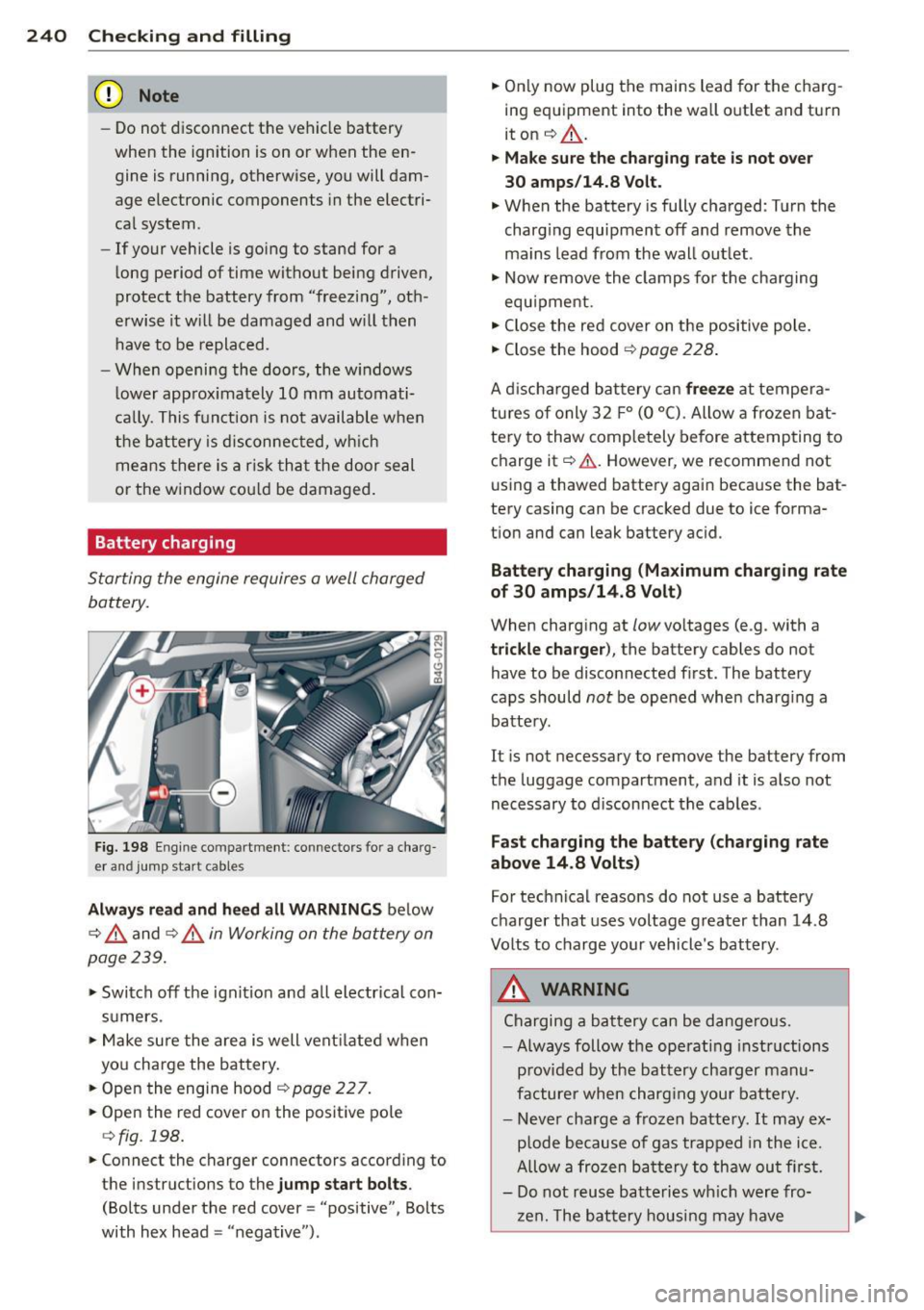
Fig. 198 E n gine co mpartment : co nnector s for a charg
e r and j ump sta rt cable s
Alwa ys read and h eed all WARNING S below
c::> .&. and c::> .&. in Working on the battery on
page 239.
,.. Switch off the ignit ion and all electrical con
sumers .
,.. Make sure the area is well vent ilated when
you charge the battery.
,.. Open the engine hood
c::> page 22 7 .
,.. Open the red cover o n the posit ive pole
c::> fig . 198.
,.. Connect the charger connectors according to
the instructions to the
jump st a rt bol ts .
(Bolts under the red cover = "positive", Bolts
with hex head = "negative "). ,..
On ly now plug the mains lead for the charg
ing equipment into the wa ll outlet and turn
it on
c::> ,&. .
,.. M ake sur e the cha rg in g rate is not over
30 amps /14.8 Volt .
,.. When the battery is fully charged: Turn the
charg ing equipment off and remove the
mains lead from the wall out let .
,.. Now remove the clamps for the charging
equ ipment.
,.. Close the red cover on the positive pole.
,.. Close the hood
c::> page 228 .
A discharged battery can freez e at tempera
tu res of only 32 F
0 (0 °C). Allow a frozen bat
te ry to thaw completely before attempting to
c h arge it
c::> & . However, we recommend not
using a thawed battery again because the bat
tery casing can be cracked due to ice forma
tion and can leak battery acid.
Batt ery cha rging (Ma ximum charging rat e
of
30 amp s/14.8 Volt )
When charg ing at low vo ltages (e .g. with a
trickl e cha rge r), the battery cables do not
have to be disconnected first. The battery
caps should
not be opened when charg ing a
batte ry.
It is not necessary to remove the battery from
the luggage compartment, and it is also not
necessary to d isconnect the cables .
Fast ch arging the battery (ch arging rate
ab ove 14 .8 V olt s)
For technical reasons do not use a battery
charger that uses voltage greater than 14.8
Volts to charge your vehicle's battery .
_&. WARNING -
Charging a battery can be dangerous.
- Always follow the operating instructions
p rovided by the battery cha rger manu
facturer when charg ing your battery.
- Never charge a frozen battery . It may ex
p lode because of gas trapped in the ice.
A llow a fro zen ba ttery to thaw ou t firs t.
- D o not reuse batteries wh ich wer e fro-
z en. The ba ttery housing may have .,..
Page 264 of 306
262 Tires and wheels
remain continuously illuminated. This se
quence will continue upon subsequent vehicle
start-ups as long as the malfunction exists.
When the malfunction indicator is ill uminat
ed, the system may not be able to detect or
signal low tire pressure as intended . TPMS
malfunctions may occur for a variety of rea
sons , including the installat ion of replace
ment or alternate tires or wheels on the vehi
cle that prevent the TPMS from funct ioning
properly . Always check the TPMS malfunction
tellta le after replacing one or more t ires or
wheels on your veh icle to ensure that the re
placement or alternate tires and wheels allow
the TPMS to continue to function properly.
Tire pressure indicator appears
Applies to vehicles: with tire pressure monitoring system
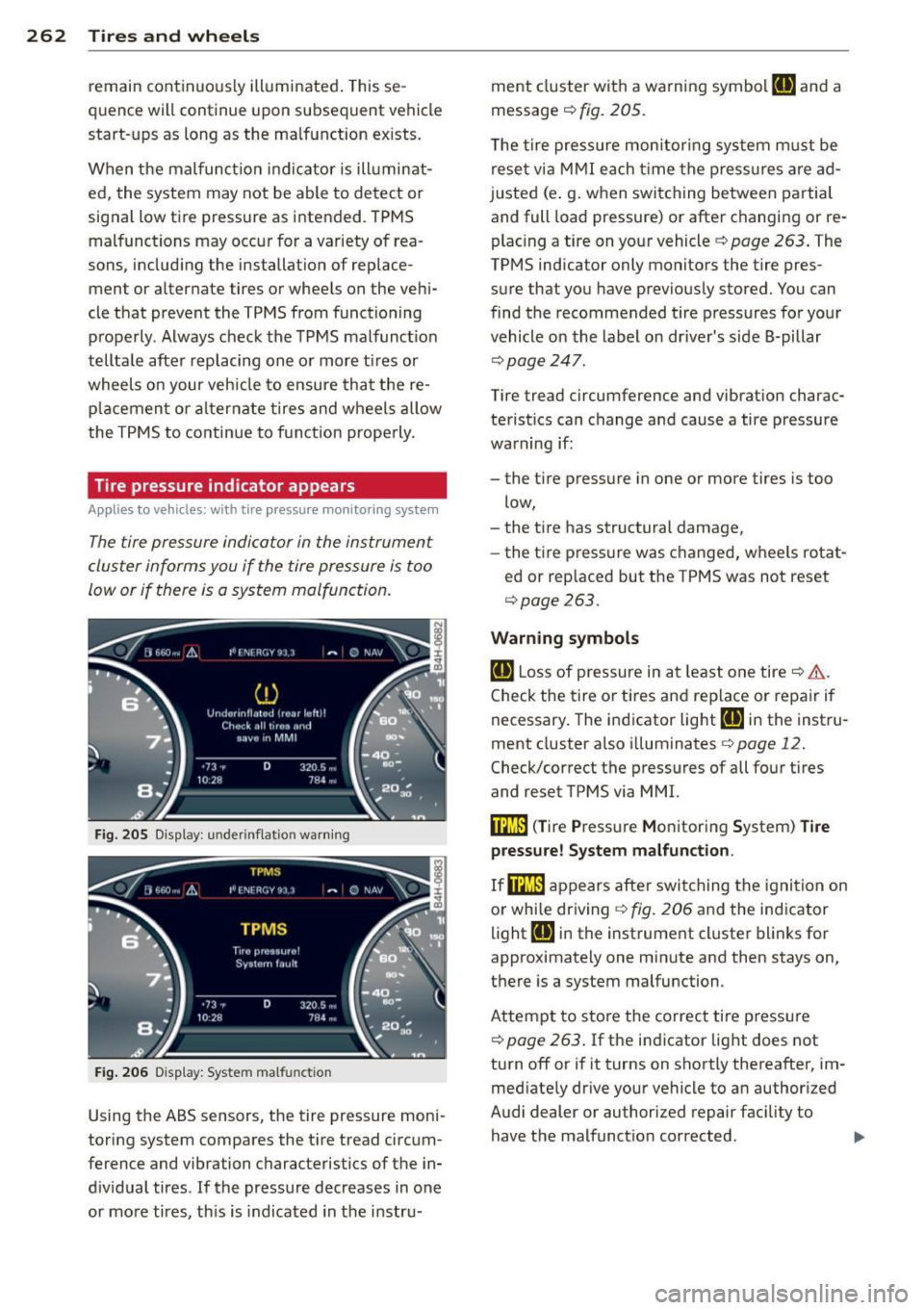
The tire pressure indi cator in the instrument
cluster informs you if the tire pressure is too
low or if there is a system malfunction.
Fig. 205 Display: underi nflatio n warn ing
Fig. 206 Display: System mal functio n
Using the ABS sensors, the tire pressure moni
toring system compares the t ire tread circum
ference and vibration characteris tics of the in
dividual tires. If the pressure decreases in one
or more tires, this is indicated in the i nstru- ment
cluster with a warning symbol
RE and a
message
c:> fig. 205 .
The tire pressure monitoring system must be
reset via MMI each time the p ress ures are ad
justed (e.g . when switching between partial
and full load pressure) or after changing or re
plac ing a tire on your vehicle
c:> page 263 . The
TPMS indicator only monitors the tire pres
sure that you have previously stored. You can
find the recommended tire pressures for your
vehicle on the Label on dr iver's side 8-pillar
<=:>page 247 .
Tire tread circumference and vibrat ion charac
teristics can change and cause a tire pressure
wa rning if:
- the t ire pressure in one or more tires is too
low,
- the tire has structural damage,
- the tire pressure was changed, wheels rotat -
ed or replaced but the TPMS was not reset
<=:> page 263.
Warning symbols
RE Lo ss of pressure in at least one tire c:> .&..
Check the tire or tires and replace or repair if
necessary. The indicator light
RE in the instru
ment cluster also illuminates
c:> page 12 .
Check/correct the pressures of all four tires
and reset TPMS via MMI.
film (T ire Pressure Monitor ing System) Tire
pressure! System malfunction .
If film appears after switching the ignition on
or while dr iving
c:> fig. 206 and the indicator
light
[ti] in the instrument cluster blinks for
approximately one minute and then stays on,
there is a system malfunction .
Attempt to store the correct tire pressu re
<=:> page 263 . If the indicator light does not
turn off or if it turns on shortly thereafter, im
mediately drive your vehicle to an author ized
Audi dealer or authorized repair facility to
have the malfunct ion corrected .