fuel cap AUDI A7 2015 User Guide
[x] Cancel search | Manufacturer: AUDI, Model Year: 2015, Model line: A7, Model: AUDI A7 2015Pages: 316, PDF Size: 78.09 MB
Page 231 of 316
M N <( I.J "". rl I.O
"' rl
"' rl
@ Tips
-The oil pressure warning display. i s
not an indicator of the oil level. Do not
rely on it. Instead , check the oil level in
your engine at regular intervals, pref
erably each time you refuel , and always
before going on a long trip .
-If you have the impression your engine
consumes excessive amounts of oil, we r ecommend that you consult your Audi
dealer to have the cause of your concern
properly diagnosed. Keep in mind that
the accurate measurement of oil con
sumption requires great care and may
take some time. Your Audi dealer has in
structions about how to measure oil con
sumption accurately.
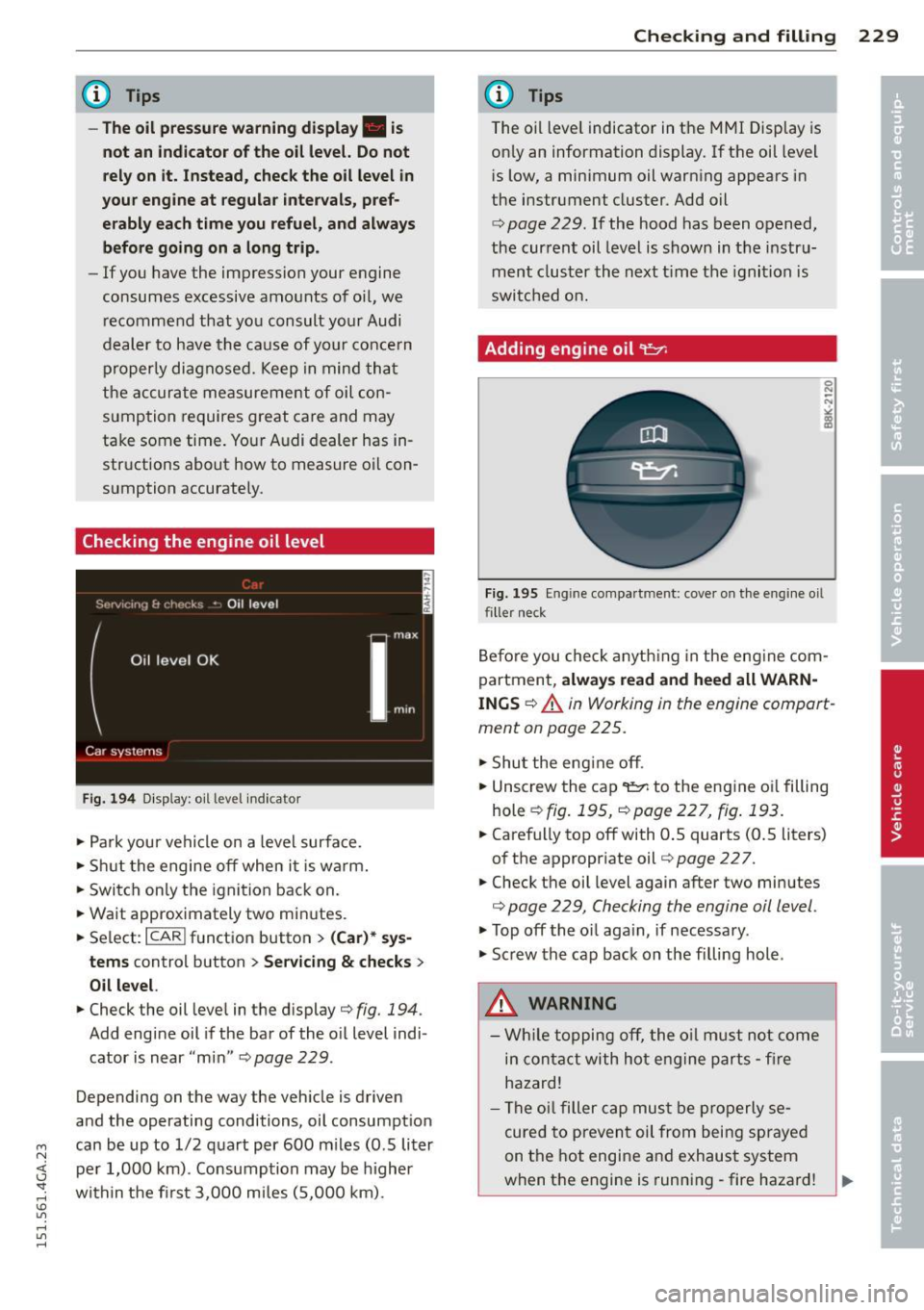
Checking the engin e oil lev el
Fig . 194 D isp lay : o il lev el indicato r
"' Park your vehicle on a level surface .
"' Sh ut the engine off when it is warm.
.. Switch only the ignition back on.
.. Wait approximately two min utes .
.. Select:
ICARI funct ion button> ( Car)* sys
tems
contro l button > Se rvicing & checks >
Oil level.
.. Check the oil level in the display¢ fig. 194 .
Add engine oil if the bar of the oil level indi
cator is near "min" ¢
page 229 .
Depending on the way the vehicle is driven
and the operating conditions, oil consumpt ion
can be up to 1/2 quart per 600 m iles (0 .5 liter
per 1,000 km) . Consumption may be higher
within the first 3,000 miles (5,000 km).
Checking and filling 229
@ Tips
The oil level indicator in the MMI Display is
on ly an information display. If the oil level
i s low, a minimum oil warn ing appears in
the instrument cluster. Add oil
c» page 229. If the hood has been opened,
the current oil level is shown in the instru
ment cluster the next time the ignition is
switched on.
Adding engine oil '1:::1:
Fig . 195 En gin e compart ment: cove r on the eng ine oil
filler neck
Before you check anything in the eng ine com
partment ,
always read and heed all WARN·
INGS
¢ A in Working in the engine compart
ment on page 225 .
.. Shu t the engine off .
"'U nscrew the cap
¢ fig. 195, ¢page 227 , fig. 193 .
.. Carefully top off with 0 .5 quarts (0 .5 liters)
of the appropr iate oil
¢ page 227.
.. Check the oil level again after two minutes
¢ page 229, Checking the engine oil level .
"'Top off the o il aga in, if necessary .
.. Screw the cap back on the fi lling hole .
_&. WARNING
-While topping off, the oil must not come
in contact with hot engine parts -fire
hazard!
- The oil filler cap must be prop erly se
cured to prevent oil from being sprayed
on the hot engine and exhaust system
when the engine is running -fire hazard! .,.
Page 245 of 316
M N <( (.J
'SI: ,...., \!) 1.1'1 ,...., 1.1'1 ,....,
Bead
means the part of the tire that
is made of steel wires, wrapped
or reinforced by ply cords and
that is shaped to fit the rim .
Bead separation
means a breakdown of the bond
between components in the
bead.
Cord
means the strands forming the
plies in the tire.
Cold tire inflation pressure
means the tire pressure recom
mended by the vehicle manu
facturer for a tire of a designat
ed size that has not been driven
for more than a couple of miles (kilometers) at low speeds in
the three hour period before
the tire pressure is measured or
adjusted.
Curb weight
means the weight of a motor
vehicle with standard equip
ment including the maximum
capacity of fuel, oil, and cool
ant, air conditioning and addi
tional weight of optional equip
ment.
Tires and wheels 243
Extra load tire
means a tire design to operate
at higher loads and at higher inflation pressures than the
corresponding standard tire .
Extra load tires may be identi
fied as "XL", "xl", "EXTRA
LOAD", or "RF" on the sidewall.
Gross Axle Weight Rating ("GAWR")
means the load-carrying capaci
ty of a single axle system,
measured at the tire-ground in
terfaces.
Gross Vehicle Weight Rating ("GVWR")
means the maximum total
loaded weight of the vehicle .
Groove
means the space between two
adjacent tread ribs.
Load rating (code)
means the maximum load that
a tire is rated to carry for a giv
en inflation pressure. You may
not find this information on all
tires because it is not required by law.
•
•
'
Page 257 of 316
M N <( (.J
'SI: ,...., \!) 1.1'1 ,...., 1.1'1 ,....,
tire failure and loss of
control.
-Excessive speed and/over loading can cause heat
build -up, sudden tire failure
and loss of control.
-If the tire pressure is too low or too high, the tires
will wear prematurely and
the vehicle will not handle
well.
-If the tire is not flat and you do not have to change a
wheel immediately, drive at
reduced speed to the near
est service station to check
the tire pressure and add air as required.
(D Note
Driving without valve stem
caps can cause damage to
the tire valves. To prevent
this, always make sure that
factory installed valve stem caps on all wheels are secure
ly mounted on the valve.
@ For the sake of the environment
Underinflated tires will also
increase the fuel consump
tion.
Tires and wheels 255
Tires and vehicle load limits
'
There are limits to the amount of load or weight that any vehi
cle and any tire can carry. Ave
hicle that is overloaded will not
handle well and is more diffi
cult to stop. Overloading can
not only lead to loss of vehicle
control, but can also damage important parts of the vehicle
and can lead to sudden tire fail
ure, including a blowout and
sudden deflation that can cause
the vehicle to crash.
Your safety and that of your passengers also depends on
making sure that load limits are
not exceeded. Vehicle load in
cludes everybody and every
thing in and on the vehicle .
These load limits are technical ly referred to as the vehicle's
Gross Vehicle Weight Rating
("GVWR").
The "GVWR" includes the
weight of the basic vehicle, all
factory installed accessories, a
full tank of fuel, oil, coolant and other fluids plus maximum ""
•
•
'
Page 270 of 316

268 Tires and wheels
loss of control, crashes and serious per
sonal injuries. Have worn or damaged tires
replaced immediately.
- Winter tires have maximum speed rating
that may be lower than your vehicle's
maximum speed .
- Never drive faster than the speed for
which the winter or other tires installed on your vehicle are rated.
A WARNING
Always adjust your driving to the road and traffic conditions. Never let the good ac
celeration of the winter tires and all-wheel
drive tempt you into taking extra risks. Al
ways remember:
- When braking, an all-wheel drive vehicle
handles in the same way as a front drive
vehicle .
- Drive carefully and reduce your speed on
icy and slippery roads, even winter tires
cannot help under black ice conditions.
@) For the sake of the environment
Use summer tires when weather condi
tions permit. They are quieter, do not wear
as quickly and reduce fuel consumption.
Snow chains
Snow chains may be fitted only to the front
wheels, and only to certain tire sizes. Ask your
authorized Audi dealer on which tire sizes
snow chains can be used .
If you are going to use snow chains, then you
must install them on the front wheels at
least.
The snow chains must have low-profile links
and must not be thicker than 0.4 inch (10,5 mm), including the lock.
Remove wheel center covers and trim discs
before putting snow chains on your vehicle
q 0 . For safety reasons cover caps must then
be fitted over the wheel bolts. These are avail
able from authorized Audi dealers.
A WARNING
Using the wrong snow chains for your vehi
cle or installing them incorrectly can in
crease the risk of loss of control leading to
serious personal injury.
- Snow chains are available in different
sizes . Always make sure to follow the in
structions provided by the snow chain
manufacturer.
- When driving with snow chains never
drive faster than the speed permitted for
your specific snow chains.
- Always observe local regulations.
@ Note
-Remove snow chains before driving on
roads not covered with snow to avoid
damaging tires and wearing the snow
chains down unnecessarily .
- Snow chains, which come into direct con
tact with the wheel rim, can scratch or damage it. Therefore, make sure that the
snow chains are suitably covered. Check
the position of the snow chains after
driving a few yards and correct if neces
sary. Follow the instructions from the
snow chain manufacturer when doing so.
- If the Adaptive Air Suspension* should
malfunction, do not mount or use snow
chains because the vehicle will be ex
tremely low. If you do drive with snow
chains on while the vehicle is at this lev
el, the snow chains might severely dam
age the wheelhouse and other parts of
the vehicle.
(j) Tips
Where snow chains are mandatory on cer
tain roads, this normally also applies to
vehicles with all-wheel drive .
Page 294 of 316
29 2 Techni cal data
designated seating position) and luggage
weight¢ .&,.
Gross Axle W eight Rating
The Gross Axle Weight Rating is the maximum
l oad that can be applied at each axle of the
vehicle ¢Lr!, .
Vehicle cap acit y weight
The vehicle capac ity we ight (max. load) is list
ed either on the dr iver's side B-pilla r or inside
the fuel filler flap.
_& WARNING
- T he actual Gross Axle Weight Rat ing at
the front and rear axles shou ld not ex
ceed the permissible weights, and their
combination must not exceed the Gross
Vehicle Weight Rating.
Dimensions
Length
Width
Width (across mirrors) Height (unloaded)al
-
-Exceeding permissible weight ratings can
result in vehicle damage, accidents and
personal injury.
(D Note
- The vehicle capacity weight figures apply
when the load is distributed evenly in the
vehicle (passengers and luggage). When
transport ing a heavy load in the luggage
compartment, carry the load as near to
the rear axle as poss ible so that the vehi
cle's handling is not impaired.
- Do not exceed the maximum permissible axle loads or the maximum gross veh icle
we ight. Always remember that the vehi
cle's handling w il l be affected by the ex
tra load. Therefo re, adj ust your speed ac
cordingly.
- Always observe local regulat ions.
in (mm)
195.6 (4969)
i n (mm) 75.2 (1911)
in (mm)
84.2 (2139)
in (mm) 55.9 (1420)
al The he ight of the veh icle depen ds on the t ires and the suspension.
When driving up steep ramps, on rough roads,
over curbs, etc . it is important to remember
that some parts of your vehicle, such as spoil-
Capacities
Fuel tank: total capacity
-gasoline engine
- d iesel engine
Windsh ield fluid container
Windsh ield and headlight washer fluid containeir* ers
or exhaust system components, may be
close to the ground . Be carefu l not to damage
them.
gal ( liters)
approx. 19.8 (75.0)
gal ( liters) approx. 19.3 (73.0)
quarts (liters) approx. 3.7 (3.5)
quarts (liters) approx. 5.2 (4 .9)
Page 306 of 316
304 Index
Gasoline ........ ......... ... .... . 21 7
Gasoline additives ................. 218
Low fuel level symbo l . . . . . . . . . . . . . . . 22
Octane rating ............ .. .. ..... 217
Recommendation ......... .... .... . 217
Refuelling .. ................ ... ... 219
Reserve .. .. ... .... ...... .. .. .. .. .. 12
Tank capacity . . . . . . . . . . . . . . . . . 12, 292
Fuses Assignment ................. .... . 281
Replacing .. ..... ........... ... .. . 281
G
Garage door opener (Homelink) .. .. .. . . 42
Garment hooks ............ .... .. .. .. 61
Gas discharge lamps ............ .. .. . 284
Gauges Engine coolant temperature .... .. .... 11
Fuel gauge ... ........... .... .... .. 12
Speedometer ... .... ..... .... .. .. .. 27
Tachometer ................ ... ... . 12
Trip odometer .. ...... .... ... .. .. .. 27
General illustration ............ .... ... 8
Generator (warning/ indicator lights) .... 17
Glossary of tire and loading terminology 242
Glove compartment (cooled) ........... 61
Glow plug system Indicator light . . . . . . . . . . . . . . . . . . . . . 21
Gross Vehicle Weight Rating (GVWR) .. . 291
H
Head -up Display . . . . . . . . . . . . . . . . . . . . . 28
H eadlights
Cleaning ... ................ ..... . 213
C leaning system .................... 48
Defective . ................. ..... .. 22
Headlight range control . . . . . . . . . 22, 44
Washer reservoir ......... .. .. .... . 238
H ead restraints . . . . . . . . . . . . . . . . . 56, 132
Adjusting .. ................ ..... . 132
Fr ont seats . . . . . . . . . . . . . . . . . . . . . . . . 56
Rear seats .... ........... .... .... .. 57
Removing ............... .. .. .. .. .. 57
H eated
exterior mirrors . . . . . . . . . . . . . . . . . . . . SO
rear window (automatic climate contro l) 73 rear window (climate cont
ro l) . . . . . . . . . 71
seats (automatic climate control) ...... 73
seats (climate contro l) . . . . . . . . . . . . . . . 71
Steering wheel ... ............. ..... 74
windshield washer spray nozzles . .... . 48
Heating ... ..... .. .. .............. .. 69
Heavy clothing and safety belts ........ 141
High beam .. ...... ............. ..... 46
High voltage warning label ..... .. .. .. 291
Hill descent control ................. 112
Homelink (garage door opener) ..... .. . 42
Hood (release lever) .. ........... .. .. 225
Hooks . .. .. .. .. .. ............... .. . 67
Horn ..... ..... .. ................ ... 8
How are child restraint system anchors re-
lated to chi ld safety .......... ...... . 187
How many airbags does my vehicle have? 155
How often should I check my tire pres-
sures? ......... .. .. .............. . 253
How safety belt pretensioners work .. .. 145
Hydroplaning ...................... 260
I
Immobilizer . . . . . . . . . . . . . . . . . . . . . . . . 27
Important things to do before driving .. 128
Improperly worn safety belts ...... .. .. 144
Ind icator lights
Dynamic steering ................. . 200
also refer to Warning/indicator lights .. 12
Infant seats .. .. .. ... .......... .... 179
Installing child safety seats Safety belts . . . . . . . . . . . . . . . . . . . . . . 184
Installing the upper tether strap on the
anchorage . . . . . . . . . . . . . . . . . . . . . . . . . 190
Instruments Adjusting the light ing .......... .... . 47
Instruments and controls General illustration . . . . . . . . . . . . . . . . . . 8
Instrument cluster ................ .. 11
Interior lighting
Ambience lighting ............. .. .. . 47
Front and rear ... ....... ...... .. .. . 47
Intermittent (windshield wipers) ... ... . 48