battery AUDI A7 2015 Owner's Manual
[x] Cancel search | Manufacturer: AUDI, Model Year: 2015, Model line: A7, Model: AUDI A7 2015Pages: 316, PDF Size: 78.09 MB
Page 238 of 316

236 Check ing and filling
&
Batt ery aci d c ont ain s s ulfuric acid .
A lw ay s w ear gloves a nd eye protec-
ti on.
@
No
- spark s
- flame s
· sm okin g.
A
When a b atte ry is ch arged , it p rodu -
ce s hydr oge n ga s wh ich i s ex plosi ve
.
and co uld cause pe rso nal injur y.
®
Alway s keep the batt ery well out of
re ach of children.
A WARNING
Whenever working on the battery or on
the electrical system, there is the r isk of
injury, acc ident and even fire. Read and
heed the following WARNINGS:
- Always wear eye protection. Do not let
battery acid or any lead part icles get on
your sk in or cloth ing . Sh ield your eyes .
Explosive gases can cause blindness or
other injury.
- Battery acid contai ns sulfur ic acid. Sulfu
ric acid can cause blindness and severe
burns.
- Always wear gloves and eye protection.
Do not tilt the battery because ac id
could leak out of the vent ilation open
ings.
- If you get battery acid in your eyes or
on your sk in, immediately rinse with
cold water for severa l m inutes and get
medical attention .
- If you should ingest any battery acid,
seek medical attention immediately .
- Do not expose the battery to an open
flame, electric sparks or an open light.
- Do not smoke.
- Do not interchange the positive and neg-
ative cab les.
- When working on the battery, be sure
not to short-circuit the terminals with
tools or other metal objects. This would
cause the battery to heat up very quickly,
wh ich could lead to damage or explosion
and personal injury. -
When a battery is charged, it produces
hydrogen gas which is explosive and
could cause personal injury.
- Always keep the battery well out of the
reach of children.
- Before work is done on the electrical sys
tem, disconnect the negat ive ground ca
ble.
- Before performing any work on the e lec
trica l system, switch off the engine and
ignit ion as well as any electrical equip
ment. The negative cable on the battery
must be disconnected .
If you are just go
ing to replace a light bulb, then it is
enough to swi tc h off the lights.
- Before disconnecting the battery, switch
off the anti-theft alarm system! Other
wise you wi ll set off the alarm.
- When disconnecting the battery, f irst
d isconnect the negat ive cab le and then
the posit ive c ab le.
- Before reconnecting the batte ry, ma ke
sure all e lectr ica l consumers are sw itch
ed off. Re connect the pos it ive cable first
and then the negative cable. Never inter
change the cables - this could start a fire!
- Never charge a frozen or a thawed-out
battery. It could exp lode! If a battery has
frozen, then it must be replaced . A dis
charged battery can freeze over at 32
°F
(0 oc).
- Make sure the vent hose is always attach
ed to the opening on the s ide of the bat
tery.
- Never use batteries which are damaged.
There is the danger of an explosion! Al
ways rep lace a damaged battery.
A WARNING
Ca lifornia Proposition 65 Warning:
- Battery posts, terminals and related ac
cessories conta in lead and lead com
pounds, chemicals known to the State of
California to cause cancer and reproduc
tive problems . Wash hands after han-
dling.
~
Page 239 of 316

M N <( I.J ""'. rl I.O
"' rl
"' rl
(D Note
- Do not disconnect the vehicle battery
when the ignition is on or when the en
gine is running, otherwise, you will dam
age electronic components in the electri
cal system .
- If your vehicle is going to stand for a
long period of time without being driven,
protect the battery from "freezing", oth
erwise it will be damaged and will then
have to be replaced .
- When opening the doors, the windows
lower approximately 10 mm automati
cally. This function is not available when
the battery is disconnected, which
means there is a risk that the door seal
or the window could be damaged.
Battery charging
Starting the engine requires a well charged
battery.
Fig. 198 Engine compa rtment : connectors for a charg
er a nd jump star t cable s
Always read and heed all WARNINGS below
¢ .&. and
¢.&. in Working an the battery on
page 236.
"'Switch off the ignition and all electrical con
sumers.
"'Make sure the area is well ventilated when
you charge the battery.
"'Open the engine hood
c::> page 225.
"'Open the red cover on the positive pole
<=>fig . 198.
"'Connect the charger connectors according to
the instructions to the
jump start bolts.
(Bolts under the red cover = "positive", Bolts
with hex head = "negative").
Checking and filling 237
"'Only now plug the mains lead for the charg
i ng equipment into the wall outlet and turn
it on
c::> ,&. .
"'Make sure the charging rate is not over
30 amps/14.8 Volt.
"'When the battery is fully charged : Turn the
charging equipment off and remove the
mains lead from the wall outlet .
"'Now remove the clamps for the charging
equipment .
"' Close the red cover on the positive pole.
"'Close the hood ¢
page 226.
A discharged battery can
freeze at tempera
tures of only 32 F
0 (0 °C). Allow a frozen bat
tery to thaw completely before attempting to
charge it
c::> ,& . However, we recommend not
using a thawed battery again because the bat
tery casing can be cracked due to ice forma
tion and can leak battery acid.
Battery charging (Maximum charging rate
of 30 amps/14.8 Volt)
When charging at
low voltages (e .g. with a
trickle charger), the battery cables do not
have to be disconnected first. The battery
caps should
not be opened when charging a
battery .
It is not necessary to remove the battery from
the luggage compartment, and it is also not
necessary to disconnect the cables .
Fa st charging the battery (charging rate
above 14.8 Volts)
For technical reasons do not use a battery
charger that uses voltage greater than 14.8
Volts to charge your vehicle's battery .
A WARNING
Charging a battery can be dangerous.
-Always follow the operating instructions
provided by the battery charger manu
facturer when charging your battery.
- Never charge a frozen battery.
It may ex
plode because of gas trapped in the ice .
Allow a frozen battery to thaw out first.
- Do not reuse batteries which were fro
zen. The battery housing may
have
Page 240 of 316

238 Check ing and filling
cracked an d weake ned when the battery
froze.
- Charge the battery in a we ll ventilated
area. Keep away from open flame or elec
trical spark. Do not smoke. Hydrogen gas
generated by the battery is explosive.
- To reduce the danger of explosion, never
connect or disconnect charger cables
wh ile the charger is operating.
- Fast charg ing a battery is dangerous and
should only be attempted by a compe
tent technician w ith the proper equip
ment.
- Battery acid that may spill during charg
ing should be washed off w ith a solution
of warm water and baki ng soda to neu
t rali ze the acid.
~ Note
Never use a fast charger as a booster to
start the engine. This will seriously dam
age sensitive el ect ronic components, such
as co ntrol units, relays, rad io, etc., as we ll
as th e batte ry charge r.
Battery replacement
The new battery must have the same specifi
cations and dimensions as the original equip
ment battery.
I ntell igent energy management in your vehi
cle is respo nsible for d ist ributing the electr i
cal energy throughou t you r vehi cle
~ page 201. The inte lligen t energy manage
ment system w ill keep the engine battery
charged better than vehicles without t his sys
tem . To make sure the additional electrical en
ergy is available once again after you have
changed the battery, we recommend that you
install batteries of the same type and manu
facture only (the same as those installed at
the t ime your vehicle was delivered). Specifi
cations a re listed on the battery hous ing. You r
author ized de aler m ust code the battery in
the energy management system to enable yo u
to use the energy managemen t fu nctions co r
rectly after replacing the battery. T
he new battery must have the same capacity,
vo ltage ( 12-volts), amperage, construction
and plug sealing.
When ins tall ing t he battery, make su re the ig
nition and a ll elect rical consume rs are switch
ed off.
(D Note
Make sure the ven tilat ion hose on the side
of the ba ttery is connecte d, otherwise
fumes or batte ry acid can lea k out .
- Ve hicles with the Start-S top-System * are
equip ped with a spec ial cycle-proof AGM
battery . Install ing a d iffe rent type of
battery can cause problems in the vehi
cle e lectr ica l system. Whe n replac ing the
vehicle battery, always install one w ith
t he same specifications as the o rigi na l
battery.
@) For the sake of the environment
Because of the prob lem of proper disposal
of a battery, we recomme nd your author
i zed Audi dealer change the battery fo r
you. Batteri es contain sulfur ic acid and
l ead and must a lways be di spo sed o f prop
erly in comp liance wi th all envi ronmental
regulations. Disposing of vehi cle batter ies
imprope rly is very dange rous to the envi
r onment.
Windshield/headlight*
washer container
F ig . 1 99 Engine compartment: cover on the windshield
a n d headl ight * was her fl ui d reservo ir
ll>
Page 285 of 316
M N <( I.J "". rl I.O
"' rl
"' rl
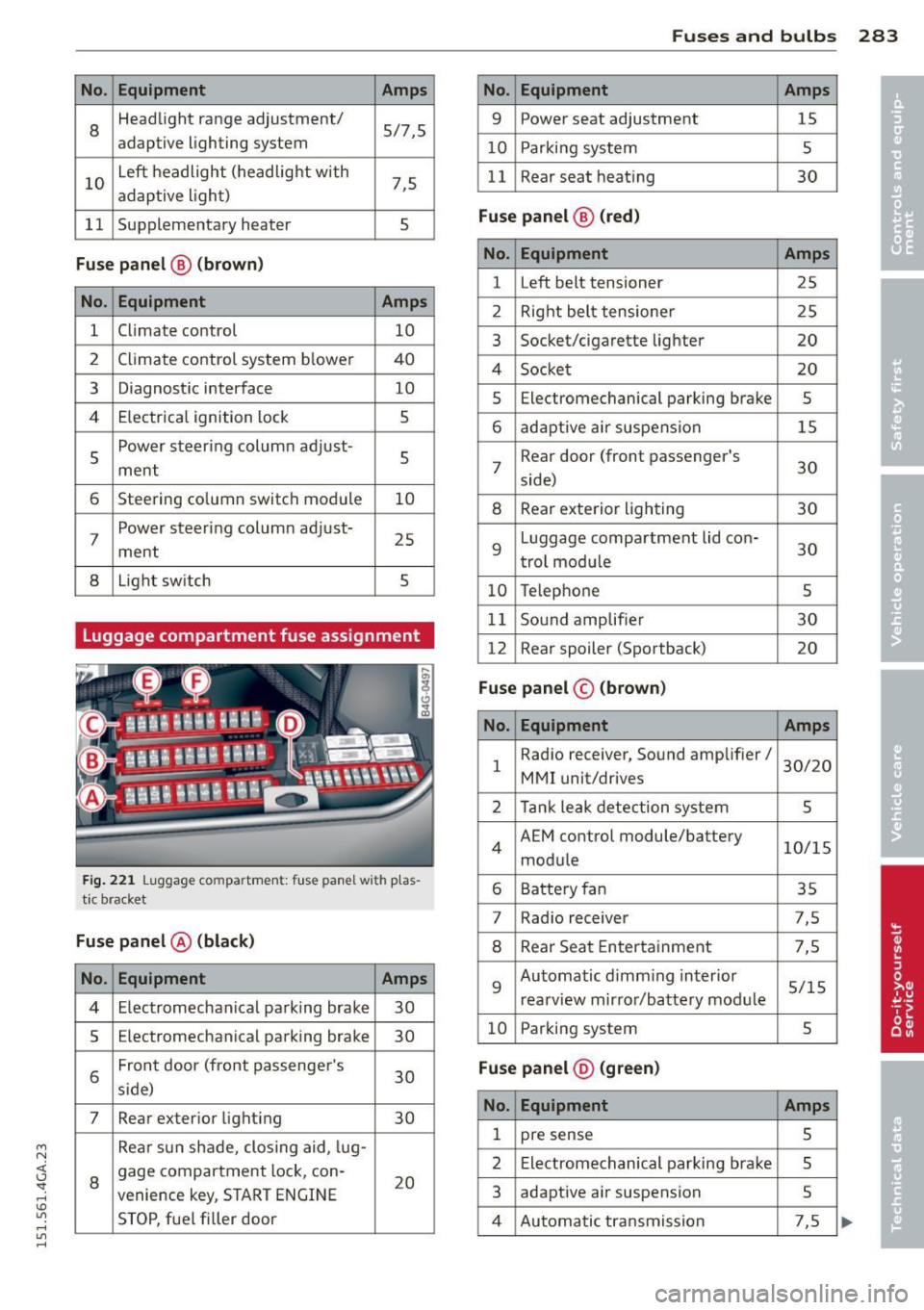
No. Equ ipment Amps
8
Headlight range adjustment/ 5/7,5
adaptive lighting system
10
Left headlight (headlight with 7,5 adaptive light)
11 Supplementary heater s
Fuse p anel @ (b ro w n)
No . Equipment Amps
1 Climate control 10
2
Climate control system blower 40
3
Diagnostic interface 10
4
E lectrical ignition lock s
5
Power steering column adjust-
ment
s
6 Steering column switch module 10
7
Power steering column adjust-
ment
25
8 Light switch 5
Luggage compartment fuse assignment
Fig . 221 Luggage compa rtmen t: fuse panel wit h p las
tic bracket
Fuse p anel @ (black )
No. Equipment Amps
4 Electromechan ical parking brake 30
5
Electromechanical parking brake 30
6
Front door (front passenge r's
30 s ide)
7 Rear exterior light ing 30
Rea r sun shade, closing aid, lug-
8
gage compartment lock, con-
20 venience key, START ENGINE
STOP, fuel filler door
Fu se s and bulb s 283
No. Equipment Amps
9 Power seat adjustment 15
10
Parking system 5
11
Rear seat heating 30
Fu se p an el@ (r e d )
No . Equipment Amps
1 Left belt tensioner 25
2
Right belt tensioner 25
3
Socket/cigarette lighter 20
4
Socket 20
5
Electromechanical parking brake 5
6 adaptive air suspension 15
7
Rear door (front passenger's
30 side)
8 Rear exterior lighting 30
9
Luggage compartment lid con-
30 trol modu le
10 Telephone 5
11
Sound amplifier 30
12
Rear spoiler (Sportback) 20
Fuse panel© (brown)
No . Equ ipment Amps
1
Radio receiver, Sound amplifier/
30/20
MMI unit/drives
2 Tank leak detection system 5
4
AEM control module/battery 10/15
module
6 Battery fan 35
7
Rad io receiver 7,5
8 Rear Seat Entertainment 7,5
9
Automatic d imm ing interior 5/15
rearview mirror/battery module
10 Parking system 5
Fu se pan el@ (gr ee n)
No . Equipment Amps
1 pre sense 5
2
Electromechanical parking brake 5
3
adaptive air suspension 5
4 Automatic transmission 7,5
Page 287 of 316

M N <( (.J
'SI: ,...., \!) ..,.,
,...., ..,., ,....,
Emergency situations
General
This chapter i s intended for trained emer
gency crews and working personnel who have the necessary tools and equipment to
perform these operations.
Starting by pushing or
towing
(D Note
Ve hicles w ith an au tomatic tra nsmission
cannot be started by pus hing o r tow ing.
Starting with jumper
cables
If necessary, the engine can be started by
connecting it to the battery of another vehi
cle.
If the engine shou ld fail to start because of a
discha rged o r wea k battery, the battery can be
connected to the battery o f
another vehicle,
using a
pair of jumper cables to start the en
g ine.
Jumper cables
Use only jumper cables of sufficiently la rge
c ross section to carry the starter c urrent safe
l y. Refer to the man ufacturer's specifications.
Use only jumper cables with
insulated te rm i
na l clamps wh ic h are d istinctly marked:
plus(+) cable i n mos t cases co lore d red
minu s(-) cable
in most cases colored black .
A WARNING
Batterie s contain e lec tricity, ac id, an d gas.
A ny of these can cause ve ry ser io us or fatal
inju ry. Follow the instructions below f or
safe han dling of your veh icle's b attery .
- Alway s shield you r eyes and avoid lean
ing over the bat te ry whenever possib le.
- A dis ch arged battery c an free ze at tem
peratures ju st be low 32 °F ( 0 °C ). Befo re
Emergency situations 285
connecting a jumpe r cab le, you must
thaw the fr ozen battery c omp lete ly, ot h
erwise it could explode.
- Do not allow battery acid to contact eyes
or skin. Fl ush any contacted area with
wate r immediately.
- Improper use of a booster battery to start a vehicle may cause an explosion.
- Vehicle batter ies genera te exp losive gas
es. Keep spar ks, flame and lighted c iga
rettes away from batte ries.
- Do not try to jump start any ve hicle w ith
a low ac id leve l in the battery.
- The vo ltage of the booste r batte ry m ust
a lso have a 12-volt rating. The capacity
(Ah) of the booster battery sho uld not be
lowe r tha n that of the discharged bat
tery . U se of batte rie s of d iffe ren t voltage
or substantially diffe rent "Ah" rat ing
may c au se an exp losion and persona l in
JU ry.
- N ever cha rge a fro zen battery. Gas trap
pe d in the ice may cause a n ex plosion.
- Never cha rge or use a batte ry tha t h as
been fr ozen. T he battery case may have
be weakened.
- Us e of b atter ies of differe nt voltage or
sub stant ia lly diffe ren t ca pa city (Ah) ra t
i ng may c ause an ex plosion an d injury .
Th e capac ity (Ah) of the booster bat tery
should not be lower than that of the dis
charged batte ry .
- Before you chec k any thing in the engine
compa rtment, always read and hee d all
WARNINGS
¢page 225.
(D Note
-App lyin g a higher vo ltage booster ba t
t ery w ill cause expens ive damage to se n
sit ive e lectronic com ponents, such as
cont ro l units, relays, rad io, etc.
- The re must be no electrical contact be
tween the vehicles as ot herwise c urrent
co uld a lready start to f low as soon as the
p o sit ive(+) term inals a re connected. ..,. •
•
Page 288 of 316

286 Emergency situations
@ Tips
The discharged battery must be properly
connected to the vehicle's electrical sys
tem. When jump starting or charging the
battery, never connect the negative
ground cable to the battery negative post
because the batte ry manager system must
be able to detect the battery 's state of
charge. Always connect the negative
ground cab le to the negative ground post
of the battery manager control unit.
Use of jumper cables
Make sure to connect the jumper cable
clamps in exactly the order described below!
Fig. 222 Engine compartment: connecto rs for jump
start cables and charger
Fig. 223 Jump start ing with the battery of another ve·
hide: @-booster battery, @-discharged ve hicle bat
tery
The procedure described below fo r connecting
jumper cables is intended to provide a jump
start for your vehicle.
Vehicle with discharged battery:
.,. Turn off lights and accessories, move lever
of automatic transmission to N (Neutral) or
P (Park) and set parking brake.
Connect POSITIVE(+) to POSITIVE(+)
(red)
.,. Open the red cover on the positive terminal
¢fig. 222.
1. Connect one end of the red positive cable
on the
jump start bolt c::;, fig. 223 @ (bolt
under the red cover = "positive") of the ve
hicle to be started @.
2. Connect the other end to the positive ter-
mina l@ of the booster battery@.
Connect NEGATIVE (-) to NEGATIVE (-)
(black)
3. Connect one end of the black negative ca
ble to the negat ive terminal @ of the
booster battery @.
4. Connect the other end to the
jump start
pin © (bolts with hex head bolt= "nega
tive") of the vehicle to be started @.
Starting the engine
.,. Start the engine of the veh icle w ith the
booster battery@. Run the engine at a
moderate speed .
.,. Start engine with discharged vehicle battery
@ in the usual manner.
.,. If the engine fails to start, do not keep the
starter cranking for longer than 10 seconds.
Wait for about 30 seconds and then try aga in .
.,. With engine running, remove jumper cables
from both vehicles in the exact
reverse o r
de r .
.,. Close the red cover on the positive term inal.
T he battery is vented to the outside to prevent
gases from entering the veh icle inter ior. Make
sure that the jumper clamps are well connect
ed with their metal parts in full contact with
the battery terminals.
_& WARNING
To avoid serious personal injury and dam
age to the vehicle, heed all warnings and
instructions of the jumper cable manufac
turer. If in doubt, call for road service .
- Jumper cables must be long enough so
that the veh icles do not touch.
-
Page 289 of 316

M N <( I.J "". rl I.O
"' rl
"' rl
-When connecting jumper cables, make
sure that they cannot get caught in any
moving parts in the eng ine compart
ment .
- Before you check anything in the engine
compartment, always read and heed all
WARNINGS ¢
page 225.
(D Note
Improper hook-up of jumper cables can r u
in the generator.
- Always connect POSITIVE( +) to POSI
TIVE(+), and NEGATIVE(-) to NEGATIVE
( - ) gro und post of the battery manager
control unit .
- Check that all screw plugs on the battery
cells a re screwed in firmly . If not, tighten
pl ugs p rior to connecting clamp on nega
tive battery term inal.
- Please note that the procedure f or con
nect ing a jump er cable as desc ribed
above appl ies spec ifically to the case of
you r vehi cle be ing jump started. When
you are giv ing a jump star t to an othe r ve
hi cle, do
not connec t the negat ive (-) ca
ble to the negat ive (-) terminal on the
discharged battery@¢
fig. 223. In
stead, securely connect the negative( -)
cable to e ithe r a solid metal component
that is firmly bolted to the engine block
or to the e ng ine block itse lf. If the bat
te ry tha t is being charged does not vent
to the outside, escaping batte ry gas
could igni te and exp lode!
Emergency towing
with commercial tow truck
General hints
Your Audi requires special handling for tow
tng.
The follow ing information is to be used by
commercia l tow tr uck operators who know
h ow to ope rate thei r equipme nt safe ly.
Emergenc y situ ation s 287
-Ne ver tow your Audi. Towing will cau se
damage to the engine and tran smission.
- Never wrap the safety chain s or w inch ca
ble s around the brake lines.
- To prevent unnece ssary damage , your Audi
must be transported with a flat bed tru ck.
- To load the vehicle on to the fl at bed , use
the towing loop found in the vehicle tools
a nd attach to the front or rear anchor age
¢ pag e 287 and ¢ page 288 .
_& WARNING
A vehicle being towed is not safe for pas
sengers. Never allow anyo ne to ride in a
vehicle be ing towed, for any reason.
Front towing loop
Only install the front towing loop when it is
needed.
Fig. 22 4 Front bu mpe r: cove r
Fig. 22 5 Front bu mpe r: in stall ing t he tow ing loop
-
The towing loop fits into the threaded hole lo
cated on the right s ide of the front bumpe r
and cove red by a sma ll cover when not in use.
.. Remove the tow ing loop from the vehicle
too l kit .
Page 302 of 316
300 Index
AUTO automatic climat e control .. .. ... ... ..
73
Automatic headlights ....... .. .... .. 44
climate control . . . . . . . . . . . . . . . . . . . . . 70
Auto Lock . . . . . . . . . . . . . . . . . . . . . . . . . . 3 3
Automatic belt retractor .. ... ..... .. .
141
Automatic climate control
Air vents . .... ........... .... .... ..
7 3
Automatic recirculation .... .. .. .. .. . . 74
Opera tion . . . . . . . . . . . . . . . . . . . . . . . . . 72
Setup . .. .. ................ ... .. .. 74
synchron izing .... ......... ... .. .. .. 73
Automatic Shift Lock (ASL) .... .. .. .. . 110
Automatic transmission ..... .. .. .. .. . 109
Automatic Shift Lock (ASL) .......... 110
Driving . . . . . . . . . . . . . . . . . . . . . . . . . . 111
Emergency mode . . . . . . . . . . . . . . . . . . 114
Emergency release .......... .. .... . 115
Kick-down ............... .. .. .... . 113
Manual shift program ..... .... .... . 113
Selector lever . . . . . . . . . . . . . . . . . . . . . 109
Automatic wipers .................. .. 48
Auto Safety Hotline ........ .. .. .. .. . 136
Ave rage consumption ....... .. .. .. .. . . 25
Average speed . . . . . . . . . . . . . . . . . . . . . . .
25
Avoid damaging the vehicle .. .. .. .. .. . 204
B
Brake fluid
Changing the brake fluid ............
234
Checking the brake fluid level ........ 234
What is the correct brake fluid level? .. 234
What should I do if the brake fluid warn-
ing light comes on? ................
234
Brake system
Anti- lock braking system . . . . . . . . . . . . .
19
Brake assist system . ....... .... .. .. 195
Brake booster .. ... .............. .. 199
Brake fluid .. .. .. .......... ...... . 234
Brake fluid specifications for refill and re-
placement ...... ................ .
234
Brake pads .... .. ............. .... 203
Electromechanical parking brake ... .. . 79
Fluid reservoir ... ................ . 234
How does moisture or road salt affect the
brakes? . . . . . . . . . . . . . . . . . . . . . . . . . .
198
Warning/indicator lights ........ .. .. . 15
Worn brake pads symbol . . . . . . . . . . . . . 20
braking guard
Settings .. .... .. .. .............. ..
93
Brak ing guard . .. .. .......... ...... .. 86
Messages ... .. .. .. ....... .... .... . 93
Break-in period .. .. ............. .... 203
Brake pads .. ... . ... ... .... ... .. .. 203
Tires ........ ... .. .............. . 203
Bulbs .......... .. .. .............. . 284
Bag hooks . . . . . . . . . . . . . . . . . . . . . . . . . . 67 C
Battery ..... ................ ..... .
Charging ................... ..... .
Important warnings ...... .. .. .. .. .
Jump starting . .... ....... .. .. .. .. .
Location
. .. .... ........... .. .... .
low ..... .. ................ ... ' . .
Replacing the battery ..... .. .. .. .. .
State of charge ........... .. .. .. .. .
w· t · 1n er operation ......... .... .... .
Working on the battery .... .. .. .... .
Before driving .............. ... .. .. .
235
237
235
285
235
201
238
201
235
235
128
Blended gasoline . . . . . . . . . . . . . . . . . . . 217
Blower (automatic climate control) . . . . . . 73
Blower (climate con trol) . . . . . . . . . . . . . . . 70
Booster seats .............. ... .... . 182
California Proposition 65 Warning ..... 226
Battery specific .. ............. .... 236
Capacities .. .. .. .. ............. .. .. 292
Engine oil ..... .. ............. .... 227
Carbon par ts
Cleaning . . . . . . . . . . . . . . . . . . . .
214,215
Car carrier
Transporting your vehicle ....... ....
289
Care ..... .. .. .. .. .... ......... .... 212
Cargo area ...... .. .. ... ........... . 134
Cargo net . . . . . . . . . . . . . . . . . . . . . . . . . . . 66
Catalytic converter . ... .. ... ..... .. .. 204
Center armrest
Cockpit . .. .. .. .. ............. .. .. .
56
Central locking .... ............. ..... 33
Emergency locking ................ ..
37
Page 305 of 316
M N <( (.J
'SI: ,...., \!) 1.1'1 ,...., 1.1'1 ,....,
Data ...... .. .... .. .... ... .. .. ... 293
Start-Stop -System . . . . . . . . . . . . . . . . . . 81
start ing . ... .... ...... ... .. .. .. .. .. 76
Starting with jumper cab les .. .. .. .. . 285
Stopping . . . . . . . . . . . . . . . . . . . . . . . . . . 77
E ng ine compartment .... ... .. .. .. .. . 22 7
C losing the hood . ..... ... .. .. .. .. . 226
Opening the hood ..... ... .. .. .. .. . 225
Safety instructions ........ .. .. .. .. . 225
Working in the engine compartment . . 225
E ng ine coolant ... ...... ... .. .. .. ... 231
Adding coolant . .. ..... ... .. .. .. ... 232
Chec king the engine coolant leve l .. .. . 23 1
Expansion tank ........... .... .. .. . 231
Malfunct ion symbo l ....... .. .. .. .. .. 16
Radiator fan .............. ... ... .. 233
Temperature gauge ........... ... ... 11
Engine oil ... .... .. .... ... .. .. .. ... 227
Adding .. .. ............. .... .. ... 229
Addit ives . .. ............. .... .. .. . 229
Changing .. .. ... .. ... ... .. .. .. ... 230
Checking the eng ine o il level .. .. ... .. 229
I ndications and cond it ions requ iring ex-
tra check ing ............. .... .. ... 229
I ndicator ligh t . . . . . . . . . . . . . . . . . . . . . 18
O il cons umption .......... .. .. .. .. . 228
P ressu re mal func tion ... ... .. .. .. .. .. 17
Recommended oil check intervals . ... . 229
Sensor defect ive . . . . . . . . . . . . . . . . . . . . 22
Specification and viscos ity .. .. .. .. .. . 227
E ng ine sound ............. .... .. .. . 10 2
Eng ine speed limitat io n ........ .. .... . 21
Engine start -stop mode
refer to Start-Stop-System . .. .. .. .. .. 83
E ng ine star t sys tem (indicator l igh ts) .. .. 18
Env ironment
Break- in period ........ ...... .... .. 203
Cata lytic converter ........... .... .. 204
D iese l par ticul ate fi lter .... .. .. .. .. . 205
Di sposing of yo ur vehicle ba ttery .. .. . 238
D riving a t high speeds .. ... .. .. .... . 206
D riving to minimize pollution and noise 205
Fu el . .... .. .. ... .. ..... ... .. .. ... 219
F ue l economy ............ .... .. ... 205
Leaks under your veh icle ... .. .. .. .. . 225
Lett ing the veh icle stand and warm up . 206
Proper disposal of dra ined brake flu id . 234
Inde x 303
Proper disposal of d rained eng ine cool -
ant . ... .. .. .. .... . ... ...... ... .. 232
Proper disposal of d rained eng ine
o il . . . . . . . . . . . . . . . . . . . . . . . . . 229, 230
Recycling used engine oil ............ 229
Un leaded fuel .. ... ................ 217
What should I do with an o ld battery? . 238
Event Data Recorder (EDR) . . . . . . . . . . . . 194
E xhaust tail pipes
Cleaning .. .. .. .. .. . .............. 213
Expansion tank .. ... ...... .......... 231
Exterior lighting ..... . .. .. ..... ... .. . 44
E xte rior m irrors
Adjus ting . .. .. .. .... ........... .. . 50
Di mming . ... .. .. .. .. .. ...... ... .. . 51
Heating ... .. .... ... .. .. ..... ... .. . 50
Exterior temperature display ........... 24
F
Fastening
Boos ter seats .. .. .. . .. .... .... .. .. 182
Co nvertib le child safety seats ........ 180
Infan t seats . . . . . . . . . . . . . . . . . . . . . . 179
Floor mats . . . . . . . . . . . . . . . . . . . . . . . . . 133
Foot peda ls ... .. .... . ... ...... ... .. 133
Fo r the sake of the environment
Gasoline fumes and t he env ironme nt .. 219
Red ucing engine noise by early upshift -
i ng ....... .. .. .. ... ............ ... 11
Ref ueling ... .... ... .. .. ..... ... .. 219
Saving f uel by early upshifting ... .. .. . 11
Fo ur- zone automatic climate control . .. . 72
Front airbags Descrip tion . . . . . . . . . . . . . . . . . . . . . . . 151
How they work . ......... ......... . 157
Frontal coll isions and the laws of physics 139
Fron t seats . . . . . . . . . . . . . . . . . . . . . . . . . 53
Adjus ting . .. .. .. .. ............... 13 0
Child rest rain ts in the front seat . ... .. 149
Fuel Additives .. .. .. .... .......... ..... 217
B lended gaso line . ............. .... 217
C u rrent cons umption .. ......... .... . 25
E conomy messages (eff icien cy program) 26
F uel fi ller flap emergency release ... .. 221
F uel fi ller neck ..... . .. .. ..... ... .. 219
Fuel gauge . . . . . . . . . . . . . . . . . . . . . . . . 12
•
•
Page 307 of 316

M N <( (.J
'SI: ,...., \!) 1.1"1 ,...., 1.1"1 ,....,
l
Jack 273
285
286
J
ump-starting ..... .. ...... .. .. .. .. .
Jumper cables ............. .... .. .. .
K
Key ... .. .. .. .. .. .. .. .... ... .. .. .... 31
Battery replacement master key ... .. .. 32
E mergency key . . . . . . . . . . . . . . . . . . . . . 31
Key not recogni zed . . . . . . . . . . . . . . . . . . 78
Key replacement . . . . . . . . . . . . . . . . . . . 31
Master key . . . . . . . . . . . . . . . . . . . . . . . . 31
Mechanical key . . . . . . . . . . . . . . . . . . . . . 32
Kick -down
tiptronic . .. ............. .... .. .. . 113
Knee airbags ... .. .. .. .... ... .. .... . 164
Description ... .. .. .. .... ... .. .. ... 164
H ow they work . .. ..... ... .. .. .. .. . 165
Important safety instructions . .. .. .. . 166
L
Lane assist . ..... .. .... ... .. .. .. .... 95
L ane Change Ass istant
refer to side assist . . . . . . . . . . . . . . . . . . 98
LATCH .... .. ................. .. ... 187
Descr ipt io n .... ........... ... ... .. 188
Install ing a child restraint ....... .... 189
L ocat io n . .. .. ........ ... .. ... ... . 188
M ounting and releasing the ancho rage
h ook .... .. ................. .. ... 189
Launch Contro l Program .. ..... .... .. 113
L eather cleaning/protection ... .. .. .. . 215
L eaving home ............. .... .. .... 46
Lifting jack .. ............. .... .. ... 277
Lifting vehicle . ..... .... ... .. .. .. ... 289
Light Ambience lighting . ....... .. .. .. .. .. 4 7
Com ing/ Leavi ng home ..... .. .. .. .. .. 46
Da ytime r unning lights .... .. .. .. .. .. 44
E mergency flashers ....... .. .. .. .. .. 45
E xterior lighting .. ..... ... .. .. .. .... 4 4
H eadlig ht range contro l ... .. .. .. .. .. 44
High beam . ............. .... .. .... 46
Low beam .. ............. .... .. .. .. 44
Rear fog lights ........... .... .. .... 44
Inde x 305
Side marker lights . .. .. ..... ... .. .. . 44
Turn signals ... .. .. . ... ...... ... .. . 46
L ight/ rain senso r
Head lights .. .. .. .... ........... .. . 44
Intermitten t (w indshie ld w ipers) . .. .. . 48
Senso r defective . . . . . . . . . . . . . . . . . . . . 23
Load ing the roof rack ............... .. 63
Locking Power locking switch ........... .... . 36
Remote contro l . . . . . . . . . . . . . . . . . . . . 34
U sing the key .. ... ...... ........... 36
Low beams ....... .. . .. .. ..... ... .. . 44
Lowe r universal ancho rages (Canada) . .. 18 7
Luggage compartment Bag hooks . . . . . . . . . . . . . . . . . . . . . . . . . 67
Cargo net . . . . . . . . . . . . . . . . . . . . . . . . . 66
ca rpeting . . . . . . . . . . . . . . . . . . . . . . . . . 67
Cove r ..... .. .. .. ................. . 64
En larging . . . . . . . . . . . . . . . . . . . . . . . . . 65
L oad ing ... .. .. .. .. . .. ... .... ... .. . 64
Movement-activated ope ning . ... .. .. . 39
Ski sack ... .. .... ... .. .. ..... ... .. . 67
Stow ing luggage . .. ............... 134
Tie-downs . . . . . . . . . . . . . . . . . . . . . . . . . 66
Trunk pass-through ................ . 68
Lumbar suppor t
Front seats . . . . . . . . . . . . . . . . . . . . . . . . 55
M
Maintenance . ... .. .. .. ... ..... ... .. 294
Malfunction Ind icator Lamp (MIL) . . 21, 29
Manua l shift program ... ...... ... .. .. 113
Ma ssage func tion
F ron t se ats . . . . . . . . . . . . . . . . . . . . . . . . 55
Mat te f inish paint clea ning .......... . 212
Mechanica l key . ..... . .. .. ..... ... .. . 32
Mir ro rs
Adjus ting the ex ter ior mirrors . . . . . . . . . SO
dimming . ... .... .. . .. ... .... ... .. . 51
Vanity mirrors ... .. . ... ...... ... .. . 48
Monito ring the Advanced Airbag System 1S9
Mult if u nct ion steer ing whee l ...... .. .. . 25
N
Natura l leather
Cleaning . ... .. .... . ... ...... ... .. 21S
•
•