light AUDI A7 2016 Owners Manual
[x] Cancel search | Manufacturer: AUDI, Model Year: 2016, Model line: A7, Model: AUDI A7 2016Pages: 294, PDF Size: 73.82 MB
Page 185 of 294
M N <( I.J "". rl I.O
"' N I.O rl
Tether anchors and tether straps
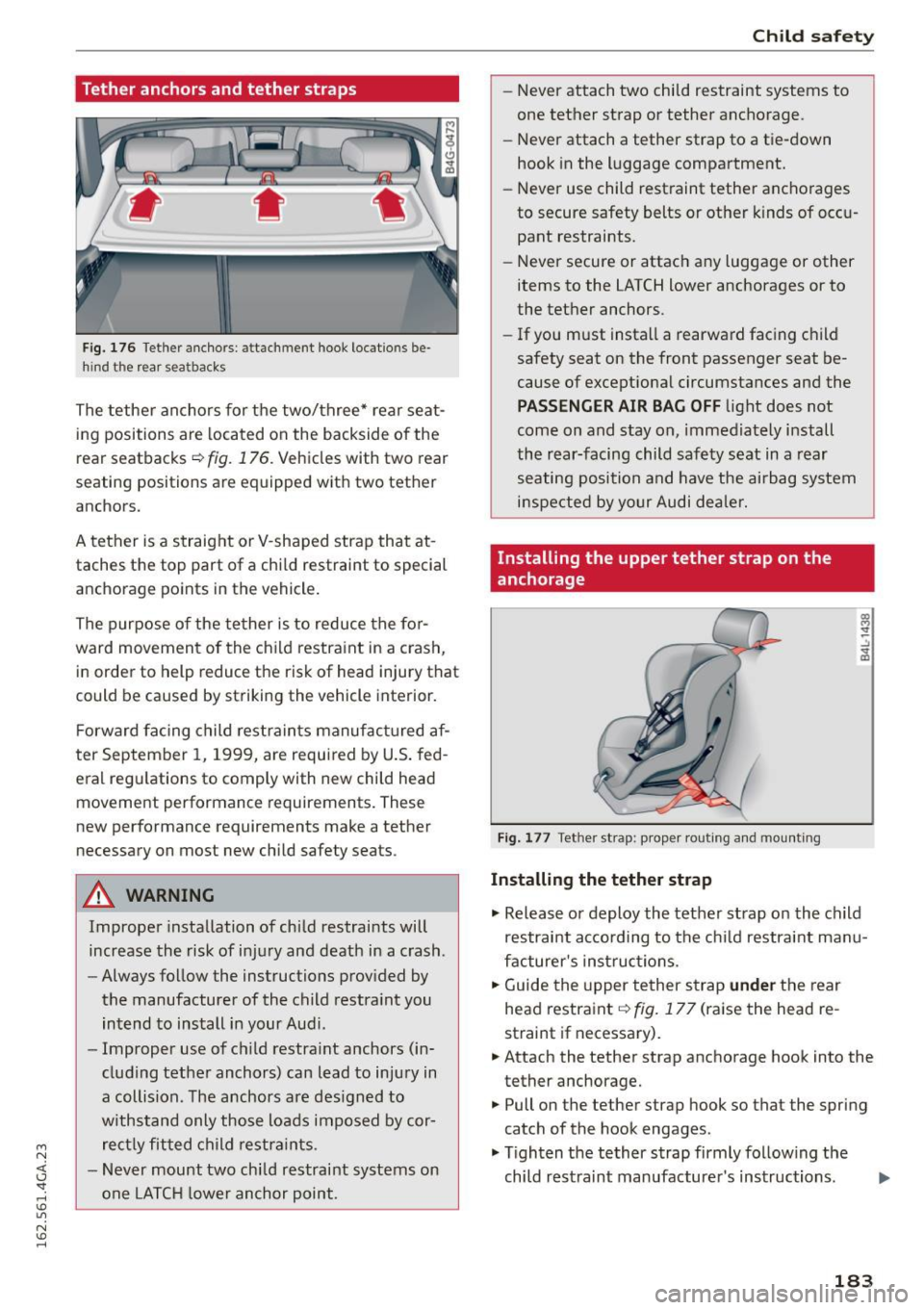
Fig. 176 Tether ancho rs: attach ment hook locatio ns be·
h ind t he rear sea tbacks
The tethe r anchors for the two/three* rear seat
ing positions are located on the backside of the
rear seatbacks
~ fig. 176 . Vehicles with two rear
seating positions are equipped with two tether
anchors.
A tether is a straight or V-shaped strap that at
taches the top part of a ch ild restraint to special
anchorage points in the vehicle.
The purpose of the te ther is to reduce the for
ward movement of the child restraint in a c rash,
in order to help reduce the risk of head injury that
could be caused by striking the vehicle interior.
F orward facing child restrain ts manufact ured af
ter Sep tember 1, 1999, are required by U.S . fed
eral reg ulations to comply with new child head
movement performance requirements. These
new performance requirements make a tether
necessary on most new chi ld safety seat s.
A WARNING
Improper installation of chi ld restraints will
increase the risk of i njury and death in a crash .
- Always follow the instructions prov ided by
the manufacturer of the child restra int you
intend to install i n your Aud i.
- Improper use of ch ild restra int anchors (in
cluding tether anchors) can lead to injury in
a collision . The anchors are des igned to
withstand only those loa ds i mposed by cor
rect ly fit ted child restra ints .
- N ever mount two chi ld restraint systems on
one LATC H lower anchor point .
.
Child sa fe ty
- Never attach two child restraint systems to
one tether strap or tether anchorage.
- Never attach a tether strap to a tie-down
hook in the luggage compartment.
- Never use child restraint tether anchorages
to secure safety belts or other k inds of occ u
pant restraints.
- Never secure or attac h any luggage or other
items to the LATCH lower anchorages or to
the tether anchors.
- If you must insta ll a rearwa rd facing child
safety seat on the front passenger seat be
cause of except ional circumstances and the
PASSENGER AIR BAG OFF light does not
come on and stay on, immediately install
the rear-facing child safety seat in a rear
seating position and have the airbag system
inspected by your Audi dealer.
Installing the upper tether strap on the
anchorage
Fig . 1 77 Tet her st ra p: prop er rou ting a nd m ou nting
Installing the tether st rap
... Release o r deploy the tet her st rap on the ch ild
restraint ac cording to the chi ld restraint manu
facturer's instructions.
... Guide the upper te ther strap
under the rear
head restraint ~
fig. 177 (raise the head re
straint if necessary).
... Attach the tether strap anchorage hook into the
tether anchorage.
... Pull on the tether strap hook so that the spring
catch of the hook engages .
.,. Tighten the tether strap firmly follow ing the
child restraint manufacturer's instructions.
ll>
183
Page 186 of 294
Child safety
Releasing the teth er str ap
.,. Loosen the tension following the c hild restra int
manufacturer's instructions.
.,. Depress the spring catch on the hook and re
lease it from the anchorage.
(D Note
I f you leave the child restraint with the tether
strap firmly insta lled for severa l days, this
co uld leave a mark on the upho lstery on the
seat cush ion and backrest in the area where
the tet he r strap was installed. The upholstery
would also be permanently stretched around the tethe r stra p. This a pplies espec ially to
l e ather seats.
Using tether straps on rearward-facing
child restraints
Cur rently, few rear-facing child rest raint systems
come with a tethe r. P lease read and h eed the
child restra int system manufactu rer's instruc
tions carefully to determ ine how to properly in
stall the tether.
A WARNING
A c hild in a rearward-facing child safety seat
installed on the front passenger seat will be
ser iously injured and can be killed if the front
air bag infl ates -even w ith an Advance d Ai rb ag
System.
- T he inflati ng a irbag w ill hit the child safety
seat or infa nt c arrie r with gre at force and
will smash t he chi ld safety seat and ch ild
against the bac krest, center armrest, or
doo r.
- If you mus t insta ll a rearward facing chi ld
safety seat on the fro nt passenger seat be
ca use of exceptional ci rc u mstances and the
PASSENGER AIR BAG OFF light does not
come on and stay on, immediately install
the rear-fac ing c hild safety seat in a rear
seat ing pos ition and have the airbag system
inspec ted by your A udi dealer .
184
Additional information
· Sources of information about child
restraints and their use
There are a number o f sources of additiona l infor
mation about child restraint se lection, insta lla
tion and use :
N HT SA advises t hat the bes t chi ld safety seat is
the one tha t fits yo ur child and fits in yo ur vehi
cle, and that you will use correctly and co nsis
tent ly.
Try before yo u buy!
U.S National Highway Traffic Safety Admin ist ra
t ion
Tel.: 1 -888-3 27-4 236 (TIY: 1-8 00-42 4-9153)
www. n htsa .gov
National SAFE KIDS Campaign
Tel.: (202) 662-0600
www.safe kids.o rg
Safety BeltSaf e U.S.A
Tel.: (800) 7 45-SAFE (English)
T el.: (800) 747-SANO (Spanish)
www. ca rseat.org
T ransport Canada Information Centre
Tel.: 1-800-333-0371 o r call 1-613-998-86 16 if
yo u are in the Ottawa a rea
http://www .t c.gc. ca/e ng/ roadsafety/menu .htm
Audi Customer Relations
Tel.: (800) 822-2834
Page 190 of 294
Intelligent Technology
shared, p le a se see yo ur contract with the
wireless telecomm unications provider and the
"About Aud i connect" tab in your vehicle's
MMI:
! MENUI button> Audi connect > About
Audi connect .
Electronic Stabilization
Control (ESC)
Description
ESC helps to improve road holding and vehicle
dynamics to help reduce the probability of sk id
d ing and loss of veh icle control.
It works only
when the engine is runn ing. ESC detects certa in
d ifficult d riving situations, including when the ve
h icle is beginn ing to sp in (yaw) o ut of control and
he lps you to ge t the veh icle back u nder cont ro l b y
selec tively braking the whee ls, and/or reduc ing
engine power and providing steering assistance
to help hold the vehicle on the driver's i ntended
course. The indicator light
DJ in the instrument
cluster blinks when ESC is taking action to help
you control t he veh icle.
ESC has lim itations. It is important to remember
that ESC cannot overcome the laws of physics. It
will not a lways be ab le to he lp out under all con
d itions you may come up against. For example,
ESC may not always be able to help you master
situations where there is a sudden change in the
coefficient of friction of the road surface. Whe n
there is a section of d ry road tha t is s udden ly cov
ere d wi th wa ter, s lush or snow, ESC ca nnot per
form the same way it wou ld on the d ry s urface . If
the vehicle hydroplanes ( rides on a cushion of wa
ter instead of t he road surface), ESC wi ll not be
ab le to he lp you steer the veh icle because contact
with the pavement has been i nterrupted and the
ve hicle cannot be b raked or steered. Dur ing fast
cor ne ring, particula rly o n w inding roads, ESC
cannot a lways deal as eff ect ively wi th d iff icu lt
d riving situat ions than at lowe r speeds.
Always ad just your speed and dr iv ing style to
road, traffic and weather conditions. ESC ca nnot
over ride the vehicle's physical limi ts, increase t he
ava ilab le tract io n, or keep a vehi cle on t he road if
roa d de pa rture is a res ult o f driver in att enti on.
I nstead, ESC improves the poss ibility of keeping
188
the veh icle unde r control and on the road dur ing
extreme maneuve rs by using the dr iver's stee ring
i nputs to help keep the vehicle going in the in
tended direction. If yo u are traveling at a speed
that causes you to run off the road before ESC
can p rov ide any assistance, you may not experi
ence the benefits of ESC.
ESC is switc hed on all the time. In certain s itua
tions when you need less tracti on, you can switch
off ASR by press ing the button
[ru c:> page 189,
fig . 178. Be sure to sw itch ASR on aga in when
you no longer need l ess traction.
The following systems are integrated in the ESC:
Anti -lock braking system (ABS )
ABS prevents the whee ls from locki ng when brak
i ng . T he veh icle can st ill be stee red even during
hard braking. App ly steady pressure to the brake
pedal. Do not pump the pedal. A puls ing in the
brake pedal indicates that the system is acting to
stab ilize the veh icle.
Brake assist sy stem
The bra ke ass ist system can decrease braking dis
tance. It increases bra king power when the driver
presses the brake peda l quickly in emergency sit
uat ions. You must press and hold the b rake peda l
u nt il the dange rous situat io n is over . In vehicles
with adaptive cruise co ntro l*, the brake ass ist
system is more sensitive if t he d ista nce detected
to t he veh icle a head is too sma ll.
Anti-slip regulation (ASR)
ASR red uces eng ine power when the drive wheels
begin spin ning and adapts the force to the road
cond it ions . Th is makes it eas ier to sta rt, acce ler
ate a nd dr ive up incl ines.
Electronic differential lock (EDL)
EDL applies t he brakes to a whee l that starts
sp inning a nd tra nsfe rs the d rive power to the
othe r drivi ng whee ls. This function is not ava ila
ble at hig he r speeds.
In extreme cases, EDL automatically sw itches off
to keep the brake o n the braked whee l from over
hea ting. The vehicle is st ill work ing cor rect ly. EDL ..,.
Page 192 of 294
Intelligent Technology
ESC lev els
Sport mode on Sport mode off
Beha vior
The ESC and ASR stabilization f unctions are The full stabilization function of t he ESC
limited
c> ,& . and ASR is avai lab le again .
Operation Press the 1.$ OFF I button. Press the 1.$ OFF I button agai n.
In dicato r II turns on. II turns off.
light s
Driv er m es- S ta bi liz at ion contr ol (ESC ): sport. Warn -Stabiliz ati on c ontr ol (ESC ): on
s age s ing! Res tricted stabilit y
A WARNING
Only switch sport mode on when yo ur driving
abilities and the traffic situation permit, be
cause there is a risk of sliding.
- The stabilization function is limited when
sport mode is switched on. The dr iv ing
wheels could spin and the vehicle could
swerve, especially on slick or slippery road
s u rfaces .
(D Tips
-Sport mode cannot be switched on if the
cruise control system* or adaptive cruise
control* is switched on.
- If the rear spoiler system malfunctions,
sport mode may not switch on or it may
switch off again automat ically.
Braking
What affects braking efficiency?
New brake pads
During the f irst 250 miles (400 km), new brake
pads do not possess the ir full braking effect, they
have to be "broken in" first
c> ,& . You can com
pensate for this sl ightly reduced brak ing power
by pushing ha rder on the brake pedal. Avoid
heavy brak ing loads dur ing the b reak-in per iod.
Operat ing condit ions and d riving hab its
The brakes on today's automobi les are st ill sub
ject to wear, depending largely on operating con
d itions and dr iving habits
c> ,& . On veh icles that
are either driven mostly in stop-and-go c ity t raf
fic or are dr iven hard, the b rake pads should be
checked by your author ized Audi dea ler mo re of -
190
ten than specified in the Warrant y & Mainte
nan ce b ookl et.
F ail ure to have your brake pads
inspected can resu lt in reduced brake perform
ance.
On steep slopes, you sho uld use the braking ef
f ect of the engine. This way, you prevent unnec
essary wear on the brake system. If yo u must use
you r brakes, do not hold the brakes down contin
u ously. Pump the brakes at intervals .
Operating noise
Noises may occur when braking depend ing on the
speed, braking force and ou tside cond itions su ch
as temperature and hum idity .
Effect of wat er and road salt
In certa in situations, for examp le after driv ing
t hr ough water, in heavy rain, after overnight con
densa tion or after washing yo ur ca r, the bra king
effect can be reduced by moisture or ice on the
brake rotors and brake pads . The brakes must be
dried fi rst with a few careful brake applications .
At higher speeds and with the winds hield wipers
turned on, the brake pads press against the brake rotors for a short amount of time . This occurs at
r egular intervals without the driver noticing and
provides for better brake response time under
wet cond itions .
The effect iveness of the brakes can be reduced
when the vehicle is d riven on a salt-covered road
and the brakes are not used. Likewise, you clean
off accumulated salt coating from brake discs
and pads wi th a few caut ious applications of the
brake
c> ,& . IJI>
Page 194 of 294
Intelligent Technology
Electromechanical
steering, dynamic
steering
The electromechanical steering supports the
driver's steering movements .
Powe r stee ring adapts electroni cally based o n
the vehicle speed.
Indicator lights and messages
• Do not dr ive v ehicle: steering d efecti ve
If th is ind icator light turns on and stays on and
this message appears, the power steering may have fa iled.
Stop the vehicle in a safe locatio n as soon as pos
sib le. Do
not continue driving. See an author iz ed
Aud i dealer or authori zed Aud i Service Facility for
assistance.
,Ton Steering: Sy stem fault You can continue
driving
If the indicator lig ht t urns on and the message
appears, t he steering may be more diffic ult to
move or more sensitive than usual. The steering
wheel may a lso be at an ang le when dr iv ing
straight.
D rive s low ly to your authorized A udi dealer or
qualified wor kshop to have the malfunction cor
rected.
,Ton Dynamic steering: Initializing
If the indi cator lig ht ls b linki ng and th is message
appears, dynam ic s teeri ng* is being ini tialized.
Once you st art the eng ine a fter this is finished,
the steering wheel will be easy to move . Re -initi
alization might be necessary if the steering whee l
was moved hard to the left and right wh ile the
veh icle was not moving . The display turns off if
the initiali zation was successfu l.
(D Tips
-If th e . or ,Ton indicator light only stays on
for a short time, you may continue driving.
- The dynamic steering sta bility systems
r=> page 188 are not ava ila ble in the event of
a system ma lf u nction.
192
- For add itiona l information on dynamic
steerin g, refer to
r=> page 101.
All wheel drive (quattro)
App lies to vehicles : with all wheel drive
In all wheel drive, all four wheels are powered .
General information
In all whee l dr ive, the dr iv ing power is divide d be
tween all four whee ls. Th is happens automat ic al
l y depending on yo ur driv ing behavior as well as
the cur rent roa d conditions . Refer to r=>
page 188,
Electronic Stabilization Control (ESC).
A cente r d iff eren tial distribu tes the d riving power
variably to the fron t and rear ax le . I t works to
gether w it h select ive whee l torq ue control, which
activates when driving throug h curves
<=> page 189. With the sport differential*, power
distribution to the rear wheels is variable a nd can
be adjusted with drive select<=>
page 101 .
The all whee l drive concept is designed for high
engine power . Yo ur vehicle is exceptionally pow
erfu l and has excellent driving characterist ics
bot h under normal driving conditions and on
snow and ice . Always read a nd follow safety pre
ca utions
<=> ,& .
Winter tires
By using all whee l dr ive, your ve hicle has good
forward motion with sta ndard t ires in winter con
dit ions . However, in winter we recommend usi ng
winter or all seaso n tires on a ll fou r wheels, be
cause this will improve the braking eff ect.
Snow chains
If there are snow chain laws, snow chai ns m ust
also be used o n ve hicles with all wheel drive
r=> page 248 , Snow chains .
Replacing tires
For vehicles with a ll wheel drive, o nly wheels with
the same rolling circum ference should be used.
Avoid w heels with d ifferent tread dept hs
<=> page 240, New tires or wheels. ..,.
Page 195 of 294
M N <( I.J "". rl I.O
"' N I.O rl
Offroad vehicle?
Your Aud i is not an off road vehicle -there is not
enough ground clea rance . For this reason, avo id
difficu lt terrain .
A WARNING
-Also, in vehicles with all whee l dr ive, adapt
your dr iving style to the current road and
traffic conditions. Do not let the increased
safety provided tempt you into taking risks, because t his increases the risk of an acci
dent .
- The brak ing ability of yo ur vehicle is lim ited
to the traction of the wheels . In this way, it
is not different from a two wh eel drive veh i
cl e. Do not be tempted to ac celerate to a
high speed when t he ro ad is s lippery th is in
cr eases the r is k of an accident .
- Note t hat on wet streets, t he front w heels
c an "hyd rop lane" if d riving at speeds that
are too high. Unli ke front whee l drive
vehicles, the engi ne does not rev higher sud
den ly when the vehicle begins hydrop laning.
For this reaso n, pay attent ion to the r oad
condit ions regardless of your speed to re
duce t he risk of an accident .
Rear spoiler
The extendable rear spoiler increases driving sta
bility.
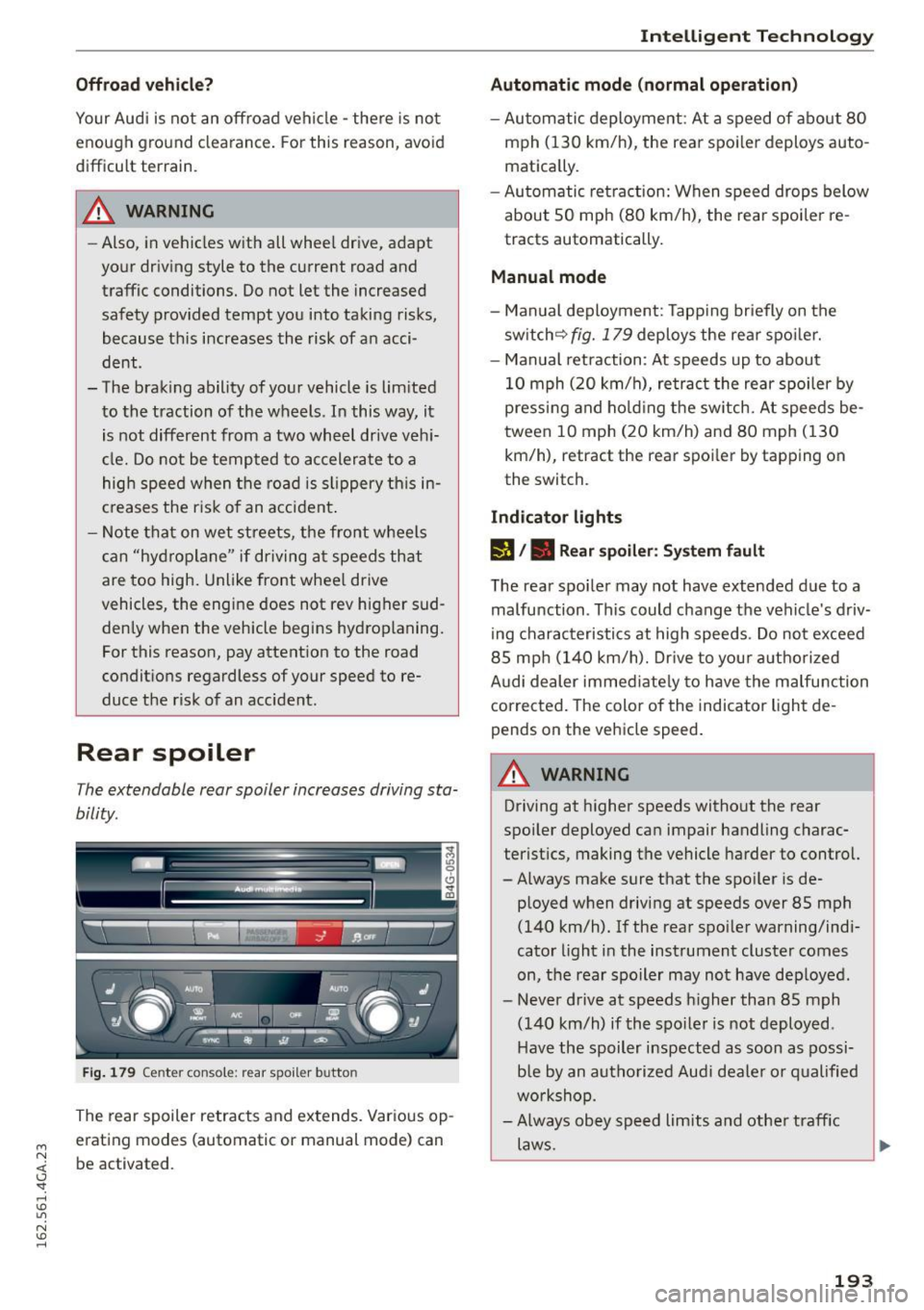
Fi g. 179 Cente r con sole : re ar s poil e r b utto n
The rear spoiler retrac ts and extends. Var ious op
erat ing modes (automatic or manual mode) can
be activated .
Intelligent Technology
Automatic mode (normal operation)
-Au tomatic deployment : At a s peed of about 80
mph (130 km/h) , the rear spo ile r deploys auto
matically .
- Au tomatic retra ction: When speed drops below
abou t SO mph (80 km/h), the rea r spoi ler re
tracts automatically.
Manual mode
- Man ual deployment: Tapp ing br iefly on the
sw itch ~
fig. 179 deploys the rea r spo ile r.
- Manual retraction : At speeds up to about
10 mph ( 20 km/h), re tract the rear spoiler by
pressi ng and hold ing t he sw itch. At speeds be
tween 10 mph (20 km/h) and 80 mph ( 130
km/h), retract the rear spoi ler by tapping on
the switch.
Indicator lights
rJ /. Rear spoiler : S ys tem fault
The rea r spoi le r may not have exte nded due to a
malfunction . Th is could change the vehicle's driv
i ng charac teristics at high speeds . Do not exceed
8 5 mp h (140 km/h). Dr ive to you r authorized
A udi dealer immed iate ly to have the malfu nction
corrected. The color of the indicator light de
pends on the vehicle speed .
A WARNING
-
Driving at higher speeds witho ut the rear
spoi ler deployed ca n impair handling charac
terist ics, making the vehicle harder to control.
- Always make sure that the spo iler is de-
p loyed w hen d riving at speeds over 85 mph
(140 km/h). If the rea r spo ile r warning/ind i
cato r light i n the instrument cluster comes
on, the rear spoile r may not have deploye d.
- Never drive at speeds h igher than 85 mph
(140 km/h) if the spo iler is not deployed.
Have the spoiler i nspected as soon as possi
b le by an au tho riz e d Aud i deale r o r q ualified
w orkshop.
- Always obey speed li mits and othe r traff ic
laws.
193
Page 196 of 294
Intelligent Technology
& WARNING
Improp er operat ion of the rear spoiler can
cause crushing injuries.
- Always make sure that nobody, espec ially
children , is in the way when the rea r spo ile r
i s deployed or retracted.
@ Note
- Neve r push on the vehicle on the rear spoi l
er. Th is co uld cause damage .
- To prevent damage to the rear spoiler do
not lean or p lace anyth ing on it.
- Only ope rate the rear spoi ler manually when
the luggage compartment lid is close and
the rear spo iler moving parts are not
blocked . Ot herwise, damage could occur.
(D Tips
Clean the rear spoiler compartment every 2 to
3 mont hs. To function correct ly, the rear
sp oiler must be free of ice, sn ow and leav es.
Energy management
The starting ability is optimized
The energy management system manages the
ele ctrical energy distribu tion and op timi zes the
availability of elec trical energy for starting the
engine .
Whe n a ve hicle wit h a co nven tional e nergy sys
tem is not dr iven for a long time, the ba tte ry is
d rained by equipmen t (fo r example the immobil
izer). In certa in circ umstances, there cou ld may
not be eno ugh energy to start the engine .
Your veh icle i s equ ipped w ith an intellige nt ener
gy managemen t system for distr ibuting electr ic i
ty . Th is significantly improves the starti ng ability
a nd increases the battery life .
T he energy m anagemen t sys tem Is made up of
battery diagno sis, idling current management
and dynamic energy management.
Battery diagnosis
T he batte ry diagnos is determines the ba tte ry
ch arge leve l. The sen sors de te ct the ba tte ry, the
194
batte ry current, an d the batte ry tempera ture.
The c urrent charge leve l and the perfo rmance of
t h e battery are determined based on th is.
Idling current management
The idling cur ren t management decr eases the
energy used wh ile pa rke d. Wi th the eng ine
switched off, it manages the energy dis trib ution
to t he d ifferent e lectr ica l components . Date from
battery diagnos is is ta ken into acco unt for this .
Depend ing on the batte ry charge leve l, elec trical
equipmen t is switched off one item afte r th e o th
e r, to prevent the battery from dra ining and to
r etain the starting ability.
Dynamic energy management
While driv ing , d ynam ic ene rgy man agement dis
t ribu tes the ap propri ate amount of energy to the
e lectrica l equ ipment. It controls the battery
c h arge level so t hat more ene rgy is not use d then
i s be ing generated in order to maintain an opti
mal battery charge level.
(D Tips
- Energy management can not overcome the
laws of p hys ics. Note that the charge level
and length of the battery life a re limited.
- W he n the sta rting ability is endange red, the
(•j indicator light t urns on¢ page 16 .
What you should know
Maintaining the starting ability is the highest
priority .
A lot of st ress is placed on the ba ttery when dr iv
i ng sho rt distances, in t raff ic, and at cold t imes
of the year . A lot of ene rgy is used but little is
generated .
It is also critical when the engine is
not ru nning but e lectr ica l equipment is sw itched
o n. In th is case, energy is used but none is gener
ated.
In sit uat ions like this, energy ma nagement w ill
active ly regu lated the distribution of energy.
Long periods without use
If you do not drive yo ur vehicle for several days or
weeks, e lectr ica l equipment is grad ually scaled ..,.
Page 197 of 294
M N <( (.J
'SI: ,...., \!) ..,.,
N \!) ,....,
back or switched off. This reduces energy use and
ensures the vehicle will be able to start after long
periods of time . Some convenience functions,
such as interior lighting or power seat adjust ment, may not be available under certa in circum
stances . These convenience functions will be
available aga in once you switch the ignition on
and start the engine.
With the engine switched off
The battery will drain if you use functions such as
listening to the rad io while the engine is switched
off.
The vehicle's ability to start may be impaired by
the energy use, a message w ill appear in the In
fotainment system d isp lay.
The message indicates that the system will
switch off automatically soon. If you would like
to continue using the funct ions, you must start
the eng ine.
With the engine running
Although electrical energy is generated whi le
driving, the battery can drain. This can happen
when little energy is generated, and much is used
and the charge level of the battery is not optimal.
To restore the balance of energy, components
that require large amounts of energy are tempo
rarily sca led back or switched off . Heating sys
tems in particu lar require a great deal of energy .
If you notice, for example, that the seat heating*
or rear window defroster is not working, then it
has been tempo rar ily reduced or sw itched off .
These systems are available again as soon as the
ene rgy balance has been restored.
In addition, you may notice that the idle speed
h as slightly increased . That is normal and no
cause for concern. Due to the increased idling
speed , the additional required energy w ill be gen
e rat ed and the battery will be charged.
Intelligent Technology
195
Page 200 of 294
Driving and th e environment
content of the fuel be ing used. Using a differ
ent brand of fuel may help, or filling the tank
w ith lead-free super grade gasoline.
Diesel particulate filter
A pp lies to veh icles: w ith d iesel e ng in e
The diesel particulate filter filters nearly a ll of
the soot particles out of the exhaust . The filter
cleans itse lf automatically under normal driving
conditions. If the f ilter cannot clean itself (for ex
ample, because you are only driving short distan
ces), the filter becomes clogged with soot and
the
II symbo l for the diesel particulate filter il
lum inates ¢
page 20.
_& WARNING
-Do no t park your vehicle ove r flammable
materials such as g rass or leaves because
the high temperature of the diesel particu
late fi lter co uld start a fire.
-
- Do not apply an underbody protectant in the
exha ust system a rea o r a fire could start.
Placing your vehicle out
of service
If you wou ld like to take your veh icle out of serv
ice for a longer t ime, contact your authorized
Aud i dealer or authorized Aud i Service Facility.
They will advise you of important measures, such
as corrosion protection, maintenance and storage p rocedures . Also follow the informat ion about
the battery ¢
page 228.
Economical and environ
mentally-friendly driving
General
Your personal style of driving will determine the
economy of your vehicle, as well as exhaust and
noise levels .
Fuel economy, environmental impact, and wear
on your engine, brakes and t ires largely depend
on three factors:
-your personal dr iv ing style
- operating conditions
198
- technical limitat ions
If you ant ic ipate what you need to do next and
drive econom ic a lly, you can easily cut yo ur fu el
consump tion by 10-15 percent. This section will
give you some tips on how you can he lp the envi
ronment and your pocketbook .
(D Tips
'
The cons ump tion es tima tes as published by
EN VIRON MENTAL PRO TEC TION AGENCY ( EPA)
and T ransport Canada may not correspond to
your actual consumption on the road, which
will vary depending upon vehicle load and
speed, road and weather conditions, tr ip
l ength, etc.
Drive smoothly and keep a lookout ahead
Vehicles use the most fuel when they are acceler
ating.
.. Avo id unnecessary accelerating and brak ing.
Vehicles use the mos t fue l when they a re acceler
ating. I f yo u anticipate what is going to happen
next, you w ill need to b rake less and, thus, accel
erate less. Let the veh icle coast whenever possi
ble -for example when you see that the next traf
fic light is red .
Avoid full throttle
Driving at moderate speeds saves fuel and im
proves your mileage.
.. Try and keep well below your car's maximum
speed.
Acce lerating gently red uces fue l cons umption,
engine wear, and does not disturb the environ
ment .
Fuel consumpt ion, exhaust emiss ions and engine
noise increase d isproportionately at high speeds .
If you drive at approximate ly three quarte rs of
top speed, fue l consumption will be reduced by
one half. Never drive faster than the posted
speed l imit and weather cond itions permit.
Page 201 of 294
M N <( (.J
'SI: ,...., \!) 1.1'1
N \!) ,....,
Reducing unnecessary idling
Even when your car is just idling it burns up fuel.
~ Shut the engine off when you are not driving
the vehicle.
~ Do not warm up the vehicle by letting the en-
gine run at idle .
The idling phase is automatically reduced for
veh icles with the Start-Stop-System . It is effi
cient to switch off the engine in vehicles without
the Start-Stop-System when stopped at railroad
crossings and long red lights. Turning the engine
off for just 30-40 seconds saves more fuel than is
burned by starting the engine again.
It takes a long time for the engine to warm up
fully when it is running at idle . However, wear
and noxious emissions are especially high when
the engine is warm ing up. So you shou ld drive
away as soon as you start the engine and avoid
running at high rpms while the engine is still
warming up .
(D Note
Do not leave engine idling unattended after
starting. If warning lights should come on to
indicate improper operation, they would go
unheeded. Extended idling a lso produces
heat, wh ich could resu lt in overheating or oth
er damage to the vehicle or other property.
Regular maintenance
A badly tuned engine unnecessarily wastes a lot of fuel.
~ Have your vehicle serviced at regular intervals.
By having your vehicle regularly serviced by an
Aud i dea ler helps to ensure that it runs properly
and economica lly. The condition of your vehicle
not only affects its safety and ability to hold its
value, it a lso affects fuel consumption .
Check your oil each time you fill your tank.
The amount of oil used is related to engine load
and speed.
Driving and the environment
It is normal for the oil consumption of a new en
gine to reach its lowest value after a certain mile
age has been driven.
You must drive your veh icle about 3,000 miles
(5,000 kilometers) before you can properly as
sess oil consumption .
T h is also applies to fuel consumption and engine
o ut put .
CD Note
- Have your vehicle maintained properly and
in accordance with the service recommenda
tions in your Warranty
& Maintenance book
let . Lack of proper maintenance as well as
improper use of the vehicle will impair the
function of the em ission contro l system and
cou ld lead to damage.
- Do not alter or remove any component of
the Emission Control System unless ap
proved by the manufacturer.
- Do not alter or remove any device, such as
heat shields, sw itches, ignition wires,
valves, which are designed to protect your
vehicle's Emission Control System and other important vehicle components .
Fewer short trips
Fuel consumption will always be relatively high
on short trips .
~ Try to avoid dr iv ing short distances w ith a co ld
eng ine .
The engine and cata lytic converter have to reach
their optimal operating temperature to reduce
fuel consumpt ion and nox ious em issions effec
t ively.
Just after starting, a co ld engine in a mid-size car
only achieves a fuel economy of 6-8 mi les per
gallon (30-40 l/100 km) . After about a half a
mile, fuel economy climbs to 12 mpg (20 l/100
km). After about
2.5 miles (4 km), the eng ine is
at its proper operating temperature and fuel
economy has reached a norma l level. So you can
see that you should avoid short trips whenever
poss ible. .,.
199