light AUDI A7 2016 Owners Manual
[x] Cancel search | Manufacturer: AUDI, Model Year: 2016, Model line: A7, Model: AUDI A7 2016Pages: 294, PDF Size: 73.82 MB
Page 203 of 294
M N <( (.J
'SI: ,...., \!) ..,.,
N \!) ,....,
Trailer mode Driving with a trailer
General information
Your Audi was designed primarily for passenger
transportation .
If you plan to tow a trailer, p lease remember that
the additional load will affect durability, econo
my and performance.
Trailer towing not only places more stress on the
vehicle, it also calls for more concentration from
the driver.
For this reason, always follow the operating and
driving instructions provided and use common
sense.
(D Note
If you are going to tow a trai ler, you must ac
tivate the trailer operat ion mode
c::> page 201, Operating instructions.
Technical requirements
Trailer hitch
Use a weight-carrying hitch conforming to the
gross trailer weight. The hitch must be suitable
for your vehicle and trailer and must be mounted
securely on the vehicle's chassis at a
technically
sound
location. Use only a trailer hitch with a re
movable ball mount. Always check with the trail
e r hitch manufacturer to make sure that you are
using the correct hitch.
Do not use a bumper hitch.
The hitch must be installed in such a way that it
does not interfere with the impact-absorbing
bumper system. No modifications should be
made to the vehicle exhaust and brake systems.
From time to time, check that all hitch mounting
bolts remain securely fastened .
When you are not towing a trailer,
remove the
trailer hitch ball mount. This prevents the hitch
from causing damage should your vehicle be
struck from behind
c::> &, .
Trailer mode
Trailer brakes
If your trailer is equipped with a brak ing system,
check to be sure that it conforms to all regula
tions.
T he trailer hydraulic brake system must not be di
rect ly connected to the vehicle's hydraulic b rake
system.
Safety chains
Always use safety chains between your veh icle
and the tra iler.
Trailer lights
Trailer lights must meet all regulations. Be sure
to check with your Aud i dealer for correct wiring,
switches and relays.
Mirrors
If you are unable to see the traffic behind you us
ing the regular outside mirrors, then you
must in
stall extended mirrors. It is important that you
always have clear vision to the rear .
A WARNING
--
After removing the trailer hitch, do not store
i t in your vehicle. In case of sudden braking,
the hitch could fly forward and injure you or
your passengers.
Operating instructions
Maximum trailer weight
A trailer for your vehicle is limited to a typical
class 1 or class 2 trailer.
Trailer load distribution
Be sure the load in the trailer is held securely in
place to prevent it from sh ifting forward, back
ward or sideways.
Never allow a passenger to ride in a trailer c::> &.
in Driving instructions on page 203 .
Engine cooling system
Towing a trailer makes the engine work harder. It
is important that the cooling system's perform
ance is up to the additional load. Make sure that
the cooling system has enough fluid . .,..
201
Page 204 of 294

Trailer mode
Tire pressure
When tow ing a trailer, inflate the tires of your ve
hicle to the cold tire pressure listed under " Full
load" on the label located on the driver's side B
pillar (visible when the door is open). Inflate
trailer tires to trailer and tire manufacturers'
specifications.
Lights
Check to make sure both vehicle and trailer lights
are working properly .
Safety chains
Be sure trailer safety cha ins are p roperly connect
ed from the trailer to the hitch on the vehicle.
L eave enough slack in the chains to permit turn
ing corners. When you install safety chains, make
sure they will not drag on the road when you are
driving.
The chains should cross under the trai ler tongue
to prevent it from dropping in case of separation
from the hitch.
Adjusting the Audi drive select
Make su re the vehicle is on a level su rface before
h itching up the trailer and before adjusting the
tongue weight . The vehicle must be in
auto or
comfort driving mode and not raised
r::!> page 101, r::!> 0.
Make sure that the vehicle is lowered. In Info
tainment, select:
ICARI function button > Lower
control button.
If you must drive under poor road conditions, you
can raise the vehicle
after coupling the traile r or
after adjusting the tongue weight c::!> page 103 .
(D Note
-Changes in temperature or load can affect
the height of the vehicle.
- Always select
auto or comfort mode. Other
wise, the tongue load specified for your ve
hicle will no longer be applicable.
202
· Driving instructions
Driving with a trailer always requires extra care
and consideration .
To obtain the best possible handling of vehicle
and trailer, please note the follow ing:
.,. Do not tow a loaded trailer when your car itself
is not loaded .
.,. Be especially carefu l when passing other
vehicles.
.,. Observe speed lim its .
.,. Do not drive at the maximum permissib le
speed.
.,. Always app ly brakes early .
.,. Monitor the temperature gauge.
Weight distribution
Towing a loaded trailer with an empty car results
i n a h ighly unstab le distribution of weight. If th is
cannot be avoided, dr ive at very low speeds only
to avoid the risk of losing steer ing control.
A "balanced" rig is easier to operate and control.
This means that the tow vehicle shou ld be loaded
to the extent possible and permissib le, w hile
k eep ing the traile r as light as possible under the
circumstances. Whenever possible, transfer
some ca rgo to the luggage compartment of the
tow vehicle while observing tongue load require
ments and vehicle loading considerations.
Speed
The higher the speed, the more difficult it be
comes for the driver to contro l the rig. Do not
drive at the maximum permissible speed. Reduce
your speed even more if load, weather or wind cond itions are unfavorab le -particular ly when
going downh ill.
Red uce vehicle speed
immediately if the trailer
shows the slightest sign of swaying .
Do not try
to stop the swaying by accelerating.
Observe speed limits . In some areas, speeds for
vehicles towing trai lers are lower than for regular
vehicles.
Always apply brakes early. When driving dow n
hill, shift i nto a lower gear to use the engine
Page 205 of 294

M N <( (.J
'SI: ,...., \!) 1.1'1
N \!) ,....,
braking effect to slow the vehicle. Use of the
brakes alone can cause them to overheat and fail.
Air suspension*
When driving with a trailer, activate the trailer
mode of the air suspension. Switch the air sus
pension trailer mode on when you are towing a
trailer. This will limit the regulation by the air
suspension while driving. Select in the MMI:
ICARI function button > (Car)* systems control
button>
Vehicle settings> Air susp.: towing>
On.
Coolant temperature
The coolant temperature gauge c::> page 10 must
be observed carefully. The coolant temperature
can increase if you drive on long inclines in a low
gear at high engine speeds . Reduce your speed
immediately if the LEDs in the top part of the dis
play turn on .
For more information about indicator lights, re
fer to.
c::> page 15.
A WARNING
Anyone not properly restrained in a moving
vehicle is at a much greater risk in an acci
dent . Never let anyone ride in your car who is
not properly wearing the restraints provided
by Audi.
Trailer mode notes
Important to know
-
Your vehicle handles differently when towing a trailer because of the additional weight and dif
ferent weight distribution . Safety, performance
and economy will greatly depend on how careful
ly you load your trailer and operate your rig.
Before you actually tow your trailer, practice
turning, stopping and backing up in an area away
from traffic . Keep practicing until you have be
come completely familiar with the way your vehi
cle-trailer combination behaves and responds.
Backing up is difficult and requires practice. Back
ing up with a trailer generally requires steering
Trailer mode
action opposite to that when backing up your ve
hicle without a trailer.
Maintain a greater distance between your vehicle
and the one in front of you . You will need more
room to stop. To compensate for the trailer, you
will need a larger than normal turning radius.
When passing, remember that you cannot accel
erate as fast as you normally would because of
the added load. Make sure you have enough room
to pass. After passing, allow plenty of room for
your trailer before changing lanes again.
Avoid jerky starts, sharp turns or rapid lane
changes.
(D Tips
- Do not tow a trailer during the break-in peri
od of your vehicle.
- If you tow a trailer, your Audi may require
more frequent maintenance due to the ex
tra load
c::> page 2 7 4.
Parking on a slope
Do not park on a slope with a trailer. If it cannot
be avoided, do so only after doing the following:
When parking:
" Apply the foot brake.
" Have someone place chocks under both the ve
hicle and the trailer wheels.
"With chocks in place, slowly release the brakes
until the wheel chocks absorb the load.
"Turn the wheels towards the curb.
... Apply the parking brake.
"Select the P selector lever position.
When restarting after parking:
"Apply the foot brake.
"Start the engine.
"Select the D/S selector lever position.
"Release the parking brake and slowly pull out
and away from the wheel chocks.
"Stop and have someone retrieve the wheel
chocks .
203
Page 207 of 294
M N <( (.J
'SI: ,...., \!) 1.1"1
N \!) ,....,
Care and cleaning
General information
Regular, proper care helps to maintain your vehi
cle's value.
It can a lso be a req uirement when
submitting warranty claims for corrosion damage
and paint defects on the body.
The necessary care products can be obtained
from your a uthorized Audi dea ler . Read and fol
l ow the instructions for use on the packaging .
A WARNING
- Using clean ing and care products incorrectly
can be dangerous to your health.
- Always store cleaning and care products out of reach of children to reduce the r isk of po i
soning .
@) For the sake of the environment
- Preferably use environmentally-friendly
products when b uying cleaning agents.
- Do not dispose of leftover cleaning and care
products with h ousehold tras h.
Car washes
The longer that deposits remain on the vehicle ,
the more the s urface may be damaged . H igh
temperatures s uch as those caused by s unlight
increase the damaging effect.
Before washing, rinse off heavy deposits with
p lenty of water.
S tu bbor n depos its s uch a s bird dropp ings o r tree
sap are best removed w ith plenty of wa ter and a
microfiber cloth .
A lso, was h the unde rs ide of your vehi cle once
ro ad salt s tops be ing use d fo r t he season .
Pressure washers
When washing your ve hicles w ith a pressure
washer, always follow the operating instructions
p rov ided with t he p ress ure washer. This is espe
ci ally importan t in reg ard to the p ress ure and
sp ray ing dist ance. Do not aim the spray direc tly
at seals on side windows, doors, the hood, the
rear lid or the sunroof * or at tires, rubber hoses,
Care and cleaning
insulat ing mater ia l, sensors * or camera lenses *.
Keep a distance of at least 16 inches (40 cm) .
D o no t remove snow and ice with a pressu re
washe r.
Never use rotary nozzles or high pressure noz
z les.
The water temperature must not be above 140 °F
(60 °() .
Automat ic car washes
Sp ray off the ve hicle before washing .
Make sure tha t the w indows and roo f* are close d
and the windshield wipers are off . Follow inst ruc
tions from the car wash operator, especially if
there are accessor ies attached to your vehicle.
If possible, use car washes th at do not h ave
brushes.
Washing
by hand
Clean the ve hicle starting from the top and work
i ng down using a soft sponge or cleani ng b rush .
U se solven t-free cle ani ng p rod ucts.
Washing vehicles with matte finish paint
by
hand
T o avoid damaging the pain t whe n washing, first
remove dus t and large particles from yo ur vehi
cle . Inse cts , grease s pots and fingerprin ts a re
best removed with a specia l cleaner for matte
finish pai nt.
Apply t he p rod uct using a mi crofiber cloth. To
avo id damaging the paint surfa ce, do not use too
much pressure.
Rinse the ve hicle thoroughly with water. Then
cl ea n usi ng a neutr al sham poo and a so ft mi cro
fiber clo th .
Rinse the ve hicle thoroughly again and let it air
dry. Remove a ny wate r residue using a s ham my.
A WARNING
- Onl y wa sh the vehicle w hen the ign ition is
off and fo llow the ins truc tions from the car
wash ope rator to reduce the risk of a cci
dents.
-
205
Page 208 of 294
Care and cleaning
- To reduce the risk of cuts, protect yourse lf
from sharp metal components when wash
ing the underbody or the inside of the wheel
housings.
- After washing the vehicle, the braking effect
may be delayed due to moisture on the
brake rotors or ice i n the winter. The brakes
must be d ried first w ith a few careful bra ke
applications.
(D Note
- If you wash the vehicle in an automatic car
wash, you must retract the rear spoiler if
necessary, and fold the exter ior mirrors in to
r educe the ris k of damage. Power folding
ex ter ior mirrors* must on ly be folded in and
out using the power folding function.
- To prevent pa int damage, do not wash the
vehicle in di re ct s unlight.
- To reduce the risk of damage to the s urface,
do not use i nsec t removing sponges, kitche n
sponges or similar ite ms. - Matte finish painted vehicle components:
-To reduce the risk of damage to the sur-
face, do not use polish ing agents or hard
wax.
- Never use protective wax.
It can destroy
the matte finish effect.
- Do not place any stickers or magnet ic
signs on vehicle parts painted w ith matte
finish paint. The pa int co uld be damaged
when the stickers o r mag nets are re
moved.
@ For the sake of the environment
Only wash t he ve hicle i n facilities spec ially de
signed for that purpose. Th is w ill re duce the
r isk of dirty water co ntaminated w ith oil from
ente ring the sewe r system.
Cleaning and care information
W hen clean ing and caring for ind ividua l vehicle
com ponents, re fer to the following tables. The
info rmation conta ined there is simply recommen- dations. For questions or for compo
nents tha t
are not li sted, refer to an au thor ized Audi dealer.
A lso follow the information found in
¢ .& .
Exterior cleaning
Component Situation Solution
Wind shield wiper
Deposits ¢ page 50, Cleaning windshield wiper blades
blades
Headlights /
Deposits Soft sponge with a mild soap solutional
tail lights
Sensors /
Deposits Sensors: soft cloth with solvent-free cleaning so lution
camera lenses Camera lenses: soft cloth with alcoho l-free clean ing solu-
tion
Snow/ ice H
and br ush/solvent -free de- icing sp ray
Wheels Road sa lt Water
Brake d ust Acid
-free spec ia l cleaning solut ion
E x haust t ail pipes Road sa lt Water, clea ning solution sui tab le for stain less stee l, if nee -
essary
Decorative parts / Deposits Mild soap solutiona>, a cleaning so lution suitable for stain -
trim less stee l,. if necessary
206
Page 210 of 294
Care and cleaning
Component S ituation Solution
Te xtiles
Deposits adhering to Vacuum cleaner
arti ficial leath er, the surface
Alca ntara Wate r-based depos its Absorben
t cloth and mild soap solutional
such as coffee, tea,
blood, etc.
Oil-based deposits Apply am ild soap solutional, blot away the disso lved oil or
such as oil, make-up, dye, treat afterwa rd with water, if necessary
etc.
Special deposits such Special stain remover, blot w ith absorbent materia l, treat
as ink, na il polish, la- afterward with mild soap so lution, if necessaryal
tex paint, shoe pol-
ish, etc.
Natural leather Fres h stains Wool cloth with a mild soap solut ional
Wate r-based depos its fresh stains: absorbent clot h
such as coffee, tea, d ried stains: stain remover suitable for leathe r
blood, etc.
Oil-based deposits Fresh stains: absorbent cloth and stain remover suitab le
such as oil, make- up, for leather
etc. dried stains: Oil cleaning spray
Special deposits such Spot remover sui table for leather
as ink, nai l polish, la -
tex paint, shoe pol-
ish, etc.
Care Regularly app ly condi tioning cream that protects from
lig ht and penet rates in to the mate rial. Use specially -col -
ored conditioning cream, if necessary.
Carbon part s Deposits clean the same way as plastic parts
al Mild soap sol ution: maxim um two tablespoons of neutral soap in 1 quar t (1 liter ) of water
_& WARNING
The windshie ld may not be tre ate d wit h wa
t er- repelling win dsh ield co ating agents. Un
favorab le conditions such as wetness, dark
ness, or low s un can resu lt in increased glare.
Wiper blade chatter is also possible.
(D Note
- Headlights/tail light s
-Never clean headlights or ta il lights with a
dry cloth or sponge.
- Do not use any cleaning prod uct that con
tains alcohol, because they could cause cracks to form.
- Wheels
208
-
- Never use any paint polish or other abra
sive mate rials.
- Damage to the protective layer on the
rims such as sto ne chips or sc ratches must
be repaired immediately.
- Sensors /camera lenses
- N eve r use warm or ho t w at er to remove
snow or ice from the camera lens . This
could ca use the lens to crack.
- N eve r use abras ive cle an ing m ateria ls or
a lcohol to clea n the camera lens. This
could ca use scratches and cracks .
-Doo r windows
- Remove snow and ice on windows and ex-
terio r mirro rs with a p lastic scraper. To
Page 211 of 294
M N <( (.J
'SI: ,...., \!) 1.1'1
N \!) ,....,
avoid scratches, move the scraper only in
one direction and not back and forth.
- Never remove snow or ice from door win
dows and mirrors using warm or hot water
because this could cause cracks to form.
- To avoid damage to the rear window de
fogger, do not apply any stickers on the
heating wires on the inside of the window.
- Decorative parts/trim
- Never use chrome care or cleaning prod-
ucts .
- Paint
- To reduce the risk of scratches, the vehicle
must be free of dirt and dust before pol
ishing or waxing.
- To prevent paint damage, do not polish or
wax the vehicle in direct sunlight.
- To reduce the risk of paint damage, do not
polish away rust spots.
- Remove cosmetics and sunscreen immedi
ately -these could damage the paint.
- Displays
- To avoid scratches, do not use dry cleaning
methods on displays.
- Controls
- Make sure that no fluids enter the con-
trols, because this could cause damage.
- Safety belts
- Do not remove the safety belts to clean
them.
- Never clean safety belts or their compo
nents chemically or with corrosive fluids
or solvents and never allow sharp objects
to come into contact with the safety belts.
This could cause damage to the belt web
bing.
- If there is damage to the webbing, the
connections, the retractors or the buckles,
have them replaced by an authorized deal
er.
- Textiles/artificial leather/Alcantara
- Never treat artificial leather/Alcantara
with leather care products, solvents, floor polish, shoe polish, spot remove or similar
products.
- Have a specialist remove stubborn stains
to prevent damage.
Care and cleaning
- Never use steam cleaners, brushes, hard
sponges, etc. when cleaning.
- Do not turn on the seat heating* to dry
the seat.
- Objects with sharp edges such as zippers,
rivets on clothing or belts can cause dam
age to the surface.
- Open hook and loop fasteners, for exam
ple on clothing, can damage seat covers.
Make sure hook and loop fasteners are
closed.
- Natural leather
- Never treat leather with solvents, floor
polish, shoe polish, spot remover or simi
lar products.
- Objects with sharp edges such as zippers, rivets on clothing or belts can cause dam
age to the surface .
- Never use steam cleaners, brushes, hard
sponges, etc. when cleaning .
- Do not turn on the seat heating* to dry the seat.
- To help prevent the leather from fading,
do not leave the vehicle in direct sunlight
for long periods of time. If leaving the ve
hicle parked for long periods of time, you
should cover the leather to protect it from
direct sunlight.
(D Tips
- Insects are easier to remove from paint that
has been freshly waxed .
- Regular waxing can prevent rust spots from
forming.
209
Page 212 of 294
Fuel and Refueling
Fuel and Refueling
Gasoline
Fuel supply
A pp lies to veh icles: w ith gaso line engine
Using the right fuel helps keep the environment
clean and prevents engine damage.
Fuel r eco mmendation
The f uel recommended for your vehicle is unlead
ed premium
grade gaso line. A udi recommends
using TOP TIER Detergent Gasoline with a min i
mum octane rating of 91 AKI (95 RON). For more
info rmation on TOP TIER Detergent Gasoli ne,
p lease go to the official website
(www.toptiergas.com).
The recommended gasoline octane rating for
your engine can a lso be found on a label located
on the ins ide of the fue l filler flap. This ra ting
may be specified as AKI or RON.
Your vehicle may also be operated using unlead
ed regula r gasol ine with a minimum octane rat
ing of 87 AKl/91 RON. However, using 87 AKl/91
RON octane fue l will slight ly reduce eng ine per
for mance.
Use unleaded ga soline only. Unleaded gasoline
is available th roughout the USA, Canada, and in
most European cou ntries. We recommend t hat
you do not ta ke yo ur vehicle to a reas or coun tries
where unlea ded gaso line may no t be ava ilab le.
For mo re info rmat ion on refueli ng your ve hicle,
see
¢page 212.
Octane rat ing
Octane rating ind icates a gaso line's ability to re
sist engine damaging "knock" caused by prema
ture ignition and detonation. The refore, buying
the co rrect g rade of gasoline is very importa nt to
he lp p revent possible eng ine damage a nd a loss
of eng ine pe rforma nce.
Gasoline most commonly used in the Un ited
States and Canada has the following octane rat
i n gs that ca n usually be found on the filler pump:
- Prem ium G rade: 91 - 96 AKI
210
- Regular Grade: 8 7 -90 AKI
E xplanation of the abb revia tions:
AKI = Anti Knock Index= (R+M)/2 = (RON+MON)/
2
RON= Research Octane Number
M ON= M otor Octane Number.
{[) Note
-Do not use a ny fue l w ith o ctane rat ings low
er th an 8 7 AKI or 91 R ON othe rwi se e xpe n
sive engine damage w ill occur .
- Do
not use le ade d gas oline . The u se of le ad
e d gasoline will severely damage your veh i
cle's cataly tic conver ter and i ts ab ility to
cont rol exha ust em issions.
Blended gasoline
App lies to vehicles: wit h gaso line e ngi ne
U se of g asoline cont aining alcohol or MTBE
(methyl tert iary butyl ether)
You may use unleaded gasoline blended with a l
cohol or MTBE (commonly referred to as oxygen
ates) if th e b le nded mixture mee ts the following
c riteria :
Blend of gasoline methanol (wood alcohol or
methyl alcohol)
- Anti -knoc k index must be 8 7 AKI or higher.
- Blend must contain no more t han 3% metha-
nol.
- Blend must contain more than 2% co -solven ts.
Blend of gasoline and ethanol (grain alcohol or
ethyl alcohol)
- Anti-knoc k index mus t be 87 AKI or higher.
- Blend must not conta in more than 15% etha-
nol.
Blend of gasoline and MTBE
- Anti-knoc k index mus t be 87 A KI or high er.
- Blend mus t contain no t mo re tha n 1S % M TBE.
Seasonally adjusted gasoline
Many gasoline grades are blended to perfo rm es
pecially well for winter or s ummer dr iv ing . Dur-
i ng seasonal change-over, we suggest that you .,..
Page 218 of 294
Fuel and Refueling
CJ) Note
-Only use Ad Blue that conforms to the
standard ISO 22241-1. Do not mix any addi
tives with the AdBlue and do not di lute it
with water.
- Do not add Ad Blue to the diesel tank or add diesel fuel to the AdBlue tank. Mixing can
lead to damage to the engine and the Ad Bl
ue tank system .
- Ad Blue attacks surfaces such as painted ve
hicle components, plastic and carpet . Re
move the fluid as quickly as poss ible with a
damp cloth and plenty of cold water. If the
AdBlue has already crysta llized, use warm
water and a sponge. Ad Blue residue that is
not removed will crysta llize and can damage
the affected su rface.
- Do not store refill bottles or canisters per
manently in the vehicle. If the container
l eaks, the escaping Ad B lue cou ld damage
the vehicle interior.
- Do not allow Ad Blue to come into contact
with clothing. If there is contact with the
fluid, flush immediately with plenty of wa
ter.
{D) Tips
Follow the Ad Blue manufacturer's instruc
tions for use and storage.
Refilling AdBlue with a bottle
Applies to veh icles: w ith selective catalyt ic reductio n
"' Remove the cap from the refill bottle c:> .&. in
Filling AdB/ue on page
215, c:> (D in Filling
AdB/ue on page
216.
"' Position the bottle on the filler tube and turn
the bottle clockwise until it stops turning.
"' Press lightly against the bottom of the bottle
to empty it. Continue pressing the bottom of
the bottle unti l it is empty or until fluid stops
flowing into the tank.
"'T urn the bott le to the left without pressing on
the bottom.
"' Close the filler neck
c:> page 217, Completing
AdBlue refill .
216
(D Tips
-You can obtain refill bottles from an author
ized Audi dea ler or authorized Audi Service
Facility.
- A refill bottle contains approximately O.S
gallon (1.9 liters) of Ad B lue.
· Refilling Ad Blue with a canister
App lies to vehicles : wit h selective cata lyt ic reduction
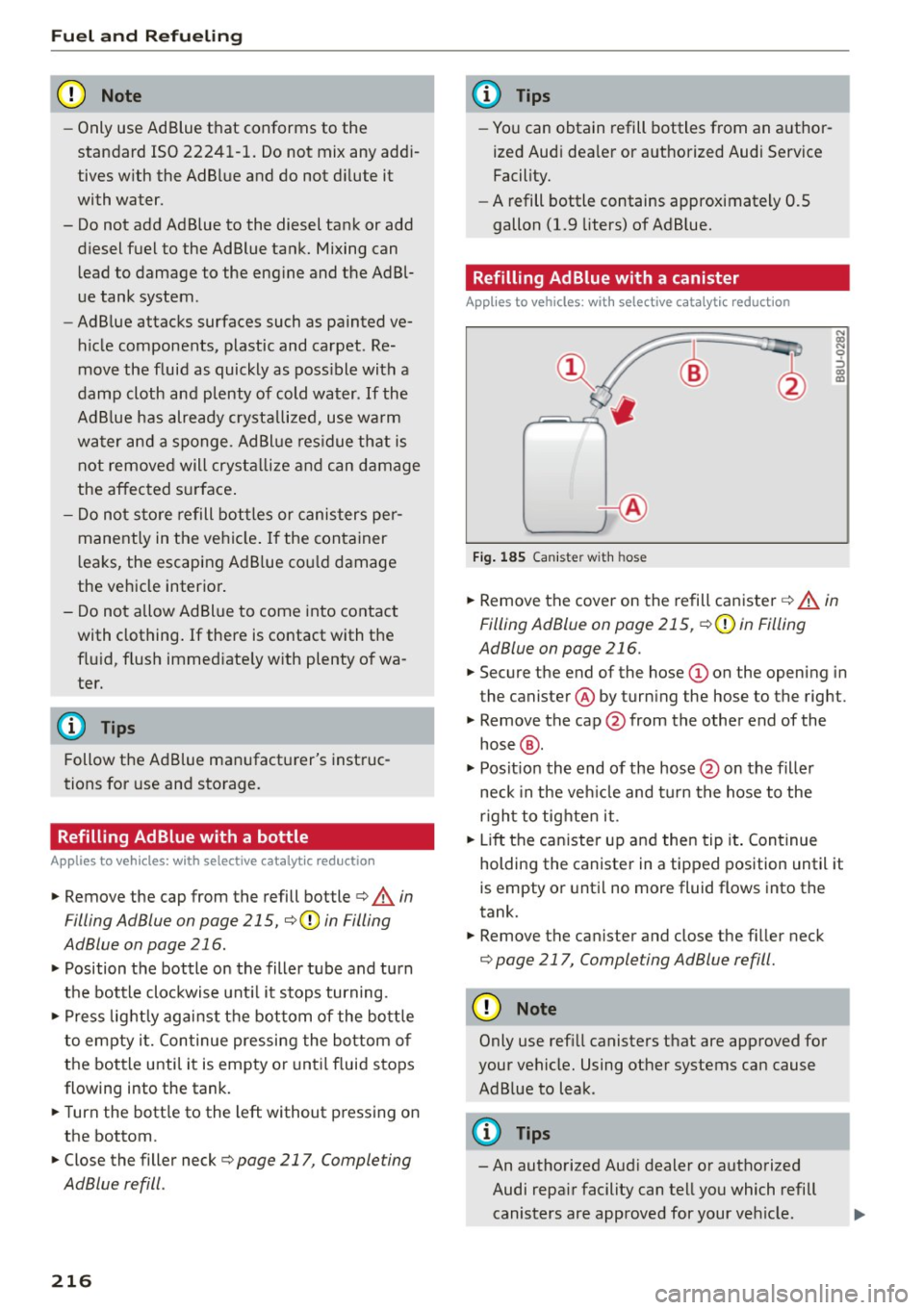
®
+®
Fig. 185 Canis te r w ith hose
N
Filling AdBlue on page
215, c:> (D in Filling
AdBlue on page 216.
"'Secure the end of the hose (Don the opening in
the canister @by turning the hose to the right.
"' Remove the cap@from the other end of the
hose @.
"' Posit ion the end of the hose @on the filler
neck in the vehicle and turn the hose to the
r ight to tighten it.
"' Lift the canister up and then tip it. Continue
holding the canister in a tipped position until it
is empty or until no more fluid flows into the
tank.
"' Remove the canister and close the filler neck
c:> page 217, Completing AdBlue refill.
(D Note
Only use ref ill canisters that are approved for
your vehicle. Using other systems can cause Ad Blue to leak .
0) Tips
-An authorized Aud i dealer or authorized
Audi repa ir facility can tell you which refill
canisters are approved for your veh icle.
Page 220 of 294
Checking and Fill in g
Checking and Filling
Hood
Releasing the engine hood
The engine hood is released from inside the vehi
cle.
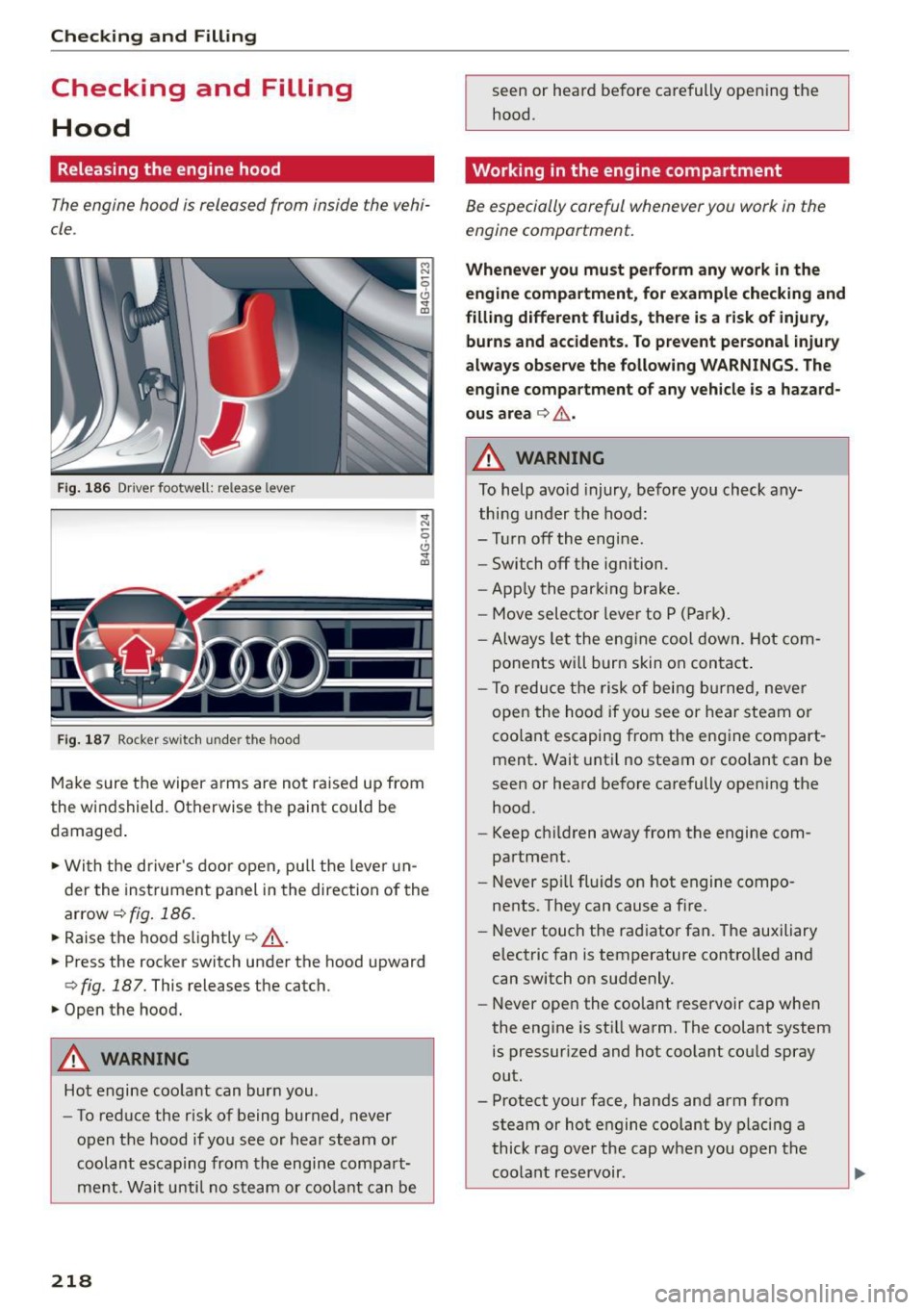
Fig. 1 86 Driver footwell: release lever
Fig. 187 Rocker sw itch under the hood
Make s ure the wiper arms are not ra ised up from
the windshield . Otherwise the paint could be
damaged .
.. Wi th the driver's door open, pu ll the lever un
der the instrument panel in the direction of the arrow
c::> fig. 186.
.. Raise the hood s lightly c::> _A .
.. Press the rocker switch under the hood upward
Q fig. 187. This releases the catch.
.. Open the hood.
A WARNING
Hot engine coo lant can burn you.
- To reduce the risk of being burned, never
open the hood if yo u see or hear steam or
coolant escap ing from the engine compa rt
me nt. Wait until no steam or coo lant can be
218
seen or heard before carefully open ing the
hood.
Working in the engine compartment
Be especially careful whenever you work in the
engine compartment.
Whenever you mu st perform any w ork in the
engine comp artment , for example checking and
filling d iff erent fluid s, the re i s a risk of injury ,
burns and accidents. To p revent pe rsonal injur y
alwa ys ob serv e the follow ing WARNING S. The
engi ne compartment o f an y vehicle is a h azard
ous are a
i::>_6 .
A WARNING
To help avo id injury, before you check any
thing under the hood:
- Turn off the engine.
- Switch off the ignition.
- App ly the parking brake.
- Move selector leve r to P (Park).
- Always le t the eng ine cool down. Hot com-
ponents wi ll burn skin on contact .
-
-To reduce the risk of bei ng bur ned, never
open the hood if you see or hear steam o r
coo lant escaping from the engine compart
ment . Wait unt il no steam o r coolant can be
seen or heard before carefully open ing the
hood.
- Keep c hildren away from the engine com
partment .
- Never sp ill fluids on hot engine compo
nents. They can cause a fire.
- Never touch the radiator fan. The auxiliary
electric fan is temperature cont ro lled and
can switch on suddenly.
- Never open the coolant reservoir cap when
the engine is sti ll warm. The coolant system
is pressur ized and hot coo lant co uld spray
out.
- Protect your face, hands and arm from
steam or hot engine coolant by placing a
thick rag ove r the cap w hen you open the
coo lant reservoir.