warning AUDI A7 2016 Owners Manual
[x] Cancel search | Manufacturer: AUDI, Model Year: 2016, Model line: A7, Model: AUDI A7 2016Pages: 294, PDF Size: 73.82 MB
Page 230 of 294
Checking and F ill in g
Battery
General information
Under no rmal operating conditions, the battery
in your Audi does not need any ma intenance.
W ith
high outside temperatu res or long daily
d rives we recommend that you have the electro
lyte level checked by a service facility . The elec
trolyte level should a lso be checked each time
the battery is charged ¢
page 230.
Have the bat tery checked when you take yo ur ve
hicle in for service . You are we ll advised to re
p lace a battery that is o lder than 5 years .
W ith certa in types of airbag deploymen t, the bat
tery is disconnected from the vehicle electrica l
system for safety reasons ¢
.&. in Repair, core
and disposal of the airbags on page 158.
Disconn ecting the battery t erminal s
Some veh icle funct ions (power window regula
tors, for examp le) are lost if the battery termi
na ls are disconnected. These functions have to be
re learned after the battery terminals are con
nected aga in. To prevent this, the battery shou ld
only be disconnected from the vehicle electrical
system when absolutely necessary for repairs.
Vehicl es not driven fo r long period s
If you do not drive your vehicle over a period of
several days or weeks, e lectrica l components are
gradually cut back or switched off. This reduces
energy consumption and maintains starting ca pability over a longer period¢
page 194. Some
of the convenience funct ions may not operate,
such as the inter ior lights or power seat adjust
ment. The convenience functions will be ava ilab le
again whe n you swit ch on the igni tion and sta rt
the engine.
Winte r operation
During the winter months, battery capacity tends
to decrease as temperatures drop . This is because
mo re power is also consumed w hile starting, and
the head lights, rear w indow defogger, etc ., are
used more often.
Avoid unnecessary power consumption, part icu
larly in city traffic or when traveling only short
228
distances. Let your authorized Audi dealer check
the capacity of the vehicle battery before winter
sets in
¢ page 230 . A well charged battery will
not only prevent starting problems when the
weather is cold, but will also last longer.
(D Tips
If your vehicle is left standing for several
weeks at extremely low temperatures, the ve
hicle battery should be removed and stored
where it will not freeze . This will prevent it
from being damaged and having to be re
placed.
Working on the battery
Be especially careful when working on or near
the battery.
The battery is located in the luggage compart
ment under the floor . Before you check anything
i n the luggage compartment,
re ad and he ed all
WARNINGS ¢&, .
Always heed the safety warning s, when working
o n the vehicle battery or the vehicle e lectr ical
system to prevent injury .
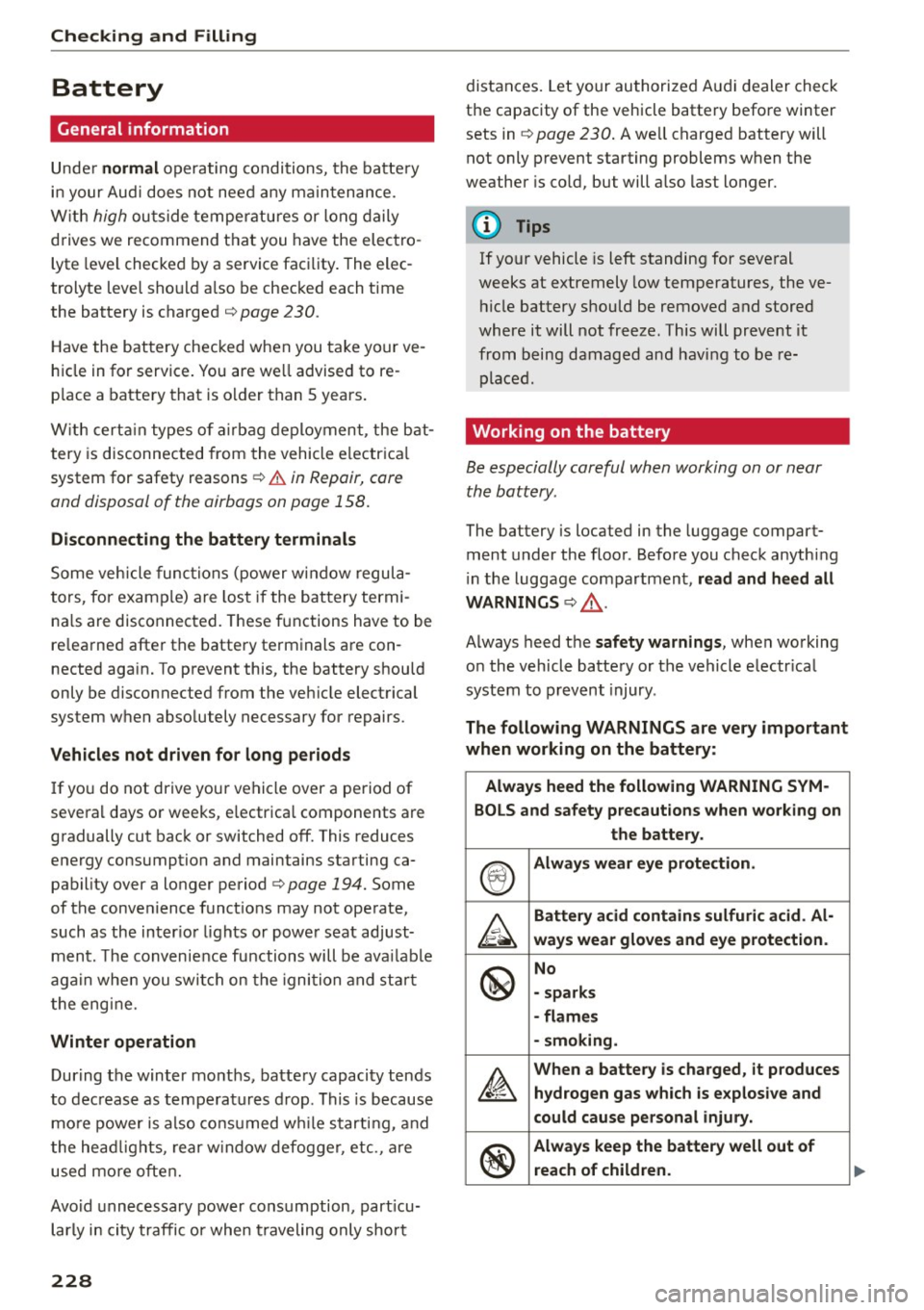
The following WARNING S are very important
when working on the battery :
Alw ay s heed the following WARNING SYM ·
BOL S and safety p recaut ions when wo rking on
the batter y.
®
Alw ay s w ear e ye protection .
~
Battery acid contains sulfuric acid . Al -
way s wear gloves and ey e protection .
@
No
· spark s
· flames
· sm oking.
~
When a battery is charged , it p roduce s
h yd rogen gas which is e xplosi ve and
'
could cause per sonal injury .
®
Always keep the battery well out of
r ea ch of ch ild ren.
...
Page 231 of 294
M N <( (.J
'SI: ,...., \!) 1.1'1
N \!) ,....,
A WARNING
-=
Whenever working on the battery or on the
electrical system, there is the risk of injury,
accident and even fire. Read and heed the fol
lowing WARNINGS:
- Always wear eye protection . Do not let bat
tery acid or any lead particles get on your skin or clothing. Shield your eyes. Explosive
gases can cause blindness or other injury .
- Battery acid contains sulfuric acid . Sulfuric
acid can cause blindness and severe burns.
- Always wear gloves and eye protection. Do
not tilt the battery because acid could leak
out of the ventilation openings.
- If you get battery acid in your eyes or on
your skin, immediately rinse with cold wa
ter for several minutes and get medical at
tention .
- If you should ingest any battery acid, seek
medical attention immediately .
- Do not expose the battery to an open flame, electric sparks or an open light.
- Do not smoke.
- Do not interchange the positive and nega-
tive cables.
- When working on the battery, be sure not to short-circuit the terminals with tools or oth
er metal objects. This would cause the bat
tery to heat up very quickly, which could
lead to damage or explosion and personal
injury .
- When a battery is charged, it produces hy
drogen gas which is explosive and could
cause personal injury.
- Always keep the battery well out of the
reach of children .
- Before work is done on the electrical sys
tem, disconnect the negative ground cable.
- Before performing any work on the electri cal system, switch off the engine and igni
tion as well as any electrical equipment . The
negative cable on the battery must be dis
connected. If you are just going to replace a
light bulb, then it is enough to switch off
the lights .
-
Checking and Filling
-Before disconnecting the battery, switch off
the anti-theft alarm system! Otherwise you
will set off the alarm.
- When disconnecting the battery, first dis
connect the negative cable and then the
positive cable.
- Before reconnecting the battery, make sure all electrical consumers are switched off. Re
connect the positive cable first and then the negative cable. Never interchange the ca
bles - this could start a fire!
- Never charge a frozen or a thawed -out bat
tery . It could explode! If a battery has fro
zen, then it must be replaced. A discharged battery can freeze over at 32 °F (0 °C).
- Make sure the vent hose is always attached
to the opening on the side of the battery.
- Never use batteries which are damaged.
There is the danger of an explosion! Always
replace a damaged battery.
A WARNING
California Proposition 65 Warning:
- Battery posts, terminals and related acces
sories contain lead and lead compounds,
chemicals known to the State of California
to cause cancer and reproductive problems.
Wash hands after handling.
([) Note
-Do not disconnect the vehicle battery when
the ignition is on or when the engine is run
ning, otherwise, you will damage electronic
components in the electrical system.
- If your vehicle is going to stand for a long
period of time without being driven, protect
the battery from "freezing", otherwise it
will be damaged and will then have to be re
placed.
- When opening the doors, the windows low
er approximately 10 mm automatically. This
function is not available when the battery is
disconnected, which means there is a risk
that the door seal or the window could be
damaged .
229
Page 232 of 294
Checking and Fill in g
Battery charging
Starting the engine requires a well charged bat
tery .
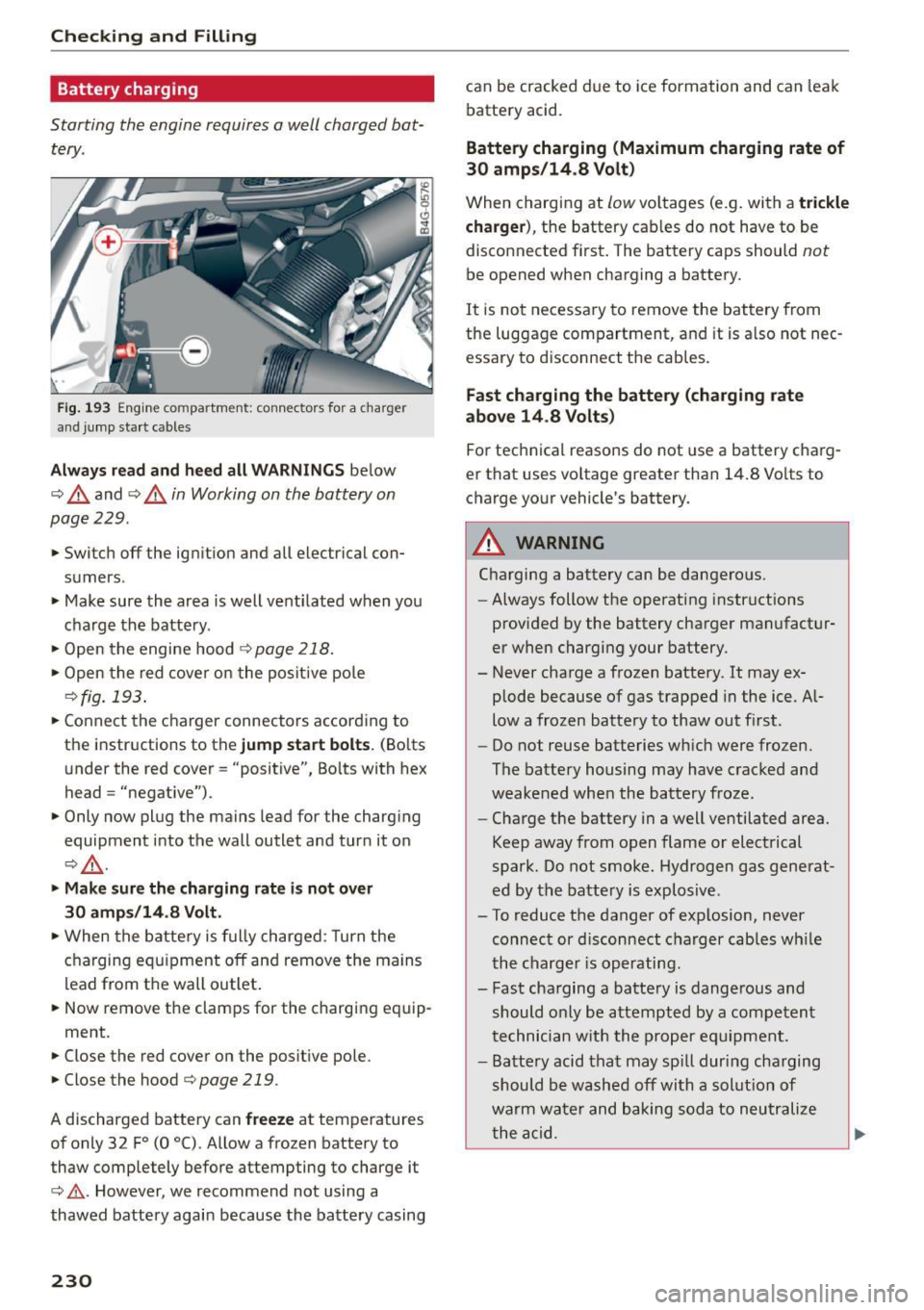
Fig. 193 Engine co mpartment : conn ectors for a charger
and jump start cable s
Always read and heed all WARN ING S below
<=:> &. and
<=:>&. in Working on the battery on
page 229 .
.,. Switch off the ignition and all electrical con
sumers .
.,. Make sure the area is well vent ilated when yo u
charge the battery .
.,. Open the engine hood
¢ page 218.
.,. Open the red cove r on the posit ive po le
¢ fig. 193.
.,. Connect the charger connectors according to
the instructions to the
j ump sta rt bolts . (Bolts
under the red cover = "positive", Bo lts with hex
head= "negative") .
.,. Only now plug the mains lead for the charg ing
equipment into the wall outlet and turn it on
¢ &_ .
.,. Ma ke s ure the charging rat e is n ot ov er
3 0 amp s/14 .8 Volt .
.,. When the batte ry is fully charged: Turn the
charging equ ipment off and remove the mains
lead from t he wall outlet .
.,. Now remove the clamps for the charging equip-
ment .
.,. Close the red cover on the positive pole.
.,. Close the hood
c::> page 219 .
A discharged battery can freeze at temperatures
of only 32 F
0 (0 °C) . Allow a frozen battery to
thaw completely before attempting to charge it
c:> &. . However, we recommend not using a
thawed battery again because the batte ry casing
230
can be cracked due to ice formation and can leak
battery acid.
Battery charging (Maximum charging rate of
30 amps /14.8 Volt )
When charging at low voltages (e.g. with a trickle
charge r),
the battery cab les do not have to be
disconnected f irst. The battery caps should
not
be opened when charging a battery.
It is not necessa ry to remove the battery from
the luggage compartment, and it is a lso not nec
essary to d isconnect the cab les.
Fast ch arging th e battery (cha rgin g ra te
above 14 .8 V olts)
For technical reasons do not use a battery charg
er that uses vo ltage greater than 14.8 Vo lts to
charge your vehicle's battery.
A WARNING
Charging a battery can be dangerous.
- Always follow the operating instructions
provided by the battery charger manufactur
er when charging your battery .
- Never charge a frozen battery. It may ex
plode because of gas trapped in the ice . Al
low a frozen battery to thaw out f irst .
- Do not reuse batteries wh ich were frozen.
The battery housing may have cracked and
weakened when the battery froze.
- Charge the battery in a well ventilated area.
Keep away from open flame or electrical
spark. Do not smoke. Hydrogen gas generat
ed by the batte ry is explosive.
- To reduce the danger of explosion, never
connect or d isconnect charger cab les wh ile
the charger is operating.
- Fast cha rging a battery is dangerous and
should only be attempted by a competent
technician w ith the proper eq uipment .
- Batte ry acid that may spill during charging
should b e washed off with a solut ion of
warm wa ter and baking soda to neu tralize
t he acid.
Page 240 of 294

Wheels
"XL" "xl" "EXTRA LOAD" or "RF" I I I
on the sidewal l.
Rim
means a metal support for a tire
or a tire and tube assembly upon
which the tire beads are seated .
Rim diameter
means nominal diameter of the
bead seat. If you change yo ur
wheel size , you w ill have to pur
chase new tires to match the new rim diameter .
Rim size designation
means rim diameter and width.
Rim width
means nomina l distance between
rim flanges .
Sidewall
means that port ion o f a t ire be
tween the tread and bead .
Speed rating (letter code)
means the speed at which a tire is
designed to be driven for extend
ed periods of t ime. The rat ings
range from 93 mph (150 km/h)
to 186 mph (298 km/h)
¢ table
on page 234 .
You may not find
this information on all tires be
cause it is not required by la w.
238
The speed rating letter code ,
where applicable , is mo lded on
the tire sidewall and indicates the maximum permiss ible road
speeds
¢ .&. in Winter tires on
page 248.
Tire pressure monitoring
system*
means a system that detects
when one or mo re of a ve hic le's
tires are under inflated and illumi
na tes a low tire p ressu re warning
tellta le .
Tread
means that portion of a tire that
comes into contact w ith the road.
Tread separation
means pu lling away of the tread
from the t ire carcass.
Treadwear indicators (TWI)
means the projections wi thin the
principal grooves designed to give
a visua l indication of the deg rees
of wear of the tread . See
¢ page 242 , Treadwear indicator
for mo re information on measur
ing t ire wear.
Page 243 of 294
different tire speeds. For this rea
son, in case of emergency, only
use a spare tire* that is the same
circumference as the regular tires.
A WARNING -
-Only use tire/rim combina
tions and suitable wheel bolts
that have been approved by
Audi. Otherwise, damage to
the vehicle and an accident
could result.
-For technical reasons, it is not possible to use tires from oth
er vehicles - in some cases,
you cannot even use tires from
the same vehicle model.
-Make sure that the tires you select have enough clearance
to the vehicle . Replacement
tires should not be chosen
simply based on the nominal
size, because tires with a dif
ferent construction can differ greatly even if they are the
same size. If there is not
enough clearance, the tires or
the vehicle can be damaged
and this can reduce driving
safety and increase the risk of
an accident.
-Only use tires that are more
than 6 years old when abso-
Wheels
lutely necessary and drive
carefully when doing so.
-Do not use run-flat tires on your vehicle . Using them when
not permitted can lead to ve
hicle damage or accidents.
-If you install wheel covers on
the vehicle, make sure they al low enough air circulation to
cool the brake system. If they
do not, this could increase the
risk of an accident.
Tire wear/damage
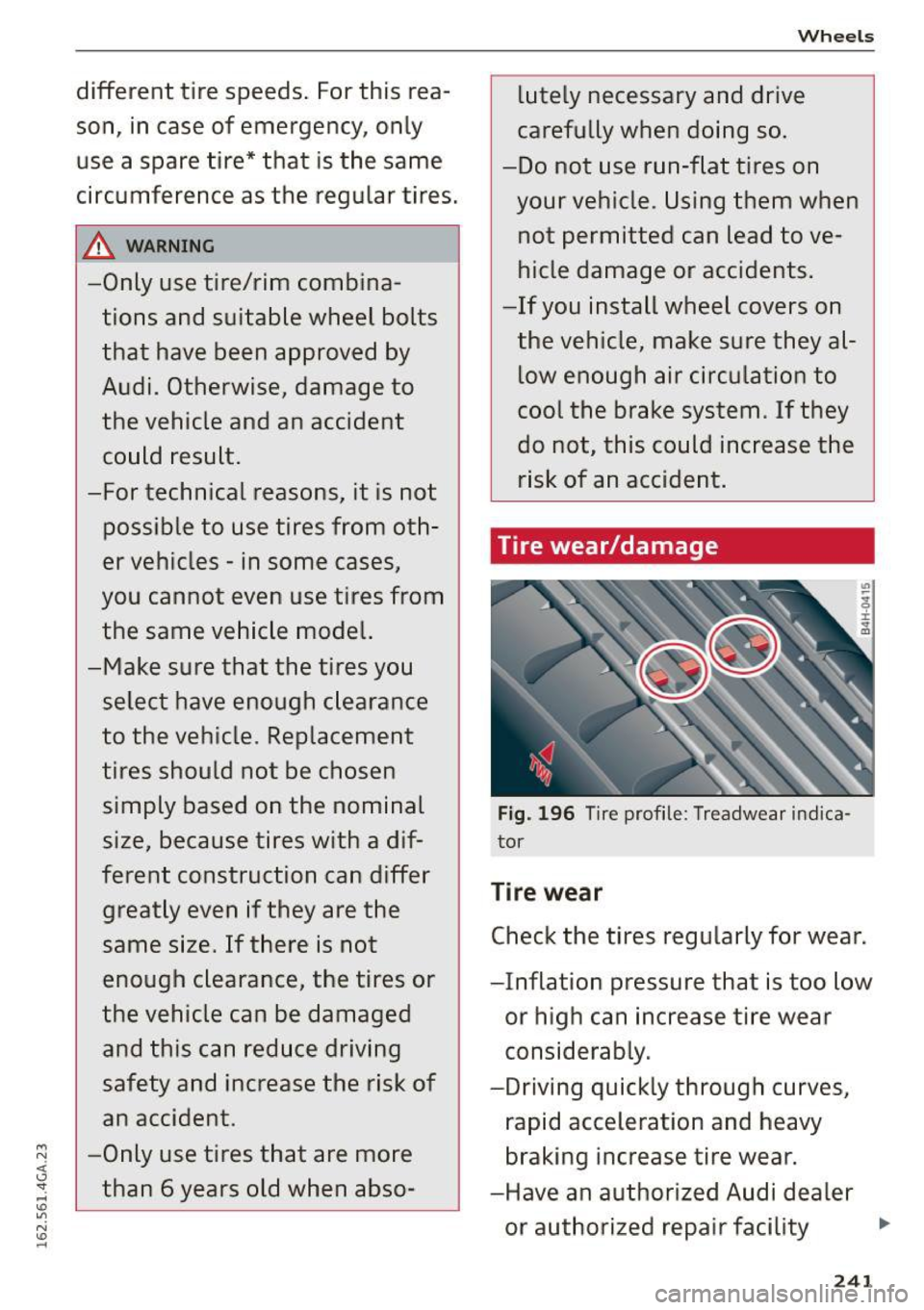
Fig. 196 T ir e profi le : Treadwear indica
tor
Tire wear
Check the tires regularly for wear.
-Inflation pressure that is too low
or high can increase tire wear
considerably .
-Driving quickly through curves,
rapid acceleration and heavy
braking increase tire wear.
-Have an authorized Audi dealer or authorized repair facility
241
...
Page 244 of 294
Wheels
check the wheel alignment if
there is unusual wear.
- Have the wheels rebalanced if an
imbalance is causing noticeable
vibration in the steering wheel. If you do not, the tires and other
vehicle components could wear more quickly.
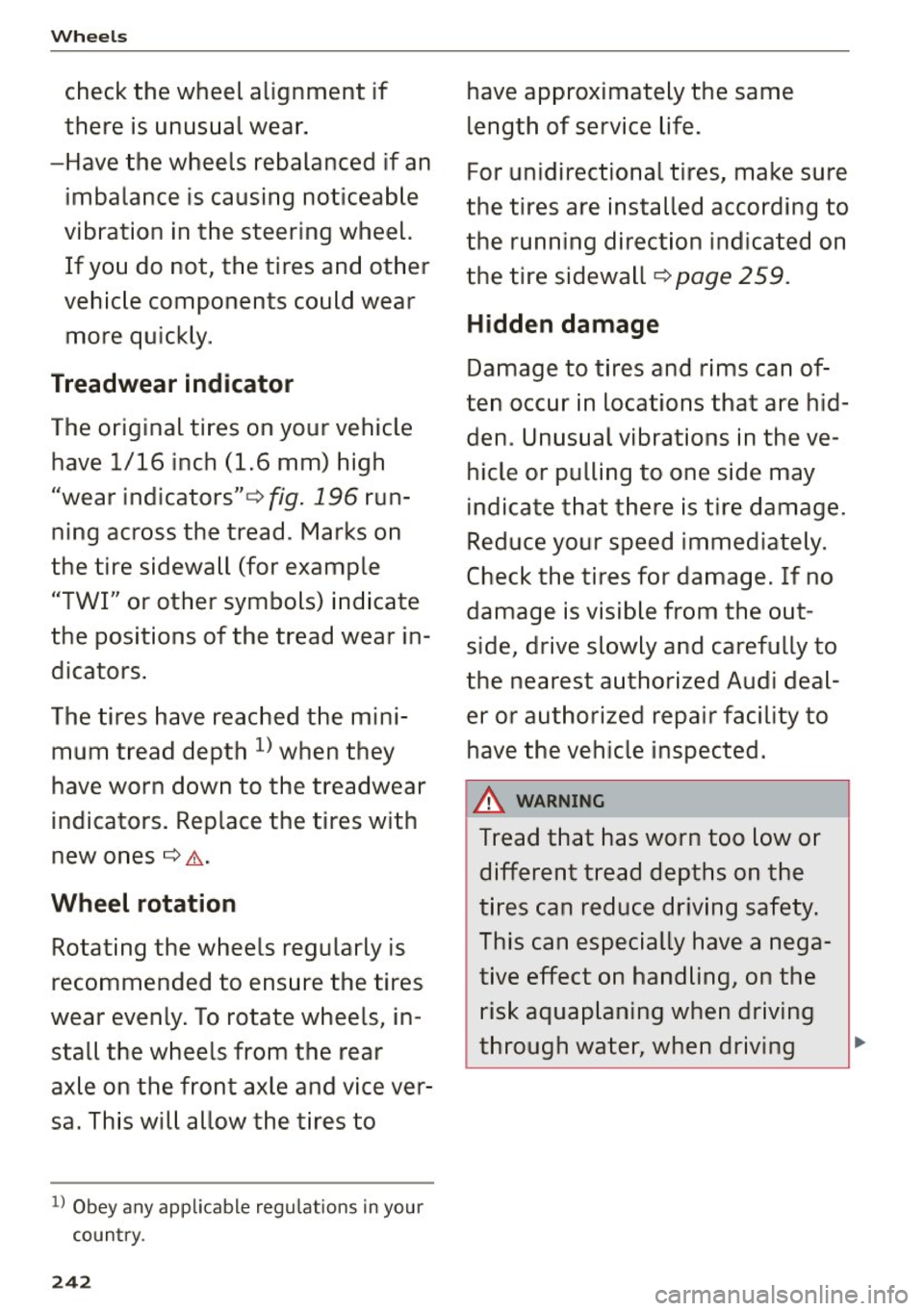
Treadwear indicator
The original tires on your vehicle have 1/16 inch (1.6 mm) high
"wear indicators" ~fig.
196 run
ning across the tread . Marks on
the tire sidewall (for example
"TWI" or other symbols) indicate
the positions of the tread wear in
dicators.
The t ires have reached the mini
mum tread depth
l) when they
have worn down to the treadwear
indicators. Replace the tires with
new ones ¢&..
Wheel rotation
Rotating the wheels regularly is
recommended to ensure the tires
wear evenly. To rotate wheels, in
stall the wheels from the rear
axle on the front axle and vice ver
sa. This will allow the tires to
1> Obey any applicable regulatio ns in you r
country .
242
have approximately the same
length of service life.
For unidirectional tires, make sure
the tires are installed according to
the running direction indicated on
the tire sidewall¢
page 259.
Hidden damage
Damage to tires and rims can of
ten occur in locations that are hid
den . Unusual vibrations in the ve
hicle or pulling to one side may
indicate that there is tire damage.
Reduce your speed immediately .
Check the tires for damage. If no
damage is visible from the out
side, drive slowly and carefully to
the nearest authorized Audi deal
er or authorized repair facility to have the vehicle inspected.
&_ WARNING
Tread that has worn too low or
different tread depths on the
tires can reduce driving safety.
This can especially have a nega
tive effect on handling, on the risk aquaplaning when driving
through water, when driving
Page 245 of 294
"'
through curves and when braking, which increases the risk of
an accident.
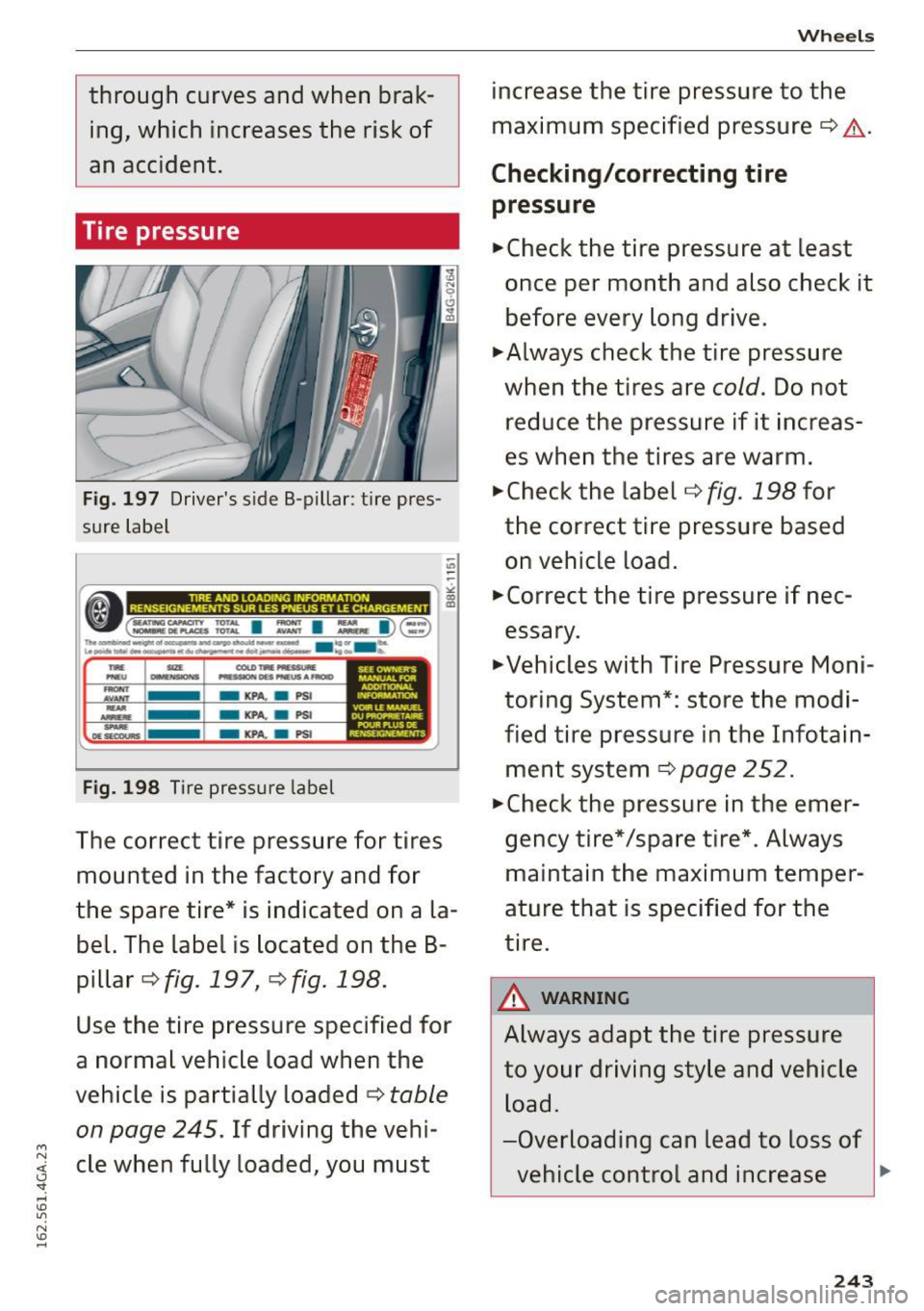
Tire pressure
Fig. 197 Driver's side B-pillar : tire pres
sure label
"' -
-~-------------------,£
tM£. IIZl COLO tlllf fllllESSt.lW. PNfU Nl:4fN$IOM$ "IIISaoN OE$ PMEU$ A FROID
-AYIJff -KPA, a PSI
Fig. 198 Tire pressure label
The correct tire pressure for tires
mounted in the factory and for
the spare tire* is indicated on a la
bel. The label is locate d on the B
pillar
¢ fig. 197, ¢fig. 198.
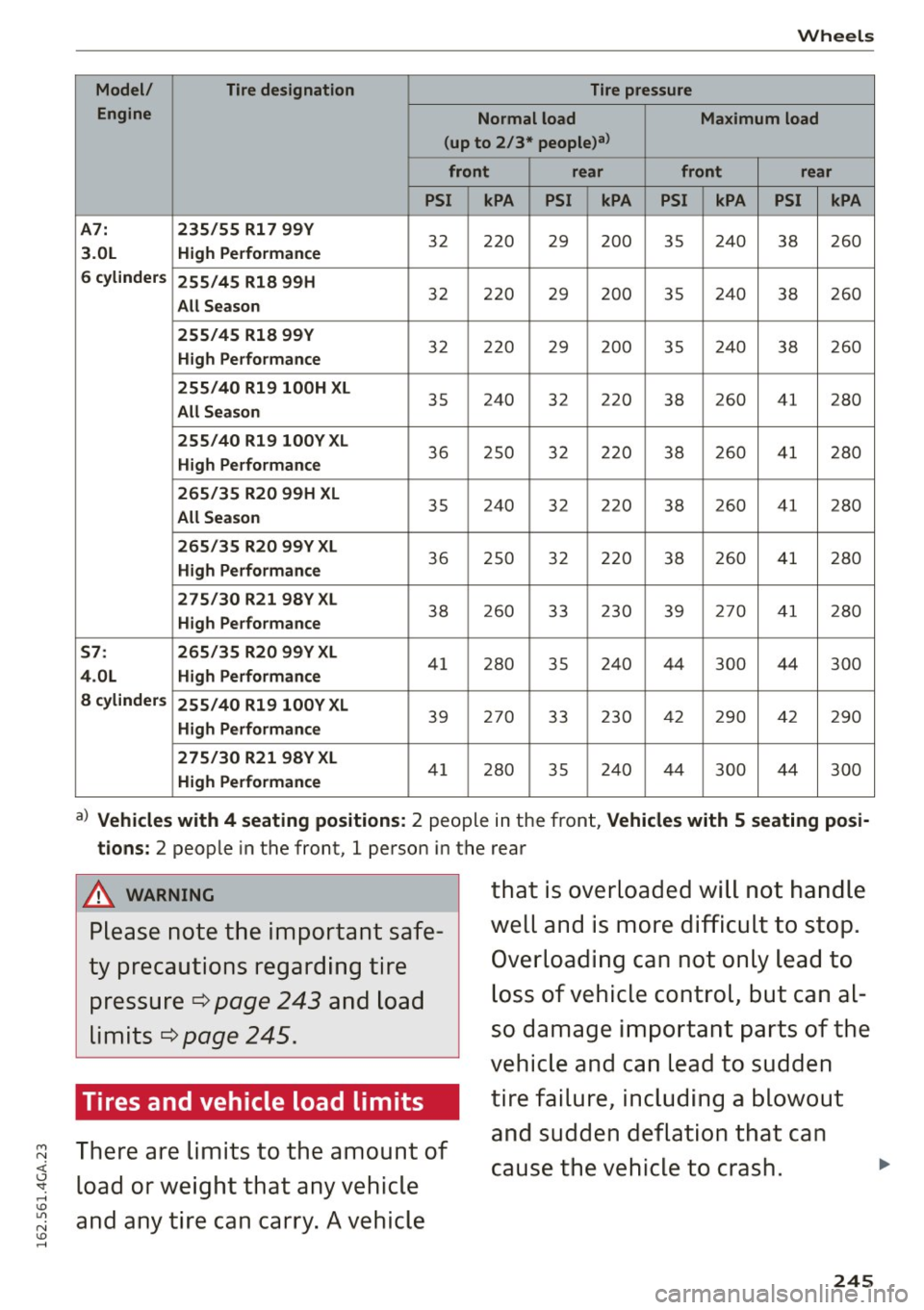
Use the tire pressure specified for
a normal vehicle load when the
vehicle is partially loaded¢
table
on page
245. If driving the vehi-
3 cle when fully loaded, you must
~ ..... \D V
N \D .....
Wheels
increase the tire pressure to the
maximum specified pressure¢&,.
Checking/correcting tire
pressure
.,,.Check the tire pressure at least
once per month and also check it before every long drive .
.,,.Always check the tire pressure
when the tires are
cold. Do not
reduce the pressure if it increas
es when the tires are warm .
... Check the label ¢
fig. 198 for
the correct tire pressure based on vehicle load.
.,,.Correct the tire pressure if nec
essary.
... vehicles with Tire Pressure Moni
toring System*: store the modi
fied tire pressure in the Infotain
ment system
¢page 252.
.,,.Check the pressure in the emer
gency tire* /spare tire*. Always maintain the maximum temper
ature that is specified for the
tire .
_& WARNING
Always adapt the tire pressure
to your driving style and vehicle
load.
-Overloading can lead to loss of vehicle control and increase .,,.
243
Page 247 of 294
M N <( (.J
'SI: ,...., \!) 1.1'1
N \!) ,....,
Wheels
Model/ Tire designation Tire pressure
Engine Normal load Maximum load
(up to 2/3* people)a>
front
rear front rear
PSI kPA PSI kPA PSI kPA PSI kPA
A7: 235/55 Rl 7 99Y 3.0L High Performance
32 22 0 29 20 0 35 240
38 260
6 cylinders
255/45 Rl8 99H
All Season
3 2 220 2 9 200 3 5 2
40
38 260
255/45 Rl8 99Y
High Performance 32 220 29 2 00 35 240
38 260
255/40 Rl9 l00H XL
All Season
35 240
32 220 38 260 41
280
255/40 Rl9 l00YXL
36 High Performance 25 0 3 2 220 3 8 260 41 280
265/35 R20 99H XL
All Season
3 5 240
32 220
38 260
41 280
265/35 R20 99Y XL
High Performance
36 250 32 220 38 260 41 280
275/30 R21 98Y XL
High Performance
38 2 60 33 230 3 9 270 41 280
S7: 265/35 R20 99Y XL
4 .0L High Performance 4 1
280 35 240
44
300 44
300
8 cylinders
255/40 Rl9 l00YXL
High Performance
39 270 33 230 42
29 0 42
290
275/30 R21 98Y XL
High Performance 41 28 0
35 2
4 0 44 300 44 300
a) Vehicles with 4 seating positions: 2 p eop le in th e fron t, Vehicles with 5 seating posi
tions:
2 pe ople in the fron t, 1 p erson i n the r ear
A WARNING
Please note the important safe
ty precautions regarding tire pressure
¢ page 243 and load
limits
¢ page 245 .
Tires and vehicle load limits
There are limits to the amount of
load or weight that any vehi cle
and any tire can carry. A vehicle that is overloaded will not handle
well and is more difficult to stop.
O verloading can not only lead to
loss of vehicle control, but can al
so damage important part s of the
vehicle and can lead to sudden tire failure , including a blowout
and sudden deflation that can
c ause the vehicle to crash.
245
Page 248 of 294
Wheels
Your safety and that of your pas
sengers also depends on making
sure that load limits are not ex
ceeded. Vehicle load includes ev
erybody and everything in and on
the vehicle. These load limits are
technically referred to as the vehi
cle's
Gross Vehicle Weight Rating
("GVWR").
The "GVWR" includes the weight of the basic vehicle, all factory in
stalled accessories, a full tank of
fuel, oil, coolant and other fluids
plus maximum load . The maxi
mum load includes the number of
passengers that the vehicle is in
tended to carry ("seating capaci
ty") with an assumed weight of 150 lbs. (68 kg) for each passen
ger at a designated seating posi
tion and the total weight of any
luggage in the vehicle. If you tow
a trai ler, the weight of the trailer
hitch and the tongue weight of
the loaded trailer must be includ
ed as part of the vehicle load.
The
Gross Axle Weight Rating
("GAWR") is the maximum load
that can be applied at each of the
vehicle's two axles.
The fact that there is an upper
limit to your vehicle's Gross Vehi -
246
cle Weight Rating means that the
total weight of whatever is being
carried in the vehicle (including
the weight of a trailer hitch and
the tongue weight of the loaded
trailer) is limited. The more pas
sengers in the vehicle or passen
gers who are heavier than the
standard weights assumed mean
that less weight can be carried as
luggage.
The Gross Vehicle Weight Rating
and the Gross Axle Weight Rating
are listed on the safety compli
ance sticker label located on the
driver's side B-pillar
c::> page 243,
fig. 197.
&_ WARNING ~
Overloading a vehicle can cause
loss of vehicle control, a crash
or other accident, serious per
sonal injury, and even death.
-Carrying more weight than your vehicle was designed to carry will prevent the vehicle
from handling properly and in
crease the risk of the loss of
vehicle control.
-The brakes on a vehicle that
has been overloaded may not
be able to stop the vehicle
within a safe distance.
Page 250 of 294
Wheels
av ailabl e cargo and luggag e
l oa d cap aci ty of your v ehi cle.
.,.Che ck th e tire sidew all
(¢ p ag e 233, fig. 1 9 5) to deter
mine the d esigna ted load ra ting
for a specifi c tire .
Wheel bolts and rims
Wheel bolts
Wheel bol ts m ust be clea n and loosen/t ighten
easi ly .
R ims
Rims with a bolted rim r ing* or w ith bolted wheel
covers * consist of mu ltiple piec es. These compo
nents we re bo lted toget he r us ing special bolts
a nd a special pro cedure. You must no t repair or
d isassemble th em ¢.&. .
A WARNING
Whee l bolts t hat are tightened or repaired in
co rrectly can become loose and resu lt in loss
o f vehicle control, which increases the risk of
an acc ident. For the correct tightening specifi
cat ion, refer to
¢ page 2 56, After changing a
wheel .
-Always keep the wheel bolts and the threads
in the wheel hub clean and free of grease .
- Only use wheel bo lts that fit the r im .
- Always have damaged rims repa ired by an
autho rized Aud i dealer or authorized repair
facility. Never repair or disassemble rims
you rself, because this increases the risk of
an acciden t.
Winter tires
Winte r tires sign ificantly improve the ve hicle's
handling when d riving i n w inte r condit io ns. Be
cause of the ir constr uction (wid th, compo und,
trea d patter n), s umme r tires p rov ide less tract ion
on ice and snow .
.,. Use w inte r tir es on all fou r wheels.
248
.,. On ly use winter tires that are approved fo r yo ur
vehicle.
.,. Please note that t he maxim um permitted
speed may be lower with winter tires ¢
_A .
Your authorized Audi dealer or authorized re
pair faci lity can inform you about the maximum
perm itted speed for your ti res .
.,. Check the tire pressure afte r instal ling whee ls
¢ page 243.
The effect iveness of w inter t ires is red uced great
ly when the tread is worn down to a dep th of
0.1 57 i nch ( 4 mm). The cha racterist ics of winter
ti res a lso de crease grea tly as the t ire ages, re
gardless of the remaining tre ad.
A WARNING
-
- Never drive faster than the max imum pe r
m itted speed for your tires. This co uld cause
the t ires to heat up too much . This increases
the risk of an accident because it can cause
the t ire to burst.
- Always adapt your dr iving to the road and
traffic cond itions. D rive carefully and reduce
your speed on icy or slippe ry roads. Even
win ter t ires ca n lose traction on black ice.
@ For the sake of the environment
Reinstall summer tires at the appropriate
time, beca use they provide better handling
when roads are free of snow and ice . Summer
tires cause less road noise, tire wear and fuel
consum ptio n.
(D Tips
You can a lso use all season tires instead of
winter tires. Please note that in some coun
tries where w inter t ires a re requir ed, only win
ter tires w ith the£ symbol may b e permit
ted.
' Snow chains
Snow chains improve traction in the snow .
.,. On ly install snow chai ns on the front w heels.
T his app lies also to vehicles with all wheel
dr ive*.