child restraint AUDI A7 2016 User Guide
[x] Cancel search | Manufacturer: AUDI, Model Year: 2016, Model line: A7, Model: AUDI A7 2016Pages: 294, PDF Size: 73.82 MB
Page 145 of 294
M N <( (.J
'SI: ,...., \!) 1.1'1
N \!) ,....,
Airbag system Important information
Importance of wearing safety belts and
sitting properly
Airbags are only supplemental restraints. For
airbags to do their job, occupants must always
properly wear their safety belts and be in a prop er seating position.
For your safety and the safety of your passen
gers, before driving off, always:
.,. Adjust the driver's seat and steering wheel
properly
r:> page 12 7,
.,. Adjust the front passenger's seat properly
9 page 53,
.,. Wear safety belts properly r::> page 137 ,
.. Always properly use the proper child restraint
to protect children
r:> page 167.
In a collision, airbags must inflate within the
blink of an eye and with considerable force. The
supplemental airbags can cause injuries if the
driver or the front seat passeng er is not seated
properly . Therefo re in order to help the ai rbag to
do its job, it is important, both as a driver and as
a passenger to si t properly at all times.
By keeping room between your body and the
steering wheel and the front of the passenger
compartment, the airbag can inflate fully and
completely and provide supplemental protection in certain frontal collisions
r:> page 12 7, Correct
passenger seating positions .
For details on the
operation of the seat adjustment controls
r::> page 53.
It's especially important that children are proper
ly restrained
r:> page 167.
There is a lot that the driver and the passengers
can and must do to help the individual safety fea
tures installed in your Audi work together as a
system.
Proper seating position is important so that the
front airbag on the driver side can do its job . If
you have a physical impairment or condition that
prevents you from sitting properly on the driver
seat with the safety belt properly fastened and
Airbag system
reaching the pedals, or if you have concerns with
regard to the function or operation of the Ad
vanced Airbag System, please contact your au
thori zed Audi dealer or qualified workshop, or
call Audi Customer Relations at 1-800-822-2834
for possible modifications to your vehicle.
When the airbag system deploys, a gas generator
will fill the airbags, break open the padded cov ers, and inflate between the steering wheel and
the driver and between the instrument panel and
the front passenger . The airbags will deflate im
mediately after deployment so that the front oc
cupants can see through the windshield again
without interruption.
All of this takes place in the blink of an eye , so
fast that many people don't even realize that the airbags have deployed. The airbags also inflate
with a great deal of force and nothing should be
in their way when they deploy. Front airbags in
combination with properly worn safety belts slow
down and limit the occupant's forward move
ment . Together they help to prevent the driver
and front seat passenger from hitting parts of
the inside of the vehicle while reducing the forces
acting on the occupant during the crash . In this
way they help to reduce the risk of injury to the
head and upper body in the crash . Airbags do not
protect the arms or the lower parts of the body.
Both front airbags will not inflate in all frontal
collisions. The triggering of the airbag system de
pends on the vehicle deceleration rate caused by
the collision and registered by the electronic con
trol unit. If this rate is below the reference value
programmed into the control unit, the airbags
will not be triggered , even though the car may be
badly damaged as a result of the collision. Vehi
cle damage, repair costs or even the lack of vehi
cle damage is not necessarily an indication of
whe ther an airbag should infla te or not.
Since the circumstances will vary considerably between one collision and another, it is not possi
ble to define a range of vehicle speeds that will
cover every possible kind and angle of impact
that will always trigger the airbags . Important
factors include, for example, the nature (hard or
soft) of the object which the car hits, the angle of
impact, vehicle speed , etc. The front airbags will ..,.
143
Page 146 of 294
Airbag syste m
also not inflate in s ide or rear collisions, or in roll
overs.
A lwa ys rem ember : Airbags will deploy on ly once,
and only in certain kinds of collis ions. Your safety
be lts are a lways there to offer p rotection in those
situations in which airbags are not supposed to
deploy, or when they have already deployed; for
examp le, when your vehicle str ikes or is struck by
another vehicle after the first collision.
This is just one of the reasons why an airbag is a
supp lementary restra int and is not a substitute
for a safety belt. The airbag system works most
effectively when used w ith the safety belts.
Therefore, always properly wear your safety belts
c::> page 135.
A WARNING
Sitting too close to the steering wheel or in
strument panel wil l decrease the effect ive
ness of the airbags and will increase the risk
o f personal injury in a collision .
- Never sit closer than 10 inches (25 cm) to
the steering wheel or instrument panel.
- If you cannot sit more than 10 inches
( 2 5 cm) from the steer ing whee l, investi
gate whether adaptive equipment may be
available to help you reach the pedals and
increase yo ur seating distance from the
steering wheel.
- All veh icle occupants and especia lly children
must be restrained properly whenever riding
in a vehicle. An unrestrained or improperly
restrained child could be injured by striking
the interior or by being ejected from the ve
hicle du ring a sudden maneuver or impact.
An unrestrained or improperly restrained child is also at greater risk of injury or death
thro ugh contac t wit h an inflat ing airbag.
- If you are unrestrained, leaning forward, s it
t ing s ideways o r out of position in any way,
yo ur risk of in jury is much higher.
- You w ill also receive serious inju ries and
c ould even be killed if you are up against the
airbag or too close to it when it inflates -
even with an Advanced Airbag.
144
-
- To reduce the risk of injury when an airbag
inflates, always wear safety belts properly
c::> page 138, Safety belts.
- Always make certain that ch ildren age 12 or
younger always ride in the rear seat. If chil
dren are not properly restrained, they may
be severe ly injured or killed when an a irbag
inflates.
- Never let ch ildren ride unrestra ined or im
prope rly restrained in the vehicle . Ad just the
front sea ts prope rly .
- Never ride with the back rest reclined .
- Always sit as far as possible from the steer-
ing wheel or the instrument panel
c::>page 127.
-Always sit upright with your back against
the backrest of your seat.
- Never p lace your feet on the instrument
panel or on the seat. Always keep both feet
on the f loor in front of the seat to help p re
vent serious injur ies to the legs and hips if
the airbag infla tes.
- Never recline the front passenger 's seat to
transport objects . Items can also move into
the area of the side airbag o r the front air
b ag du ring bra king or in a sudden maneu
ver . Ob jects near the airbags can become
projectiles and cause in jury when an airbag
inflates.
A WARNING
Airbags that have deployed in a crash must be replaced.
- Use on ly original equipment airbags ap
proved by Audi and installed by a trained
technician who has the necessary too ls and
diagnostic equipment to properly rep lace
any airbag in you r vehicle and assure system
effectiveness in a crash.
- Never perm it salvaged or recycled airbags to
be installed in your vehicle.
Child restraints on the front seat - some
important things to know
.,. Be s ure to read the important information and
hee d the WAR NIN GS for import ant details .,..
Page 147 of 294
M N <( (.J
'SI: ,...., \!) 1.1'1
N \!) ,....,
about children and Advanced Airbags
¢page 167.
Even though yo ur vehicle is equ ipped with an Ad
vanced Airbag System, make certain that all ch il
dren, especially those 12 years and yo unger, al
ways ride in the back seat properly restrained for
their age and s ize. The airbag on the passenger
side makes the front seat a potentially dangerous
p lace for a child to ride. The front seat is not the
safest place for a chi ld in a fo rward -facing chi ld
seat .
It can be a very dangerous place fo r an in
fant or a ch ild in a rea rward-facing seat.
T he Advanced Airbag System i n your veh icle has
been certified to comp ly w ith the requi rements
of Uni ted States Federal Moto r Veh icle Safety
Standa rd 208 as applicab le at the t ime your vehi
cle was man ufactu red.
The Standard requires the front a irbag on the
passenger side to be turned off ("supp ressed ") if
a child up to abo ut one year of age restrained in
one o f th e rear-fa cing or forward -facing infant re
s traints listed in Fede ral Motor Vehicle Safety
S tanda rd 20 8 wit h which the Advanced Airbag
System in yo ur vehicle was certifie d has been in
stalled on the front passenger seat. For a listing
of the ch ild restra ints that were used to ce rtify
compliance with the US Safety Standard
¢ page 169.
The PASSENGER AIR BAG OFF light in the instru
ment panel tells you when the front Advanced
Airbag on t he passenger side has been turned off
by the electro nic contro l unit .
Each t ime yo u sw itch on the ig nit ion, the
PAS
SENGER AIR BAG OFF
light w ill come on for a
few seconds and:
- will stay on if the front passenger seat is not
occupied,
- will stay on if the elect rical capacitance meas
u red by t he capacitive passenger detection sys
tem for the front passenger seat eq uals the
combined capacitance of an infant up to abo ut
one yea r of age and one of the rearward- fac ing
o r forward-faci ng chi ld restraints listed in Fed
eral Motor Vehicle Safety Standard 208 w it h
wh ich the Advanced Airbag System in your veh i
cl e was cert ified. Fo r a listing of t he ch ild re -
Airbag syste m
st raints that we re used to cert ify yo ur vehicle's
compliance with the U.S. Safety Standard
¢ page 169.
-wi ll stay on if there is a small c hild or child re
st raint on the front passenger seat,
- w ill go off i f th e front passenger sea t is occu
pie d by an adu lt as registere d by the capacitive
passe nger detect ion system
c> page 154, Mon
itoring the Advanced Airbag System.
T he PASSENGER AIR BAG OFF light comes on
whe n electrica l capacitance registered on the
front passenger seat is eq ua l to or less than the
combined capacitance of a typical 1 year-o ld in
fan t and one of the rearward-facing or forward
facing child restraints listed in Federa l Moto r Ve
hicle Safety Standard 208 with w hich the Ad
vanced Airbag System in your vehicl e was certi
fied.
If the total e lectr ica l capacitance registered on
the front passenge r seat is more than that of a
typ ica l 1 year-old ch ild b ut less than the we ight
of a sma ll adult, the fron t air bag on the passen
ger side can deploy ( the
PASSENGER AIR BAG
OFF
light does not come on).
If th e PASSENGER AIR BAG OFF light does not
come on, the front a irbag on the passenger side
h as not been turned off by the elec tronic con trol
u ni t and can dep loy if the con trol un it senses an
impact that meets the conditions stored i n its
memo ry .
For example , the airbag may deploy if :
-a small ch ild that is heav ie r than a typical 1
yea r-old ch ild is on the front passenge r seat (re
ga rdless of whethe r th e chi ld is in one of the
child sea ts listed
¢ page 169), or
- a child who has outgrown ch ild restraints is on
t he fron t passenger seat .
If the front passenger airbag is turned off, the
PASSENGER AIR BAG OFF light comes on in the
inst rument cluste r and stays on.
If the front passenger airbag dep loys, the Fede ral
Standard requires the airbag to meet t he ''low
r isk" deployment criteria to red uce the risk of i n
j u ry through interaction with the a irbag. "Low
risk" de ploymen t occurs in t hose cra shes tha t ..,.
145
Page 148 of 294

Airbag syste m
take place at lower decelerations as defined in
the electronic contro l unit ¢
page 155, PASSEN
GER AIR BAG OFF light.
Always remember, a chi ld seat or infant carrier
installed on the front seat may be struck and
knocked out of position by the rapid ly inflating
passenger's airbag in a frontal collision. The air
bag could greatly reduce the effect iveness of the
child restraint and even seriously injure the child
during inflation .
For this reason, and because the back seat is the
safest place for ch ildren -when properly restrain
ed according to their age and s ize -we strongly
recommend that ch ildren always sit in the back
seat ¢
page 167, Child safety .
A WARNING
A child in a rearward-facing child seat instal
led on the front passenger seat will be seri
ously inju red and can be killed if the front air
bag inf lates -even with an Advanced Airbag
System.
- The inflating a irbag w il l hit the child seat or
infant carrier w ith great force and w ill
smash the chi ld seat and child against the
backrest, center armrest, door or roof .
- Always insta ll rear -facing child seats on the
rear seat .
- If you must install a rearward facing child
seat on the front passenger seat beca use of
exceptional circ umstances and the
PASSEN
GER AIR BAG OFF
light does not come on
and stay on, immediately install the rear
facing child seat in a rear seating position
and have the a irbag system inspected by
you r Audi dealer.
- Forward-facing ch ild seats installed on the
front passenger's seat may interfere w ith
the deployment of the airbag and cause se rious persona l injury to the ch ild.
A WARNING
If, in exceptional c ircums tances, you mus t in
stall a forward-facing chi ld restraint on the
front passenger 's seat:
- Always make sure the forward-fac ing seat
has been designed and ce rtified by i ts man-
146
-
ufacturer for use on a front seat with a pas
senger front and s ide a irbag.
- Never put the forward-facing child restraint
up against or very near the instrument pan
el.
- Always move the passenger seat into its
rearmost position in the seat's fore and aft
adjustment range, as far away from the a ir
bag as poss ible before installing the for
ward-facing child rest raint. The backrest
must be adjusted to an upr ight position.
- Make sure that the
PASSENGER AIR BAG
OFF
li ght comes on and stays on all the time
wheneve r the ignit ion is switched on.
A WARNING
To reduce the risk of ser ious injury, ma ke su re
that the
PA SSENGER AIR BAG OFF light will
be d isp layed wheneve r a ch ild restr aint is in
stalled on the front passenger seat and the
ignition is switched on.
- If the
PASSENGER AIR BAG OFF light does
not stay on, perform the checks described
c::> page 154, Monitoring the Advanced Air ·
bag System.
-Ta ke the child restraint off the front passen
ger seat and install it properly at one of the
rear seat positions if the
PA SSENGER AIR
BAG OFF
light does not stay on.
- Have the airbag system inspected by your
Aud i dea ler immediately.
- Always carefu lly follow instr uctions from
child restraint manufacturers when instal
ling child restraints.
A WARNING
If, in exceptiona l circumstances, you must in
stall a forward or rearward-facing ch ild re
straint on the front passenger's seat:
- Improper installation of ch ild restraints can
reduce their effectiveness or even prevent
them from providing any protect ion.
- An improperly installed ch ild restra int can
interfere w ith the airbag as it deploys and
seriously injure or even kill the child -even
w ith an Advanced A irbag System. ..,.
Page 151 of 294
M N <( (.J
'SI: ,...., \!) 1.1'1
N \!) ,....,
and your passengers must always be properly re
strained, not just because the law requires you to
be.
The Advanced Airbag System in your vehicle has been certified to meet the "low risk" require
ments for 3 and 6 year-old children on the pas
senger side and very small adults on the driver
side. The low risk deployment criteria are intend
ed to help reduce the risk of injury through inter
action with the front airbag that can occur, for
example, by being too close to the steering wheel
and instrument panel when the airbag inflates.
In addition, the system has been certified to
comply with the "suppression" requirements of
the Safety Standard, to turn off the front airbag
for infants 12 months old and younger who are
restrained on the front passenger seat in child re
straints that are listed in the Standard
q page 169, Child restraints and Advanced front
airbag system.
"S uppression " requires the front airbag on the
passenger side to be turned off if:
- a child up to about one year of age is restrained
on the front passenger seat in one of the rear
facing or forward-facing infant restraints listed
in Federal Motor Vehicle Safety Standard 208
with which the Advanced Airbag System in your
vehicle was certified. For a listing of the child
restraints that were used to certify your vehi
cle's comp liance with the US Safety Standard
qpage 169,
- When a person is detected on the front passen
ger seat that has an electrical capacitance that
is more than the total electrical capacitance of
a child that is about 1 year old restrained in one
of the rear-facing or forward-facing infant re
stra ints (listed in Federal Motor Vehicle Safety
Standard 208 with which the Advanced Airbag
System in your vehicle was certified), the front
airbag on the passenger side may or may not
deploy.
The
PASSENGER AIR BAG OFF light comes on
when the electronic control unit detects a total
e lectr ical capacitance on the front passenger seat
that requires the front airbag to be turned off. If
the
PASSENGER AIR BAG OFF light does not
Airbag system
come on, the front airbag on the passenger side
has not been turned off by the control unit and
can deploy if the control unit senses an impact
that meets the conditions stored in its memory.
If the total electrical capacitance registered on
the front passenger seat is more than that of a
typical 1 year-old, but less than the weight of a
small adult, the front airbag on the passenger
side may deploy (the
PASSENGER AIR BAG OFF
light does not come on).
For example, the airbag may deploy if:
-a small child that is heavier than a typical 1
year-old child is on the front passenger seat (re
gardless of whether the child is in one of the
child seats listed
q page 169),
- a child who has outgrown child restraints is on
the front passenger seat.
If the front passenger airbag is turned off, the
PASSENGER AIR BAG OFF light in the center of
the instrument panel will come on and stay on.
If the front passenger airbag deploys, the Federal
Standard requires the airbag to meet the "low
risk" deployment criteria to help reduce the risk
of injury through interaction with the airbag.
"Low risk" deployment occurs in those crashes
that take place at lower decelerations as defined
in the electronic control unit
q page 154.
Always remember: Even though your vehicle is
equipped with Advanced Airbags, the safest place
for children is properly restrained on the back
seat. Please be sure to read the impor tant infor
mation in the sections that follow and be sure to
heed all of the WARNINGS .
_& WARNING
To reduce the risk of injury when an airbag in
flates, always wear safety belts properly.
- If you are unrestrained, leaning forward, sit
ting sideways or out of position in any way,
your risk of injury is much higher.
- You will also receive serious injuries and
could even be killed if you are up against the
airbag or too close to it when it inflates -
even with an Advanced Airbag
9page 143.
149
Page 152 of 294
Airbag syste m
A WARNING
A child in a rearward-facing child seat instal
led on the front passenger seat wi ll be seri
ously injured and can be killed if the front air
bag inflates -even with an Advanced Airbag
System.
- Although the Advanced Airbag System in
your vehicle is designed to turn off the front
airbag when a rearward-facing child re
straint has been installed on the front pas
senger seat, nobody can absolutely guaran
tee that deployment is impossible in all con
ceivable s ituations that may happen dur ing
the usef ul life o f you r vehicle.
- The inf lating a irbag w ill hit the child seat or
infa nt carrier w ith great force and w il l
smash the ch ild seat and child agains t the
backrest, center armrest, door, or roo f.
- Always insta ll rearward -facing child re
straints on the rear sea t.
-If you mus t install a rearward facing chi ld
seat on the fron t passenger sea t beca use of
exceptional circ umstances and the
PASSEN
GER AIR BAG OFF light does not come on
and stay on, immediately install the rear
facing child seat in a rear seating position
and have the a irbag system inspected by
your Audi dealer.
A WARNING
If, in exceptional c ircumstances, you must in
stall a forward-facing chi ld restraint on the
front passenger 's seat:
-Always make sure the forward-fac ing seat
has been designed and ce rtified by its man
ufact urer for use on a front seat wit h a pas
senger front and side airbag.
- Never put the forwa rd-facing child rest raint
up against or ve ry nea r the instrument pan
el.
- Always move the passenger seat into its
rearmost position in the se at's fore and aft
adjustment range, as far away from the air
bag as possib le, before installing the fo r
war d-fac ing c hild restraint . The backrest
must be adjuste d to an up right position .
150
-
-Always ma ke sure that there is nothing on
the front passenger seat that w ill cause the
capacitive passenger detection system in
the seat to signal to the Airbag System that
the seat is occup ied by a person when i t is
not, or to s ignal that it is occupied by some
one who is heavier than the person a ctua lly
si tti ng on the se at. T he presence of addi
tional objects could cause the p assenger
front airbag to be turned on when it s hou ld
be off, or co uld cause the a irbag to wo rk in a
way that is different from the way it would
have worked without the object on the seat.
- Make sure that the
PASSENGER AIR BAG
OF F light comes on and stays on all the time
whenever the ignit ion is switched on.
Advanced Airbag System components
The front passenger seat in your vehicle has a lot
of very impo rtant parts of the Advanced A irbag
System i n it. T hese pa rts include the capacitive
passenger detection system, wir ing, b ra ckets,
and more. The control u nit mon itors the system
o n the fron t passenger seat when the ign it ion is
swi tched on and turns the airbag indica tor ligh t
o n when a malfunction in the one of the system
components is detected~
page 155. Because
the front passenger seat contains important
parts of the Adv a need A irbag System, you must
take care to prevent it from being damaged .
Damage to the seat may prevent the Advanced
A irbag System for the front passenger seat from
do ing its job in a crash.
The front Advanced Airbag Sy stem consists
of the following:
- Cras h sensors in the front of the vehicle that
measu re vehicle acceleration/deceleration to
provide i nfo rmat ion to the Advanced Airbag
System abo ut the sever ity of the cr ash.
- An ele ct ro nic contro l unit, with integrated
crash sensor s for front and s ide impac ts. The
cont ro l uni t "dec ides" whether to fire the fron t
airbags based on the information received from
the crash se nsors . The control unit a lso "de
cides" whether the sa fety belt pretensioners
should be activated. ..,_
Page 153 of 294
-An Advanced Airbag with gas generator and
control valve for the driver inside the steering
wheel hub.
- An Advanced Airbag with gas generator and
control valve inside the instrument panel for
the front passenger .
- A capacitive passenger detection system under
neath the front passenger seat cover. This sys
tem measures the electrical capacitance of the
person in the seat. The information registered
is sent continuously to the electronic control
unit to regulate deployment of the front Ad
vanced Airbag on the passenger side .
- An airbag monitoring system and indicator
light in the instrument cluster~
page 154.
-A sensor in each front seat registers the dis
tance between the respective seat and the steering wheel or instrument panel. The infor
mation registered is sent continuously to the
electronic control unit to regulate deployment
of the front Advanced Airbags.
- The
PASSENGER AIR BAG OFF light comes on
and stays on in the center of the instrument
panel ~
page 155, fig. 160 and tells you when
the front Advanced Airbag on the passenger side has been turned
off.
- A sensor in the safety belt latch for the driver
and for the front seat passenger that senses
whether that safety belt is latched or not and
transmits this information to the electronic control unit.
A WARNING
Damage to the front passenger seat can pre
vent the front airbag from working properly.
- Improper repair or disassembly of the front
passenger and driver seat will prevent the
Advanced Airbag System from functioning properly.
- Repairs to the front passenger seat must be
performed by qualified and properly trained
workshop personnel.
- Never remove the front passenger or driver
seat from the vehicle.
~ - Never remove the upholstery from the front <(
~ passenger seat.
~ -Never disassemble or remove parts from the 1.1'1
N seat or disconnect wires from it. ID ......
Airbag system
-Never carry sharp objects in your pockets or
put them on the seat. The capacitive pas
senger detection mat in the front passenger
seat will not function properly if it is punc
tured.
- Never carry things on your lap or carry ob
jects on the front passenger seat . Such ob
jects can influence the capacitance regis
tered by the capacitive passenger detection
system, so that incorrect information is pro
vided to the airbag control unit.
- Never store items under the front passenger
seat. Parts of the Advanced Airbag System
under the passenger seat could be dam
aged, preventing them and the airbag sys
tem from working properly.
- Never place seat covers or replacement up
holstery that have not been specifically ap
proved by Audi on the front seats.
- Seat covers can prevent the Advanced Air
bag System from recognizing child re
straints or occupants on the front passenger
seat and prevent the side airbag in the seat
backrest from deploying properly.
- If a seat heater has been retrofitted or oth
erwise added to the front passenger seat,
never install any child restraint system on
this seat.
- Never use cushions, pillows, blankets, or
similar items on the front passenger seat .
The additional layers prevent the capacitive
passenger detection system from accurately
measuring the capacitance of the child safe
ty seat and/or the person on the seat and
thus keep the Advanced Airbag System from
working properly.
- Never place or use any electrical device
(such as a laptop, CD player, electronic
games device, power inverter or seat heater
for child seats) on the front passenger seat if the device is connected to the 12-volt
socket or the cigarette lighter socket. Such
devices can influence the capacitance regis
tered by the capacitive passenger detection
system, so that incorrect information is pro
vided to the airbag control unit.
- If you must use a child restraint on the front
passenger seat and the child restraint
~
151
Page 154 of 294
Airb ag syst em
manufacturer's instructions require the use
of a towel, foam cushion or something else
to properly position the child restraint,
make certain that the
PA SSE NGE R A IR BAG
OFF
light comes on and stays on whenever
the chi ld restraint is insta lled on the front
passenge r seat.
- If the PA SSEN GER AIR BAG OFF light does
not come on and stay on, immed iate ly in
sta ll c hild restra int in a rear seating position
and have the a irbag system inspected by
your Audi dealer .
_& WARNING
If the front passenger seat gets we t, dry i t i m
mediately .
- If liquid soaks into the front passenger sea t,
this can keep the airbag system from work
ing properly and may, for instance, deacti
vate the passenger frontal airbag. If th is
happens, the
PASSENGER AIR BAG OFF
light will come on and stay on together with
the airbag ind icator light
fl in the inst ru
ment cluster.
- If liquid is poo led on the seat, but has not
soaked in, this may a lso keep the airbag sys
tem from work ing properly and cause the
passenge r frontal a irbag to be enab led
(turned on), even tho ugh there is a properly
insta lled child restraint system on the sea t.
Wet towels or other wet things on the seat cus hion can have the same effect .
If the
front passenger fronta l airbag is turned on,
the
PASSENGER AIR BAG OFF light light
will go out.
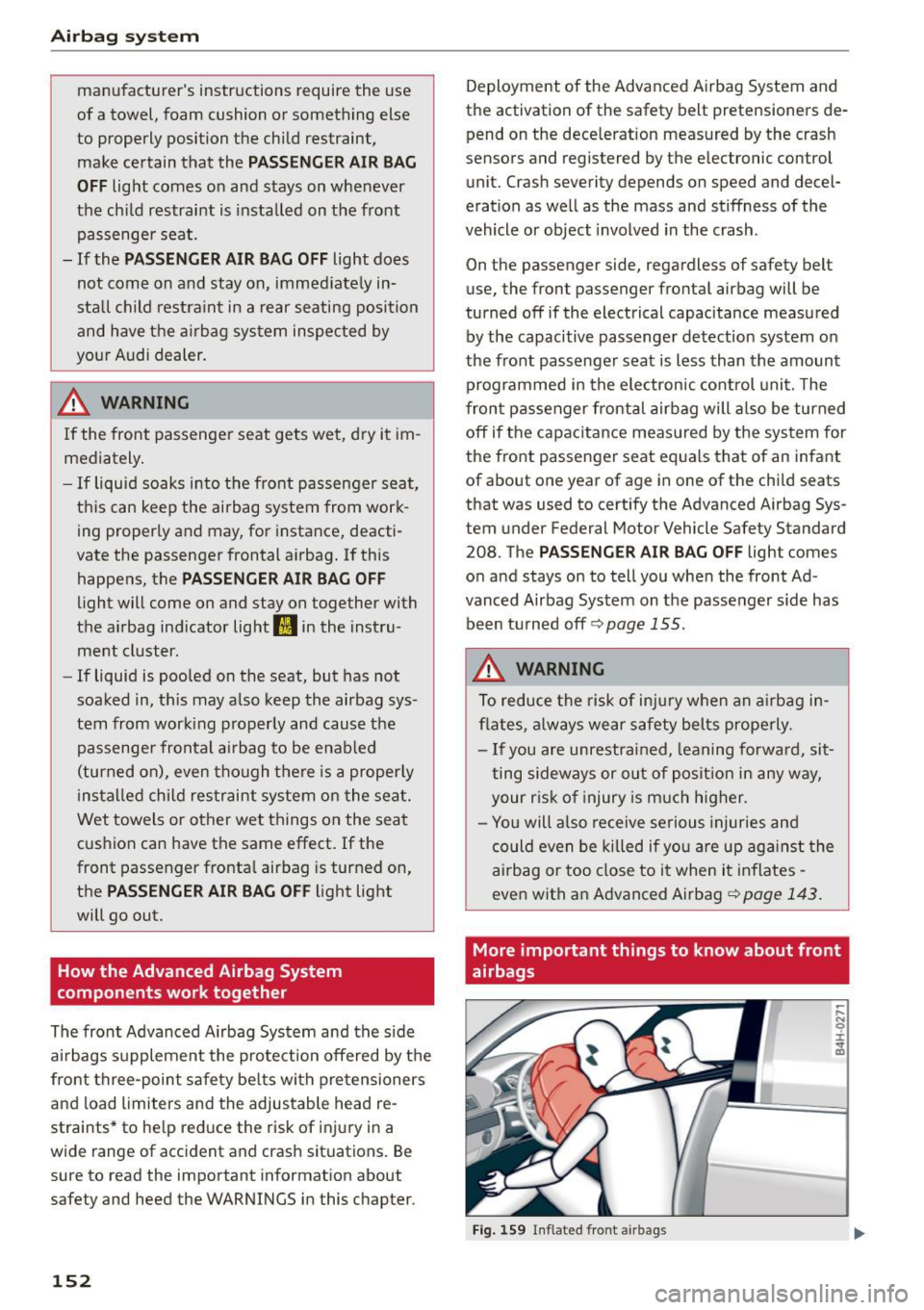
How the Advanced Airbag System
components work together
The fron t Advanced A irbag System and the s ide
a ir bags s upplement the prote ction offered by the
front three-point s afety be lts wi th pre tensioners
a nd load limiters and the adjustable head re
straints * to he lp red uce the risk of i njury in a
wide range of acc ident and crash situations . Be
sure to read the important informat ion about
safety and heed the WARNINGS in this chapter.
152
Deployment of the Advanced A irbag System and
the activation of the safety belt pretensioners de
pend on the dece leration meas ured by the crash
sensors and registered by the electronic control unit. Crash severity depends on speed and decel
eration as we ll as the mass and stiffness of the
vehicle or object involved in the crash .
On the passenger side, regardless of safety belt
use, the front passenger frontal airbag will be
turned
off if the electrical capacitance measured
by the capacitive passenge r detection system on
the front passenger seat is less than the amount programmed in the electronic cont rol uni t. T he
fron t passenger frontal airbag will a lso be turned
off if the capac itance meas ured by the sys tem for
the front passenger seat equals that of an infant of about one year of age in one of the chi ld seats
that was used to certify the Advanced Airbag Sys
tem under Federal Motor Vehicle Safety Standard 208. The
PA SSENGER AIR BAG OFF light comes
on a nd stays on to tell you when the front Ad
vanced Airbag System on the passe nger side has
been t urned
off ¢ page 155.
_& WARNING
To reduce the ris k of inj ury w hen an a irbag i n
fla tes, a lways wear safety belts prope rly.
- If you are unrestra ined, leaning forward, sit
ting sideways or out of posit io n in any way,
your r isk of injury is much higher.
- You will also receive se rious injuries and
co uld even be killed if yo u are up ag ains t t he
ai rbag or too close to it when i t inflates -
eve n with an Advanced Airbag
¢ page 143.
More important things to know about front
airbags
Fig . 159 Inflated fro nt a irbags
" "' 0 ± ., a,
Page 155 of 294
Safety belts are important to help keep front seat
occupants in the proper seated position so that
airbags can unfold proper ly and provide supple
mental protection in a frontal collision.
The front airbags are designed to provide addi
tional protection for the chest and face of the
driver and the front seat passenger when:
- sa fety belts are worn properly,
- the seats have been posit ioned so that the oc-
c u pant is properly seated as far as poss ib le
from the airbag,
- and for adjustable head restraints: the head re -
stra ints have been properly adjusted.
Because airbags inflate in the blink of an eye w ith
g reat force, things you have on your lap or h ave
p laced on the seat cou ld become dangerous p ro
jectiles, and be pus hed into yo u if the airbag in
flates.
W hen an a irbag deploys, fine dust is released.
This is normal and is not caused by a fire in the
ve hicl e. This dust is made up mos tly of a powde r
used to lubricate the airbags as they deploy. It
could irritate skin.
I t is impor tan t to remember that while the sup
p lemental air bag sys tem is designed to reduce
the likelihood o f se rious injuries, othe r injuries,
for example swe lling, bruising and minor abra
sions, can also happen when airbags inflate . Air
bags do not protect the arms or the lower parts
of the body. Front airbags supplement the three
point safety belts only in some frontal collisions
in which the veh icle deceleration is h igh enough
to deploy the airbags .
Front airbags will not deploy:
- if the ignit ion is switched off when a crash oc-
curs,
- in side collisions,
- in rear-end collisions,
- in ro llovers,
- when the crash deceleration measured by the
airbag system is less than the minimum thresh -
~ old needed for airbag deployment as registered <( o by the electronic control unit. 'SI: ,...., \!) 1.1"1
N \!) ,....,
Airbag syste m
The front passenge r airbag also will not
deploy :
-when t he front passenger seat is not occupied,
- when the electr ica l capacitance measured by
the capacitive passenger detection system for
the front passenger seat indicates that the pas
senger s ide frontal airbag must be switched off
by the electronic control unit (the
PASSENGER
AIR BAG OFF
light¢ page 155 and how they
work comes on and stays on).
A WARNING ,..__ -Sitting in the wrong pos ition can increase the
r isk of ser ious injury in crashes.
- To reduce the risk of injury when the airbags
inflate, the driver and passenge rs must al
ways sit in an up right pos ition, must no t
lean ag ains t or place any part of the ir body
too close to the area where the a irb ags are
located .
- Occupants who are unbel ted, out of position
or too close to the airbag can be serio usly
inj ured by an ai rbag as it unfo lds with great
force in the blink of an eye ¢ page 1 44 .
A WARNING
A child in a rearward-facing ch ild seat insta l
l ed on the front passenger seat will be ser i
ously injured and can be k illed if the front air
bag inflates -even with an Advanced Airbag
System.
- The inflating airbag will hit the ch ild seat o r
infant carrier with great force and will
smash the child seat and child against the
backrest, cente r armrest, door or roof.
- Always install rear-fac ing ch ild seats on the
rea r seat .
- If you must install a rearward fac ing child
seat on the front passenger seat because of
exceptiona l circumstances and the
PASSEN
GER AIR BAG OFF
l ight does not come on
an d stay on , immedi ately ins tall the rear
facing chi ld seat in a rear seat ing pos ition
and have the airbag system inspected by
your Audi dea ler.
153
Page 158 of 294
Airbag system
compliance with the U.S. Safety Standard
¢page 169 .
-will go out if the front passenger seat is occu
pied by an adult as registered by the capacitive
passenger detection system.
- The
PASSENGER AIR BAG OFF light must come
on and stay on if the ignition is on and .. .
- a car bed has been installed on the front pas
senger seat, or
- a rearward-facing child restraint has been in
stalled on the front passenger seat, or
- a fo rward -facing child restraint has been instal
led on the front passenger seat,
- and if the e lectrica l capacitance registered on
the front passenger seat is equal to or less than
the combined capacitance of a typical 1 year
o ld infant and one of the rearward-facing or
forward-facing chi ld restraints listed in Federal
Motor Vehicle Safety Standard 208 with which
the Advanced Airbag System in your vehicle was certified.
If the front passenger seat is not occupied, the
front airbag will not deploy, and the
PASSENGER
AIR BAG OFF light will stay on. Never install a
rearward-facing child restraint on the front pas
senger seat, the safest place for a child in any
kind of child restraint is at one of the seating po
sitions on the rear seat ¢
page 144, Child re
straints on the front seat -some important
things to know
and ¢ page 167, Child safety.
If the PASSENGER AIR BAG light comes
on ...
If the PASSENGER AIR BAG OFF light comes on
when one of the conditions listed above is met,
be sure to check the light regularly to make cer
tain that the
PASSENGER AIR BAG OFF light
stays on contin uously whenever the ignition is
on. If the
PASSENGER AIR BAG OFF light does
not appear on and does not stay on all the t ime,
stop as soon as it is safe to do so and
- reactivate the system by turning the ignition
off
for more than 4 seconds and then turning it on
again;
- remove and reinstall the child restraint . Make
sure that the chi ld restraint is properly installed
and that the safety belt for the front passenger
156
seat has been correctly routed through the
child restraint as described in the chi ld restraint
manufacture r's instruct ions;
- make sure that the convertib le locking retractor
on the safety be lt for the front passenger seat
has been activated and that the safety belt has
been pulled tight .
- make sure that no electrical device (such as a
laptop,
CD player, electron ic games dev ice,
power inverter or seat heater for ch ild seats) is
placed or used on the front passenger seat if
the device is connected to the 12-volt socket or
the cigarette lighter socket;
- make sure that no seat heater has been retrofit
ted or otherwise added to the front passenger
seat;
- make sure that nothing can interfere with the
safety belt buckles and that they are not ob
structed;
- make sure that there are no wet objects (such
as a wet towe l) and no water or other liquids on
the fron t passenger seat cushion.
If the PASSENGER AIR BAG light still does
not come on ...
If the PASSENGER AIR BAG OFF light still does
not come on and does not stay on continuously
(when the ignition is switched on),
- take the child restraint
off the front passenger
seat and insta ll it p roperly at one of the rear
seat positions. Have the airbag system inspect
ed by your Audi dealer immed iately.
- move the child to a rear seat position and make
sure that the child is pro pe rly restrained in a
child restraint that is appropriate for its siz e
and age .
The PASSENGER AIR BAG light should NOT
come on ...
The PASSENGER AIR BAG OFF light should NOT
come on when the ignit ion is on and an adult is
sitting in a proper seating position on the front
passenger seat. If the
PASSENGER AIR BAG OFF
light comes on and stays on or flashes for about
S seconds while dr iv ing, under these c ircumstan
ces, make sure that:
- the adult on the front passenger seat is proper-
ly seated on the center of the seat cushion with ..,.