heating AUDI A7 2016 User Guide
[x] Cancel search | Manufacturer: AUDI, Model Year: 2016, Model line: A7, Model: AUDI A7 2016Pages: 294, PDF Size: 73.82 MB
Page 77 of 294
M N <( I.J "". rl I.O
"' N I.O rl
There must be at least 10 inches (25 cm) be
tween your chest and the center of the steering
wheel.
If you cannot sit more than 10 inches (25
cm) from the steering wheel, see if adaptive
equipment is available to help you reach the ped
als and increase the distance from the steering
wheel.
For detailed information on how to adjust the
driver's seat, see
r:::>page 53.
In vehicles with the memory function*, the steer
ing column settings are stored together with the
seat position.
A WARNING
Improper use of steering wheel adjustment
and improper seating position can cause seri
ous personal injury.
- Adjust the steer ing wheel column only when
the vehicle is not mov ing to prevent loss of
vehicle control.
- Adjust the driver's seat or steering wheel so
that there is a minimum of 10 inches (25
cm) between yo ur chest and the steering
wheel
r:::>page 127, fig. 144. If you cannot
mainta in this min imum d istance, the a irbag
system cannot protect you properly .
- If phys ica l limitations prevent you from sit
ti ng 10 inches (25 cm) or more from the
steering wheel, check with your authorized
Audi dealer to see if adaptive eq uipment is
available.
- If the steering wheel is aligned wi th your
face, the supp lemental driver's airbag can
not provide as much protection in an acci
dent. Always make sure that the steering
wheel is aligned w ith your chest.
- Always hold the steering wheel with your hands at the 9 o'clock and 3 o'clock posi
t ions to reduce the r isk of personal injury if
the driver 's airbag deploys.
- Never hold the steer ing wheel at the 12
o'clock posit ion or w ith your hands inside
the steering wheel rim or on the steering
wheel hub. Holding th e steering wheel the
wrong way can cause se rious injuries to the
hands, arms and head if the driver's a irbag
dep loys .
Drivi ng
Easy seat entry
Applies to vehicles: with power steering wheel adjustment
Easy seat entry makes it easier to enter and exit
the vehicle by adjusting the steering column au
tomatically.
.. In the Infotainment system, select: the ICARI
function button > ( Car) * Systems control but
ton
> V ehicle sett ings > Se ats> Driver 's se at>
Ea sy se at entry > On .
When easy seat entry is sw itched on, the steering
column goes back up into the park pos ition when
the ignit ion is switched off . After entering the ve
hicle, the steeri ng column returns to the stored
pos ition once the ig nit ion is switched on.
Starting and stopping
the engine
Starting the engine
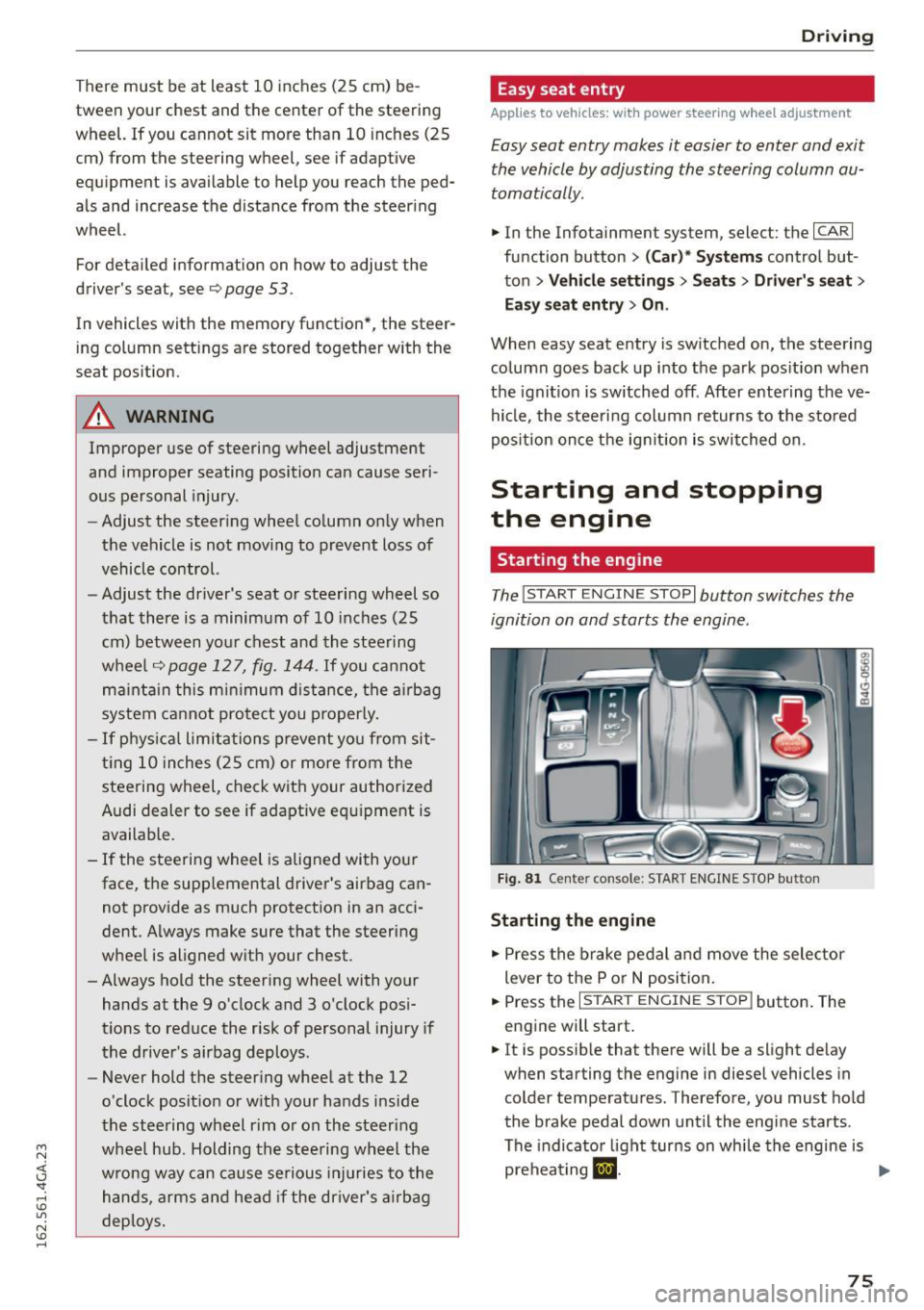
The I STAR T ENGIN E ST OPI button switches the
ignition on and starts the engine .
Fig . 8 1 Center console: START ENGINE STOP button
Sta rting the engine
.. Press the brake pedal a nd move the selector
lever to the P o r
N position.
.. Press the
I START ENGINE STOP j button . The
eng ine will start .
.. It is possib le that there will be a slight delay
when starting the engine in diesel vehicles in
colder temperatu res. Therefore, you must hold
the brake pedal down unt il the engi ne starts .
The indicator light turns on whi le the engine is
preheating
m . ...
75
Page 197 of 294
M N <( (.J
'SI: ,...., \!) ..,.,
N \!) ,....,
back or switched off. This reduces energy use and
ensures the vehicle will be able to start after long
periods of time . Some convenience functions,
such as interior lighting or power seat adjust ment, may not be available under certa in circum
stances . These convenience functions will be
available aga in once you switch the ignition on
and start the engine.
With the engine switched off
The battery will drain if you use functions such as
listening to the rad io while the engine is switched
off.
The vehicle's ability to start may be impaired by
the energy use, a message w ill appear in the In
fotainment system d isp lay.
The message indicates that the system will
switch off automatically soon. If you would like
to continue using the funct ions, you must start
the eng ine.
With the engine running
Although electrical energy is generated whi le
driving, the battery can drain. This can happen
when little energy is generated, and much is used
and the charge level of the battery is not optimal.
To restore the balance of energy, components
that require large amounts of energy are tempo
rarily sca led back or switched off . Heating sys
tems in particu lar require a great deal of energy .
If you notice, for example, that the seat heating*
or rear window defroster is not working, then it
has been tempo rar ily reduced or sw itched off .
These systems are available again as soon as the
ene rgy balance has been restored.
In addition, you may notice that the idle speed
h as slightly increased . That is normal and no
cause for concern. Due to the increased idling
speed , the additional required energy w ill be gen
e rat ed and the battery will be charged.
Intelligent Technology
195
Page 199 of 294

M N <( (.J
'SI: ,...., \!) 1.1"1
N \!) ,....,
CD Note
-Vehicle components such as the engine ,
transmission, suspension or e lectr ical sys
tem can be severe ly damaged by driving
through water .
- Always switch the Start-Stop -System* off
when driving through water
c> page 80.
@ T ips
- Determine the depth before driving through
water.
- Do not stop the vehicle, drive in reverse or
switch the eng ine off when driving through
water.
- Keep in mind that oncoming vehicles may
create waves that raise the water level and
make it too deep for your vehicle to drive
through safely.
- Avoid driving through sa lt water (corrosion).
Catalytic converter
Applies to vehicles: with gasoline engine
It is very impor tan t tha t your emission control
system (catalyti c converter) is functioning prop
erly to ensure that your vehicle is running in an
environmentally sound manner .
... Always use lead-free gasoline c> page 210,
F uel supply .
... Never run the tank down all the way to empty .
.,. Never put too much motor oil in your engine
c> page 222, Adding engine oil~-
.,. Never try to push- or tow-start your veh icle.
The catalytic converter is an eff icient "clean-up"
dev ice bu ilt into the exhaust system of the vehi
cle . T he catalytic converter burns many of the
pollutants in the exhaust gas before they are re
l eased into the atmosphere.
The exclusive use of unleaded fuel is cr itically im
portant for the life of the catalyt ic converte r and
proper functioning o f the eng ine .
A WARNING
The temperature o f the exhaust system is
high, both when driving and after stopping
the engine .
Driving and th e en vir onm ent
- Never touch the exhaust tail pipes once they
have become hot. Th is could resu lt in burns.
- Do not park or operate the vehicle in areas
where the hot exhaust system may come in contact w ith dry grass, brush, fuel spill or
other material which can cause a fire.
- Do not app ly additional undercoating or
rustproofing on or near the exhaust mani
fold, exhaust pipes, catalytic converter or heat shields . During dr iving, the substance
used for undercoat ing could overheat and
cause a fire .
CD Note
-Be aware that just one tank filling with lead
ed
fuel w ill already ser iously degrade the
performance of the catalyt ic converter .
- Do not exceed the correct engine oil level
¢ page 222.
-Do not drive until the fuel tank becomes
completely empty . The engine cou ld misfire .
Unburned fuel could also get into the ex
haust system and this cou ld cause the cata
lyt ic converter to overheat.
- Do not switch off the ignit io n while the veh i
cle is movi ng.
- Do not continue to ope rate your veh icle un
der these conditions, as othe rwise f uel can
reach the catalytic converter . This could re
sult in overheating of the co nve rter , requ ir
ing its replacement .
- T o assu re eff icient operation of the Emission
Contro l System:
- Have your vehicle maintained properly and
in accordance w ith the serv ice recommen
dat ions in your Warranty
& Maintena nce
booklet .
- Lack of proper maintenance as we ll as im
p roper use of the vehicle will impair the
function of the emission control system
and could lead to damage.
@ For the sake of the environment
Even when the Emiss ion Control System is op
erating properly, the exhaust gas can have a
su lfu r-like exhaus t gas sme ll unde r some op
erating states. Th is depends on the s ulf ur
197
Page 201 of 294
M N <( (.J
'SI: ,...., \!) 1.1'1
N \!) ,....,
Reducing unnecessary idling
Even when your car is just idling it burns up fuel.
~ Shut the engine off when you are not driving
the vehicle.
~ Do not warm up the vehicle by letting the en-
gine run at idle .
The idling phase is automatically reduced for
veh icles with the Start-Stop-System . It is effi
cient to switch off the engine in vehicles without
the Start-Stop-System when stopped at railroad
crossings and long red lights. Turning the engine
off for just 30-40 seconds saves more fuel than is
burned by starting the engine again.
It takes a long time for the engine to warm up
fully when it is running at idle . However, wear
and noxious emissions are especially high when
the engine is warm ing up. So you shou ld drive
away as soon as you start the engine and avoid
running at high rpms while the engine is still
warming up .
(D Note
Do not leave engine idling unattended after
starting. If warning lights should come on to
indicate improper operation, they would go
unheeded. Extended idling a lso produces
heat, wh ich could resu lt in overheating or oth
er damage to the vehicle or other property.
Regular maintenance
A badly tuned engine unnecessarily wastes a lot of fuel.
~ Have your vehicle serviced at regular intervals.
By having your vehicle regularly serviced by an
Aud i dea ler helps to ensure that it runs properly
and economica lly. The condition of your vehicle
not only affects its safety and ability to hold its
value, it a lso affects fuel consumption .
Check your oil each time you fill your tank.
The amount of oil used is related to engine load
and speed.
Driving and the environment
It is normal for the oil consumption of a new en
gine to reach its lowest value after a certain mile
age has been driven.
You must drive your veh icle about 3,000 miles
(5,000 kilometers) before you can properly as
sess oil consumption .
T h is also applies to fuel consumption and engine
o ut put .
CD Note
- Have your vehicle maintained properly and
in accordance with the service recommenda
tions in your Warranty
& Maintenance book
let . Lack of proper maintenance as well as
improper use of the vehicle will impair the
function of the em ission contro l system and
cou ld lead to damage.
- Do not alter or remove any component of
the Emission Control System unless ap
proved by the manufacturer.
- Do not alter or remove any device, such as
heat shields, sw itches, ignition wires,
valves, which are designed to protect your
vehicle's Emission Control System and other important vehicle components .
Fewer short trips
Fuel consumption will always be relatively high
on short trips .
~ Try to avoid dr iv ing short distances w ith a co ld
eng ine .
The engine and cata lytic converter have to reach
their optimal operating temperature to reduce
fuel consumpt ion and nox ious em issions effec
t ively.
Just after starting, a co ld engine in a mid-size car
only achieves a fuel economy of 6-8 mi les per
gallon (30-40 l/100 km) . After about a half a
mile, fuel economy climbs to 12 mpg (20 l/100
km). After about
2.5 miles (4 km), the eng ine is
at its proper operating temperature and fuel
economy has reached a norma l level. So you can
see that you should avoid short trips whenever
poss ible. .,.
199
Page 211 of 294
M N <( (.J
'SI: ,...., \!) 1.1'1
N \!) ,....,
avoid scratches, move the scraper only in
one direction and not back and forth.
- Never remove snow or ice from door win
dows and mirrors using warm or hot water
because this could cause cracks to form.
- To avoid damage to the rear window de
fogger, do not apply any stickers on the
heating wires on the inside of the window.
- Decorative parts/trim
- Never use chrome care or cleaning prod-
ucts .
- Paint
- To reduce the risk of scratches, the vehicle
must be free of dirt and dust before pol
ishing or waxing.
- To prevent paint damage, do not polish or
wax the vehicle in direct sunlight.
- To reduce the risk of paint damage, do not
polish away rust spots.
- Remove cosmetics and sunscreen immedi
ately -these could damage the paint.
- Displays
- To avoid scratches, do not use dry cleaning
methods on displays.
- Controls
- Make sure that no fluids enter the con-
trols, because this could cause damage.
- Safety belts
- Do not remove the safety belts to clean
them.
- Never clean safety belts or their compo
nents chemically or with corrosive fluids
or solvents and never allow sharp objects
to come into contact with the safety belts.
This could cause damage to the belt web
bing.
- If there is damage to the webbing, the
connections, the retractors or the buckles,
have them replaced by an authorized deal
er.
- Textiles/artificial leather/Alcantara
- Never treat artificial leather/Alcantara
with leather care products, solvents, floor polish, shoe polish, spot remove or similar
products.
- Have a specialist remove stubborn stains
to prevent damage.
Care and cleaning
- Never use steam cleaners, brushes, hard
sponges, etc. when cleaning.
- Do not turn on the seat heating* to dry
the seat.
- Objects with sharp edges such as zippers,
rivets on clothing or belts can cause dam
age to the surface.
- Open hook and loop fasteners, for exam
ple on clothing, can damage seat covers.
Make sure hook and loop fasteners are
closed.
- Natural leather
- Never treat leather with solvents, floor
polish, shoe polish, spot remover or simi
lar products.
- Objects with sharp edges such as zippers, rivets on clothing or belts can cause dam
age to the surface .
- Never use steam cleaners, brushes, hard
sponges, etc. when cleaning .
- Do not turn on the seat heating* to dry the seat.
- To help prevent the leather from fading,
do not leave the vehicle in direct sunlight
for long periods of time. If leaving the ve
hicle parked for long periods of time, you
should cover the leather to protect it from
direct sunlight.
(D Tips
- Insects are easier to remove from paint that
has been freshly waxed .
- Regular waxing can prevent rust spots from
forming.
209
Page 213 of 294
fill up at busy gas stations where the seasonal
adjustment is more likely to be made in time.
(D Note
- Methanol fuels which do not meet these re
quirements may cause corrosion and dam
age to plastic and rubber components in the
fuel system.
- Do not use fue ls that fail to meet the speci
fied criteria in this chapter.
- If you are unable to determine whether or
not a particular fuel blend meets the speci
fications, ask your service station or its fuel
supplier.
- Do not use fuel for which the contents can
not be identified.
- Fuel system damage and performance prob
l ems resulting from the use of fuels differ
ent from those specified are not the respon
s ibility of Audi and are not covered under
the New Vehicle or the Emission Control
System Warranties.
- If you experience a loss of fuel economy or
driveability and performance problems due
to the use of one of these fuel blends, we
recommend that you switch to unb lended
fuel.
Gasoline additives
A ma jor concern among many auto manufactur
ers is carbon deposit build-up caused by the type
of gasoline you use.
Although gasol ine grades differ from one manu
facture r to another, they have certa in things in
common. All gasoline grades contain substances
that can cause deposits to collect on vita l engine
parts, such as fuel injectors and intake valves. Al
though most gasoline brands include additives to
keep engine and fuel systems clean, they are not
equally effective .
Audi recommends using TOP TIER Detergent Gas
oline. For more information on TOP TIER Deter-
M gent Gasoline, please go to the official website N
j (www .toptiergas.com).
'SI: ,...., \!) 1.1'1
N \!) ,....,
Fuel and Refueling
After an extended period o f using inadequate
fuels, carbon deposit build-ups can rob your en
gine of peak performance .
(D Note
Damage or malfunction due to poor fuel qual
ity is not covered by the Audi New Vehicle
Limited Warranty.
Diesel fuel
Applies to vehicles: with diesel engine
Always use ULSD (Ultra Low Su lfur Diesel) No. 2.
The ULSD No. 2 meets the ASTM 0975.
Diesel fuel with concentrations of biodiese l high
er than 5
% such as Bl 1, B20 or 8100 are strictly
prohibited.
Service station fue l pumps are labeled with the
correct fue l information for easy recognit ion by
the user .
If the d iese l fue l pump is not labe led
ask the station operator what fuel is being dis
pensed before fi lling up your vehicle.
ULSD No. 2 may not be available outside the USA
and Canada . Be sure to check before traveling to
other countries.
ULSD No. 2 can become thicker in very cold tem
peratures, and this can impair the engine's start
ing and running. Depending on the season, gas
stations provide ULSD No. 2 that flows better in
cold temperatures so that you can continue oper
ating your vehicle as usual.
@ Note
- Your vehicle's diesel engine was designed
soley for use with ULSD No. 2. Therefore,
never use gasoline, heating oil, other fuels
or flow improvers. These conta in substances
that will severely damage the fuel system
and the engine . Such damage will not be
covered by your New Vehicle Limited War
ranty.
- If you put any amount of incorrect fuel in
the fuel tank, do not start the engine under
any circumstances. Immediately contact the
nearest authorized Audi dealer or author
ized Audi Service Facility for assistance.
211
Page 226 of 294
Checking and F ill in g
areas, into open streams or down sewage
drains.
- Recycle used engine o il by taking it to a used
engine oil collection facility in your area, or
contact a service station.
Cooling system
Coolant
T he engine coolant performs two functions: it
keeps the engine from overheating and it pro
tects the engine from freezing in the winter .
The cooling sys tem is sealed and generally re
qu ires little attention .
T he cooling system has been filled at the facto ry
with a permanent coo lant wh ich does not need to
be changed . T he coolan t consists of a mixture of
specially condit ioned water and the manufactur
er's glycol-based coolant addit ive Gl3 ant ifreeze
with a nticorrosion add itives (50% fo r USA mod
e ls · 60% for Canadian mode ls). Thi s m ix tu re both
'
assures the ne cessary fros t protection and pro -
t ects meta l components in t he engine's cooling
system from corrosion and scaling. It a lso raises
the boiling point of the coolant.
D o not reduce the concentr ation o f the coo lant in
the summer by addi ng p la in water.
The propor
tion of coolant additive must be at least 50 %
but not more than 60 %
to maintain antifreeze
protection and cooling efficiency .
If the coolant
frost protection is too low, the coolant could
freeze and damage the ve hicle heati ng and en
g ine cooling system .
For year-round driving, antifreeze is added at the
factory for tempera tures down to:
- -3 1 °F (- 35°C)USA
- - 4 0 °F ( - 4 0 °C) Canada.
I f you must add coo lant, use a m ixt ur e of wate r
a nd coolant add it ive. Mixing the coolant additive
w ith d istilled w ate r is recommended.
_& WARNING
Before yo u check any thing in t he engine com
par tment, always read and hee d all WA RN -
224
INGS ~ &. in Working in the engine compart
ment on page 218.
(D Note
- Be fore wi nter sets in, have the coo lant
checke d to see if the coolant additive in you r
vehicle is sufficient to meet the climate con ditions. This is espec ia lly impo rtant if you
live in a region where the winter is extreme
ly cold . If necessary, increase the p roportion
of coolan t addit ive to 60% .
- Whe n adding coolant additive to your cool
ing system, remember:
- We re commend usin g on ly cool ant addi
tive Gl2++ o r Gl3 (chec k the label) fo r
your ve hicle. This coo lant additive is avai l
ab le at aut horized Aud i dea le rs . Othe r
types of ant ifreeze can significant ly re
d uce co rrosion protection. The resulting
corrosion can cause a loss of coolant a nd
serious e ngine damage .
- Do not add any type of rad iator leak sealant
to your vehicle's engine coolant. Adding ra
diator repa ir fl uid may adverse ly affec t the
func tion and perfo rmance of your cooling
system a nd could result in d amage not cov
ere d by yo ur N ew Vehi cle Lim ited War ranty.
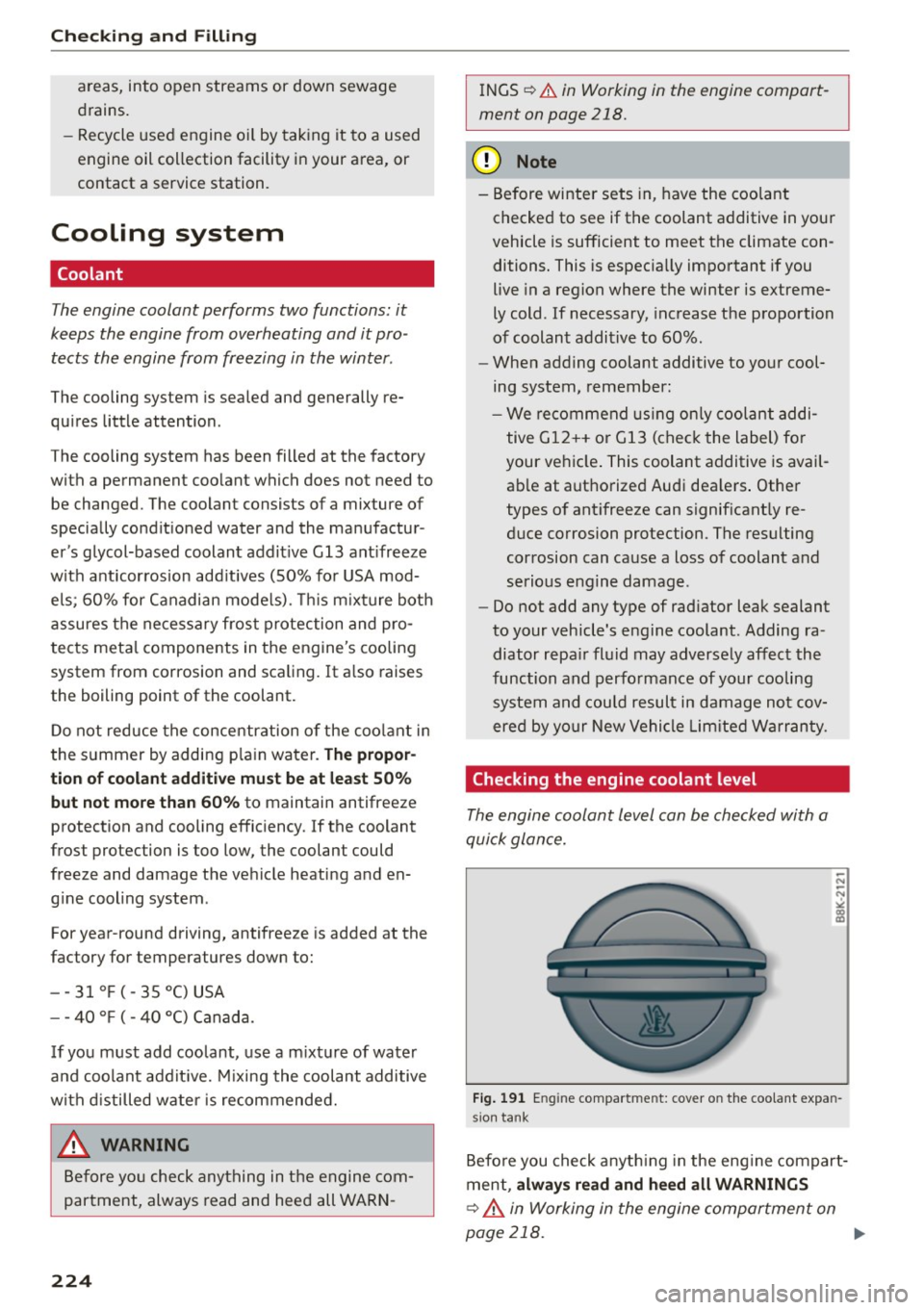
Checking the engine coolant level
The engine coolant level can be checked with a
quick glance.
Fi g. 1 91 Eng ine co mpar tmen t: c over on t he coo la nt expa n
sio n tan k
Befo re you check a nyth ing in the eng ine compart
men t,
always read and he ed all WARNINGS
~ A in Working in the engine compartmen t on
page 218. ..,.
Page 264 of 294
Fuses
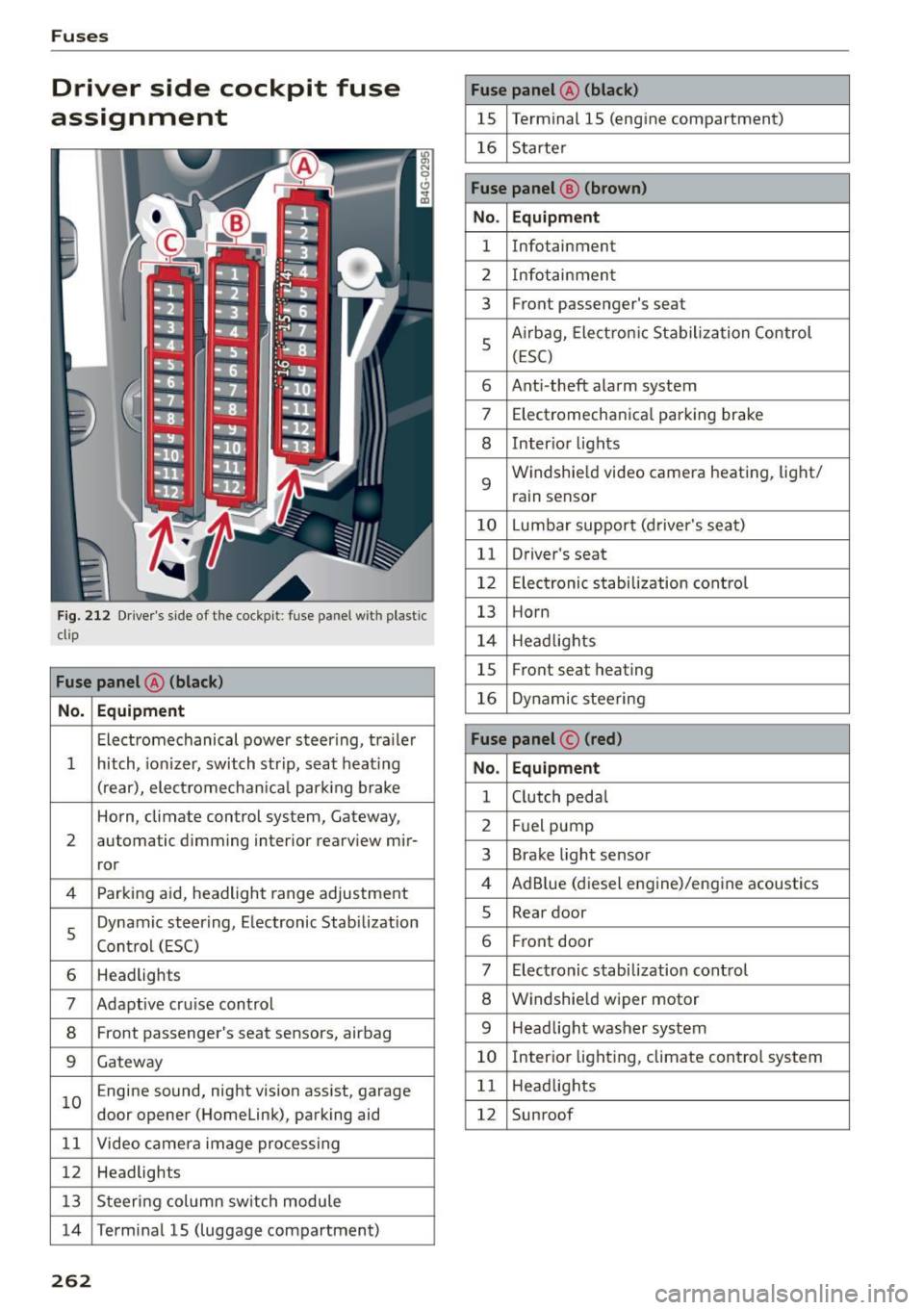
Driver side cockpit fuse
assignment
Fig. 212 Driver's side of the cockpit : fuse pa nel w it h plastic
cl ip
Fuse panel @ (black)
No. Equipment
Electromechanical power steer ing, trailer
1 hitch, ionizer, switch strip, seat heating
(rear), electromechanica l park ing brake
Horn, climate control system, Gateway,
2 automatic dimming interior rearview mir-
ror
4 Parking aid, headlight range adjustment
5 Dynamic steering, Electronic Stabilization
Control (ESC)
6 Headlights
7 Adaptive cru
ise control
8 Front passenger's seat sensors, airbag
9 Gateway
10 E
ngine sound, night vision assist, garage
door opener (Homelink), parking aid
11 Video camera image processing
12 Headlights
13 Steering col umn switch module
14 Terminal 15 (luggage compartment)
262
Fuse panel @ (black)
15 Terminal 15 (engine compartment)
16 Starter
Fuse panel @ (brown)
No . Equipment
1 Infotainment
2 Infotainment
3 Front passenger
's seat
5 Airbag, Electron
ic Stabilization Control
(ESC)
6 Anti -theft alarm system
7 Electromechanical parking brake
8 Inter
ior lights
9 Windshie
ld video camera heating , light/
rain sensor
10 Lumbar support (driver's seat)
11 Driver's seat
12 Electronic stabilization control
13 Horn
14 Headlights
15 Front seat heating
16 Dynamic steering
Fuse panel © (red)
No. Equipment
1 Clutch pedal
2 Fuel pump
3 Brake light sensor
4 AdBlue (diesel engine)/engine acoustics
5 Rear door
6 Front
door
7 Electronic stabilization control
8 Windshield wiper motor
9 Headlight washer system
10 Interior lighting, climate control system
11 Headlights
12 Sunroof
Page 265 of 294
M N <( I.J "". rl I.O
"' N I.O rl
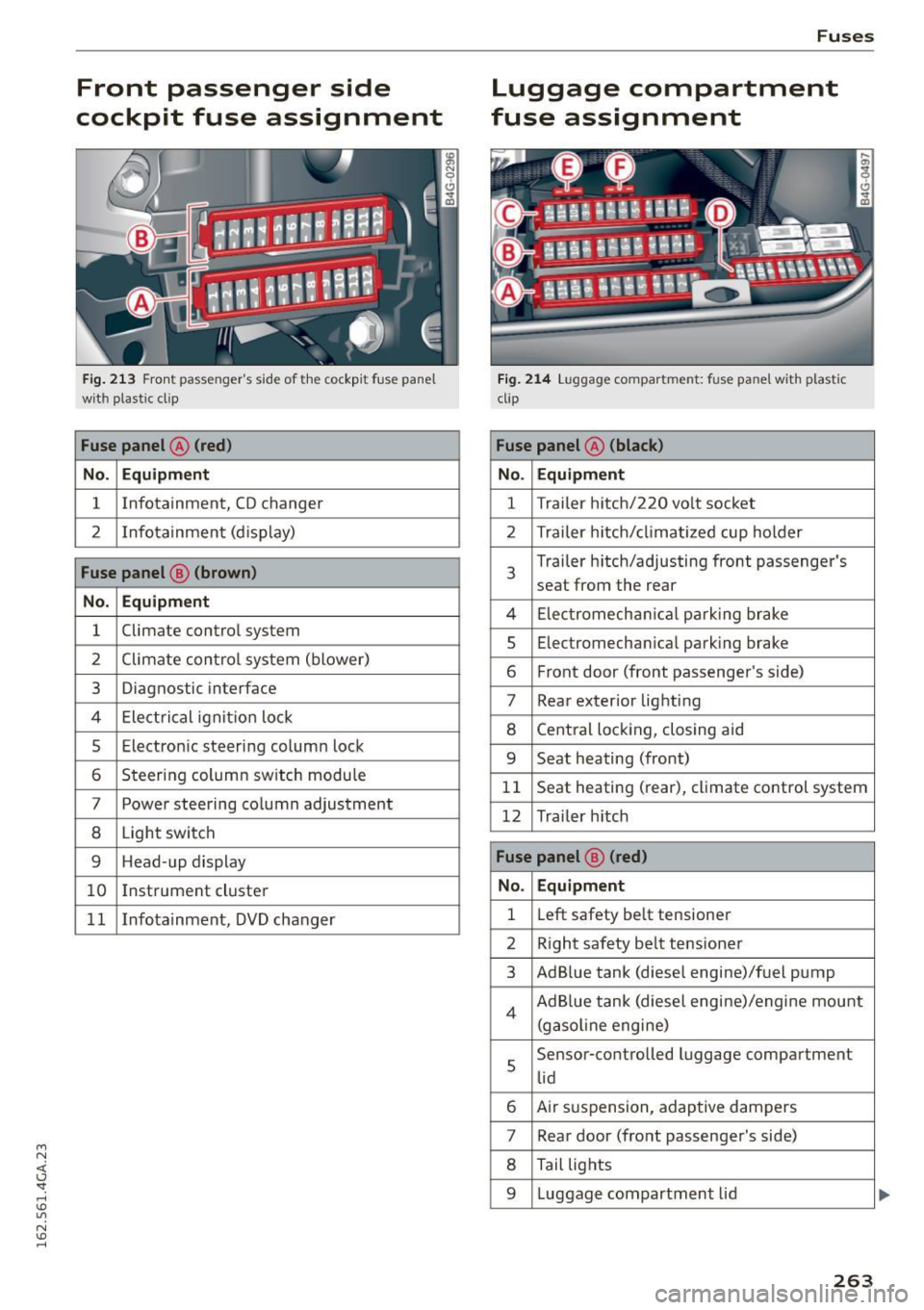
Front passenger side
cockpit fuse assignment
F ig. 21 3 Front passenger 's s ide of t he cockp it fuse pa nel
wit h plast ic cl ip
Fuse panel @ (red)
No. Equipment
1 Infotainment, CD changer
2 I nfotain ment (d isplay)
Fuse panel @ (brown)
No . Equipment
1 Climate control system
2 Climate con
trol sys tem (blower)
3 Diagnostic interface
4 Ele ctric al ignit ion loc k
5 Electro nic steer ing colum n lock
6 Steer ing column sw itch modu le
7 Power steering co lumn adjustment
8 Light switch
9 Head-up display
1 0 I
nstrument cluste r
1 1 Infotainment, DVD changer
Fuses
Luggage compartment
fuse assignment
F ig . 214 Lu ggage compa rtm ent: fuse pa nel w ith plastic
cli p
Fuse panel @ (black)
No. Equipment
1 Trailer h
itch/220 vo lt socket
2 Trailer h itch/ climatize d cup holder
3
Trailer h itch/adjusting front passenger's
seat from the rear
4 El ec tromech anical p ar kin g bra ke
5 Electromecha nica l park ing brake
6 Fr ont door (front passenger 's side)
7 Rear exterior lig hti ng
8 Cent ral loc king, closing aid
9 Seat heating (front)
1 1 Seat heating (rear), climate control system
12 Trailer h itch
Fuse panel @ (r ed)
No. Equipment
1 L
eft safety be lt tensioner
2 R ight safety be lt tensione r
3 AdBlue tank (diesel engine)/f uel p ump
4 Ad B lue tank (diese l engi ne)/engine mount
(g asol ine engine)
s
Sensor -co ntrolled luggage compartment
li d
6 Air s uspension, adaptive dam pers
7 Rear door (fro nt passenge r's side)
8 Tail lig hts
9 Luggage compartment lid
263
Page 284 of 294
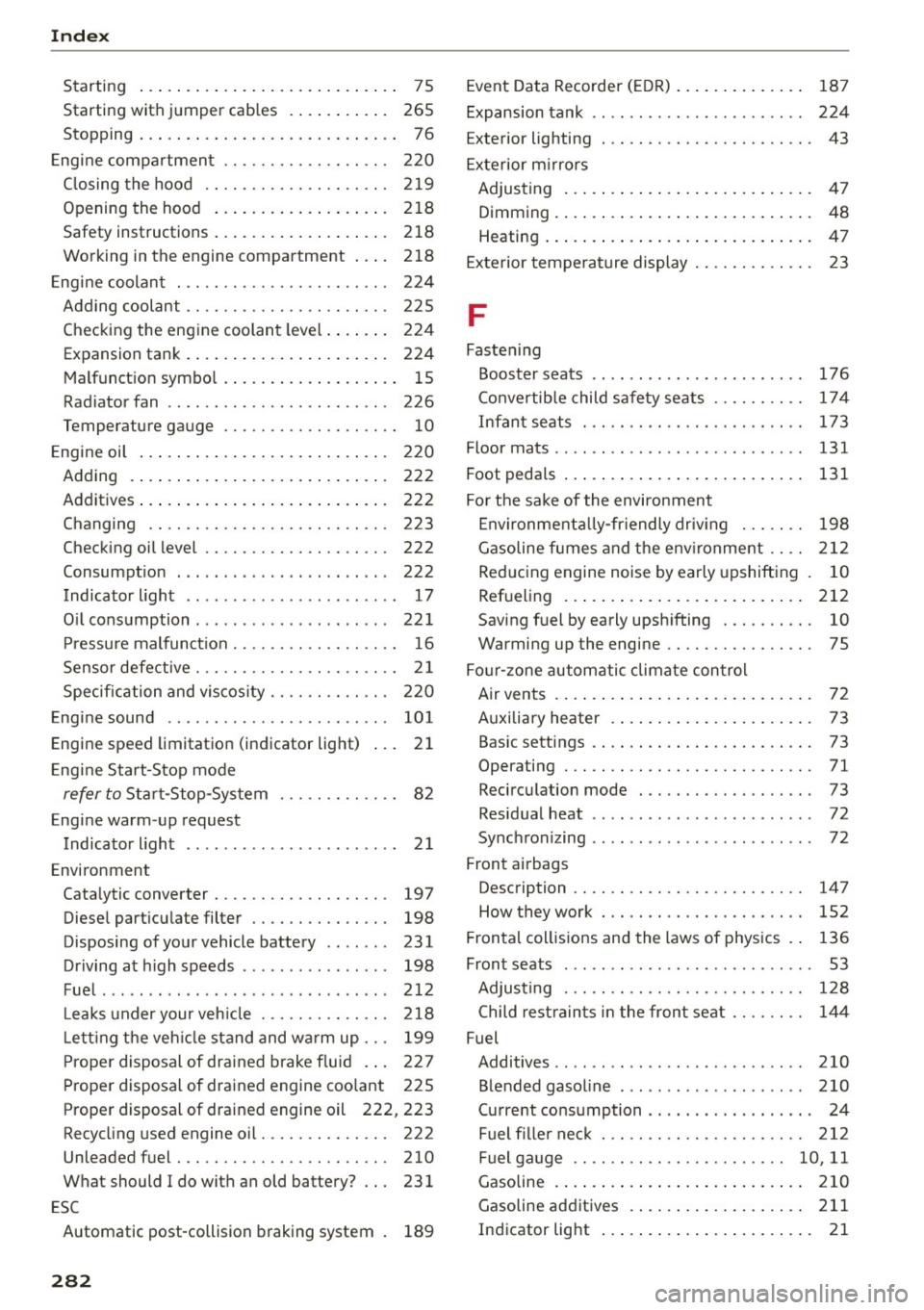
Index
Starting . . . . . . . . . . . . . . . . . . . . . . . . . . . . 75
Starting with jumper cab les . . . . . . . . . . . 265
Stopping . . . . . . . . . . . . . . . . . . . . . . . . . . . . 76
Engine compartment . . . . . . . . . . . . . . . . . . 220
Closing the hood . . . . . . . . . . . . . . . . . . . . 219
Opening the hood . . . . . . . . . . . . . . . . . . . 218
Safety instructions . . . . . . . . . . . . . . . . . . . 218
Working in the engine compartment . . . . 218 Event Data Recorder (EDR)
. . . . . . . . . . . . . . 187
Expansion tank . . . . . . . . . . . . . . . . . . . . . . . 224
Exterior lighting . . . . . . . . . . . . . . . . . . . . . . . 43
Exterior mirrors
Adjusting . . . . . . . . . . . . . . . . . . . . . . . . . . . 47
Dimming ..... ..... .. ................ 48
Heating...... ..... .. ................ 47
Exterior temperature display . . . . . . . . . . . . . 23
Engine coolant . . . . . . . . . . . . . . . . . . . . . . . 224
Adding coolant . . . . . . . . . . . . . . . . . . . . . . 225
F
Checking the engine coolant leve l. . . . . . . 224
Expansion tank . . . . . . . . . . . . . . . . . . . . . . 224
Malfunction symbol . . . . . . . . . . . . . . . . . . . 15
Radiator fan . . . . . . . . . . . . . . . . . . . . . . . . 226
Temperature gauge . . . . . . . . . . . . . . . . . . . 10
Engine oil . . . . . . . . . . . . . . . . . . . . . . . . . . . 220
Adding . ..... .. ................ .... 222
Additives . . . . . . . . . . . . . . . . . . . . . . . . . . . 222
Changing . . . . . . . . . . . . . . . . . . . . . . . . . . 223
Checking oil level . . . . . . . . . . . . . . . . . . . . 222
Consumpt ion . . . . . . . . . . . . . . . . . . . . . . . 222
Indicator light . . . . . . . . . . . . . . . . . . . . . . . 17
O il consumption. .............. ... .. . 221
Pressure malfunct ion . . . . . . . . . . . . . . . . . . 16
Sensor defective . . . . . . . . . . . . . . . . . . . . . . 21
Specification and viscos ity . . . . . . . . . . . . . 220
Engine sound . . . . . . . . . . . . . . . . . . . . . . . . 101
Engine speed limitation (indicator light) 21
E ngine Start-Stop mode
refer to Start-Stop-System . . . . . . . . . . . . . 82
Engine warm -up request
Indicator light . . . . . . . . . . . . . . . . . . . . . . . 2 1
Environment Catalytic converter . . . . . . . . . . . . . . . . . . . 197
Diesel particulate filter . . . . . . . . . . . . . . . 198
Disposing of your vehicle battery . . . . . . . 231
Driving at high speeds . . . . . . . . . . . . . . . . 198
Fuel ...... ... .. ... ............. ... . 212
L eaks under your veh icle . . . . . . . . . . . . . . 218
L ett ing the veh icle stand and warm up . . . 199
Proper disposal of drained brake fluid . . . 227
Proper disposal of drained engine coo lant 225
Proper disposal of drained engine oil 222, 223
Recycling used engine oil. . . . . . . . . . . . . . 222
Unleaded fuel .................. .. ... 210
What should I do with an old battery? . . . 231
ESC Automatic post-collision braking system 189
282
Fastening
Booster seats . . . . . . . . . . . . . . . . . . . . . . . 176
Convertib le child safety seats . . . . . . . . . . 17 4
Infant seats . . . . . . . . . . . . . . . . . . . . . . . . 173
Floor mats ...... ... ... ........ ...... . 131
Foot pedals .......................... 131
For the sake of the environment Environmentally-friendly driving . . . . . . . 198
Gasoline fumes and the env ironment . . . . 212
Reducing engine noise by early upshifting . 10
Refueling . . . . . . . . . . . . . . . . . . . . . . . . . . 212
Saving fuel by early upshifting . . . . . . . . . . 10
Warming up the engine . . . . . . . . . . . . . . . . 75
Four-zone automatic climate control Air vents . . . . . . . . . . . . . . . . . . . . . . . . . . . . 72
Auxiliary heater . . . . . . . . . . . . . . . . . . . . . . 73
Basic settings . . . . . . . . . . . . . . . . . . . . . . . . 73
Operating . . . . . . . . . . . . . . . . . . . . . . . . . . . 71
Recirculation mode . . . . . . . . . . . . . . . . . . . 73
Residual heat . . . . . . . . . . . . . . . . . . . . . . . . 72
Synchronizing . . . . . . . . . . . . . . . . . . . . . . . . 72
Front airbags Description . . . . . . . . . . . . . . . . . . . . . . . . . 147
How they work . . . . . . . . . . . . . . . . . . . . . . 152
Frontal collisions and the laws of physics . . 136
Front seats . . . . . . . . . . . . . . . . . . . . . . . . . . . 53
Adjusting . . . . . . . . . . . . . . . . . . . . . . . . . . 128
Child restraints in the front seat . . . . . . . . 144
Fuel Additives .. .. .. . . . . . . . . . . . . . . . . . . . . . 210
Blended gasoline . . . . . . . . . . . . . . . . . . . . 210
Current consumption . . . . . . . . . . . . . . . . . . 24
Fuel filler neck . . . . . . . . . . . . . . . . . . . . . . 212
Fuel gauge . . . . . . . . . . . . . . . . . . . . . . . 10 , 11
Gasoline . . . . . . . . . . . . . . . . . . . . . . . . . . . 210
Gasoline additives . . . . . . . . . . . . . . . . . . . 211
Indicator light . . . . . . . . . . . . . . . . . . . . . . . 21