oil AUDI A7 2016 User Guide
[x] Cancel search | Manufacturer: AUDI, Model Year: 2016, Model line: A7, Model: AUDI A7 2016Pages: 294, PDF Size: 73.82 MB
Page 193 of 294
M N <( (.J
'SI: ,...., \!) 1.1'1
N \!) ,....,
Corro sion
There may be a tendency fo r dirt to bui ld up on
the brake pads and corrosion to fo rm on the discs
if the car is not driven regularly or only for short
trips with little use of the brakes.
If the b rakes are not used frequently, or if corro
sion has formed on the discs, it is advisab le to
clean
off the pads and discs by braking firmly a
few times from a moderately high speed
c=> .&, .
Faults in the brake sy stem
If you should not ice a sudden increase in brake
pedal travel, then one of the two brake circuits
may have fai led
c=> .&, .
Low brake flu id level
Malfunct ions can occur in the brake system if the
brake fluid level is too low. The brake flu id leve l is
monitored e lectronically.
Br ake boo ste r
The brake booster works w ith vacuum pressure
which is created only when the engine is running
~ ,& .
Brake lining wear sta tu s
Brake lining wear may be checked by visual in
spection of the condition of the brake pads
through the openings in the wheel. If necessary,
the wheel may be removed for this inspection
c=> page 2 55, Replacing wheels.
.8, WARNING -
- New brake pads don't have the best stop
ping power and must be "broken-in" during
the initial 250 mi les ( 400 km) . You can com
pensate for this by pressing the brake peda l
more firmly. This a lso applies later when
new pads are installed.
- You should perform braking maneuvers for
the purpose of clean ing the brake system
only if road conditions perm it. Other road
users must not be put at risk -you may
cause an accident!
- Before descending a steep grade, reduce
speed and shift transmiss ion into a lower
gear or lower driving range. Do not ride the
In te llig ent T echnolog y
brakes or hold the peda l down too long o r
too often. This could cause the brakes to get
hot and dimin ish braking effic iency.
- Do not "ride the brakes" by rest ing your foot
on the pedal when you do not intend to
brake. This may cause the brakes to over
heat, premature wear and increased stop
ping distance .
- Under certain cl imatic and operat ing condi
tions such as passing through water , dr iv ing
in heavy rain or afte r washing the veh icle,
the effect iveness of the brakes can be re
duced. In winter, ice c an accumulate on the
b rake pads, lin ings, discs and drums. Care
fu lly apply brakes for a test . Brakes will dry
and ice coatings will be cleaned
off after a
few ca reful brake app lications.
- Driving for an extended period of t ime on
salt-covered roads without using your
brakes can a lso affect braking efficiency.
Clean
off accumulated salt coating from
brake discs and pads with a few careful
brake applications.
- If you damage the front spoiler, or if you in
stall a different spoiler, be su re the air f low
to the front brakes is not obstructed . Other
wise the brake system could overheat reduc ing the effect iveness of the entire brake sys
tem.
- Fai lure of one brake circuit will impa ir th e
b rak ing capability res ulting in an increased
s topping distance. Avoid driving the vehicle
a nd have it towed to the nearest Aud i dea ler
or qualified workshop .
- Never let the vehi cle roll to a s top with the
engine shut
off .
- If the b rake booste r is no t working, the
b rake peda l must be pressed cons iderably
harder to make up for the lack of booster as
sistance.
191
Page 195 of 294
M N <( I.J "". rl I.O
"' N I.O rl
Offroad vehicle?
Your Aud i is not an off road vehicle -there is not
enough ground clea rance . For this reason, avo id
difficu lt terrain .
A WARNING
-Also, in vehicles with all whee l dr ive, adapt
your dr iving style to the current road and
traffic conditions. Do not let the increased
safety provided tempt you into taking risks, because t his increases the risk of an acci
dent .
- The brak ing ability of yo ur vehicle is lim ited
to the traction of the wheels . In this way, it
is not different from a two wh eel drive veh i
cl e. Do not be tempted to ac celerate to a
high speed when t he ro ad is s lippery th is in
cr eases the r is k of an accident .
- Note t hat on wet streets, t he front w heels
c an "hyd rop lane" if d riving at speeds that
are too high. Unli ke front whee l drive
vehicles, the engi ne does not rev higher sud
den ly when the vehicle begins hydrop laning.
For this reaso n, pay attent ion to the r oad
condit ions regardless of your speed to re
duce t he risk of an accident .
Rear spoiler
The extendable rear spoiler increases driving sta
bility.
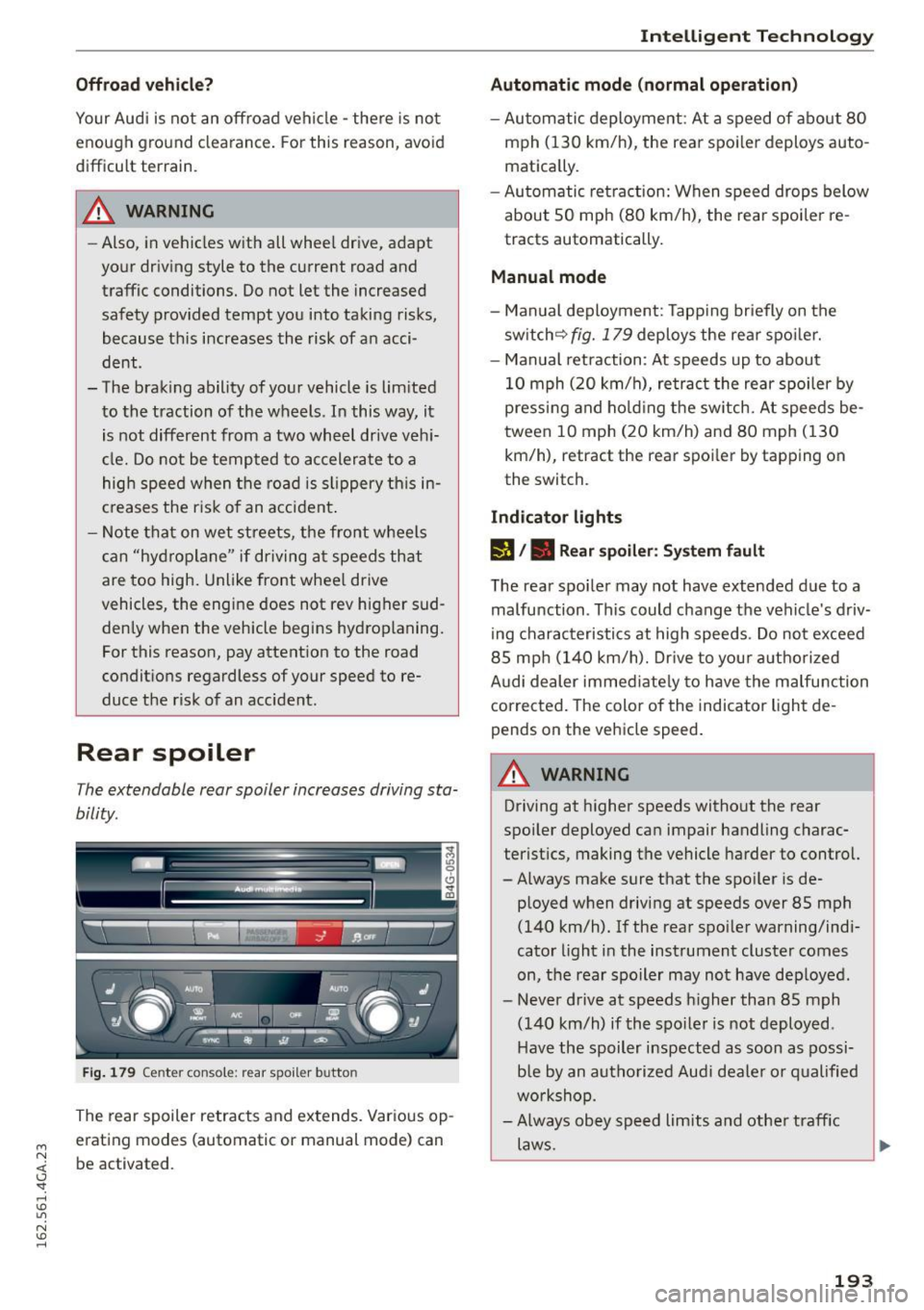
Fi g. 179 Cente r con sole : re ar s poil e r b utto n
The rear spoiler retrac ts and extends. Var ious op
erat ing modes (automatic or manual mode) can
be activated .
Intelligent Technology
Automatic mode (normal operation)
-Au tomatic deployment : At a s peed of about 80
mph (130 km/h) , the rear spo ile r deploys auto
matically .
- Au tomatic retra ction: When speed drops below
abou t SO mph (80 km/h), the rea r spoi ler re
tracts automatically.
Manual mode
- Man ual deployment: Tapp ing br iefly on the
sw itch ~
fig. 179 deploys the rea r spo ile r.
- Manual retraction : At speeds up to about
10 mph ( 20 km/h), re tract the rear spoiler by
pressi ng and hold ing t he sw itch. At speeds be
tween 10 mph (20 km/h) and 80 mph ( 130
km/h), retract the rear spoi ler by tapping on
the switch.
Indicator lights
rJ /. Rear spoiler : S ys tem fault
The rea r spoi le r may not have exte nded due to a
malfunction . Th is could change the vehicle's driv
i ng charac teristics at high speeds . Do not exceed
8 5 mp h (140 km/h). Dr ive to you r authorized
A udi dealer immed iate ly to have the malfu nction
corrected. The color of the indicator light de
pends on the vehicle speed .
A WARNING
-
Driving at higher speeds witho ut the rear
spoi ler deployed ca n impair handling charac
terist ics, making the vehicle harder to control.
- Always make sure that the spo iler is de-
p loyed w hen d riving at speeds over 85 mph
(140 km/h). If the rea r spo ile r warning/ind i
cato r light i n the instrument cluster comes
on, the rear spoile r may not have deploye d.
- Never drive at speeds h igher than 85 mph
(140 km/h) if the spo iler is not deployed.
Have the spoiler i nspected as soon as possi
b le by an au tho riz e d Aud i deale r o r q ualified
w orkshop.
- Always obey speed li mits and othe r traff ic
laws.
193
Page 196 of 294
Intelligent Technology
& WARNING
Improp er operat ion of the rear spoiler can
cause crushing injuries.
- Always make sure that nobody, espec ially
children , is in the way when the rea r spo ile r
i s deployed or retracted.
@ Note
- Neve r push on the vehicle on the rear spoi l
er. Th is co uld cause damage .
- To prevent damage to the rear spoiler do
not lean or p lace anyth ing on it.
- Only ope rate the rear spoi ler manually when
the luggage compartment lid is close and
the rear spo iler moving parts are not
blocked . Ot herwise, damage could occur.
(D Tips
Clean the rear spoiler compartment every 2 to
3 mont hs. To function correct ly, the rear
sp oiler must be free of ice, sn ow and leav es.
Energy management
The starting ability is optimized
The energy management system manages the
ele ctrical energy distribu tion and op timi zes the
availability of elec trical energy for starting the
engine .
Whe n a ve hicle wit h a co nven tional e nergy sys
tem is not dr iven for a long time, the ba tte ry is
d rained by equipmen t (fo r example the immobil
izer). In certa in circ umstances, there cou ld may
not be eno ugh energy to start the engine .
Your veh icle i s equ ipped w ith an intellige nt ener
gy managemen t system for distr ibuting electr ic i
ty . Th is significantly improves the starti ng ability
a nd increases the battery life .
T he energy m anagemen t sys tem Is made up of
battery diagno sis, idling current management
and dynamic energy management.
Battery diagnosis
T he batte ry diagnos is determines the ba tte ry
ch arge leve l. The sen sors de te ct the ba tte ry, the
194
batte ry current, an d the batte ry tempera ture.
The c urrent charge leve l and the perfo rmance of
t h e battery are determined based on th is.
Idling current management
The idling cur ren t management decr eases the
energy used wh ile pa rke d. Wi th the eng ine
switched off, it manages the energy dis trib ution
to t he d ifferent e lectr ica l components . Date from
battery diagnos is is ta ken into acco unt for this .
Depend ing on the batte ry charge leve l, elec trical
equipmen t is switched off one item afte r th e o th
e r, to prevent the battery from dra ining and to
r etain the starting ability.
Dynamic energy management
While driv ing , d ynam ic ene rgy man agement dis
t ribu tes the ap propri ate amount of energy to the
e lectrica l equ ipment. It controls the battery
c h arge level so t hat more ene rgy is not use d then
i s be ing generated in order to maintain an opti
mal battery charge level.
(D Tips
- Energy management can not overcome the
laws of p hys ics. Note that the charge level
and length of the battery life a re limited.
- W he n the sta rting ability is endange red, the
(•j indicator light t urns on¢ page 16 .
What you should know
Maintaining the starting ability is the highest
priority .
A lot of st ress is placed on the ba ttery when dr iv
i ng sho rt distances, in t raff ic, and at cold t imes
of the year . A lot of ene rgy is used but little is
generated .
It is also critical when the engine is
not ru nning but e lectr ica l equipment is sw itched
o n. In th is case, energy is used but none is gener
ated.
In sit uat ions like this, energy ma nagement w ill
active ly regu lated the distribution of energy.
Long periods without use
If you do not drive yo ur vehicle for several days or
weeks, e lectr ica l equipment is grad ually scaled ..,.
Page 198 of 294
Driving and the environment
Driving and the
environment
Breaking in
New engine
The engine needs to be run-in during the first
1,000 miles (1,500 km).
For the first 600 miles (1,000 kilometers ):
.,. Do not use full throttle .
.,. Do not drive at engine speeds that are more
than 2/3 of the maximum permitted RPM .
.,. Avoid high engine speeds.
From 600 to 1,000 miles (1,000 to 1,500
kilometers ):
.,. Speeds can gradually be increased to the maxi
mum perm issible road or eng ine speed.
During and after break-in period
.,. Do not rev the engine up to high speeds when it
is cold . This applies whether the transmission is
i n N (Neutral) or in gear .
After the break-in period
.,. Do not exceed maximum engine speed under
any circumstances.
.,. Upshift into the next higher gear
before reach
i ng the red area at the end of the tachometer
scale~
page 10 .
During the first few hours of driving, the engine's
internal friction is higher than later when all the
mov ing parts have been broken in. How well th is
break-in process is done depends to a cons idera
b le extent on the way the vehicle is driven during
the first 1,000 miles (1,500 kilometers).
(D Note
Extremely high engine speeds are automati
cally reduced. However, these rpm limits are
programmed for an engine wel l run-in, not a
new engine.
196
® For the sake of the environment
Do not drive with unnecessarily high engine
speeds -upshifting early saves fuel, reduces
noise and protects the environment.
New tires
If your vehicle is running on new tires, drive par
ticularly careful for the first 350 miles (500 kilo
meters) after f itting .
.8, WARNING
New tires tend to be slippery and must also
be "broken- in". Be sure to remember this dur
ing the first 350 mi les (500 kilometers).
Brake gently. Avoid following closely behind
other ve hicles or other situations that might
require sudden, hard braking.
Avoid damaging the
vehicle
When you are driving on poor roads, or over
curbs, steep ramps, etc ., make certain that low
lying parts such as spoilers and exhaust system
parts do not bottom out and get damaged .
This is especially true for vehicles with low-slung chass is (sports chassis)* and fully loaded
vehicles .
-
Driving through water on
roads
Note the following to avoid vehicle damage whe n
driving through water, for example on flooded
roads:
- The water must not be any highe r than the bot
tom of the vehicle body.
- Do not dr ive faster than walk ing speed .
.8, WARNING
After driv ing through water or mud, the brak
ing effect can be reduced due to moisture on
the brake discs and brake pads. A few careful
brake applications shou ld dry off the brakes.
Page 199 of 294

M N <( (.J
'SI: ,...., \!) 1.1"1
N \!) ,....,
CD Note
-Vehicle components such as the engine ,
transmission, suspension or e lectr ical sys
tem can be severe ly damaged by driving
through water .
- Always switch the Start-Stop -System* off
when driving through water
c> page 80.
@ T ips
- Determine the depth before driving through
water.
- Do not stop the vehicle, drive in reverse or
switch the eng ine off when driving through
water.
- Keep in mind that oncoming vehicles may
create waves that raise the water level and
make it too deep for your vehicle to drive
through safely.
- Avoid driving through sa lt water (corrosion).
Catalytic converter
Applies to vehicles: with gasoline engine
It is very impor tan t tha t your emission control
system (catalyti c converter) is functioning prop
erly to ensure that your vehicle is running in an
environmentally sound manner .
... Always use lead-free gasoline c> page 210,
F uel supply .
... Never run the tank down all the way to empty .
.,. Never put too much motor oil in your engine
c> page 222, Adding engine oil~-
.,. Never try to push- or tow-start your veh icle.
The catalytic converter is an eff icient "clean-up"
dev ice bu ilt into the exhaust system of the vehi
cle . T he catalytic converter burns many of the
pollutants in the exhaust gas before they are re
l eased into the atmosphere.
The exclusive use of unleaded fuel is cr itically im
portant for the life of the catalyt ic converte r and
proper functioning o f the eng ine .
A WARNING
The temperature o f the exhaust system is
high, both when driving and after stopping
the engine .
Driving and th e en vir onm ent
- Never touch the exhaust tail pipes once they
have become hot. Th is could resu lt in burns.
- Do not park or operate the vehicle in areas
where the hot exhaust system may come in contact w ith dry grass, brush, fuel spill or
other material which can cause a fire.
- Do not app ly additional undercoating or
rustproofing on or near the exhaust mani
fold, exhaust pipes, catalytic converter or heat shields . During dr iving, the substance
used for undercoat ing could overheat and
cause a fire .
CD Note
-Be aware that just one tank filling with lead
ed
fuel w ill already ser iously degrade the
performance of the catalyt ic converter .
- Do not exceed the correct engine oil level
¢ page 222.
-Do not drive until the fuel tank becomes
completely empty . The engine cou ld misfire .
Unburned fuel could also get into the ex
haust system and this cou ld cause the cata
lyt ic converter to overheat.
- Do not switch off the ignit io n while the veh i
cle is movi ng.
- Do not continue to ope rate your veh icle un
der these conditions, as othe rwise f uel can
reach the catalytic converter . This could re
sult in overheating of the co nve rter , requ ir
ing its replacement .
- T o assu re eff icient operation of the Emission
Contro l System:
- Have your vehicle maintained properly and
in accordance w ith the serv ice recommen
dat ions in your Warranty
& Maintena nce
booklet .
- Lack of proper maintenance as we ll as im
p roper use of the vehicle will impair the
function of the emission control system
and could lead to damage.
@ For the sake of the environment
Even when the Emiss ion Control System is op
erating properly, the exhaust gas can have a
su lfu r-like exhaus t gas sme ll unde r some op
erating states. Th is depends on the s ulf ur
197
Page 201 of 294
M N <( (.J
'SI: ,...., \!) 1.1'1
N \!) ,....,
Reducing unnecessary idling
Even when your car is just idling it burns up fuel.
~ Shut the engine off when you are not driving
the vehicle.
~ Do not warm up the vehicle by letting the en-
gine run at idle .
The idling phase is automatically reduced for
veh icles with the Start-Stop-System . It is effi
cient to switch off the engine in vehicles without
the Start-Stop-System when stopped at railroad
crossings and long red lights. Turning the engine
off for just 30-40 seconds saves more fuel than is
burned by starting the engine again.
It takes a long time for the engine to warm up
fully when it is running at idle . However, wear
and noxious emissions are especially high when
the engine is warm ing up. So you shou ld drive
away as soon as you start the engine and avoid
running at high rpms while the engine is still
warming up .
(D Note
Do not leave engine idling unattended after
starting. If warning lights should come on to
indicate improper operation, they would go
unheeded. Extended idling a lso produces
heat, wh ich could resu lt in overheating or oth
er damage to the vehicle or other property.
Regular maintenance
A badly tuned engine unnecessarily wastes a lot of fuel.
~ Have your vehicle serviced at regular intervals.
By having your vehicle regularly serviced by an
Aud i dea ler helps to ensure that it runs properly
and economica lly. The condition of your vehicle
not only affects its safety and ability to hold its
value, it a lso affects fuel consumption .
Check your oil each time you fill your tank.
The amount of oil used is related to engine load
and speed.
Driving and the environment
It is normal for the oil consumption of a new en
gine to reach its lowest value after a certain mile
age has been driven.
You must drive your veh icle about 3,000 miles
(5,000 kilometers) before you can properly as
sess oil consumption .
T h is also applies to fuel consumption and engine
o ut put .
CD Note
- Have your vehicle maintained properly and
in accordance with the service recommenda
tions in your Warranty
& Maintenance book
let . Lack of proper maintenance as well as
improper use of the vehicle will impair the
function of the em ission contro l system and
cou ld lead to damage.
- Do not alter or remove any component of
the Emission Control System unless ap
proved by the manufacturer.
- Do not alter or remove any device, such as
heat shields, sw itches, ignition wires,
valves, which are designed to protect your
vehicle's Emission Control System and other important vehicle components .
Fewer short trips
Fuel consumption will always be relatively high
on short trips .
~ Try to avoid dr iv ing short distances w ith a co ld
eng ine .
The engine and cata lytic converter have to reach
their optimal operating temperature to reduce
fuel consumpt ion and nox ious em issions effec
t ively.
Just after starting, a co ld engine in a mid-size car
only achieves a fuel economy of 6-8 mi les per
gallon (30-40 l/100 km) . After about a half a
mile, fuel economy climbs to 12 mpg (20 l/100
km). After about
2.5 miles (4 km), the eng ine is
at its proper operating temperature and fuel
economy has reached a norma l level. So you can
see that you should avoid short trips whenever
poss ible. .,.
199
Page 208 of 294
Care and cleaning
- To reduce the risk of cuts, protect yourse lf
from sharp metal components when wash
ing the underbody or the inside of the wheel
housings.
- After washing the vehicle, the braking effect
may be delayed due to moisture on the
brake rotors or ice i n the winter. The brakes
must be d ried first w ith a few careful bra ke
applications.
(D Note
- If you wash the vehicle in an automatic car
wash, you must retract the rear spoiler if
necessary, and fold the exter ior mirrors in to
r educe the ris k of damage. Power folding
ex ter ior mirrors* must on ly be folded in and
out using the power folding function.
- To prevent pa int damage, do not wash the
vehicle in di re ct s unlight.
- To reduce the risk of damage to the s urface,
do not use i nsec t removing sponges, kitche n
sponges or similar ite ms. - Matte finish painted vehicle components:
-To reduce the risk of damage to the sur-
face, do not use polish ing agents or hard
wax.
- Never use protective wax.
It can destroy
the matte finish effect.
- Do not place any stickers or magnet ic
signs on vehicle parts painted w ith matte
finish paint. The pa int co uld be damaged
when the stickers o r mag nets are re
moved.
@ For the sake of the environment
Only wash t he ve hicle i n facilities spec ially de
signed for that purpose. Th is w ill re duce the
r isk of dirty water co ntaminated w ith oil from
ente ring the sewe r system.
Cleaning and care information
W hen clean ing and caring for ind ividua l vehicle
com ponents, re fer to the following tables. The
info rmation conta ined there is simply recommen- dations. For questions or for compo
nents tha t
are not li sted, refer to an au thor ized Audi dealer.
A lso follow the information found in
¢ .& .
Exterior cleaning
Component Situation Solution
Wind shield wiper
Deposits ¢ page 50, Cleaning windshield wiper blades
blades
Headlights /
Deposits Soft sponge with a mild soap solutional
tail lights
Sensors /
Deposits Sensors: soft cloth with solvent-free cleaning so lution
camera lenses Camera lenses: soft cloth with alcoho l-free clean ing solu-
tion
Snow/ ice H
and br ush/solvent -free de- icing sp ray
Wheels Road sa lt Water
Brake d ust Acid
-free spec ia l cleaning solut ion
E x haust t ail pipes Road sa lt Water, clea ning solution sui tab le for stain less stee l, if nee -
essary
Decorative parts / Deposits Mild soap solutiona>, a cleaning so lution suitable for stain -
trim less stee l,. if necessary
206
Page 210 of 294
Care and cleaning
Component S ituation Solution
Te xtiles
Deposits adhering to Vacuum cleaner
arti ficial leath er, the surface
Alca ntara Wate r-based depos its Absorben
t cloth and mild soap solutional
such as coffee, tea,
blood, etc.
Oil-based deposits Apply am ild soap solutional, blot away the disso lved oil or
such as oil, make-up, dye, treat afterwa rd with water, if necessary
etc.
Special deposits such Special stain remover, blot w ith absorbent materia l, treat
as ink, na il polish, la- afterward with mild soap so lution, if necessaryal
tex paint, shoe pol-
ish, etc.
Natural leather Fres h stains Wool cloth with a mild soap solut ional
Wate r-based depos its fresh stains: absorbent clot h
such as coffee, tea, d ried stains: stain remover suitable for leathe r
blood, etc.
Oil-based deposits Fresh stains: absorbent cloth and stain remover suitab le
such as oil, make- up, for leather
etc. dried stains: Oil cleaning spray
Special deposits such Spot remover sui table for leather
as ink, nai l polish, la -
tex paint, shoe pol-
ish, etc.
Care Regularly app ly condi tioning cream that protects from
lig ht and penet rates in to the mate rial. Use specially -col -
ored conditioning cream, if necessary.
Carbon part s Deposits clean the same way as plastic parts
al Mild soap sol ution: maxim um two tablespoons of neutral soap in 1 quar t (1 liter ) of water
_& WARNING
The windshie ld may not be tre ate d wit h wa
t er- repelling win dsh ield co ating agents. Un
favorab le conditions such as wetness, dark
ness, or low s un can resu lt in increased glare.
Wiper blade chatter is also possible.
(D Note
- Headlights/tail light s
-Never clean headlights or ta il lights with a
dry cloth or sponge.
- Do not use any cleaning prod uct that con
tains alcohol, because they could cause cracks to form.
- Wheels
208
-
- Never use any paint polish or other abra
sive mate rials.
- Damage to the protective layer on the
rims such as sto ne chips or sc ratches must
be repaired immediately.
- Sensors /camera lenses
- N eve r use warm or ho t w at er to remove
snow or ice from the camera lens . This
could ca use the lens to crack.
- N eve r use abras ive cle an ing m ateria ls or
a lcohol to clea n the camera lens. This
could ca use scratches and cracks .
-Doo r windows
- Remove snow and ice on windows and ex-
terio r mirro rs with a p lastic scraper. To
Page 213 of 294
fill up at busy gas stations where the seasonal
adjustment is more likely to be made in time.
(D Note
- Methanol fuels which do not meet these re
quirements may cause corrosion and dam
age to plastic and rubber components in the
fuel system.
- Do not use fue ls that fail to meet the speci
fied criteria in this chapter.
- If you are unable to determine whether or
not a particular fuel blend meets the speci
fications, ask your service station or its fuel
supplier.
- Do not use fuel for which the contents can
not be identified.
- Fuel system damage and performance prob
l ems resulting from the use of fuels differ
ent from those specified are not the respon
s ibility of Audi and are not covered under
the New Vehicle or the Emission Control
System Warranties.
- If you experience a loss of fuel economy or
driveability and performance problems due
to the use of one of these fuel blends, we
recommend that you switch to unb lended
fuel.
Gasoline additives
A ma jor concern among many auto manufactur
ers is carbon deposit build-up caused by the type
of gasoline you use.
Although gasol ine grades differ from one manu
facture r to another, they have certa in things in
common. All gasoline grades contain substances
that can cause deposits to collect on vita l engine
parts, such as fuel injectors and intake valves. Al
though most gasoline brands include additives to
keep engine and fuel systems clean, they are not
equally effective .
Audi recommends using TOP TIER Detergent Gas
oline. For more information on TOP TIER Deter-
M gent Gasoline, please go to the official website N
j (www .toptiergas.com).
'SI: ,...., \!) 1.1'1
N \!) ,....,
Fuel and Refueling
After an extended period o f using inadequate
fuels, carbon deposit build-ups can rob your en
gine of peak performance .
(D Note
Damage or malfunction due to poor fuel qual
ity is not covered by the Audi New Vehicle
Limited Warranty.
Diesel fuel
Applies to vehicles: with diesel engine
Always use ULSD (Ultra Low Su lfur Diesel) No. 2.
The ULSD No. 2 meets the ASTM 0975.
Diesel fuel with concentrations of biodiese l high
er than 5
% such as Bl 1, B20 or 8100 are strictly
prohibited.
Service station fue l pumps are labeled with the
correct fue l information for easy recognit ion by
the user .
If the d iese l fue l pump is not labe led
ask the station operator what fuel is being dis
pensed before fi lling up your vehicle.
ULSD No. 2 may not be available outside the USA
and Canada . Be sure to check before traveling to
other countries.
ULSD No. 2 can become thicker in very cold tem
peratures, and this can impair the engine's start
ing and running. Depending on the season, gas
stations provide ULSD No. 2 that flows better in
cold temperatures so that you can continue oper
ating your vehicle as usual.
@ Note
- Your vehicle's diesel engine was designed
soley for use with ULSD No. 2. Therefore,
never use gasoline, heating oil, other fuels
or flow improvers. These conta in substances
that will severely damage the fuel system
and the engine . Such damage will not be
covered by your New Vehicle Limited War
ranty.
- If you put any amount of incorrect fuel in
the fuel tank, do not start the engine under
any circumstances. Immediately contact the
nearest authorized Audi dealer or author
ized Audi Service Facility for assistance.
211
Page 221 of 294
M N <( (.J
'SI: ,...., \!) 1.1'1
N \!) ,....,
-Do not remove the engine cover under any
circumstances. This increases the risk of
burns.
- If work on the fuel system or the electrical
system is necessary :
- Always disconnect the battery.
- Never smoke or work near heaters or open
flames . Fluids in the engine compartment
could start a fire.
- Keep an approved fire extinguisher imme
diately available.
- To avoid electrical shock and personal injury
while the engine is running or being started,
never touch:
- Ignition cables
- Other components of the high voltage
electronic ignition system.
-If you must perform a check or repair with
the engine running:
- First, fully apply the parking brake, move
selector lever to P (Park).
- Always use extreme caution to prevent
clothing, jewelry, or long hair from getting
caught in the radiator fan, V-belts or other moving parts, or from contacting hot
parts. Tie back hair before starting, and do
not wear clothing that will hang or droop
into the engine.
- Minimize exposure to emission and chemi
cal hazards ¢.&. .
..&, WARNING
California Proposition 65 Warning:
- Engine exhaust, some of its constituents,
and certain vehicle components contain or
emit chemicals known to the State of Cali
fornia to cause cancer and birth defects and
reproductive harm. In addition, certain flu
ids contained in vehicles and certain prod
ucts of component wear contain or emit
Checking and Filling
chemicals known to the State of California
to cause cancer and birth defects or other
reproductive harm.
- Battery posts, terminals and related acces
sories contain lead and lead compounds,
chemicals known to the State of California
to cause cancer and reproductive harms.
Wash hands after handling .
([) Note
When adding fluids, always make sure that
they are poured into the proper container or
filler opening, otherwise serious damage to
vehicle systems will occur .
® For the sake of the environment
To detect leaks in time, inspect the vehicle
floor pan from underneath regularly. If you
see spots from oil or other vehicle fluids, have
your vehicle inspected by an authorized Audi
dealer .
Closing the engine hood
.,.. Pull the hood down until the pressure from the
struts is reduced.
.,.. Let the hood
drop down and latch in place. Do
not try to push it shut;
it may fail to engage
¢ ,& .
..&, WARNING
--A hood that is not completely latched could
fly up and block your view while driving .
- When you close the engine hood, check it to
make sure the safety catch has properly en
gaged . The hood should be flush with the
surrounding vehicle body parts .
- If you notice while driving that the hood is
not secured properly, stop at once and close
it .
-
219