air condition AUDI A7 2016 Owner's Manual
[x] Cancel search | Manufacturer: AUDI, Model Year: 2016, Model line: A7, Model: AUDI A7 2016Pages: 294, PDF Size: 73.82 MB
Page 195 of 294
M N <( I.J "". rl I.O
"' N I.O rl
Offroad vehicle?
Your Aud i is not an off road vehicle -there is not
enough ground clea rance . For this reason, avo id
difficu lt terrain .
A WARNING
-Also, in vehicles with all whee l dr ive, adapt
your dr iving style to the current road and
traffic conditions. Do not let the increased
safety provided tempt you into taking risks, because t his increases the risk of an acci
dent .
- The brak ing ability of yo ur vehicle is lim ited
to the traction of the wheels . In this way, it
is not different from a two wh eel drive veh i
cl e. Do not be tempted to ac celerate to a
high speed when t he ro ad is s lippery th is in
cr eases the r is k of an accident .
- Note t hat on wet streets, t he front w heels
c an "hyd rop lane" if d riving at speeds that
are too high. Unli ke front whee l drive
vehicles, the engi ne does not rev higher sud
den ly when the vehicle begins hydrop laning.
For this reaso n, pay attent ion to the r oad
condit ions regardless of your speed to re
duce t he risk of an accident .
Rear spoiler
The extendable rear spoiler increases driving sta
bility.
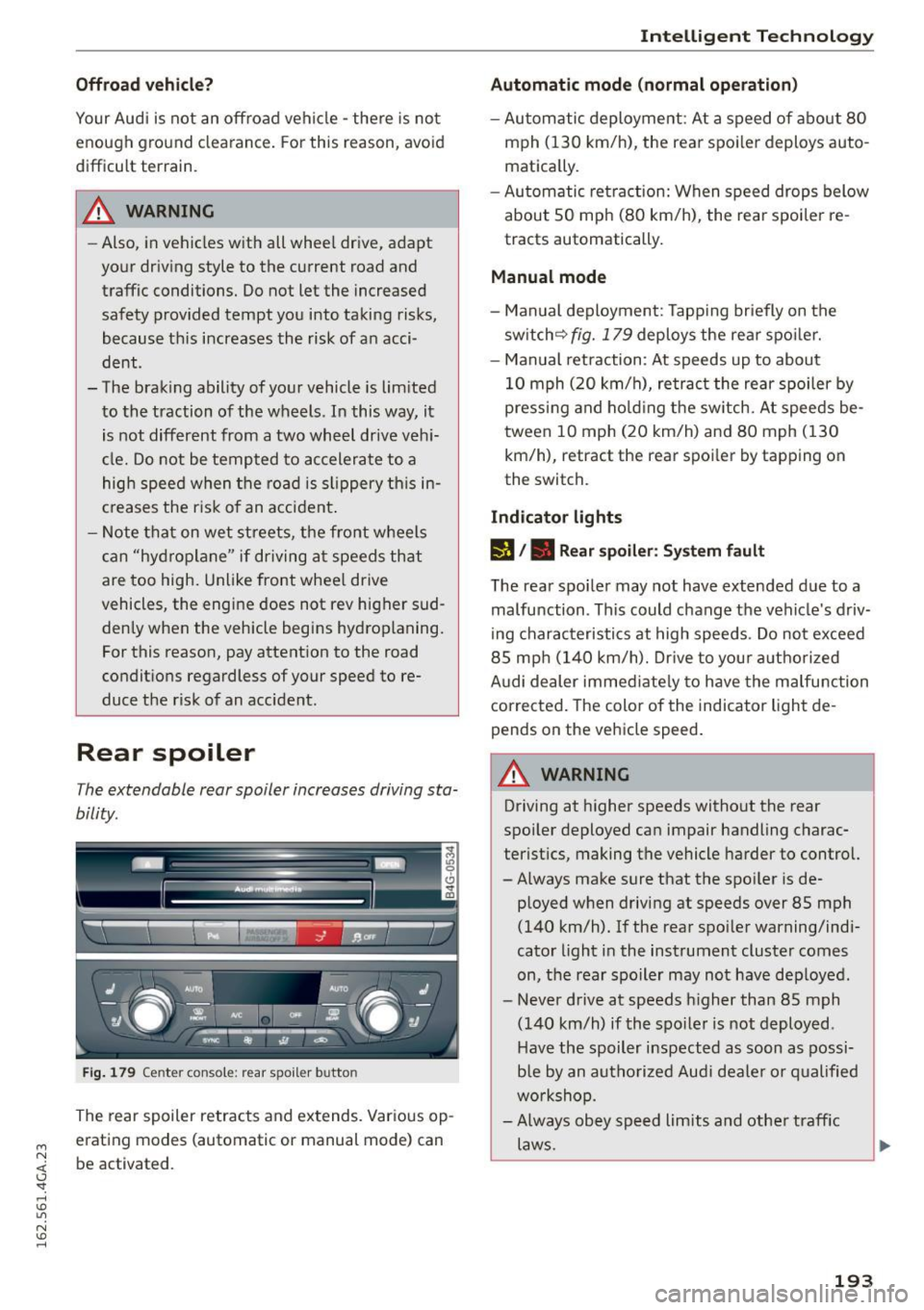
Fi g. 179 Cente r con sole : re ar s poil e r b utto n
The rear spoiler retrac ts and extends. Var ious op
erat ing modes (automatic or manual mode) can
be activated .
Intelligent Technology
Automatic mode (normal operation)
-Au tomatic deployment : At a s peed of about 80
mph (130 km/h) , the rear spo ile r deploys auto
matically .
- Au tomatic retra ction: When speed drops below
abou t SO mph (80 km/h), the rea r spoi ler re
tracts automatically.
Manual mode
- Man ual deployment: Tapp ing br iefly on the
sw itch ~
fig. 179 deploys the rea r spo ile r.
- Manual retraction : At speeds up to about
10 mph ( 20 km/h), re tract the rear spoiler by
pressi ng and hold ing t he sw itch. At speeds be
tween 10 mph (20 km/h) and 80 mph ( 130
km/h), retract the rear spoi ler by tapping on
the switch.
Indicator lights
rJ /. Rear spoiler : S ys tem fault
The rea r spoi le r may not have exte nded due to a
malfunction . Th is could change the vehicle's driv
i ng charac teristics at high speeds . Do not exceed
8 5 mp h (140 km/h). Dr ive to you r authorized
A udi dealer immed iate ly to have the malfu nction
corrected. The color of the indicator light de
pends on the vehicle speed .
A WARNING
-
Driving at higher speeds witho ut the rear
spoi ler deployed ca n impair handling charac
terist ics, making the vehicle harder to control.
- Always make sure that the spo iler is de-
p loyed w hen d riving at speeds over 85 mph
(140 km/h). If the rea r spo ile r warning/ind i
cato r light i n the instrument cluster comes
on, the rear spoile r may not have deploye d.
- Never drive at speeds h igher than 85 mph
(140 km/h) if the spo iler is not deployed.
Have the spoiler i nspected as soon as possi
b le by an au tho riz e d Aud i deale r o r q ualified
w orkshop.
- Always obey speed li mits and othe r traff ic
laws.
193
Page 199 of 294

M N <( (.J
'SI: ,...., \!) 1.1"1
N \!) ,....,
CD Note
-Vehicle components such as the engine ,
transmission, suspension or e lectr ical sys
tem can be severe ly damaged by driving
through water .
- Always switch the Start-Stop -System* off
when driving through water
c> page 80.
@ T ips
- Determine the depth before driving through
water.
- Do not stop the vehicle, drive in reverse or
switch the eng ine off when driving through
water.
- Keep in mind that oncoming vehicles may
create waves that raise the water level and
make it too deep for your vehicle to drive
through safely.
- Avoid driving through sa lt water (corrosion).
Catalytic converter
Applies to vehicles: with gasoline engine
It is very impor tan t tha t your emission control
system (catalyti c converter) is functioning prop
erly to ensure that your vehicle is running in an
environmentally sound manner .
... Always use lead-free gasoline c> page 210,
F uel supply .
... Never run the tank down all the way to empty .
.,. Never put too much motor oil in your engine
c> page 222, Adding engine oil~-
.,. Never try to push- or tow-start your veh icle.
The catalytic converter is an eff icient "clean-up"
dev ice bu ilt into the exhaust system of the vehi
cle . T he catalytic converter burns many of the
pollutants in the exhaust gas before they are re
l eased into the atmosphere.
The exclusive use of unleaded fuel is cr itically im
portant for the life of the catalyt ic converte r and
proper functioning o f the eng ine .
A WARNING
The temperature o f the exhaust system is
high, both when driving and after stopping
the engine .
Driving and th e en vir onm ent
- Never touch the exhaust tail pipes once they
have become hot. Th is could resu lt in burns.
- Do not park or operate the vehicle in areas
where the hot exhaust system may come in contact w ith dry grass, brush, fuel spill or
other material which can cause a fire.
- Do not app ly additional undercoating or
rustproofing on or near the exhaust mani
fold, exhaust pipes, catalytic converter or heat shields . During dr iving, the substance
used for undercoat ing could overheat and
cause a fire .
CD Note
-Be aware that just one tank filling with lead
ed
fuel w ill already ser iously degrade the
performance of the catalyt ic converter .
- Do not exceed the correct engine oil level
¢ page 222.
-Do not drive until the fuel tank becomes
completely empty . The engine cou ld misfire .
Unburned fuel could also get into the ex
haust system and this cou ld cause the cata
lyt ic converter to overheat.
- Do not switch off the ignit io n while the veh i
cle is movi ng.
- Do not continue to ope rate your veh icle un
der these conditions, as othe rwise f uel can
reach the catalytic converter . This could re
sult in overheating of the co nve rter , requ ir
ing its replacement .
- T o assu re eff icient operation of the Emission
Contro l System:
- Have your vehicle maintained properly and
in accordance w ith the serv ice recommen
dat ions in your Warranty
& Maintena nce
booklet .
- Lack of proper maintenance as we ll as im
p roper use of the vehicle will impair the
function of the emission control system
and could lead to damage.
@ For the sake of the environment
Even when the Emiss ion Control System is op
erating properly, the exhaust gas can have a
su lfu r-like exhaus t gas sme ll unde r some op
erating states. Th is depends on the s ulf ur
197
Page 201 of 294
M N <( (.J
'SI: ,...., \!) 1.1'1
N \!) ,....,
Reducing unnecessary idling
Even when your car is just idling it burns up fuel.
~ Shut the engine off when you are not driving
the vehicle.
~ Do not warm up the vehicle by letting the en-
gine run at idle .
The idling phase is automatically reduced for
veh icles with the Start-Stop-System . It is effi
cient to switch off the engine in vehicles without
the Start-Stop-System when stopped at railroad
crossings and long red lights. Turning the engine
off for just 30-40 seconds saves more fuel than is
burned by starting the engine again.
It takes a long time for the engine to warm up
fully when it is running at idle . However, wear
and noxious emissions are especially high when
the engine is warm ing up. So you shou ld drive
away as soon as you start the engine and avoid
running at high rpms while the engine is still
warming up .
(D Note
Do not leave engine idling unattended after
starting. If warning lights should come on to
indicate improper operation, they would go
unheeded. Extended idling a lso produces
heat, wh ich could resu lt in overheating or oth
er damage to the vehicle or other property.
Regular maintenance
A badly tuned engine unnecessarily wastes a lot of fuel.
~ Have your vehicle serviced at regular intervals.
By having your vehicle regularly serviced by an
Aud i dea ler helps to ensure that it runs properly
and economica lly. The condition of your vehicle
not only affects its safety and ability to hold its
value, it a lso affects fuel consumption .
Check your oil each time you fill your tank.
The amount of oil used is related to engine load
and speed.
Driving and the environment
It is normal for the oil consumption of a new en
gine to reach its lowest value after a certain mile
age has been driven.
You must drive your veh icle about 3,000 miles
(5,000 kilometers) before you can properly as
sess oil consumption .
T h is also applies to fuel consumption and engine
o ut put .
CD Note
- Have your vehicle maintained properly and
in accordance with the service recommenda
tions in your Warranty
& Maintenance book
let . Lack of proper maintenance as well as
improper use of the vehicle will impair the
function of the em ission contro l system and
cou ld lead to damage.
- Do not alter or remove any component of
the Emission Control System unless ap
proved by the manufacturer.
- Do not alter or remove any device, such as
heat shields, sw itches, ignition wires,
valves, which are designed to protect your
vehicle's Emission Control System and other important vehicle components .
Fewer short trips
Fuel consumption will always be relatively high
on short trips .
~ Try to avoid dr iv ing short distances w ith a co ld
eng ine .
The engine and cata lytic converter have to reach
their optimal operating temperature to reduce
fuel consumpt ion and nox ious em issions effec
t ively.
Just after starting, a co ld engine in a mid-size car
only achieves a fuel economy of 6-8 mi les per
gallon (30-40 l/100 km) . After about a half a
mile, fuel economy climbs to 12 mpg (20 l/100
km). After about
2.5 miles (4 km), the eng ine is
at its proper operating temperature and fuel
economy has reached a norma l level. So you can
see that you should avoid short trips whenever
poss ible. .,.
199
Page 210 of 294
Care and cleaning
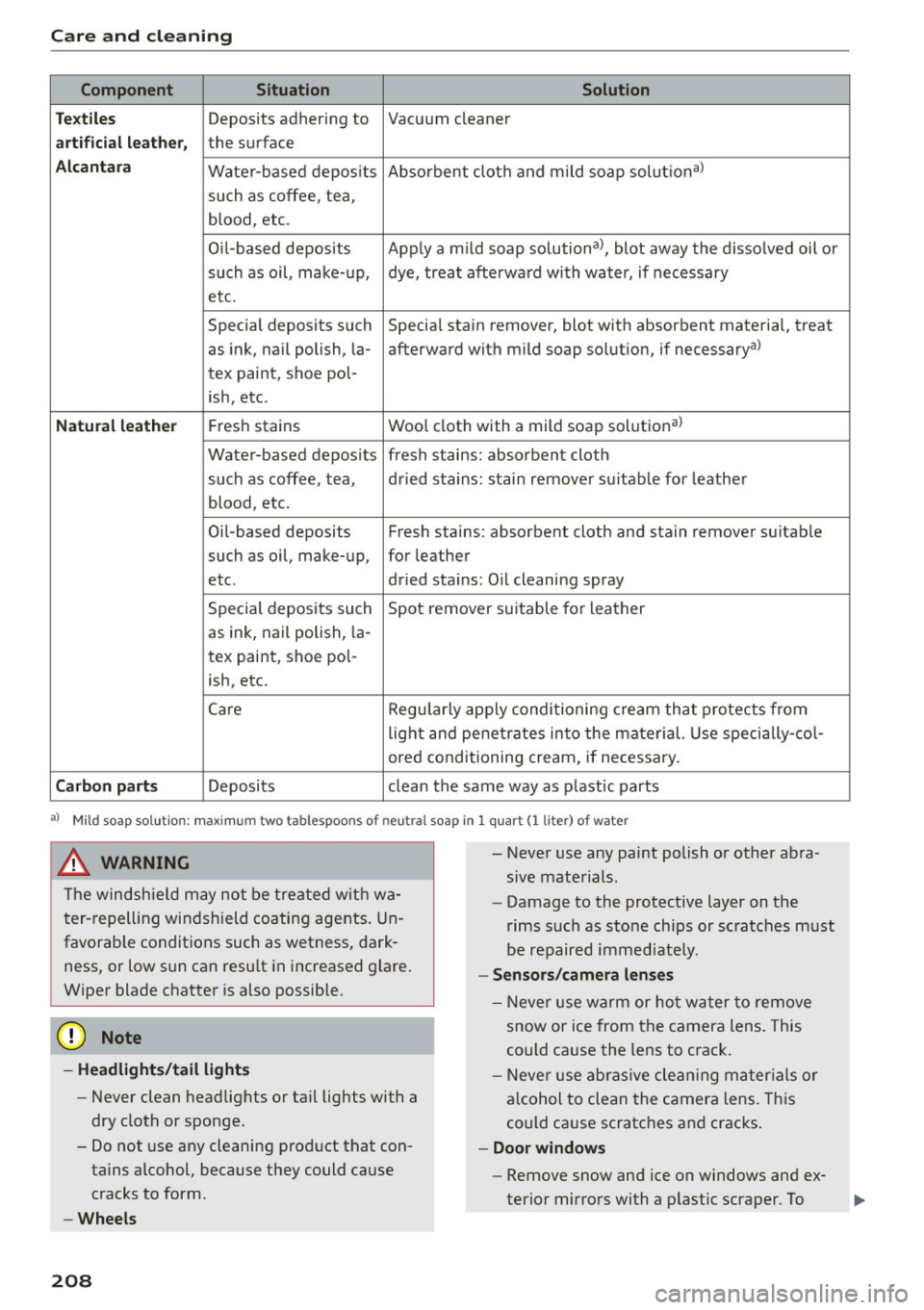
Component S ituation Solution
Te xtiles
Deposits adhering to Vacuum cleaner
arti ficial leath er, the surface
Alca ntara Wate r-based depos its Absorben
t cloth and mild soap solutional
such as coffee, tea,
blood, etc.
Oil-based deposits Apply am ild soap solutional, blot away the disso lved oil or
such as oil, make-up, dye, treat afterwa rd with water, if necessary
etc.
Special deposits such Special stain remover, blot w ith absorbent materia l, treat
as ink, na il polish, la- afterward with mild soap so lution, if necessaryal
tex paint, shoe pol-
ish, etc.
Natural leather Fres h stains Wool cloth with a mild soap solut ional
Wate r-based depos its fresh stains: absorbent clot h
such as coffee, tea, d ried stains: stain remover suitable for leathe r
blood, etc.
Oil-based deposits Fresh stains: absorbent cloth and stain remover suitab le
such as oil, make- up, for leather
etc. dried stains: Oil cleaning spray
Special deposits such Spot remover sui table for leather
as ink, nai l polish, la -
tex paint, shoe pol-
ish, etc.
Care Regularly app ly condi tioning cream that protects from
lig ht and penet rates in to the mate rial. Use specially -col -
ored conditioning cream, if necessary.
Carbon part s Deposits clean the same way as plastic parts
al Mild soap sol ution: maxim um two tablespoons of neutral soap in 1 quar t (1 liter ) of water
_& WARNING
The windshie ld may not be tre ate d wit h wa
t er- repelling win dsh ield co ating agents. Un
favorab le conditions such as wetness, dark
ness, or low s un can resu lt in increased glare.
Wiper blade chatter is also possible.
(D Note
- Headlights/tail light s
-Never clean headlights or ta il lights with a
dry cloth or sponge.
- Do not use any cleaning prod uct that con
tains alcohol, because they could cause cracks to form.
- Wheels
208
-
- Never use any paint polish or other abra
sive mate rials.
- Damage to the protective layer on the
rims such as sto ne chips or sc ratches must
be repaired immediately.
- Sensors /camera lenses
- N eve r use warm or ho t w at er to remove
snow or ice from the camera lens . This
could ca use the lens to crack.
- N eve r use abras ive cle an ing m ateria ls or
a lcohol to clea n the camera lens. This
could ca use scratches and cracks .
-Doo r windows
- Remove snow and ice on windows and ex-
terio r mirro rs with a p lastic scraper. To
Page 228 of 294

Checking and Filling
Do not fill coolant above the "MAX" mark. Excess
coolant will be forced out through the pressure relief valve in the cap when the engine becomes
hot.
A WARNING
- The cooling system is under pressure and
can get very hot. Reduce the risk of scalding
from hot coolant by following these steps .
- Turn off the engine and allow it to cool
down.
- Protect your face, hands and arms from
escaping fluid and steam by covering the
cap with a large, thick rag.
- Turn the cap slowly and very carefully in a
counter-clockwise direction while applying light, downward pressure on the top of
the cap.
- To avoid being burned, do not spill anti
freeze or coolant on the exhaust system or
hot engine parts. Under certain condi
tions, the ethylene glycol in engine cool
ant can catch fire .
-Antifreeze is poisonous. Always store anti
freeze in its original container and well out
of the reach of children .
- If you drain the coolant, it must be caught
and safely stored in a proper container
clearly marked "poison" .
(D Note
- Do not add coolant if the expansion tank is empty. Air could enter the cooling system
and damage the engine. If this is the case,
do not continue driving. Seek professional
assistance .
- Coolant pollutes the environment and could cause an engine fire. Excess coolant will be
forced out through the pressure relief valve
in the cap when the engine becomes hot.
- If, in an emergency, only water can be add
ed, the correct ratio between water and an
tifreeze
¢ page 224 must be restored as
soon as possible.
226
-
® For the sake of the environment
Drained coolant should not be reused. Always
dispose of used coolant while observing all
environmental regulations.
Radiator fan
The radiator fan switches on automatically by it
self
An auxiliary electric radiator fan switches on and
off depending on coolant temperature and other
vehicle operating conditions.
After you switch the engine off, the auxiliary fan
can continue running for up to 10 minutes -even
with the ignition off. It can even switch on again later by itself ¢& . if
- the temperature of the engine coolant rises due
to the heat build-up from the engine in the en
gine compartment, or
- the engine compartment heats up because the
vehicle is parked in intense sunlight.
A WARNING
- To reduce the risk of personal injury never
touch the radiator fan.
- The auxiliary electric fan is temperature con
trolled and can switch on suddenly even
when the engine is not running.
- The auxiliary radiator fan switches on auto
matically when the engine coolant reaches a
certain temperature and will continue to run
until the coolant temperature drops. -
Page 230 of 294
Checking and F ill in g
Battery
General information
Under no rmal operating conditions, the battery
in your Audi does not need any ma intenance.
W ith
high outside temperatu res or long daily
d rives we recommend that you have the electro
lyte level checked by a service facility . The elec
trolyte level should a lso be checked each time
the battery is charged ¢
page 230.
Have the bat tery checked when you take yo ur ve
hicle in for service . You are we ll advised to re
p lace a battery that is o lder than 5 years .
W ith certa in types of airbag deploymen t, the bat
tery is disconnected from the vehicle electrica l
system for safety reasons ¢
.&. in Repair, core
and disposal of the airbags on page 158.
Disconn ecting the battery t erminal s
Some veh icle funct ions (power window regula
tors, for examp le) are lost if the battery termi
na ls are disconnected. These functions have to be
re learned after the battery terminals are con
nected aga in. To prevent this, the battery shou ld
only be disconnected from the vehicle electrical
system when absolutely necessary for repairs.
Vehicl es not driven fo r long period s
If you do not drive your vehicle over a period of
several days or weeks, e lectrica l components are
gradually cut back or switched off. This reduces
energy consumption and maintains starting ca pability over a longer period¢
page 194. Some
of the convenience funct ions may not operate,
such as the inter ior lights or power seat adjust
ment. The convenience functions will be ava ilab le
again whe n you swit ch on the igni tion and sta rt
the engine.
Winte r operation
During the winter months, battery capacity tends
to decrease as temperatures drop . This is because
mo re power is also consumed w hile starting, and
the head lights, rear w indow defogger, etc ., are
used more often.
Avoid unnecessary power consumption, part icu
larly in city traffic or when traveling only short
228
distances. Let your authorized Audi dealer check
the capacity of the vehicle battery before winter
sets in
¢ page 230 . A well charged battery will
not only prevent starting problems when the
weather is cold, but will also last longer.
(D Tips
If your vehicle is left standing for several
weeks at extremely low temperatures, the ve
hicle battery should be removed and stored
where it will not freeze . This will prevent it
from being damaged and having to be re
placed.
Working on the battery
Be especially careful when working on or near
the battery.
The battery is located in the luggage compart
ment under the floor . Before you check anything
i n the luggage compartment,
re ad and he ed all
WARNINGS ¢&, .
Always heed the safety warning s, when working
o n the vehicle battery or the vehicle e lectr ical
system to prevent injury .
The following WARNING S are very important
when working on the battery :
Alw ay s heed the following WARNING SYM ·
BOL S and safety p recaut ions when wo rking on
the batter y.
®
Alw ay s w ear e ye protection .
~
Battery acid contains sulfuric acid . Al -
way s wear gloves and ey e protection .
@
No
· spark s
· flames
· sm oking.
~
When a battery is charged , it p roduce s
h yd rogen gas which is e xplosi ve and
'
could cause per sonal injury .
®
Always keep the battery well out of
r ea ch of ch ild ren.
...
Page 251 of 294

M N <( (.J
'SI: ,...., \!) 1.1'1
N \!) ,....,
~ Check and correct the seating of the snow
chains if necessary after driving a few feet. Fol
low the instructions from the manufacturer.
~ Note the maximum permitted speed when driv
ing with snow chains. Do not exceed 30 mph
(SO km/h) .
Snow chains not only improve the driving in win
ter road conditions, but also the braking.
Use of snow chains is only permitted with certain
rim/tire combinations due to technical reasons.
Check with an authorized Audi dealer or author
i z ed repair facility to see if you may use snow
chains .
You must remove the chains when driving on roads that are free of snow. When roads are free
of snow, snow chains can impair handling and
damage the tires, and the chains will quickly be
destroyed.
A WARNING
Using incorrect snow chains or installing snow
chains incorrectly can result in loss of vehicle
control, which increases the risk of an acci
dent.
- Snow chains can damage the rims/wheel
covers* if the chains come into direct con
tact with them. Remove the wheel covers*
first. Use coated snow chains.
- Using snow chains that add more than 0 .4
inch (10.5 mm) of height can severely dam
age the wheel housings and other vehicle
components.
- Do not install and use snow chains if there is
a malfunction in the adaptive air suspen
sion*, because the vehicle height will be
very low. If you drive with snow chains any
way, the wheel housings and other vehicle
components can be severely damaged.
Low aspect ratio tires
Your Audi is factory-equipped with low aspect ra
tio tires . These tires have been thoroughly tested
and been selected specifically for your model for
Wheels
their superb performance, road feel and handling
under a variety of driving conditions. Ask your au
thorized Audi dealer for more details.
The low aspect ratio of these tires is indicated by
a numeral of
55 or less in the tire's size designa
tion. The numeral represents the ratio of the
tire's sidewall height in relation to its tread width
expressed in percentage. Conventional tires have
a heigh t/width ratio of 60 or more.
The performance of low-aspect-ratio tires is par
ticularly sensitive to improper inflation pres
sure. It is therefore important that low aspect
ratio tires are inflated to the specified pressure
and that the inflation pressure is regularly
checked and maintained. Tire pressures should be checked at least once a month and always
before a long trip
~ page 2 43.
What you can do to avoid tire and rim
damage
Low aspect ratio tires can be damaged more easi
ly by impact with potholes, curbs , gullies or
ridges on the road, particularly if the tire is un
deri nflated.
In order to minimize the occurrence of impact
damage to the tires of your vehicle, we recom
mend that you observe the following precau
tions:
- Always maintain recommended inflation pres
sures. Check your tire pressure every 2,000
miles (3 ,000 km) and add air if necessary.
- Drive carefully on roads with potholes , deep
gullies or ridges. The impact from driving
through or over such obstacles can damage
your tires. Impact with a curb may also cause
damage to your tires.
- After any impact, immediately inspect your
tires or have them inspected by the nearest au
thorized Audi dealer. Replace a damaged tire as
soon as possible.
- Inspect your tires every 2,000 miles (3,000 km)
for damage and wear. Damage is not always
easy to see . Damage can lead to loss of air and
underinflation, which could eventu ally cause
tire failure . If you believe that a tire may have
been damaged, replace the tire as soon as pos -
sible . .,.
249
Page 254 of 294
Wheels
the recommended tire pressure for your vehicle
¢ page 243, fig. 198.
Tire tread ci rcumfe rence and v ibration character
istics can change and cause a tire pressure warn
ing if:
- the tire pressure in one or more t ires is too low .
- the tire has structural damage .
- the tire was replaced or the tire pressure was
changed and it was not stored
¢ page 252.
-the spare tire* is installed .
Indicator lights
IE Loss of pressure in at least one tire¢.&. .
Check the tires and replace or repair if necessary.
Check/correct the pressures of all four tires and
store the pressure again in the Infotainment sys
tem
¢page 252 .
mm (Tire Pressure Monitoring System) Tire pres
sure: System malfunction!. Ifffim
appears after
switching the ignition on or while driving and the
IE indicator light in the instrument cluster
blinks for approximately one minute and then
stays on, there is system malfunction . Try to
store the correct tire pressures¢ page 252. If
the indicator light does turn off or turns on again
after a short period of time, drive to your author
ized Audi dealer or authorized Audi Service Facili
ty immediately to have the malfunction correct
ed .
A WARNING
- If the tire pressure indicator appears in the
display, reduce your speed immediately and
avoid any hard steering or braking maneu
vers . Stop as soon as possible and check the
t ir es and their pressure .
- The driver is responsible for maintaining the correct tire pressure. You must check the
tire pressure regularly.
- Under certain conditions (such as a sporty
dr iving style, winter cond itions or unpaved
roads), the tire pressure monitoring system
indicator may be delayed.
- Do not use run-flat tires on your veh icle. Us
ing them when not permitted can lead to
vehicle damage or accidents.
252
(D Tips
-The tire pressure monitoring system can al
so stop working when there is an ESC mal
function.
- Using snow chains may result in a system
malfunction.
- The tires with the identification "AO" or
"RO" ¢
page 240 have been matched with
your Audi tire pressure monitoring system.
We recommend that you use these tires.
Storing tire pressures
If the tire pressure changes or a tire is replaced,
it must be confirmed in the Infotainment sys tem.
... Make sure before storing that the tire pressures
of all four tires meet the specified values and
are adapted to the load¢
page 243 .
... Switch the ignition on .
... Select: the
I CARI function button > (Car)* Sys
tems
control button > Servicing & checks > Tire
pressure monitoring
> Store tire pressures >
Yes, store now.
(D Tips
Do not store the tire pressures if snow chains
are instal led.
Page 276 of 294
Consumer information
Consumer information
Warranty coverages
Your Audi is covered by the following warran
ties:
- New Vehicle Limited Warranty
- Limited Warranty Against Corrosion Perfora-
tion
- Emissions Control System Warranty
- Emissions Performance Warranty
- California Emissions Control Warranty (USA
vehicles only)
- California Emissions Performance Warranty
(USA vehicles only)
Detailed information regarding your warranties
can be found in your
Warranty & Maintenance
booklet .
Operating your vehicle
outside the U.S.A. or
Canada
Government regulations in the United States and
Canada require that automobiles meet specific
emission regulations and safety standards.
Therefore, vehicles built for the U.S.A. and Cana
da differ from vehicles sold in other countr ies.
If you plan to take your veh icle outside the conti
nenta l limits of the United States or Canada,
there is the possibility that:
- unleaded fuels for vehicles with catalytic con
verter may not be available;
- fuel may have a considerably lower octane rat
ing . Improper fuel may cause engine damage;
- serv ice may be inadequate due to lack of proper
serv ice facilities , tools or testing equipment;
- r eplacement parts may not be readily available .
- Nav igat ion systems for vehicles built for the
U.S.A. and Canada will not necessar ily work in
Europe, and may not work in othe r countries
outside North America .
274
(D Note
Aud i cannot be responsib le for mechanical
damage that could result from inadequate
fuel, service or parts availability.
Audi Service Repair
Manuals and Literature
Audi Offic ial Factory Service Manuals and Litera
ture are published as soon as possible after mod
el introduction. Service manuals and literature
are available to order from the Audi Technical Lit
erature Ordering Center at:
www.audi.techliterature .com
Maintenance
General '
Your vehicle has been designed to help keep
maintenance requirements to a minimum. How
ever, a certain amount of regular maintenance is
still necessary to assure your veh icle's safety,
economy and reliability. For deta iled vehicle
maintenance consult your Warranty & Mainte
nance booklet .
Under difficult operating conditions, for exam
ple at extremely low outs ide temperatures, in
very dusty regions, when towing a trailer very fre
quently , etc., some service work should be per
formed between the intervals specified. This ap
plies particularly to:
- oil changes, and
- cleaning or replacing the air filter .
'
@) For the sake of the environment
By regularly maintaining your vehicle, you
help make sure that emission standards are
maintained, thus minimizing adverse effects
on the environment.
Important considerations for you and your
vehicle
The increasing use of electronics, sophisticated
fuel injection and emission control systems , and
the generally increasing technical comp lexity of
llJJ,
Page 279 of 294
M N <( (.J
'SI: ,...., \!) 1.1'1
N \!) ,....,
means that you risk both a substantia l reduction
in the operational safety of your vehicle and an
increased wear of vehicle parts~.& .
Author ized Audi dealers w ill perform this work in
a professiona l and competent manner or , in spe
cial cases, refer you to a professional company
that spec ializes in such modifications.
A WARNING
Improper repairs and modifications can
change the way vehicle systems work and
cause damage to the veh icle and ser ious per
sonal injury .
If emergency repairs must be performed e lse
where, have the veh icle examined by an au
thorized Audi dealer as soon as possib le .
Declaration of
Compliance, Telecommu nication and Electronic
Systems
Radio Frequency Devices and Radiocommunica
tion Equipment User Manual Notice.
T he manufacturer is not responsible for any radio
or TV interference caused by unauthorized modi
fications to this equipment.
De vices
The fo llow ing devices each comply w ith FCC Part
15.19, FCC 15.21 and RSS-Gen Issue
1:
- Adaptive cruise control*
- Audi side assist*
- Cell phone package*
- Convenience key*
- Electronic immob ilizer
- Garage door opener (Home link)*
- Remote contro l key
FCC Part 15.19
This device complies with part 15 of the FCC
Rules . Operation is subject to the following two
conditions :
Co nsum er information
(1) This device may not cause harm ful interfe r
ence , and
(2) this device must ac cept any inte rfe rence re
ce ived, in clu ding in terference that may cause un
desired operation.
FCC Part 15.21
CAUT ION:
Changes or mod ificat ions not expressly approved
by the party responsible for compliance could
vo id the user's authori ty to ope rate the equ ip
me nt.
RSS-Gen Is sue 1
Operation is subject to the follow ing two condi
tions:
(1) this device may not ca use interference, and
(2) this devi ce must ac cep t any inte rference , in
clud ing interference that may cause undesired
operation of the device .
277