air condition AUDI A7 2016 User Guide
[x] Cancel search | Manufacturer: AUDI, Model Year: 2016, Model line: A7, Model: AUDI A7 2016Pages: 294, PDF Size: 73.82 MB
Page 129 of 294
M N
.. Make sure to use the right child restraint cor
rect ly to protect children ¢
page 167, Child
safety .
.. Sit properly in your seat and make sure that
your passengers do the same ¢
page 52, Gen
eral information.
.. Fasten your safety belt and wear it properly . Al
so instruct your passengers to fasten their safe
ty belts properly ¢
page 135.
What impairs driving safety?
Safe driving is directly related to the condition of
the vehicle, the driver as well as the driver's abili
ty to concentrate on the road without being dis
tracted.
The driver is respons ible for the safety of the ve
hicle and all of its occ upan ts. If your ability to
drive is impaired , safety r isks for everybody in the
vehicle increase a nd you also become a hazard to
everyone else on the road ¢,A .Therefore:
.. Do not let yourself be distracted by passengers
or by using a cellular telephone .
.. NEVER drive when your driv ing ability is im
paired (by medications, alcohol, drugs, etc.).
.. Observe all traffic laws, rules of the road and
speed limits and plain common sense.
.,. ALWAYS adjust your speed to road, traffic and
weather cond itions.
.. Take frequent breaks on long trips. Do not dr ive
for more than two hours at a stretch .
.. Do NOT drive when you are t ired, under pres
sure or when you a re stressed.
_& WARNING
Impaired driving safety increases the risk of
serious personal injury and death whenever a
vehicle is being used.
.
Driving safety
Correct passenger
seating positions
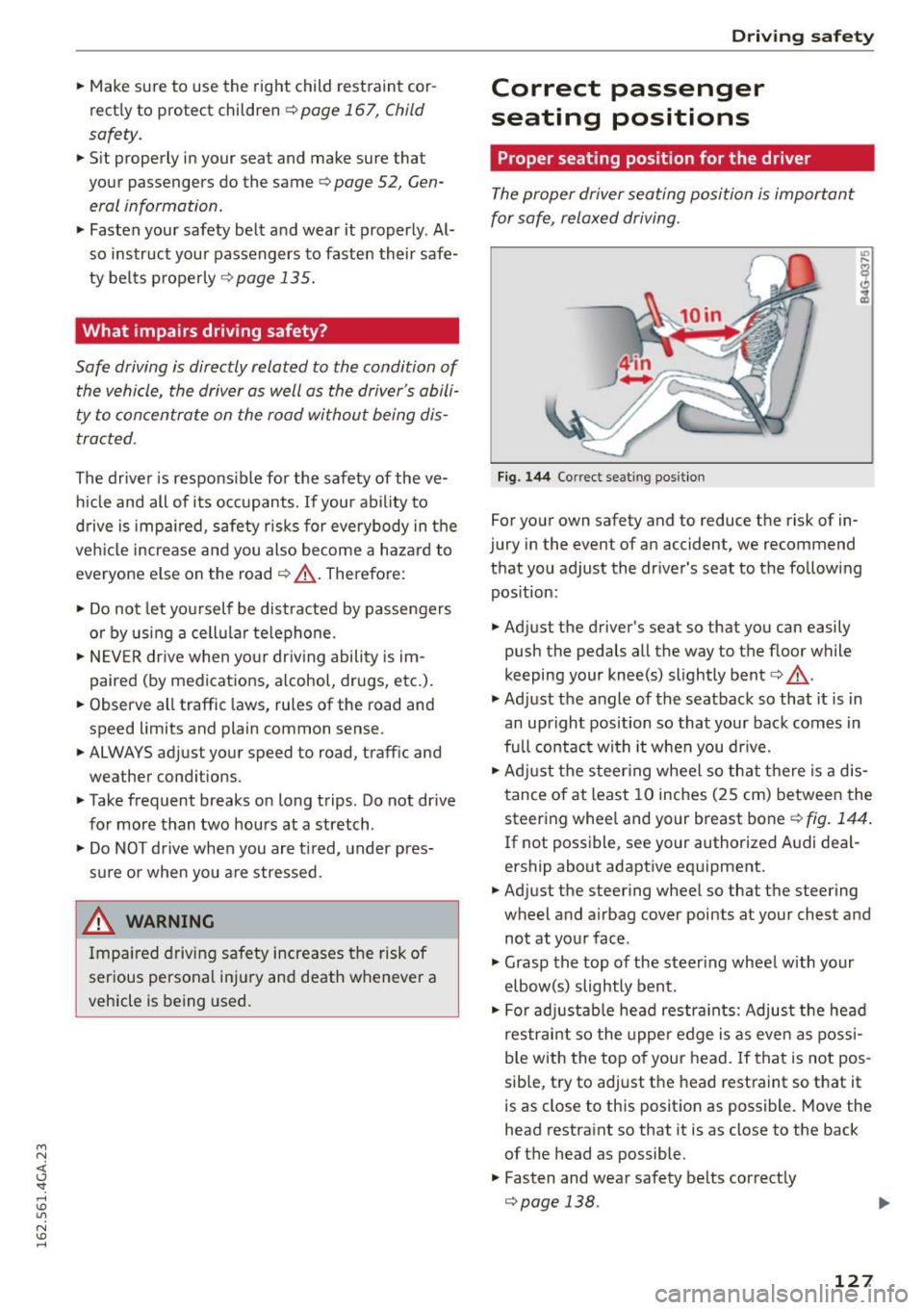
Proper seating position for the driver
The proper driver seating position is important
for safe, relaxed driving .
Fig. 144 Correct se ating position
For your own safety and to reduce the risk of in
jury in the event of an accident, we recommend
that you adjust the driver's seat to the following pos ition:
.. Adjust the driver's seat so that you can easily
push the pedals all the way to the floor while
keeping your knee(s) slightly bent¢,&. .
.,. Adjust the angle of the seatback so that it is in
an upright position so that your back comes in
fu ll contact wi th it when you dr ive .
.. Adjust the steer ing wheel so that there is a dis
tance of at least 10 inches (25 cm) between the
steering whee l and your breast bone¢
fig. 144.
If not possible, see your authorized A udi deal
ership about adaptive equipment.
.. Adjust the steering wheel so that the steering
wheel and airbag cover points at your chest and
not at your face .
.,. Grasp the top of the steer ing wheel with your
elbow(s) slightly bent .
.. For adjustable head restra ints: Adjust the head
restraint so the upper edge is as even as possi
b le with the top of your head. If that is not pos
sible, try to adjust the head restraint so that it
is as close to this position as possible. Move the
head restraint so that it is as close to the back
of the head as possible.
.. Fasten and wear safety belts correctly
¢page 138. IJJ,-
127
Page 145 of 294
M N <( (.J
'SI: ,...., \!) 1.1'1
N \!) ,....,
Airbag system Important information
Importance of wearing safety belts and
sitting properly
Airbags are only supplemental restraints. For
airbags to do their job, occupants must always
properly wear their safety belts and be in a prop er seating position.
For your safety and the safety of your passen
gers, before driving off, always:
.,. Adjust the driver's seat and steering wheel
properly
r:> page 12 7,
.,. Adjust the front passenger's seat properly
9 page 53,
.,. Wear safety belts properly r::> page 137 ,
.. Always properly use the proper child restraint
to protect children
r:> page 167.
In a collision, airbags must inflate within the
blink of an eye and with considerable force. The
supplemental airbags can cause injuries if the
driver or the front seat passeng er is not seated
properly . Therefo re in order to help the ai rbag to
do its job, it is important, both as a driver and as
a passenger to si t properly at all times.
By keeping room between your body and the
steering wheel and the front of the passenger
compartment, the airbag can inflate fully and
completely and provide supplemental protection in certain frontal collisions
r:> page 12 7, Correct
passenger seating positions .
For details on the
operation of the seat adjustment controls
r::> page 53.
It's especially important that children are proper
ly restrained
r:> page 167.
There is a lot that the driver and the passengers
can and must do to help the individual safety fea
tures installed in your Audi work together as a
system.
Proper seating position is important so that the
front airbag on the driver side can do its job . If
you have a physical impairment or condition that
prevents you from sitting properly on the driver
seat with the safety belt properly fastened and
Airbag system
reaching the pedals, or if you have concerns with
regard to the function or operation of the Ad
vanced Airbag System, please contact your au
thori zed Audi dealer or qualified workshop, or
call Audi Customer Relations at 1-800-822-2834
for possible modifications to your vehicle.
When the airbag system deploys, a gas generator
will fill the airbags, break open the padded cov ers, and inflate between the steering wheel and
the driver and between the instrument panel and
the front passenger . The airbags will deflate im
mediately after deployment so that the front oc
cupants can see through the windshield again
without interruption.
All of this takes place in the blink of an eye , so
fast that many people don't even realize that the airbags have deployed. The airbags also inflate
with a great deal of force and nothing should be
in their way when they deploy. Front airbags in
combination with properly worn safety belts slow
down and limit the occupant's forward move
ment . Together they help to prevent the driver
and front seat passenger from hitting parts of
the inside of the vehicle while reducing the forces
acting on the occupant during the crash . In this
way they help to reduce the risk of injury to the
head and upper body in the crash . Airbags do not
protect the arms or the lower parts of the body.
Both front airbags will not inflate in all frontal
collisions. The triggering of the airbag system de
pends on the vehicle deceleration rate caused by
the collision and registered by the electronic con
trol unit. If this rate is below the reference value
programmed into the control unit, the airbags
will not be triggered , even though the car may be
badly damaged as a result of the collision. Vehi
cle damage, repair costs or even the lack of vehi
cle damage is not necessarily an indication of
whe ther an airbag should infla te or not.
Since the circumstances will vary considerably between one collision and another, it is not possi
ble to define a range of vehicle speeds that will
cover every possible kind and angle of impact
that will always trigger the airbags . Important
factors include, for example, the nature (hard or
soft) of the object which the car hits, the angle of
impact, vehicle speed , etc. The front airbags will ..,.
143
Page 147 of 294
M N <( (.J
'SI: ,...., \!) 1.1'1
N \!) ,....,
about children and Advanced Airbags
¢page 167.
Even though yo ur vehicle is equ ipped with an Ad
vanced Airbag System, make certain that all ch il
dren, especially those 12 years and yo unger, al
ways ride in the back seat properly restrained for
their age and s ize. The airbag on the passenger
side makes the front seat a potentially dangerous
p lace for a child to ride. The front seat is not the
safest place for a chi ld in a fo rward -facing chi ld
seat .
It can be a very dangerous place fo r an in
fant or a ch ild in a rea rward-facing seat.
T he Advanced Airbag System i n your veh icle has
been certified to comp ly w ith the requi rements
of Uni ted States Federal Moto r Veh icle Safety
Standa rd 208 as applicab le at the t ime your vehi
cle was man ufactu red.
The Standard requires the front a irbag on the
passenger side to be turned off ("supp ressed ") if
a child up to abo ut one year of age restrained in
one o f th e rear-fa cing or forward -facing infant re
s traints listed in Fede ral Motor Vehicle Safety
S tanda rd 20 8 wit h which the Advanced Airbag
System in yo ur vehicle was certifie d has been in
stalled on the front passenger seat. For a listing
of the ch ild restra ints that were used to ce rtify
compliance with the US Safety Standard
¢ page 169.
The PASSENGER AIR BAG OFF light in the instru
ment panel tells you when the front Advanced
Airbag on t he passenger side has been turned off
by the electro nic contro l unit .
Each t ime yo u sw itch on the ig nit ion, the
PAS
SENGER AIR BAG OFF
light w ill come on for a
few seconds and:
- will stay on if the front passenger seat is not
occupied,
- will stay on if the elect rical capacitance meas
u red by t he capacitive passenger detection sys
tem for the front passenger seat eq uals the
combined capacitance of an infant up to abo ut
one yea r of age and one of the rearward- fac ing
o r forward-faci ng chi ld restraints listed in Fed
eral Motor Vehicle Safety Standard 208 w it h
wh ich the Advanced Airbag System in your veh i
cl e was cert ified. Fo r a listing of t he ch ild re -
Airbag syste m
st raints that we re used to cert ify yo ur vehicle's
compliance with the U.S. Safety Standard
¢ page 169.
-wi ll stay on if there is a small c hild or child re
st raint on the front passenger seat,
- w ill go off i f th e front passenger sea t is occu
pie d by an adu lt as registere d by the capacitive
passe nger detect ion system
c> page 154, Mon
itoring the Advanced Airbag System.
T he PASSENGER AIR BAG OFF light comes on
whe n electrica l capacitance registered on the
front passenger seat is eq ua l to or less than the
combined capacitance of a typical 1 year-o ld in
fan t and one of the rearward-facing or forward
facing child restraints listed in Federa l Moto r Ve
hicle Safety Standard 208 with w hich the Ad
vanced Airbag System in your vehicl e was certi
fied.
If the total e lectr ica l capacitance registered on
the front passenge r seat is more than that of a
typ ica l 1 year-old ch ild b ut less than the we ight
of a sma ll adult, the fron t air bag on the passen
ger side can deploy ( the
PASSENGER AIR BAG
OFF
light does not come on).
If th e PASSENGER AIR BAG OFF light does not
come on, the front a irbag on the passenger side
h as not been turned off by the elec tronic con trol
u ni t and can dep loy if the con trol un it senses an
impact that meets the conditions stored i n its
memo ry .
For example , the airbag may deploy if :
-a small ch ild that is heav ie r than a typical 1
yea r-old ch ild is on the front passenge r seat (re
ga rdless of whethe r th e chi ld is in one of the
child sea ts listed
¢ page 169), or
- a child who has outgrown ch ild restraints is on
t he fron t passenger seat .
If the front passenger airbag is turned off, the
PASSENGER AIR BAG OFF light comes on in the
inst rument cluste r and stays on.
If the front passenger airbag dep loys, the Fede ral
Standard requires the airbag to meet t he ''low
r isk" deployment criteria to red uce the risk of i n
j u ry through interaction with the a irbag. "Low
risk" de ploymen t occurs in t hose cra shes tha t ..,.
145
Page 150 of 294

Airbag syste m
A WARNING
Objects between you and the a irbag w ill in
crease the risk of injury in a crash by interfer
ing with the way the airba g unfo lds and/or by
being pus hed into you as the airbag inflates.
- Always make sure nothing is in the front air-
bag depl oyment zone that could be struck
by the airbag when it inflates.
- Objects in the zone of a deploying a irbag
can become project iles when the airbag de
ploys and cause serious personal injury.
- Never hold things in your hands or on your
lap when the vehicle is in use .
- Never place accessor ies or other objects
(such as cup holders, telephone brackets,
note pads, navigation systems, or things
that are large, heavy, or bulky) on the doors; never attach then to the doors or the wind
shield; never place them over or near or at
tach them to the area marked ,.AIRBAG" on
the steering wheel, instrument pane l or the
seat backrests; never place them between
these a reas and you or any other person in
the vehicle .
- Never attach objects to the windshield
above the passenger front airbag, such as
accessory GPS navigation units or music players. Such objects co uld cause serious in
jury in a collision, especially when the a ir
bags inflate.
- Never recline the front passenger seat to transport objects. Items can also move into
the deployment area of the side airbags or
the front airbag dur ing breaking or in a sud
den maneuver . Objects near the a irbags can
fly dangerously th rough the passenger com
partment and ca use i njur y, partic ularly
when the seat is reclined and the airbags in
flate .
A WARNING
A person on the front passenge r seat, espe
cially infants and small children, wi ll receive
serious injuries and can even be killed by be
ing too close to the airbag when it inflates.
- Although the Advanced Airbag System in
your vehicle is designed to turn off the front
148
-
passenger airbag if an infant or a small child
is on the front passenger seat, nobody can
absolutely guarantee that dep loyment un
de r these specia l condit ions is impossible in
all conceivable situations that may happen
during the useful life of yo ur vehicle.
- The Advanced Airbag System can dep loy in
accordance with the ,,low risk" option for 3-
and 6-year-o ld children under the U.S. Fed
era l Standard if a c hild with e lectr ica l capac
itance greater than the combined capaci
tance of a typical one -yea r old infant re
strained in one of the forward facing or rear
ward-facing child seats with which your ve
hicle was certif ied is on the front passenger
seat and the other conditions for airbag de
ployment are met.
- Accident statistics have shown that children
are generally safer in the rear seat area than
in the front seating position .
- For their own safety, all ch ildren, especially
12 yea rs and younger, should a lways ride in
the back properly restrained for their age
and size .
Advanced front airbag system
Your veh icle is equipped with a front Advanced
A irbag System in compliance w ith United States
Federa l Mo tor Ve hicl e Safety Standa rd 208 asap
plicable at the time your vehicle was manufac
tured.
The front Advanced Airbag System supp lements
the safety be lts to p rov ide additional protec tion
f or the driver 's and front passenger 's heads and
u pper bodies in frontal crashes . The airbags in
flate only in fronta l impacts when the ve hicle de
ce lerat ion is high enough.
The front Advanced Airbag System for the front seat occ upants is not a s ubstitute for yo ur safety
belts. Rather , it is part of the overall occupant re
stra int system in your vehicle. A lways remember
that the airbag system can only he lp to protect
you, if you are sitting upr ight, wear ing your safe-
ty belt and wear ing it properly . Th is is why you
ll>
Page 151 of 294
M N <( (.J
'SI: ,...., \!) 1.1'1
N \!) ,....,
and your passengers must always be properly re
strained, not just because the law requires you to
be.
The Advanced Airbag System in your vehicle has been certified to meet the "low risk" require
ments for 3 and 6 year-old children on the pas
senger side and very small adults on the driver
side. The low risk deployment criteria are intend
ed to help reduce the risk of injury through inter
action with the front airbag that can occur, for
example, by being too close to the steering wheel
and instrument panel when the airbag inflates.
In addition, the system has been certified to
comply with the "suppression" requirements of
the Safety Standard, to turn off the front airbag
for infants 12 months old and younger who are
restrained on the front passenger seat in child re
straints that are listed in the Standard
q page 169, Child restraints and Advanced front
airbag system.
"S uppression " requires the front airbag on the
passenger side to be turned off if:
- a child up to about one year of age is restrained
on the front passenger seat in one of the rear
facing or forward-facing infant restraints listed
in Federal Motor Vehicle Safety Standard 208
with which the Advanced Airbag System in your
vehicle was certified. For a listing of the child
restraints that were used to certify your vehi
cle's comp liance with the US Safety Standard
qpage 169,
- When a person is detected on the front passen
ger seat that has an electrical capacitance that
is more than the total electrical capacitance of
a child that is about 1 year old restrained in one
of the rear-facing or forward-facing infant re
stra ints (listed in Federal Motor Vehicle Safety
Standard 208 with which the Advanced Airbag
System in your vehicle was certified), the front
airbag on the passenger side may or may not
deploy.
The
PASSENGER AIR BAG OFF light comes on
when the electronic control unit detects a total
e lectr ical capacitance on the front passenger seat
that requires the front airbag to be turned off. If
the
PASSENGER AIR BAG OFF light does not
Airbag system
come on, the front airbag on the passenger side
has not been turned off by the control unit and
can deploy if the control unit senses an impact
that meets the conditions stored in its memory.
If the total electrical capacitance registered on
the front passenger seat is more than that of a
typical 1 year-old, but less than the weight of a
small adult, the front airbag on the passenger
side may deploy (the
PASSENGER AIR BAG OFF
light does not come on).
For example, the airbag may deploy if:
-a small child that is heavier than a typical 1
year-old child is on the front passenger seat (re
gardless of whether the child is in one of the
child seats listed
q page 169),
- a child who has outgrown child restraints is on
the front passenger seat.
If the front passenger airbag is turned off, the
PASSENGER AIR BAG OFF light in the center of
the instrument panel will come on and stay on.
If the front passenger airbag deploys, the Federal
Standard requires the airbag to meet the "low
risk" deployment criteria to help reduce the risk
of injury through interaction with the airbag.
"Low risk" deployment occurs in those crashes
that take place at lower decelerations as defined
in the electronic control unit
q page 154.
Always remember: Even though your vehicle is
equipped with Advanced Airbags, the safest place
for children is properly restrained on the back
seat. Please be sure to read the impor tant infor
mation in the sections that follow and be sure to
heed all of the WARNINGS .
_& WARNING
To reduce the risk of injury when an airbag in
flates, always wear safety belts properly.
- If you are unrestrained, leaning forward, sit
ting sideways or out of position in any way,
your risk of injury is much higher.
- You will also receive serious injuries and
could even be killed if you are up against the
airbag or too close to it when it inflates -
even with an Advanced Airbag
9page 143.
149
Page 158 of 294
Airbag system
compliance with the U.S. Safety Standard
¢page 169 .
-will go out if the front passenger seat is occu
pied by an adult as registered by the capacitive
passenger detection system.
- The
PASSENGER AIR BAG OFF light must come
on and stay on if the ignition is on and .. .
- a car bed has been installed on the front pas
senger seat, or
- a rearward-facing child restraint has been in
stalled on the front passenger seat, or
- a fo rward -facing child restraint has been instal
led on the front passenger seat,
- and if the e lectrica l capacitance registered on
the front passenger seat is equal to or less than
the combined capacitance of a typical 1 year
o ld infant and one of the rearward-facing or
forward-facing chi ld restraints listed in Federal
Motor Vehicle Safety Standard 208 with which
the Advanced Airbag System in your vehicle was certified.
If the front passenger seat is not occupied, the
front airbag will not deploy, and the
PASSENGER
AIR BAG OFF light will stay on. Never install a
rearward-facing child restraint on the front pas
senger seat, the safest place for a child in any
kind of child restraint is at one of the seating po
sitions on the rear seat ¢
page 144, Child re
straints on the front seat -some important
things to know
and ¢ page 167, Child safety.
If the PASSENGER AIR BAG light comes
on ...
If the PASSENGER AIR BAG OFF light comes on
when one of the conditions listed above is met,
be sure to check the light regularly to make cer
tain that the
PASSENGER AIR BAG OFF light
stays on contin uously whenever the ignition is
on. If the
PASSENGER AIR BAG OFF light does
not appear on and does not stay on all the t ime,
stop as soon as it is safe to do so and
- reactivate the system by turning the ignition
off
for more than 4 seconds and then turning it on
again;
- remove and reinstall the child restraint . Make
sure that the chi ld restraint is properly installed
and that the safety belt for the front passenger
156
seat has been correctly routed through the
child restraint as described in the chi ld restraint
manufacture r's instruct ions;
- make sure that the convertib le locking retractor
on the safety be lt for the front passenger seat
has been activated and that the safety belt has
been pulled tight .
- make sure that no electrical device (such as a
laptop,
CD player, electron ic games dev ice,
power inverter or seat heater for ch ild seats) is
placed or used on the front passenger seat if
the device is connected to the 12-volt socket or
the cigarette lighter socket;
- make sure that no seat heater has been retrofit
ted or otherwise added to the front passenger
seat;
- make sure that nothing can interfere with the
safety belt buckles and that they are not ob
structed;
- make sure that there are no wet objects (such
as a wet towe l) and no water or other liquids on
the fron t passenger seat cushion.
If the PASSENGER AIR BAG light still does
not come on ...
If the PASSENGER AIR BAG OFF light still does
not come on and does not stay on continuously
(when the ignition is switched on),
- take the child restraint
off the front passenger
seat and insta ll it p roperly at one of the rear
seat positions. Have the airbag system inspect
ed by your Audi dealer immed iately.
- move the child to a rear seat position and make
sure that the child is pro pe rly restrained in a
child restraint that is appropriate for its siz e
and age .
The PASSENGER AIR BAG light should NOT
come on ...
The PASSENGER AIR BAG OFF light should NOT
come on when the ignit ion is on and an adult is
sitting in a proper seating position on the front
passenger seat. If the
PASSENGER AIR BAG OFF
light comes on and stays on or flashes for about
S seconds while dr iv ing, under these c ircumstan
ces, make sure that:
- the adult on the front passenger seat is proper-
ly seated on the center of the seat cushion with ..,.
Page 169 of 294

M N <( (.J
'SI: ,...., \!) 1.1'1
N \!) ,....,
Child safety
Important information
Introduction
The rear seat is generally the safest place in a
collision .
The physical principles of what happens when
your veh icle is in a crash apply also to children
c:> page 136, What happens to occupants not
wearing safety belts? .
But unlike adults and
teenagers, the ir muscles and bones are not fu lly
developed. In many respe cts c hildren are at
g reater risk of serio us i njur y in crashes than
a d ul ts.
Because ch ildren's bod ies are not fully deve loped,
they requ ire rest ra int systems especially de
signed fo r their size, weight, and body st ru ct ure.
M any countr ies and a ll states of the Uni ted
States and p rovinces of Canada have laws requi r
ing the use of approved c hil d restraint systems
for infants and small chi ldren.
I n a front al crash at a speed o f 20 -35 mph
(30 -56 km/h) the forces acting on a 13 -po und
(6 kg) infa nt wi ll be more than 20 t imes t he
weight of the child . Th is means the weight of the
chi ld would sudden ly be more than 260 pounds
(120 kg). Under these conditions, only an appro
p riate ch ild restra int properly used can reduce
the r isk of se rious i nju ry. Ch ild restra ints, like
ad ult safety belts, must be used prop erly to be
effective . U sed improperly, they can increa se the
ris k of serious injury in an accident.
Consult the child safety seat manufacturer's in
structions in orde r to be s ure the seat is right fo r
your chi ld's si ze
c:> page 170, Important safety
instructions for using child safety seats .
Please
be sure to read an d heed a ll of th e importa nt in
formation and WAR NINGS about c hild safety, Ad
vanced Ai rbags, and the installation of child re
straints in th is chapter.
There is a lot you need to know abou t the Ad
vanced Airbags in yo ur vehicle and how they work
when infa nts and children in child rest raints a re
on the front passenger seat. Because of the large
amo unt of important informat ion, we cannot re-
Child sa fety
pea t it all he re . We urge you to read the detailed
information in this owner's ma nual about airbags
and the Advanced Airbag System in yo ur veh icle
and the very important information about trans
porting children on the front passenger seat.
Please be sure to heed the WARNINGS -they are
extremely importa nt for your safety and t he safe
ty of you r passengers, especially infants and
small ch ild ren .
& WARNING
-Accident st atistics have shown th at children
a re generally safer in the rear sea t area than
in the front seatin g position. Always restra in
any child age 12 and under in the rea r.
- All vehicle occupants and es pecially children
m ust be restrained properly whenever ri ding
in a vehicle. An un rest rained or improperly
restrained ch ild could be injured by striking
the inter ior or by be ing ejected from the ve
h icle dur ing a sudden maneuve r or impact .
An unrestra ined o r improperly restrained
child is a lso at greate r risk of in ju ry or death
through conta ct with an inflating airbag .
- A suitable ch ild restraint properly installed
an d used at one of the rear seating posit ions
p rovi des the highest deg ree of prote ction
for infan ts and small children in most a cci
dent situat ions.
& WARNING f"-"----
Children on the front sea t of any car even with
Advanced Air bags can be ser iously injured or
even kil led when an a irbag inflates. A chi ld in
a rearward-facing child safety seat installed
on the front passenger seat will be serious ly
i njured and can be k illed if the front a irbag in
flates .
- The inflating airbag will h it the ch ild safety
seat or infant carr ier with great force and
will smash the child safety seat and child aga inst the backrest, cent er armrest, o r
door.
- Always install rear-fac ing ch ild safety seats
on the rear sea t.
- If you must ins tall a rearwa rd fac ing child
safety seat on th e front passenger s eat in
167
Page 189 of 294

M N <( (.J
'SI: ,...., \!) 1.1'1
N \!) ,....,
Intelligent Technology Notice about data
recorded by the Event
Data Recorder and
vehicle control modules
Event Data Recorder
This vehicle is equipped with an Event Data Re
corder (EDR). The main purpose of an EDR is to
record, in certain crash or near crash-like situa
tions, such as an a irbag deployment or hitting a
road obstacle, data that will assist in understand
ing how a vehicle's systems performed. The EDR
is designed to record data related to vehicle dy
namics and safety systems for a short period of
time, typically 30 seconds or less. The EDR in this
vehicle is designed to record such data as:
- How various systems in your vehicle were oper
ating;
- Whether or not the driver and passenger safety
belts were buckled/fastened;
- How far (if at all) the driver was depressing the
accelerator and/or brake pedal; and,
- How fast the vehicle was traveling.
These data can he lp provide a better understand
ing of the circumstances in which crashes and in
juries occur. NOTE: EDR data are recorded by your
vehicle only if a non-trivial crash situation occurs;
no data are recorded by the EDR under normal
driving conditions and no personal data (e .g.,
name, gender, age, and crash location) are re
corded. However, other parties, such as law en
forcement, could combine the EDR data with the
type of personally identifying data routinely ac
quired during a crash investigation.
To read data recorded by an EDR, special equip
ment is requ ired, and access to the vehicle or the
E DR is needed. In addition to the vehicle manu
facturer, other parties, such as law enforcement,
that have the special equipment , can read the in
formation if they have access to the vehicle or the
EDR.
Some state laws restrict the retr ieval or down
l oading of data stored by EDRs installed in a vehi
cle for the express purpose of retrieving data af-
Intelligent Technology
ter an accident or crash event without the own
er's consent.
A udi will not access the EDR and/or similar data
o r give it to others -
- unless the vehicle owner (or lessee if the vehi
cle has been leased) agrees; or
- upon the official request by the police; or
- upon the order of a court of law or a govern-
ment agency; or
- for the defense of a lawsuit through the judicial
discovery process .
- Audi may also use the data for research about
veh icle operation and safety performance or
provide the data to a third party for research
purposes without identifying the specific vehi
cle or information about the ident ity of its own
er or lessee and only after the recorded vehicle
data has been accessed.
Vehicle control modules
Your vehicle is also equipped with a number of
electron ic control modules for various vehicle
systems, such as eng ine management, emission
control, airbags, and safety belts.
These electronic control modules record data during norma l vehicle operation that may be
needed by trained technicians for diagnostic and
repair purposes. The recording capabil ity of these
modules is lim ited to data (no sound is reco rded).
Only a small amount of data is actua lly recorded
over a very limited period of time, or stored when
a system fau lt is detected by a contro l module.
Some of the data stored may relate to vehicle
speed, direction, or braking, as well as restraint
system use and performance in the event of a
crash . Stored data can also only be read and
downloaded w ith specia l equipment that is di
rectly connected to the vehicle.
(D Tips
Your vehicle may be equipped with Audi con
nect. Your use of certain Audi connect fea
tures requires wireless services that are pro
v id ed by a third party wire less telecommuni
cations provider . For detai ls regard ing how in
formation obtained through Audi connect is
collected, processed, transmitted, used, and ..,.
187
Page 191 of 294
M N <( I.J ""'. rl I.O
"' N I.O rl
will switch on again automatically when
conditions have returned to normal.
Steering recommendation
The ESC helps to stabilize the vehicle by changing
the steering torque.
In vehicles with dynam ic steering*, ESC also
he lps to stabilize the steering in critical situa
tions.
Selective wheel to rque control
Selective wheel torque control is used when driv
ing on curves . The front wheel on the inside of
the curve or both wheels on the i nside of the
curv e are braked selectively as needed . This al
lows more precise dr iving in curves.
Automatic post-collision braking system
The "Automatic post-collision braking system"
can help to reduce the risk of sliding and of other
collis ions after an accident. If the airbag control
module detects a coll is ion above a ce rtain veh icle
speed, the vehicle is braked by the ESC.
The vehicle does not brake automatically if:
- the driver presses the acce lerator pedal, or
- the braking force generated by the pressed
brake pedal is greater than the braking force
that would be initiated by the system, or
- the ESC, the brake system or the vehicle electri
ca l system are not functioning.
Switching on/off
Intelligent Technology
A WARNING ,-
-The ESC and its integrated systems cannot
overcome the limits posed by natural phys i
cal laws. This is especially important on slip
pe ry or wet roads. If the systems begin act
ing to stabilize your vehicle, you should im
mediately alter your speed to match the
road and traffic conditions. Do not let the in
creased safety provided tempt you into tak
ing risks. This could increase your risk of a
collis ion.
- Please note the r isk of a collision increases
when driving fast, especially thro ugh curves
and on slippery or wet roads, and when driv
ing too close to objects ahead. The ESC and its integrated systems cannot always pre
vent collisions· there is still a risk of acc i
dents!
- Press the accelerator pedal carefully when
accelerating on even, slippery surfaces such
as ice and snow. The drive wheels can spin
even when these control systems are instal
led and this can affect driving stability and
i n crease the r isk of a coll ision .
(j) Tips
-ABS and ASR only function correctly when
all four wheels are equipped with identical
tires. Different tire s izes can lead to a reduc
tion in engine power .
- You may hear noises when the systems de
scribed are working.
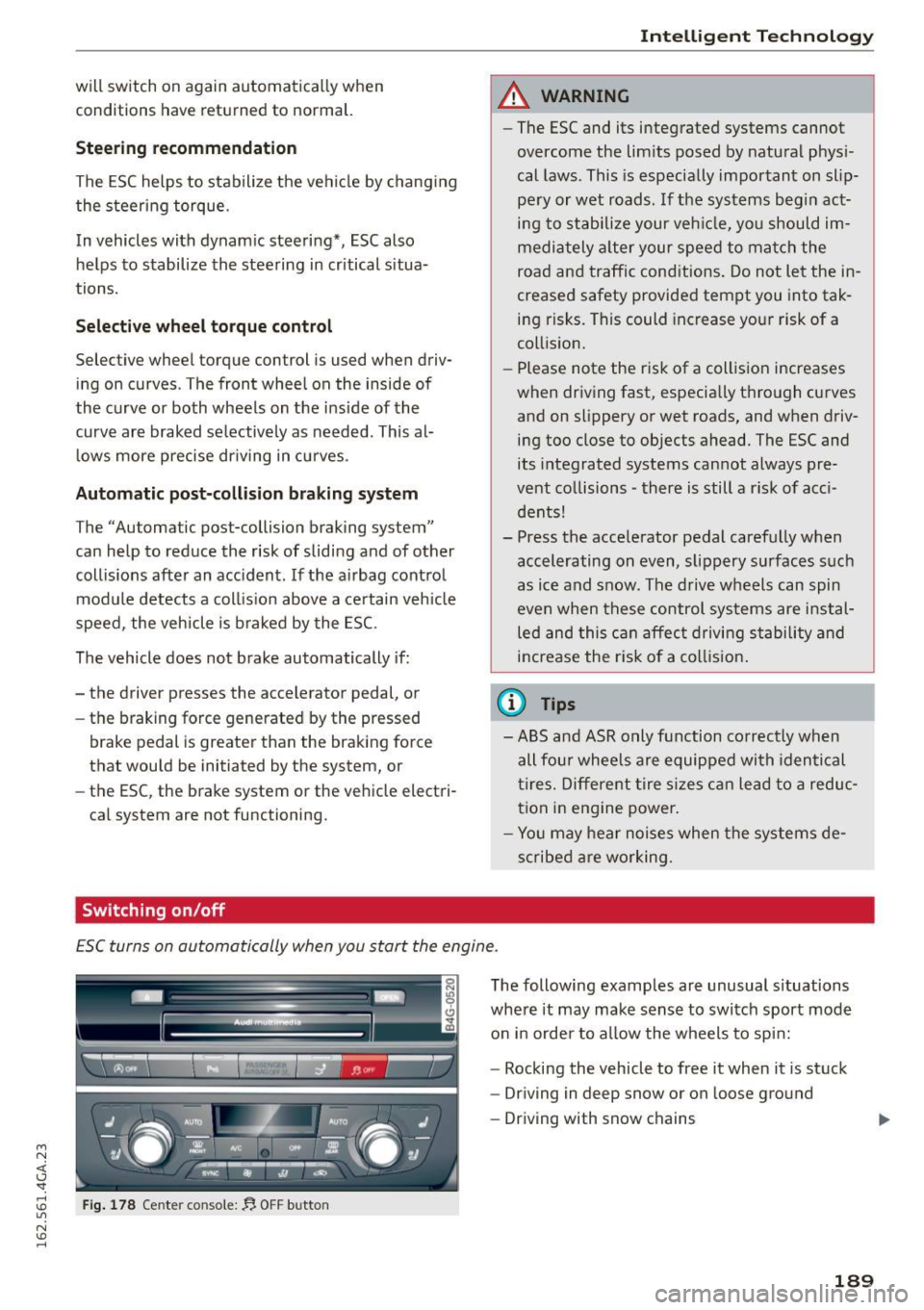
ESC turns on automatically when you start the engine .
Fig. 178 Center console: !J, OFF butto n
The following examples are unusual situations
where it may make sense to switch sport mode
on in orde r to allow the wheels to sp in:
- Rocking the vehicle to free it when it is stuck
- Driving in deep snow or on loose ground
- Driving with snow chains
189
Page 193 of 294
M N <( (.J
'SI: ,...., \!) 1.1'1
N \!) ,....,
Corro sion
There may be a tendency fo r dirt to bui ld up on
the brake pads and corrosion to fo rm on the discs
if the car is not driven regularly or only for short
trips with little use of the brakes.
If the b rakes are not used frequently, or if corro
sion has formed on the discs, it is advisab le to
clean
off the pads and discs by braking firmly a
few times from a moderately high speed
c=> .&, .
Faults in the brake sy stem
If you should not ice a sudden increase in brake
pedal travel, then one of the two brake circuits
may have fai led
c=> .&, .
Low brake flu id level
Malfunct ions can occur in the brake system if the
brake fluid level is too low. The brake flu id leve l is
monitored e lectronically.
Br ake boo ste r
The brake booster works w ith vacuum pressure
which is created only when the engine is running
~ ,& .
Brake lining wear sta tu s
Brake lining wear may be checked by visual in
spection of the condition of the brake pads
through the openings in the wheel. If necessary,
the wheel may be removed for this inspection
c=> page 2 55, Replacing wheels.
.8, WARNING -
- New brake pads don't have the best stop
ping power and must be "broken-in" during
the initial 250 mi les ( 400 km) . You can com
pensate for this by pressing the brake peda l
more firmly. This a lso applies later when
new pads are installed.
- You should perform braking maneuvers for
the purpose of clean ing the brake system
only if road conditions perm it. Other road
users must not be put at risk -you may
cause an accident!
- Before descending a steep grade, reduce
speed and shift transmiss ion into a lower
gear or lower driving range. Do not ride the
In te llig ent T echnolog y
brakes or hold the peda l down too long o r
too often. This could cause the brakes to get
hot and dimin ish braking effic iency.
- Do not "ride the brakes" by rest ing your foot
on the pedal when you do not intend to
brake. This may cause the brakes to over
heat, premature wear and increased stop
ping distance .
- Under certain cl imatic and operat ing condi
tions such as passing through water , dr iv ing
in heavy rain or afte r washing the veh icle,
the effect iveness of the brakes can be re
duced. In winter, ice c an accumulate on the
b rake pads, lin ings, discs and drums. Care
fu lly apply brakes for a test . Brakes will dry
and ice coatings will be cleaned
off after a
few ca reful brake app lications.
- Driving for an extended period of t ime on
salt-covered roads without using your
brakes can a lso affect braking efficiency.
Clean
off accumulated salt coating from
brake discs and pads with a few careful
brake applications.
- If you damage the front spoiler, or if you in
stall a different spoiler, be su re the air f low
to the front brakes is not obstructed . Other
wise the brake system could overheat reduc ing the effect iveness of the entire brake sys
tem.
- Fai lure of one brake circuit will impa ir th e
b rak ing capability res ulting in an increased
s topping distance. Avoid driving the vehicle
a nd have it towed to the nearest Aud i dea ler
or qualified workshop .
- Never let the vehi cle roll to a s top with the
engine shut
off .
- If the b rake booste r is no t working, the
b rake peda l must be pressed cons iderably
harder to make up for the lack of booster as
sistance.
191