battery AUDI A7 2016 Owner's Manual
[x] Cancel search | Manufacturer: AUDI, Model Year: 2016, Model line: A7, Model: AUDI A7 2016Pages: 294, PDF Size: 73.82 MB
Page 231 of 294
M N <( (.J
'SI: ,...., \!) 1.1'1
N \!) ,....,
A WARNING
-=
Whenever working on the battery or on the
electrical system, there is the risk of injury,
accident and even fire. Read and heed the fol
lowing WARNINGS:
- Always wear eye protection . Do not let bat
tery acid or any lead particles get on your skin or clothing. Shield your eyes. Explosive
gases can cause blindness or other injury .
- Battery acid contains sulfuric acid . Sulfuric
acid can cause blindness and severe burns.
- Always wear gloves and eye protection. Do
not tilt the battery because acid could leak
out of the ventilation openings.
- If you get battery acid in your eyes or on
your skin, immediately rinse with cold wa
ter for several minutes and get medical at
tention .
- If you should ingest any battery acid, seek
medical attention immediately .
- Do not expose the battery to an open flame, electric sparks or an open light.
- Do not smoke.
- Do not interchange the positive and nega-
tive cables.
- When working on the battery, be sure not to short-circuit the terminals with tools or oth
er metal objects. This would cause the bat
tery to heat up very quickly, which could
lead to damage or explosion and personal
injury .
- When a battery is charged, it produces hy
drogen gas which is explosive and could
cause personal injury.
- Always keep the battery well out of the
reach of children .
- Before work is done on the electrical sys
tem, disconnect the negative ground cable.
- Before performing any work on the electri cal system, switch off the engine and igni
tion as well as any electrical equipment . The
negative cable on the battery must be dis
connected. If you are just going to replace a
light bulb, then it is enough to switch off
the lights .
-
Checking and Filling
-Before disconnecting the battery, switch off
the anti-theft alarm system! Otherwise you
will set off the alarm.
- When disconnecting the battery, first dis
connect the negative cable and then the
positive cable.
- Before reconnecting the battery, make sure all electrical consumers are switched off. Re
connect the positive cable first and then the negative cable. Never interchange the ca
bles - this could start a fire!
- Never charge a frozen or a thawed -out bat
tery . It could explode! If a battery has fro
zen, then it must be replaced. A discharged battery can freeze over at 32 °F (0 °C).
- Make sure the vent hose is always attached
to the opening on the side of the battery.
- Never use batteries which are damaged.
There is the danger of an explosion! Always
replace a damaged battery.
A WARNING
California Proposition 65 Warning:
- Battery posts, terminals and related acces
sories contain lead and lead compounds,
chemicals known to the State of California
to cause cancer and reproductive problems.
Wash hands after handling.
([) Note
-Do not disconnect the vehicle battery when
the ignition is on or when the engine is run
ning, otherwise, you will damage electronic
components in the electrical system.
- If your vehicle is going to stand for a long
period of time without being driven, protect
the battery from "freezing", otherwise it
will be damaged and will then have to be re
placed.
- When opening the doors, the windows low
er approximately 10 mm automatically. This
function is not available when the battery is
disconnected, which means there is a risk
that the door seal or the window could be
damaged .
229
Page 232 of 294
Checking and Fill in g
Battery charging
Starting the engine requires a well charged bat
tery .
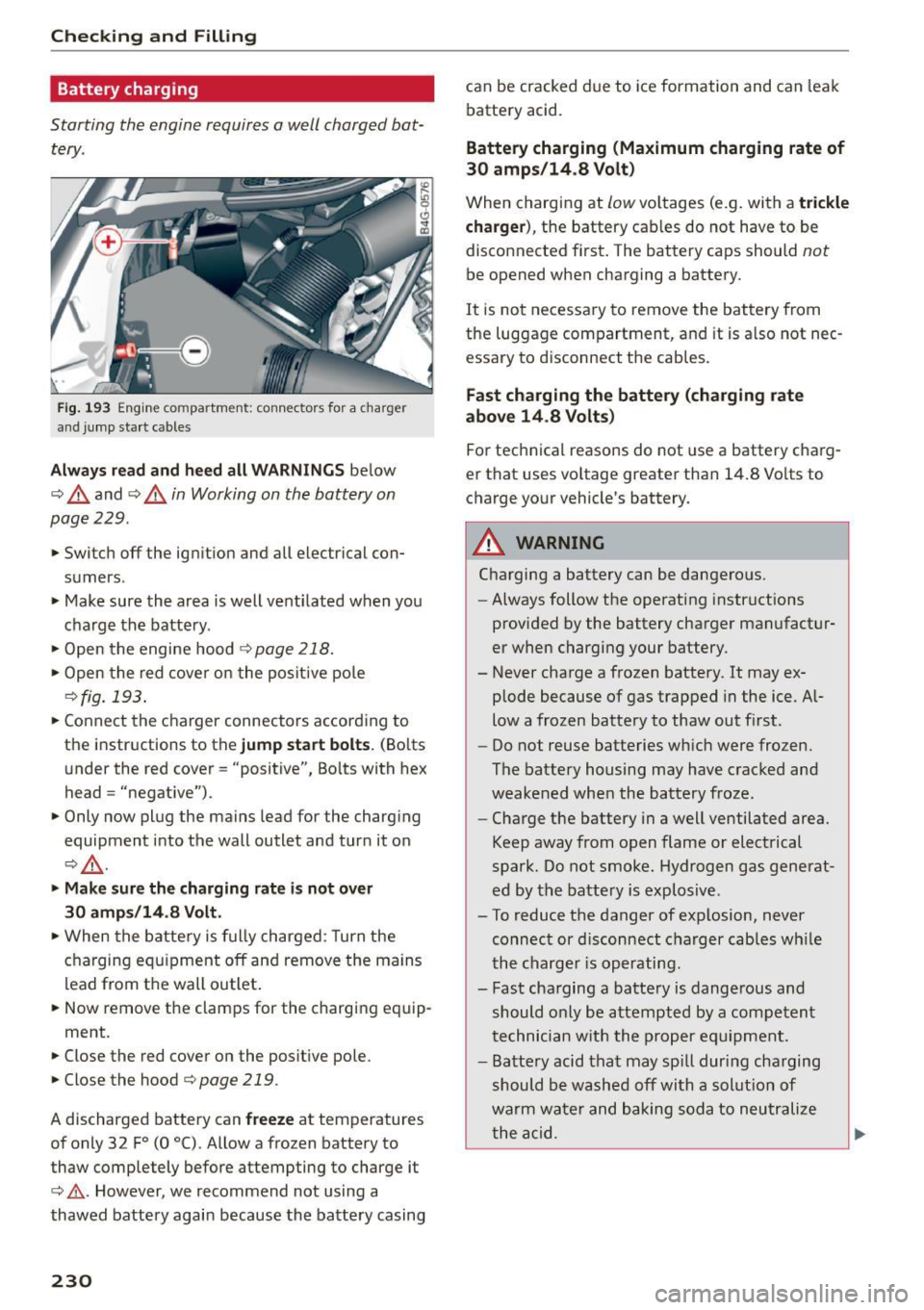
Fig. 193 Engine co mpartment : conn ectors for a charger
and jump start cable s
Always read and heed all WARN ING S below
<=:> &. and
<=:>&. in Working on the battery on
page 229 .
.,. Switch off the ignition and all electrical con
sumers .
.,. Make sure the area is well vent ilated when yo u
charge the battery .
.,. Open the engine hood
¢ page 218.
.,. Open the red cove r on the posit ive po le
¢ fig. 193.
.,. Connect the charger connectors according to
the instructions to the
j ump sta rt bolts . (Bolts
under the red cover = "positive", Bo lts with hex
head= "negative") .
.,. Only now plug the mains lead for the charg ing
equipment into the wall outlet and turn it on
¢ &_ .
.,. Ma ke s ure the charging rat e is n ot ov er
3 0 amp s/14 .8 Volt .
.,. When the batte ry is fully charged: Turn the
charging equ ipment off and remove the mains
lead from t he wall outlet .
.,. Now remove the clamps for the charging equip-
ment .
.,. Close the red cover on the positive pole.
.,. Close the hood
c::> page 219 .
A discharged battery can freeze at temperatures
of only 32 F
0 (0 °C) . Allow a frozen battery to
thaw completely before attempting to charge it
c:> &. . However, we recommend not using a
thawed battery again because the batte ry casing
230
can be cracked due to ice formation and can leak
battery acid.
Battery charging (Maximum charging rate of
30 amps /14.8 Volt )
When charging at low voltages (e.g. with a trickle
charge r),
the battery cab les do not have to be
disconnected f irst. The battery caps should
not
be opened when charging a battery.
It is not necessa ry to remove the battery from
the luggage compartment, and it is a lso not nec
essary to d isconnect the cab les.
Fast ch arging th e battery (cha rgin g ra te
above 14 .8 V olts)
For technical reasons do not use a battery charg
er that uses vo ltage greater than 14.8 Vo lts to
charge your vehicle's battery.
A WARNING
Charging a battery can be dangerous.
- Always follow the operating instructions
provided by the battery charger manufactur
er when charging your battery .
- Never charge a frozen battery. It may ex
plode because of gas trapped in the ice . Al
low a frozen battery to thaw out f irst .
- Do not reuse batteries wh ich were frozen.
The battery housing may have cracked and
weakened when the battery froze.
- Charge the battery in a well ventilated area.
Keep away from open flame or electrical
spark. Do not smoke. Hydrogen gas generat
ed by the batte ry is explosive.
- To reduce the danger of explosion, never
connect or d isconnect charger cab les wh ile
the charger is operating.
- Fast cha rging a battery is dangerous and
should only be attempted by a competent
technician w ith the proper eq uipment .
- Batte ry acid that may spill during charging
should b e washed off with a solut ion of
warm wa ter and baking soda to neu tralize
t he acid.
Page 233 of 294
M N <( (.J
'SI: ,...., \!) ..,.,
N \!) ,....,
(D Note
Never use a fast charger as a booster to start
the engine . This w ill seriously damage sensi
tive electron ic components, such as control
units, relays, radio, etc., as well as the battery
charger.
Battery replacement
The new battery must have the same specifica
tions and dimensions as the original equipment
battery .
Intelligent energy management in your vehicle is
responsible for distributing the electrica l energy
throughout your vehicle
c:> page 194. The intell i
gent energy management system will keep the
engine battery charged better than vehicles w ith
out this system . To make sure the additional elec
tr ical energy is available once again after you
have changed the battery, we recommend that
you install batteries of the same type and manu facture only (the same as those installed at the
time your veh icle was delivered). Specif ications
are listed on the battery housing. Your author
ized dealer must code the battery in the energy
management system to enable you to use the en
e rgy management functions correctly after re
p lacing the battery.
The new battery must have the same capacity ,
voltage (12-volts), amperage, construction and plug sealing .
When installing the battery, make sure the igni
tion and all electrical consumers are switched off.
Make sure the ventilation hose on the s ide of
the battery is connected, otherwise fumes or
battery acid can leak out.
- Vehicles with the Start-Stop-System* are equipped with a special cycle-proof AGM battery. Installing a different type of bat
tery can cause problems in the vehicle elec
trical system. When replacing the vehicle
battery, always install one with the same
specifications as the original battery.
Checking and Filling
{® For the sake of the environment
Because of the prob lem of proper disposal of
a battery, we recommend your authorized
Audi dealer change the battery for you. Bat
teries contain sulfur ic acid and lead and must
always be disposed of properly in compliance
with all environmental regulations. Disposing
of vehicle batteries improperly is very danger
ous to the environment.
Windshield/headlight
washer container
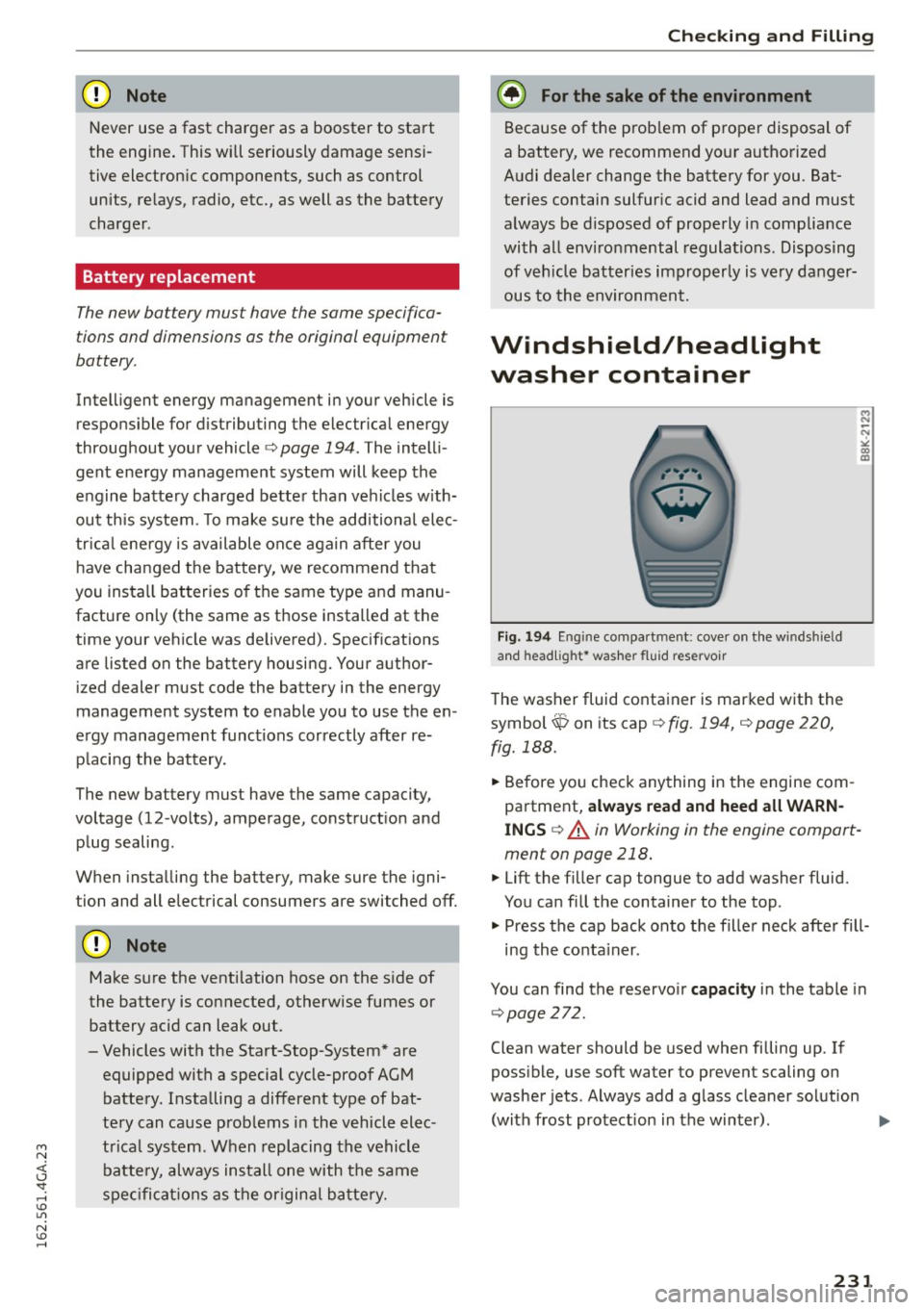
Fig. 194 Engine compa rtment: cover on the winds hie ld
and head lig ht* washer fluid reservoir
The washer fluid container is marked with the
symbol
ip on its cap c:>fig. 194, c:>page 220,
fig. 188.
.. Before you check anything in the engine com
partment,
always read and heed all WARN
INGS c:> .&. in Working in the engine compart
ment on page 218.
.. Lift the filler cap tongue to add washer fluid.
You can fill the container to the top .
.. Press the cap back onto the filler neck after fill-
ing the container .
You can find the reservoir
capacity in the table in
c:>page272.
Clean water should be used when filling up. If
possible, use soft water to prevent scaling on
washer jets. Always add a g lass cleaner solution
(with frost protection in the winter) . ..,.
231
Page 267 of 294

M N <( (.J
'SI: ,...., \!) 1.1'1
N \!) ,....,
Emergency situations
General
This chapter is intended for trained emergency
crews and working personnel who have the nec
essary tools and equipment to perform the se
operations.
Starting by pushing or
towing
(D Note
Vehicles w ith an automatic transmission can
not be started by push ing o r tow ing.
Starting with jumper
cables
If necessary, the engine can be started by con
necting it to the battery of another vehicle .
If the engine should fail to start because o f a dis
charged or weak battery, the battery can be con
nected to the battery of
another vehicle, us ing a
pair of jumper cables to start the engine .
Jumper cables
Use only jumper cables of sufficiently large cros s
section
to carry the starter current safe ly. Refer
to the manufacturer's specifications.
Use only jumper cables with
insulated term inal
clamps which are distinctly marked:
plus(+) cable in most cases co lored red
minus (-) cable
in most cases colored black .
A WARNING
Batteries contain electricity, acid, and gas .
Any of these can cause very ser ious or fatal in
jury . Fo llow the instructions be low for safe
handling of your vehicle's battery.
- Always shield your eyes and avoid leaning
over the battery whenever possible.
- A discharged battery can freeze at tempera
tures just below 32 °F (0 °C) . Before con
necting a jumper cable, you must thaw the
Emergency situations
frozen battery completely, otherwise it
could explode .
- Do not allow battery acid to contact eyes or
skin. Flush any contacted area with water immediately.
- Improper use of a booster battery to start a
veh icle may cause an explosion.
- Vehicle batteries generate explosive gases .
Keep sparks, flame and lighted cigarettes
away from batteries.
- Do not try to jump start any vehicle with a
low acid level in the battery.
- The voltage of the booster battery must al
so have a 12-volt rating. The capacity (Ah) of
the booster battery should not be lower
than that of the discharged battery. Use of batteries of different voltage or substantial
ly different" Ah" rating may cause an explo
sion and personal injury.
- Never charge a frozen battery . Gas trapped
in the ice may cause an explosion .
- Never charge or use a battery that has been
frozen . The battery case may have be weak
ened ,
- Use of batter ies of different voltage or sub
stantially different capacity (Ah) rating may
cause an exp losion and injury. Th e capacity
(Ah) of the booste r battery should not be
lower than that of the discharged battery.
- Before you check anything in the engine
compartment, always read and heed a ll
WARNINGS
q page 218 .
(D Note
-Applying a h igher voltage booster battery
w ill cause expensive damage to sensitive
electronic components, such as control
units, relays, radio, etc.
- Th ere must be no ele ct rical contact between
the vehicles as otherwise current could al
ready start to flow as soon as the positive
(+) termina ls are connected.
(D Tips
The discharged battery must be properly con-
nected to the vehicle's e lectrical system. .,..
265
Page 268 of 294
Emergency situation s
When jump sta rting or charging the battery,
never connect the negative ground cable to
the batte ry negat ive post because the battery
manager system must be able to detect the
battery's state of c harge. Always connect the
negat ive grou nd cab le to the negative ground
post of the batte ry manager control unit .
Use of jumper cables
Make sure to connect the jumper cable clamps in
ex actly the order described below!
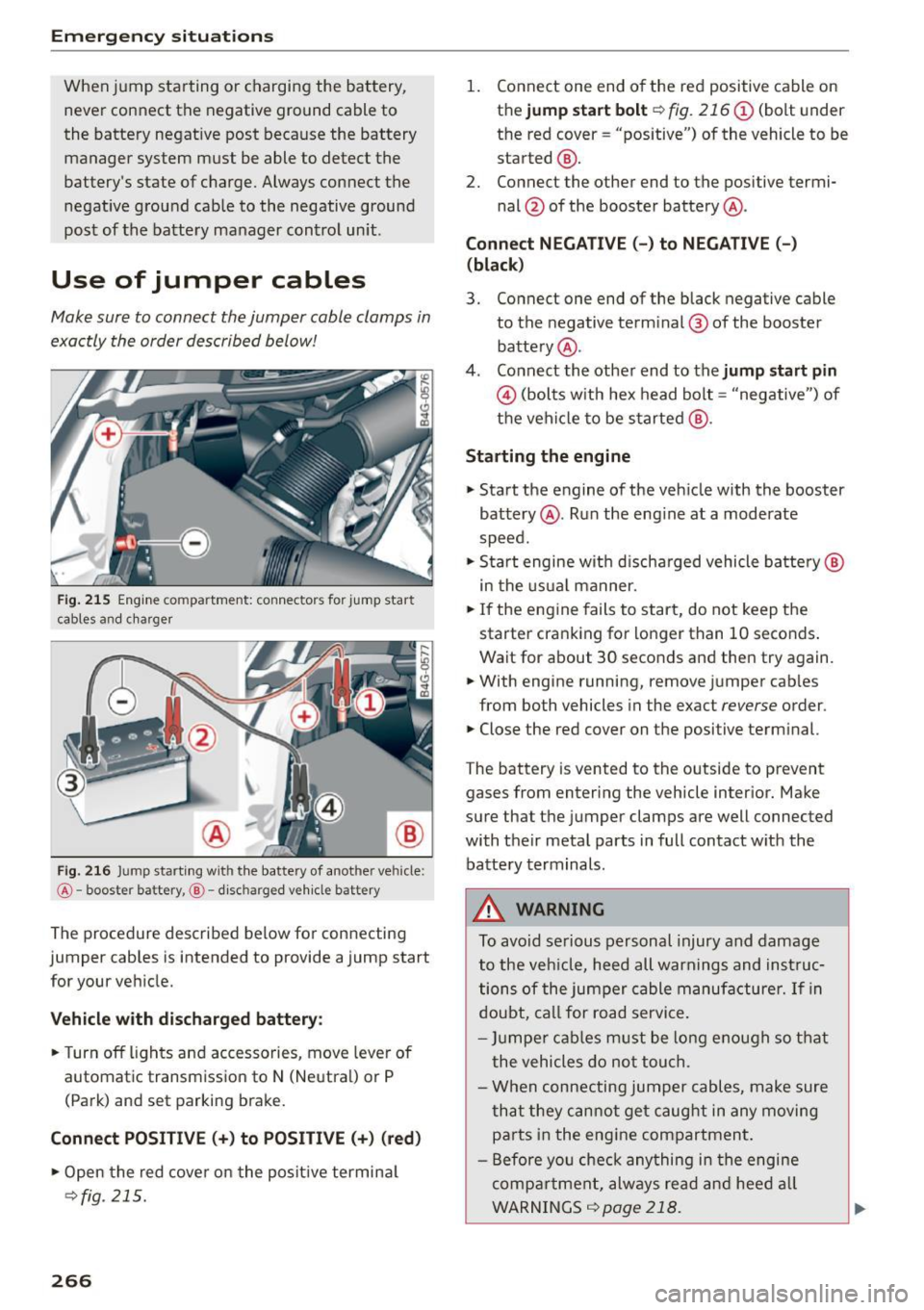
F ig . 215 Eng ine co m pa rt m ent: con nec tors for ju mp star t
cab les a nd cha rge r
® .--l @
Fig . 2 16 Jum p start ing w it h t he bat te ry of a not her ve hicl e:
@-boos te r ba ttery , @ -disc harg ed v eh icle batt ery
The procedure described be low for con necting
jumper cables is intended to p rovide a jump start
for your ve hicle.
Vehicle with discharged battery: •T urnoff lig ht s and accesso ries , move lever of
automat ic transmiss ion to N (Ne utra l) or P
(Park) and set parking brake.
Connect POSITIVE(+) to POSITIVE(+) (red)
• Open the red cove r o n t he po sit ive termin al
~fig . 2 15.
266
1. Connect one end o f the red positive ca ble on
the
jump start bolt ~ fig. 216 /J) (bolt under
the red cover = "positive") of the vehicle to be
started @.
2. Connect the other end to the positive termi-
nal@ of the booster battery @.
Connect NEGATIVE (-) to NEGATIVE (-)
(black )
3. Co nnect one end of the black negative cable
to the negative term inal ® of the booste r
batte ry @ .
4 . Connect th e other end to the
jump start pin
@ (bolts w it h hex head bolt = "negative") of
the veh icle to be s tarte d@ .
Starting the engine • Sta rt the engine of the veh icle with the booster
bat tery @. Run the eng ine at a moderate
speed.
• Sta rt engine w it h discha rged vehicle ba ttery @
i n t he usual man ner.
• If the engine fails to start, do not keep the
starter cra nking for lo nger than 10 seco nds .
Wait for about 30 seconds and then try again .
• With engine running , remove jumper cab les
from both vehicles in the exact
reverse order .
• Close the red cover on the positive term inal.
The batt ery is vented to the o utside to prevent
gases from enter ing the vehicle inter ior. Make
su re that t he jumper clamps are well connected
with their metal parts in full contact w ith the
batte ry terminals.
&_ WARNING
To avoid se rious personal injury and damage
to the veh icle, heed all war nings and inst ruc
tion s of the jumper cable m anufa cture r.
If in
d oubt, cal l for ro ad service.
- Ju mpe r cabl es must be lo ng enoug h so tha t
t he vehicles do no t tou ch.
- When conne cting jumper cables, make sure
th at they c an not get c aug ht in any moving
p art s in the engine com partmen t.
- B efore you check any thing in the e ngine
comp artment, alw ays re ad an d hee d all
WAR NINGS
~ page 218.
Page 269 of 294
M N <( I.J "". rl I.O
"' N I.O rl
(D Note
Improper hook-up of jumper cables can ruin
the generator.
- Always connect POSITIVE( +) to POSITIVE
( + ), and NEGATIVE( -) to NEGATIVE(-)
ground post of the battery manager control
unit.
- Check that all screw plugs on the battery
cells are screwed in firmly. If not, tighten
plugs prior to connecting clamp on negative
battery terminal.
- Please note that the procedure for connect
ing a jumper cable as described
above ap
plies specifically to the case of your vehicle
being jump started. When you are giving a
jump sta rt to another vehicle, do
not con
nect the negative(-) cab le to the negative
( - ) terminal on the discharged battery @
r:::;, fig. 216. Instead, secure ly connect the
negative(-) cab le to either a solid metal
component that is firm ly bolted to the en
gine block or to the engine block itself. If
the battery that is being charged does not
vent to the outs ide, escap ing battery gas
could ignite and explode!
Towing with a tow truck
General hints
Your Audi requires special handling for towing.
The follow ing information is to be used by com
mercial tow truck operators who know how to op
erate their eq uipment safe ly.
- Never t ow your Audi. To wing will cau se da m
age to the engine and tran smi ssion .
- Neve r wrap th e safety cha in s or win ch cab le s
around the brake line s.
- To pre vent unnecess ary dama ge, your A udi
mu st b e trans port ed w ith a fl at b ed t ru ck .
- To lo ad the vehicle on to th e flat bed, us e the
towing l oop found in th e vehicle tool s and at
tach to th e fr ont or re a r anc hora ge
¢ page 267 and ¢page 268.
Emergen cy situati ons
A WARNING
-A veh icle being towed is not safe for passen-
gers. Neve r all ow anyone to ride in a vehicle
being towed, for any reason .
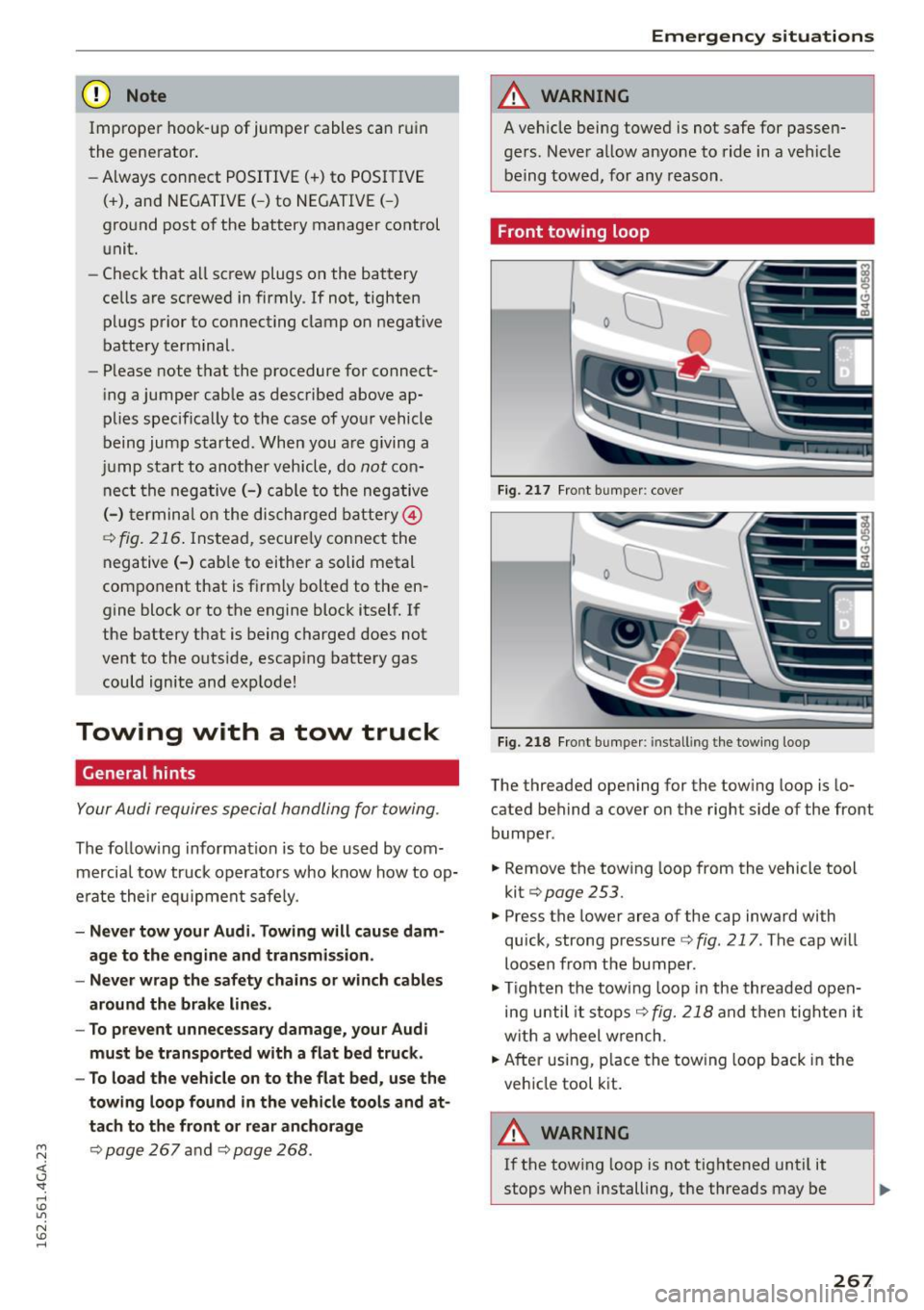
Front towing loop
Fig. 217 Fro nt bumper: cover
Fig . 2 18 Fro nt bumper : insta lling the tow ing loop
The threaded opening for the towing loop is lo
cated behind a
cover on the right side of the front
bumper .
.,. Remove the towing loop from the vehicle tool
kit¢
page 253.
.,. Press the lower area of the cap inward with
quick, strong pressure
r::;, fig . 217 . The cap w ill
loosen from the bumper .
.,. Tighten the towing loop in the threaded open
ing until it stops
¢ fig. 218 and then tighten it
w ith a wheel wrench .
.,. After using, p lace the towing loop back in the
vehicle tool k it.
A WARNING
--
If the towing loop is not tightened until it
stops when installing, the threads may be
267
Page 281 of 294
M N <( (.J
'SI: ,...., \!) 1.1'1
N \!) ,....,
AUTO Automatic headlights . . . . . . . . . . . . . . . . . 43
Four -zone automatic climate control . . . . . 71
Three- zone climate control . . . . . . . . . . . . . 69
Auto Lock . . . . . . . . . . . . . . . . . . . . . . . . . . . . 32
Automatic belt retractor . . . . . . . . . . . . . . . 138
Automatic post-collision braking system . . 189
Automatic t ransmission . . . . . . . . . . . . . . . . 107
Driving . . . . . . . . . . . . . . . . . . . . . . . . . . . . 109
Emergency mode . . . . . . . . . . . . . . . . . . . . 112
Hill descent control . . . . . . . . . . . . . . . . . . 110
Kick-down . . . . . . . . . . . . . . . . . . . . . . . . . . 111
M anual shift program . . . . . . . . . . . . . . . . 111
Selector lever . . . . . . . . . . . . . . . . . . . . . . . 107
Selector lever emergency release . . . . . . . 113
Automatic wipe/wash system . . . . . . . . . . . . 49
Auto Safety Hotline . . . . . . . . . . . . . . . . . . . 133
Auxiliary heater (four- zone automatic climate
control) . . . . . . . . . . . . . . . . . . . . . . . . . . . . . . 73
Auxiliary heater (three-zone climate control) 70
Average consumption . . . . . . . . . . . . . . . . . . . 24
Ave rage speed . . . . . . . . . . . . . . . . . . . . . . . . . 24
Avoid damaging the vehicle . . . . . . . . . . . . . 196
B
Battery . . . . . . . . . . . . . . . . . . . . . . . . . . . . . 228
Charge level . . . . . . . . . . . . . . . . . . . . . . . . 194
Charging . . . . . . . . . . . . . . . . . . . . . . . . . . . 230
Energy management . . . . . . . . . . . . . . . . . 194
Important warnings . . . . . . . . . . . . . . . . . 228
Jump starting . . . . . . . . . . . . . . . . . . . . . . . 265
Location . . . . . . . . . . . . . . . . . . . . . . . . . . . 228
Replacing the battery . . . . . . . . . . . . . . . . 231
Win ter operation . . . . . . . . . . . . . . . . . . . . 228
Working on the battery . . . . . . . . . . . . . . . 228
Before driving . . . . . . . . . . . . . . . . . . . . . . . . 126
Belt tensioners . . . . . . . . . . . . . . . . . . . . . . . 141
Blended gasoline . . . . . . . . . . . . . . . . . . . . . 210
Blower (four-zone automatic climate control) .7.2
Blower (three-zone climate control) . . . . . . . 69
Booster seats
Brake fluid 1
7 6
Changing the brake fluid . . . . . . . . . . . . . . 227
Checking the brake fluid level . . . . . . . . . . 227
Brakes Indicator light . . . . . . . . . . . . . . . . . . . . . . . 21
Index
Brake system
Anti- lock braking system . . . . . . . . . . . . . . . 19
Brake booster . . . . . . . . . . . . . . . . . . . . . . . 191
Brake fluid . . . . . . . . . . . . . . . . . . . . . . . . . 227
Br ake fluid specifications for refill and re
placement . . . . . . . . . . . . . . . . . . . . . . . . . 22 7
Brake power ass ist unit . . . . . . . . . . . . . . . 190
Brakes . . . . . . . . . . . . . . . . . . . . . . . . . . . . . 190
Electromechanical parking brake . . . . . . . . 78
Fluid reservo ir . . . . . . . . . . . . . . . . . . . . . . 227
Warning/indicator lights . . . . . . . . . . . . . . . 14
Worn brake pads symbo l . . . . . . . . . . . . . . . 19
Braking Brake assist . . . . . . . . . . . . . . . . . . . . . . . . 188
Emergency braking funct ion . . . . . . . . . . . . 79
Braking guard . . . . . . . . . . . . . . . . . . . . . . . . . 8S
Messages . . . . . . . . . . . . . . . . . . . . . . . . . . . 92
Settings . . . . . . . . . . . . . . . . . . . . . . . . . . . . 92
Break-in pe riod
Brake pads . . . . . . . . . . . . . . . . . . . . . . . . . 190
Tires
Breaking in New tires
C
196
196
240
California Proposition 65 Warning . . . . . . . 219
Battery specific . . . . . . . . . . . . . . . . . . . . . 229
Capacities . . . . . . . . . . . . . . . . . . . . . . . . . . . 272
AdBlue . . . . . . . . . . . . . . . . . . . . . . . . . . . . 214
Engine oil 220
Car carrier Transporting your vehicle . . . . . . . . . . . . . 268
Care
... .... .. .. .. ............. .... .. 205
Cargo area . . . . . . . . . . . . . . . . . . . . . . . . . . . 132
Cargo net . . . . . . . . . . . . . . . . . . . . . . . . . . . . . 65
Catalytic converter . . . . . . . . . . . . . . . . . . . . 197
Center armrest Cockpit . . . . . . . . . . . . . . . . . . . . . . . . . . . . . 55
Central locking . . . . . . . . . . . . . . . . . . . . . . . . 31
Emergency locking . . . . . . . . . . . . . . . . . . . . 36
Power windows . . . . . . . . . . . . . . . . . . . . . . 40
Setting . . . . . . . . . . . . . . . . . . . . . . . . . . . . . 33
Sunroof... .. .. .. .. ........... .... .. . 40
Cer tifica tion . . . . . . . . . . . . . . . . . . . . . . . . . 277
Changing engine oil . . . . . . . . . . . . . . . . . . . 223
279
Page 284 of 294
Index
Starting . . . . . . . . . . . . . . . . . . . . . . . . . . . . 75
Starting with jumper cab les . . . . . . . . . . . 265
Stopping . . . . . . . . . . . . . . . . . . . . . . . . . . . . 76
Engine compartment . . . . . . . . . . . . . . . . . . 220
Closing the hood . . . . . . . . . . . . . . . . . . . . 219
Opening the hood . . . . . . . . . . . . . . . . . . . 218
Safety instructions . . . . . . . . . . . . . . . . . . . 218
Working in the engine compartment . . . . 218 Event Data Recorder (EDR)
. . . . . . . . . . . . . . 187
Expansion tank . . . . . . . . . . . . . . . . . . . . . . . 224
Exterior lighting . . . . . . . . . . . . . . . . . . . . . . . 43
Exterior mirrors
Adjusting . . . . . . . . . . . . . . . . . . . . . . . . . . . 47
Dimming ..... ..... .. ................ 48
Heating...... ..... .. ................ 47
Exterior temperature display . . . . . . . . . . . . . 23
Engine coolant . . . . . . . . . . . . . . . . . . . . . . . 224
Adding coolant . . . . . . . . . . . . . . . . . . . . . . 225
F
Checking the engine coolant leve l. . . . . . . 224
Expansion tank . . . . . . . . . . . . . . . . . . . . . . 224
Malfunction symbol . . . . . . . . . . . . . . . . . . . 15
Radiator fan . . . . . . . . . . . . . . . . . . . . . . . . 226
Temperature gauge . . . . . . . . . . . . . . . . . . . 10
Engine oil . . . . . . . . . . . . . . . . . . . . . . . . . . . 220
Adding . ..... .. ................ .... 222
Additives . . . . . . . . . . . . . . . . . . . . . . . . . . . 222
Changing . . . . . . . . . . . . . . . . . . . . . . . . . . 223
Checking oil level . . . . . . . . . . . . . . . . . . . . 222
Consumpt ion . . . . . . . . . . . . . . . . . . . . . . . 222
Indicator light . . . . . . . . . . . . . . . . . . . . . . . 17
O il consumption. .............. ... .. . 221
Pressure malfunct ion . . . . . . . . . . . . . . . . . . 16
Sensor defective . . . . . . . . . . . . . . . . . . . . . . 21
Specification and viscos ity . . . . . . . . . . . . . 220
Engine sound . . . . . . . . . . . . . . . . . . . . . . . . 101
Engine speed limitation (indicator light) 21
E ngine Start-Stop mode
refer to Start-Stop-System . . . . . . . . . . . . . 82
Engine warm -up request
Indicator light . . . . . . . . . . . . . . . . . . . . . . . 2 1
Environment Catalytic converter . . . . . . . . . . . . . . . . . . . 197
Diesel particulate filter . . . . . . . . . . . . . . . 198
Disposing of your vehicle battery . . . . . . . 231
Driving at high speeds . . . . . . . . . . . . . . . . 198
Fuel ...... ... .. ... ............. ... . 212
L eaks under your veh icle . . . . . . . . . . . . . . 218
L ett ing the veh icle stand and warm up . . . 199
Proper disposal of drained brake fluid . . . 227
Proper disposal of drained engine coo lant 225
Proper disposal of drained engine oil 222, 223
Recycling used engine oil. . . . . . . . . . . . . . 222
Unleaded fuel .................. .. ... 210
What should I do with an old battery? . . . 231
ESC Automatic post-collision braking system 189
282
Fastening
Booster seats . . . . . . . . . . . . . . . . . . . . . . . 176
Convertib le child safety seats . . . . . . . . . . 17 4
Infant seats . . . . . . . . . . . . . . . . . . . . . . . . 173
Floor mats ...... ... ... ........ ...... . 131
Foot pedals .......................... 131
For the sake of the environment Environmentally-friendly driving . . . . . . . 198
Gasoline fumes and the env ironment . . . . 212
Reducing engine noise by early upshifting . 10
Refueling . . . . . . . . . . . . . . . . . . . . . . . . . . 212
Saving fuel by early upshifting . . . . . . . . . . 10
Warming up the engine . . . . . . . . . . . . . . . . 75
Four-zone automatic climate control Air vents . . . . . . . . . . . . . . . . . . . . . . . . . . . . 72
Auxiliary heater . . . . . . . . . . . . . . . . . . . . . . 73
Basic settings . . . . . . . . . . . . . . . . . . . . . . . . 73
Operating . . . . . . . . . . . . . . . . . . . . . . . . . . . 71
Recirculation mode . . . . . . . . . . . . . . . . . . . 73
Residual heat . . . . . . . . . . . . . . . . . . . . . . . . 72
Synchronizing . . . . . . . . . . . . . . . . . . . . . . . . 72
Front airbags Description . . . . . . . . . . . . . . . . . . . . . . . . . 147
How they work . . . . . . . . . . . . . . . . . . . . . . 152
Frontal collisions and the laws of physics . . 136
Front seats . . . . . . . . . . . . . . . . . . . . . . . . . . . 53
Adjusting . . . . . . . . . . . . . . . . . . . . . . . . . . 128
Child restraints in the front seat . . . . . . . . 144
Fuel Additives .. .. .. . . . . . . . . . . . . . . . . . . . . . 210
Blended gasoline . . . . . . . . . . . . . . . . . . . . 210
Current consumption . . . . . . . . . . . . . . . . . . 24
Fuel filler neck . . . . . . . . . . . . . . . . . . . . . . 212
Fuel gauge . . . . . . . . . . . . . . . . . . . . . . . 10 , 11
Gasoline . . . . . . . . . . . . . . . . . . . . . . . . . . . 210
Gasoline additives . . . . . . . . . . . . . . . . . . . 211
Indicator light . . . . . . . . . . . . . . . . . . . . . . . 21
Page 288 of 294
Index
Pregnant women
Specia l consid erations when wearing a safe-
ty belt . . . . . . . . . . . . . . . . . . . . . . . . . . . . . 140
Pre sense . . . . . . . . . . . . . . . . . . . . . . . . . . . . 185
Pressure (t ires) . . . . . . . . . . . . . . . . . . . . . . . 251
Pretensioners Pre sense . . . . . . . . . . . . . . . . . . . . . . . . . . 185
Preven tat ive passenger protect ion . . . . . . . 185
Prewarming . . . . . . . . . . . . . . . . . . . . . . . . . . 75
Prope r occupant seating posit ions . . . . . . . 12 7
Prope r safety belt pos ition . . . . . . . . . . . . . . 139
Proper seat ing pos ition
Front passenger . . . . . . . . . . . . . . . . . . . . . 128
Occupa nts . . . . . . . . . . . . . . . . . . . . . . . . . . 127
Rear passengers . . . . . . . . . . . . . . . . . . . . . 129
Protect ing . . . . . . . . . . . . . . . . . . . . . . . . . . . 207
Q
quattro (all wheel drive) . . . . . . . . . . . . . . . . 192
Question What happens to unbelted occupants? 136
R
Rad iator fan 226
Rain/light sensor Headlights . . . . . . . . . . . . . . . . . . . . . . . . . . 43
Indicator light . . . . . . . . . . . . . . . . . . . . . . . 22
Intermittent (winds hield wipers) . . . . . . . . 49
Raising the vehicle . . . . . . . . . . . . . . . . . . . . 269
Range (fuel leve l) . . . . . . . . . . . . . . . . . . . . . . 24
Reading lights . . . . . . . . . . . . . . . . . . . . . . . . . 46
Rear fog lights . . . . . . . . . . . . . . . . . . . . . . . . 43
Rear light Indicator l ight . . . . . . . . . . . . . . . . . . . . . . . 21
Rear she lf . . . . . . . . . . . . . . . . . . . . . . . . . . . . 63
Rear spoiler . . . . . . . . . . . . . . . . . . . . . . . . . . 193
Rearview camera
refer to Pa rking systems .......... 115,116
Rear view mir ror . . . . . . . . . . . . . . . . . . . . . . . 48
Rear w indow defogger (four- zone a utomat ic
clim ate cont ro l) . . . . . . . . . . . . . . . . . . . . . . . 7 2
Rear window defogger (three -zone climate
control) . . . . . . . . . . . . . . . . . . . . . . . . . . . . . . 70
Recirculation mode (fo ur-zone automatic cli
mate control) . . . . . . . . . . . . . . . . . . . . . . . . . 71
286
Recircu lation mode (th ree-zone climate con -
trol) . . . . . . . . . . . . . . . . . . . . . . . . . . . . . . . . . 69
Recupe rat io n . . . . . . . . . . . . . . . . . . . . . . . . . . 24
Ref illing Ad B lue
With bottle .. .. .. .. .... .. .... ... .. .. 216
With can ister .. .. ..... ........... ... 216
Ref uel ling . . . . . . . . . . . . . . . . . . . . . . . . . . . 212
Remote cont ro l
Ga rage door opener ( HomeLink) . . . . . . . . . 41
Unl ocking and locking . . . . . . . . . . . . . . . . . 33
Remote cont rol key
L E D . . . . . . . . . . . . . . . . . . . . . . . . . . . . . . . . 31
Rep lac ing the battery . . . . . . . . . . . . . . . . . 31
Repair manuals .... .. ............... .. 274
Repairs Airbag system . . . . . . . . . . . . . . . . . . . . . . 158
Rep laci ng windsh ie ld w iper b lades . . . . . . . . 50
Reporting Safety Defects . . . . . . . . . . . 133, 134
Reset bu tton (trip odome ter) . . . . . . . . . . . . 26
Resetting the trip odometer . . . . . . . . . . . . . 26
Residua l heat (four-zone a utomatic climate
control) . . . . . . . . . . . . . . . . . . . . . . . . . . . . . . 72
Retractor . . . . . . . . . . . . . . . . . . . . . . . . . . . . 138
Reversible mat . . . . . . . . . . . . . . . . . . . . . . . . 65
Rims ... ... .. .... .. .. .. .. .. .... ... .. 248
Roof rac k . . . . . . . . . . . . . . . . . . . . . . . . . . . . . 61
Lo ad ing . . . . . . . . . . . . . . . . . . . . . . . . . . . . . 62
Roof weight . . . . . . . . . . . . . . . . . . . . . . . . . 62
s
Safe d rivi ng habits
Safety 1
26
Airbag system . . . . . . . . . . . . . . . . . . . . . . 143
Belts . . . . . . . . . . . . . . . . . . . . . . . . . . . . . . 135
Cargo . . . . . . . . . . . . . . . . . . . . . . . . . . . . . 132
Correc t seating posi tion . . . . . . . . . . . . . . 12 7
Pedal area . .. .... .. .. .. ......... .. .. 131
Safety be lt position . . . . . . . . . . . . . . . . . . . 139
Safety belt height adjustment . . . . . . . . . 140
Safety be lts wo rn by preg nant women 140
Safety be lt pretensioner
Serv ice and disposal . . . . . . . . . . . . . . . . . 142
Safety be lts . . . . . . . . . . . . . . . . . . . . . . 13 5, 138
Cleaning . . . . . . . . . . . . . . . . . . . . . . . . . . . 207
Danger to passengers who do not wear a
safety be lt . . . . . . . . . . . . . . . . . . . . . . . . . 136
Page 292 of 294
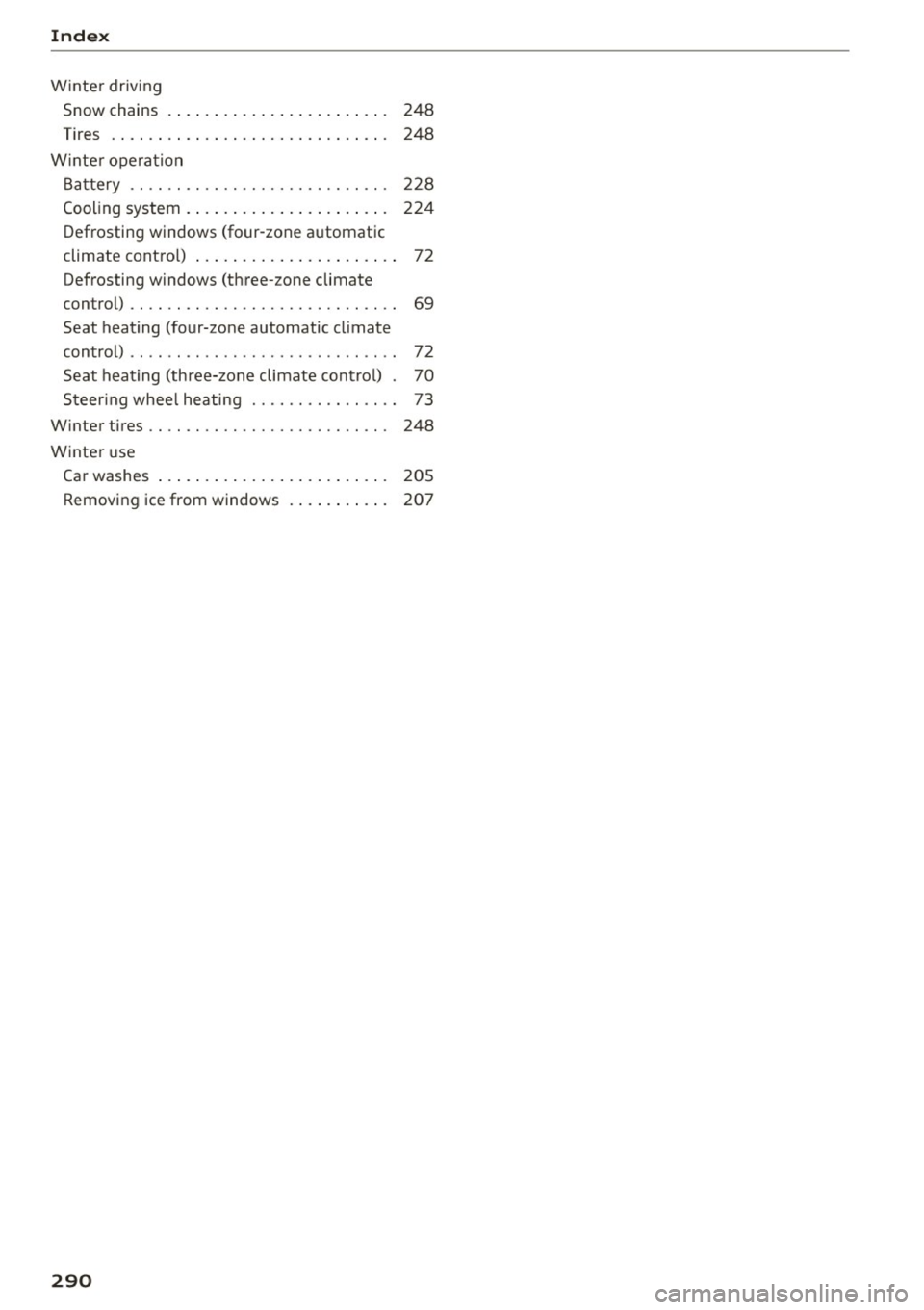
Index
Winter driving
Snow chains . . . . . . . . . . . . . . . . . . . . . . . . 248
Tires ... ... .. .. ................ .... 248
W inter operation
Battery . . . . . . . . . . . . . . . . . . . . . . . . . . . . 228
Cooling system . . . . . . . . . . . . . . . . . . . . . . 224
Defrosting windows (four-zone automatic
climate control) . . . . . . . . . . . . . . . . . . . . . . 72
Defrosting windows (three-zone climate
control) . . . . . . . . . . . . . . . . . . . . . . . . . . . . . 69
Seat heating (four-zone automatic climate
control) . . . . . . . . . . . . . . . . . . . . . . . . . . . . . 72
Seat heating (three-zone climate control) . 70
Steer ing whee l heating . . . . . . . . . . . . . . . . 73
Winter tires . . . . . . . . . . . . . . . . . . . . . . . . . . 248
Winter use
Car washes . . . . . . . . . . . . . . . . . . . . . . . . . 205
Removing ice from windows . . . . . . . . . . . 207
290