battery AUDI A7 2016 User Guide
[x] Cancel search | Manufacturer: AUDI, Model Year: 2016, Model line: A7, Model: AUDI A7 2016Pages: 294, PDF Size: 73.82 MB
Page 61 of 294
M N <( I.J "". rl I.O
"' N I.O rl
12 Volt sockets
Applies to vehicles: with 12-volt sockets
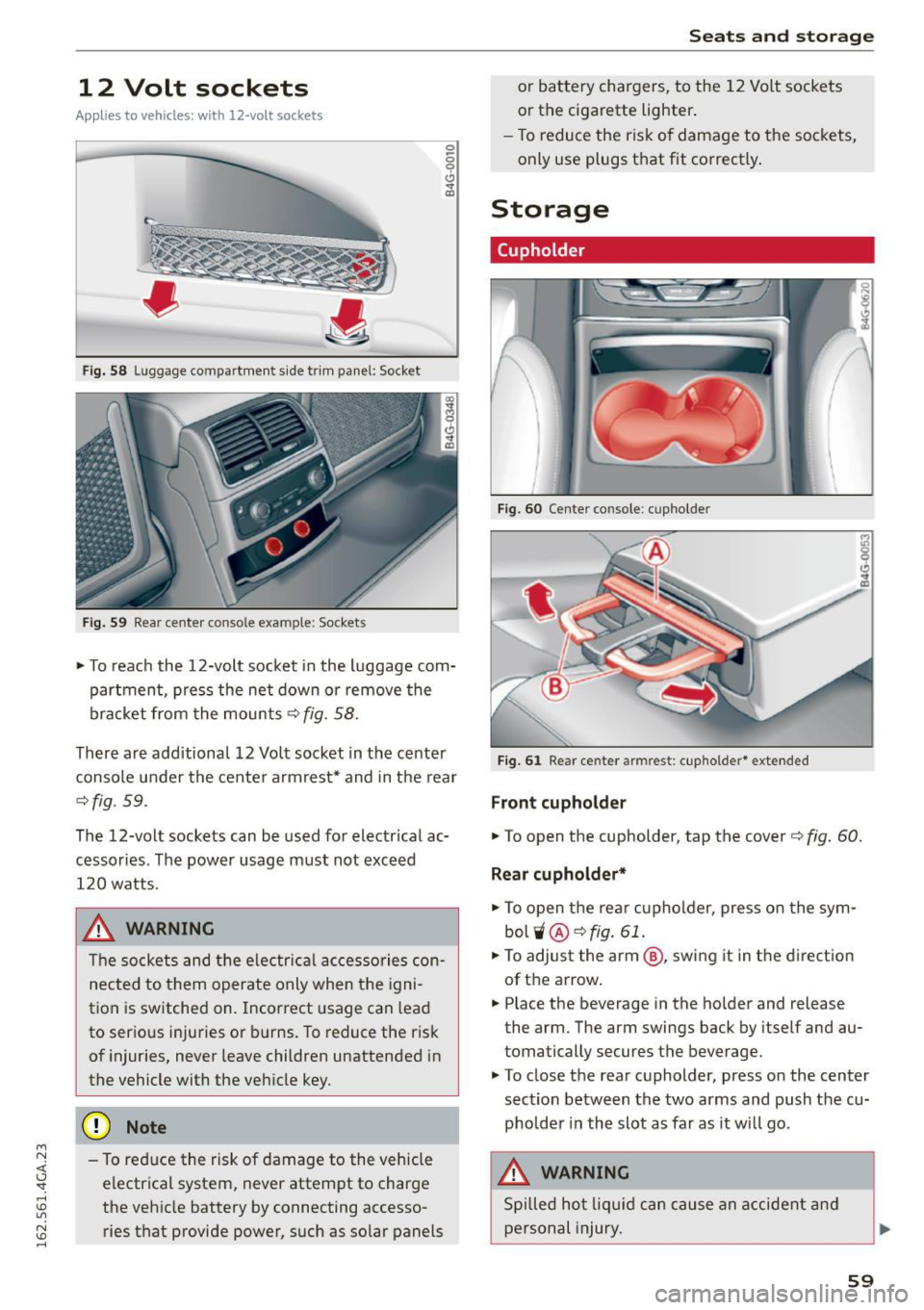
Fig. 58 Luggage compartme nt s ide trim panel: Socket
Fig. 59 Rear center console example: Sockets
0 0 9 (!) ., ID
~ To reach the 12-volt socket in the luggage com
partment, press the net down or remove the
bracket from the mounts
c::> fig. 58.
There are additional 12 Volt socket in the center
console under the center armrest* and in the rear
c::> fig. 59.
The 12-volt sockets can be used for electrical ac
cessories . The power usage must not exceed
120 watts.
_& WARNING
The sockets and the electr ical accessories con
nected to them operate only when the igni
tion is switched on. Incorrect usage can lead
to serious injuries or burns. To reduce the risk
of injuries, never leave children unattended in
the vehicle with the vehicle key.
(D Note
- To reduce the risk of damage to the vehicle electrical system, never attempt to charge
the vehicle battery by connecting accesso
ries that provide power, such as solar panels
Seats and storage
or battery chargers, to the 12 Volt sockets
or the cigarette lighter .
- To reduce the risk of damage to the sockets,
only use plugs that fit correctly .
Storage
(upholder
I
I
Fig. 60 Center console: cupho lder
Fig. 61 Rear center armrest: cup holder * extended
Front cupholder
~ To open the cupholder, tap the cover c::> fig. 60.
Rear cupholder*
~ To open the rea r cupholder, press on the sym
bol
ii @ c::> fig . 61.
~ To adjust the arm @, swing it in the direction
of the arrow .
~ Place the beverage in the ho lder and release
the arm. The arm swings back by itself and au
tomatically secures the beverage.
~ To close the rear cupholder, press on the center
section between the two arms and push the cu
pholder in the slot as far as it will go .
_& WARNING
Spilled hot liquid can cause an accident and
personal injury.
59
Page 79 of 294

M N <( I.J "". rl I.O
"' N I.O rl
-After the engine has been switched off , the
radiator fan can cont in ue to run for up to 10
minutes - even with the ign ition sw itched
off . It can a lso switch on again after some
t i me if t he coolant tern pera ture rises as the
result of a heat bu ildup or if the engine is
ho t and the engi ne compa rtmen t is addi
ti onal ly he ate d by the su n's ra ys.
(D Note
Do not stop the engine imme diate ly afte r
ha rd or extend ed dr iving . K eep the engi ne
r u nning for app roximately two m inutes to
p reven t exces sive heat build-up.
Messages
Turn off ignition before leaving car
This message appea rs and a war ning tone sounds
if you open the d river's doo r whe n the ignition is
switche d on .
Press brake ped al to start engine
This message appears if you do not press the
brake peda l when starting the engine.
Ill Is key in the vehicle?
This indi ca tor light tur ns on and t his message ap
pears i f the ignit ion key was removed from the
ve hicl e when the e ngine was ru nning . If the igni
tion key is no longer in the vehicle, you cannot
switch on the ignit ion or start the engine once
you stop it. You also cannot lock the veh icle from
the outside.
Shift to P , otherwise vehicle can roll away.
Doors do not lock if lev er is not in P.
This message appears for sa fe ty reasons if the
tra nsmission is not i n the P position when you
switch the ignition off . Move the selector lever to
the P pos ition . Otherwise the vehicle is not pro
tected from roll ing and it cannot be locked.
DJ Key is not recognized . Hold back of key
again st ma rked a rea. See owner's manual
If the i ndic ator lig ht turns on and th is mess age
appears, there is a malfunction ~
page 77.
Driv ing
Turn off ignition before leaving car. Battery is
di scha rging
T his dr iver message appears if the drive r's door is
o pened wh ile the ign ition is switched on. Always
switch off the ignition if you are leav ing t he veh i
cle . Refer to
¢ page 81.
Shift to P and turn off ignition b efore leaving
car , otherwise vehicle can roll away
This message appears if the drive r's door is
opened wh ile the ign ition is switched on and the
sele ctor lever is not in the P position . Move the
se lector lever in to the P posi tion a nd switch the
i gnition off when you exit the vehicle . Otherwise
t h e vehicle co uld ro ll. Refer to ¢
page 81.
Starting the engine when there is a
malfunction
It may not be possible to start the engine under
certain circumstances, for example if the battery
in the vehicle key is drained , if interference is af
fected the key or if there
is a system malfunc
tion .
Fig . 8 2 Ce nte r c onsol e/master key : s tar ting t he e ngin e
w hen t here is a ma lf un ctio n
Requirement: The message Key is not recog
nized. Hold back of key against marked are a.
Se e owner 's manual
is displayed and the DJ indi
c ator lig ht tu rns on.
.. Hold the master key i n the location indicated as
shown in the illustration
f>l) ¢ fig . 82 .
.. Press the brake pedal ¢ A. in Starting the en
gine on page
76.
.. Press the
~ IS_ T_A_ R_T _E_N_G-IN_E_S_ T_O_P ~I bu tton. The
eng ine will start .
77
Page 83 of 294
M N <( I.J "". rl 1.0
"' N 1.0 rl
-The ignition will turn off if you press the
I START ENGINE STOP I button during a stop
phase . The needle in the tachometer
moves
into the OFF position.
General information
Applies to vehi cles: with Start-Stop-System
The standard Start-Stop mode con be canceled
for different system-related reasons.
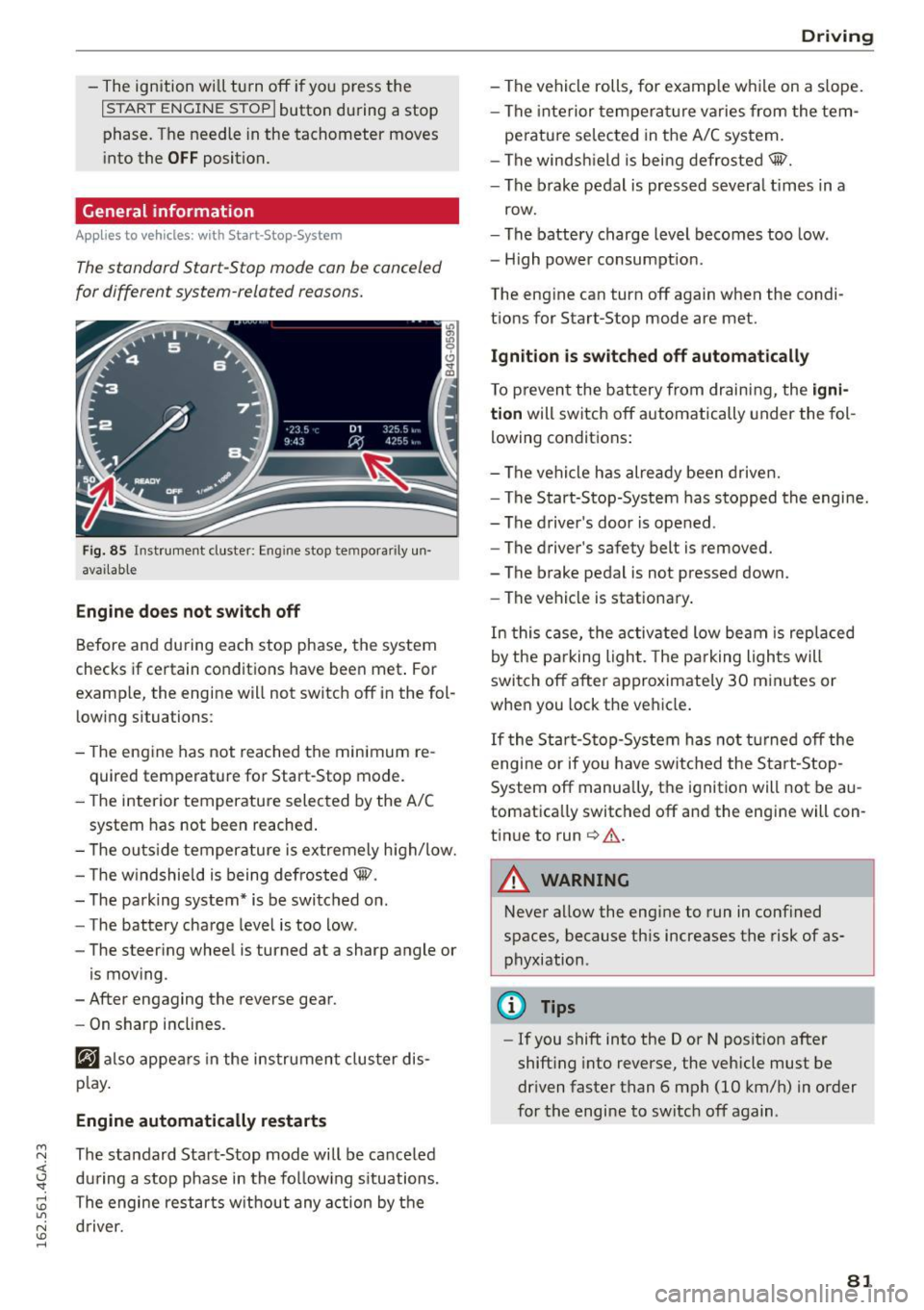
Fig. 85 Instrument cluster: Eng ine stop tempora rily un
avai lable
Engine does not switch off
Before and during each stop phase, the system
checks if certain conditions have been met . For
examp le, the engine will not switch off in the fol
lowing situations:
- The engine has not reached the minimum re
quired temperature for Start-Stop mode.
- The interior temperature selected by the A/C
system has not been reached.
- The outside temperature is extremely high/low.
- The windshield is being defrosted@.
- The parking system* is be switched on .
- The battery charge level is too low .
- The steering wheel is turned at a sharp angle or
is moving .
- After engaging the reverse gear.
- On sharp inclines.
@J also appears in the instrument cluster dis
play.
Engine automatically restarts
The standard Start-Stop mode will be canceled
during a stop phase in the following situations .
The engine restarts without any action by the driver.
Driving
- The vehicle rolls, for examp le while on a s lope.
- The interior temperature varies from the tem-
perature selected in the A/C system.
- The windshield is being defrosted@.
- The brake pedal is pressed severa l times in a
row.
- The battery charge level becomes too low.
- High power consumption.
The engine can turn off again when the condi tions for Start-Stop mode are met.
Ignition is switched off automatically
To prevent the battery from draining, the igni
tion
will switch off automatically under the fol
lowing conditions:
- The vehicle has already been driven.
- The Start-Stop-System has stopped the engine.
- The driver's door is opened .
- The driver's safety belt is removed.
- The brake pedal is not pressed down.
- The vehicle is stationary.
In this case, the activated low beam is replaced
by the parking light. The parking lights will
switch off after approximately 30 minutes or
when you lock the vehicle.
If the Start-Stop-System has not turned off the
engine or if you have switched the Start-Stop
System off manually, the ignition will not be au
tomatically switched off and the engine will con
tinue to run
c> .&. .
A WARNING
--Never allow the engine to run in confined
spaces, because this increases the risk of as
phyxiation .
@ Tips
-If you shift into the D or N position after
shifting into reverse, the vehicle must be
driven faster than 6 mph (10 km/h) in order
for the engine to switch off again .
81
Page 102 of 294
Audi side assist
(D Tips
-Si de ass ist is not active wh ile you are ma k
i ng the a djustment .
- Your settings are automat ica lly stored and
assi gned to t he remote control key being
u sed.
Driver messages
Applies to veh icles: w ith Audi side assist
If s ide ass ist switches off by itse lf, t he LED in the
button turns
off and a message w ill appear in the
i n str ument cluster d isp lay:
Audi side assist not available: sensor blocked
The radar sensors' vision is affected. Do not cover
the area in fr ont of the senso rs with bike wheels,
stic kers, dirt or oth er objects. Clean the a rea in
fro nt of the sensors, if necessa ry ¢
page 98,
fig . 107 .
Audi side assist: currently unavailable
Side assist cannot be switched on tempora rily be
cause t here is a ma lf u nction (for e xamp le , th e
battery c harge level may be too l ow).
Audi side assist: System fault!
T he system can not guara ntee that it wi ll detect
ve hicl es co rrectly a nd it is switche d off . The sen
s o rs have been disp laced or are faulty. Have the
system checke d by an auth orized A udi dealer or
author ized Audi Se rv ice Facility so on .
Audi side assist: Unavailable when towing
Side as sis t sw itches off aut omatically when a fac
to ry -insta lled t railer hitch is connected to t he
e lectr ica l co nnector on t he tra ile r. T he re is n o
gua rantee t he system w ill switch
off when using
a retrofitted tra ile r hitc h. Do n ot use s ide assist
wh en t owing a t ra ile r.
100
Page 115 of 294
M N <( I.J "". rl I.O
"' N I.O rl
Selector lever emergency release
If the vehicle's power supply fails, the selector lever can be released in an emergency.
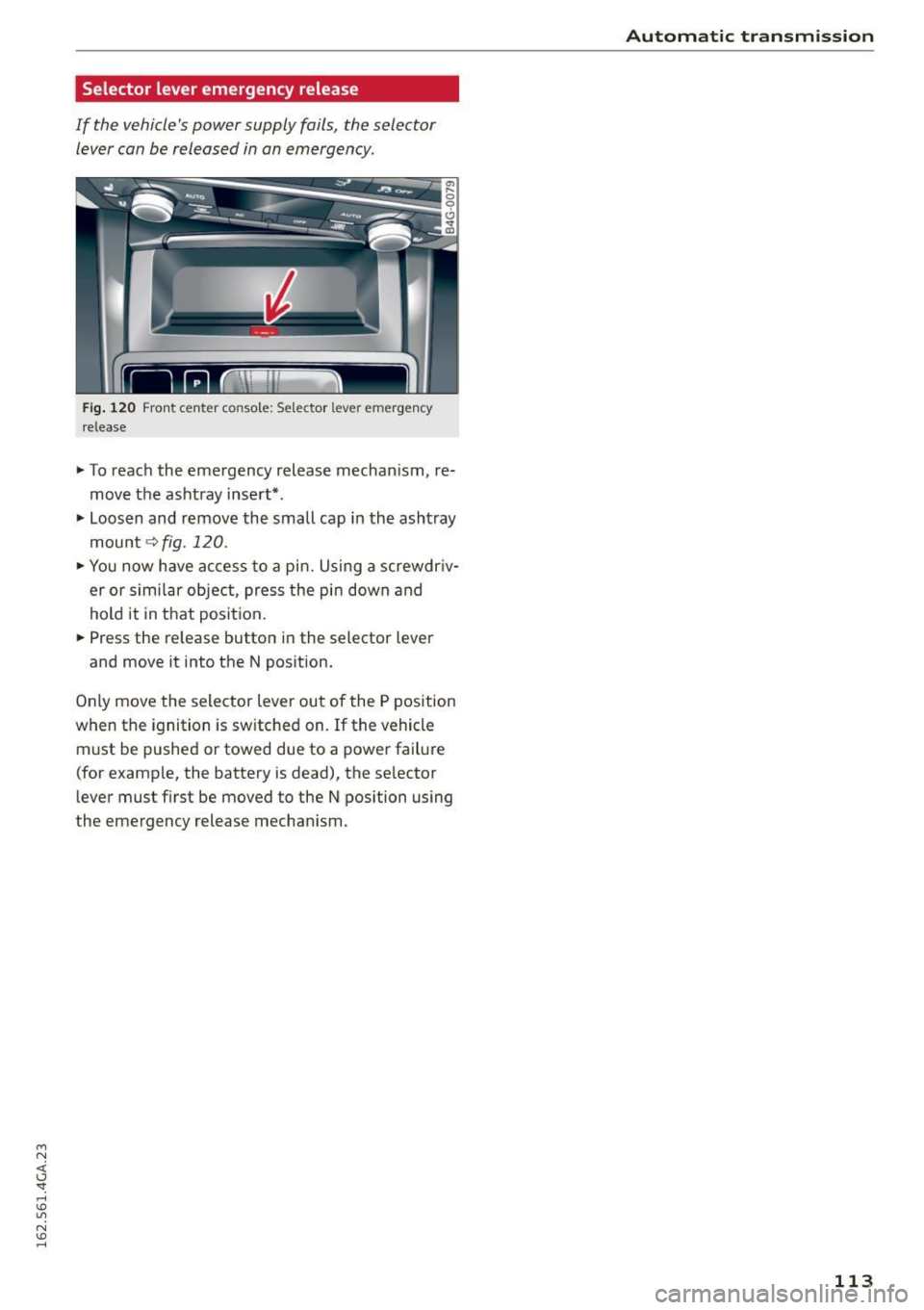
Fig . 120 Front center co nsole: Selector leve r em ergency
re lease
• To reach the emergency release mechanism, re
move the ashtray insert*.
• Loosen and remove the small cap in the ashtray
mount ¢ffg.120.
• You now have access to a pin. Using a screwdriv
er or similar object, press the pin down and
hold it in that position.
• Press the release button in the selector lever
and move it into the N position.
Only move the selector lever out of the P position
when the ignition is switched on. If the vehicle
must be pushed or towed due to a power failure
(for example, the battery is dead), the selector
lever must first be moved to the N position using
the emergency release mechanism .
Automatic transmission
113
Page 196 of 294
Intelligent Technology
& WARNING
Improp er operat ion of the rear spoiler can
cause crushing injuries.
- Always make sure that nobody, espec ially
children , is in the way when the rea r spo ile r
i s deployed or retracted.
@ Note
- Neve r push on the vehicle on the rear spoi l
er. Th is co uld cause damage .
- To prevent damage to the rear spoiler do
not lean or p lace anyth ing on it.
- Only ope rate the rear spoi ler manually when
the luggage compartment lid is close and
the rear spo iler moving parts are not
blocked . Ot herwise, damage could occur.
(D Tips
Clean the rear spoiler compartment every 2 to
3 mont hs. To function correct ly, the rear
sp oiler must be free of ice, sn ow and leav es.
Energy management
The starting ability is optimized
The energy management system manages the
ele ctrical energy distribu tion and op timi zes the
availability of elec trical energy for starting the
engine .
Whe n a ve hicle wit h a co nven tional e nergy sys
tem is not dr iven for a long time, the ba tte ry is
d rained by equipmen t (fo r example the immobil
izer). In certa in circ umstances, there cou ld may
not be eno ugh energy to start the engine .
Your veh icle i s equ ipped w ith an intellige nt ener
gy managemen t system for distr ibuting electr ic i
ty . Th is significantly improves the starti ng ability
a nd increases the battery life .
T he energy m anagemen t sys tem Is made up of
battery diagno sis, idling current management
and dynamic energy management.
Battery diagnosis
T he batte ry diagnos is determines the ba tte ry
ch arge leve l. The sen sors de te ct the ba tte ry, the
194
batte ry current, an d the batte ry tempera ture.
The c urrent charge leve l and the perfo rmance of
t h e battery are determined based on th is.
Idling current management
The idling cur ren t management decr eases the
energy used wh ile pa rke d. Wi th the eng ine
switched off, it manages the energy dis trib ution
to t he d ifferent e lectr ica l components . Date from
battery diagnos is is ta ken into acco unt for this .
Depend ing on the batte ry charge leve l, elec trical
equipmen t is switched off one item afte r th e o th
e r, to prevent the battery from dra ining and to
r etain the starting ability.
Dynamic energy management
While driv ing , d ynam ic ene rgy man agement dis
t ribu tes the ap propri ate amount of energy to the
e lectrica l equ ipment. It controls the battery
c h arge level so t hat more ene rgy is not use d then
i s be ing generated in order to maintain an opti
mal battery charge level.
(D Tips
- Energy management can not overcome the
laws of p hys ics. Note that the charge level
and length of the battery life a re limited.
- W he n the sta rting ability is endange red, the
(•j indicator light t urns on¢ page 16 .
What you should know
Maintaining the starting ability is the highest
priority .
A lot of st ress is placed on the ba ttery when dr iv
i ng sho rt distances, in t raff ic, and at cold t imes
of the year . A lot of ene rgy is used but little is
generated .
It is also critical when the engine is
not ru nning but e lectr ica l equipment is sw itched
o n. In th is case, energy is used but none is gener
ated.
In sit uat ions like this, energy ma nagement w ill
active ly regu lated the distribution of energy.
Long periods without use
If you do not drive yo ur vehicle for several days or
weeks, e lectr ica l equipment is grad ually scaled ..,.
Page 197 of 294
M N <( (.J
'SI: ,...., \!) ..,.,
N \!) ,....,
back or switched off. This reduces energy use and
ensures the vehicle will be able to start after long
periods of time . Some convenience functions,
such as interior lighting or power seat adjust ment, may not be available under certa in circum
stances . These convenience functions will be
available aga in once you switch the ignition on
and start the engine.
With the engine switched off
The battery will drain if you use functions such as
listening to the rad io while the engine is switched
off.
The vehicle's ability to start may be impaired by
the energy use, a message w ill appear in the In
fotainment system d isp lay.
The message indicates that the system will
switch off automatically soon. If you would like
to continue using the funct ions, you must start
the eng ine.
With the engine running
Although electrical energy is generated whi le
driving, the battery can drain. This can happen
when little energy is generated, and much is used
and the charge level of the battery is not optimal.
To restore the balance of energy, components
that require large amounts of energy are tempo
rarily sca led back or switched off . Heating sys
tems in particu lar require a great deal of energy .
If you notice, for example, that the seat heating*
or rear window defroster is not working, then it
has been tempo rar ily reduced or sw itched off .
These systems are available again as soon as the
ene rgy balance has been restored.
In addition, you may notice that the idle speed
h as slightly increased . That is normal and no
cause for concern. Due to the increased idling
speed , the additional required energy w ill be gen
e rat ed and the battery will be charged.
Intelligent Technology
195
Page 200 of 294
Driving and th e environment
content of the fuel be ing used. Using a differ
ent brand of fuel may help, or filling the tank
w ith lead-free super grade gasoline.
Diesel particulate filter
A pp lies to veh icles: w ith d iesel e ng in e
The diesel particulate filter filters nearly a ll of
the soot particles out of the exhaust . The filter
cleans itse lf automatically under normal driving
conditions. If the f ilter cannot clean itself (for ex
ample, because you are only driving short distan
ces), the filter becomes clogged with soot and
the
II symbo l for the diesel particulate filter il
lum inates ¢
page 20.
_& WARNING
-Do no t park your vehicle ove r flammable
materials such as g rass or leaves because
the high temperature of the diesel particu
late fi lter co uld start a fire.
-
- Do not apply an underbody protectant in the
exha ust system a rea o r a fire could start.
Placing your vehicle out
of service
If you wou ld like to take your veh icle out of serv
ice for a longer t ime, contact your authorized
Aud i dealer or authorized Aud i Service Facility.
They will advise you of important measures, such
as corrosion protection, maintenance and storage p rocedures . Also follow the informat ion about
the battery ¢
page 228.
Economical and environ
mentally-friendly driving
General
Your personal style of driving will determine the
economy of your vehicle, as well as exhaust and
noise levels .
Fuel economy, environmental impact, and wear
on your engine, brakes and t ires largely depend
on three factors:
-your personal dr iv ing style
- operating conditions
198
- technical limitat ions
If you ant ic ipate what you need to do next and
drive econom ic a lly, you can easily cut yo ur fu el
consump tion by 10-15 percent. This section will
give you some tips on how you can he lp the envi
ronment and your pocketbook .
(D Tips
'
The cons ump tion es tima tes as published by
EN VIRON MENTAL PRO TEC TION AGENCY ( EPA)
and T ransport Canada may not correspond to
your actual consumption on the road, which
will vary depending upon vehicle load and
speed, road and weather conditions, tr ip
l ength, etc.
Drive smoothly and keep a lookout ahead
Vehicles use the most fuel when they are acceler
ating.
.. Avo id unnecessary accelerating and brak ing.
Vehicles use the mos t fue l when they a re acceler
ating. I f yo u anticipate what is going to happen
next, you w ill need to b rake less and, thus, accel
erate less. Let the veh icle coast whenever possi
ble -for example when you see that the next traf
fic light is red .
Avoid full throttle
Driving at moderate speeds saves fuel and im
proves your mileage.
.. Try and keep well below your car's maximum
speed.
Acce lerating gently red uces fue l cons umption,
engine wear, and does not disturb the environ
ment .
Fuel consumpt ion, exhaust emiss ions and engine
noise increase d isproportionately at high speeds .
If you drive at approximate ly three quarte rs of
top speed, fue l consumption will be reduced by
one half. Never drive faster than the posted
speed l imit and weather cond itions permit.
Page 221 of 294
M N <( (.J
'SI: ,...., \!) 1.1'1
N \!) ,....,
-Do not remove the engine cover under any
circumstances. This increases the risk of
burns.
- If work on the fuel system or the electrical
system is necessary :
- Always disconnect the battery.
- Never smoke or work near heaters or open
flames . Fluids in the engine compartment
could start a fire.
- Keep an approved fire extinguisher imme
diately available.
- To avoid electrical shock and personal injury
while the engine is running or being started,
never touch:
- Ignition cables
- Other components of the high voltage
electronic ignition system.
-If you must perform a check or repair with
the engine running:
- First, fully apply the parking brake, move
selector lever to P (Park).
- Always use extreme caution to prevent
clothing, jewelry, or long hair from getting
caught in the radiator fan, V-belts or other moving parts, or from contacting hot
parts. Tie back hair before starting, and do
not wear clothing that will hang or droop
into the engine.
- Minimize exposure to emission and chemi
cal hazards ¢.&. .
..&, WARNING
California Proposition 65 Warning:
- Engine exhaust, some of its constituents,
and certain vehicle components contain or
emit chemicals known to the State of Cali
fornia to cause cancer and birth defects and
reproductive harm. In addition, certain flu
ids contained in vehicles and certain prod
ucts of component wear contain or emit
Checking and Filling
chemicals known to the State of California
to cause cancer and birth defects or other
reproductive harm.
- Battery posts, terminals and related acces
sories contain lead and lead compounds,
chemicals known to the State of California
to cause cancer and reproductive harms.
Wash hands after handling .
([) Note
When adding fluids, always make sure that
they are poured into the proper container or
filler opening, otherwise serious damage to
vehicle systems will occur .
® For the sake of the environment
To detect leaks in time, inspect the vehicle
floor pan from underneath regularly. If you
see spots from oil or other vehicle fluids, have
your vehicle inspected by an authorized Audi
dealer .
Closing the engine hood
.,.. Pull the hood down until the pressure from the
struts is reduced.
.,.. Let the hood
drop down and latch in place. Do
not try to push it shut;
it may fail to engage
¢ ,& .
..&, WARNING
--A hood that is not completely latched could
fly up and block your view while driving .
- When you close the engine hood, check it to
make sure the safety catch has properly en
gaged . The hood should be flush with the
surrounding vehicle body parts .
- If you notice while driving that the hood is
not secured properly, stop at once and close
it .
-
219
Page 230 of 294
Checking and F ill in g
Battery
General information
Under no rmal operating conditions, the battery
in your Audi does not need any ma intenance.
W ith
high outside temperatu res or long daily
d rives we recommend that you have the electro
lyte level checked by a service facility . The elec
trolyte level should a lso be checked each time
the battery is charged ¢
page 230.
Have the bat tery checked when you take yo ur ve
hicle in for service . You are we ll advised to re
p lace a battery that is o lder than 5 years .
W ith certa in types of airbag deploymen t, the bat
tery is disconnected from the vehicle electrica l
system for safety reasons ¢
.&. in Repair, core
and disposal of the airbags on page 158.
Disconn ecting the battery t erminal s
Some veh icle funct ions (power window regula
tors, for examp le) are lost if the battery termi
na ls are disconnected. These functions have to be
re learned after the battery terminals are con
nected aga in. To prevent this, the battery shou ld
only be disconnected from the vehicle electrical
system when absolutely necessary for repairs.
Vehicl es not driven fo r long period s
If you do not drive your vehicle over a period of
several days or weeks, e lectrica l components are
gradually cut back or switched off. This reduces
energy consumption and maintains starting ca pability over a longer period¢
page 194. Some
of the convenience funct ions may not operate,
such as the inter ior lights or power seat adjust
ment. The convenience functions will be ava ilab le
again whe n you swit ch on the igni tion and sta rt
the engine.
Winte r operation
During the winter months, battery capacity tends
to decrease as temperatures drop . This is because
mo re power is also consumed w hile starting, and
the head lights, rear w indow defogger, etc ., are
used more often.
Avoid unnecessary power consumption, part icu
larly in city traffic or when traveling only short
228
distances. Let your authorized Audi dealer check
the capacity of the vehicle battery before winter
sets in
¢ page 230 . A well charged battery will
not only prevent starting problems when the
weather is cold, but will also last longer.
(D Tips
If your vehicle is left standing for several
weeks at extremely low temperatures, the ve
hicle battery should be removed and stored
where it will not freeze . This will prevent it
from being damaged and having to be re
placed.
Working on the battery
Be especially careful when working on or near
the battery.
The battery is located in the luggage compart
ment under the floor . Before you check anything
i n the luggage compartment,
re ad and he ed all
WARNINGS ¢&, .
Always heed the safety warning s, when working
o n the vehicle battery or the vehicle e lectr ical
system to prevent injury .
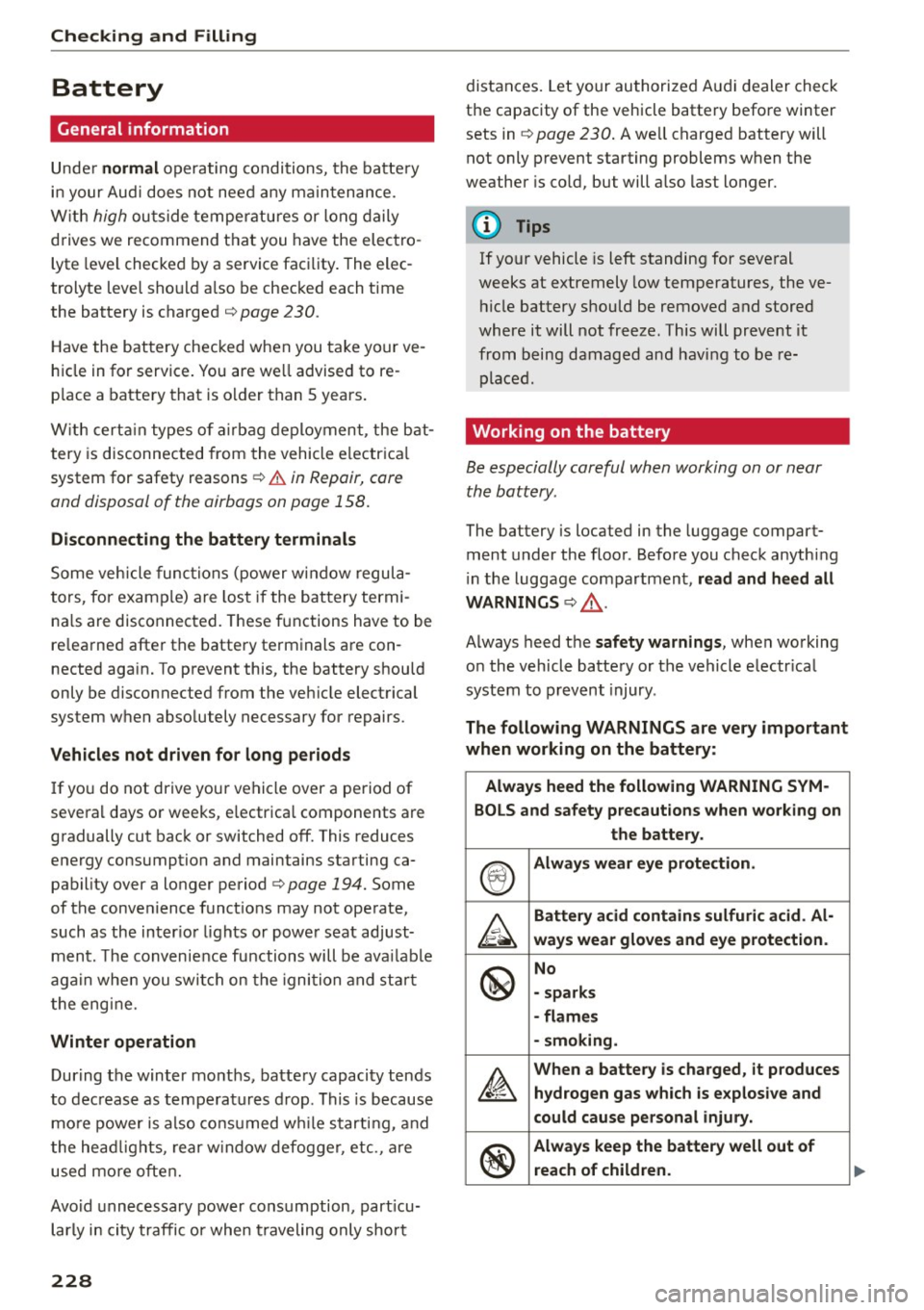
The following WARNING S are very important
when working on the battery :
Alw ay s heed the following WARNING SYM ·
BOL S and safety p recaut ions when wo rking on
the batter y.
®
Alw ay s w ear e ye protection .
~
Battery acid contains sulfuric acid . Al -
way s wear gloves and ey e protection .
@
No
· spark s
· flames
· sm oking.
~
When a battery is charged , it p roduce s
h yd rogen gas which is e xplosi ve and
'
could cause per sonal injury .
®
Always keep the battery well out of
r ea ch of ch ild ren.
...