cruise control AUDI A7 2016 Owner's Manual
[x] Cancel search | Manufacturer: AUDI, Model Year: 2016, Model line: A7, Model: AUDI A7 2016Pages: 294, PDF Size: 73.82 MB
Page 96 of 294
Audi active lane assist
Audi active lane assist Lane assist
Description
A pp lies to veh icles: w ith Audi active lane assist
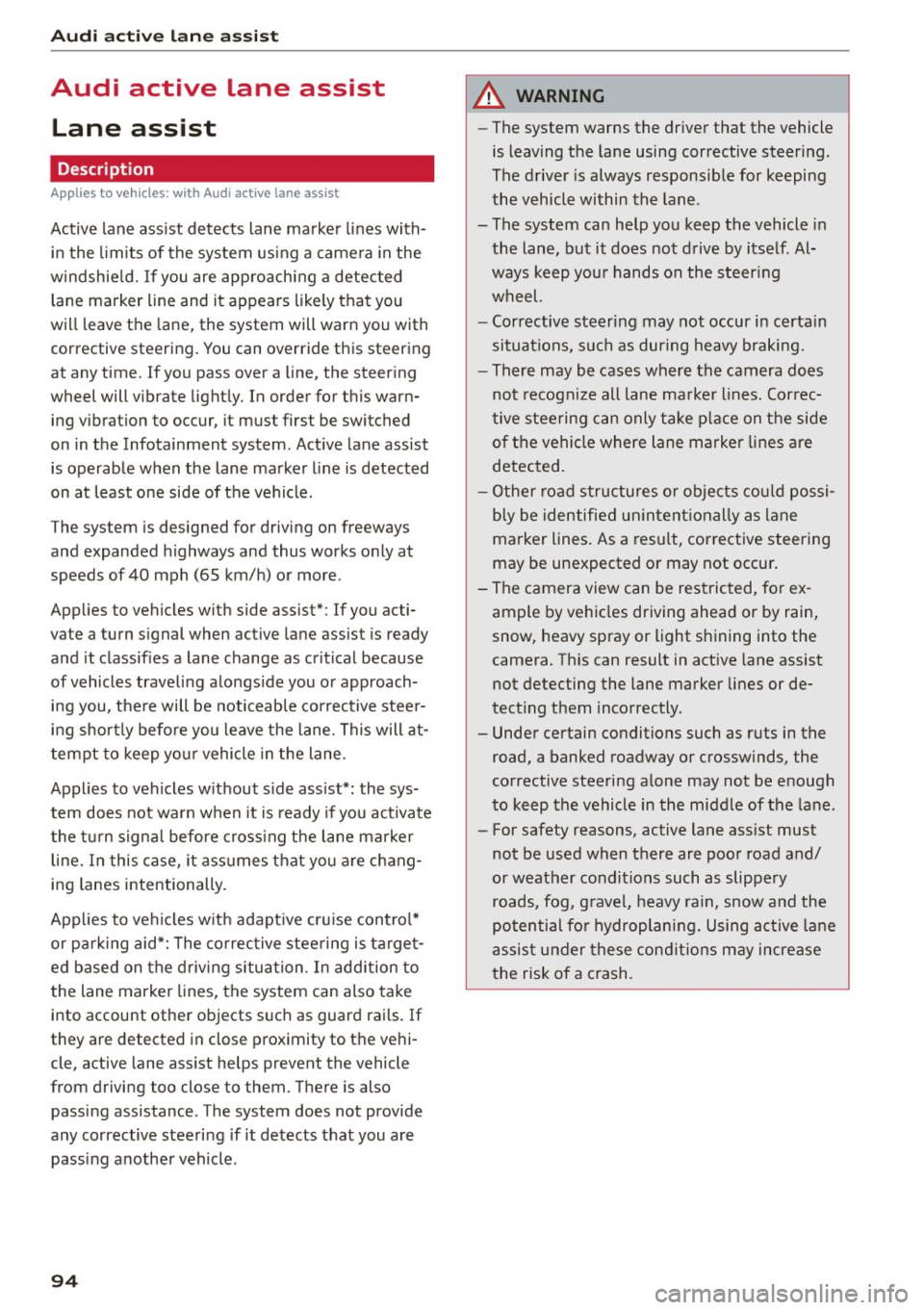
Active lane assist detects lane marker lines with
in the limits of the system using a camera in the
windshield. If you are approaching a detected lane marker line and it appears likely that you
will leave the lane, the system will warn you with
corrective steering. You can override this steering
at any time. If you pass over a line, the steering
wheel will vibrate lightly. In order for this warn
ing vibration to occur, it must first be switched
on in the Infotainment system. Active lane assist is operable when the lane marker line is detected
on at least one side of the vehicle.
The system is designed for driving on freeways
and expanded highways and thus works only at
speeds of 40 mph (65 km/h) or more .
Applies to vehicles with side assist*: If you acti
vate a turn s ignal when active lane assist is ready
and it classifies a lane change as critical because
of vehicles traveling alongside you or approach ing you, there will be noticeable corrective steer
ing shortly before you leave the lane. This will at
tempt to keep your vehicle in the lane.
Applies to vehicles without side assist*: the sys
tem does not warn when it is ready if you activate
the turn signal before crossing the lane marker line. In this case, it assumes that you are chang
ing lanes intentionally.
Applies to vehicles with adaptive cruise control*
or parking aid*: The corrective steering is target
ed based on the driving situation. In addition to
the lane marker lines, the system can also take
into account other objects such as guard rails. If
they are detected in close proximity to the vehi
cle, active lane assist helps prevent the vehicle
from driving too close to them. There is also
passing assistance . The system does not provide
any corrective steering if it detects that you are
passing another vehicle.
94
A WARNING
-
- The system warns the driver that the vehicle
is leaving the lane using corrective steering.
The driver is always responsible for keeping
the vehicle within the lane.
- The system can help you keep the vehicle in the lane, but it does not drive by itself. Al
ways keep your hands on the steering
wheel.
- Corrective steering may not occur in certain
situations, such as during heavy braking.
- There may be cases where the camera does
not recognize all lane marker lines. Correc
tive steering can only take place on the side
of the vehicle where lane marker lines are
detected.
- Other road structures or objects could possi
bly be identified unintentionally as lane marker lines. As a result, corrective steering
may be unexpected or may not occur.
- The camera view can be restricted, for ex
ample by vehicles driving ahead or by rain,
snow, heavy spray or light shining into the
camera. This can result in active lane assist
not detecting the lane marker lines or de
tecting them incorrectly.
- Under certain conditions such as ruts in the
road, a banked roadway or crosswinds, the
corrective steering alone may not be enough
to keep the vehicle in the middle of the lane.
- For safety reasons, active lane assist must
not be used when there are poor road and/
or weather conditions such as slippery roads, fog, gravel, heavy rain, snow and the
potential for hydroplaning. Using active lane
assist under these conditions may increase
the risk of a crash.
Page 103 of 294
M N <( (.J
'SI: ,...., \!) ..,.,
N \!) ,....,
Audi drive select Driving settings
Introduction
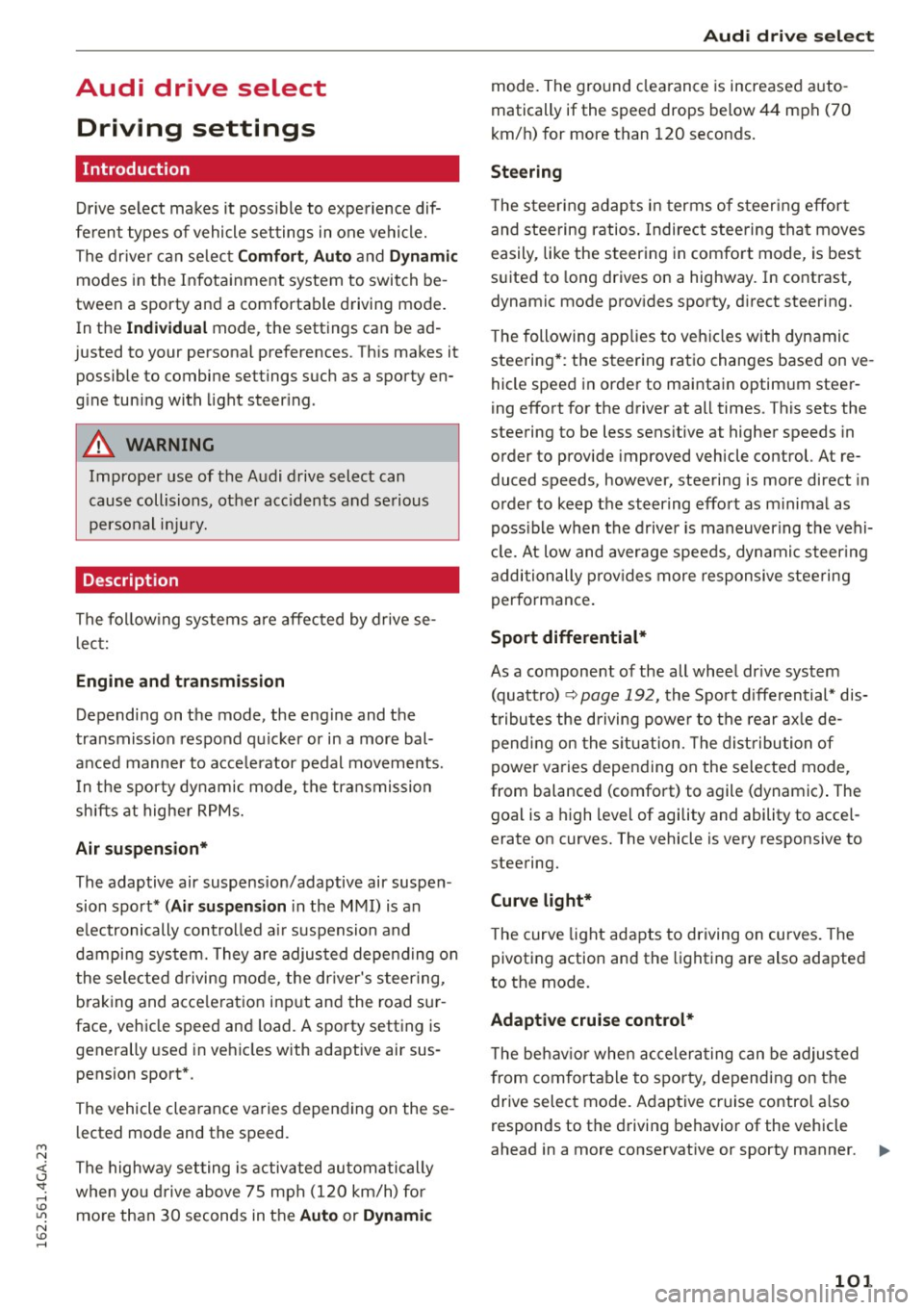
Drive select makes it possible to experience dif
ferent types of vehicle settings in one vehicle.
The driver can select
Comfort, Auto and Dynamic
modes in the Infotainment system to switch be
tween a sporty and a comfortable driving mode.
In the
Individual mode, the settings can be ad
justed to your personal preferences. This makes it possible to combine settings such as a sporty en
g ine tun ing with light steering.
_&. WARNING
Improper use of the Audi drive select can
cause collisions, other acc idents and serious
personal injury.
Description
-
The follow ing systems are affected by drive se
lect:
Engine and transmission
Depending on the mode, the eng ine and the
transmission respond quicker or in a more bal
anced manner to acce lerator pedal movements.
I n the sporty dynamic mode, the transmission
shifts at higher RPMs.
Air suspension*
The adaptive air suspension/adaptive air suspen
sion sport*
(Air suspension in the MMI) is an
e lectronically controlled a ir suspension and
damping system. They are adjusted depending on
the selected driving mode, the driver's steering,
b raking and acce leration input and the road sur
face, vehicle speed and load. A sporty setting is generally used in vehicles with adaptive air sus
pension sport*.
The vehicle clearance varies depending on these lected mode and the speed.
The highway setting is activated automatically
when you drive above 75 mph (120 km/h) for
more than 30 seconds in the
Auto or Dynamic
Audi drive select
mode. The ground clearance is increased auto
matically if the speed drops below 44 mph (70
km/h) for more than 120 seconds.
Steering
T he steering adapts in terms of steer ing effort
and steering ratios . Indirect steering that moves
easily, like the steering in comfort mode, is best
suited to long drives on a highway. In contrast,
dynamic mode provides sporty, direct steering.
T he following applies to vehicles with dynamic
steering*: the steering ratio changes based on ve
hicle speed in order to maintain optimum steer
ing effort for the driver at all times. This sets the
steering to be less sensitive at higher speeds in
order to provide improved vehicle control. At re
duced speeds, however, steering is more direct in
order to keep the steering effort as minimal as
poss ible when the driver is maneuvering the vehi
cle. At low and average speeds, dynamic steer ing
additionally provides more responsive steering
performance.
Sport differential*
As a component of the all wheel dr ive system
(quattro)
¢ page 192, the Sport differential* dis
tributes the driving power to the rear axle de
pending on the sit uation. The distribution of
power varies depending on the selected mode,
from balanced (comfort) to agile (dynamic) . The
goal is a high level of agility and ability to accel
erate on curves. The vehicle is very responsive to
steering.
Curve light*
T he curve light adapts to driving on curves. The
pivoting action and the lighting are also adapted
to the mode.
Adaptive cruise control*
T he behav ior when accelerating can be adjusted
from comfortable to sporty, depending on the
drive select mode. Adaptive cruise control a lso
responds to the driving behavior of the vehicle
ahead in a more conservative or sporty manner. ..,_
101
Page 105 of 294

M N <( (.J
'SI: ,...., \!) 1.1'1
N \!) ,....,
After you have closed the settings, you are auto
matica lly driving in the
Individual driving mode.
Systems Comfort
Engine/Transmission
balanced
air suspension* comfortable
Steering comfortable
Audi drive select
The equipment in your vehicle will determine
which settings you can adjust . The following ta
ble g ives an overview of the characteristics.
Auto Dynamic
balanced sporty
ba lanced sporty
ba lanced sporty
Dynamic
steering* comfortable/indirect ba lanced/direct sporty/direct
Sport differential* balanced
Adaptive cruise control* comfortable
Engine sound* subtle
a) Subtle in the se lector lever position D and sporty in S.
(D Tips
Your Ind ividual mode settings are automat i
cally stored and assigned to the remote con
trol key being used.
Raising/lowering the
vehicle
A ppl ies to vehicles: with a daptive air s uspensio n
Raising the vehicle
You can ra ise your veh icle temporarily, for exam
p le to drive over a tall curb.
.,. Select the following in the Infota inment sys
tem: the
ICARI function button > Raise control
button .
.,. Wait for the arrows in the Infotainment system
display to stop blinking and the vehicle to reach
its fina l position.
Lowering the vehicle
.,. To lower the vehicle, select the follow ing in the
Infotainment system: the
! CARI function button
> Lower control button .
.,. Wait for the arrows in the Infotainment system
display to stop blinking and the vehicle to lower
completely .
(D Note
-Remember that your veh icle is not suitable
for driving offroad even when it is raised.
There is not enough ground clearance . ag
ile sporty
ba lanc ed sporty
subtle/sportyal sporty
- If the vehicle is raised, it wi ll lower auto
matically when driving 62 mph (100 km/h)
or faster.
Driver messages
App lies to vehicles: wit h adaptive a ir suspens ion
Air suspension : Vehicle is too high. Controlling
level. ..
Air suspension: Vehicle is too low. Controlling
level. ..
The driver message switches off when the level
control process is complete .
103
Page 112 of 294
Automatic transmission
-Do not ride the brakes or press the brake
pedal too often or too long when driving
down a hill. Constant braking causes the
brakes to overheat and substantially re
duces braking performance, increases brak
ing distance or causes complete failure of
the brake system .
- To prevent the vehicle from rolling back
when stopping on inclines, always hold it in
place with the brake pedal or parking brake.
- Never hold the vehicle on an incline with a
slipping clutch. The clutch opens automati
cally when it becomes too hot from the
overload . An indicator lamp
mJ illuminates
and a driver message appears¢
page 112
when the clutch is overloaded.
-If the engine must remain running, never
have any driving position engaged when
checking under the hood. Make sure these
lector lever has securely engaged and is
locked in P with the parking brake set
¢page 218. Otherwise, any increase in en
gine speed may set the vehicle in motion,
even with the parking brake applied.
@ Note
- When stopping on an incline, do not try to
hold the vehicle in place by pressing the ac
celerator pedal while a driving gear is se lected . This can cause the transmission to
overheat and can damage it . Activate the
parking brake or press the brake pedal to
prevent the vehicle from rolling.
- Allowing the vehicle to roll when the engine
is stopped and the selector lever is in N will
damage the transmission because it is not
lubricated under those circumstances.
@ Tips
For safety reasons, the parking brake is re
leased automatically only when the driver's
safety belt is engaged in the buckle.
110
· Hill descent control
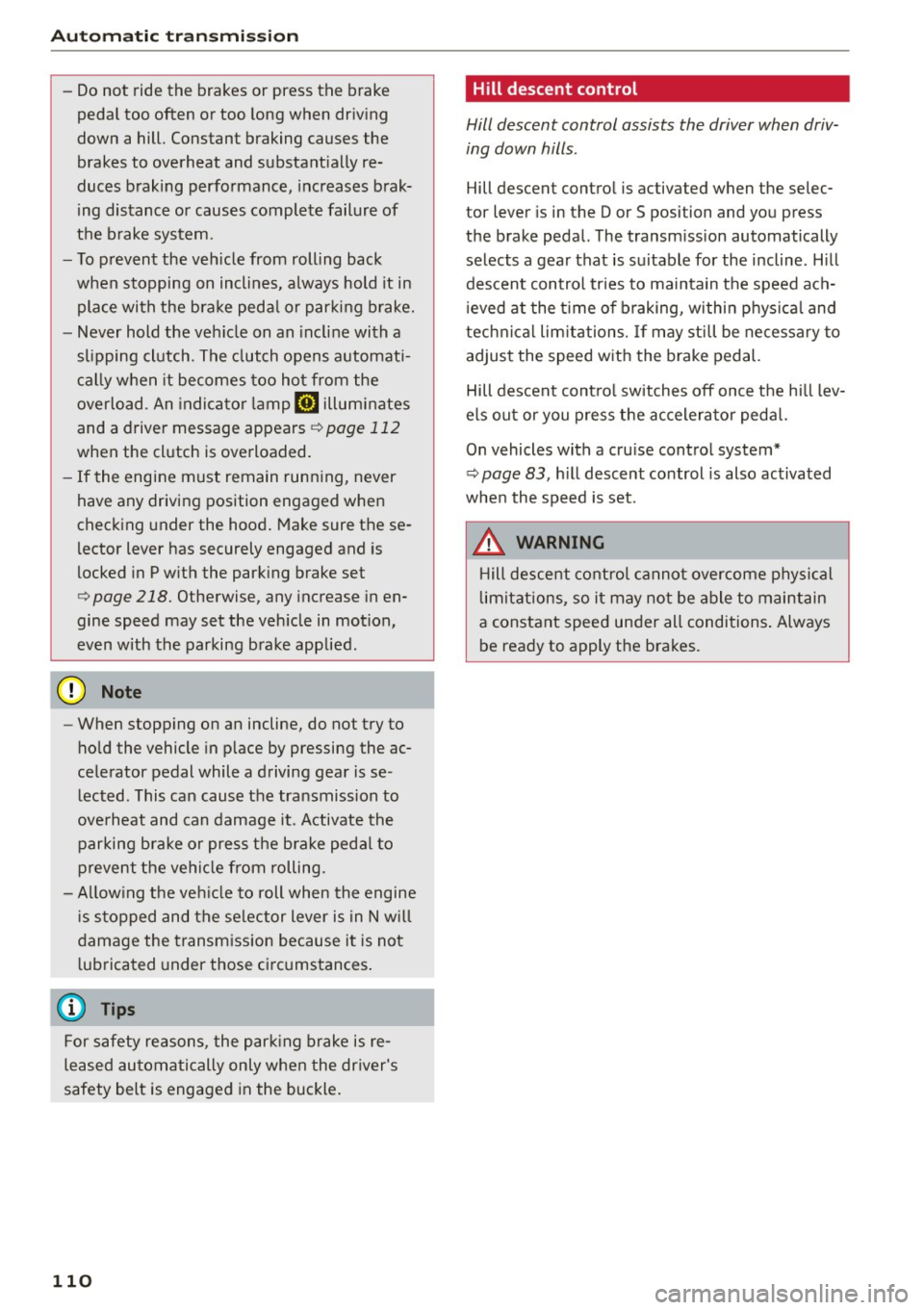
Hill descent control assists the driver when driv
ing down hills .
Hill descent control is activated when the selec
tor lever is in the D or S posi tion and you press
the brake pedal. The transmission automatically selects a gear that is suitable for the incline . Hill
descent control tries to maintain the speed ach
ieved at the time of braking, within physical and
technical limitations. If may still be necessary to
adjust the speed with the brake pedal.
Hill descent control switches off once the hill lev
els out or you press the accelerator pedal.
On vehicles with a cruise control system*
¢
page 83, hill descent control is also activated
when the speed is set.
A WARNING
Hill descent control cannot overcome physical
limitations, so it may not be able to maintain
a constant speed under all conditions. Always be ready to apply the brakes.
Page 187 of 294
M N <( (.J
'SI: ,...., \!) 1.1'1
N \!) ,....,
Audi pre sense Preventative passenger
protection
App lies to veh icles: with Audi p re se nse
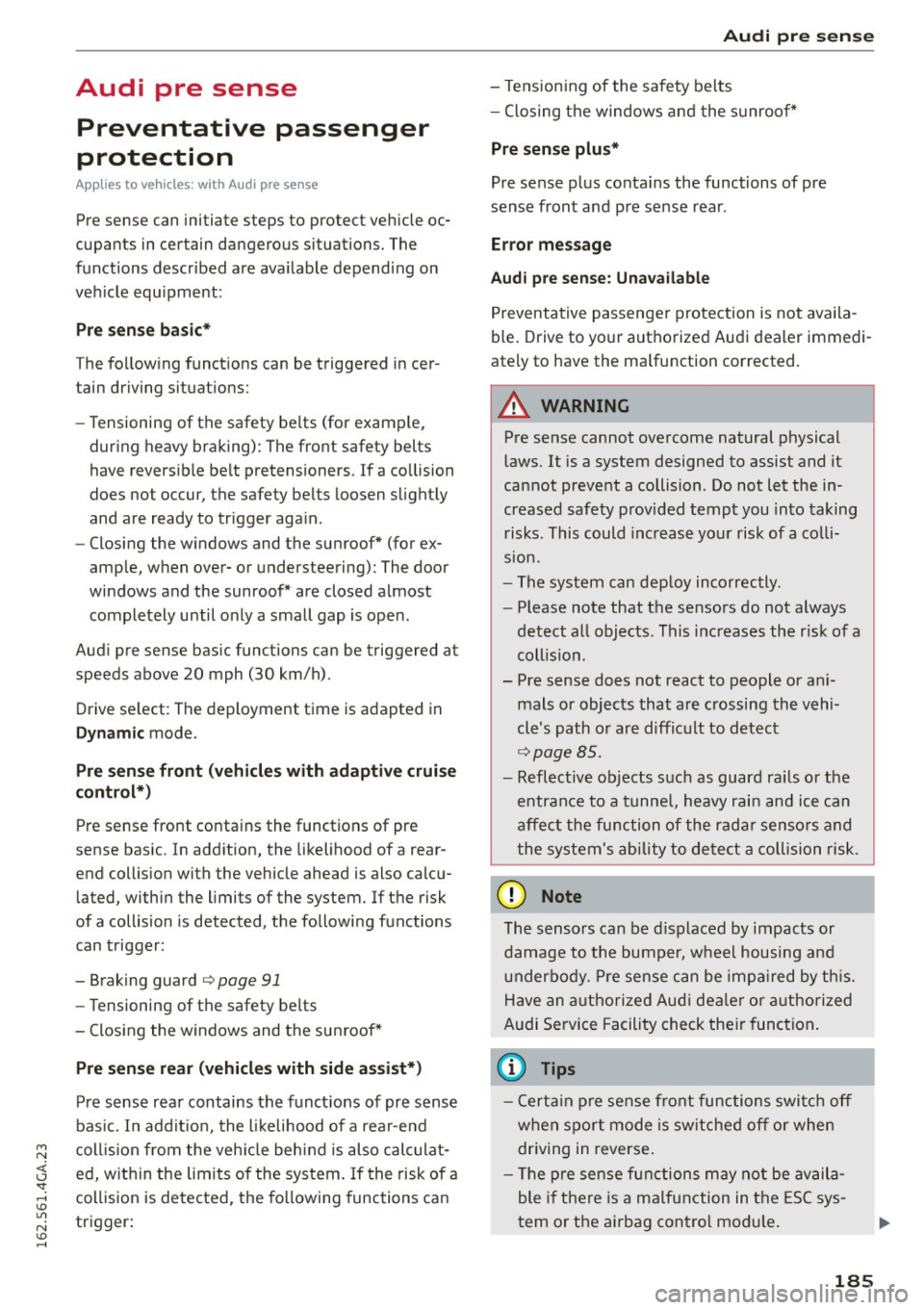
Pre sense can initiate steps to protect veh icle oc
cupa nts in certain dangerous situations. The
functions descr ibed a re ava ilable depending on
ve hicle equ ipme nt:
Pre sense ba sic*
The fo llow ing funct ions can be triggered in cer
tain driving situations:
- Tensioning of the safety be lts (for example,
during heavy b raking) : The front safety belts
have revers ib le be lt pretensioners. If a collision
does not occur, the safety belts loosen sli ght ly
and are ready to trigger aga in.
- Clos ing the windows and the sunroof* (for ex
amp le, when over- or understeering): The door
windows and the sunroof* are closed almost
completely until o nly a sma ll gap is open .
Audi pre sense basic functions can be triggered at
speeds above 20 mph (30 km/h).
Drive se lect: The deployment time is adapted in
Dynamic mode .
Pre sense front (vehicles with adaptive cruise
control* }
Pre sense front contains the functions of pre
sense basic . In add ition, the likelihood of a rear
end collis ion with the vehicle ahead is also calcu
lated, within the limits of the system. If the risk
of a collision is detected, the following functions
can trigger:
- Brak ing guard
¢ page 91
-Tensioning of the safety be lts
- Closing the w indows and the sun roof*
Pre sense rear (v ehicles with side assist* }
Pre sense rea r contains the funct ions of pre sense
bas ic. I n addit io n, the li kelihood of a rea r-end
coll is ion from the veh icle behi nd is also calc ulat
ed, w it hi n the lim its of the system. If the risk of a
collision is de tected, the following functions can
trigger :
Audi pre sense
-Tens ion ing of the sa fe ty belts
- Clos ing the windows an d the s unroo f*
Pre sense plus*
P re sense p lus conta ins the functions of pre
sense front and p re se nse rea r.
Error mes sage
Aud i pre sense: Unavailable
Preventative passenge r protection is not availa
ble. Drive to yo ur autho rized Audi deale r immedi
ately to have the ma lfunction corrected.
A WARNING
-
Pre sense cannot overcome natural physical
l aws. It is a system designed to assist and it
ca nnot prevent a collision. Do not let the in
creased safety prov ided temp t you into taking
risks . This could incr eas e yo ur risk of a co lli
s ion.
- The system can deploy incorrectly .
- Please note that t he sensors do not always
detect a ll objects . This inc reases the r isk of a
coll is io n.
- Pre sense does not react to people or a ni
mals or objec ts that are crossi ng the vehi
cle 's path o r are difficult to det ect
¢ page 85.
-Reflec tive ob jects s uch as guard rai ls o r the
entrance to a tunne l, heavy rai n and ice can
a ffec t the fu nction of the rada r senso rs and
t he system's ability to de te ct a co llision risk.
(D Note
The sensors can be d isplaced by impacts or
d amage to the bumper, w heel housing a nd
u nder body. Pre se nse can be impa ired by th is .
H ave an a utho riz e d Aud i de aler o r au th orized
A udi Service Facility check the ir func tion .
(D Tips
-Certa in p re sense fro nt functions swi tch off
w he n sp o rt mode is sw itche d off or w hen
dr iving in reverse .
- T he p re sense fun ctions m ay not be av aila
b le i f th ere is a m alfu nction in t he ES C sys
tem or t he a irbag con tro l mod ule.
185
Page 190 of 294
Intelligent Technology
shared, p le a se see yo ur contract with the
wireless telecomm unications provider and the
"About Aud i connect" tab in your vehicle's
MMI:
! MENUI button> Audi connect > About
Audi connect .
Electronic Stabilization
Control (ESC)
Description
ESC helps to improve road holding and vehicle
dynamics to help reduce the probability of sk id
d ing and loss of veh icle control.
It works only
when the engine is runn ing. ESC detects certa in
d ifficult d riving situations, including when the ve
h icle is beginn ing to sp in (yaw) o ut of control and
he lps you to ge t the veh icle back u nder cont ro l b y
selec tively braking the whee ls, and/or reduc ing
engine power and providing steering assistance
to help hold the vehicle on the driver's i ntended
course. The indicator light
DJ in the instrument
cluster blinks when ESC is taking action to help
you control t he veh icle.
ESC has lim itations. It is important to remember
that ESC cannot overcome the laws of physics. It
will not a lways be ab le to he lp out under all con
d itions you may come up against. For example,
ESC may not always be able to help you master
situations where there is a sudden change in the
coefficient of friction of the road surface. Whe n
there is a section of d ry road tha t is s udden ly cov
ere d wi th wa ter, s lush or snow, ESC ca nnot per
form the same way it wou ld on the d ry s urface . If
the vehicle hydroplanes ( rides on a cushion of wa
ter instead of t he road surface), ESC wi ll not be
ab le to he lp you steer the veh icle because contact
with the pavement has been i nterrupted and the
ve hicle cannot be b raked or steered. Dur ing fast
cor ne ring, particula rly o n w inding roads, ESC
cannot a lways deal as eff ect ively wi th d iff icu lt
d riving situat ions than at lowe r speeds.
Always ad just your speed and dr iv ing style to
road, traffic and weather conditions. ESC ca nnot
over ride the vehicle's physical limi ts, increase t he
ava ilab le tract io n, or keep a vehi cle on t he road if
roa d de pa rture is a res ult o f driver in att enti on.
I nstead, ESC improves the poss ibility of keeping
188
the veh icle unde r control and on the road dur ing
extreme maneuve rs by using the dr iver's stee ring
i nputs to help keep the vehicle going in the in
tended direction. If yo u are traveling at a speed
that causes you to run off the road before ESC
can p rov ide any assistance, you may not experi
ence the benefits of ESC.
ESC is switc hed on all the time. In certain s itua
tions when you need less tracti on, you can switch
off ASR by press ing the button
[ru c:> page 189,
fig . 178. Be sure to sw itch ASR on aga in when
you no longer need l ess traction.
The following systems are integrated in the ESC:
Anti -lock braking system (ABS )
ABS prevents the whee ls from locki ng when brak
i ng . T he veh icle can st ill be stee red even during
hard braking. App ly steady pressure to the brake
pedal. Do not pump the pedal. A puls ing in the
brake pedal indicates that the system is acting to
stab ilize the veh icle.
Brake assist sy stem
The bra ke ass ist system can decrease braking dis
tance. It increases bra king power when the driver
presses the brake peda l quickly in emergency sit
uat ions. You must press and hold the b rake peda l
u nt il the dange rous situat io n is over . In vehicles
with adaptive cruise co ntro l*, the brake ass ist
system is more sensitive if t he d ista nce detected
to t he veh icle a head is too sma ll.
Anti-slip regulation (ASR)
ASR red uces eng ine power when the drive wheels
begin spin ning and adapts the force to the road
cond it ions . Th is makes it eas ier to sta rt, acce ler
ate a nd dr ive up incl ines.
Electronic differential lock (EDL)
EDL applies t he brakes to a whee l that starts
sp inning a nd tra nsfe rs the d rive power to the
othe r drivi ng whee ls. This function is not ava ila
ble at hig he r speeds.
In extreme cases, EDL automatically sw itches off
to keep the brake o n the braked whee l from over
hea ting. The vehicle is st ill work ing cor rect ly. EDL ..,.
Page 192 of 294
Intelligent Technology
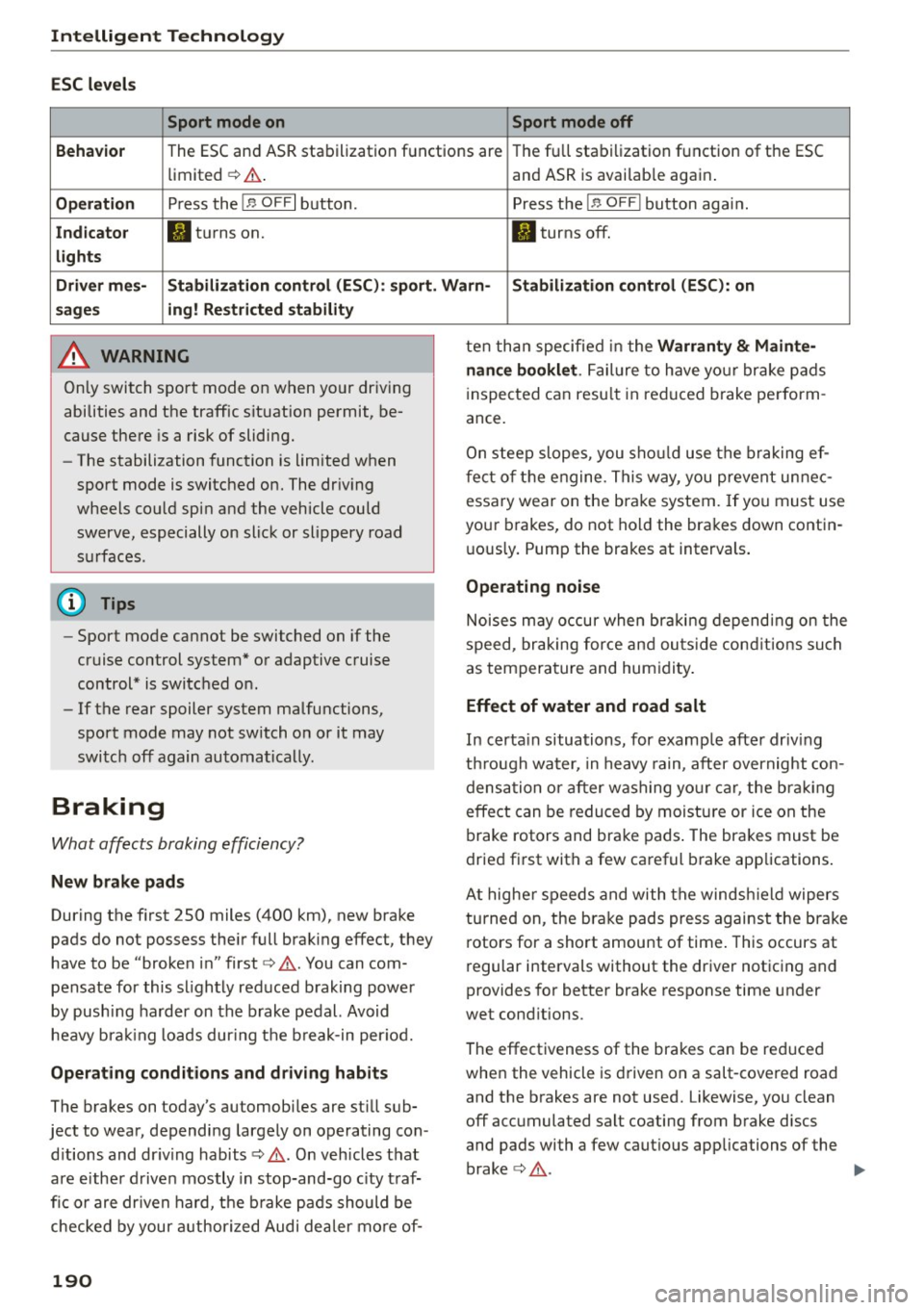
ESC lev els
Sport mode on Sport mode off
Beha vior
The ESC and ASR stabilization f unctions are The full stabilization function of t he ESC
limited
c> ,& . and ASR is avai lab le again .
Operation Press the 1.$ OFF I button. Press the 1.$ OFF I button agai n.
In dicato r II turns on. II turns off.
light s
Driv er m es- S ta bi liz at ion contr ol (ESC ): sport. Warn -Stabiliz ati on c ontr ol (ESC ): on
s age s ing! Res tricted stabilit y
A WARNING
Only switch sport mode on when yo ur driving
abilities and the traffic situation permit, be
cause there is a risk of sliding.
- The stabilization function is limited when
sport mode is switched on. The dr iv ing
wheels could spin and the vehicle could
swerve, especially on slick or slippery road
s u rfaces .
(D Tips
-Sport mode cannot be switched on if the
cruise control system* or adaptive cruise
control* is switched on.
- If the rear spoiler system malfunctions,
sport mode may not switch on or it may
switch off again automat ically.
Braking
What affects braking efficiency?
New brake pads
During the f irst 250 miles (400 km), new brake
pads do not possess the ir full braking effect, they
have to be "broken in" first
c> ,& . You can com
pensate for this sl ightly reduced brak ing power
by pushing ha rder on the brake pedal. Avoid
heavy brak ing loads dur ing the b reak-in per iod.
Operat ing condit ions and d riving hab its
The brakes on today's automobi les are st ill sub
ject to wear, depending largely on operating con
d itions and dr iving habits
c> ,& . On veh icles that
are either driven mostly in stop-and-go c ity t raf
fic or are dr iven hard, the b rake pads should be
checked by your author ized Audi dea ler mo re of -
190
ten than specified in the Warrant y & Mainte
nan ce b ookl et.
F ail ure to have your brake pads
inspected can resu lt in reduced brake perform
ance.
On steep slopes, you sho uld use the braking ef
f ect of the engine. This way, you prevent unnec
essary wear on the brake system. If yo u must use
you r brakes, do not hold the brakes down contin
u ously. Pump the brakes at intervals .
Operating noise
Noises may occur when braking depend ing on the
speed, braking force and ou tside cond itions su ch
as temperature and hum idity .
Effect of wat er and road salt
In certa in situations, for examp le after driv ing
t hr ough water, in heavy rain, after overnight con
densa tion or after washing yo ur ca r, the bra king
effect can be reduced by moisture or ice on the
brake rotors and brake pads . The brakes must be
dried fi rst with a few careful brake applications .
At higher speeds and with the winds hield wipers
turned on, the brake pads press against the brake rotors for a short amount of time . This occurs at
r egular intervals without the driver noticing and
provides for better brake response time under
wet cond itions .
The effect iveness of the brakes can be reduced
when the vehicle is d riven on a salt-covered road
and the brakes are not used. Likewise, you clean
off accumulated salt coating from brake discs
and pads wi th a few caut ious applications of the
brake
c> ,& . IJI>
Page 279 of 294
M N <( (.J
'SI: ,...., \!) 1.1'1
N \!) ,....,
means that you risk both a substantia l reduction
in the operational safety of your vehicle and an
increased wear of vehicle parts~.& .
Author ized Audi dealers w ill perform this work in
a professiona l and competent manner or , in spe
cial cases, refer you to a professional company
that spec ializes in such modifications.
A WARNING
Improper repairs and modifications can
change the way vehicle systems work and
cause damage to the veh icle and ser ious per
sonal injury .
If emergency repairs must be performed e lse
where, have the veh icle examined by an au
thorized Audi dealer as soon as possib le .
Declaration of
Compliance, Telecommu nication and Electronic
Systems
Radio Frequency Devices and Radiocommunica
tion Equipment User Manual Notice.
T he manufacturer is not responsible for any radio
or TV interference caused by unauthorized modi
fications to this equipment.
De vices
The fo llow ing devices each comply w ith FCC Part
15.19, FCC 15.21 and RSS-Gen Issue
1:
- Adaptive cruise control*
- Audi side assist*
- Cell phone package*
- Convenience key*
- Electronic immob ilizer
- Garage door opener (Home link)*
- Remote contro l key
FCC Part 15.19
This device complies with part 15 of the FCC
Rules . Operation is subject to the following two
conditions :
Co nsum er information
(1) This device may not cause harm ful interfe r
ence , and
(2) this device must ac cept any inte rfe rence re
ce ived, in clu ding in terference that may cause un
desired operation.
FCC Part 15.21
CAUT ION:
Changes or mod ificat ions not expressly approved
by the party responsible for compliance could
vo id the user's authori ty to ope rate the equ ip
me nt.
RSS-Gen Is sue 1
Operation is subject to the follow ing two condi
tions:
(1) this device may not ca use interference, and
(2) this devi ce must ac cep t any inte rference , in
clud ing interference that may cause undesired
operation of the device .
277
Page 280 of 294
Index
A
A/C (four -zone automat ic climate control) . . 7 1
A/C (three-zone climate control) . . . . . . . . . . 69
Accessories . . . . . . . . . . . . . . . . . . . . . . . 59, 276
Active lane ass ist . . . . . . . . . . . . . . . . . . . . . . 94
Ad justing the vibration warning . . . . . . . . . 96
C leaning the camera area . . . . . . . . . . . . . 206
Driver messages . . . . . . . . . . . . . . . . . . . . . . 95
Indicator light . . . . . . . . . . . . . . . . . . . . . . . 95
sw itching on and
off . . . . . . . . . . . . . . . . . . 95
Adapt ive a ir s uspension/spo rt . . . . . . . . . . . 101
Adapt ive cruise control . . . . . . . . . . . . . . . . . . 85
Clean ing the sensor . . . . . . . . . . . . . . . . . . 206
Messages . . . . . . . . . . . . . . . . . . . . . . . . . . . 92
Request fo r driver intervention . . . . . . . . . . 90
S top-and-go traffic . . . . . . . . . . . . . . . . . . . 89
Adapt ive Light (defective) . . . . . . . . . . . . . . . 22
AdB lue. ... . ... ... .. .. ..... ... .. .. ... 214
Messages . . . . . . . . . . . . . . . . . . . . . . . . . . 215
Opening the tank door......... .. .. .. . 215
Refilling . .. .. ................. .. ... 215
Adding Engine coolant . . . . . . . . . . . . . . . . . . . . . . 225
E ng ine oil . . . . . . . . . . . . . . . . . . . . . . . . . . 222
W indshield washer fluid . . . . . . . . . . . . . . 231
Addit ives
E ngine oi l . . . . . . . . . . . . . . . . . . . . . . . . . . 222
Ad justing
Fr ont seats . . . . . . . . . . . . . . . . . . . . . . . . . . 53
Steer ing colum n elec trically . . . . . . . . . . . . 74
S teer ing column manually . . . . . . . . . . . . . 74
Adjusti ng a ir distribution (fou r- zone automat -
ic climate control) . . . . . . . . . . . . . . . . . . . . . . 72
Ad justing a ir distribution (three-zone climate
control) . . . . . . . . . . . . . . . . . . . . . . . . . . . . . . 69
Adj usting the temperat ure (fou r-zone au to-
matic climate control) . . . . . . . . . . . . . . . . . . 71
Ad justing the tempe ratu re (three-zone cl i-
ma te con trol) . . . . . . . . . . . . . . . . . . . . . . . . . 69
advanced key
refer to Convenience key . . . . . . . . . . . . . . . 7 5
Airbag . . . . . . . . . . . . . . . . . . . . . . . . . . . . . . 143
Ai rbag system . . . . . . . . . . . . . . . . . . . . . . . . 163
Advanced A irbag-System . . . . . . . . . . . . . . 147
Advanced Airbag Sys tem components . . . 1 50
Ca re . . . . . . . . . . . . . . . . . . . . . . . . . . . . . . . 158
278
Children . . . . . . . . . . . . . . . . . . . . . . . . . . . 169
Child restraints . . . . . . . . . . . . . . . . . . . . . . 169
Components (front a irbags) . . . . . . . . . . . 150
Danger of fitting a ch ild seat on the front
passenger seat . . . . . . . . . . . . . . . . . . . . . . 144
D isposa l . . . . . . . . . . . . . . . . . . . . . . . . . . . 158
Front a irbags .. .. .. .. ..... ...... 147, 148
How do the front airbags work? . . . . . . . . 152
How many a irbags does my vehicle have? 150
How the Adv anced Airbag System compo-
nen ts work togethe r . . . . . . . . . . . . . . . . . 152
Important information . . . . . . . . . . . . . . . 143
Important safety instructions on the knee
airbag system . . . . . . . . . . . . . . . . . . . . . . . 161
Knee a irbags. . . . . . . . . . . . . . . . . . . . . . . . 159
Monitoring . . . . . . . . . . . . . . . . . . . . . . . . . 154
PASSE NGER AIR BAG O FF light . . . . . . . . . 155
Repa irs . . . . . . . . . . . . . . . . . . . . . . . . . . . . 158
Safety i nstructions . . . . . . . . . . . . . . . . . . . 15 7
S ide a irbags . . . . . . . . . . . . . . . . . . . . . . . . 161
S ide curta in a irbag s . . . . . . . . . . . . . . . . . . 164
Warning/indicator lights . . . . . . . . . . . . . . . 18
Warning/Indicator lights . . . . . . . . . . . . . 154
When must the system be inspected? 154
A ircraft
T ra nspo rting yo ur vehicle . . . . . . . . . . . . . 268
All season tires . . . . . . . . . . . . . . . . . . . . . . . 248
A ll weat her lights . . . . . . . . . . . . . . . . . . . . . . 43
All w heel d rive . . . . . . . . . . . . . . . . . . . . . . . 1 92
Alternator . . . . . . . . . . . . . . . . . . . . . . . . . . . . 16
Ambient lighting . . . . . . . . . . . . . . . . . . . . . . 46
Ant i-freeze
refer to Engine coolant . . . . . . . . . . . . . . . 224
Ant i- lock brak ing system
Ind icator lig ht . . . . . . . . . . . . . . . . . . . . . . . 18
Warning/ind icator lights . . . . . . . . . . . . . . . 19
Anti -Lock Braking System . . . . . . . . . . . . . . 188
Ant i-slip regu lation
Ind icator lig ht . . . . . . . . . . . . . . . . . . . . . . . 18
Ant i-S lip Regulation . . . . . . . . . . . . . . . . . . . 188
Anti -theft systems
E lectronic immob ilizer .... ..... ... .. .. . 31
Asht ray . . . . . . . . . . . . . . . . . . . . . . . . . . . . . . 58
Audi drive select
refer to Drive se lect . . . . . . . . . . . . . . . . . . 101
Audi Se rvice Repair Manuals and Literature 274
Page 282 of 294
Index
Checking
Engin e coolant leve l. . . . . . . . . . . . . . . . . .
224
Ch ild restra ints
D anger of using ch ild restra ints in the front
seat... .. .. .. .... ... .. .. .... .. .. .. .
144
Where can I get additional information
about child restraints and their use? . . . .
184
Ch ild restra int system anchors . . . . . . . . . . 180
Ch ild safety . . . . . . . . . . . . . . . . . . . . . . . . . . 167
Important sa fety ins truc tions for us ing ch ild
safety seats . . . . . . . . . . . . . . . . . . . . . . . .
170
Important things to know when dr iv ing with
chi ldren . . . . . . . . . . . . . . . . . . . . . . . . . . .
167
Tethe r anchors . . . . . . . . . . . . . . . . . . . . . . 183
Tether st raps . . . . . . . . . . . . . . . . . . . . . . . 183
Ch ild safety lock
Rear doors, windows in the rear . . . . . . . . .
39
Ch ild safety seats
Booster seats . . . . . . . . . . . . . . . . . . . . . . .
176
Convertible c hild seats . . . . . . . . . . . . . . . 174
Convertible locking retractor . . . . . . . . . . . 179
H ow do I p roperly install a ch ild safety seat
. h' l 7 170 in myve 1c e .... ... ..... ... .. .. .. .. .
I nfant sea ts . . . . . . . . . . . . . . . . . . . . . . . .
173
Insta lling a child res traint using the LA T CH
system . . . . . . . . . . . . . . . . . . . . . . . . . . . .
18 2
LA T CH system . . . . . . . . . . . . . . . . . . . . . . . 182
Lower anchorages . . . . . . . . . . . . . . . . . . . 181
Mounting and re leasing the anchorage
hook . . . . . . . . . . . . . . . . . . . . . . . . . . . . . .
182
Safety instructions . . . . . . . . . . . . . . . . . . . 170
Unused safety belts on the rear seat . . . . 172
Chil d seats . . . . . . . . . . . . . . . . . . . . . . . . . . 173
Secur ing . . . . . . . . . . . . . . . . . . . . . . . . . . . 177
Ciga re tte lig hte r . . . . . . . . . . . . . . . . . . . . . . . 58
Clea ning . . . . . . . . . . . . . . . . . . . . . . . . . . . . 205
Clea ning/removing ice from windows . . . . . 207
C lea ning Alcanta ra . . . . . . . . . . . . . . . . . . . . 208
Clean ing artificia l leather. . . . . . . . . . . . . . . 208
C lean ing carbon parts . . . . . . . . . . . . . 207, 20 8
Cleaning controls . . . . . . . . . . . . . . . . . . . . . 207
Clean ing deco rative parts and trim . . . 206, 207
C lea ning displays . . . . . . . . . . . . . . . . . . . . . 207
Clean ing exhaust ta il pipes . . . . . . . . . . . . . 206
Clea ning plastic parts . . . . . . . . . . . . . . . . . . 207
Clea ning rims . . . . . . . . . . . . . . . . . . . . . . . . 206
Clean ing texti les . . . . . . . . . . . . . . . . . . . . . . 208
280
Climate control system . . . . . . . . . . . . . . . . . 68
Closing
Su nroof. . . . . . . . . . . . . . . . . . . . . . . . . . . . .
40
Windows . .. .... .. .. .. ........... .. . 39
Coming home . . . . . . . . . . . . . . . . . . . . . . . . . 45
Compact spare tire . . . . . . . . . . . . . . . . . . . . 254
Compartments . . . . . . . . . . . . . . . . . . . . . . . . 59
Compliance . . . . . . . . . . . . . . . . . . . . . . . . . .
277
Consumer info rmation . . . . . . . . . . . . . . . . . 2 74
Consumer Information . . . . . . . . . . . . . . . . . 133
Co nsumption (fuel) . . . . . . . . . . . . . . . . . . . . 24
Contacting NHTSA . . . . . . . . . . . . . . . . . . . . 133
Convenience key . . . . . . . . . . . . . . . . . . . . . . . 34
Starting the engine (START ENGINE S TOP
button) . . . . . . . . . . . . . . . . . . . . . . . . . . . . . 75
Stopping the eng ine (START ENG INE S TOP
bu tton) . . . . . . . . . . . . . . . . . . . . . . . . . . . . .
76
Swi tc hi ng the ignit ion on . . . . . . . . . . . . . . 75
U nlocking and locking vehi cle . . . . . . . . . . .
34
Convenience opening . . . . . . . . . . . . . . . . . . . 40
Convertib le child safety seats . . . . . . . . . . . 1 74
Conve rtib le locki ng retractor
Activati ng . . . . . . . . . . . . . . . . . . . . . . . . . .
179
Dea ct ivatin g . . . . . . . . . . . . . . . . . . . . . . . . 180
U sing to secure a child safety seat . . . . . . 179
Coolant
refer to Eng ine coolan t . . . . . . . . . . . . . . . 224
Cooling mode (four- zone automatic climate
control) . . . . . . . . . . . . . . . . . . . . . . . . . . . . . .
71
Cooling mode (three-zone climate control) . 69
Cross ing wa ter . . . . . . . . . . . . . . . . . . . . . . . 196
Cruise contro l
Switc hing off . . . . . . . . . . . . . . . . . . . . . . . .
84
Warning/indicator lights . . . . . . . . . . . . . . . 22
Cruise contro l system
Changi ng speed . . . . . . . . . . . . . . . . . . . . . .
83
Preselect ing speed . . . . . . . . . . . . . . . . . . . . 84
switching on . . . . . . . . . . . . . . . . . . . . . . . . . 83
(upholder . . . . . . . . . . . . . . . . . . . . . . . . . . . . 59
Cu rve light . . . . . . . . . . . . . . . . . . . . . . . . . . .
101
Cylinder management
refer to Cylinder on demand System . . . . . 24
Cylinder on demand System . . . . . . . . . . . . .
24
D
Data recorde r . . . . . . . . . . . . . . . . . . . . . . . . 18 7