fuel AUDI A7 2016 Owner's Guide
[x] Cancel search | Manufacturer: AUDI, Model Year: 2016, Model line: A7, Model: AUDI A7 2016Pages: 294, PDF Size: 73.82 MB
Page 224 of 294
Checking and Fill in g
@ Tips
-The oil pre ssure warning displ ay. is not
a n ind icato r of the oil le vel. Do no t rel y on
i t. In stead , che ck the oil level i n your en
gine at regular inte rvals, preferab ly each
tim e you r efu el, and alway s befor e going
on a long trip .
-If you have the impression your engine con
sumes excess ive amounts of o il, we recom
mend that you cons ult your Audi dealer to
have the cause of your concern prope rly di
agnosed. Keep in mind that t he accurate
measurement of oil consumpt ion req uires
great care and may take some time . Your
A udi dealer has instructions about how to
measure oil consumption accurately.
Checking the eng ine oil level
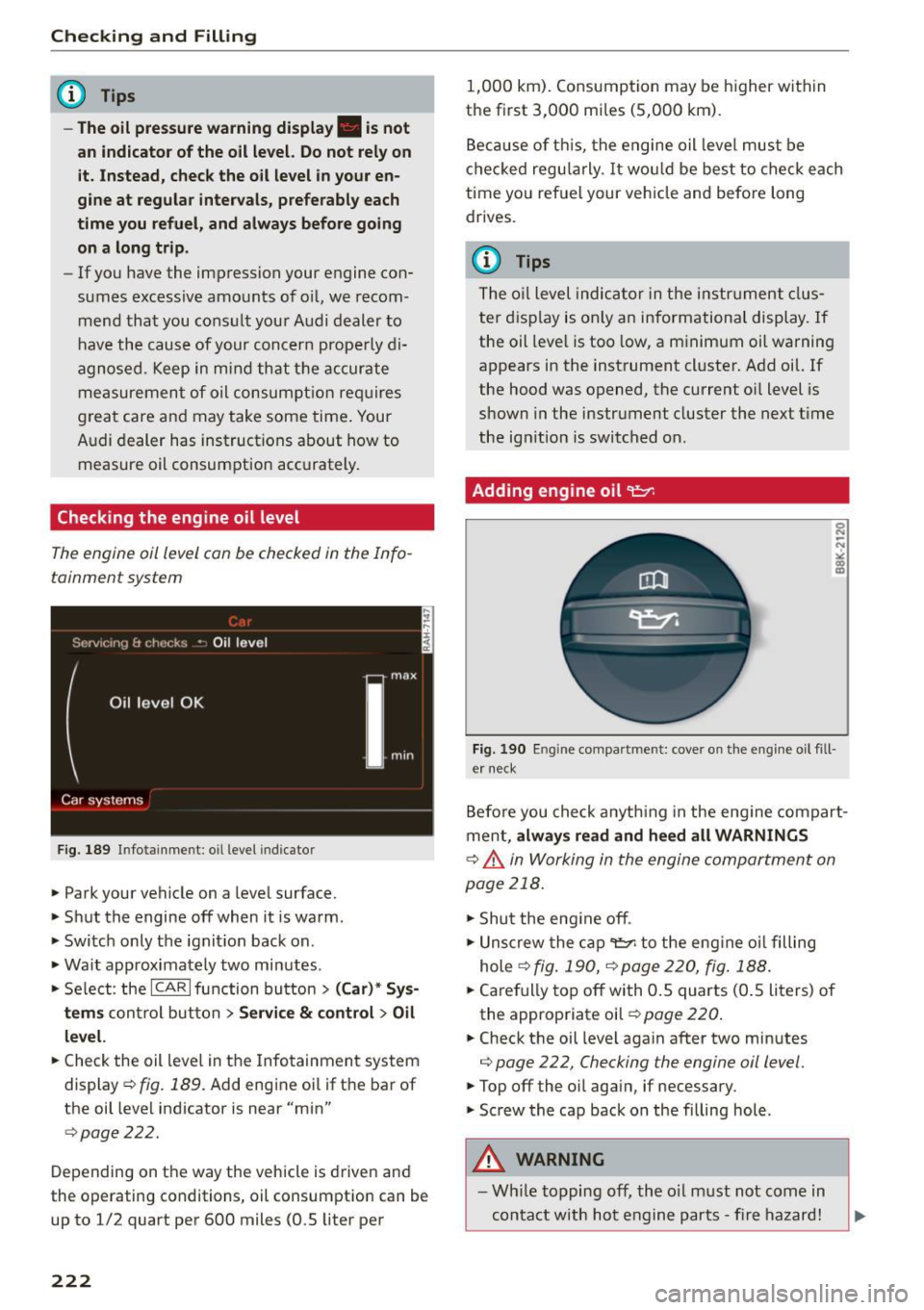
The engine oil level can be checked in the Info
tainment system
F ig. 189 Infotainment: o il level indicato r
• Park your vehicle on a level surface.
• Shut the engine off when it is warm.
• Switch only the ignit ion back on .
• Wait approximately two minutes .
• Se lect : the
ICAR I function button > (C ar)* Sys
tem s
control but ton > S er vic e & con trol > O il
le vel.
• Check the oil leve l in the Info tainment system
display ¢
fig. 189. Add engine oil if the bar of
the oil level indicator is near "min"
r::!;>page222.
Depending on the way the vehicle is driven and
the operating conditions, oil consumption can be
up to 1/2 quart per 600 miles (0.5 liter per
222
1,000 km). Consumption may be h igher within
the first 3,000 miles (5,000 km).
Because of t his, the engine oil Leve l must be
chec ked regu larly . It wo uld be best to check each
time you refuel your vehicle and before long
drives .
{!) Tips
The oil level indicator in the instr ument clus
ter d isplay is only an informational display. If
the oil leve l is too low, a m inimum oil warning
appears in the instrument cluster. Add oil. If
the hood was opened, the current oi l Level is
shown in the instrument cluster the next ti me
the ignition is switched on.
Adding engine oil 'l:::1:
Fig. 190 Engine compart ment: cover on the engine oil fill
er neck
Before you check anyth ing in the eng ine compart
ment,
alwa ys read and h eed all WARN ING S
r::!;> .&. in Working in the engine compartment on
page 218.
• Shu t the eng ine off .
• Unscrew the cap~ to the eng ine oi l filling
hole
r::!;> fig. 190, r::!;> page 220, fig. 188.
• Carefully top off with 0 .5 quarts (0.S liters) of
the appropriate oil
r::!;> page 220.
• Check the oil level again after two minutes
r::!;> page 222, Checking the engine oil level.
• Top off the oil aga in, if necessary.
• Screw the cap back on the filling hole.
_&. WARNING
-Wh ile topping off, the o il must not come in
con tact with hot engine parts -fire hazard!
Page 235 of 294
Wheels
Wheels and Tires
General information
.,.Che ck your tires regularly for
damage (punctures, cuts, cracks
and bulges). Remove foreign ob
jects from the tire tread.
.,. If driving over curbs or similar
obstacles, drive slowly and ap
proach the curb at an angle.
.,.Have faulty tires or rims re
placed immediately.
"'Protec t your tires from oil,
grease and fuel.
.,.Ma rk tires before removing
them so that the same running direction can be maintained if
they are reinstalled .
.,.Lay tires flat when storing and
store them in a cool, dry location
with as little exposure to light as
possible.
(D Note
-Please note that summer and
winter tires are designed for
the conditions that are typical
in those seasons. Audi recom
mends using winter tires dur
ing the winter months. Low
temperatures significantly de crease the elasticity of summ
er tires, which affects traction
Wheels
and braking ability. If summer
tires are used in very cold tem
peratures, cracks can form on
the tread bars, resulting in
permanent tire damage that
can cause loud driving noise
and unbalanced tires.
-Burnished, polished or
chromed rims must not be
used in winter driving condi
tions. The surface of the rims
does not have sufficient corro
sion protection for this and
could be permanently dam
aged by road salt or similar
substances.
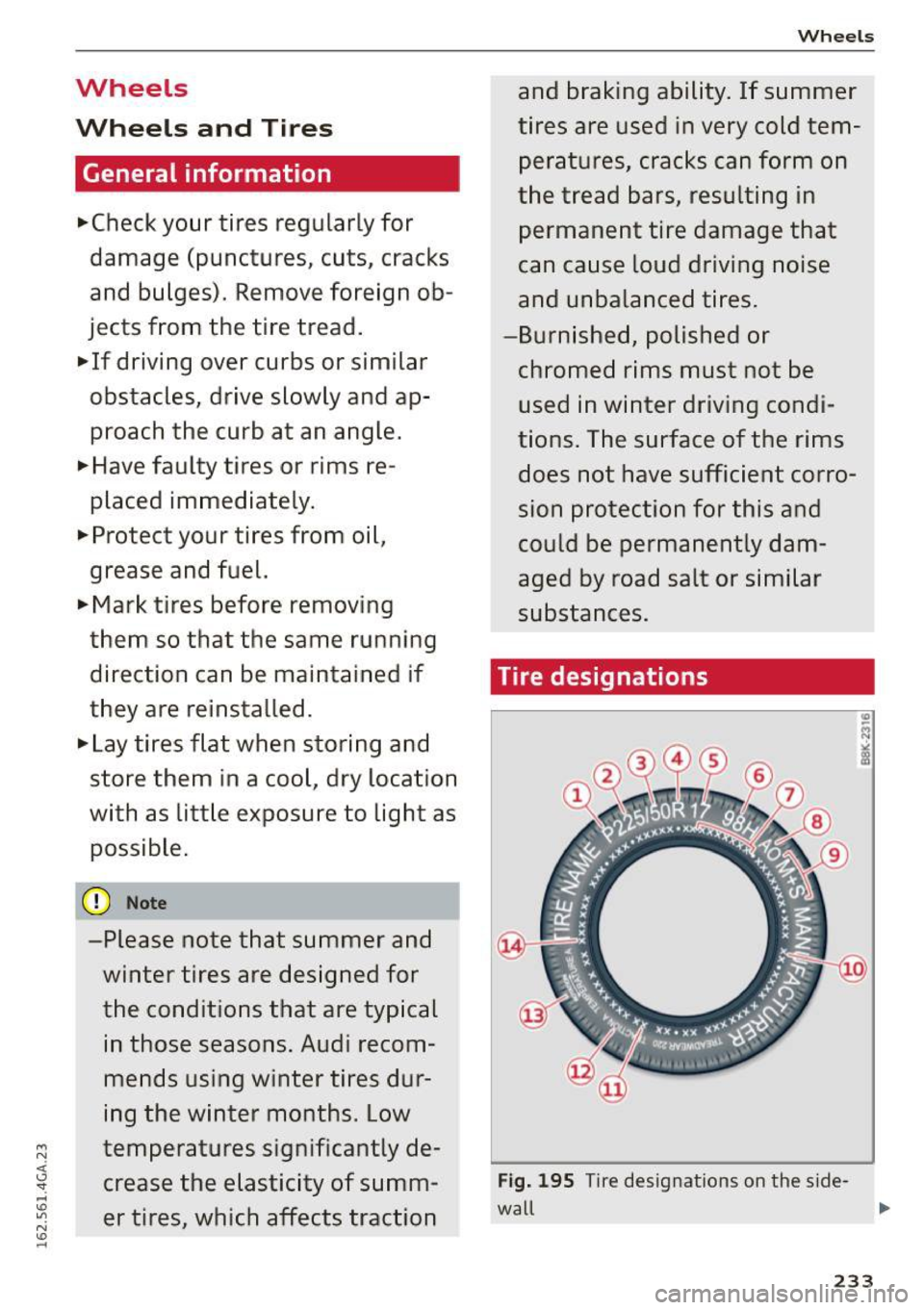
Tire designations
Fig. 195 T ir e designations on the sid e-
wall ,..
233
Page 238 of 294
Wheels
Bead
means the part of the tire that is
made of steel wires, wrapped or
reinforced by ply cords and that is
shaped to fit the rim .
Bead separation
means a breakdown of the bond
between components in the bead.
Cord
means the strands form ing the
plies in the tire.
Cold tire inflation pressure
means the tire pressure recom
mended by the vehicle manufac
turer for a tire of a designated
size that has not been driven for
more than a coup le of miles (kilo
meters) at low speeds in the three
hour period before the tire pres
sure is measured or adjusted .
Curb weight
means the weight of a motor ve
hicle with standard equipment in
cluding the maximum capacity of
fuel, oi l, and coolant , air condi
tioning and additional weight of optional equipment.
E x tra load tire
means a tire des igned to operate
at higher loads and at higher in-
236
flation pressures than the corre
sponding standard tire . Extra load
tires may be identified as "XL",
"xl", "EXTRA LOAD", or "RF" on
the sidewall.
G ross A xle Weight Rating
("GAWR ")
means the load-carrying capacity
of a single axle system , measured
at the tire-ground interfaces .
Gross Vehicle Weight Rating
( "GVWR" )
means the max imum total loaded
weight of the vehicle .
Groove
means the space between two ad
jacent tread ribs .
Load rating (code )
means the max imum load that a
tire is rated to carry for a given in
flation pressure . You may not find
this information on all tires be cause it is not required by law.
Ma ximum load rating
means the load rating for a tire at
the maximum permissible infla
tion pressure for that tire .
Maximum loaded vehicle
w eight
means the sum of: ...
Page 246 of 294
Wheels
the risk of an accident. Read and follow the important
safety precautions in
¢ page 245, Tires and vehicle
load limits .
-The tire must flex more if the
tire pressure is too low or if
the vehicle speed or load are
too high . This heats the tire up
too much. This increases the
risk of an accident because it
can cause the tire to burst and
result in loss of vehicle con
trol.
-Incorrect tire pressure increas es tire wear and has a negative
effect on driving and braking
Tire pressure table
Please note that the information
contained in the following table
was correct at the time of print ing, and the information is sub
ject to change. If there are differ
ences between this information
and the tire pressures specified
on the label on the driver's side Bpillar, always follow the specifica
tion on the B-pillar label
¢ page 243, fig. 197.
244
behavior, which increases the
risk of an accident.
(D Note
Replace lost valve caps to re
duce the risk of damage to the
tire valves.
@ For the sake of the environment
Tire pressure that is too low in
creases fuel consumption.
(D Tips
Audi recommends using the
tire pressure specified for a nor
mal load
¢ table on page 245
or for a full load when the vehi
cle is partially loaded .
Make sure that the tire designa
tion on your tire matches the des
ignation on the tire pressure label
and the tire pressure table.
The following table lists recom mended tire pressures in cold
tires according to the load and
the size of the tires installed. ...
Page 248 of 294
Wheels
Your safety and that of your pas
sengers also depends on making
sure that load limits are not ex
ceeded. Vehicle load includes ev
erybody and everything in and on
the vehicle. These load limits are
technically referred to as the vehi
cle's
Gross Vehicle Weight Rating
("GVWR").
The "GVWR" includes the weight of the basic vehicle, all factory in
stalled accessories, a full tank of
fuel, oil, coolant and other fluids
plus maximum load . The maxi
mum load includes the number of
passengers that the vehicle is in
tended to carry ("seating capaci
ty") with an assumed weight of 150 lbs. (68 kg) for each passen
ger at a designated seating posi
tion and the total weight of any
luggage in the vehicle. If you tow
a trai ler, the weight of the trailer
hitch and the tongue weight of
the loaded trailer must be includ
ed as part of the vehicle load.
The
Gross Axle Weight Rating
("GAWR") is the maximum load
that can be applied at each of the
vehicle's two axles.
The fact that there is an upper
limit to your vehicle's Gross Vehi -
246
cle Weight Rating means that the
total weight of whatever is being
carried in the vehicle (including
the weight of a trailer hitch and
the tongue weight of the loaded
trailer) is limited. The more pas
sengers in the vehicle or passen
gers who are heavier than the
standard weights assumed mean
that less weight can be carried as
luggage.
The Gross Vehicle Weight Rating
and the Gross Axle Weight Rating
are listed on the safety compli
ance sticker label located on the
driver's side B-pillar
c::> page 243,
fig. 197.
&_ WARNING ~
Overloading a vehicle can cause
loss of vehicle control, a crash
or other accident, serious per
sonal injury, and even death.
-Carrying more weight than your vehicle was designed to carry will prevent the vehicle
from handling properly and in
crease the risk of the loss of
vehicle control.
-The brakes on a vehicle that
has been overloaded may not
be able to stop the vehicle
within a safe distance.
Page 250 of 294
Wheels
av ailabl e cargo and luggag e
l oa d cap aci ty of your v ehi cle.
.,.Che ck th e tire sidew all
(¢ p ag e 233, fig. 1 9 5) to deter
mine the d esigna ted load ra ting
for a specifi c tire .
Wheel bolts and rims
Wheel bolts
Wheel bol ts m ust be clea n and loosen/t ighten
easi ly .
R ims
Rims with a bolted rim r ing* or w ith bolted wheel
covers * consist of mu ltiple piec es. These compo
nents we re bo lted toget he r us ing special bolts
a nd a special pro cedure. You must no t repair or
d isassemble th em ¢.&. .
A WARNING
Whee l bolts t hat are tightened or repaired in
co rrectly can become loose and resu lt in loss
o f vehicle control, which increases the risk of
an acc ident. For the correct tightening specifi
cat ion, refer to
¢ page 2 56, After changing a
wheel .
-Always keep the wheel bolts and the threads
in the wheel hub clean and free of grease .
- Only use wheel bo lts that fit the r im .
- Always have damaged rims repa ired by an
autho rized Aud i dealer or authorized repair
facility. Never repair or disassemble rims
you rself, because this increases the risk of
an acciden t.
Winter tires
Winte r tires sign ificantly improve the ve hicle's
handling when d riving i n w inte r condit io ns. Be
cause of the ir constr uction (wid th, compo und,
trea d patter n), s umme r tires p rov ide less tract ion
on ice and snow .
.,. Use w inte r tir es on all fou r wheels.
248
.,. On ly use winter tires that are approved fo r yo ur
vehicle.
.,. Please note that t he maxim um permitted
speed may be lower with winter tires ¢
_A .
Your authorized Audi dealer or authorized re
pair faci lity can inform you about the maximum
perm itted speed for your ti res .
.,. Check the tire pressure afte r instal ling whee ls
¢ page 243.
The effect iveness of w inter t ires is red uced great
ly when the tread is worn down to a dep th of
0.1 57 i nch ( 4 mm). The cha racterist ics of winter
ti res a lso de crease grea tly as the t ire ages, re
gardless of the remaining tre ad.
A WARNING
-
- Never drive faster than the max imum pe r
m itted speed for your tires. This co uld cause
the t ires to heat up too much . This increases
the risk of an accident because it can cause
the t ire to burst.
- Always adapt your dr iving to the road and
traffic cond itions. D rive carefully and reduce
your speed on icy or slippe ry roads. Even
win ter t ires ca n lose traction on black ice.
@ For the sake of the environment
Reinstall summer tires at the appropriate
time, beca use they provide better handling
when roads are free of snow and ice . Summer
tires cause less road noise, tire wear and fuel
consum ptio n.
(D Tips
You can a lso use all season tires instead of
winter tires. Please note that in some coun
tries where w inter t ires a re requir ed, only win
ter tires w ith the£ symbol may b e permit
ted.
' Snow chains
Snow chains improve traction in the snow .
.,. On ly install snow chai ns on the front w heels.
T his app lies also to vehicles with all wheel
dr ive*.
Page 253 of 294
M N <( I.J "". rl I.O
"' N I.O rl
_& WARNING
Temperature grades apply to tires that are properly inflated and not over or underinflat
ed .
Tire pressure monitoring
system
CD General notes
Each tire, includ ing the spare (if provided),
should be checked monthly when cold and inflat
ed to the inflation pressure recommended by the
vehicle manufacturer on the vehicle placard or tire inflation pressure label. (If your veh icle has
tires of a different size than the size indicated on
the vehicle placard or tire inflation pressure la
be l, you shou ld determine the proper tire infla
tion pressure for those tires).
As an added safety feature, your vehicle has been
equipped with a tire pressure monitoring system
(TPMS) that illuminates a low tire pressure tell
tale when one or more of your tires is significant ly under -inflated. Accordingly, when the low tire
pressure telltale illuminates, you should stop and
check your tires as soon as poss ible, and inflate
them to the proper pressure. Driving on a signifi cantly under-inflated tire causes the tire to over
heat and can lead to t ire failure. Under-inflation
also reduces fuel efficiency and tire tread life,
and may affect the vehicle's handling and stop
ping ability .
Please note that the TPMS is not a substitute for
proper tire maintenance, and it is the driver's re
sponsib ility to ma inta in correct tire pressure,
even if under-inflation has not reached the level
to trigger illuminat ion of the TPMS low t ire pres
sure telltale.
Your vehicle has also been equ ipped with a TPMS
malfunction indicator to indicate when the sys
tem is not operating properly. The TPMS mal
function indicator is combined with the low tire
pressure telltale. When the system detects a
malfunction, the telltale will flash for approxi
mately one minute and then remain continuously
illuminated . This sequence will cont inue upon
Wheels
subsequent vehicle start -ups as long as the mal
function exists.
When the malfunction indicator is illuminated ,
the system may not be able to detect or signal
low tire pressure as intended . TPMS malfunctions
may occur for a variety of reasons, including the
i nsta llation of replacement or alternate tires or
wheels on the vehicle that prevent the TPMS
from functioning properly. Always check the
TPMS malfunction telltale after replacing one or
more t ires or wheels on your veh icle to ensure
that the replacement or alternate t ires and
whee ls allow the TPMS to continue to function
properly.
If the Tire Pressure Monitoring System
indicator appears
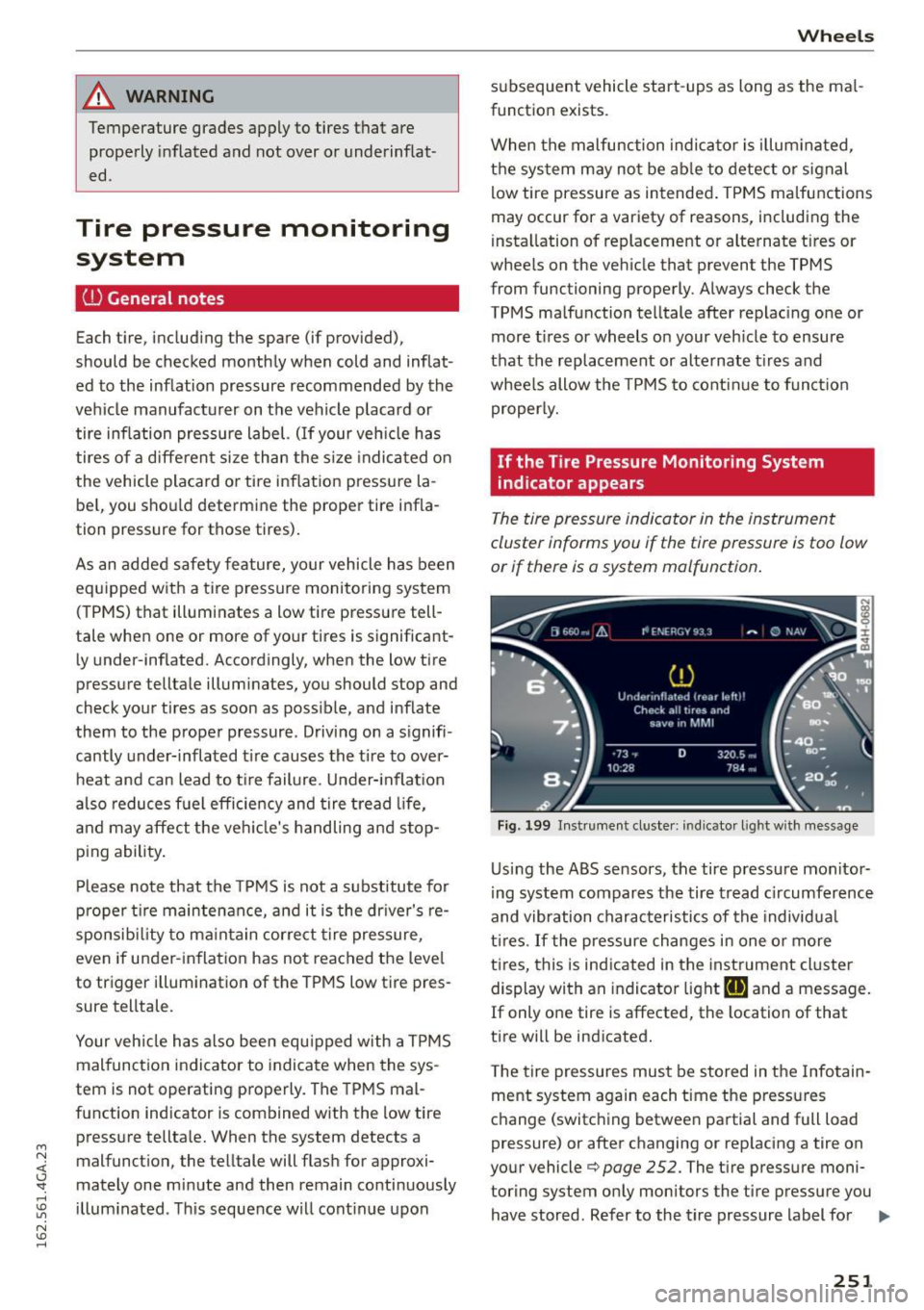
The tire pressure indicator in the instrument
cluster informs you if the tire pressure is too low
or if there is a system mo/function .
Fig. 199 Instrument cluster: indicator light with message
Using the ABS sensors, the tire pressure monitor
ing system compares the tire tread circumference
and vibration characteristics of the individual
tires . If the pressure changes in one or more
t ir es, this is indicated in the instrument cluster
display with an indicator light
HE and a message.
If only one tire is affected, the location of that
tire will be indicated.
T he tire pressures must be stored in the Infotain
ment system again each time the pressures
change (switching between partial and full load
pressure) or after changing or rep lacing a tire on
your vehicle
¢ page 252. The ti re pressure moni
toring system only monitors the tire pressure you have stored. Refer to the tire pressure label for ..,.
251
Page 264 of 294
Fuses
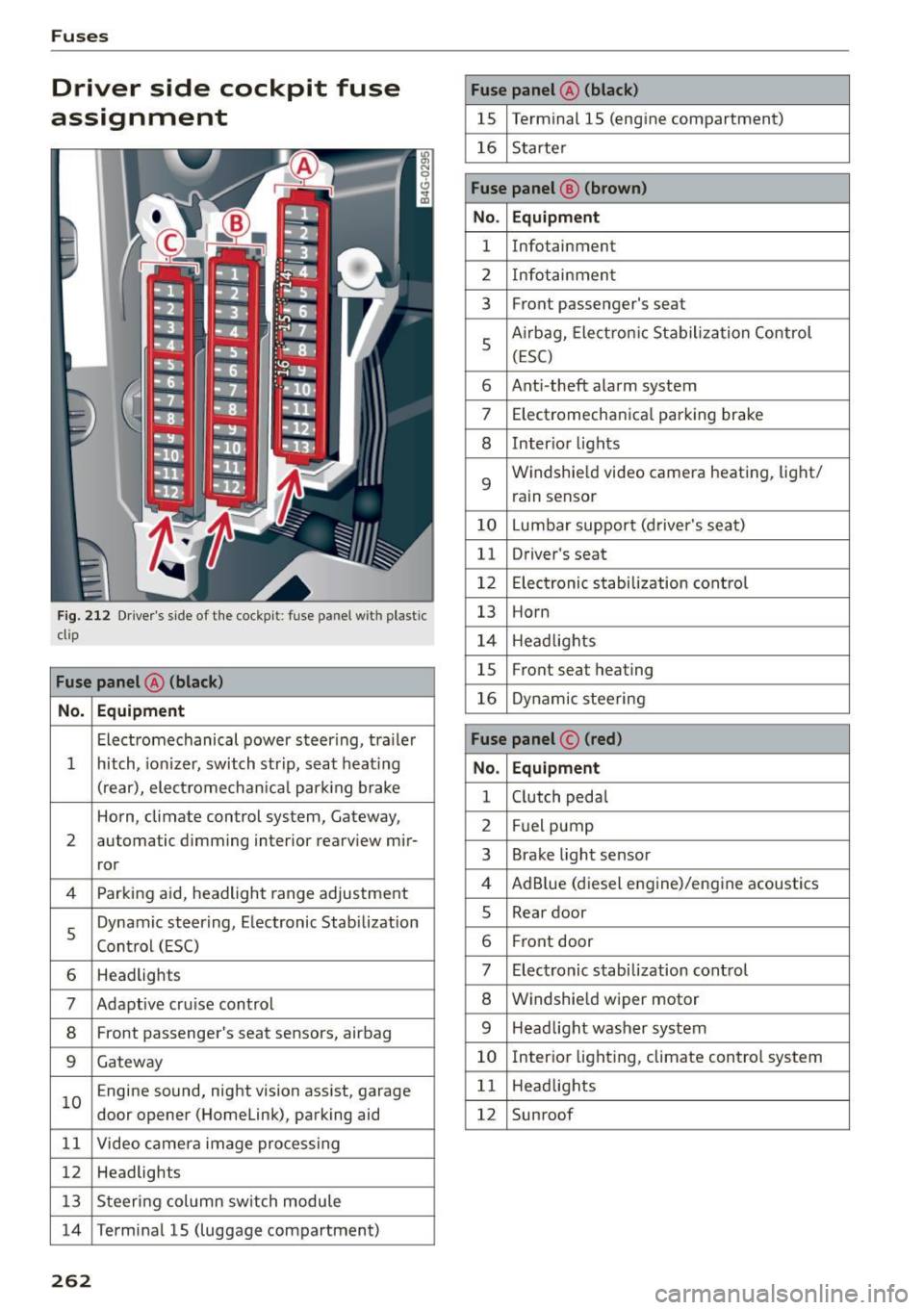
Driver side cockpit fuse
assignment
Fig. 212 Driver's side of the cockpit : fuse pa nel w it h plastic
cl ip
Fuse panel @ (black)
No. Equipment
Electromechanical power steer ing, trailer
1 hitch, ionizer, switch strip, seat heating
(rear), electromechanica l park ing brake
Horn, climate control system, Gateway,
2 automatic dimming interior rearview mir-
ror
4 Parking aid, headlight range adjustment
5 Dynamic steering, Electronic Stabilization
Control (ESC)
6 Headlights
7 Adaptive cru
ise control
8 Front passenger's seat sensors, airbag
9 Gateway
10 E
ngine sound, night vision assist, garage
door opener (Homelink), parking aid
11 Video camera image processing
12 Headlights
13 Steering col umn switch module
14 Terminal 15 (luggage compartment)
262
Fuse panel @ (black)
15 Terminal 15 (engine compartment)
16 Starter
Fuse panel @ (brown)
No . Equipment
1 Infotainment
2 Infotainment
3 Front passenger
's seat
5 Airbag, Electron
ic Stabilization Control
(ESC)
6 Anti -theft alarm system
7 Electromechanical parking brake
8 Inter
ior lights
9 Windshie
ld video camera heating , light/
rain sensor
10 Lumbar support (driver's seat)
11 Driver's seat
12 Electronic stabilization control
13 Horn
14 Headlights
15 Front seat heating
16 Dynamic steering
Fuse panel © (red)
No. Equipment
1 Clutch pedal
2 Fuel pump
3 Brake light sensor
4 AdBlue (diesel engine)/engine acoustics
5 Rear door
6 Front
door
7 Electronic stabilization control
8 Windshield wiper motor
9 Headlight washer system
10 Interior lighting, climate control system
11 Headlights
12 Sunroof
Page 273 of 294
Technical data
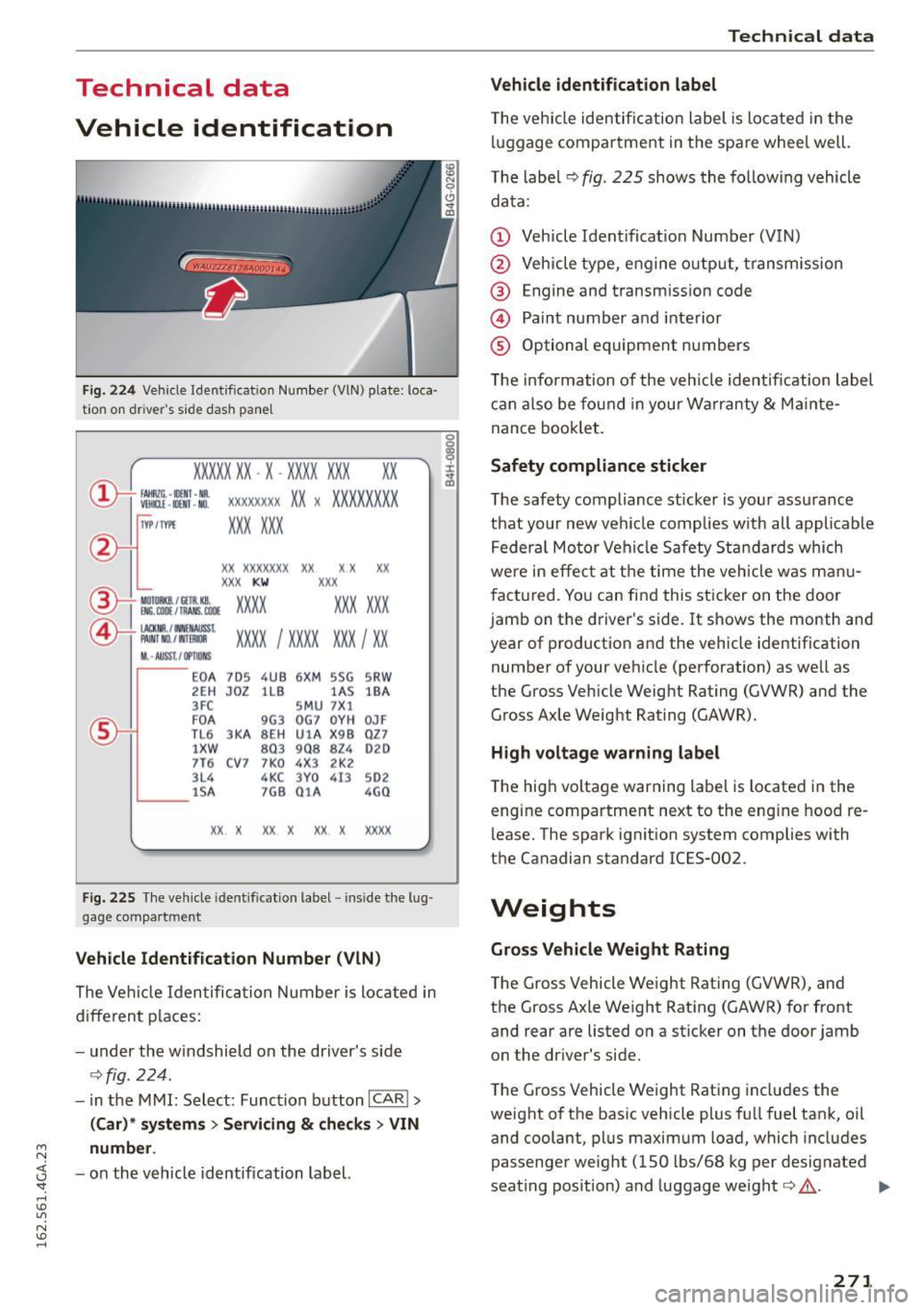
Vehicle identification
F ig. 22 4 Vehicl e Ide ntificat io n Number (VlN) plate: loca ·
t io n on drive r's s id e das h pane l
XXXXX XX -X -XXXX XXX XX
CD+ ~t :1:: xxxxxxxx xx x xxxxxxxx
T VP /fffl XXX XXX
XX XXXXXXX XX X X XX
XXX
KW XXX
®i ~:J ·f lfils~~ XXXX XXX XXX
®-+ ~N:a=i~ l xxxx ; xxxx xxx ; xx
II.· AUSS, I OPTIONS
E0 A
7D5 4UB 6XM 5SG 5RW
2EH J0Z lLB l
A S lB A
3FC SMU 7Xl
F0A 9G3 0G7
0YH 0JF
T L6 3KA 8EH Ul A X98 QZ7
l X W 803 908 824 020
7T6 CV7 7K0 4X3 2K2
3L4 4KC 3Y0 413
502
lSA 7GB 01A 4G0
XX. X XX X XX X xxxx
Fig. 225 T he veh icle iden ti fica tion label -inside the lug ·
g age compart ment
Vehicle Identification Number (VlN )
The Veh icle Iden tifica tion Number is located in
d iffe rent p laces:
- u nder the w indshield on the dr iver's side
¢ fig . 224.
-in the MMI: Select: Funct ion button ICAR I >
(Car )* syste ms> Servi cing & checks > VIN
~ numb er.
i3 -on the vehicle identification label.
"". rl I.O
"' N I.O rl
Technical d ata
Vehicle identification label
The vehicle identification label is lo cate d in the
lu ggage compartment in the spare whee l we ll.
T he labe l¢
fig. 225 shows the fo llowing vehicle
da ta:
(D Vehicle Ident ificat ion Number (VIN)
@ Vehicle type , engine o utp ut, transmission
® Engine and transm iss ion code
@ Paint number and interior
® Optional equipment numbers
T he information of the veh icle identification label
c a n a lso be fo und in your W arranty
& Mai nte·
nance booklet.
Safety compliance sticker
The safety compliance sticker is you r assurance
that your new vehi cle complies w ith all applicable
Fede ra l Mo tor Vehi cle Safety Sta ndards which
were in effec t at the time the vehicle was m anu
fac tured. Yo u can find this sticker on the door
jamb on the driver 's side. It shows the month and
year of production and the vehicle identification number of your vehicle (perforation) as we ll as
the Gross Veh icle Weight Rating (GVWR) and the
Gross Axle Weight Rating (GAWR).
H igh vo ltage warn ing lab el
T he high voltage wa rning label is located in the
engine compartment next to the eng ine hood re
lease. The spark ign it ion system complies with
t h e Canadian standard ICES-002 .
Weights
Gross Vehicle Weight Rating
The Gross Vehicle Weight Rat ing (GVWR), and
the Gross Axle Weight Rating (GAWR) for front
and rear are listed on a st icker on the door jamb
on the dr iver 's side.
The Gross Vehicle Weight Rat ing includes the
weight of the basic vehicle plus f ull fuel tank, oil
and coolant, pl us maxim um load, which includes
passenger weigh t (150 lbs/68 kg per design ated
seat ing pos ition) and luggage weight ¢.&, . ..,,.
271
Page 274 of 294

Technical data
Gross Axle Weight Rating
The Gross Axle Weight Rating is the maximum
load that can be applied at each axle of the vehi
cle ¢& .
Vehicle capacity weight
The vehicle capacity we ight (max. load) is listed
eithe r on the driver's side B-pillar or inside the
fue l filler f lap.
A WARNING
- The actual Gross Axle Weight Rating at the
front and rear axles should not exceed the
permissible weights, and their combination
must not exceed the Gross Vehicle Weight
Rating .
Dimensions
Length i
n (mm)
Width in
(mm)
Width (across mirrors) in (mm)
Height (unloaded)al in
(mm) -
Exceeding permissible weight ratings can
result in veh icle damage, acc idents and per
sonal injury.
(D Note
-The vehicle capacity weight figures apply
when the load is distributed evenly in the
vehicle (passengers and luggage). When
transporting a heavy load in the luggage
compartment, carry the load as near to the
rear axle as possible so that the vehicle's
hand ling is not impaired.
- Do not exceed the maximum permissible
axle loads or the maximum gross veh icle
we ight. Always remember that the vehicle's
hand ling will be affected by the extra load.
T herefore, adjust your speed accordingly.
- Always observe local regulations.
A7 S7
196.2 (4984) 196 .3 (4985)
75.2 (1911) 75 .2 (1911)
84.2 (2139) 84.2 (2139)
55.9 (1420) 55 .0 (1398)
al Th e he igh t of th e vehicl e de pe nd s on th e tires a nd the su sp ension .
When driving up steep ramps, on rough roads,
over curbs, etc. it is important to remember that
some parts of your vehicle, such as spo ilers or ex-
Capacities
Fuel tank: tota l capacity
- gasoline engine
- diesel engine
Windsh ield f lu id container
Windshield and headlight washer fluid container*
272
haust system components, may be close to the
ground. Be careful not to damage them.
gal (liters) approx. 19.8 (75.0)
gal (liters) approx. 19.3 (73.0)
quarts (liters) approx. 3.7 (3.5)
quarts (liters) approx. 5.2 (4.9)