change wheel AUDI A7 2017 Owner´s Manual
[x] Cancel search | Manufacturer: AUDI, Model Year: 2017, Model line: A7, Model: AUDI A7 2017Pages: 284, PDF Size: 72.29 MB
Page 218 of 284

Wheels
Rim
means a metal support for a tire
or a tire and tube assembly upon
which the t ire beads are seated .
Rim diameter
means nominal diameter of the
bead seat . If you change your
wh eel size, you will have to p ur
chase new tires to match the new
rim d iameter .
Rim size designation
means rim diameter and w idth.
Rim width
means nomina l distance between
r im flanges .
Sidewall
means that portion of a t ire be
twee n the tread and bead .
Speed rating (letter code)
means the speed at which a t ire is
designed to be driven for extend
ed periods of ti me. The ratings
range from 93 mph (150 km/h)
to 186 mph (298 km/h)
¢ table
on page 212 .
You may not find
this information on all tires be
cause it is not required by law.
The speed rating letter code,
wh ere applicable, is molded on
the tire sidewall and ind icates the
2 16
maximum permissible road
speeds
¢ A in Winter tires on
page 227 .
Tire pressure monitoring
system *
means a system that detects
when one or mo re of a vehicle's
tires a re underinflated and illumi
nates a low tire pressure war ning
telltale .
Tread
means that portion of a tire that
comes into contact wi th the road.
Tread separation
means pulling away of the tread
from the tire carcass .
Treadwear indicators (TWI)
means the project ions wi thin the
pr inc ipal grooves designed to g ive
a visua l indication of the degrees
of wear of the tread . See
¢ page 2 20, Treadwear indicator
for mo re information on meas ur
ing tire wear.
Uniform Tire Quality Grading
i s a tire informa tion system devel
oped by the Unite d States Nation
a l Highway Traffic Safety Admin
istration (NHTSA) that is designed
to help buyers make re lative
..
Page 224 of 284
Wheels
and follow the important safe
ty precautions in
q page 224,
Tires and vehicle load limits.
-The tire must flex more if the
tire pressure is too low or if
the vehicle speed or load are
too high. This heats the tire up
too much. This increases the
risk of an accident because it
can cause the tire to burst and
result in loss of vehicle con
trol.
-Incorrect tire pressure in
creases tire wear and has a
negative effect on driving and
Tire pressure table
Please note that the information
contained in the following table
was correct at the time of print ing, and the information is sub
ject to change. If there are differ
ences between this information
and the tire pressures specified
on the label on the driver's side B
pillar, always follow the specifica
tion on the B-pillar label
q page 221, fig. 192.
222
braking behavior, which in
creases the risk of an accident.
(D Note
Replace lost valve caps to re
duce the risk of damage to the
tire valves.
@ For the sake of the environment
Tire pressure that is too low in
creases fuel consumption.
(D Tips
Audi recommends using the
tire pressure specified for a
normal load
q table on
page 223
or for a full load
when the vehicle is partially
loaded.
Make sure that the tire designa
tion on your tire matches the des
ignation on the tire pressure label
and the tire pressure table.
The following table lists recom
mended tire pressures in cold
tires according to the load and
the size of the tires installed.
Page 232 of 284

Wheels
As an added safety feature, your vehicle has been
equipped with a tire pressure mon itor ing system
(TPMS) that illuminates a low tire pressure tell
tale when one or more of your tires is significant
ly under-inflated . Accordingly, when the low tire
pressure telltale illuminates, you should stop and
check your tires as soon as possible, and inflate
them to the proper pressure . Driving on a signifi
cantly under-inflated tire causes the tire to over
heat and can lead to tire failure. Under-inflation
also reduces fuel efficiency and ti re tread life,
and may affect the vehicle's handling and stop
ping ability.
Please note that the TPMS is not a substitute for
proper tire maintenance, and it is the driver's re
sponsibility to maintain correct tire pressure,
even if under- inflation has not reached the level
to trigger illumination of the TPMS low tire pres
sure telltale.
Your vehicle has also been equipped with a TPMS
malfunction indicator to indicate when the sys
tem is not operating properly. The TPMS mal
function indicator is combined with the low tire
pressure telltale . When the system detects a
malfunction, the telltale will flash for approxi
mately one m inute and then remain cont inuously
illuminated . This sequence will continue upon
subsequent vehicle start-ups as long as the mal
function exists .
When the malfunct ion indicator is illuminated,
the system may not be able to detect or signal
low tire pressure as intended. TPMS malfunctions
may occur for a variety of reasons, including the
installation of replacement or alternate tires or
wheels on the vehicle that prevent the TPMS
from functioning properly. Always check the
TPMS malfunction telltale after replacing one or more tires or wheels on your vehicle to ensure
that the replacement or alternate tires and
wheels allow the TPMS to continue to function
properly.
230
Tire pressure monitoring system
Applies to: vehicles with Tire Pressure Monitoring System in
dicator
The tire pressure indicator in the instrument
cluster informs you if the tire pressure is too low
or if there is a system malfunction.
Fig. 194 Instrumen t cl uster : indicator l ig ht with me ssage
Using the ABS sensors, the tire pressure monitor
ing system compares the tire tread circumfer
ence and vibration characteristics of the individu
al tires. If the pressure changes in one or more
tires, this is indicated in the instrument cluster
display with an indicator light
Rt] and a message.
If only one tire is affected, the location of that
tire will be indicated.
The tire pressures must be stored in the Infotain
ment system again each time the pressures
change (switching between partial and full load
pressure) or after changing or replacing a tire on
your vehicle
¢ page 231. The tire pressure mon i
toring system only monitors the tire pressure you have stored . Refer to the tire pressure label for
the recommended tire pressure for your vehicle
¢page 221, fig. 193.
Tire tread circumference and vibrat ion character
istics can change and cause a tire pressure warn
ing if :
- the tire pressure in one or more tires is too low.
- the tire has structural damage.
- the tire was replaced or the tire pressure was
changed and it was not stored¢
page 231 .
-the spare tire* is installed.
Indicator lights
RI]-Loss of pressure in at least one tire¢.&_ .
Check the tires and replace or repair if necessary . .,..
Page 234 of 284

Wheels
Please note that the TPMS is not a substitute for
proper tire maintenance, and it is the driver's re
sponsib ility to ma intain correct tire pressure,
even if under-inflation has not reached the level
to trigger illumination of the TPMS low tire pres
sure telltale.
Your veh icle has also been equ ipped with a TPMS
malfunction indicator to indicate when the sys
tem is not operating properly. The TPMS mal
function indicator is combined with the low tire
pressure telltale . When the system detects a
malfunction, the telltale will flash for approxi mately one minute and then remain cont inuously
illum inated. This sequence will continue upon
subsequent vehicle start-ups as long as the mal
function exists.
When the malfunct ion indicator is illuminated,
the system may not be able to detect or signal
low tire pressure as intended. TPMS ma lfunctions
may occur for a variety of reasons, including the
installation of replacement or alternate tires or
wheels on the vehicle that prevent the TPMS
from functioning properly . Always check the
TPMS malfunction telltale after replacing one or
more tires or wheels on your vehicle to ensure
that the replacement or alternate t ires and
wheels a llow the TPMS to continue to function
properly.
Description
A pp lies to: ve hicles w ith tire p ressure monitoring system
The tire pressure monitoring system monitors
the pressure in the four tires when driving.
The system uses sensors that measure the tem
perature and pressure in the tires . The data is
sent from these sensors to the contro l module by
radio frequency.
The Tire Pressure Monitoring System shows the current pressures and temperatures of the tir es
in the Infota inment system
c:> page 232. It also
compares the current t ire pressures with the
stored tire pressu res and gives a warning in the
d river information system if the tire pressure is
different from what is stored
r:';> page 233.
232
The system does not detect if the stored tire
pressures match the recommended tire pres
sures. You must store the tire pressures again
c:> page 233:
-every time the tire pressures change, for exam
ple when the load in the vehicle changes,
- after replacing a tire, or
- if wheels with new whee l sensors are used.
_&. WARNING
- The tire pressure monitoring system assists
the driver in monitoring tire pressures. The
driver is responsib le for having the tires in
flated to the correct pressure.
- Do not change the tire pressure when the
temperature of the tire is high. This could
result in serious damage to the tire and
even cause the tire to burst, increasing the
risk of an accident.
-A tire with low pressure flexes more. This heats the tire up too much. This could cause
the tread to separate and even cause the
tire to burst, increasing the risk of an acc i
dent.
- The tire pressure monitoring system does
not warn about damage or defects in the
tire construct ion that could cause the tire to
burst, for examp le. Inspect your tires reg u
larly.
(D Tips
- If tires are replaced, the sensors/valves do
not need to be removed or replaced. Just re
placed the va lve stem and, if necessary, the
valve and the wheel electronics.
If you have
questions, see your authorized Audi dealer
or authorized Audi Service Facility.
- An incorrect display or a malfunction in the
tire pressure monitoring system can occur
after using the tire mobility kit. Have the
sensors rep laced by an authorized Audi
dealer or author ized Audi Service Facility.
Displaying tire pressures/temperatures
App lies to: vehicles wit h tire pressure monitoring syste m
Requirement: the ignition must be switched on . ...,
Page 236 of 284

Wheels
"'If the changed tire pressures are not displayed
in the Infotainment system, drive the vehicle
for approximately 10 minutes so that the sen
sor signal from the wheels is received again.
During this adaptation phase, --.--is displayed
for the pressure and temperature and the tire
pressure monitoring system is only partially
available. It only provides a warning if one or
more t ire pressures is below the minimum per
mitted specified pressure. If this is the case, the
Rt] indicator light appears with a message.
_& WARNING
Read and follow the important information
and notes
r::!;>page 232.
Malfunctions
Appl ies to : vehicles wi th tire pressure mo nito rin g system
If the Tire Pressure Monitoring System is not
avai lable, the
mm indicator light appears in the
driver information system. The
Rt] indicator light
also blinks for approximately one minutes each
time the ignition is switched on. The tire pressure
monitoring system cannot be selected in the In
fotainment system. The following are examples
of situations that could cause a malfunction:
- If the message appears at the end of the adap
tation phase, the system cannot detect the
wheels installed on the vehicle. This may result
from one or more wheels being installed with out wheel sensors or with incompatible wheel
sensors.
- A wheel sensor or another component has
failed.
- Using snow chains can affect the function of
the system because of the shield ing effect of
the cha ins.
- The tire pressure monitoring system is not
available due to a malfunction .
- Transmitters with the same frequency, such as
headphones or remote-controlled devices, may
cause a temporary system malfunction due to
the strong electromagnetic field.
The
mm indicator light turns off once the Tire
Pressure Monitoring System is available again.
If
you cannot correct the malfunction and the mm
234
indicator light stays on, drive immediately to an
authorized Audi dealer or authorized Audi Service Facility to have the malfunction repaired.
Page 245 of 284

co
co
.... N
" N .... 0
00
\.J '
authorized Aud i dealer or authorized Audi
Service Facility for assistance.
@ For the sake of the environment
You can give the used tire sealant bottle to an
authorized Audi dealer or authorized A udi
Service Facility for disposal.
@ Tips
Remember to obtain a new bottle of sea lant
from an authorized Audi dea ler or authorized
Audi Service Facility after repairing a tire.
Replacing wheels
Before changing a wheel
Observe the following precautions for your own
and your passenger's safety when changing a
wheel.
.. After you experience a tire failure, pull the car
well away from moving traffic and try to reach
level ground before you stop c::> &.,.
.. All passengers should leave the car and move
to a safe location (for instance, beh ind the
guardrai l) ¢ ,&. .
.. Engage the
parking brake to prevent your vehi
cle from rolling unintentionally ¢,&. .
.. Move
selector lever to position P ¢ ,&. .
.. If you are towing a trailer, unhitch the trailer
from your vehicle .
.. Take the
jack and the spare tire* out of the lug
gage compartment ¢
page 240.
.8, WARNING
You or your passengers could be injured while
changing a wheel if you do not follow these
safety precautions:
- If you have a flat tire, move a safe distance
off the road. Turn off the engine, turn the
emergency flashers on and use other warn
ing devices to alert other motorists.
- Make sure that passengers wait in a safe
place away from the vehicle and well away
from the road and traffic.
Emergency assistance
- To help prevent the vehicle from moving
suddenly and possibly slipping off the jack,
always fully set the parking brake and block
the wheel diagonally opposite the wheel be
ing changed . When one front wheel is lifted
off the ground, placing the Automatic
Transmission in P (Park) wi ll
not prevent the
veh icle from moving.
- Before you change a wheel, be sure the
ground is leve l and firm. If necessary, use a
sturdy board under the jack.
- Always store the vehicle tool kit, the jack
and the replaced tire in the luggage com
pa rtment
¢page 135.
(D Tips
Before changing the wheel, you must activate
the jacking mode, so that the automatic con
trols for the Adaptive Air Suspension* do not
make it more difficult to lift the vehicle with
the jack ¢
page 245 .
Changing a wheel
When you change a wheel, follow the sequence
described below step-by-step and in exactly that
order.
1. Activate the vehicle jack mode*¢ page 245.
2. Remove the decorative wheel cover* or the
wheel bolt caps*. For more details see also
¢ page 244, Decorative wheel covers or
¢ page 244, Wheels with wheel bolt caps .
3. Loosen the wheel bolts ¢page 245.
4. Locate the proper mounting point for the
jack and align the jack below that point
¢page 245.
5. Raise the car with the jack¢ page 245 .
6. Remove the wheel with the flat tire and then
install
the spare ¢ page 247.
7. Tighten all whee l bolts lightly.
8.
Lower the vehicle with the jack.
9. Use the wheel bolt wrench and
firmly tighten
all wheel bolts
c::>page 245.
10. Replace the decorative wheel cover* or the
wheel bolt caps*.
11. Deactivate the vehicle jack mode* in the
MMI:
I CARI funct ion button> (C ar )* systems .,.
243
Page 246 of 284
Emergency assistance
control button > Servicing & checks > Air
susp.: jack mode> Off .
The vehicle jack mode* switches off automatical
ly at speeds above 6 mph (10 km/h).
&_ WARNING
Always read and fo llow all WARNINGS and in
formation ¢
.&. in Raising the vehicle on
page 246
and¢ page 248.
After changing a wheel
A wheel change is not complete without the do
ing the following.
.. Always store the vehicle tool kit, the jack* and
the replaced tire in the luggage compartment
¢page 135.
.. Check the tire pressure on the spare wheel im
med iately after mounting it.
.. As soon as possible, have the
tightening tor
ques
on all wheel bolts checked with a torque
wrench. The correct tightening torque is
90 ft
lb (120 Nm).
.. Have the flat tire
replaced as soon as possible.
(D Tips
-If you notice that the wheel bolts are cor
roded and difficu lt to t urn wh ile changing a
tire, they should be replaced before you
check the tightening torque.
- Drive at reduced speed until you have the
tightening torques checked.
- After changing a wheel, the tire pressure in
a ll four tires must be checked/corrected and
the tire pressure mon itor ing indicato r must
be stored in the MMI
¢page 231,
¢pa ge 233 .
244
Decorative wheel covers
Applies to: vehicles with decorative wheel covers
The decorative wheel covers must be removed
first to access the wheel bolts.
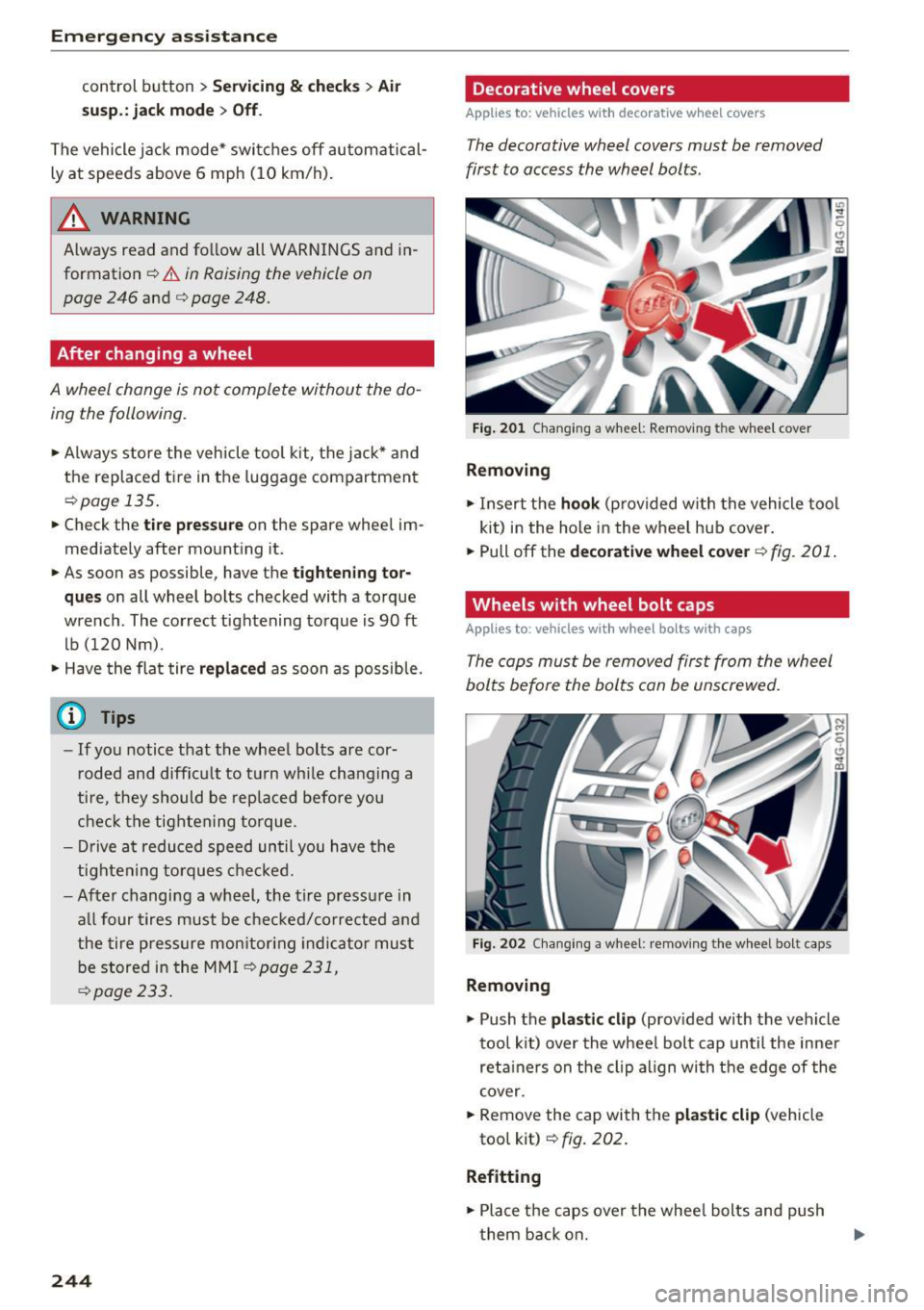
Fig. 201 Changing a whee l: Removing the whee l cover
Removing
.. Insert the hook (provided w ith the vehicle tool
kit) in the hole in the wheel hub cover.
.. Pull off the
decorative wheel cover ¢ fig. 201 .
Wheels with wheel bolt caps
Applies to: vehicles with wheel bolts with caps
The caps must be removed first from the wheel
bolts before the bolts can be unscrewed.
Fig. 202 Chang ing a wheel: remov ing the wheel bolt caps
Removing
.. Push the plastic clip (provided with the vehicle
tool kit) over the wheel bolt cap until the inne r
reta iners on the clip align with the edge of the
cover .
.. Remove the cap with the
plastic clip (vehicle
tool kit)
<:!> fig. 202.
Refitting
.. Place the caps over the wheel bolts and push
them back on.
Page 247 of 284
co
co
.... N
" N .... 0 co <.,;) 'SI'
The caps are to protect and keep the wheel bolts
clean.
Loosening and tightening the wheel bolts
The whe el bolts must be loosen ed b efor e raising
the vehicle.
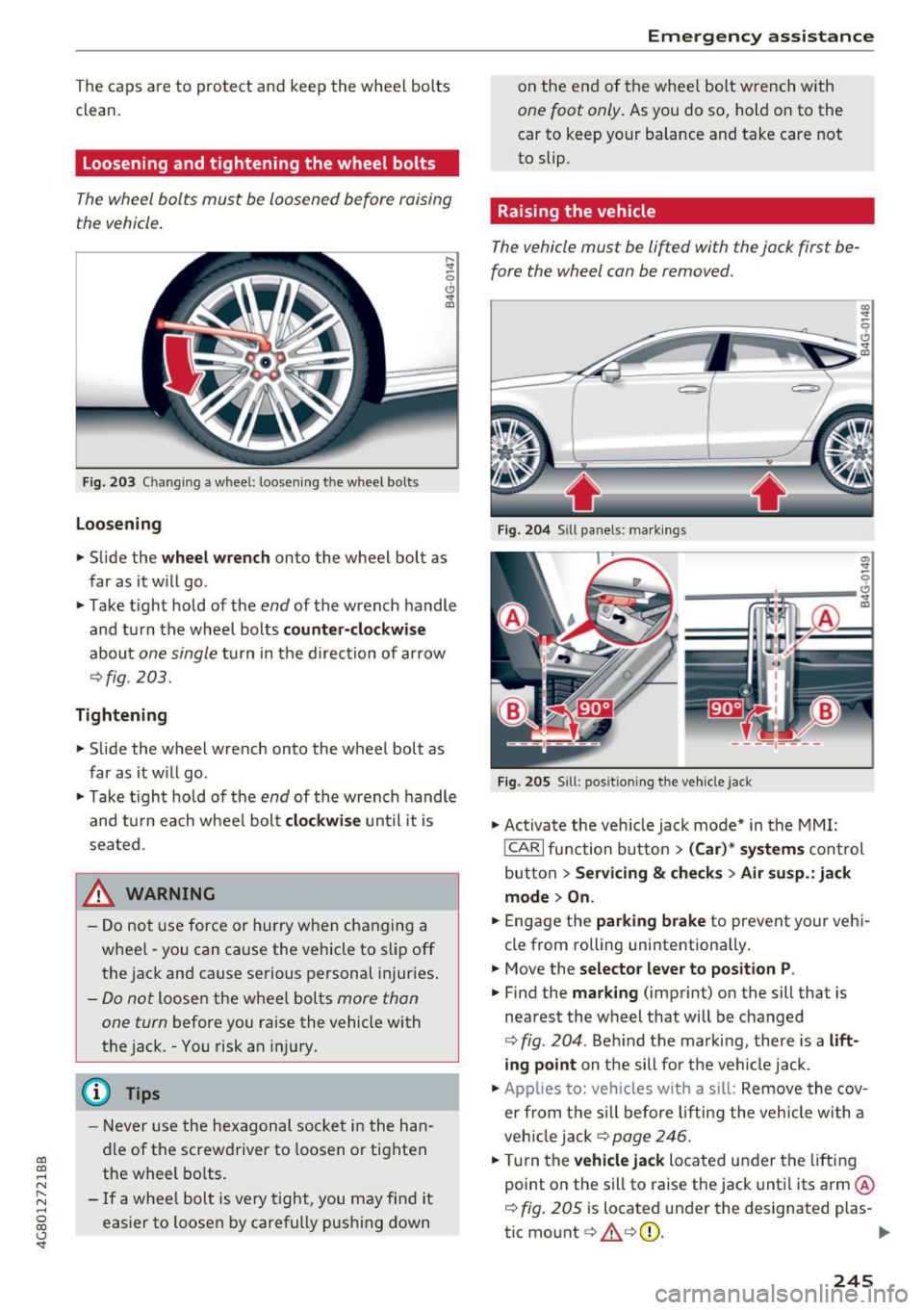
F ig. 20 3 Chan gin g a w hee l: l oose ning t he wheel bo lts
Loo sening
.. Slide the w he el wr enc h onto the wheel bolt as
far as it will go .
.. Take t ight hold of the
end of the wrench hand le
and turn the wheel bolts
c o unt er-clockwis e
about one single turn in the d irection of arrow
¢fig . 203.
Tightening
.. Slide the wheel wrench onto the wheel bolt as
far as it w ill go.
.. Take t ight hold of the
end of the wrench handle
and tu rn each whee l bolt
clockwi se unt il it is
seated .
& WARNING
- Do not use force or hurry when changing a
wheel -you can cause the vehicle to slip off
the jack and cause serious personal injuries .
-Do not loosen the wheel bolts more than
one turn
before you raise the vehicle w ith
the jack. - You risk an injury.
(D Tips
- Never use the hexagonal socket in the han
dle of the screwdriver to loosen o r tighten
the wheel bo lts .
- If a whee l bolt is very tight, you may find it
easier to loosen by carefully push ing down
Em ergen cy a ssis tanc e
on the end of the whee l bolt wrench with
one foot only . As you do so, hold on to the
car to keep your balance and take care not
to slip .
Raising the vehicle
The vehicl e must b e lift ed with the jock first be
fore the wheel can be removed.
F ig. 20 4 Sill pane ls: ma rkin gs
F ig. 205 S ill: pos it ion ing t he veh icle jac k
.. Activa te the veh icle jack mode* in the MMI:
!CARI function button > (Car )* sy stems control
button
> S erv ici ng & ch ecks > Air su sp .: jack
mode > On .
.. Engage the parking brake to prevent your vehi
cl e from rolling unintentiona lly .
.. Move the
selector le ver to p osit ion P .
.. Find the mar king (impr int) on the sill that is
nearest the wheel that will be changed
¢
fig . 204 . Behind the marking , there is a lift
ing poin t on the sill for the vehicle jack .
.. App lies to: veh icles with a s ill: Remove the cov
er from the s ill before lifting the vehicle with a
veh icle jack ¢
page 246.
.. Turn the vehicle jack located under the lift ing
point on the sill to raise the jack unt il its arm @
¢
fig. 205 i s locat ed und er the d esignat ed plas-
tic mount ¢
,&¢0. ..,.
245
Page 248 of 284
Emerg ency assis ta nce
• Align the jack so that its arm @ c::> fig. 205 en
gages in the designated lifting point in the door
s ill and the movable base ® lies flat on the
ground. The base ® must be
vertical under the
lifting point @.
• Wind the jack up further until the flat tire
comes off the ground
c::> ,&. .
Position the vehicle jack on ly unde r the designat
ed lifting points on the sill
c::> fig . 204 . There is ex
actly
one locat ion for each wheel. The jack must
not be positioned at any other location
c::> .&. c::>0.
An unst able s urfa ce under the jack can cause the
ve hicle to slip off the jack . Always provide a firm
base for the jack on the ground . If necessary
p lace a sturdy boa rd or simi lar support under the
jack . On
h ard, slipp ery su rface s (such as tiles)
use a rubbe r mat or similar to prevent the jack
from sl ipping
c::> .&. .
& WARNING
- Yo u or your passengers could be injured
whi le changing a wheel if you do not follow
these safety precautions:
- Position the veh icle jack only at the desig
nated lifting points and align the jack .
Othe rw ise, the vehicle jack cou ld slip and
cause an injury if i t does not have suffi
cient hold on the vehicle.
- A soft or unstable s urface unde r the jack
may cause the vehicle to slip off the jack.
A lways provide a firm base for the jack on
the ground. If necessary, use a sturdy
board under the jack .
- On hard, s lippery surface (such as tiles)
use a rubber mat or similar to prevent the
jack from slipping.
- To help prevent injury to yourself and your
passenge rs:
- Do not raise the vehicle unt il you are sure
the jack is securely engaged .
- Passengers must not remain in the vehicle
when it is jacked up.
- Make sure that passengers wait in a safe
place away from the vehicle and well away
from the road and traff ic.
246
- Make sure jack position is correct, adjust
as necessary and then continue to ra ise
the jack .
- Changes in temperature or load can affect
the height of the veh icle.
(D Note
Do not lift the vehicle by the si ll. Position the
vehicle jack only at the des ignated lift ing
points on the sill. Otherwise, your vehicle will
be damaged.
(D Tips
The vehicle jack mode * switches off automati
cally at speeds above 6 mph (10 km/h).
Removing and installing the sill extension
cover
App lies to: vehicles with sill extension
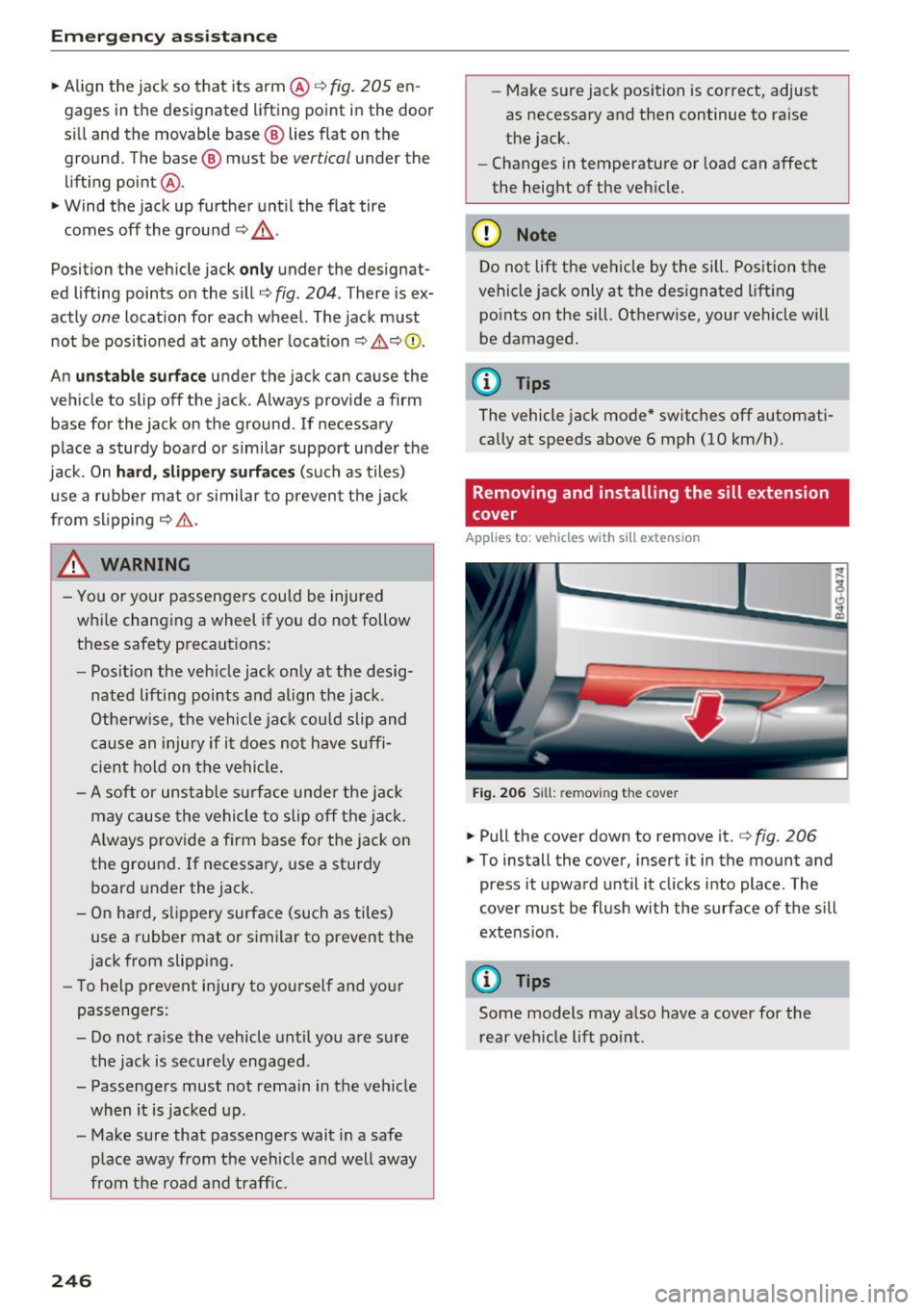
Fig . 206 S ill: rem ovin g the cover
• Pull the cover down to remove it. c::> fig. 206
• To install the cover, insert it in the mount and
pre ss it upward until it clicks into place . The
cover must be flush with the surface of the sill
extens ion .
@ Tips
Some models may also have a cover for the
rear veh icle lift point .
Page 250 of 284

Emergency assistance
Tires with unidirectional tread design
Tires with unidirectional tread design must be
mounted with their tread pattern pointed in the
right direction .
Using a spare tire with a tread pattern
intended for use in a specific direction
When using a spare t ire with a tread pattern in
tended for use in a specific direction, please note
the following:
- The direction of rotation is marked by an arrow
on the side of the tire.
- If the spare tire has to be installed in the incor
rect direction, use the spare tire only tempora
rily since the tire will not be able to achieve its
optimum performance characteristics with re
gard to aquaplaning, noise and wear.
- We recommend that you pay particular atten
tion to this fact during wet weather and that
you adjust your speed to match road condi
tions.
- Replace the flat tire with a new one and have it
installed on your vehicle as soon as possible to
restore the handling advantages of a unidirec
tional tire.
Notes on wheel changing
Please read the information q page 218, New
tires or wheels
if you are going to use a spare tire
which is different from the tires on your vehicle.
After you change a tire:
- Check the tire pressure on the spare tire im
mediately after installation.
- Have the wheel bolt tightening torque
checked with a torque wrench as soon as pos
sible by your authorized Audi dealer or a
qualified service station.
- With steel and alloy wheel rims, the wheel
bolts are correctly tightened at a torque of 90
ft lb
(120 Nm).
- If you notice that the wheel bolts are corroded
and difficult to turn while changing a tire ,
they should be replaced before you check the
tightening torque.
248
- Replace the flat tire with a new one and have
it installed on your vehicle as soon as possi
ble. Remount the wheel cover.
Until then , drive with extra care and at reduced
speeds.
~ WARNING
- If you are going to equip yo ur vehicle with
tires or rims which differ from those which
were factory installed, then be sure to read
the information
q page 218, New tires or
wheels.
- Always make sure the damaged wheel or
even a flat tire and the jack and tool kit are
properly secured in the luggage compart
ment and are not loose in the passenger
compartment.
- In an accident or sudden maneuver they
could fly forward, injuring anyone in the ve
hicle.
- Always stor e damaged wheel, jack and tools
secure ly in the luggage compartment. Oth
erwise, in an accident or sudden maneuver
they could fly forward, causing injury to pas
sengers in the vehicle.
Spare tire
Space-saving spare tire
App lies to: vehicles wit h spare tire
Fig. 209 Luggage compartment: space -saving spare t ire
The spare tire is intended for short-term use on-
-
ly. Have the damaged tire checked and, if neces
sary, replaced by an authorized Audi dealer or au
thorized Audi Service Facility as soon as possible . .,..