brake AUDI A7 2017 Owner´s Manual
[x] Cancel search | Manufacturer: AUDI, Model Year: 2017, Model line: A7, Model: AUDI A7 2017Pages: 284, PDF Size: 72.29 MB
Page 227 of 284
plus maximum load. The maxi
mum load includes the number of
passengers that the vehicle is in
tended to carry ("seating capaci
ty") with an assumed weight of
150 lbs. (68 kg) for each passen
ger at a designated seating posi
tion and the total weight of any luggage in the vehicle . If you tow
a trailer, the weight of the trailer
hitch and the tongue weight of
the loaded trailer must be includ
ed as part of the vehicle load .
The
Gross A xle Weight Rating
("GAWR") is the maximum load
that can be appl ied at each of the
vehicle's two axles.
The fact that there is an upper
limit to your vehicle's Gross Vehi
c le Weight Rating means that the
total weight of whatever is being
carried in the vehicle (including
the weight of a tra iler hitch and
the tongue weight of the loaded
trailer) is limited. The more pas
sengers in the vehicle or passen
gers who are heavier than the
standard weights assumed mean
that less weight can be carried as luggage.
; The Gross Vehicle We ight Rating
N
~ and the Gross Axle Weight Rating 0 co OJ ..
Wheels
are listed on the safety compli
ance sticker label located on the
driver's side B -pillar
¢ page 221,
fig . 192.
_& WAR NING
Overloading a vehicle can cause
loss of vehicle control, a crash
or other accident, serious per
sonal in jury, and even death.
-Carrying more weight than
your vehicle was designed to carry will prevent the vehicle
from handling properly and increase the risk of the loss of
vehicle control.
- The brakes on a vehicle that
has been overloaded may not
be able to stop the vehicle
within a safe distance.
-Tires on a vehicle that has
been overloaded can fail sud
denly, including a blowout and
sudden deflation, causing loss
of control and a crash.
-Always make sure that the to
tal load being transported -
including the weight of a trail
er hitch and the tongue
weight of a loaded trailer - does not make the vehicle
heavier than the vehicle's
Gross Vehicle Weight Rating .
225
Page 238 of 284

Care and cleaning
A WARNING
- Only wash the vehicle when the ignition is
off and follow the instructions from the car
wash operator to reduce the risk of acci
dents.
- To reduce the risk of cuts, protect yourself
from sharp metal components when wash
ing the underbody or the inside of the wheel
housings.
-After washing the vehicle, the braking effect
may be delayed due to mo isture on the
brake rotors or ice in the winter . This in
creases the risk of an acc ident. The brakes
must be d ried first w ith a few careful b rake
applications.
(D Note
- If yo u wash the ve hicle in an automatic car
wash, yo u m ust retract the rear spoiler if
necessary, and fold the exte rior mi rrors in
to reduce the risk of da mage. Power fo ld ing
ex ter ior mirro rs* m ust only be folded in and
out using the power folding func tion.
-
- To red uce the risk of pa int damage, do not
wash the vehicle in direct sun light .
- T o reduce the risk of damage to the s urface,
do not use insect removing sponges, kitchen
sponges o r similar items .
- Matte finish painted vehicle components:
-To reduce the risk of damage to the sur-
face, do not use polis hing agents or hard
wax .
- Never use protective wax. It can destroy
the matte finish effect .
- Do not place any stickers or magnetic
signs on vehicle parts painted with matte
finish paint. The paint could be damaged
when the stickers or magnets are re
moved.
@ For the sake of the environment
Only wash the veh icle in facili ties spec ially de
s igned for that pu rpose . This will reduce the
r isk of dirty wate r contam inated with o il from
ente ring the sewe r system.
Cleaning and care information
W hen clean ing and ca ring for ind ividua l vehicle
components, refer to the fo llow ing tables. The
i n formation conta ined there is s imply recom
mendations. For quest ions or for components t
h at are not listed, cons ult an autho rize d Aud i
dealer or au thor ized Aud i Servi ce Fac ility. Also
fo llow the informa tion found in <=> & .
Ext erior cleaning
Component Situation Solution
Windshield wiper
Deposits ¢ page 47, Cleaning windshield wiper blades
blades
Headlights /
Deposits Soft sponge wi th a m ild soap solution3>
Tail light s
Sensors /
Deposits Sensors: soft cloth with solvent-free cleaning solution
camera lens es Camera lenses: soft cloth w ith alcohol -free cleaning solu -
tion
Snow/ice Hand br ush/solvent-free de-icing spray
Wheels Road salt Water
Bra ke dust Acid-free special cleaning solution
Exhaust tail pipes Road salt Water, clea ning solution su itab le for s tainl ess stee l, if nee-
essa ry
236
Page 242 of 284

Emerg ency assis ta nce
Emergency assistance
General information
... Park the vehicle as far as possible from moving
traffic in the event of a breakdown. In the event
of a flat tire, park the vehicle on a level surface .
It you are on a steep hill, be especially careful.
.,. Set the parking brake .
.,. Switch the emergency flashers on .
... Set up the warning triangle
r=;,page 240 .
... Have the passengers exit the vehicle . They
should move to a safe place, for example be
hind a guard rail.
A WARNING
Follow the steps given above. This is for your
protection and the for the safety of other driv
ers.
Equipment
Warning triangle
A ppl ies to: ve hicles w ith warning triangle
Fig. 196 Luggage compartment lid : wa rnin g triangle
The warning triangle placed in the vehicle at the
factory is located in the luggage compartment.
... Turn the twist lock
r::;, fig. 196 and pull the cover
downward to open the cover .
.,. Remove the warning triangle from its holder.
The luggage compartment lid is only designed to
hold the warning triangle offered by the Audi
Genuine Accessories program.
240
Vehicle tool kit
Fig. 197 Luggage compartment: vehicle tool kit, tire mob i
lity kit and comp ressor
The vehicle tool kit, vehicle jack*, tire mobility
kit* and compressor are stored in the luggage
compartment under the cargo floor cover.
.,. Lift the cargo floor by the plastic handle .
.,. Tu rn the handle counter-clockwise and remove
the cover or the spare ti re*.
A WARNING
Improper use of the vehicle jack can cause se
rious personal injuries.
- Never use the screw driver hex head to
tighten wheel bolts, since the bolts cannot
attain the necessary tightening torque if you
use the hex head, potentially causing an ac
cident.
- The factory-supplied jack is intended only
for your vehicle model. Under no circum stances should it be used to lift heavy
veh icles or other loads; you risk injuring
yourself.
- Never start the engine when the veh icle is
raised, which could cause an accident.
- Support the vehicle securely with a ppropri
ate stands if work is to be performed under
neath the vehicle; otherwise, there is a po
tential risk for injury .
- Never use the jack supplied with your Aud i
on another vehicle, particularly on a heavier
one. The jack is only suitable for use on the
veh icle i t came with.
¢j) Tips
The vehicle jack* in your vehicle is mainte
nance-free.
Page 245 of 284

co
co
.... N
" N .... 0
00
\.J '
authorized Aud i dealer or authorized Audi
Service Facility for assistance.
@ For the sake of the environment
You can give the used tire sealant bottle to an
authorized Audi dealer or authorized A udi
Service Facility for disposal.
@ Tips
Remember to obtain a new bottle of sea lant
from an authorized Audi dea ler or authorized
Audi Service Facility after repairing a tire.
Replacing wheels
Before changing a wheel
Observe the following precautions for your own
and your passenger's safety when changing a
wheel.
.. After you experience a tire failure, pull the car
well away from moving traffic and try to reach
level ground before you stop c::> &.,.
.. All passengers should leave the car and move
to a safe location (for instance, beh ind the
guardrai l) ¢ ,&. .
.. Engage the
parking brake to prevent your vehi
cle from rolling unintentionally ¢,&. .
.. Move
selector lever to position P ¢ ,&. .
.. If you are towing a trailer, unhitch the trailer
from your vehicle .
.. Take the
jack and the spare tire* out of the lug
gage compartment ¢
page 240.
.8, WARNING
You or your passengers could be injured while
changing a wheel if you do not follow these
safety precautions:
- If you have a flat tire, move a safe distance
off the road. Turn off the engine, turn the
emergency flashers on and use other warn
ing devices to alert other motorists.
- Make sure that passengers wait in a safe
place away from the vehicle and well away
from the road and traffic.
Emergency assistance
- To help prevent the vehicle from moving
suddenly and possibly slipping off the jack,
always fully set the parking brake and block
the wheel diagonally opposite the wheel be
ing changed . When one front wheel is lifted
off the ground, placing the Automatic
Transmission in P (Park) wi ll
not prevent the
veh icle from moving.
- Before you change a wheel, be sure the
ground is leve l and firm. If necessary, use a
sturdy board under the jack.
- Always store the vehicle tool kit, the jack
and the replaced tire in the luggage com
pa rtment
¢page 135.
(D Tips
Before changing the wheel, you must activate
the jacking mode, so that the automatic con
trols for the Adaptive Air Suspension* do not
make it more difficult to lift the vehicle with
the jack ¢
page 245 .
Changing a wheel
When you change a wheel, follow the sequence
described below step-by-step and in exactly that
order.
1. Activate the vehicle jack mode*¢ page 245.
2. Remove the decorative wheel cover* or the
wheel bolt caps*. For more details see also
¢ page 244, Decorative wheel covers or
¢ page 244, Wheels with wheel bolt caps .
3. Loosen the wheel bolts ¢page 245.
4. Locate the proper mounting point for the
jack and align the jack below that point
¢page 245.
5. Raise the car with the jack¢ page 245 .
6. Remove the wheel with the flat tire and then
install
the spare ¢ page 247.
7. Tighten all whee l bolts lightly.
8.
Lower the vehicle with the jack.
9. Use the wheel bolt wrench and
firmly tighten
all wheel bolts
c::>page 245.
10. Replace the decorative wheel cover* or the
wheel bolt caps*.
11. Deactivate the vehicle jack mode* in the
MMI:
I CARI funct ion button> (C ar )* systems .,.
243
Page 247 of 284
co
co
.... N
" N .... 0 co <.,;) 'SI'
The caps are to protect and keep the wheel bolts
clean.
Loosening and tightening the wheel bolts
The whe el bolts must be loosen ed b efor e raising
the vehicle.
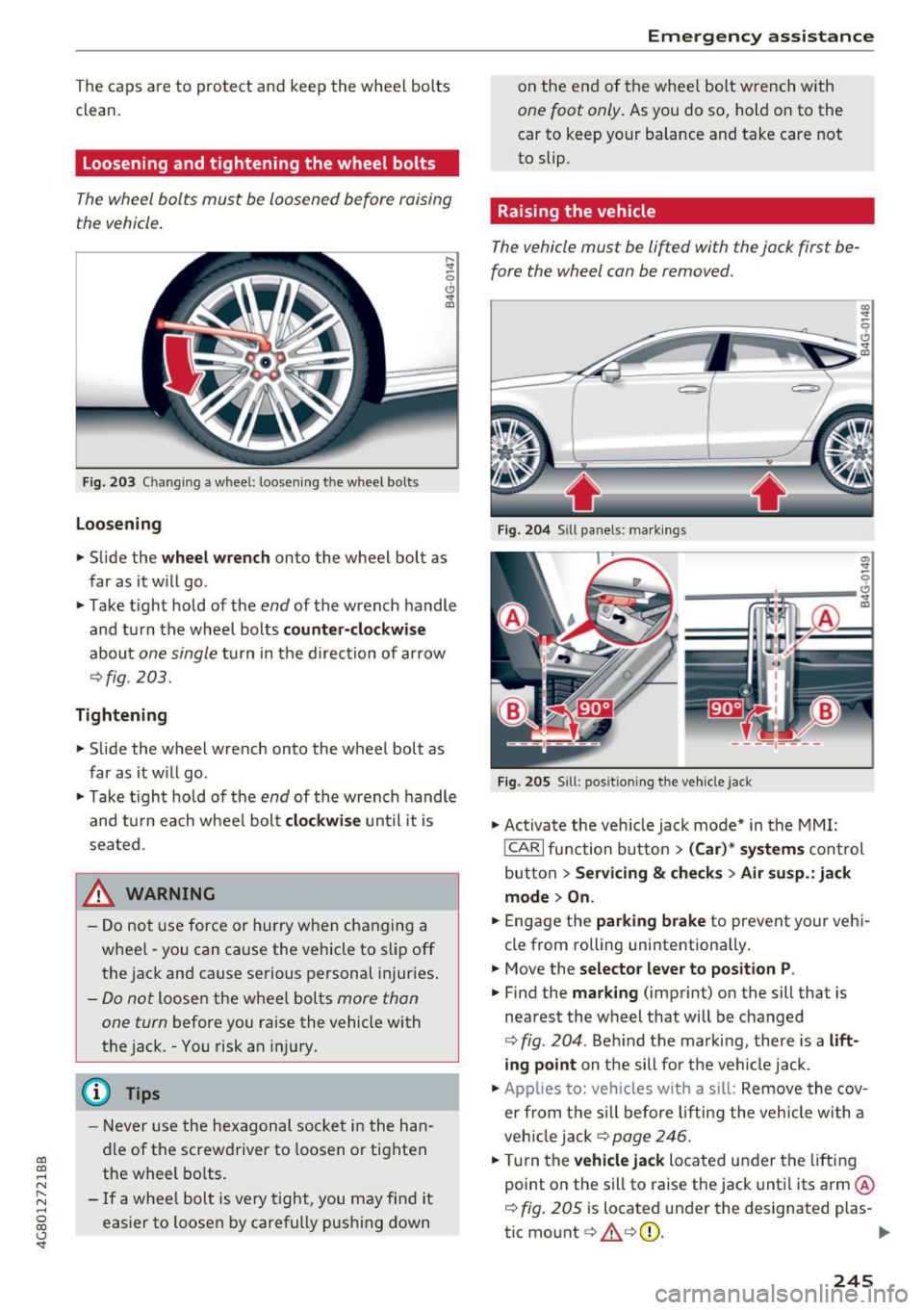
F ig. 20 3 Chan gin g a w hee l: l oose ning t he wheel bo lts
Loo sening
.. Slide the w he el wr enc h onto the wheel bolt as
far as it will go .
.. Take t ight hold of the
end of the wrench hand le
and turn the wheel bolts
c o unt er-clockwis e
about one single turn in the d irection of arrow
¢fig . 203.
Tightening
.. Slide the wheel wrench onto the wheel bolt as
far as it w ill go.
.. Take t ight hold of the
end of the wrench handle
and tu rn each whee l bolt
clockwi se unt il it is
seated .
& WARNING
- Do not use force or hurry when changing a
wheel -you can cause the vehicle to slip off
the jack and cause serious personal injuries .
-Do not loosen the wheel bolts more than
one turn
before you raise the vehicle w ith
the jack. - You risk an injury.
(D Tips
- Never use the hexagonal socket in the han
dle of the screwdriver to loosen o r tighten
the wheel bo lts .
- If a whee l bolt is very tight, you may find it
easier to loosen by carefully push ing down
Em ergen cy a ssis tanc e
on the end of the whee l bolt wrench with
one foot only . As you do so, hold on to the
car to keep your balance and take care not
to slip .
Raising the vehicle
The vehicl e must b e lift ed with the jock first be
fore the wheel can be removed.
F ig. 20 4 Sill pane ls: ma rkin gs
F ig. 205 S ill: pos it ion ing t he veh icle jac k
.. Activa te the veh icle jack mode* in the MMI:
!CARI function button > (Car )* sy stems control
button
> S erv ici ng & ch ecks > Air su sp .: jack
mode > On .
.. Engage the parking brake to prevent your vehi
cl e from rolling unintentiona lly .
.. Move the
selector le ver to p osit ion P .
.. Find the mar king (impr int) on the sill that is
nearest the wheel that will be changed
¢
fig . 204 . Behind the marking , there is a lift
ing poin t on the sill for the vehicle jack .
.. App lies to: veh icles with a s ill: Remove the cov
er from the s ill before lifting the vehicle with a
veh icle jack ¢
page 246.
.. Turn the vehicle jack located under the lift ing
point on the sill to raise the jack unt il its arm @
¢
fig. 205 i s locat ed und er the d esignat ed plas-
tic mount ¢
,&¢0. ..,.
245
Page 249 of 284

co
co
.... N
" N .... 0
00
<.,;) 'SI"
Taking the wheel off/installing the spare
Follow these instructions step-by-step for chang
ing the wheel.
Fig. 207 Changing a wheel: using the screwdriver hahd le
(with the blade removed} to turn the bolts
F ig. 208 Changing a wheel: alignment pin ins ide the top
hole
After you have loosened all wheel bo lts and
raised the vehicle
off the ground, remove and re
p lace the whee l as follows:
Removing th e wheel
" Use the hexagon al so cket in the screwdri ver
handle to completely remove the topmost
wheel bolt and set it aside on a
clean surface
¢fig. 207.
.. Screw the threaded end of the alignment pi n
from the tool kit hand-tight into the empty bolt
hole
¢ fig. 2oa1>.
" Then remove the other wheel bolts as described
above .
" Take
off the wheel leaving the a lignment pin in
the bolt ho le
¢ 0 .
l) Applies to vehicles with ceram ic brake rotors•: Use a sec
ond alignme nt pin• (stored in t he spa re wheel well mold
ing} for the lower hole , fo llow ing the descript ion for the
first alignment pin.
Em ergen cy a ssis tanc e
Putting on th e spar e wheel
" Lift the spare whee l and caref ully slide it over
the alignment pin to guide it in place¢(!).
.. Use the hexagona l socket in the screwdriver
handle to screw in and tighten all wheel bolts
slightly .
"Remove the alignment pin and insert and tight
en the remaining wheel bo lt slightly like the
rest .
.. Turn the jack hand le counter-clockw ise to lower
the vehicle unt il the ja ck is fully released.
" Use the wheel bo lt wrench to t ighten a ll wheel
bolts firmly¢
page 245. Tighten them cross
wise,
from one bo lt to the (approx imately) op
posite one, to keep the wheel centered.
(D Note
When removing or installing the wheel, the
rim could hit the brake rotor/ceramic brake
rotor* and damage the rotor . Work carefully
and have a second person he lp you.
(D Tips
Never use the hexagonal socket in the hand le
of the screwdriver to loosen or tighten the
whee l bolts.
- Pull the reversible blade from the screwdr iv
er before you use the hexagona l socket in
the handle to turn the wheel bolts.
- When mounting tires with unidirectional
t read de sign make sure the tread pattern is
pointed the right way
¢ page 248.
- The wheel bolts sho uld be clean and easy to
turn. Check for dirt and corrosion on the
mating surfaces of both the wheel and the
hub. Remove all dirt from these surfaces be
fore remounting the wheel.
247
Page 253 of 284
co
co
.... N
" N .... 0
00
<.,;) 'SI"
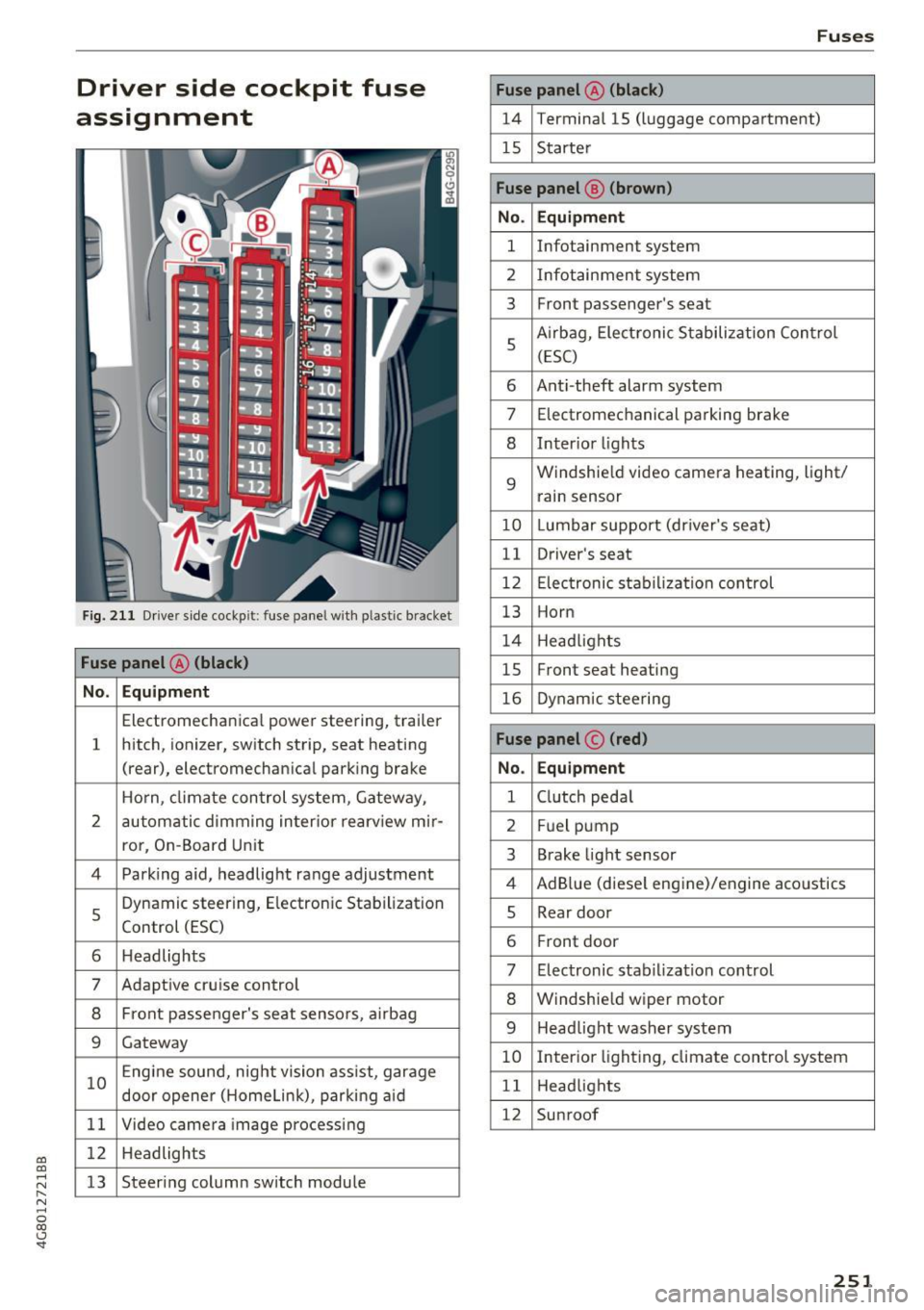
Driver side cockpit fuse
assignment
Fig. 2 11 Driver side cockp it: fuse panel wit h plastic bracket
Fuse panel @ (black)
No . Equipment
Electromecha nica l powe r steering, trailer
1 hitch, ionizer, switch st
rip, seat heating
(rear), electromechan ica l park ing brake
Ho rn, climate con trol system, Gateway,
2 automati
c dimm ing in ter ior rearv iew m ir-
ro r, On -Board Un it
4 Park ing aid, headlight ra nge adjustment
5
Dynamic steering, E lectron ic Stabilization
Control (ESC)
6 Headlights
7 Adapt ive cruise control
8 Front passenger's seat senso rs, a irbag
9 Gateway
10 Engine sound, night vision ass
ist, garage
door opene r (H ome link), parki ng aid
11 Video camera image processing
1 2 Headlights
13 Steering column sw
itch module
Fuses
Fuse panel @ (black)
14 Termina l 15 (luggage compartment)
15 S tarte r
Fuse panel @ (brown)
No . Equipment
1 Infotainment system
2 Infotainment system
3 Front passenger's seat
5
A
irbag, Elect ronic S tabilization Con trol
( E SC)
6 Ant
i-theft alarm system
7 Electromec hanical pa rking brake
8 Inter io r li ghts
9
Windshie ld video came ra heating, light/
rain sensor
10 Lumbar support (dr iver's seat)
11 Driver
's seat
12 Electronic st abilization con trol
13 Horn
1 4 Head lights
15 Front seat heating
16 Dynam ic steering
Fuse panel © (red)
No . Equipment
1 Clutch peda l
2 Fuel p ump
3 Brake
light sensor
4 AdB lue (diese l engine)/engine aco ustics
5 Rear door
6 Fr
ont door
7 Electronic stab ilization control
8 Windshie ld w iper motor
9 Head light washer system
10 Interio
r lighting, climate control system
1 1 Head lights
12 Sunroof
251
Page 254 of 284
Fuses
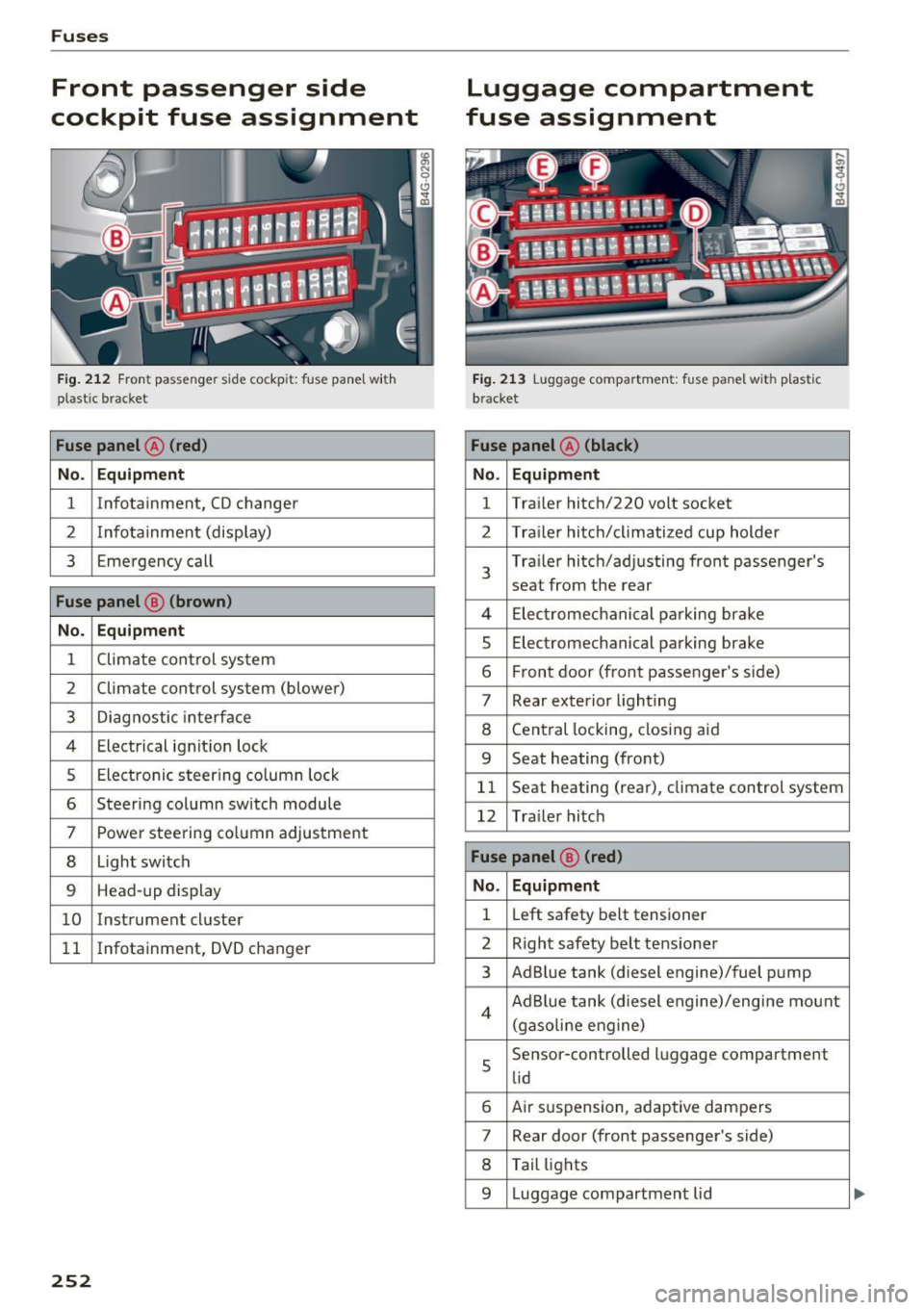
Front passenger side
cockpit fuse assignment
Fig. 212 Front passenger side cockpit: fuse panel wit h
plastic bracket
Fuse panel @ (red)
No. Equipm ent
1 Infotainment, CD changer
2 Inf
ota inment (display)
3 Emergency call
Fuse panel @ (brown)
No. Equipment
1 Climate control system
2 Climate control
system (blower)
3 Diagnostic interface
4 Electrical ignit ion lock
5 Electronic steering column lock
6 Steering column switch module
7 Power steering column adjustment
8 Light switch
9 Head-up display
10 Instrument cl uster
11 Infotainment, DVD
changer
252
Luggage compartment
fuse assignment
Fig. 213 Luggage compa rtme nt: fuse panel with plast ic
bracket
Fuse panel @ (black)
No . Equipment
1 Tra
iler hitch/220 volt socket
2 Trailer hitch/climatized cup holder
3
Trailer hitch/adjusting front passenger's
seat from the rear
4 El ec trom echan ical parking brake
5 Electromechanical parking brake
6 Front door (front passenger's side)
7 Rear exterior lighting
8 Central locking, closing aid
9 Seat heating (fro nt)
11 Seat heating
(rear), climate control system
12 Trailer hitch
Fuse panel @ (red)
No. Equipment
1 L
eft safety belt tensioner
2 Right safety belt tensioner
3 Ad Blue tank (diesel engine)/fuel pump
4 Ad Blue tank (diesel engine)/engi ne mount
(gaso lin e eng ine)
5
Se nsor-controlled luggage compartment
lid
6 Air suspension, adaptive dampers
7 Rear door (front passenger's side)
8 Tail lights
9 Luggage compartment lid
Page 257 of 284
@ Tips
The discharged battery must be properly con
nected to the vehicle's electrical system .
When jump starting or charg ing the battery,
never connect the negative ground cable to
the battery negative post because the battery
manager system must be able to detect the
battery's state of charge. Always connect the
negative ground cable to the negative ground
post of the battery manager control unit.
Use of jumper cables
Make sure to connect the jumper cable clamps in
exactly the order described below!
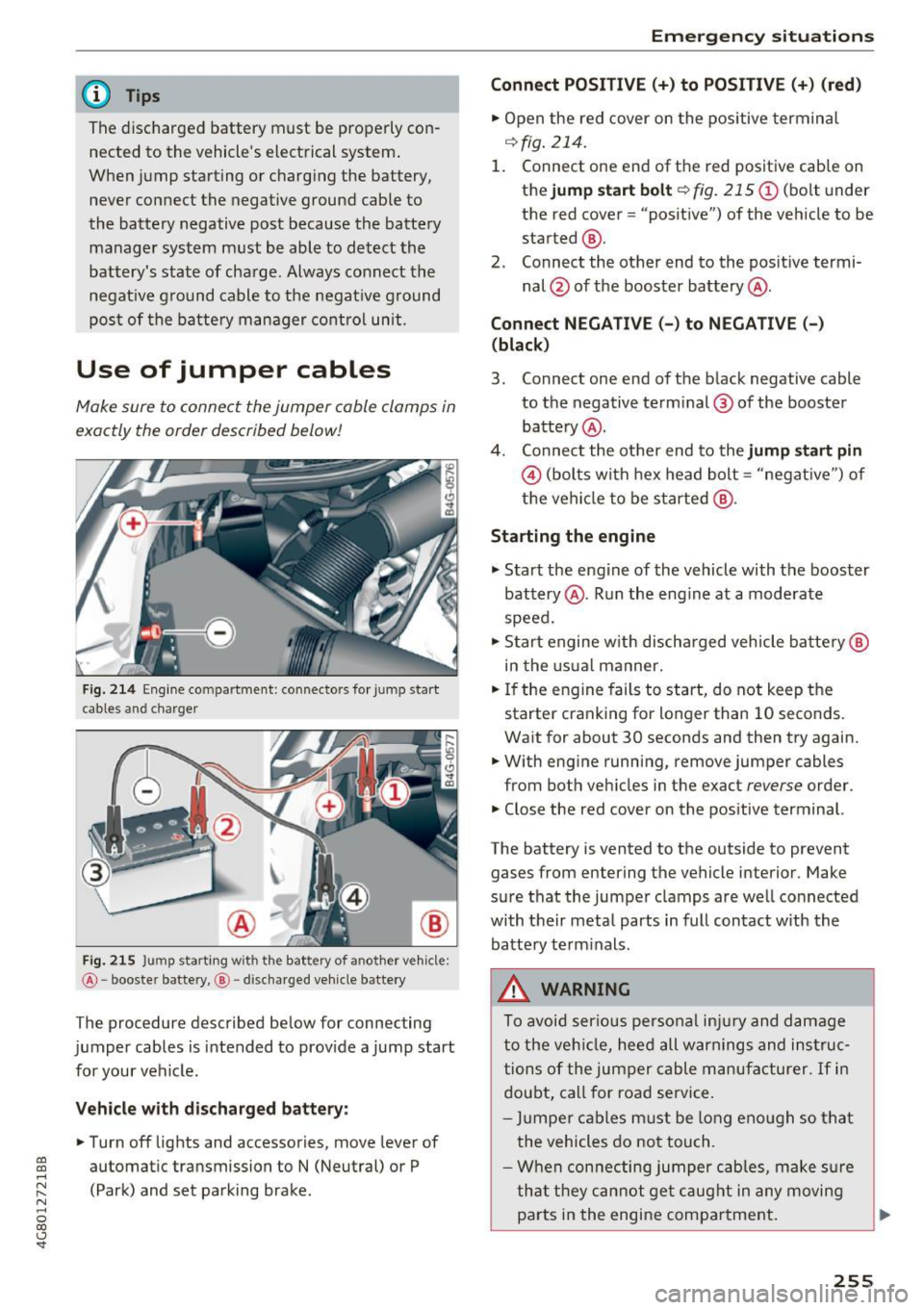
Fig. 214 Engine compartment: connectors fo r ju mp start
cables and charger
® @
Fig. 215 Jump starting with the battery of another vehicle:
@-booste r battery, @-discharged veh icle batte ry
The procedure described below for connecting
jumper cables is intended to provide a jump start
for your vehicle .
Vehicle with discharged battery:
.. Turn off lights and accessories, move lever of
~ automatic transmission to N (Neutral) or P ....
~ (Park) and set parking brake . N .... 0
00
<.,;) 'SI"
Emergency situations
Connect POSITIVE(+) to POSITIVE (+) (red)
.. Open the red cover on the pos itive terminal
qfig. 214.
1. Connect one end of the red posit ive cab le on
the jump start bolt~
fig. 215 (D (bolt under
the red cover= "positive") of the vehicle to be
started @.
2. Connect the other end to the positive termi- nal@ of the booster battery @.
Connect NEGATIVE (-) to NEGATIVE (-)
(black)
3. Connect one end of the black negative cable
to the negative terminal ® of the booster
battery @.
4. Connect the other end to the jump start pin
@ (bolts with hex head bolt= "negat ive'') of
the vehicle to be started @.
Starting the engine
.. Start the engine of the vehicle with the booster
battery @. Run the eng ine at a moderate
speed .
.. Start engine w ith discharged vehicle battery@
in the usual manner .
.. If the engine fails to start, do not keep the
starter cranking for longer than 10 seconds.
Wait for about 30 seconds and then try again .
.. With engine running, remove jumper cables
from both vehicles in the exact
reverse order .
.. Close the red cover on the positive terminal.
The battery is vented to the outside to prevent gases from entering the vehicle interior . Make
sure that the jumper clamps are well connected
with their metal parts in full contact with the battery terminals .
_&. WARNING
To avoid serious personal injury and damage
to the vehicle, heed all warnings and instruc
tions of the jumper cable manufacturer. If in
doubt, call for road service.
- Jumper cables must be long enough so that
the vehicles do not touch .
- When connecting jumper cables, make sure
that they cannot get caught in any moving
parts in the engine compartment. ..,.
255
Page 258 of 284
Emergency situations
-Before you check anything in the engine
compartment, always read and heed all
WARNINGS
c> page 199.
(D Note
Improper hook-up of jumper cables can ruin
the generator.
-Always connect POSITIVE(+) to POSITIVE
(+), and NEGATIVE(-) to NEGATIVE(-)
ground post of the battery manager control
unit.
- Check that all screw plugs on the battery
cells are screwed in firmly. If not, tighten
plugs prior to connecting clamp on negative
battery terminal.
- Please note that the procedure for connect
ing a jumper cable as described above ap
plies specifically to the case of your vehicle
being jump started . When you are giving a
jump start to another vehicle, do
not con
nect the negative (-) cable to the negative
(-) terminal on the discharged battery @
c> fig. 215. Instead, securely connect the
negative(-) cable to either a solid metal
component that is firmly bolted to the en
gine block or to the engine block itself. If
the battery that is being charged does not
vent to the outside, escaping battery gas
could ignite and explode!
Towing with a tow truck
General hints
Your Audi requires special handling for towing.
The following information is to be used by com
mercial tow truck operators who know how to op
erate their equipment safely.
- Never tow your Audi. Towing will cause dam
age to the engine and transmission.
- Never wrap the safety chains or winch cables
around the brake lines.
- To prevent unnecessary damage, your Audi
must be transported with a flat bed truck.
- To load the vehicle on to the flat bed, use the
towing loop found in the vehicle tools and at-
256
tach to the front or rear anchorage
c>page 256 and ¢page 257.
A WARNING
A vehicle being towed is not safe for passen
gers . Never allow anyone to ride in a vehicle
being towed, for any reason.
Front towing loop
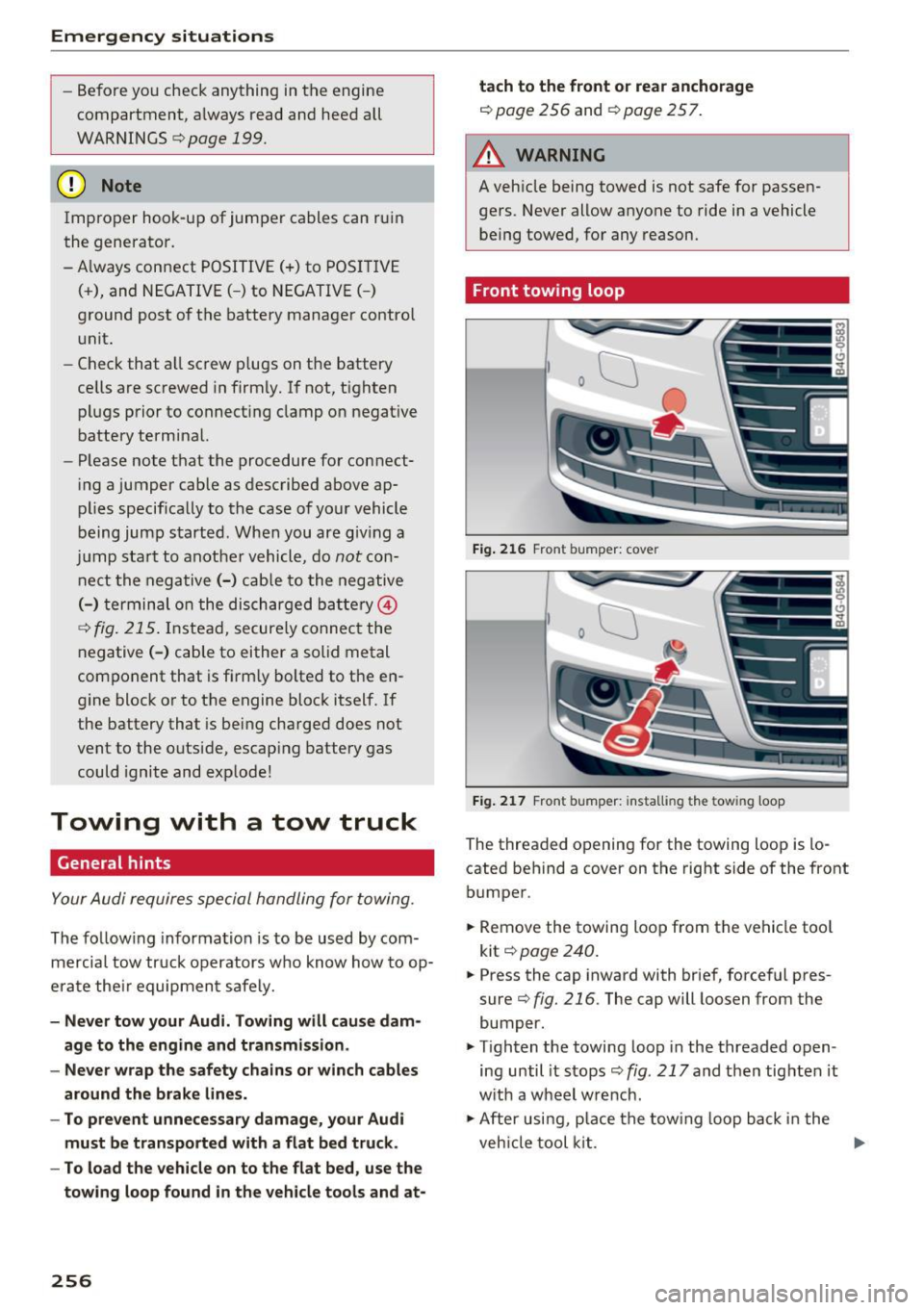
Fig. 216 Front bumper: cover
Fig. 217 Front bumpe r: install ing the tow ing loop
The threaded opening for the towing loop is lo
cated behind a cover on the right side of the front
bumper .
.. Remove the towing loop from the vehicle tool
kit
c> page 240.
.. Press the cap inward with brief, forceful pres
sure
¢fig. 216. The cap will loosen from the
bumper.
.. Tighten the towing loop in the threaded open
ing until it stops
¢ fig. 217 and then tighten it
with a wheel wrench .
.. After using, place the towing loop back in the
vehicle tool kit.
IJli>