lock AUDI A7 2017 Owner´s Manual
[x] Cancel search | Manufacturer: AUDI, Model Year: 2017, Model line: A7, Model: AUDI A7 2017Pages: 284, PDF Size: 72.29 MB
Page 187 of 284
co
co
.... N
" N .... 0
00
\.J '
has been designed and certified by its man
ufacturer for use on a front seat with a
passenger front and side airbag.
- Never put the forward-facing child restraint
up, against or very near the instrument pan
el.
- Always move the front passenger seat to
the highest position in the up and down ad
justment range and move it back to the
rearmost position in the seat's fore and aft
adjustment range, as fa r away from the air
bag as possib le, before insta lling the for
wa rd-facing child restra int.
- Always make sure that the safety belt upper
anchorage is beh ind the child restraint and
not next to or in front of the chi ld restraint
so that the safety belt will be properly posi
tioned.
- Make sure that the
PAS SENGER AIR BAG
OFF
light comes on and stays on all the time
whenever the ignition is switched on .
_&. WARNING
Rearward-facing child restraints:
- A ch ild in a rearward-facing child safety seat
installed on the front passenger seat will be
seriously injured and can be killed if the
front airbag inflates - even with an Ad
vanced Airbag System.
- The inflating a irbag will hit the child safety
seat or infant carrier with great force and
will smash the ch ild safety seat and child
against the backrest, center armrest, door
or roof .
- Always be especially careful if you must in
stall a rearward facing child safety seat on
the front passenger seat in exceptional c ir
c u mstances.
- Make sure that the
PASSENGER AI R BA G
OFF
light comes on and stays on all the time
whenever the ignition is switched on.
- If the
PA SSENGER A IR BAG OFF light does
not come on and stay on, immediately in
sta ll the rear-fac ing ch ild safety seat in a
rear seating position and have the airbag
system inspected by your Audi dealer .
Child safety
Activating the convertible locking retractor
Use the convertible locking retractor to secure a
child restraint .
Always heed the ch ild safety seat manufacturer 's
instruct ions when installing a child restraint in
your vehicle. To activate the convertible locking retractor:
.. Place the child restraint on a seat, preferably
on the rear seat .
.. Slowly pull the belt
all the w ay out .
.. Route it around or through the child restra int
be lt path ¢&_ .
.. Push the ch ild safety seat down with you r full
weight to get the safety belt really tight.
.. Insert the belt tongue into the buckle for that
seating position.
.. Guide the safety belt back into the retractor un
til the belt lies flat and snug on the child safety
seat .
.. You should hear a ''cl icking" noise as the belt
w inds back into the inertia reel. Test the con
vert ible lock ing retractor by pull ing on the belt .
You shou ld no longer be able to pull the belt
out of the retractor. The convertib le loc kin g re
t ractor is now activated.
.. Make sure that the red release button is facing
away from the child restraint so that it can be
unbuckled quickly .
.. Pull on the belt to make sure the safety belt is
properly tight and fastened so that the seat
cannot move forward or sideways more than
one inch (2 .5 cm) .
,&. WARNING
Using the wrong ch ild rest raint o r an improp
e rly installed child restra int can cause se rious
personal injury or death in a crash.
- Always make sure that the safety be lt re
tr actor is locked when installing a child
safety seat . An un locked safety be lt retrac
tor cannot hold the chi ld safety seat in p lace
during normal driving or in a crash.
- Always buckle the child safety seat firm ly in
p lace even if a child is not sitting in it. A
loose child safety seat can fly around during
a sudden stop or in a crash. .,.
185
Page 188 of 284
Child safety
-Always make sure the seat backrest to which
the child restraint is installed is in an up
right position and securely latched into
place and cannot fold forward. Otherwise,
the seatback with the child safety seat at
tached to it could fly forward in the event of
an accident or other emergency situation.
- Always read and heed all WARNINGS when
ever using a child restrained in a vehicle is
being used
¢ page 172 . Special precautions
apply when installing a child safety seat on
the front passenger seat¢
page 149, Child
restraints on the front seat -some impor
tant things to know.
Deactivating the convertible locking
retractor
The convertible Locking retractor for child re
straints will be deactivated automatically when
the belt is wound all the way bock into the re
tractor .
~ Press the red button on the safety belt buckle .
Th@ belt tongue will pop out of the buckle.
~ Guide the safety belt all the way back into its
stowed position .
Always let the safety belt retract completely into
its stowed position . The safety belt can now be
used as an ordinary safety belt without the con
vertible locking retractor for child restraints .
If the convertible locking retractor should be ac
tivated inadvertently, the safety belt must be un
fastened and guided completely back into its
stowed position to deactivate this feature. If the
convertible lock ing retractor is not deactivated,
the safety belt will gradually become tighter and
uncomfortable to wear.
A WARNING
-
Improperly installed child safety seats in
crease the risk of serious personal injury and
death in a collision.
- Never unfasten the safety belt to deactivate
the convertible locking retractor for child re straints while the vehicle is moving . You
186
would not be restrained and could be seri
ously injured in an accident.
- Always read and heed all WARNINGS when
ever using a child restrained in a vehicle is
being used
¢page 172. Special precautions
apply when installing a child safety seat on
the front passenger seat¢
page 149, Child
restraints on the front seat -some impor
tant things to know.
LATCH system (lower
anchorages and tethers
for children)
' Child Restraint System anchors and how
are they related to child safety
To provide a simpler and more practicable way to
attach the child restraint on the vehicle seat, Federal regulations require special lower ancho
rages in vehicles and devices on new child re
straints to attach to the vehicle anchorages .
In the United States, the combination of the
tether anchorages and the lower anchorages is
now generally called the LATCH system for
"Lower Anchorages and Tethers for Children" . In
Canada, the terms "top tether" with "lower uni
versal anchorages" (or "lower universal anchor
age bars") are used to describe the system .
In other countries the term "ISOFIX" is used to
describe the lower anchorages .
Forward-facing child restraints manufactured af
ter September 1, 1999, are required by U.S. fed
eral regulations to comply with new child head
movement performance requirements . These
new performance requirements make a tether
necessary on most new child seats.
Installing a child restraint that requires a top
tether without one can seriously impair the per
formance of the child restraint and its ab ility to
protect the child in a collision. Installing a child
restraint that requires a top tether without the
top tether may be a violation of state law.
Child restraint manufacturers offer LATCH lower
anchorages on their child seats with hook-on or ...
Page 190 of 284
Child safety
Please remember that the lower anchorage
points are only intended for installation and at
tachment of child restraints specifically certified
for use with
LATCH lower anchorages. Child re
straints that are not equipped with the lower an
chorage attachments can still be installed in
compliance with the child restraint manufactur
er's instructions on using vehicle safety belts .
A WARNING
Improper use of LATCH lower anchorages can
cause serious personal injury in an accident.
- Always carefully follow the child restraints
manufacturer's instructions for proper in
stallation of the child restraint and proper
use of the lower anchorages or safety belts
in your vehicle.
- Never secure or attach any luggage or other
items to the
LATCH lower anchorages.
- Always read and heed the important infor
mation about child restraints in this chapter
and WARNINGS
¢ page 172, Child safety.
Installing a child restraint with LATCH
lower anchorages
Whenever you install a child restraint always fol
low the child restraint manufacturer 's instruc
tions.
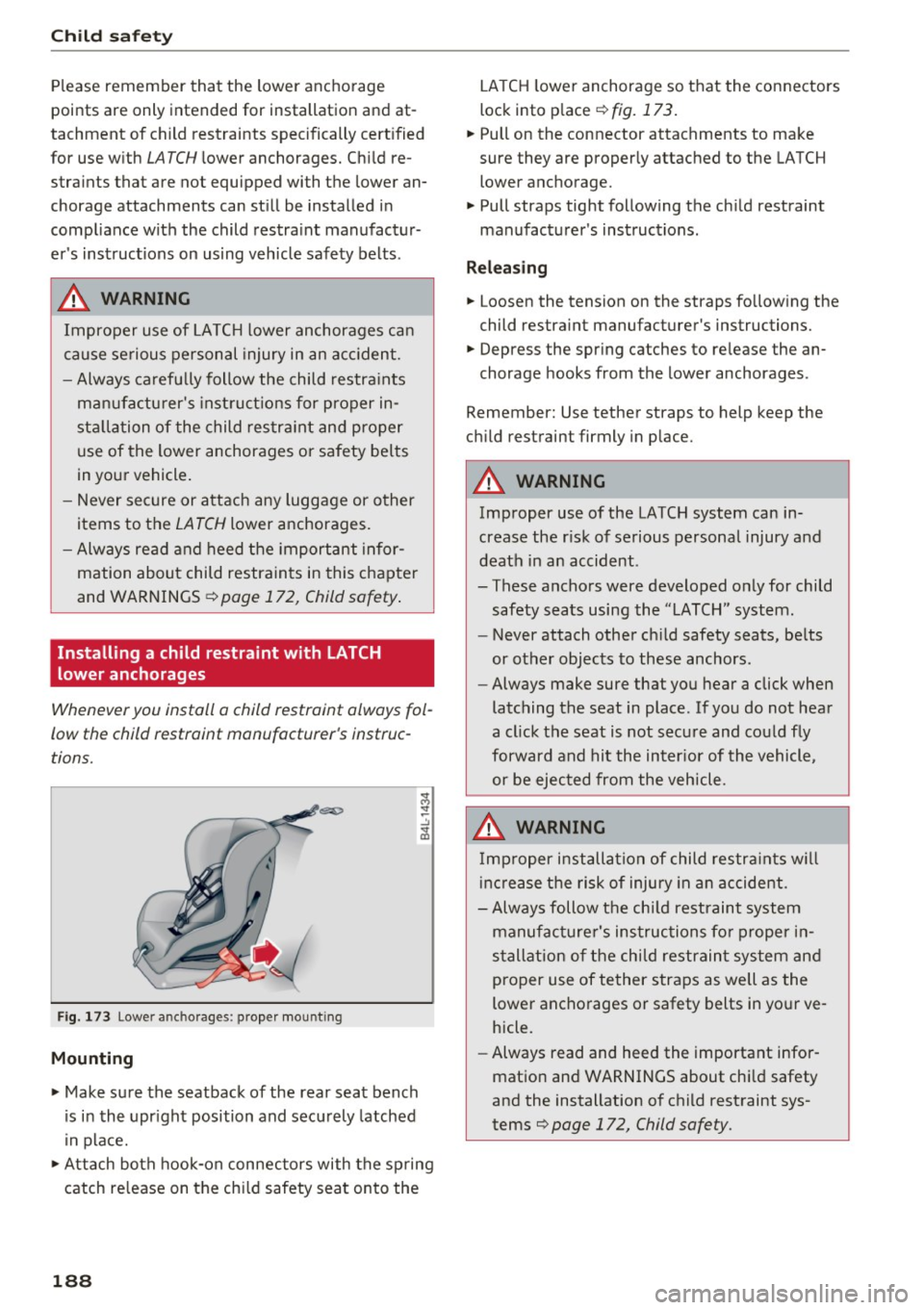
Fig. 173 Lowe r an ch orages : proper mou nting
Mounting
.,. Make sure the seatback of the rear seat bench
is in the upright position and securely latched
in place .
.. Attach both hook-on connectors with the spring
catch release on the child safety seat onto the
188 LATCH
lower anchorage so that the connectors
lock into place
¢ fig. 173.
.. Pull on the connector attachments to make
sure they are properly attached to the LATCH
lower anchorage.
.. Pull straps tight following the child restraint
manufacturer's instructions.
Releasing
.. Loosen the tension on the straps following the
child restraint manufacturer's instructions.
.. Depress the spring catches to release the an
chorage hooks from the lower anchorages .
Remember: Use tether straps to help keep the
child restraint firmly in place.
A WARNING
-
Improper use of the LATCH system can in
crease the risk of serious personal injury and
death in an accident .
- These anchors were developed only for child safety seats using the "LATCH" system.
- Never attach other child safety seats, belts
or other objects to these anchors .
- Always make sure that you hear a click when
latching the seat in place. If you do not hear
a click the seat is not secure and could fly
forward and hit the interior of the vehicle,
or be ejected from the vehicle.
A WARNING
Improper installation of child restraints will
increase the risk of injury in an accident.
- Always follow the child restraint system
manufacturer's instructions for proper in
stallation of the child restraint system and
proper use of tether straps as well as the lower anchorages or safety belts in your ve
hicle.
- Always read and heed the important infor
mation and WARNINGS about child safety
and the installation of child restraint sys
tems¢
page 172, Child safety.
-
Page 195 of 284

co
co
.... N
" N .... 0
00
<..:l 'SI"
These fuels contain substances that can se
vere ly damage the fuel system and the en
gine if the engine is started .
Refueling
Fuel filler neck
The fuel filler neck is located on the right rear
side panel behind the fuel filler flap.
If the power locking system should fail , you can
still open the flap manually - for detailed instruc
tions see
~ page 195 .
You can find the fuel tank capacity of your vehicle in
~ page 262 .
The label on the inside of the fuel filler flap tells
you the correct fuel for your vehicle. For mo re in
formation about fuel specifications , see
~ page 191 .
You r vehicle fuel tank has an onboa rd refuelling
vapor recovery sys tem . This fea tu re helps to pre
vent fuel vapors from escaping from the tank and polluting the environment while you refuel your
vehicle. In order to fill the tank properly while
protecting the environment, please follow this
refueling procedure carefully.
_& WARNING
Under norma l operating conditions, never car
ry additiona l fuel containers in your car. Gas
canisters and other containers used to trans
port fuel can be dangerous. Such containers,
full or empty, may leak and could cause a fire
in a collision . If you must transport fuel to
use for your lawn mower, snow blower, etc.,
be very careful and always observe local and
state laws regarding the use, transportation
and storage of such fuel containers. Make cer
tain the container meets industry standards
(ANSI/ASTM F852 -86).
(D Note
Never drive your vehicle until the fuel tank is
completely empty. The irregular supply of
fue l can cause misfiring. Gasoline could enter
the exhaust system and damage the catalyt ic
converter.
Checking and Filling
Fueling procedure
Fig. 176 Righ t re ar sid e of the v ehicl e: openin g th e fu el
fille r door
Fig. 177 Fue l filler doo r with at tached fuel cap
T he fue l filler door is unlocked or locked by the
central locking system.
Opening the fuel cap
"' Press on the left side of the fue l filler door to
open ~
fig. 176 .
"'U nscrew the tank cap counterclockwise.
"' Place the cap from above on the open fuel filler
door ~
fig. 177.
Closing the fuel cap
"' Sc rew the tank cap on to the right on the filler
neck until it cannot turn any farther.
"' Then press on the left s ide of the tank door un-
til it latches.
Once the pump nozzle switches off, the fuel tank
is "full ". Do not fill the tank mo re . Otherwise the
expans ion space in the tank w ill be filled .
The correct fuel type for your vehicle can be
found on a label located on the inside of the fuel
filler door. Fo r additional informa tion on fuel,
see
~ page 191.
193
Page 196 of 284

Checking and Filling
The fuel tank capacity of your vehicle is listed in
the
Technical Data section ~ page 262.
To avoid fuel spilling or evaporating from the fuel
tank always close fuel cap properly and com
pletely. An improperly closed fuel filler cap may
also cause the MIL lamp~
page 25 to come on.
A WARNING
Not paying attention when fueling or han
dling fuel incorrectly can lead to fires, explo
sions or serious injuries .
- Fuel ignites easily and can cause serious burns and other injuries .
- If you do not switch the engine off when fu
eling and/or do not insert the fuel no zzle
completely into the tank opening, fuel can
leak out or run over . Leaked fuel can ignite
and start a fire .
- Do not use the telephone while fueling. The
electromagnetic rays can cause sparks,
which can ignite fuel vapors and start a fire .
- Do not sit in your vehicle while fueling . If
you must make an exception and enter your
vehicle again while fueling, close the door
and touch metal to discharge static electricity before touching the fuel nozzle . Static
electricity can create sparks, which can ig
nite vapors when fueling.
- Do not smoke or have an open flame in the
area when fueling your vehicle or filling a
fuel container because this increases the risk of an explosion.
- For your safety, carrying fuel containers in
your vehicle is not recommended. Whether
full or empty, the container can leak and
cause a fire in the event of an accident.
- If you must make an exception and trans
port a fuel container, note the following:
- Never fill the fuel container with fuel
while it is in or on the vehicle. Static elec
tricity is discharged when filling which can
cause the fuel vapors to ignite and in
creases the risk of an explosion.
- Always place a fuel container on the
ground before filling.
- Always hold the fuel nozzle completely in
the fuel container when filling.
194
-If the fuel container is made of metal, the
fuel nozzle must always be in contact with
the container when filling it with fuel. This
prevents static electricity from discharg
ing .
-Never spill fuel in the vehicle or the lug
gage compartment . Evaporated fuel is ex
plosive and increases the risk of serious in
jury or death .
- Follow legal requirements when using, storing and transporting fuel containers .
- Make sure the fuel container conforms to industry standards (ANSI/ASTM F852-86).
(D Note
-Remove spilled fuel from vehicle paint im
mediately, because it can damage paint.
- Never drive until the fuel tank is completely
empty. The irregular supply of fuel that re
sults from that can cause engine misfires.
Uncombusted fuel will enter the exhaust
system and increase the risk of damage to
the catalytic converter .
(D Note
Applies to: vehicles with diesel eng ines
If the fuel tank runs completely empty, the
ignition must remain switched on for at least
30 seconds after refueling before starting the
engine. It may take longer than usual for the
engine to start, even up to a minute. This is
because the air must first bleed out of the
fuel system when starting the engine.
@ For the sake of the environment
Do not overfill the fuel tank, otherwise fuel
can leak out when the vehicle is warming up.
(y Tips
The fuel filler door on your vehicle does not lock if you lock the vehicle from the inside.
(D Tips
Applies to: veh icles with diesel e ngin es
Diesel vehicles are equipped with a misfueling
guard
l) . It allows the vehicle to be fueled on-
ly with a diesel fuel pump nozzle . .,.
Page 197 of 284
-A worn or damaged nozzle or a nozz le that
i s too sma ll may not be ab le to open the
diesel misfueling guard. If this is the case,
try turning the nozzle before insert ing it in
the fue l fi ller neck, use a different fuel
pump, o r see an a uth orized Audi dea ler or
aut horized Aud i Serv ice Fac ility fo r ass is
tance.
- The m isfueling guard does not open when
adding fue l from a fue l conta iner . You ca n
bypass it by addi ng the diesel fuel s low ly.
Fuel filler door emergency release
If the central locking system is faulty, the fuel
filler door con be unlocked manually .
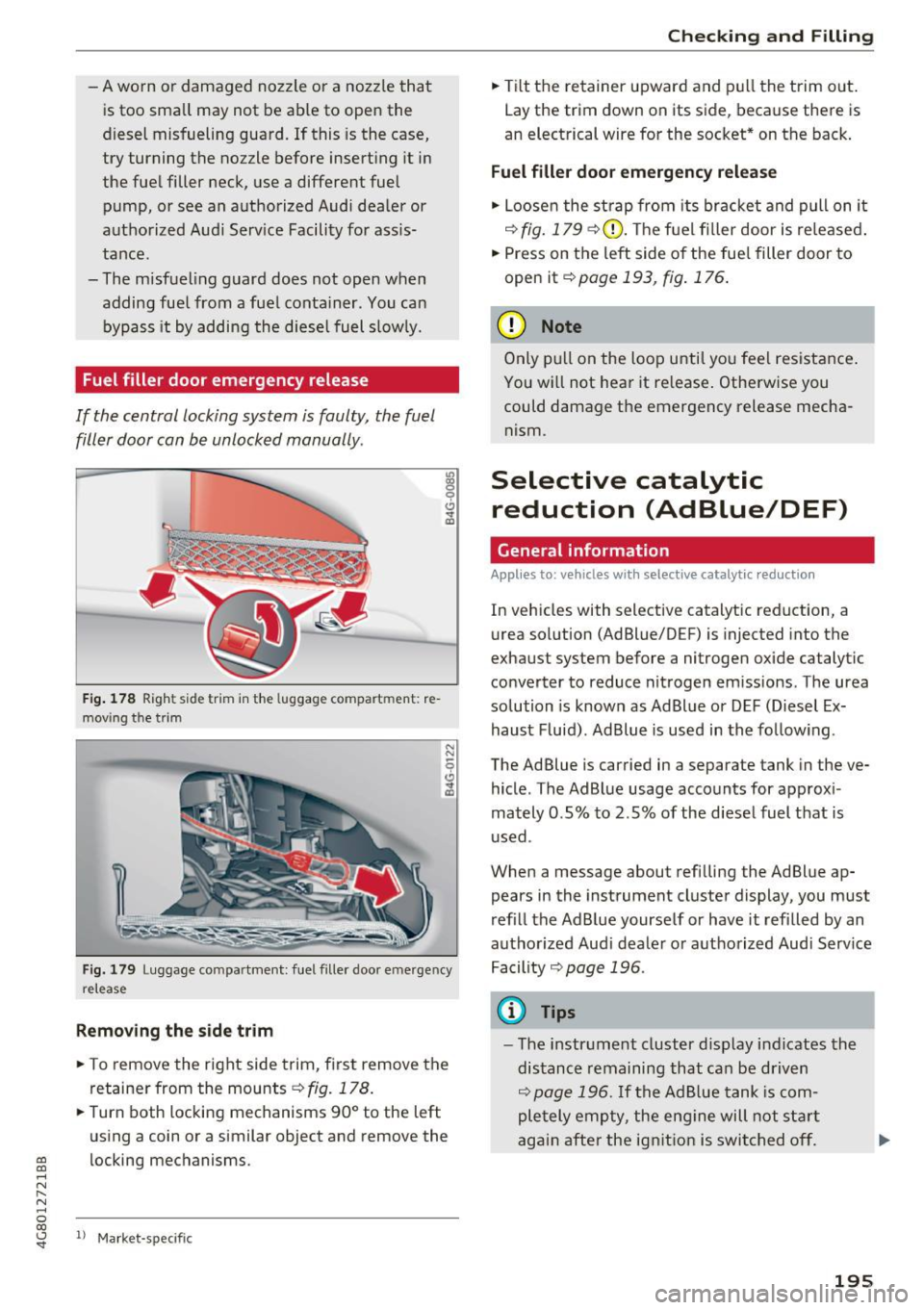
Fig. 178 Righ t side tr im in the luggage compart ment : re
mov ing t he trim
N N
9
~
Fig . 17 9 Luggage compartme nt: fuel f iller door emerge ncy
release
Removing the side trim
.,. To remove the right side trim, first remove the
retaine r from the mounts
c::> fig. 178 .
.. Turn both locking mechanisms 90° to the left
us ing a coin or a similar object and remove the
~ locking mec hanisms . .-, N
" N .-, 0
00
~ ll Ma rket -spe cific
Checking and Filling
.. Tilt the retainer upward and pull the trim out .
Lay the trim down on its side, beca use there is
an elect rical wire for the soc ket* on the back .
Fuel filler door emergency release
.. Loose n the st rap from its br acke t and pull on it
c::> fig. 179 c::> (i) . The f uel f iller door is re le ased .
.. Press on the left side of the fue l filler door to
open it
c::> page 193, fig. 176 .
(D Note
Only pull on the loo p until yo u fee l resista nce .
You w ill not hea r it re lease . Othe rw ise you
could damage the emergency release mecha
nism.
Selective catalytic reduction (AdBlue/DEF)
General information
Appl ies to: vehicles with selective catalytic reduct io n
In vehicles with selective catalyt ic reduction, a
urea sol ution (AdBlue/DEF) is injected into the
exhaust system before a nitrogen oxide catalytic
converter to reduce nitrogen em issions . The urea
solution is known as Ad Blue or DEF (Diesel Ex
haust F luid) . Ad Blue is used in the fo llow ing .
The Ad Blue is carried in a separate tank in the ve
hicle . The AdBlue usage acco unts for app rox i
mately 0 .5% to 2.5% of the diesel fuel that is
u sed .
When a message about refi lling the AdBlue ap
pears in the instrument cluste r display, you must
r efil l the Ad B lue yourse lf or have it refilled by an
autho rized Aud i dea le r or a utho rized Aud i Serv ice
Fa cility
c::> page 196 .
(D Tips
-The instr ument cluster d isp lay i ndicates the
distanc e remaining that ca n be driven
c::> page 1 96. If the Ad B lue tank is com
ple tely emp ty, the eng ine will not s tart
agai n afte r the ign it io n is swit ched of f.
195
Page 198 of 284

Checking and Filling
-Ad Blue is required by law to operate this ve
hicle .
Messages in the instrument cluster display
Applies to: vehicles with selective catalytic reduction
The display indicates if the Ad Blue level is low or
if there is a system malfunction.
AdBlue level low
You will be informed if the Ad Blue in the tank
drops below a certain level.
Please refill AdBlue . Range x mi (km)
This message appears when there is only enough
Ad Blue left to drive the distance indicated in the
driver information system . Fill the AdBlue.
Ad Blue ,0 Refill AdBlue! Cannot start engine
in x mi (x km)! See owner's manual
This message appears when there is only enough
Ad Blue left to drive the distance indicated in the
driver information system. Fill the AdBlue. Other
wise the engine will not start again if you stop it
once the distance indicated has been driven. You
can also check the remaining distance in the on
board computer* .
Refill Ad Blue! No restart! See own-
er's manual
This message appears when the Ad Blue tank is
empty . Fill the Ad Blue . Otherwise you will not be
able to start the engine again once you stop it .
The AdB lue must be refilled when the amount in
the tank has reached the minimum level
c::> page 196, Filling AdBlue.
Incorrect filling/system malfunction
A message appears if the Ad Blue tank was filled
with a fluid other than AdBlue and the system
has detected that the tank was fi lled incorrect ly,
or if there is a system malfunction .
Ad Blue-/' Ad Blue : system fault. No re start in
x mi (x km) See owner's manual
This message appears when it is only possible to
d rive the distance indicated in the driver informa
tion system. Drive to the nearest authorized Aud i
dealer or authorized Aud i Serv ice Facility to have
196
the malfunction corrected . Otherwise the engine
will not start again if you stop it once the dis
tance indicated has been driven.
AdBlue: System fault No restart!
See owner's manual
This message appears if the system has detected
that the tank was fi lled incorrect ly or that there
i s a ma lfunction. Drive immed iate ly to the near
est authorized Audi dealer or authorized Audi
Service Facility to have the ma lfunction co rrect
ed. Otherwise you wi ll not be able to start the en
gine again once you stop it.
Filling AdBlue
Applies to: vehicles with selective cata lytic reduct ion
Fig. 180 R ig ht rea r side of t he ve hicle: removing the Ad B l
ue cap
The Ad Blue tank open ing is located near the die
sel tank opening . Add at least 1.5 gallons (S . 7
lit ers) of Ad Blue . This is the minimum amount re
quired to ensure the system detects the refilling
and to start the eng ine. You can add a maximum
of 4.5 gallons (17 lite rs).
Requirement: the request to add AdBl ue must
appear in the ins trument cluster display .
.,. Switch the ignition off.
.,. Open the tank filler door
c::> page 193.
.,. Tu rn the cap on the filler neck counter-clock
w ise using the wheel wrench from the vehicle
tool kit to remove it
c::> fig. 180.
.. Fill the Ad Blue using a bottle c::> page 197 or a
canister
c::> page 19 7.
Page 199 of 284

co co .... N
" N .... 0
00
\.J -
Ad Blue can irritate the skin, eyes and respira
tory system. If there is contact with the fluid,
flush immediately with plenty of water . Con
sult a physician if necessary.
CD Note
- Only use Ad Blue that conforms to the
standard ISO 22241 -1. Do not mix any addi
tives w ith the AdBlue and do not d ilute it
with water.
- Do not add Ad Blue to the diesel ta nk or add
diesel fuel to the Ad Blue tank. Do not start
the engine under any circumstances if the
wrong f uel is filled in the tank. There is a
risk of damaging the fuel tank system and
the engine. See an author ized Audi dealer or
authorized Audi Service Facility for ass is
tance .
- Ad B lue attacks surfaces such as pa inted ve
hicle components, plast ic and carpet . Re
move the fluid as quickly as poss ible with a
damp cloth and plenty of cold water. If the
Ad Blue has already crysta llized, use warm
water and a sponge . AdBlue residue that is
not removed will crysta llize a nd can damage
the affected surface.
- Do not store refill bottles or canisters per
mane ntly in the vehicle . If the container
l ea ks, the escaping AdBl ue could damage
t h e veh icle inter io r.
- Do not allow AdBlue to come into co ntact
with clothing. If there is contact w ith the
f lui d, f lush immed iate ly w ith p lenty of wa
te r.
(j) Tips
Follow the Ad B lue man ufact urer's instr uc
t ions fo r use and storage.
Refilling AdBlue using a bottle
Applies to: vehicles with selective catalytic reduction
.. Remove the cap from the refi ll bottle ¢ A in
Filling AdBlue on page 197, ¢(Din Filling
AdBlue on page 197 .
Check ing and Filling
.. Position the bott le on the fi ller tube and turn
the bottle clockwise until it stops turning .
.. Press lightly against the bottom of the bottle
to empty it. Cont inue pressing the bottom of
the bottle until it is empty or until fluid stops
flow ing into the tank .
.,. Remove the bottle and seal the filler neck
¢ page 198, Completing AdBlue refill.
CD Note
Only use refill bottles that are approved for
your vehicle . Using other systems can cause
Ad B lue to leak.
@ Tips
- You can obtain ref ill bottles from an author
ized Aud i dea le r o r aut horized Aud i Serv ice
Facility.
- A permitted refi ll bottle contains approxi
mately 0.5 gallon (1.9 liters) of AdBl ue.
Refilling AdBlue using a canister
Applies to: vehicles with selective catalytic reduction
®
+®
Fig. 181 Can iste r w ith attachable hose
.. Remove the cover from the refill canister¢ A
in Filling AdBlue on page 197, ¢(Din Filling
AdBlue on page 197 .
.,. Secure the end of the hose (Don the opening in
t he caniste r@ by turni ng the hose to the right.
.,. Remove the cap @ from the o ther end of the
hose @.
.. Position the end of the hose @ on the filler
neck in the veh icle and turn the hose to the
r ight to tighten it .
.. Lift the canister up and then t ip it. Cont inue
holding the canister in a tipped pos ition until it ..,.
197
Page 208 of 284

Check ing and F illing
The coolant leve l is monitored through the. in
dicator light ¢
page 14. However, we do recom
mend occasionally check ing the coo lant level
manually.
I f you must add coolant, use a mixture of water
and coolant additive. Mixing the coolant additive
with d istilled water is recommended.
Coolant additiv e
The coolant addi tive is made of anti-freezi ng and
corros ion protection agents. Only use the fo llow
ing coolant additives . These additives may be
mixed with each other.
Coolant additive Specification
Gl3 TL 774)
Gl2++
TL 774 G
The amount of coolant add itive that needs to be
mixed w ith water depends on the climate where
the vehicle will be operated. If the coolant addi
tive percentage is too low, the coolant can freeze
a nd damage the engine.
Coolant
Freeze protec·
additive tion
Warm reg ions min. 40% m in. -13 ° F
max. 45% (-25 °C)
Cold regions min. 50% max . -40 °F
max . 55% (-40 °C)
([)
Note
-Before the start of winter, have your author
ized Audi dealer or authorized A udi Se rvice
Fac ility check if the coolant additive in you r
vehicle matches the percentage approp riate
fo r the clim ate. Thi s is especially important
when driving in co lder climates .
- If the approp riate coolant additive is not
available in an emergen cy, do no t add any
other additive. You cou ld damage the en
gine. If this happens, only use water and re store the correct mixture ratio with the
spec ified coolant additive as soon as possi
ble.
- Only refill with new coo lant.
- Radiator sealant must not be mixed w ith
the coo lant .
206
· Adding coolant
F ig. 186 En gin e compartment : coolant exp ansion tank
cover
-N
-~
~
Observe the safety precautions ~ .&. in Working
in the engine compartment on page 199.
Check ing the engin e coolant level
Park the vehicle on a leve l surface.
.,. Switch the ignit ion off.
.,. Read the coolant level on the coolant expansion
tank ¢
page 202, fig . 184. The coolant level
must be betwee n the MIN and MAX mark ings
when the e ngine in co ld. When the engine is
wa rm it c an be slightly above the MAX marking.
Adding coolant
Requirement: there must be a residual amount of
coolant in the expansion tank ¢(D .
.,. Let the engine cool down .
.,. Place a cloth over the coolant expansion tank
cap and unscrew the cap counterclockw ise
¢ .8_ .
.,. Add coo lant m ixed in the correct rat io
¢ page 205 up to t he MAX mar king.
.,. Make sure that the f luid level remains stab le.
Add mo re coolant if necessary.
.,. Close the cap securely .
Coolant loss usually ind icates there is a lea k. Im
med iate ly dr ive your vehi cle to a n author ized
Audi dealer or author ized A udi Service Fac ility
and have the cooling system inspected . If the
cooling system is not leaking, a loss can come
from the coolant boiling through overheating
and being pushed out of the cooling system.
Page 239 of 284
co
co
.... N
" N .... 0
00
\.J '
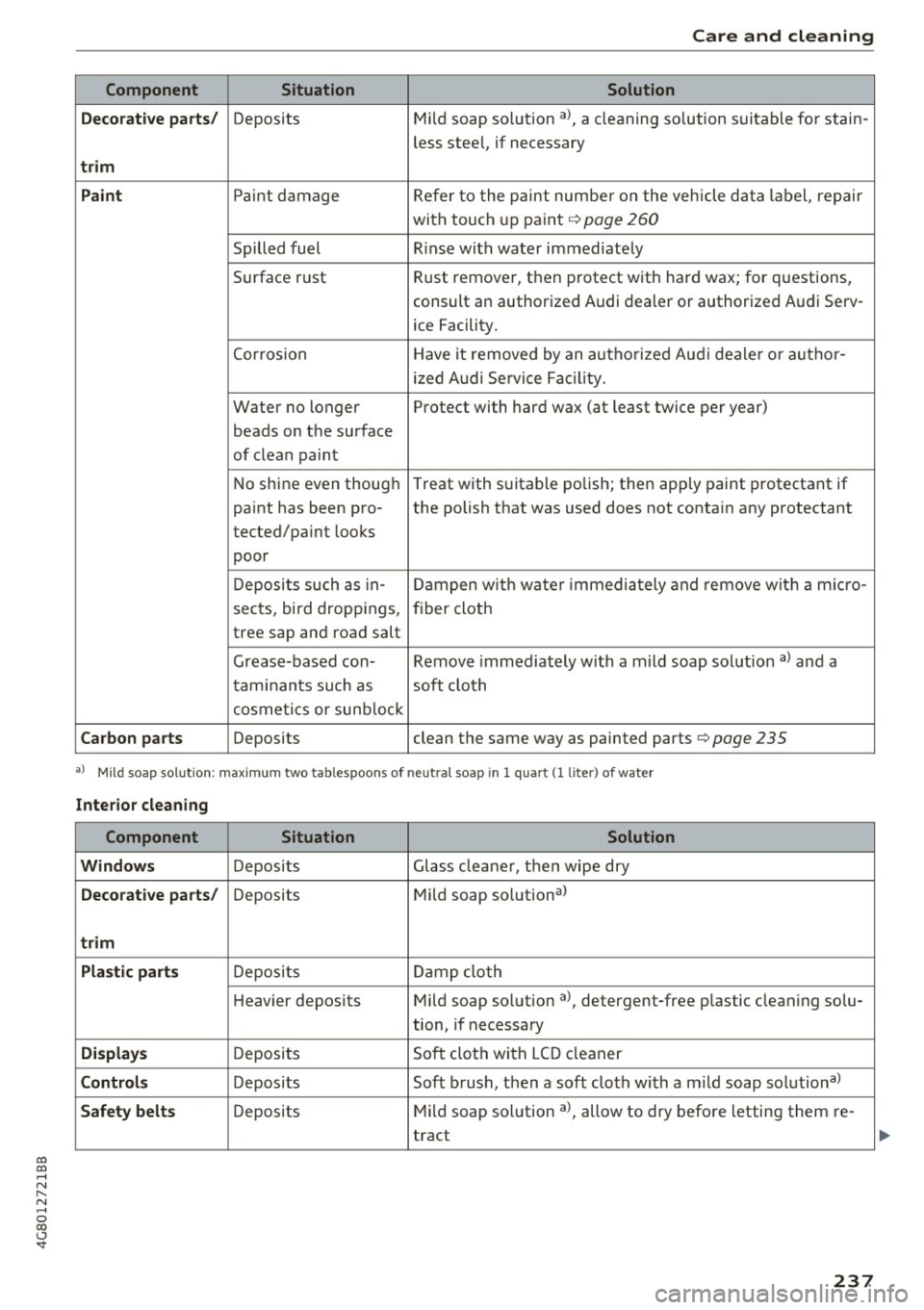
Component Situation Solution
Decorati ve parts /
Deposits Mild
soap solution al, a cleaning so lution suitable for stain-
less stee l, if necessary
trim
Paint
P aint damage Refer to the paint number on the vehicle data label, repair
with touch up paint
q page 260
Spilled fuel Rinse with water immediately
Surface rust Rust
remover, then protect with hard wax; for questions,
consult an authorized Audi dealer or authorized Audi Serv-
ice Facility.
Corrosion Have it removed by an authorized Aud i dealer or author-
ized Audi Se rvice Facility.
Water no longer Protect with hard wax (at least twice per year)
beads on the surface
of clean paint
No shine even though Treat with suitable polish; then app ly paint protectant if
paint has been pro -the polish that was used does not contain any protectant
tected/paint looks
poor
Deposits such as in - Dampen with water immediately and remove with a m icro-
sects, bird droppings,
fiber cloth
tree sap and road salt
Grease-based con- Remove immediately with a m ild soap solution al and a
taminants such as soft cloth
cosmetics or sunb lock
Carbon parts Deposits clean the same way as painted parts q page 235
a} Mi
ld soap solution: maximum two tab lespoons of neutral soap in 1 quart (1 lite r) of water
Interior cleaning
Component Situation Solution
Windows
Deposits Glass cleaner, then wipe dry
Decorative parts/ Deposits Mild
soap solutional
trim
Plastic parts
Deposits Damp cloth
Heavier deposits Mild soap solution al, detergent-free plastic cleaning solu-
tion, if necessary
Display s Deposits Soft cloth with LCD cleaner
Controls Deposits Soft brush, then a soft cloth with a m ild soap solutional
Safety belts Deposits Mild
soap so lution al, allow to dry before letting them re-
tract
237