ignition AUDI A7 2017 Owner´s Manual
[x] Cancel search | Manufacturer: AUDI, Model Year: 2017, Model line: A7, Model: AUDI A7 2017Pages: 284, PDF Size: 72.29 MB
Page 233 of 284

co
co
.... N
" N .... 0
00
\.J -
store the pressure again in the Infotainment sys
tem
¢page 231.
ffim (T ire Pressure Monitoring System) T ire
pressu re : S ys tem malfunction !. If ffim
appears
after switching the ignition on or whi le driving
and the
[I] indicator light in the instrument clus
ter blinks for approximate ly one minute and then
stays on, there is system malfunction. Try to
store the correct tire pressures¢
page 231. If
the ind icator light does turn off or turns on again
after a short period of time, dr ive to an author
i zed A udi dealer o r authorized Audi Service Fac ili
ty immediately to have the malfunc tion correct
ed .
& WARNING ,___ -
-If the tire pressure indicator appea rs in the
display, reduce your speed immed iate ly and
avoid any hard steer ing or braking maneu
vers. Stop as soon as possib le and check the
t ires and their pressure.
- The driver is responsib le for maintaining the
correct tire pressure. You must check the
t ire pressure regu larly.
- Under certa in conditions (such as a sporty
driv ing style, winter cond itions or unpaved
roads), the tire p ressure monitoring system
indicator may be delayed.
{D) Tips
- The t ire pressure monitoring system can al
so stop work ing when there is an ESC mal
funct ion.
- Using snow chains may result in a system
malfunction .
- The t ire pressure monitoring system in your
Audi was calibrated with "Audi Orig inal
Tires"
¢ page 218. We recommend that you
use these t ires .
Wh eel s
Storing tire pressures
Applies to: vehicles with Tire Pressure Monitor ing System in
dicator
If the tire pressure changes or a tire is replaced,
it must be confirmed in the Infotainment sys tem.
.,. Make sure before storing that the tire pressures
of all four tires meet the specified values and
are adapted to the load
¢ page 221.
.,. Switch the ignit ion on.
.,. Select: the
I CAR ! funct ion button > ( C ar) * Sys
tem s
contro l button > S ervic e & ch eck s> Tire
pres sure monitor > Store tire pre ssure > Yes,
s tore now .
(D Tips
Do not store the tire pressures if snow chains
a re installed.
Tire pressure monitoring
system
ill General notes
Each tire, including the spare (if provided),
shou ld be checked monthly whe n cold and inflat
ed to the i nflat io n press ure recommended by the
vehicle manufacturer on the veh icle placard or
t ir e inflation pressure labe l. (If your ve hicle has
tires of a different size than the size indicated on
the vehicle placard or tire inflation pressure la
bel, you should determ ine the proper tire infla
t ion pressure for those tires).
As an added safety feature, yo ur vehicle has been
equipped with a tire pressure mon itor ing system
(TPMS) that illuminates a low tire pressure tell
ta le when one or more of your tires is signif icant
ly under-inflated. According ly, when the low t ire
pressure te lltale illum inates, you sho uld stop and
chec k your tires as soon as possib le, and inflate
t h em to the prope r pressure. Dr iving on a sig nifi
ca nt ly unde r-inflated t ire causes the t ire to over
hea t and can lead to tire fa il ur e. Under-inflat ion
also reduces fue l effic iency and tire tread life,
and may affect the vehicle's handling and stop -
ping ability .
liJJ,-
231
Page 234 of 284

Wheels
Please note that the TPMS is not a substitute for
proper tire maintenance, and it is the driver's re
sponsib ility to ma intain correct tire pressure,
even if under-inflation has not reached the level
to trigger illumination of the TPMS low tire pres
sure telltale.
Your veh icle has also been equ ipped with a TPMS
malfunction indicator to indicate when the sys
tem is not operating properly. The TPMS mal
function indicator is combined with the low tire
pressure telltale . When the system detects a
malfunction, the telltale will flash for approxi mately one minute and then remain cont inuously
illum inated. This sequence will continue upon
subsequent vehicle start-ups as long as the mal
function exists.
When the malfunct ion indicator is illuminated,
the system may not be able to detect or signal
low tire pressure as intended. TPMS ma lfunctions
may occur for a variety of reasons, including the
installation of replacement or alternate tires or
wheels on the vehicle that prevent the TPMS
from functioning properly . Always check the
TPMS malfunction telltale after replacing one or
more tires or wheels on your vehicle to ensure
that the replacement or alternate t ires and
wheels a llow the TPMS to continue to function
properly.
Description
A pp lies to: ve hicles w ith tire p ressure monitoring system
The tire pressure monitoring system monitors
the pressure in the four tires when driving.
The system uses sensors that measure the tem
perature and pressure in the tires . The data is
sent from these sensors to the contro l module by
radio frequency.
The Tire Pressure Monitoring System shows the current pressures and temperatures of the tir es
in the Infota inment system
c:> page 232. It also
compares the current t ire pressures with the
stored tire pressu res and gives a warning in the
d river information system if the tire pressure is
different from what is stored
r:';> page 233.
232
The system does not detect if the stored tire
pressures match the recommended tire pres
sures. You must store the tire pressures again
c:> page 233:
-every time the tire pressures change, for exam
ple when the load in the vehicle changes,
- after replacing a tire, or
- if wheels with new whee l sensors are used.
_&. WARNING
- The tire pressure monitoring system assists
the driver in monitoring tire pressures. The
driver is responsib le for having the tires in
flated to the correct pressure.
- Do not change the tire pressure when the
temperature of the tire is high. This could
result in serious damage to the tire and
even cause the tire to burst, increasing the
risk of an accident.
-A tire with low pressure flexes more. This heats the tire up too much. This could cause
the tread to separate and even cause the
tire to burst, increasing the risk of an acc i
dent.
- The tire pressure monitoring system does
not warn about damage or defects in the
tire construct ion that could cause the tire to
burst, for examp le. Inspect your tires reg u
larly.
(D Tips
- If tires are replaced, the sensors/valves do
not need to be removed or replaced. Just re
placed the va lve stem and, if necessary, the
valve and the wheel electronics.
If you have
questions, see your authorized Audi dealer
or authorized Audi Service Facility.
- An incorrect display or a malfunction in the
tire pressure monitoring system can occur
after using the tire mobility kit. Have the
sensors rep laced by an authorized Audi
dealer or author ized Audi Service Facility.
Displaying tire pressures/temperatures
App lies to: vehicles wit h tire pressure monitoring syste m
Requirement: the ignition must be switched on . ...,
Page 235 of 284

co
co
.... N
" N .... 0
00
<.,;) 'SI"
.. Se lect: the I CAR I function button > Car syst ems
> Se rvice & checks > Tire pres sure monitor >
Di splay ti re pres sure s.
The cu rrent tire press ures are shown in green and
ye llow numbers in the Infotainment system:
- Green : the cur ren t tire pressure and the speci
fied tire press ure are app roxima tely the same.
- Yellow : the cu rrent tire pressu re is too low
comp ared to the specified ti re pressure.
The spec ified tire pressure is the last tire pres
sure that was stored
c> page 233 .
Note that the tire pressure also depends on the
temperature of the t ire . The tire press ure in
creases as the engine becomes warmer wh ile
d riving.
..&, WARNING
Read and follow the important inform ation
an d no tes
c> page 232.
@ Tips
The tire pressure or temperature a re not dis
played in adaptation mode. Dashes --.-- are
show n in place of the press ure and tempe ra
ture.
CD Tire pressure loss
A pp lies to: ve hicles with tire p ressu re m oni toring sys tem
F ig . 19 5 Display : indicato r lig ht wit h a me ssage
If t he RI) indicato r light turns on, t he p ressure in
at least one t ire is too low o r new sensors were
n o t adapted :
Wheels
II] indicator light s turns on after turning the
ignition on
T he tire press ure is too low compared to the
specified press ure .
.. Check and store the tire pressure(s) the next
time it is possible
<:!> page 233 .
HE indicator light turns on while driving
Wheels with new sensors we re not adapted or
t h e tire p ressure h as reac hed a cr itica l level com
pared to the specified p ressure.
.,. Avoid unnecessary steer ing and brak ing mane u-
vers.
.. Adapt your dr iving sty le to the sit uation.
.. Stop as soon as poss ible and check the tire(s).
.. If i t is possib le to continue dr iving , see an au-
thorized A udi dealer or authorized Audi Service
Facility immediately and have your tire(s) re
paired or rep laced.
..&, WARNING
--
Read and follow the important info rmation
and notes
r=> page232 .
Storing new tire pressures
Applies to: vehicles wit h tire pressure monito rin g system
Correctly stored t ire pressure specifications are
necessary for reliable tire pressure monitoring.
.. Check the tire pressures in all whee ls .
.. Correct the t ire pressure if necessary . Refer to
the ti re pressure label for the recommended
tire pressure for your vehicle
c> page 221,
fig . 193.
On ly co rrect the pressure i n tires
whose temperature is app roximately the same
as the a mbient tempe ra tu re.
If the tempe ra
t ure of t he tire is higher than t he ambien t air
t em pe rature, the t ire press ure must be in
creased approximately 3 PSI (0, 2 bar) above
the value on the sticker .
.. Switch t he ignit ion on.
.. Select:
!CAR I function button> Car systems >
T ire pressure monitoring > Store tire pressu re.
After stori ng, the t ire pressure monitori ng sys
tem meas ures t he curre nt t ire pressures and
sto res them as the new specified pressures .
233
Page 236 of 284

Wheels
"'If the changed tire pressures are not displayed
in the Infotainment system, drive the vehicle
for approximately 10 minutes so that the sen
sor signal from the wheels is received again.
During this adaptation phase, --.--is displayed
for the pressure and temperature and the tire
pressure monitoring system is only partially
available. It only provides a warning if one or
more t ire pressures is below the minimum per
mitted specified pressure. If this is the case, the
Rt] indicator light appears with a message.
_& WARNING
Read and follow the important information
and notes
r::!;>page 232.
Malfunctions
Appl ies to : vehicles wi th tire pressure mo nito rin g system
If the Tire Pressure Monitoring System is not
avai lable, the
mm indicator light appears in the
driver information system. The
Rt] indicator light
also blinks for approximately one minutes each
time the ignition is switched on. The tire pressure
monitoring system cannot be selected in the In
fotainment system. The following are examples
of situations that could cause a malfunction:
- If the message appears at the end of the adap
tation phase, the system cannot detect the
wheels installed on the vehicle. This may result
from one or more wheels being installed with out wheel sensors or with incompatible wheel
sensors.
- A wheel sensor or another component has
failed.
- Using snow chains can affect the function of
the system because of the shield ing effect of
the cha ins.
- The tire pressure monitoring system is not
available due to a malfunction .
- Transmitters with the same frequency, such as
headphones or remote-controlled devices, may
cause a temporary system malfunction due to
the strong electromagnetic field.
The
mm indicator light turns off once the Tire
Pressure Monitoring System is available again.
If
you cannot correct the malfunction and the mm
234
indicator light stays on, drive immediately to an
authorized Audi dealer or authorized Audi Service Facility to have the malfunction repaired.
Page 238 of 284

Care and cleaning
A WARNING
- Only wash the vehicle when the ignition is
off and follow the instructions from the car
wash operator to reduce the risk of acci
dents.
- To reduce the risk of cuts, protect yourself
from sharp metal components when wash
ing the underbody or the inside of the wheel
housings.
-After washing the vehicle, the braking effect
may be delayed due to mo isture on the
brake rotors or ice in the winter . This in
creases the risk of an acc ident. The brakes
must be d ried first w ith a few careful b rake
applications.
(D Note
- If yo u wash the ve hicle in an automatic car
wash, yo u m ust retract the rear spoiler if
necessary, and fold the exte rior mi rrors in
to reduce the risk of da mage. Power fo ld ing
ex ter ior mirro rs* m ust only be folded in and
out using the power folding func tion.
-
- To red uce the risk of pa int damage, do not
wash the vehicle in direct sun light .
- T o reduce the risk of damage to the s urface,
do not use insect removing sponges, kitchen
sponges o r similar items .
- Matte finish painted vehicle components:
-To reduce the risk of damage to the sur-
face, do not use polis hing agents or hard
wax .
- Never use protective wax. It can destroy
the matte finish effect .
- Do not place any stickers or magnetic
signs on vehicle parts painted with matte
finish paint. The paint could be damaged
when the stickers or magnets are re
moved.
@ For the sake of the environment
Only wash the veh icle in facili ties spec ially de
s igned for that pu rpose . This will reduce the
r isk of dirty wate r contam inated with o il from
ente ring the sewe r system.
Cleaning and care information
W hen clean ing and ca ring for ind ividua l vehicle
components, refer to the fo llow ing tables. The
i n formation conta ined there is s imply recom
mendations. For quest ions or for components t
h at are not listed, cons ult an autho rize d Aud i
dealer or au thor ized Aud i Servi ce Fac ility. Also
fo llow the informa tion found in <=> & .
Ext erior cleaning
Component Situation Solution
Windshield wiper
Deposits ¢ page 47, Cleaning windshield wiper blades
blades
Headlights /
Deposits Soft sponge wi th a m ild soap solution3>
Tail light s
Sensors /
Deposits Sensors: soft cloth with solvent-free cleaning solution
camera lens es Camera lenses: soft cloth w ith alcohol -free cleaning solu -
tion
Snow/ice Hand br ush/solvent-free de-icing spray
Wheels Road salt Water
Bra ke dust Acid-free special cleaning solution
Exhaust tail pipes Road salt Water, clea ning solution su itab le for s tainl ess stee l, if nee-
essa ry
236
Page 244 of 284
Emergency assistance
Repairing tires
Applies to: vehicles w ith tire mob ility k it
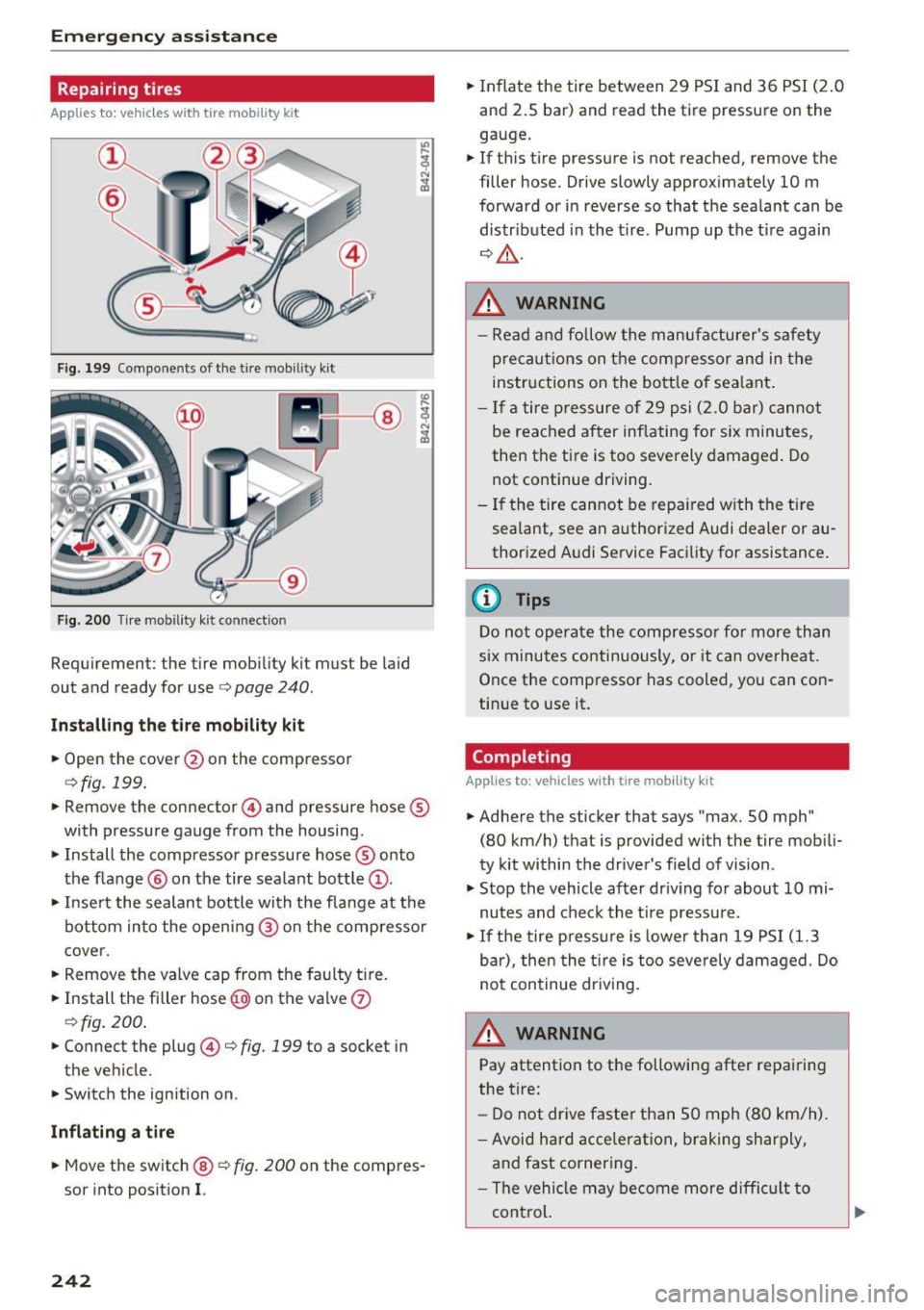
Fig. 199 Components of the tire mobility kit
F ig. 200 Tire mobility k it connecti on
Requirement: the tire mobility kit must be laid
out and ready for use
o page 240.
Installing the tire mobility kit
.. Open the cover @on the compressor
¢fig. 199 .
.. Remove the connector@) and pressure hose®
with pressure gauge from the housing.
• Install the compressor pressure hose ® onto
the f lange @ on the tire sea lant bottle
(D .
.. Insert the sealant bottle with the flange at the
bottom into the opening @ on the compressor
cover.
.. Remove the valve cap from the fau lty tire.
.. Install the filler hose@) on the valve
0
ofig. 200 .
.. Connect the plug @¢ fig. 199 to a socket in
the vehicle.
.. Switch the ignition on.
Inflating a tire
.. Move the switch @ o fig. 200 on the compres
sor into position
I.
242
.. Inflate the tire between 29 PSI and 36 PSI (2 .0
and 2.5 bar) and read the tire pressure on the
gauge .
.. If this tire pressure is not reached, remove the
filler hose. Drive slowly approximately 10 m
forward or in reverse so that the sealant can be
distr ibuted in the t ire. Pump up the tir e again
¢ _&. .
.&_ WARNING
-Read and follow the manufacturer's safety
precaut ions on the compressor and in the
instructions on the bottle of sea lant .
- If a tire pressure of 29 psi (2.0 bar) cannot
be reached after inflating for six minutes,
then the tire is too severely damaged. Do
not continue driving.
- If the tire cannot be repa ired with the tire
sealant, see an authorized Audi dealer or au
thorized Audi Service Facility for assistance.
(D Tips
Do not operate the compressor for more than
six minutes continuously, or it can overheat.
Once the compressor has cooled, you can con
tinue to use it.
Completing
App lies to : vehicles wit h tire mob ility kit
.. Adhere the sticker that says "max. 50 mph"
(80 km/h) that is provided with the tire mob ili
ty kit within the driver's field of vision.
.. Stop the vehicle after driv ing for about 10 mi
nutes and check the tir e pressure.
.. If the tire press ure is lower than 19 PSI (1.3
bar), then the tire is too severely damaged. Do
not continue driving .
.&_ WARNING
Pay attention to the following after repairing
the tire:
- Do not drive faster than 50 mph (80 km/h).
- Avoid hard acceleration, braking sharply,
and fast cornering .
- The vehicle may become more difficult to
control.
Page 252 of 284
Fuses
Fuses
Replacing fuses
A fuse that has blown will have metal strips that have burned through.
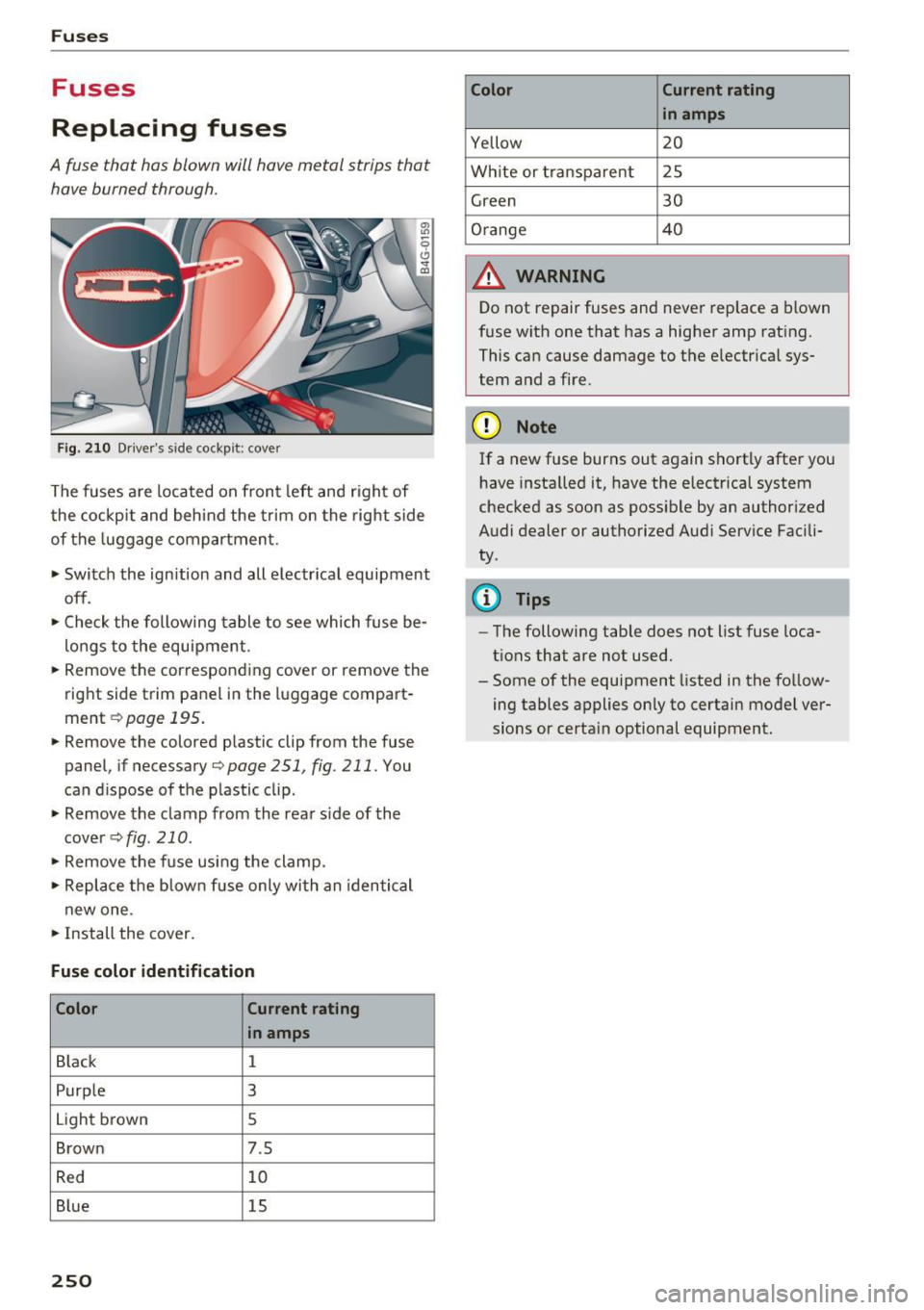
F ig . 21 0 Driver 's side cockpit: cove r
The fuses are located on front left and r ight of
t he cockpit and behind the trim on the rig ht s ide
of the luggage compartmen t.
"' Switch the ignition and all e lectr ica l equipment
off.
"' Che ck the following table to see which fuse be
l o ngs to the equipment.
... Remove the correspond ing cover or remove the
right side trim panel in the l uggage compart
ment
¢ poge 195 .
... Remove the colored plastic clip from the fuse
panel, if necessary
¢page 251, fig. 211. You
can d ispose of the p lastic clip .
... Remove the clamp from the rea r side of the
cove r
¢fig. 210 .
... Remove the fuse usi ng the clamp.
"' Replace t he blow n fu se only wi th an identical
new one.
"' Install the cover.
Fuse color identification
Color Current rating
in amp s
Black 1
Purp le 3
L ight brown 5
B rown 7.5
Red 10
B lue 15
250
Color Current rating
in amps
Yellow 20
Wh ite or transpa rent 25
Green 30
O range 4 0
A WARNING
Do not repair fuses and neve r replace a blown
f u se with one that has a higher amp rat ing.
This can cause damage to the e lectr ica l sys
tem and a fire.
(D Note
If a new fuse burns out again shortly after you
h ave insta lled it, have the e lectrical system
checked as soon as possible by an authorized
Audi dealer or authorized Aud i Service Fac ili
ty.
(D Tips
- The following table does not list fuse loca
t ions that are not used .
- Some of the equipment listed in the fo llow
ing tables applies on ly to certain model ver
sions or certa in optional equipment .
Page 267 of 284
co
co
.... N
" N .... 0
00
\.J '
carried out by vehicle owners.
Also, safet y and
en vir onm enta l
concerns place very strict limits
on the nature of repairs and adjustments to en
g ine and transm ission parts wh ich an owner can
perform .
Maintenance, adjustments and repairs usually re
qu ire special tools, test ing devices and other
equ ipment available to specially trained work
shop perso nnel i n order to assure proper per
forma nce, re liability and safety of the ve hicle and
i ts many systems.
Improper maintenance, adjustments and repairs
can impair the operation and reliability of your
vehicle and even void your veh icle warranty.
Therefore, proof of se rvicing in accordance with
the ma intenance sc hedule may be a condition for
upho ld ing a possib le wa rranty claim made wi thin
the warranty pe riod.
Above all, operational safety can be adversely af
fected, creating unnecessa ry risks fo r you and
your p assengers.
If in doubt about any se rvicing, have it done by
your author ized Audi dealer or any other properly
eq uipped and qua lified workshop. We strongly
urge yo u to g ive your author ized Audi dealer the
opport unity to perform a ll scheduled ma inte
nance and necessary repairs . Your dealer has the
facilities, origina l parts and trained specialists to
keep your veh icle running properly .
Performing limited maintenance yourself
The follow ing pages des cribe a lim ited number of
p rocedures w hich can be per formed o n your veh i
cle with ordinary tools, should the need arise and
trained personnel be unavailable . Before per
forming any of these procedures, always thor
ough ly read a ll of the app licab le text and carefu l
ly follow the instructions g iven. Always rigorously
observe the
WARNING S provided .
Before you check anything in the engine com ·
partment , always read and heed all WARNINGS
c:> &. and c:> &. in Working in the engine compart
ment on page 199.
Con sumer inf ormation
A WARNING
- Ser ious personal in jury may occur as a result
of improperly performed maintenance, ad
justments or re pairs .
- Always be extremely careful when work ing
on the vehicle. Always follow commonly ac
cepted safety practices and general com mo n sense. Never risk pe rsonal injury.
- Do not attempt any of the mai ntenance,
checks or repairs described on t he following
pages if you are not fu lly familiar wi th these
or other proce dures with respect to the ve
h icle, o r are uncerta in how to pro ceed.
- Do not do a ny work withou t the prope r tools
a nd eq uipment. H ave the necessary wo rk
done by your au thorized Audi dealer or an
other proper ly equipped and qualified wo rk
shop.
- The engine compa rtment of any motor ve hi
cle is a potent ially hazardous area . Never
reach into the area around or touch the radi
ator fan.
It is temperature controlled and
can switch o n suddenly - even when the en
g ine is off . The radiato r fan switches on au
tomatically when the coolan t reaches a cer
tain tempe ra ture and w ill cont inue to run
until the coolant temperature d rops.
- Always sw itch off the ignition before anyone
gets under the vehicle.
- Always support your veh icle with safety
s tands if it is necessary to work underneat h
the vehicle . The jack supp lied with t he veh i
cle is no t adequ ate for t his pu rpose and
could collapse ca us ing serious personal in
jury.
- If you m ust wor k unde rne ath the vehicle
with the wheels on the ground, always make
sure the vehicle is on level ground, that the
wheels a re always sec urely blocked and that
the engine cannot be started.
- Always make sure the transmission se lector
lever (automatic t ransmiss ion) is in P (Park
position) and the pa rk brake is applied .
II>
265
Page 275 of 284

co
co
.... N ,..._
N .... 0
00
\.J '
Adjusting . . . . . . . . . . . . . . . . . . . . . . . . . . 131
Ch ild restraints in the front seat . . . . . . . . 149
also refer to Seats . . . . . . . . . . . . . . . . . . . . 48
Fu el
Additives ... .. ................ ..... . 191
Blended gasoline . . . . . . . . . . . . . . . . . . . . 191
Current consumption . . . . . . . . . . . . . . . . . . 22
Fuel filler neck . . . . . . . . . . . . . . . . . . . . . . 193
Fuel gauge . . . . . . . . . . . . . . . . . . . . . . . . 9, 10
Fuel tank capacity . . . . . . . . . . . . . . . . . . . 262
Gasoline . . . . . . . . . . . . . . . . . . . . . . . . . . . 191
Gasoline additives . . . . . . . . . . . . . . . . . . . 192
Indicator light . . . . . . . . . . . . . . . . . . . . . . . 18
Octane rat ing . . . . . . . . . . . . . . . . . . . . . . . 191
Recommendation . . . . . . . . . . . . . . . . . . . . 191
Saving fuel . . . . . . . . . . . . . . . . . . . . . . 66, 105
Fue ling
Fuel gauge . . . . . . . . . . . . . . . . . . . . . . . . . . 10
Fuel tank capacity . . . . . . . . . . . . . . . . . . . 262
Opening the fuel filler door . . . . . . . . . . . . 193
Fuses Assignment . . . . . . . . . . . . . . . . . . . . . . . . 251
Replac ing . . . . . . . . . . . . . . . . . . . . . . . . . . 250
G
Garage door opener (Home Link) . . . . . . . . . . 38
Garment hook . . . . . . . . . . . . . . . . . . . . . . . . . 54
Glasses holder . . . . . . . . . . . . . . . . . . . . . . . . 54
Glossary of tire and loading terminology .. 213
Glove compartment . . . . . . . . . . . . . . . . . . . . 54
cooled . . . . . . . . . . . . . . . . . . . . . . . . . . . . . . 54
Gross Vehicle Weight Rat ing (GVWR) . . . . . 261
H
Head-up Display . . . . . . . . . . . . . . . . . . . . . . . 24
Headlight range control
Indicator light . . . . . . . . . . . . . . . . . . . . . . . 19
Headlight range control system . . . . . . . . . . 40
H eadlights . . . . . . . . . . . . . . . . . . . . . . . . . . . 41
Cleaning . . . . . . . . . . . . . . . . . . . . . . . . . . . 236
Headlight range contro l system . . . . . . . . . 40
Washer system . . . . . . . . . . . . . . . . . . . . . . 46
He ad restraints . . . . . . . . . . . . . . . . . . . . . . . 132
Adjusting ................ .... 49, 50, 132
Removing and installing . . . . . . . . . . . . . . . 50
Index
Heated
Exterior mirrors . . . . . . . . . . . . . . . . . . . . . . 44
Rear w indow (4-zone deluxe automat ic cli
mate control) . . . . . . . . . . . . . . . . . . . . . . . . 63
Rear window (deluxe automatic climate con-
trol) . . . . . . . . . . . . . . . . . . . . . . . . . . . . . . . 61
Seats (4-zone deluxe automatic climate con-
trol) . . . . . . . . . . . . . . . . . . . . . . . . . . . . . . . 62
Seats (deluxe automatic climate control) . . 61
Washer nozzles . . . . . . . . . . . . . . . . . . . . . . 46
Heating . . . . . . . . . . . . . . . . . . . . . . . . . . . . . . 59
Heavy clothing and safety be lts . . . . . . . . . . 142
High beams
Ass istant . . . . . . . . . . . . . . . . . . . . . . . . . . . . 41
High voltage warning label . . . . . . . . . . . . . 260
Hill descent control . . . . . . . . . . . . . . . . . . . . 79
Hill hold assist . . . . . . . . . . . . . . . . . . . . . . . . 7S
also refer to Hill hold assist . . . . . . . . . . . . 75
Hold assist (hill) . . . . . . . . . . . . . . . . . . . . . . . 75
Homelink (garage door opener) . . . . . . . . . . 38
Hooks . . . . . . . . . . . . . . . . . . . . . . . . . . . . . . . 57
Horn . . . . . . . . . . . . . . . . . . . . . . . . . . . . . . . . . 6
How are child restraint system anchors relat-
ed to child safety . . . . . . . . . . . . . . . . . . . . . 186
How many airbags does my vehicle have? . . lSS
How safety belt pretensioners work . . . . . . 146
I
Ignition
Indicator light . . . . . . . . . . . . . . . . . . . . . . . lS
Switching on/off . . . . . . . . . . . . . . . . . . . . . 69
Imbalance (wheels) . . . . . . . . . . . . . . . . . . . 219
Immobilizer . . . . . . . . . . . . . . . . . . . . . . . 24, 28
Important things to do before driving . . . . 129
Improperly worn safety belts . . . . . . . . . . . 146
Indicator lights . . . . . . . . . . . . . . . . . . . . . . . . 10
Infant seats . . . . . . . . . . . . . . . . . . . . . . . . . 178
Inflation pressure (tires) . . . . . . . . . . . . . . . 221
Inspection interval . . . . . . . . . . . . . . . . . . . . 209
Installing child safety seats
Safety belts . . . . . . . . . . . . . . . . . . . . . . . . 183
Installing the upper tether strap on the an
chorage . . . . . . . . . . . . . . . . . . . . . . . . . . . . . 189
Instrument cluster . . . . . . . . . . . . . . . . . . . . . . 9
Indicator lights . . . . . . . . . . . . . . . . . . . . . . 10
Messages . . . . . . . . . . . . . . . . . . . . . . . . . . . 10
273