change time AUDI A7 2018 User Guide
[x] Cancel search | Manufacturer: AUDI, Model Year: 2018, Model line: A7, Model: AUDI A7 2018Pages: 274, PDF Size: 42.77 MB
Page 110 of 274

Parking syste m s
Parking systems
General information
A pplies to: ve hicles w ith pa rk in g system plus/rearview cam
era/peripheral camera
Depending on your vehicle 's equipment , various
parking aids will help you when parking and ma
ne uvering.
The
p ark in g sys tem plu s assists you when park
ing by aud ibly and visua lly indicating objects de
tected
in front of and behind the veh icle
Q page 109.
The rea rv iew c am era shows the area beh ind the
veh icle in the Infotainment system d isp lay. The
lines in the rearv iew came ra image he lp you to
pa rk or maneuve r
Qpage 110.
The peripher al c am era s assist you with parking
and maneuvering . You are aided by var ious cam
eras depend ing on the vehicle equipment leve l
Qpage 113. The pa rk ing system pl us functions
are also available
Q page 109 .
& WARNING
-Always look for traffic and check the area
around your vehicle by looking at it direct ly
as well. The parking system cannot replace
the driver's attent ion. The driver is always
respons ible when enter ing or leav ing a park
ing space and dur ing s imilar maneuvers.
- Please note that some surfaces, such as
clothing, are not detected by the system .
-
-Sensors and cameras have blind spots in
wh ich people and objects cannot be detect
ed . Be especially caut ious of small children
and animals .
- The sensors can be displaced by impacts or
damage to the radiator gr ille, bumper,
wheel housing and the underbody . The park
ing system may be impa ired as a result.
Have a n author ized A udi dealer or au thor
ized Audi Service Facility check their func
tion .
- Make s ure the senso rs ar e not obst ructed by
stickers, deposits or other materia ls. If they
are, the sensor function could be impaired.
For additiona l information on cleaning, see
Q page 228.
108
@ Note
-Some objects are not detected or disp layed
by t he system under certain c ircumstances:
- objects such as barrier cha ins, tra iler draw
ba rs, ve rtical po les o r fences
- objects above the sensors such as wall ex
tensions
- objects with certain s urfaces or structures
such as cha in li nk fe nces or powder snow
- If you continue driving closer to a low ob
ject, it may disappear from the sensor range . Note that you will no lo nger be
wa rned about th is obstacle.
- Keep enough distance from the curb to re
duce the risk of damage to the rims .
(D Tips
-The system may prov ide a war ning even
though there are no obstacles in the cover
age area in some situations, such as :
- certain road surfaces or when there is tall
grass
- exte rna l ul trasonic sources such as from
cleaning vehicles
- in heavy rain, snow, o r th ick vehicle ex
h a u st
- We recommend th at you practice p arki ng in
a traffic -free loca tion or parking lot to be
come fami liar with the system . When doing
this, there s hou ld be good light and weath
er conditions.
- You can change the vo lume and pitch of the
signa ls as well as the d isp lay
Q page 118.
- Please refer to the instructions for towing a
trai ler located in
Q page 118.
-What appea rs in the infotainment d isplay is
somewhat time -de layed.
- Th e sensors m ust be ke pt clean and free of
snow and ice for the parking aid to operate .
Page 120 of 274
Parking systems
Adjusting the display and the warning tones
Applies to: vehicles with parking system plus/rearview cam
era/peripheral camera
The display and warning tones can be adjusted in
the Infotainment.
~ Se lect: the ICARI function button > (Car)* Sys
tems
cont rol b utton > Driver assistance > Park
ing aid .
Display
On* -
an op tical d isp lay is shown for the parki ng
system plus, a rearview camera image is s hown
for the rea rview camera *.
Off -when the p arking syste m is sw itche d off,
only audib le s ign als a re give n.
Signal tones
Front volume -
volume for the front a rea
Rear volume -volume fo r the rear area
Front frequency -frequency for the front a rea
Rear frequen cy -freq uen cy fo r the rear area
Music volume during nav . prompts -the volume
of the a udio/video so urce is lowe red when t he
pa rking system is tur ned on
The new value is g iven briefly during the adjust
ment.
(D Tips
- The wa rning tones ca n also be ad justed di
r ect ly by the v is u al d isp lay or the picture
from the camera. Sim ply p ress the
Settings
contro l bu tton.
- Changed set tings a re act ivated whe n the
p arking sys tem is swi tched o n aga in.
- The settings for volume a nd frequency are
a utomat ica lly saved and assigned to the re
mote con trol key be ing used .
Error messages
Applies to: vehicles with parking system plus/rearview cam
era/peripheral camera
There is an erro r in the system if the LED in the
Pw Jl. button is b link ing and yo u hear a continuous
118
ala rm for a few seconds after sw itch ing on the
par kin g system or when the pa rking system is al
r eady activated . If the erro r is not cor rected be
fo re yo u switch off the ignition, the LED in the
Pw Jl.
button will blink the next time you switch on the
parki ng system by shifting into reverse.
Parking system plus*
If a sensor is fa ulty, th e~ symbol will appear i n
front of/be hind the veh icle in the Infotainment
display. If a rear sensor is faulty, on ly obstacles
that are in areas @and @ are shown
¢ page 109, fig . 115 . If a front sensor is faulty,
o nly obs tacles tha t are in a reas © and @are
shown . T he re i s also a system ma lf u nction if all
segme nts aroun d the vehicle are red or if no seg
men ts a re disp laye d.
Peripheral cameras*
There is a system malfunction if the -(l!:) , symbol
appears and the co rresponding disp lay area is
s h own in bl ue. The c amera is no t wo rking in this
a re a .
Drive to an authorized A udi dealer or authorized
Audi Se rvice Fac il ity i mme diate ly to have the
malfunction cor rec ted .
Trailer hitch
Applies to: vehicles with parking system plus/rearview cam
era/peripheral cameras and trailer hitch
When the trailer soc ket is i n use, the pa rking sys
tem rear sensors are not act ivated when you sh ift
i nto reverse gear or when yo u press the
P •11A b ut
ton. This res ults in the following restrict io ns.
Parking system plus*
There is no distance warning for the rear. The
front senso rs rema in activated. T he visua l display
switches to trailer mode.
Rearview camera* /peripheral cameras*
The re is no distance warning for the rear . The
front senso rs remain activated . The visua l display
switches to trailer mode. The rearview came ra
i mage w ill not show the orie ntation lines and the
bl ue sur faces.
..,
Page 137 of 274
a co .... N
" N .... 0 00 \,;J '
~ page 54.
~ Make sure that the rear seatback is securely
latched in place.
A WARNING
Improperly stored luggage or other items can
fly through the vehicle causing serious per
sonal injury in the event of hard b raking or an
accident . To help reduce the risk of serious
personal in jury:
- Always put objects, fo r example, luggage o r
other heavy items in the luggage compart
ment.
- Always sec ure objects in the luggage com
partmen t using the tie-down hooks an d
s u itable straps.
A WARNING
Heavy loads wi ll influence the way yo ur vehi
cle handles. To he lp reduce the ris k of a loss
of contro l leading to serio us pe rsonal injury:
- Always keep in mind when transporting
heavy objects, that a change in the center of
gravity can also cause changes in vehicle
handling:
- Always d istribute the load as evenly as
possible.
- Place heavy objects as far forward in the
luggage compartment as poss ible .
- Never exceed the Gross Axle Weight Rating or the Gross Vehicle Weight Rat ing specified
on the safety compliance sticker on the driv
er's side B-p illar. Exceeding permissible
we ight s tanda rds can cause the vehicle to
slide and handle differently .
- Please obse rve information on safe driving
~page 1 2 9.
A WARNING
To help prevent poisonous exhaust gas from
being drawn into the vehicle, always keep the
rear lid closed wh ile driving.
- Never transport objects larger than those
fitt ing completely into the luggage area be
cause the rear lid can not be fully closed.
-
Dri ving saf ety
- If you absolutely m ust dr ive with the rear lid
open, observe the following notes to reduce
the risk of poisoning:
- Close all windows,
- Close the power roof*,
- Open all a ir outlets in the instrument pan-
el,
- Switch
off the air rec irculat ion,
- Set the fresh air fan to the highest speed.
A WARNING
=
A lways make su re that the doo rs, all win-
dows, the powe r roof* and the rea r lid are se
curely closed and locked to reduce the r isk of
i njury when the veh icle is not being used .
- After closing the rear lid , always make sure
that it is properly closed and locked .
- Never leave your veh icle unattended espe
cially with the rear lid left open . A child
could crawl in to the vehicle th rough the lug
gage compartment and close the rea r lid be
coming trapped and unab le to get o ut. Be
ing trapped in a vehicle c an le ad to ser ious
pe rsonal injury.
- Never let children play in o r around the vehi
cle .
- Never let passengers ride in the luggage
compa rtment. Vehicle occupants mus t al
ways be p roperly restrained in one of the ve
h icle's seat ing pos itions.
(D Tips
- Air circulation helps to reduce w indow fog
ging. Stale air esc apes to the outs ide
t hrough vents in the tr im panel. Be sure to
keep these slots free and open.
- The tire p ressure m ust co rres pond to the
load. The t ire pressure is shown on the tire
pressure label. The t ire pressure label is lo
cated on the dr iver's side B-pillar . The tire
pressure label lists the recommended cold
tire inflation pressures fo r the veh icle at its
maximum capac ity weight and the tires that
we re on your vehicle at the time it was man
ufac tured . For recommended t ire pressures
for normal load condi tions, p lease see chap
t er
~page 217.
135
Page 160 of 274

Airbag system
Monitoring the
Advanced Airbag System
:~ (USA models) /!f (Canada models)
Airbag monitoring indicator light
Two separate indicators monitor the function of
the Advanced Airbag System : the airbag moni
toring indicator light and the
PASSENGER AIR
BAG OFF
ligh t.
The Advanced Airbag System as well as the side
airbags and side curtain airbags with eject ion
mitigation features (including the e lectroni c con
trol unit, sensors and system wiring) are all
monitored continuously to make sure that they
are funct ion ing prope rly whenever the ignition is
on . Every time you turn on the ignition, the air
bag system indicator light
II (USA models) 1fll
(Canada models) will come on for a few seconds
(function check).
The system must be inspected when the
indicator light
II (USA models) tfll
(Canada models):
-does not come on w hen the ignition is switched
on,
-does not go out a few seconds after you have
switched on the ign ition, or
-comes on wh ile driving .
If an airbag system ma lf u nction is detected, the
ind icator light wi ll come on to serve as a constant
reminder to have the system inspected immedi
ately.
If a malfunction occurs that turns the front air
bag on the passenger side off, the
PASSENGER
AIR BAG OFF
light will come on and stay on
whenever the igni tion is on .
A WARNING
An airbag system that is not funct ioning prop
erly cannot provide supplemental protection
in a frontal crash .
-If the airbag indicato r light ¢page 16
comes when the vehicle is being used, have
the system inspected immediate ly by your
authorized Audi dealer . It is possible that
158
the airbag will inflate when it is not sup
posed to, or will not inflate when it should.
PASSENGER AIR BAG OFF light
Fig. 156 Sect io n fro m t he inst rume nt panel: PASSENGER
AIR BAG O FF lig ht
The PASSENGER AIR BAG OFF light is located in
the center of the instrument panel ¢
fig. 156.
The PASSENGER AIR BAG OFF light will come on
and stay on to tell you when the front Advanced
Airbag on the passenger side has been turned off
by the electronic contro l unit . If the bulb for the
PASSENGER AIR BAG OFF light burns out, the
airbag indicator light
II (USA models) a (Can
ada models) will come on to signal a malfunction
i n the Advanced A irbag System. Although the
burned-out bulb will not change the way the
front passenger's frontal airbag works, it wi ll no
l onger be poss ible to use the
PASSENGER AIR
BAG OFF
lig ht to make sure that the a irbag on/
off status is correct for the occupant on the front
passenger seat . Have the airbag system inspect
ed immediately by your author ized Audi dealer .
The PASSENGER AIR BAG OFF light will blink
for about 5 seconds when:
-the ignition is switched on and
- the capacit ive passenger detection system,
which switches the front seat passenger's fron
tal Advanced Airbag on and off, detects a
change in the status of the front passenger
seat.
As soon as the
PASSENGER AIR BAG OFF light
stops blinking, always make sure that the airbag
status (on or off) as shown by the
PASSENGER
AIR BAG OFF
light is proper for the age, size and
electrical capacitance of the person occupying
.,..
Page 163 of 274
a co .... N
" N .... 0 00 \,;J '
install a forward-facing child restraint on
the front passenger seat, always move the
seat into its rearmost position in the seat's
fore and aft adjustment range, as far away
from the airbag as possible. The backrest must be adjusted to an upright position.
- Make sure that the
PASSENGER AIR BAG
OFF
light comes on and stays on all the time
whenever the ignition is switched on.
A WARNING
- If the PASSENGER AIR BAG OFF light does
not go out when an adult is sitting on the
front passenger seat after taking the steps
described above, make sure the adult is
properly seated and restrained at one of the
rear seating positions.
- Have the airbag system inspected by your
Audi dealer before transporting anyone on
the front passenger seat .
(D Tips
If the capacitive passenger detection system
determines that the front passenger seat is
empty, the frontal airbag on the passenger
side will be turned off, and the
PASSENGER
AIR BAG OFF
light will stay on.
Repair, care and disposal of the airbags
Parts of the airbag system are installed at many
different places on your Audi . Installing , remov
ing , servicing or repairing a part in an area of the
vehicle can damage a part of an airbag system
and prevent that system from working properly
in a collision.
There are some important things you have to
know to make sure that the effectiveness of the
system will not be impaired and that discarded
components do not cause injury or pollute the
environment.
A WARNING
Improper care, servicing and repair proce
dures can increase the risk of personal injury
and death by preventing an airbag from de-
-
Airbag system
ploying when needed or deploying an airbag
unexpectedly :
- Never cover, obstruct, or change the steer
ing wheel horn pad or airbag cover or the in
strument panel or modify them in any way.
- Never attach any objects such as cup holders
or telephone mountings to the surfaces cov
ering the airbag units.
- For cleaning the horn pad or instrument
panel, use only a soft, dry cloth or one mois
tened with plain water . Solvents or cleaners
could damage the airbag cover or change
the stiffness or strength of the material so
that the airbag cannot deploy and protect properly.
- Never repair, adjust, or change any parts of
the airbag system.
-All work on the steering wheel, instrument
panel, front seats or electrical system (in
cluding the installation of audio equipment,
cellular telephones and CB radios, etc.)
must be performed by a qualified technician
who has the training and special equipment
necessary.
- For any work on the airbag system, we
strongly recommend that you see your au
thorized Audi dealer or qualified workshop.
- Never modify the front bumper or parts of
the vehicle body.
- Always make sure that the side airbag can inflate without interference:
- Never install seat covers or replacement
upholstery over the front seatbacks that
have not been specifically approved by
Audi .
- Never use additional seat cushions that
cover the areas where the side airbags in
flate.
- Damage to the original seat covers or to
the seam in the area of the side airbag
module must always be repaired immedi
ately by an authorized Audi dealer.
- The airbag system can deploy only once. Af
ter an airbag has been deployed, it must be
replaced with new replacement parts de
signed and approved especially for your
Audi model version. Replacement of com plete airbag systems or airbag components
161
Page 174 of 274
Child sa fety
all the time whenever the ignition is
sw itched on.
- If the
PASSENGER AIR BAG OFF light
does not come on and stay on, immediate ly install the forward-facing child seat in a
rear seating posit ion and have the airbag
system inspected by your authorized Aud i
dealer .
- Always buckle the child seat firmly in
place even if a ch ild is not sitt ing in it . A
loose child seat can fly around during a
sudden stop o r in a collision.
- Always read and heed all WARNINGS
wheneve r us ing a child restraint in a vehi
cle ~ page 138 , Safety belts, ~ page 146,
Airbag system
and ~ page 170, Impor
tant information .
(D Tips
Always replace chi ld restraints that were in
stalled in a vehicle dur ing a crash. Damage to
a child res traint that is not visib le cou ld cause
it to fail in anothe r collision situation .
Advanced front airbag system and children
Your ve hicle is equipped with a front "Advanced
Airbag System" in compliance with United States Federal Motor Vehicle Safety Standard (FMVSS)
208, as well as Canada Motor Veh icle Safe ty
Standard (CMVSS) 208 as applicable at the time
your ve hicle was manufactured .
The Advanced Airbag system in you r veh icle has
been cert ified to meet the "low-risk" requ ire
ments for 3- and 6 -year old children on the pas
senger s ide and small adults on the driver side .
The low risk deployment cr ite ria are intended to
reduce t he r isk of injury through inte ract ion with
the airbag t hat can occur, for examp le, by being
too close to the steering whee l and instrument
panel when the airbag inflates . In addition, the
system has been certified to comply with the
"suppress ion" req uirements of the Safety Stand
ard, to turn off the front airbag for infants up to
12 months who are restra ined on the front pas
senger seat in child restraints that are listed in
the Standard .
172
Even though your vehicle is equipped w it h an Ad
vanced Airbag system, all chi ldren, especially
t h ose 12 years and younger, sho uld a lways ride
i n the back seat properly restrained for their age
and s ize . The airbag on the passenger s ide makes
the front seat a potentia lly dangerous p lace for a
c hi ld to ride . T he front seat is not the safest place
fo r a ch ild in a fo rward-fac ing ch ild safety seat .
It
can be a very dangerous place fo r an infant o r a
l a rge r ch ild in a re ar war d-facing seat.
The veh icle's Advanced A irbag System has a ca
pac it ive passenger detection system in the front
passenge r seat cushion that can detect the p res
ence of a baby o r a c hild i n a child res train t sys
tem on this seat .
The capacitive passenger detection system reg is
te rs the changes that result i n an elect rical field
whe n a child, a chi ld restra int, and a baby b la nk et
are on the front passenger sea t. The change in
the measured capacitance due to the presence of
a chi ld, a c hild restraint, and a baby blanket on
the front passenger seat is re lated to the child
restra int system resting on the seat . The meas
ured capacitance of a child restra int system var
i es depending on the type of system and specific
make and model.
The elect rical capac itance of the various types,
makes, and models of child restraints specif ied
by the U .S . National Highway Traffic Safety Ad
min istrat ion (NHTSA) in the releva nt safety
standard are stored in the Advanced Airbag Sys
tem contro l unit together with the capacitances
typ ic al of infants and a 1 -year old ch ild. When a
c hi ld restraint is used on the front passenger
seat wit h a typical 1 year-old infant, t he Ad
vanced Airbag System compares the capacitance
measured by the capacitive passenger detection
system with the data stored in the electronic con
tro l unit .
Child restraints and Advanced front airbag
system
Regardless of the ch ild rest raint that yo u use,
make s ure tha t it has been ce rtified to mee t Safe
ty Standards and has been cert ified by its man u-
facturer for use with an airbag . A lways be sure
..,.
Page 191 of 274

a co .... N
" N .... 0 00 \,;J '
Gasoline grade
A pplies to: ve hicles with gasoline engines
The correct gasoline grade is stated on the inside
of the fuel filler door .
The vehicle is equipped with a catalytic converter
and must only be driven with
unleaded gasoline .
Audi recommends using TOP TIER Detergent Gas
oline. Additiona l information on TOP TIER Deter
gent Gasoline can be found on the official web
site (www .topt iergas.com).
The individual gasoline grades are differentiated
by
octane ratings. T his value is given with (R +M)/
2 equating to AKI or in RON.
The following headings match the corresponding
sticker in the fuel fi ller door.
UNLEADED FUEL ONLY MIN. (R+M)/2 87
Regular/ MIN. RON 91 Regular
Use regu lar gasoline with minimum 87 AKI/
91 RON
i::> (@ .
The maximum engine power is only reached if
premium gasoline 91 AKI/ 95 RON is used.
UNLEADED FUEL ONLY PREMIUM MIN . (R
+M)/2 91 / SUPER MIN. RON 95
Using premium gasoline with minimum 91 AKI/
95 RON is recommended.
If premium gasoline is not available, you can also
use regular gasoline 87 AKI/ 91 RON . However
this does reduce the engine power slightly.
({D) Note
-Fill in g the tank just one time with leaded
fuel or other metallic additives will cause
permanent deterioration to the catalytic
converter function.
- When gasoline with an octane rating that is
too low is used, high speeds or heavy engine
load can lead to eng ine damage.
Checking and Filling
(D Tips
The vehicle may be filled with fuel that has a
higher octane rating than what is required by
the engine .
Blended gasoline
Applies to : vehicles wi th gasoli ne e ngi ne
Use of gasoline containing alcohol or MTBE
(methyl tertiary butyl ether)
You may use unleaded gasoline blended with al
coho l or MTBE (commonly referred to as oxygen
ates) if the blended mixture meets the following
criteria:
Blend of gasoline methanol (wood alcohol or
methyl alcohol)
-Anti-knock index must be 87 AKI or higher.
- Blend must contain no more than
3% metha-
nol.
- Blend must contain more than
2% co-solvents.
Blend of gasoline and ethanol (grain alcohol or
ethyl alcohol)
-Anti-knock index must be 87 AKI or higher.
- Blend must not conta in more than
15% etha-
nol.
Blend of gasoline and MTBE
- Anti -knock index must be 87 AKI or higher.
- Blend must contain not more than
15% MTBE.
Seasonally adjusted gasoline
Many gasoline grades are blended to perform es
pecially well for winter or summer dr iving . Dur
ing seasonal change-over, we suggest that you
fill up at busy gas stat ions where the seasonal
adjustment is more likely to be made in time .
@ Note
-Methanol fuels which do not meet these re
quirements may cause corrosion and dam
age to plast ic and rubbe r components in the
fuel system.
- Do not u se fuels that fail to meet the speci-
fied criteria in this chapter.
.,.
189
Page 198 of 274
Checking and Filling
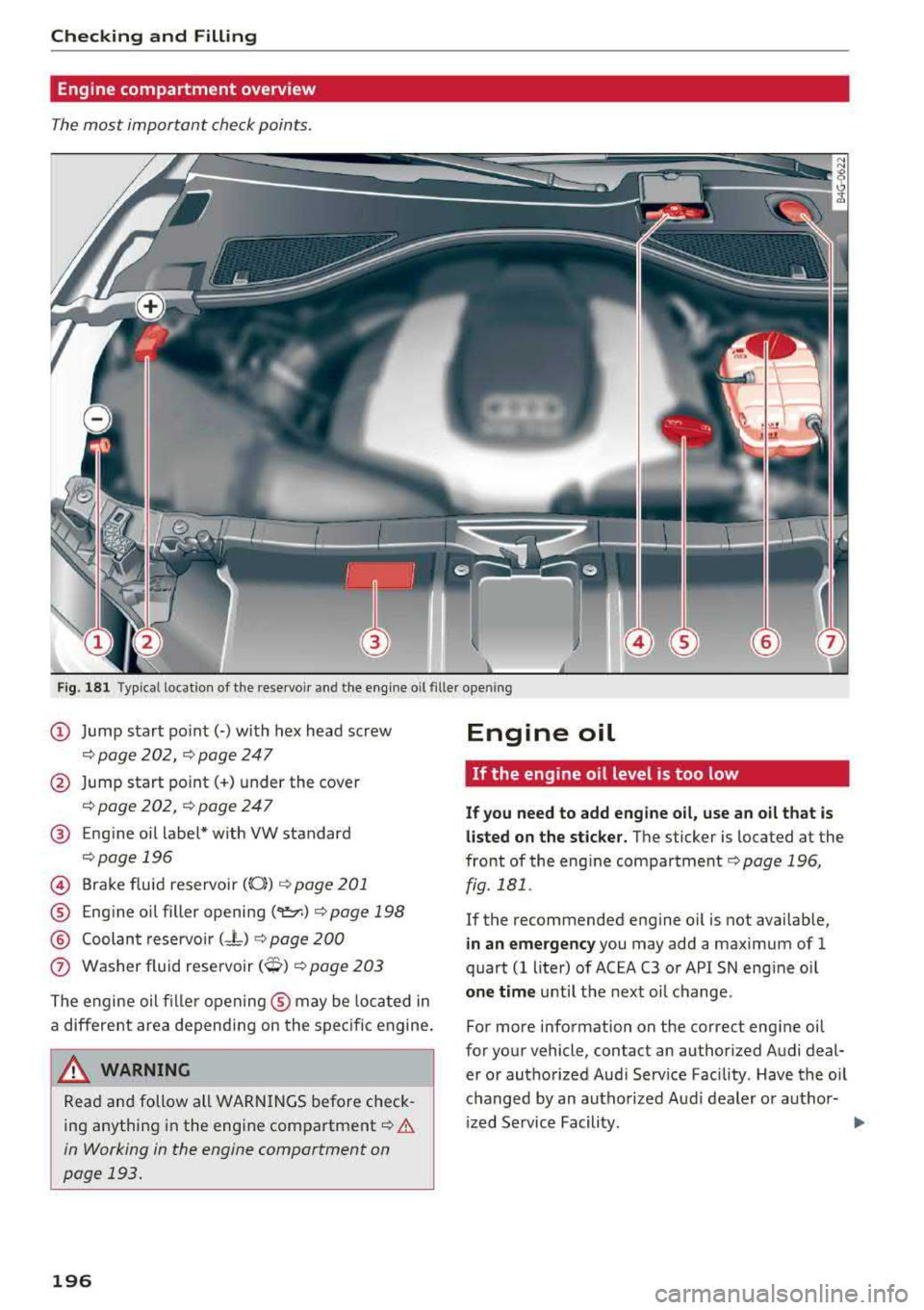
Engine compartment overview
The most important check points.
Fig. 181 Typical location of the rese rvoir and the engine o il filler open ing
(D Jump start po int(-) with hex head screw
~ page 202, ¢page 247
@ Jump start point(+) under the cover
~page 202, ¢page 247
® Engine oil label* w ith VW standard
¢ page 196
@ Brake fluid reservoir ((0)) ¢ page 201
® Engine oil filler opening(~)¢ page 198
@ Coolant reservoir (- L) ~ page 200
(j) Washer fluid reservoir (0) ¢ page 203
The engine oil fill er opening ® may be located in
a different area depending on the specific engine.
& WARNING
Read and follow all WARNINGS before check
ing anything in the engine
compartment¢ &
in Working in the engine compartment on
page 193.
196
Engine oil
If the engine oil level is too low
If you need to add engine oil, use an oil that is
listed on the sticker.
The sticker is located at the
front of the eng ine
compartment¢ page 196,
fig . 181 .
If the recommended engine o il is not availab le,
in an emergency you may add a maximum of 1
quart(! liter) of ACEA C3 or API SN eng ine oi l
one time until the next oil change .
For more information on the correct eng ine oil
for your vehicle, contact an authorized Audi deal
er or authorized Aud i Serv ice Facility . Have the oil
c h anged by an authorized Audi dealer or author
i zed Service Facility.
Page 199 of 274
a co .... N
" N .... 0 00 \,;J '
~ Castrot /lftlg;'f.E@t Frtrrr.::--.~lri,'lAl.
A ud i recomm ends using the Lo ng Life h igh
perfo rm ance eng ine oil from Aud i Genu ine
Parts .
Checking the engine oil level
The engine oil level can be checked in the Info
tainment system
Observe the safety precautions¢ A in Working
in the engine compartment on page 193.
~ Park your vehicle on a level surface.
~ Shut the engine off when it is warm.
~ Switch only the ignition back on.
~ Wait approx imately two minutes.
~ Select: the ICARI function button > ( C ar)* Sys
tem s
control button > Service & control > O il
l e v el.
~ Read the o il level in the I nfota inme nt system.
Add eng ine oil if the ba r in the oil leve l ind ica
tor is just before
"min"¢ page 198.
(UJ) Note
The engine oil leve l mus t not be unde r the
"min" mark ing, as this will increase the risk of
engine damage.
(D Tips
The o il level indica tor in the disp lay is on ly an
informationa l display. If the o il level is too
low, a minimum oi l warning appears in the in
strument cluster. Add oil and close the hood.
The current oil level is d isplayed in the Info
tainment system the next t ime the ignition is
sw itched on.
(D Tips
The engine oil consumption may be up to
0.5 quart/600 m iles (0.S liter/1,000 km), de
pending on driving style and operating condi
tions. In RS models, the o il consumption may
be up to 1 qt/600 mi (0 .8 l/ 1,000 km). Con
sumpt io n may be h igher du ring the first
3,00 0 miles (5, 000 km). Be cause of this, the
eng ine o il level must be checked reg ularly. It
Ch eck ing and F illing
is best to check each time you refue l yo ur ve
hicle and before long drives.
- In order to p rov ide effective lubrication and
cooling of interna l engine components, a ll
internal comb ustion engines consume acer
tain amount of oil. Oi l consumption var ies
from engine to engine and may change sig nifica ntly over the life of the engine. Typi
cally, eng ines with a specif ied break-in peri
od consume more o il du ring the break-in pe
r iod than they consume afte r oil cons ump
tion has stabilized.
- Under norma l condit ions, the rate of oil
c ons umption depends on the q ual ity and
vis cos ity of the oil, the R PM (revo lutions per
m in ute) a t which the engine is operated, the
ambient temperature and road conditions .
Furt her factors are the amount of oi l di lu
tion from water condensat ion or fue l resi
due and the oxidation level of the oil. As any
eng ine is subject to wear as m ileage builds
up, the oil consumption may increase over
t ime until replacement of worn components
may become necessa ry.
- With all these var iables com ing into play,
no sta ndard rate of o il consumption can be
established o r specified. There is no a lter na
ti ve to c hec king the oil leve l reg ula rly and
frequently.
- If you have the impress ion your engine co n
sumes excessive amo unts of o il, we recom
mend that yo u consult an author ized A udi
dea ler to have the cause of your concern
properly diagnosed . Keep in mind that the
accurate measurement of o il consumption
requires great care and may take some
time. An authorized Aud i dealer has instruc
tions about how to measure o il consump
tion accurately.
- You can find informat ion on engine oil and
eng ine o il capacit ies for the USA at
www .aud i usa .com/he lp/ma intenance, o r
for Ca nada at www.aud i.ca/ca/web/en/
cu stomer -area/ ca re -and -m a i ntena nee/ au di
serv i ce -sched u les. htm l, or ca ll
800 -8 22-2834 .
197
Page 201 of 274
a co .... N
" N .... 0 00 \,;J '
cle where temperatures remain below freezing
for extended periods.
Detergent additives in the oil will make fresh oil
l ook dark after the engine has been running for a
short time. This is norma l and is not a reason to
change the oil more often than recommended.
Because of the problem of proper disposa l, along
with the special tools and necessary expertise re
quired, we strong ly recommend that you have
your oil changed by an authorized
Audi dealer or
a qualified service station .
If you choose to change your oil yourself, please
note the following important information:
A WARNING
To reduce the risk of personal injury if you
must change the engine oil in your veh icle
yourself:
- Wear eye protection.
- To reduce the risk of burns from hot engine
o il, let the eng ine cool down to the touch.
-
-When removing the oil drain plug with your
fingers, stay as far away as possible. Always
keep your forearm parallel to the ground to
help prevent hot oil from running down your
arm.
- Drain the oil into a container designed for
this purpose, one large enough to hold at
least the total amount of oil in your engine .
- Engine oil is poisonous. Keep it well out of
the reach of children.
- Cont inuous contact w ith used engine oil is
harmful to your sk in. Always protect your
sk in by washing oil off thoroughly w ith soap
and water.
@ Note
Never mix oil addit ives with your engine o il.
These additives can damage your eng ine and
adversely affect your Audi Limited New Vehi
cle Warranty.
Checking and Filling
@) For the sake of the environment
-Before changing your oi l, first make sure
you know where you can properly dispose of
the used oil.
- Always dispose of used engine oi l properly.
Do not dump it on garden soil, wooded
areas, into open streams or down sewage
drains.
- Recycle used engine o il by tak ing it to a used
eng ine oil collection fac ility in your area, or
contact a service station .
Cooling system
Coolant
The engine cooling system is filled wit h a mixture
of purified water and coolant additive at the fac
tory. This coolant must not be not changed.
T he coolant level is monitored through
the . in
dicator light
r=;, page 14. However, we do recom
mend occasionally checking the coolant leve l
manua lly.
If you must add coolant, use a mixture of water
and coolant additive. Mixing the coo lant additive
with distilled water is recommended.
Coolant additive
The coolant additive is made of anti-freezing and
corrosion protection agents. Only use the follow
ing coolant additives. These additives may be
mixed with each other .
Coolant additive Specification
Gl2evo
TL 774 L
Gl2++ TL 774 G
Gl3 TL 774
J
The amount of coolant additive that needs to be
mixed with water depends on the climate where
the vehicle wi ll be operated .
If the coolant addi
tive percentage is too low, the coolant can freeze
and damage the engine.
.,.
199