change time AUDI A7 2018 Owner's Manual
[x] Cancel search | Manufacturer: AUDI, Model Year: 2018, Model line: A7, Model: AUDI A7 2018Pages: 274, PDF Size: 42.77 MB
Page 205 of 274

a co .... N
" N .... 0 00 \.J '
Service Facility for more information.
- Do not connect or disconnect the charging
cable while charging because this increases
the risk of an exp losion.
(D Tips
- Only charge the vehicle battery through the
connections in the engine compartment.
- Read all of the manufacturer's instructions
for the charger before charging the vehicle
battery.
Windshield washer system
Fig. 186 Engine compa rtment: washer flu id reservo ir cap
M N
-N ~
"' a,
The windshield washer reservoir O contains the
cleaning solution for the windshie ld and the
headlight washer
system* ¢ page 196, fig . 181.
The reservoir capacity can be found in
¢page 254.
To reduce the risk of lime sca le deposits on the
spray nozzles, use clean water with low amounts
of calc ium . A lways add window cleaner to the wa
ter. When the outs ide temperatures are cold, an
anti -freezing agent should be added to the water
so that it does not freeze .
@ Note
-The concentration of anti-freezing agent
must be adjusted to the vehicle operating
cond itions in the respective climate. A con
ce ntration that is too high can lead to vehi
cle damage.
- Never add radiator anti-freeze or other addi
tives to the washer fluid.
Checking and Filling
- Do not use a glass cleaner that contains
paint so lvents, because t his could damage
the paint.
Service interval display
The service interval display detects when your ve
hicle is due for service .
The service interval display works in two stages:
-Inspection or oil change reminder : afte r a cer -
tain distance driven, a message appears in the
instrument cluster display each time the igni
tion is switched on or off. The remaining dis
tance or time is disp layed briefly.
- Inspection or oil change due: if your vehicle
has reached an inspection or oil change interval
or both intervals at the same t ime, the mes
sage
Inspection due! or Oil change due! or Oil
change and inspection due!
appears briefly af
ter switching the ignition on/off .
Checking service intervals
You can check the remaining distance or time un
til the next oil change or next inspection in the
Car menu. To do t his, select: the !CAR !function
button
> (Car)* Systems control button > Service
& control > Service intervals .
Resetting the indicator
An authorized Audi dea ler or a uthorized Audi
Service Facility w ill reset the service interval dis
play after performing service.
If you have ch anged the oi l yourse lf, you must re
set the oil change interval.
T o reset the indicator, select : the
I CAR ! function
button
> (Car)* Systems control button > Service
& control > Service intervals . Turn the control
knob downward to
Reset oil change interval and
press the control knob.
@ Note
-Only reset the oi l change indicator if the oi l
was changed.
- Following the service intervals is critical to
maintaining the service life and value of
your vehicle, especially the engine. Even if
203
Page 206 of 274
Checking and Filling
the mileage on the vehicle is low, do not
exceed the time for the next service.
- Calculating the time to the next oi l change
is interrupted when the vehicle battery is
disconnected
r=> page 232.
204
Page 212 of 274
Wheels
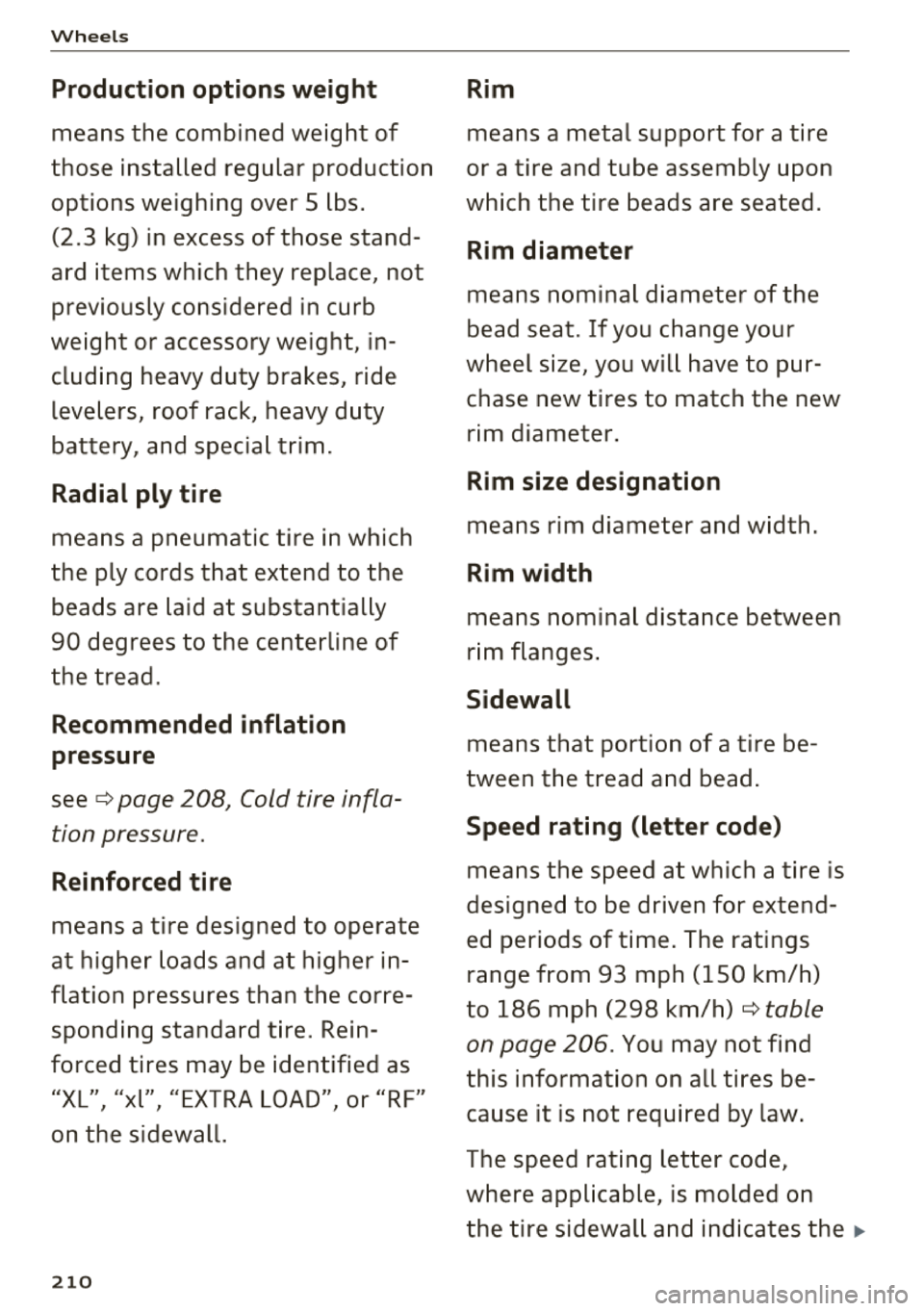
Production options we igh t
means the combined weight of
those installed regular production
options weighing over 5 lbs.
(2.3 kg) in excess of those stand
ard items which they replace, not previously considered in curb
weight or accessory weight, in
cluding heavy duty brakes, ride levelers, roof rack, heavy duty
battery, and special trim.
Radial pl y tir e
means a pneumatic tire in which
the ply cords that extend to the beads are laid at substantially
90 degrees to the centerline of
the tread.
R ecomm ended in flation
pressure
see ¢ page 208 , Cold tire infla
tion pressure.
R einforced tire
means a tire designed to operate
at higher loads and at higher in
flation pressures than the corre
sponding standard tire . Rein
forced tires may be identified as
"XL" "xl" "EXTRA LOAD" or "RF" , , ,
on the sidewall.
210
Rim
means a metal support for a tire
or a tire and tube assembly upon
which the tire beads are seated.
Rim diam eter
means nominal diameter of the
bead seat . If you change your
wheel size, you will have to pur
chase new tires to match the new rim diameter .
Rim size designation
means rim diameter and width.
Rim width
means nomina l distance between
r im
flanges .
Sidewall
means that portion of a tire be
tween the tread and bead .
Speed rating (letter code )
means the speed at which a tire is
designed to be driven for extend
ed periods of time. The ratings range from 93 mph (150 km/h)
to
186 mph (298 km/h) ¢ table
on page 206 .
You may not find
this information on all tires be
cause it is not required by law .
The speed rating letter code,
where applicable, is molded on
the tire sidewall and indicates the
...
Page 219 of 274
a co .... N
" N .... 0 00 \,;J '
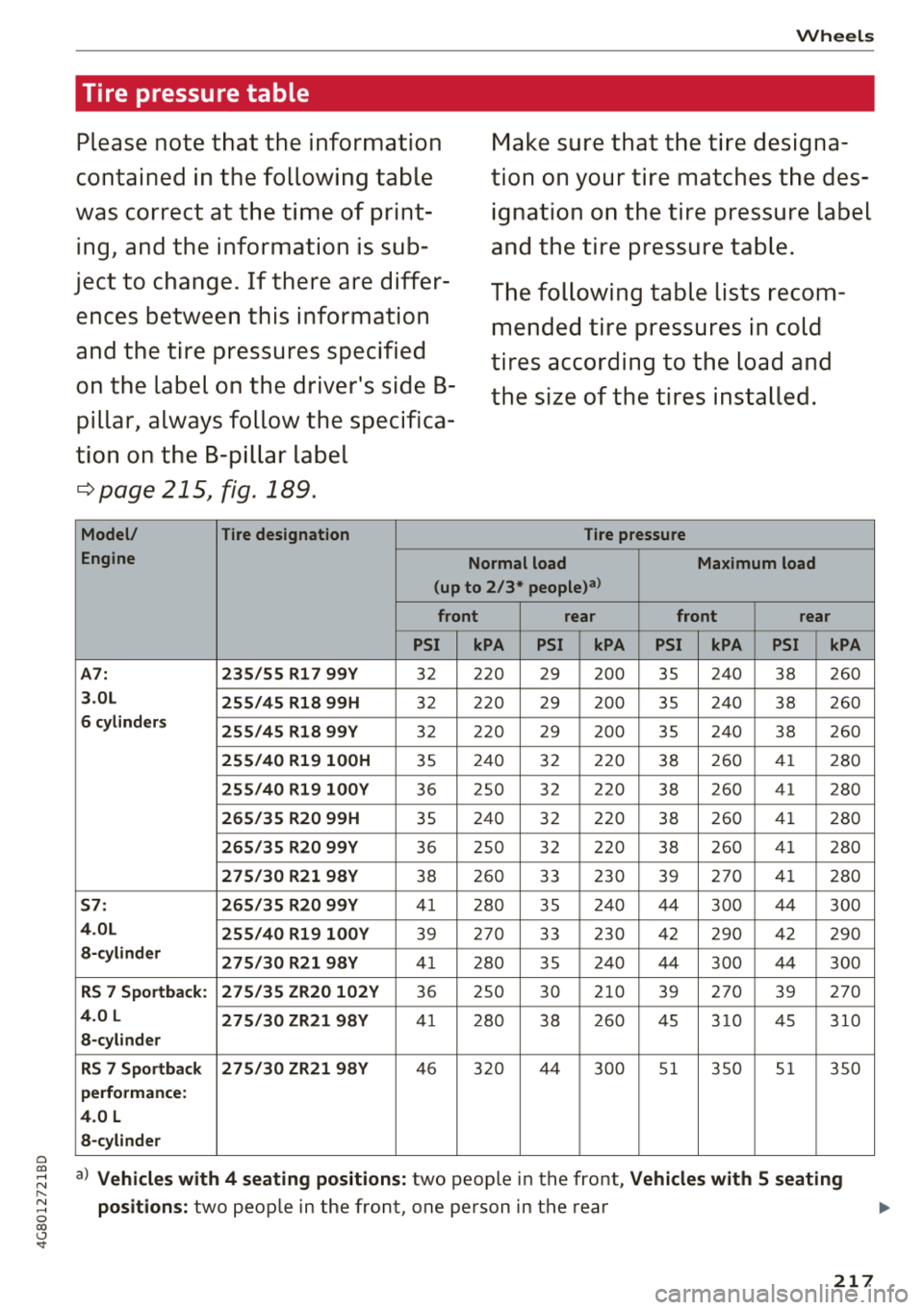
Please note that the information
contained in the following table
was correct at the time of print
ing, and the information is sub
ject to change. If there are differ
ences between this information
and the tire pressures specified
on the label on the driver's side
B
pillar, always follow the specifica
tion on the B-pillar label
¢ page 215, fig. 189.
Model/ Tire designation
Engine
Wheels
Make sure that the tire designa
tion on your tire matches the des
ignation on the tire pressure label
and the tire pressure table.
The following table lists recom mended tire pressures in cold
tires according to the load and
the size of the tires installed.
Tire pressure
Normal load Maximum load
(up to
2/3* people)a>
front rear front rear
PSI kPA PSI kPA PSI kPA PSI kPA
A7: 235/55 Rl 7 99V
32 220 29 200 35 240
38 260
3.0L
255/45 Rl8 99H 32 220 29 200 35 240 38 260
6 cylinders
255/45 Rl8 99V 32 220 29 200 35 240
38 260
255/40 Rl9 l00H 35 240 32 220 38 260 41
280
255/40 Rl9 l00Y 36 250 32 220
38 2
60 41 280
265/35 R20 99H 35 240 32 220 38 260 41
280
265/35 R20 99V 36 250 32 220
38 260 41 280
275/30 R21 98V 38 260 33 230 39 270 41
280
57: 265/35 R20 99V 41 280
35 240 44 300 44 300
4.0L
255/40 Rl9 l00Y 39 270 33 230 42
290 42
290
a-cylinder
275/30 R21 98V 41 280 35 240 44 300 44 300
RS 7 Sportback: 275/35 ZR20 102V 36 250 30 210 39 270 39 270
4.0 L 275/30 ZR21 9aY 41
280 38 260 45 310 45 310
a-cylinder
RS 7 Sportback 275/30 ZR21
9aY 46 320 44 300 51 350 51 350
performance:
4.0 L a-cylinder
a ) Vehicles with 4 seating positions: two people in the front, Vehicles with 5 seating
positions:
two people in the front, one person in the rear
217
Page 225 of 274

a co ,...,
N
" N ,...,
0 00 <.,;) '
overheat and can lead to tire failure. Under-inf la
tion also reduces fuel efficiency and tire tread
life, and may affect the vehicle's handling and
stopping ability.
Please note that the TPMS is not a substitute for
proper tire maintenance, and it is the driver's re
sponsibility to maintain correct tire pressure,
even if under-inflation has not reached the level
to trigger illumination of the TPMS low tire pres
sure telltale .
Your vehicle has also been equipped with a TPMS
malfunction indicator to indicate when the sys
tem is not operating properly . The TPMS mal
function indicator is combined with the low tire pressure telltale . When the system detects a
malfunction, the telltale will flash for approxi
mately one minute and then remain continuously
illuminated. This sequence will continue upon
subsequent vehicle start-ups as long as the mal
function exists.
When the malfunction indicator is illuminated,
the system may not be able to detect or signal
low tire pressure as intended. TPMS malfunctions
may occur for a variety of reasons, including the
installation of replacement or alternate tires or
wheels on the vehicle that prevent the TPMS
from functioning properly . Always che ck the
TPMS malfunction telltale after replacing one or
more tires or wheels on your vehicle to ensure
that the replacement or alternate tires and
wheels allow the TPMS to continue to function
properly.
Wheels
If the tire pressure monitoring system
indicator appears
Applies to: vehicles with Tire Pressure Monito ring System in
dicator
The tire pressure indicator in the instrument
cluster informs you if the tire pressure is too low
or if there is a system malfunction.
Fig. 191 Ins trumen t cluster : indicator light w it h message
Using the ABS sensors, the tire pressure monitor
ing system compares the tire tread circumfer
ence and vibration characteristics of the individu
al tires.
If the pressure changes in one or more
tires, th is is ind icated in the instrument cluster
display with an indicato r light
[I] and a message .
If only one tire is affected, the location of that
tire will be indicated.
The tire pressures must be stored in the Infotain
ment system again each time the pressures
change (switching between partial and full load
pressure) or after changing or replacing a tire on
your
vehicle ~ page 224. The tire pressure moni
toring system only monitors the tire pressure you
have stored. Refer to the tire pressure label for
the recommended tire pressure for your vehicle
~ page 215, fig . 190.
Tire tread circumference and vibration character
istics can change and cause a tire pressure warn
ing if :
- the tire pressure in one or more tires is too low
- the tire has structural damage
- the tire was replaced or the tire pressure was
changed and it was not stored
~ page 224
- the spare tire* is installed
223
Page 226 of 274
![AUDI A7 2018 Owners Manual Wheels
Indicator lights
It]-loss of pressure in at least one tire¢,&. .
Check the tires and replace or repair if necessary.
Check/correct the pressures of all four tires and
st](/img/6/57599/w960_57599-225.png "AUDI A7 2018 Owners Manual Wheels
Indicator lights
It]-loss of pressure in at least one tire¢,&. .
Check the tires and replace or repair if necessary.
Check/correct the pressures of all four tires and
st")
Wheels
Indicator lights
It]-loss of pressure in at least one tire¢,&. .
Check the tires and replace or repair if necessary.
Check/correct the pressures of all four tires and
store the pressure again in the Infotainment sys
tem
¢ page 224.
[m]) (Tire Pressure Monitoring System) Tire
pressure: System malfunction!.
If[m]J appears
after switching the ignition on or while driving
and the
RI] indicator light in the instrument clus
ter blinks for approximately one minute and then
stays on, there is system malfunction. Try to
store the correct tire
pressures¢ page 224 . If
the indicator light does turn off or turns on again
after a short period of time, drive to an author
ized Audi dealer or authorized Audi Service Facili
ty immediately to have the malfunction correct
ed.
A WARNING
- If the tire pressure indicator appears in the
display, reduce your speed immediately and
avoid any hard steering or braking maneu
vers. Stop as soon as possible and check the
tires and their pressure .
- The driver is responsible for maintaining the
correct tire pressure. You must check the
tire pressure regularly.
- Under certain conditions (such as a sporty
driving style, winter conditions or unpaved
roads), the tire pressure monitoring system
indicator may be delayed.
(D Tips
- The tire pressure monitoring system can al
so stop working when there is an ESC mal
function.
- Using snow chains may result in a system
malfunction.
- The tire pressure monitoring system in your
Audi was calibrated with "Audi Original
Tires"
¢ page 212. Using these tires is rec
ommended .
224
Storing tire pressures
Applies to: vehicles with Tire P ressure Monitoring System in
dicator
If the tire pressure changes or a tire is replaced,
it must be confirmed in the Infotainment sys
tem.
.,. Make sure before storing that the tire pressures
of all four tires meet the specified values and
are adapted to the load
¢page 215.
.,. Switch the ignition on .
.,. Select: the I CARI function button > (Car)* Sys
tems
control button > Service & control > Tire
pressure monitor> Store tire pressure > Yes,
store now.
(D Tips
Do not store the tire pressures if snow chains
are installed.
Tire pressure monitoring
system
ill General notes
Each tire, including the spare (if provided),
should be checked monthly when cold and inflat
ed to the inflation pressure recommended by the
vehicle manufacturer on the vehicle placard or
tire inflation pressure label. (If your vehicle has
tires of a different size than the size indicated on
the vehicle placard or tire inflation pressure la
bel, you should determine the proper tire infla
tion pressure for those tires).
As an added safety feature, your vehicle has been
equipped with a tire pressure monitoring system
(TPMS) that illuminates a low tire pressure tell
tale when one or more of your tires is significant
ly under-inflated. Accordingly, when the low tire
pressure telltale illuminates, you should stop and
check your tires as soon as possible, and inflate
them to the proper pressure. Driving on a signifi
cantly under-inflated tire causes the tire to over
heat and can lead to tire failure. Under-inflation
also reduces fuel efficiency and tire tread life,
and may affect the vehicle's handling and stop-
ping ability.
.,.
Page 227 of 274

a co .... N
" N .... 0 00 \,;J '
proper tire maintenance, and it is the driver's re
sponsibility to maintain correct tire pressure,
even if under-inflation has not reached the level
to trigger illumination of the TPMS low tire pres
sure telltale .
Your vehicle has also been equipped with a TPMS malfunction indicator to indicate when the sys
tem is not operating properly. The TPMS mal
function indicator is combined with the low tire pressure telltale. When the system detects a
malfunction, the telltale will flash for approxi
mately one minute and then remain continuously
illuminated. This sequence will continue upon
subsequent vehicle start-ups as long as the mal
function exists.
When the malfunction indicator is illuminated,
the system may not be able to detect or signal
low tire pressure as intended. TPMS malfunctions
may occur for a variety of reasons, including the
installation of replacement or alternate tires or
wheels on the vehicle that prevent the TPMS
from functioning properly . Always check the
TPMS malfunction telltale after replacing one or
more tires or wheels on your vehicle to ensure
that the replacement or alternate tires and
wheels allow the TPMS to continue to function
properly.
Description
Applies to: vehicles with tire pressure monitor ing system
The tire pressure monitoring system monitors
the pressure in the four tires when driving.
T he system uses sensors that measure the tem
perature and pressure in the tires . The data is
sent from these sensors to the control module by radio frequency.
T he Tire Pressure Monitoring System shows the
current pressures and temperatures of the tires
in the Infotainment system
¢page 226. It also
compares the current tire pressures with the
stored tire pressures and gives a warning in the
driver information system if the tire pressure is
different from what is
stored ¢ page 226 .
Wheels
The system does not detect if the stored tire
pressures match the recommended tire pres
sures. You must store the tire pressures again
¢ page 226:
- every time the tire pressures change, for exam
ple when the load in the vehicle changes,
- after replacing a tire, or
- if wheels with new wheel sensors are used.
_& WARNING
- The tire pressure monitoring system assists
the driver in monitoring tire pressures. The
driver is responsible for having the tires in
flated to the correct pressure.
- Do not change the tire pressure when the
temperature of the tire is extremely high.
This could result in serious damage to the
tire and even cause the tire to burst, in
creasing the risk of an accident.
- A tire with low pressure flexes more. This heats the tire up too much. This could cause
the tread to separate and even cause the
tire to burst, increasing the risk of an acci
dent.
- The tire pressure monitoring system does not warn about damage or defects in the
tire construction that could cause the tire to
burst, for example. Inspect your tires regu
larly.
(D Tips
- If tires are replaced, the sensors/valves do
not need to be removed or replaced . Just re
placed the valve stem and, if necessary, the
valve and the wheel electronics. If you have questions, see an authorized Audi dealer or
authorized Audi Service Facility.
- An incorrect display or a malfunction in the
tire pressure monitoring system can occur
after using the tire mobility kit. Have the
sensors replaced by an authorized Audi
dealer or authori zed Audi Service Facility.
- For an explanation on conformity with the
FCC regulations in the United States and the
Industry Canada regulations, see
¢ page 258.
225
Page 229 of 274

a co .... N
" N .... 0 00 \.J '
tem measures the current tire pressures and stores them as the new specified pressures.
~ If the changed tire pressures are not displayed
in the Infotainment system, drive the vehicle
for approximately 10 minutes so that the sen
sor signal from the wheels is received again.
During this adaptation phase, --.·· is displayed
for the pressure and temperature and the tire
pressure monitoring system is only partially
available. It only provides a warning if one or
more tir e pressures is below the minimum per
mitted specified pressure. If this is the case, the
IE indicator light appears with a message.
& WARNING
Read and follow the important information
and notes
¢p age 225.
Malfunctions
Applies to: vehicles with tire pressure monitoring syste m
-
If the Tire Pressure Monitoring System is not
avai lable, the
mm indicator light appears in the
driver information system. The
IE indicator light
also blinks for approximately one minutes each
time the ignition is switched on . The tire pressure
monitoring system cannot be selected in the In
fotainment system. The fol lowing are examples
of situat ions that could cause a malfunction:
-If the message appears at the end of the adap
tation phase, the system cannot detect the
wheels installed on the vehicle. This may resu lt
from one or more wheels being installed with
out wheel sensors or with incompatible wheel
sensors.
-A wheel sensor or another component has
failed.
-Using snow cha ins can affect the function of
the system because of the shield ing effect of
the chains .
-The tire pressure monitoring system is not
available due to a malfunction.
-T ransmitters with the same frequency, such as
headphones or remote-control led dev ices, may
cause a temporary system malfunction due to
the strong electromagnetic field.
Wheels
T he m;i indicator light turns off once the Tire
Pressure Monitoring System is available again. If
you cannot correct the ma lfunction and the
m;i
indicator light stays on, drive immediately to an
authorized Audi dealer or authorized Audi Service
Facility to have the malfunction repaired.
227
Page 273 of 274
It has always been Audi's po licy to cont inuous ly
improve its products. AUDI AG reserves the r ight
to make changes in design and specifications,
and to make additions or improvements in its
products without incu rring any ob ligat io n to in
stall them on prod ucts prev iously ma nufactured .
This Owne r's Ma nual is based on the current da ta
av aila ble when it was printed. Text, ill ust ra tions
and specif ications in this owner's manua l are
based on the most up-to -date information availa
b le at the time of printing, and s ha ll not const i
tute a basis for liability claims. These instructions may not be reproduced or
translated in whole or in part without written
conse nt of AUDI AG . All rights reserved by AUDI
AG .
@) For the sake of the environment
Printed on eco-friendly paper (bleached with
out chlorine, recyclable) .