seats AUDI A7 2018 User Guide
[x] Cancel search | Manufacturer: AUDI, Model Year: 2018, Model line: A7, Model: AUDI A7 2018Pages: 274, PDF Size: 42.77 MB
Page 58 of 274
Seats and stor age
Luggage compartment cover
The luggage compartment cover consists of two
parts .
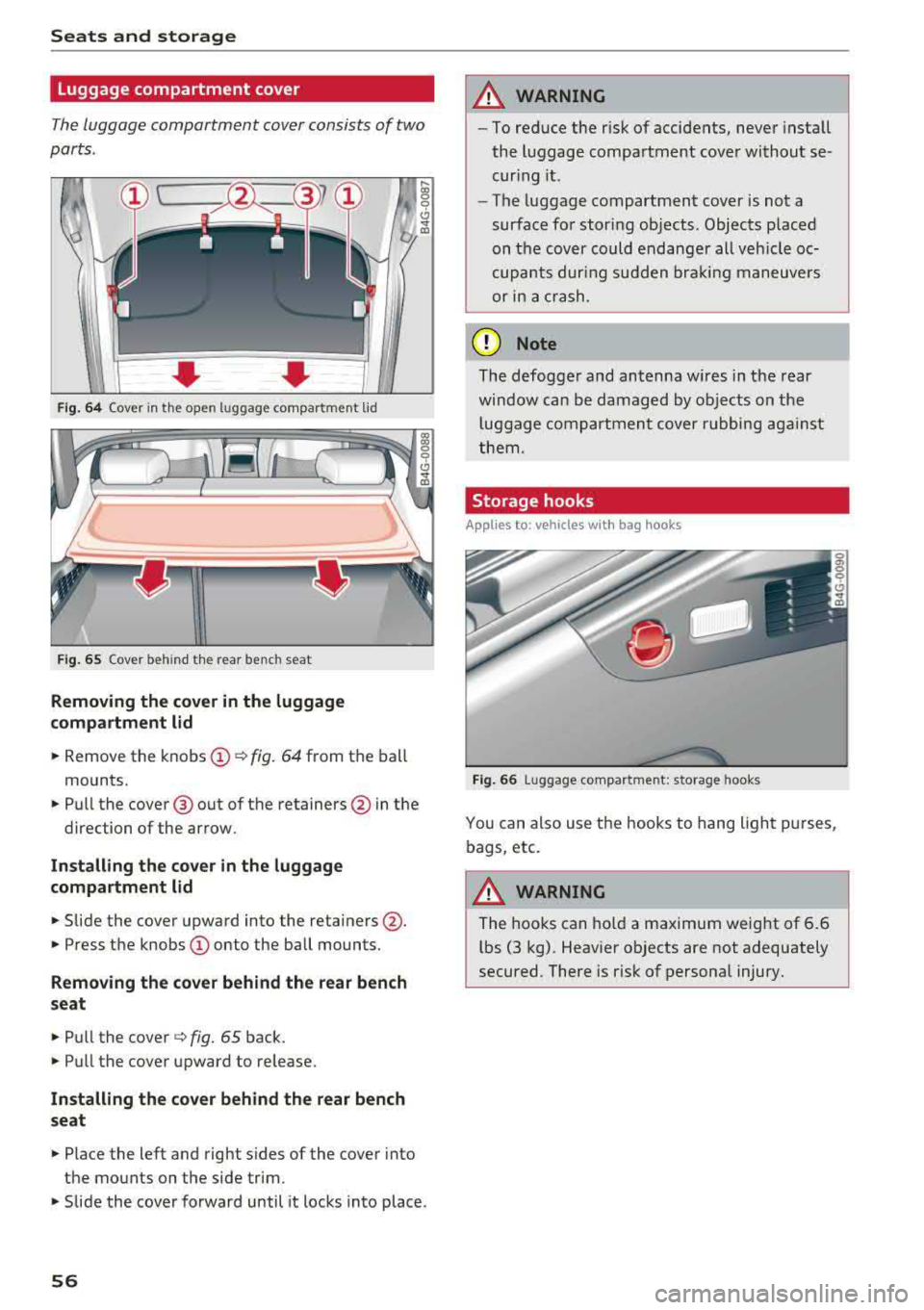
• Fig . 6 4 Cover in the open luggage compartment lid
F ig . 6 5 Cover behind the rear bench seat
Removing th e cover in the luggage
compartment lid
.. Remove the knobs @¢ fig. 64 from the ball
mounts.
" Pull the cover@out of the retainers @ in the
direction of the arrow.
In stall ing th e cov er in the luggage
c ompa rtment lid
" Slide the cover upward into the retainers @.
"Press the knobs (D onto the ball mounts.
Removing the c over beh ind the rear bench
s eat
" Pull the cover ¢ fig. 65 back.
"Pull the cover upward to release.
Install ing th e co ver beh ind the r ear bench
s eat
" Place the left and right s ides of the cover into
the mounts on the side trim.
9 C) ..,. ID
" Slide the cover forward until it locks into place.
56
A WARNING
,-
- To reduce the r isk of accidents, never install
the luggage compartment cover without se
curing it.
- The luggage compartment cover is not a
surface for stor ing objects . Objects p laced
on the cover could endanger all veh icle oc
cupants dur ing sudden bra king maneuvers
or in a crash.
(D Note
The defogger and antenna w ires in the rear
window can be damaged by objects on the
l uggage compartment cover rubbing aga inst
them.
Storage hooks
App lies to: vehicles wi th bag hooks
Fig . 66 Luggage compa rtment: storage hooks
You can also use the hooks to hang light purses,
bags, etc.
A WARNING
The hooks can ho ld a maximum weight of 6.6
lbs (3 kg). Heavier objects are not adequately
secured. There is r isk of personal injury.
Page 62 of 274
Warm and cold
The maximum amo unt of air flows ma inly from
the vents below the windshield. Recircu lation
mode switches off . The temperature should be
set to approximately 72
°F (22 °() .
The IAUTO I button switches the defroster off .
IClill REAR I Switching the rear window defogger
on /off
T he re a r window heate r on ly operates when t he
engine is r unning . It sw itches of f automat ica lly
afte r a few minutes, depe nding on the outs ide
temperature .
T o preven t the rear w indow hea ter from swit ch
i n g off automatically, p ress and ho ld the
I Qiil REARI
button fo r more than 2 seconds . This is stored
until the ignit io n is switched o ff.
[i] Adjusting seat heating*
P ress ing t he b utton swi tches the se at heati ng on
at the highes t set ting (level 3). The LEDs indicate
the tempe ra tu re level. To reduce the tempera
ture, press the button again. To switch the seat heating off, press the butto n repeatedly until the
LED turns off.
After 10 minutes, t he seat hea ting au tomatically
sw itches from leve l 3 to leve l 2 .
4-zone deluxe automatic climate control
A pp lies to: ve hicles with 4-zo ne deluxe auto matic cl imate cont rol
Air vents
You can open o r close the center and re a r ve nts in
t h e co ckpit and the vents in the rear center con
so le using the ridged thumbw heels . The leve rs
adjust the direction of the airflow from the vents .
.&_ WARNING
- You sho uld not use the recirc ulation mode
for an extended period of time since no
fresh air is drawn in . W ith the air-condition
ing sw itched off, the windows can fog up,
which inc reas es th e risk of an acc ident.
- Individ uals with red uced sensit iv ity to pa in
or temperature could develop b urns when
using the seat h eating f unction. To re duce
t he risk of injur y, t hese i ndividu als s ho uld
no t u se se at h eating .
(D Note
To avoid damage to the hea ting elements in
th e se ats , d o no t kne el on th e seats or place
h eavy lo ad s on a small a rea of the se at.
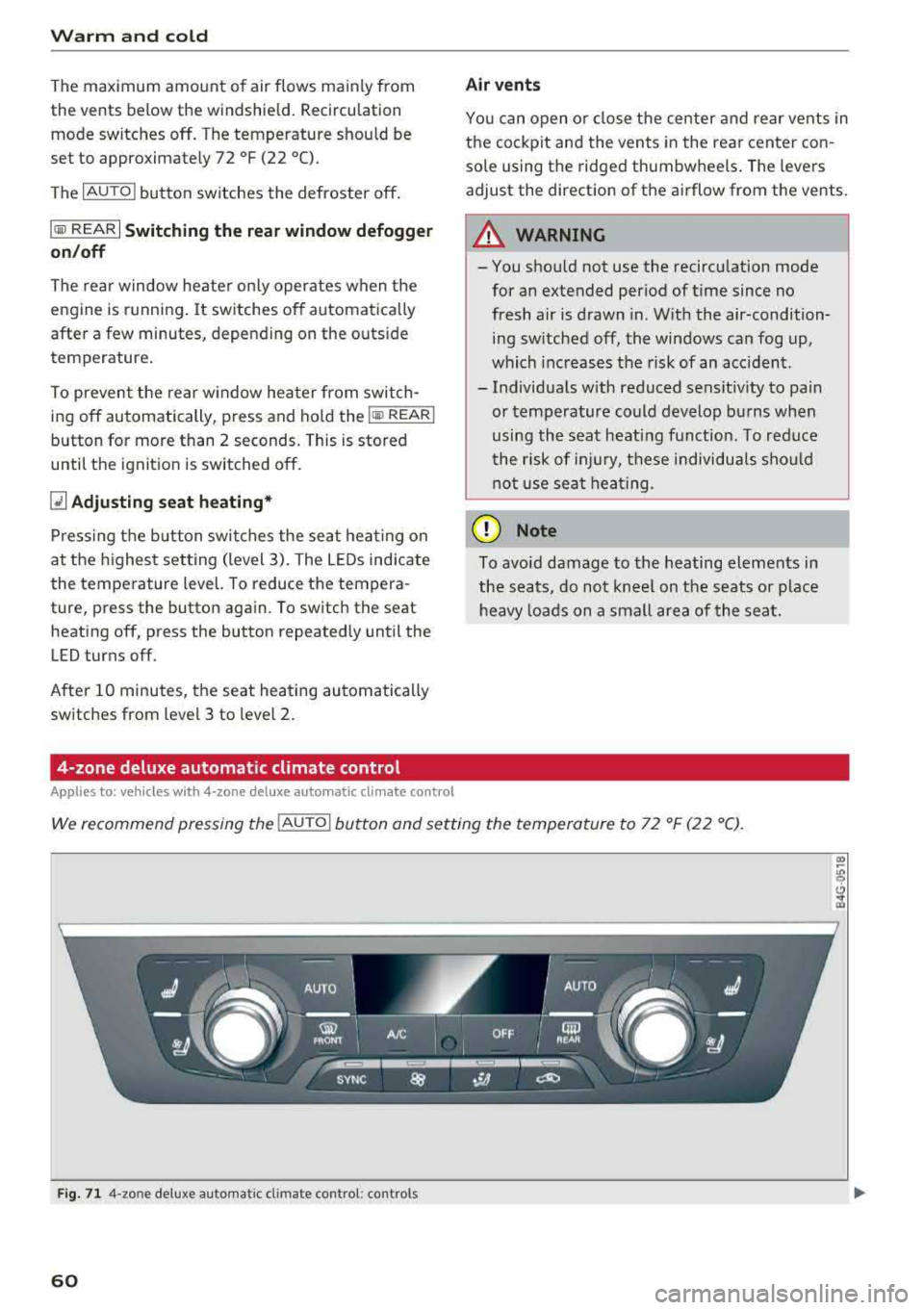
We recommend pressing the !AU TO I button and se tting the temperatu re to 72 ° F (2 2 °C).
Fig. 71 4-zo ne deluxe a uto mat ic cl imate contro l: cont rols
60
Page 64 of 274
Warm and cold
mode switches off . The temperature shou ld be
set to approximate ly 72 ° F (22 °C).
The
IAUTOI button sw itches the defroster off.
IQill REAR I Switching the rear window defogger
on /off
The rear window heate r on ly operates when the
e ng ine is r unni ng.
It sw itches off a utomat ica lly
afte r a few minutes, depend ing on the o utside
temperature .
To prevent the rear w indow heater from swit ch
i n g off automatically, p ress and ho ld the
l lliil REAR I
button fo r more than 2 seconds . This is s tored
until the ignition is switched off.
I SYNC I Synchronization
When synchronization is switched on, the set
tings for the dr ive r's side are appl ied to the front
p a ssenger's s ide (except for se at heating/ventila
tion*) . The settings in t he rear are a lso synchron
ized. Synchronization switches off when the set
tings are adj usted individually for the front pas
senger 's side or for the rear.
You can sync hronize the settings in a row by
p ressing and holding a contro l. For example, to
app ly the settings for the front passenger 's side
to the driver's side, press and ho ld the contro l on
the front passenger's side. The same applies to
the rear .
Residual heat *
With the ignition turned off, yo u can activate the
residual heat function by pressing the
Iii button
c:> fig. 71. The residual heat from the coolant is
used to heat the vehicle interior. The residual
heat function switches off automatically after
about 30 m inutes .
Air vents
You can open or close the center and rear vents in
the cockpit and the vents in the rear center con
sole and door p illars using the r idged thumb
wheels . The levers adjust the direct ion of the a ir
flow from the vents .
62
A WARNING
-You shou ld not use the recircu lation mode
for an extended period of time since no
fresh air is drawn in . W it h the air-condition
ing sw itched off, the windows ca n fog up,
whi ch inc reases the risk of an acc ident.
- Individ uals w ith reduced sensit iv ity to pa in
or tempe rature co uld develop b urns when
using the sea t heat ing f unct io n. T o re duce
t he r isk of injury, t hese individua ls sho uld
no t u se sea t hea ting.
@ Note
T o avoid damage to the heating elements in
the seats, do no t knee l on t he se ats o r pla ce
h eavy lo ads on a small area of the seat.
Basic settings
The climate control system basic settings are ac
cessed in the Infotainment system.
~ Select: the I CARI funct ion button > (Car )* Sys-
tems
contro l butto n > AC.
Rear seat settings *
When this function is se lected, all settings for
the rear can be adjusted through the climate con
trol system in the cockp it . T he climate control
system settings cannot be ad justed in the rear
seat at the same time. This f unct io n sw itches off
after a ce rtain per iod of t ime o r whe n one of t he
con tro ls in t he coc kp it is pressed.
Automatic recirculation*
The sensitivity level of t he automatic recircula
tion mode can be set at various levels from
Off to
Sen sitive . Recircul at io n mode is cont ro lled auto
matically. If the w indows fog up, p ress t he
l
Footwell temperature*
You can adjust the footwell temperature so that
i t is cooler or wa rme r.
Page 69 of 274
a co ,...,
N
" N ,...,
0 00 <.,;) '
face, the supplemental driver's airbag can
not provide as much protection in an acci
dent . Always make sure that the steering
wheel is aligned with your chest .
- Always hold the steering wheel with your
hands at the 9 o'clock and 3 o'clock posi
tions to reduce the risk of personal injury if
the driver's airbag deploys.
- Never hold the steering wheel at the 12 o'clock position or with your hands inside
the steering wheel rim or on the steering
wheel hub. Holding the steering wheel the
wrong way can cause serious injuries to the hands, arms and head if the driver's airbag
deploys.
Power steering wheel position adjustment
Applies to: veh icles with power steering wheel adjustment
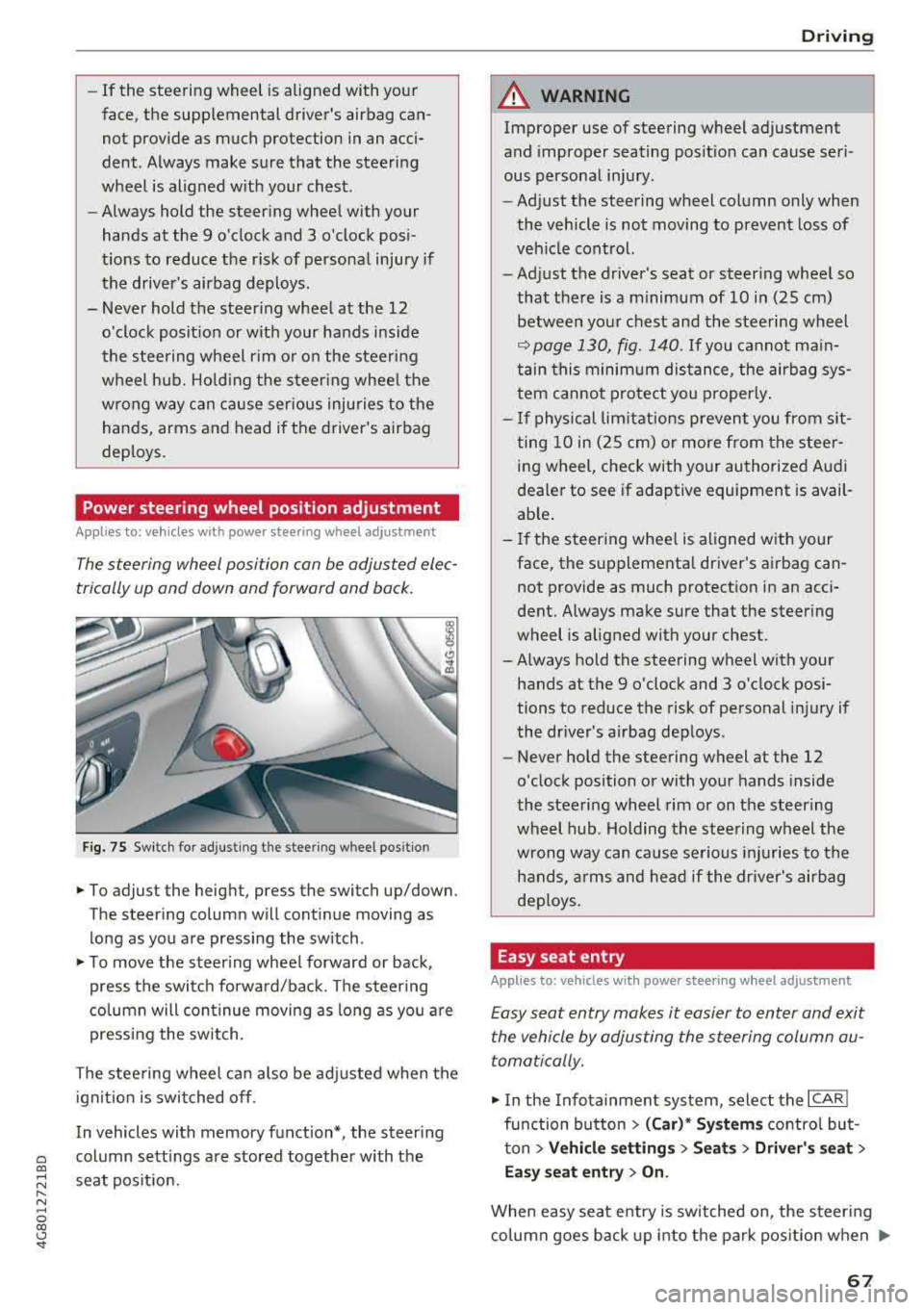
The steering wheel position can be adjusted elec
trically up and down and forward and back.
Fig. 75 Switch for adjusting the steering whee l pos itio n
.,. To adjust the height, press the switch up/down.
The steering column will continue moving as
long as you are pressing the switch .
.,. To move the steering wheel forward or back,
press the switch forward/back. The steering
column will continue moving as long as you are
pressing the switch.
The steering wheel can also be adjusted when the ignition is switched off .
In vehicles with memory fun ction*, the steering
column settings are stored together with the
seat position.
Driving
A WARNING
Improper use of steering wheel adjustment
and improper seating position can cause seri
ous personal injury.
- Adjust the steering wheel column only when
the vehicle is not moving to prevent loss of
vehicle control.
- Adjust the driver's seat or steering wheel so
that there is a minimum of 10 in (25 cm) between your chest and the steering wheel
¢ page 130, fig. 140. If you cannot main
tain this minimum distance, the airbag sys
tem cannot protect you properly.
- If physical limitations prevent you from sit
ting 10 in (25 cm) or more from the steer
ing wheel, check with your authorized Audi
dealer to see if adaptive equipment is avail
able.
- If the steering wheel is aligned with your
face, the supplemental driver's airbag can not provide as much protection in an acci
dent. Always make sure that the steering
wheel is aligned with your chest.
- Always hold the steering wheel with your
hands at the 9 o'clock and 3 o'clock posi
tions to reduce the risk of personal injury if
the driver's airbag deploys .
- Never hold the steering wheel at the 12
o'clock position or with your hands inside
the steering wheel rim or on the steering
wheel hub. Holding the steering wheel the
wrong way can cause serious injuries to the
hands, arms and head if the driver's airbag
deploys.
Easy seat entry
Applies to: vehicles with power stee ring wheel adjus tment
Easy seat entry makes it easier to enter and exit
the vehicle by adjusting the steering column au
tomatically.
.,. In the Infotainment system, select the ICARI
function button > (Car)* Systems control but
ton
> Vehicle settings > Seats > Driver's seat >
Easy seat entry > On.
When easy seat entry is switched on, the steering
column goes back up into the park position when
.,.
67
Page 131 of 274
a co .... N
" N .... 0 00 \.J '
Basics
Safe driving habits
Please remember -safety first!
The individua l safety features of your vehicle can
work together as a system to help protect you
and your passengers in a wide range of accidents.
These features cannot work as a system if they
are not always correctly adjusted and correctly
used .
This chapter contains important informat ion,
tips, instruct ions and warn ings that you need to
read and observe for your own safety, the safety
of your passengers and others . We have summar
i zed here what you need to know about safety
be lts, a irbags, child restra ints as well as child
safety. Yo ur safety is for us priority number 1. Al
ways observe the information and warnings in
this section - for your own safety as well as that
of your passengers.
The informa tion in t his sect ion app lies to all
model versions of your vehicle. Some of the fea
tures described in this sections may be standard
eq uipment on some models, or may be optional
equ ipment on others. If you are not sure, ask
your author ized Audi dealer.
A WARNING
-Always make sure that you follow the in
struct ions and heed the WARNINGS in th is
Manual. It is in your i nterest a nd in the in
te rest of your passengers .
-
-Always keep the complete Owner's Litera
t ur e in yo ur Audi whe n you lend or se ll yo ur
vehicle so that this important information
w ill a lways be available to the d rive r and
passengers.
-Always keep the Owne r's literature h andy so
that you can f ind it easily if yo u have ques
tions .
Driving saf ety
Important things to do before driving
Safety is everybody 's job ! Vehicle and occupant
safety always depends on the informed and care
ful driver .
For your safety and the safety of your passen
gers,
befor e dri ving alw ays:
.. Make sure that a ll lights and signals are operat
ing correctly.
.. Make sure tha t the tire pressure is correct .
.. Make sure that all windows are clean and afford
good vis ibility to the outs ide .
.. Secure all luggage and othe r items ca refully
¢ page 54, ¢page 53 .
.. Make sure that not hing c an interfere wi th the
peda ls .
.. Adjust front seat, head restraint and mirrors
correct ly for your height.
.. Instruct passengers to adjust the head re
straints according to their height.
.. Make sure to use the rig ht child restra int cor
rectly to protect children
¢ page 170, Child
safety .
.. Sit properly in your seat and make sure t hat
your passengers do the
same ¢ page 47, Seats
and storage.
.. Fasten your safety belt and wear it properly . Al
so instruct your passengers to fasten their safe
ty belts
properly ¢ page 138 .
What impairs driving safety?
Safe driving is directly related to the condition of
the vehicle , the driver as well as the driver 's abili
ty to concentrate on the road without being dis
tracted.
The driver is responsib le for the safety of the ve
hicle and a ll of its occupants. If your ability to
drive is impa ired, safety risks for everybody in the
vehicle increase and you a lso become a hazard to
everyone else on the road
¢ &_ . Therefore:
.. Do not let yourse lf be distracted by passengers
or by using a cellular telephone .
.. NEVER drive when your driving abi lity is im
pa ired (by med ications, alcohol, drugs, etc .) .
.. Observe all traffic laws, rules of the road and
speed lim its and plain common sense .
129
Page 133 of 274

a co .... N
" N .... 0 00 \,;J '
face decreases the ability of the supplemen
tal driver's airbag to protect you in a colli sion .
- Always sit in an upright position and never
lean against or place any part of your body
too close to the area where the airbags are
located .
- Before driving, always adjust the front seats
properly and make sure that all passengers
are properly restrained .
- For adjustable head restraints : before driv
ing, always also adjust the head restraints
properly .
- Never adjust the seats while the vehicle is moving . Your seat may move unexpectedly
and you could lose control of the vehicle.
- Never drive with the backrest reclined or
tilted far back! The farther the backrests are
tilted back, the greater the risk of injury due
to incorrect positioning of the safety belt
and improper seating position.
- Children must always ride in child seats
~ page 170. Special precautions apply
when installing a child seat on the front
passenger seat
i::> page 146 .
Proper seating position for the front
passenger
The proper front passenger seating position is
important for safe, r elaxed driving.
For your own safety and to reduce the risk of in
jury in the event of an accident, we recommend that you adjust th e seat for the front passenger
to the following position:
.. Adjust the angle of the seatback so that it is in
an upright position and your back comes in full
contact with it wh enever the vehicle is moving.
.. For adjustable head restraints: adjust the head
restraint so the upper edge is as even as possi
ble with the top of your head. If that is not pos
sible , try to adjust the head restraint so that it
is as close to this position as possible
~ page 132. Move the head restraint so that it
is as close to the back of the head as possible.
Driving safety
.. Keep both feet flat on the floor in front of the
front passeng er seat.
.. Fasten and wear safety belts correctly
i::> page 141 .
For detailed information on how to adjust the
front pass enger's s eat, see
i::> pag e 47.
A WARNING
= -
Front seat passengers who are unbelted, out
of position or too close to the airbag can be
seriously injured or killed by the airbag as it
unfolds . To help reduce the risk of serious
personal injury:
- Passengers must always sit in an upright po
sition and never lean against or place any part of their body too close to the area
where the airbags are located.
- Passengers who are unbelted, out of posi
tion or too close to the airbag can be seri
ously injured by an airbag as it unfolds with
g reat force in the blink of an eye.
- Always make sure that there are at least
10 inches (25 cm) between the front pas
senger's breastbone and the instrument panel.
- Always make sure that there are at least
4 inches (10 cm) between the front passen
ger's knees and the lower part of the instru
ment panel.
- Each passenger must always sit on a seat of
their own and properly fasten and wear the
safety belt belonging to that seat .
- Before driving, always adjust the front pas
senger seat properly.
- For adjustable head restraints: before driv
ing, always also adjust the head restraints
properly .
- Always keep your feet on the floor in front
of the seat. Never rest them on the seat, in
strument panel, out of the window, etc. The
airbag system and safety belt will not be
able to protect you properly and can even in
crease the risk of injury in a crash .
- Never drive with the backrest reclined or
tilted far back! The farther the backrests are
tilted back, the greater the risk of injury due
~
131
Page 134 of 274
Driving safety
to incorrect positioning of the safety belt
and improper seating position.
- Children must always ride in child seats
c:> page 170. Special precautions apply
when installing a child seat on the front passenger seat
c:> page 146 .
Proper seating positions for passengers in
rear seats
Rear sea t passengers must si t upright wi th both
feet on the floor consistent with their physical
size and be properly restrained whenever the
ve
hicle is in use.
To reduce the r isk of injury caused by an incorrect
seating position in the event of a sudden braking
maneuver or an accident, yo ur passengers on the
rear bench seat must always observe the follow
i n g:
• For adjustable head restra ints: adjust the head
r estra int so the uppe r edge is as even as poss i
ble with the top of your head. If that is not pos
sible, try to ad just the head restra int so th at it
is as close to this position as possib le
c:> page 132 .
• Keep both feet flat i n the footwell i n front of
the rear seat.
• Fas ten and wear safety belts properly
c:> page 141.
• Make sure that children are always properly re
strained in a ch ild restraint that is approp riate
for their size and age
c::> page 170 .
_& WARNING
Passengers who are imp roperly seated on the
rear seat can be seriously injured in a crash .
- E ach passenger m ust always sit on a seat o f
their own an d properly fas ten and we ar the
safe ty belt belongi ng to that sea t.
- Safe ty belts only offe r m aximum p rotection
when the safety belts are properly posi
tioned on the body and securely latched . By
not sitting upright, a rear seat passenger
in
c reases the risk of personal in ju ry from im
properly positioned safety belts!
132
- For adjustable head restraints: always ad
just the head restraint properly so that it
can give maximum protection.
Proper adjustment of head restraints
App lies to : vehicles with adjustable head restra ints
Correctly adjusted head restraints are an impor
tant part of your vehicle's occupant restraint sys
tem and can help to reduce the risk of injuries in
acciden t situations.
Fig. 141 Head rest ra in t: v iewed from t he front
The head rest raints must be corre ctly adjus ted to
a chieve t he best protec tion .
• Adjust the head rest ra int so the upper edge is
as even as possib le w ith the top of you r head . If
t ha t is no t possib le, try to adjus t the head
re
strai nt so that it is as close to this pos it ion as
possible
c:> fig. 141 . Move the head restraint so
that it is as close to the back of the head as
possible .
• If there is a passenger on the rear center seat
ing position*, slide the center head restraint *
upward at least to the next notch .
Adjust ing head restraints
c:> page 48.
_& WARNING
All seats are equipped w ith head restraints .
Driving w ithout head restraints or w ith head
rest raints that are not prope rly adj usted in
creases the r is k of se rious or fata l neck injury
d ramat ica lly . To help reduce t he risk of injury:
- Always drive with the head restra ints in
place and prope rly adjusted.
- Every pe rson in the vehicle must have a
proper ly adjusted head restraint .
-
Page 135 of 274
a co .... N
" N .... 0 00 \.J '
properly adjusts their head restraint. Adjust
the head restra int so the upper edge is as
even as possible w ith the top of your head .
If that is not possible, try to adjust the head
restra int so that it is as close to th is position
as possib le. Move the head restra in t so that
it is as close to t he b ack of the he ad as pos
sible.
- Never attempt to adjust head restra int
w hil e d riving. If you have dr iven off and
must adjust the dr ive r headrest for any rea
son, first stop the vehicle safely before at
tempting to adjust the head restraint .
- Children must a lways be proper ly restrained
in a chi ld restraint that is appropriate for
their age and size
~ page 170.
Examples of improper seating positions
Th e occupant r estraint syst em con only r educ e
the risk of injury if vehicle occupants ore properly
seated.
I mp roper seating posi tions can cause se rious in
jury or death . Safety belts can only work when
they ar e properly positioned on the body. Im
prope r seating positions reduce the effectiveness
of safe ty belts and w ill even increase the r isk of
injury and death by moving the s afety belt to crit
ical areas of the body . Improper seating posit ions
also increase the risk of ser ious injury and death
when an airbag deploys and strikes an occupant
who is not i n the prope r seat ing pos ition. A d rive r
i s respons ible for the safety of a ll vehicle occu
pants and especia lly fo r children . There fore:
"' Never allow anyone to assume an inco rrect
seat ing pos it ion w hen t he ve hicle is being used
~& -
The follow ing bulletins list only some sample po
sitions that will increase the risk of serious inju ry
and dea th. O ur hope is that these examp les w ill
make you more aware of seat ing pos it ions tha t
are dangerous .
Therefore, wh enever th e vehicle is moving:
- never stand up in the veh icle
- never stand on the seats
Dri ving saf ety
- never kneel on the seats
- neve r ride wit h the seatback recl ined
- neve r lie down on the seats
- neve r lean up against the instrument panel
- never s it on the edge of the seat
- never s it sideways
- never lean out the window
- never put your feet out the window
- neve r put your feet on t he instr ument pane l
- neve r rest your feet on the seat cushion or back
of the seat
- neve r ride in the footwell
- never ride in the cargo area
A WARNING
-
Imp roper seating positions inc rease the risk
of ser ious perso nal in jury and death whenever
a ve hicl e is being u sed .
- Always make sure that all ve hicle occupants
stay in a p roper seating posit ion and a re
p roperly restra ined whe never the veh icle is
be ing used.
Driver's and front
passenger's footwell
Important safety instructions
Applies to: vehicles with knee airbags
A WARNING
= -
A lways make s ure t hat the knee airbag can in
flate w ithout interference. Objects between
yourself and the airbag can increase the risk
of injury in an accide nt by interfering with the
way t he a irbag dep loys or by be ing pushed in
to you as the a irbag dep loys .
- No persons (ch ildren) or animals should ride
in the footwell in front of the passenger
seat . If the a irbag deploys, this can res ult in
ser io us or fatal injur ies.
- N o objects of a ny kind should be ca rr ied in
the footwell a rea in front of the dr ive r's or
p a sse nger's seat. B ulky objects (shopp ing
b ags, for exam ple) can h amper o r preven t
proper dep loymen t of the airbag . Sma ll ob
jects can be thrown thro ugh the vehicle if
133
Page 140 of 274
Safety belts
Safety belts
General information
Always wear safety belts!
Wearing safety belts correctly saves lives!
This chapte r exp lains why safety be lts a re neces
sary, how they work and how to adjust and wear
them correct ly.
~ Read all the information that follows and heed
all of t he instr uctions and WARNINGS.
A WARNING
Not wea ring safety belts or wearing them im
properly inc reases the risk of ser io us personal
inju ry and dea th.
- Safety belts are the s ingle most effective
mea ns ava ila bl e to reduce t he ris k of ser ious
injury and dea th in automob ile acc idents.
Fo r yo ur pro tec tion an d that of your passe n
gers, alw ays co rre ctly wea r sa fe ty be lts
whe n the veh icle is mov ing.
- Pr egnan t wome n, in ju re d, o r physically i m
paired perso ns m us t al so use s afety be lts.
L ik e all ve hicl e o ccupa nts, they are mor e
li ke ly to be serio usly i nju re d if th ey d o no t
wea r safety be lts. The best way to protect a
fetus is to protect the mothe r
-th roughout
the ent ire pregnancy.
Number of seats
Your Aud i has a total of four seating positions:
two in the front and two in the rear. In some
ve hicles, there are f ive seating positions: two in
the front and three i n the rea r. Each sea ting pos i
t ion has a safety belt.
A WARNING
Not wearin g s afety bel ts or weari ng the m im
p ro perly in cr eas es th e risk of ser io us person al
inju ry and dea th.
- N ever strap mo re th an on e person, inclu d
i ng sm all childr en, into an y be lt .
It is espe
ci ally d angerous to pla ce a sa fety bel t over a
c h ild sitting o n you r lap .
138 -
Never let more peop le r ide in the vehicle
than there are safety be lts available.
- Be s ure everyone ridin g in t he vehicle is
properly restrained with a separate safety
be lt or c hild restraint.
~ Safety belt warning light
Your vehicle has a warning system for the driver
and front seat passenger (on USA models only)
to remind you about the importance of buckling
up .
Fig. 142 Safety belt wa rning lig ht in th e inst rume nt clus
ter
-e nl arged
Before driving off , always :
~ Fasten yo ur safety belt an d ma ke sure you are
wearing it prope rly.
and properly wea r the ir safety belts.
~ Protect ch ild ren w ith a c hild restraint system
app ropr iate for the size and age .
The wa rning lig ht . in the inst rument cluste r
li ghts up w hen the ig nition is o n as a rem inder to
fasten the safety bel ts . In addi tion, you w ill hear
a war ning tone for a certain period of time .
Fasten your safety belt and make sure that your
passengers also properly put on their safety
belts.
A WARNING -
- Sa fety belt s are th e sing le mo st effecti ve
means av ail able to reduc e the risk of ser ious
in jur y and de ath in a utom obile accide nts.
Fo r your p rotec tion and t hat o f yo ur p ass en
ge rs, a lways cor rect ly wear safety belts
w hen t he ve hicle is moving .
~
Page 142 of 274
Safe ty belts
instrument panel, windshield, or whatever e lse is
in the way
r:!> fig. 145. This impact with the vehi
cle interior has all the energy they had just be
fore the crash.
Never rely on airbags alone for protection . Even
when they deploy, airbags provide only additiona l
protection. A irbags are not supposed to dep loy in
all kinds of accidents. A lthough your Audi is
equipped w ith airbags, all vehicle occupants, in
cluding the dr iver, must wear safety belts cor
rectly in order to minimize the risk of severe in
jury or death in a crash .
Remember too, that airbags will deploy only
once and that your safety belts are always there
to offer protect ion in those accidents in w hich
airbags are not supposed to deploy or when they
have a lready deployed . Unbel ted occupants can
a lso be thrown o ut of the veh icle where eve n
mo re severe or fatal injur ies can occur .
It is also important for the rear passenge rs to
wear safety belts correctly. Unbel ted passengers
i n t he re ar seats endanger no t on ly themse lves
but also the drive r and other passengers
c::> fig . 146 . In a frontal collision they will be
thrown forward violently, where they can hit and
in jure the driver and/or front seat passenger .
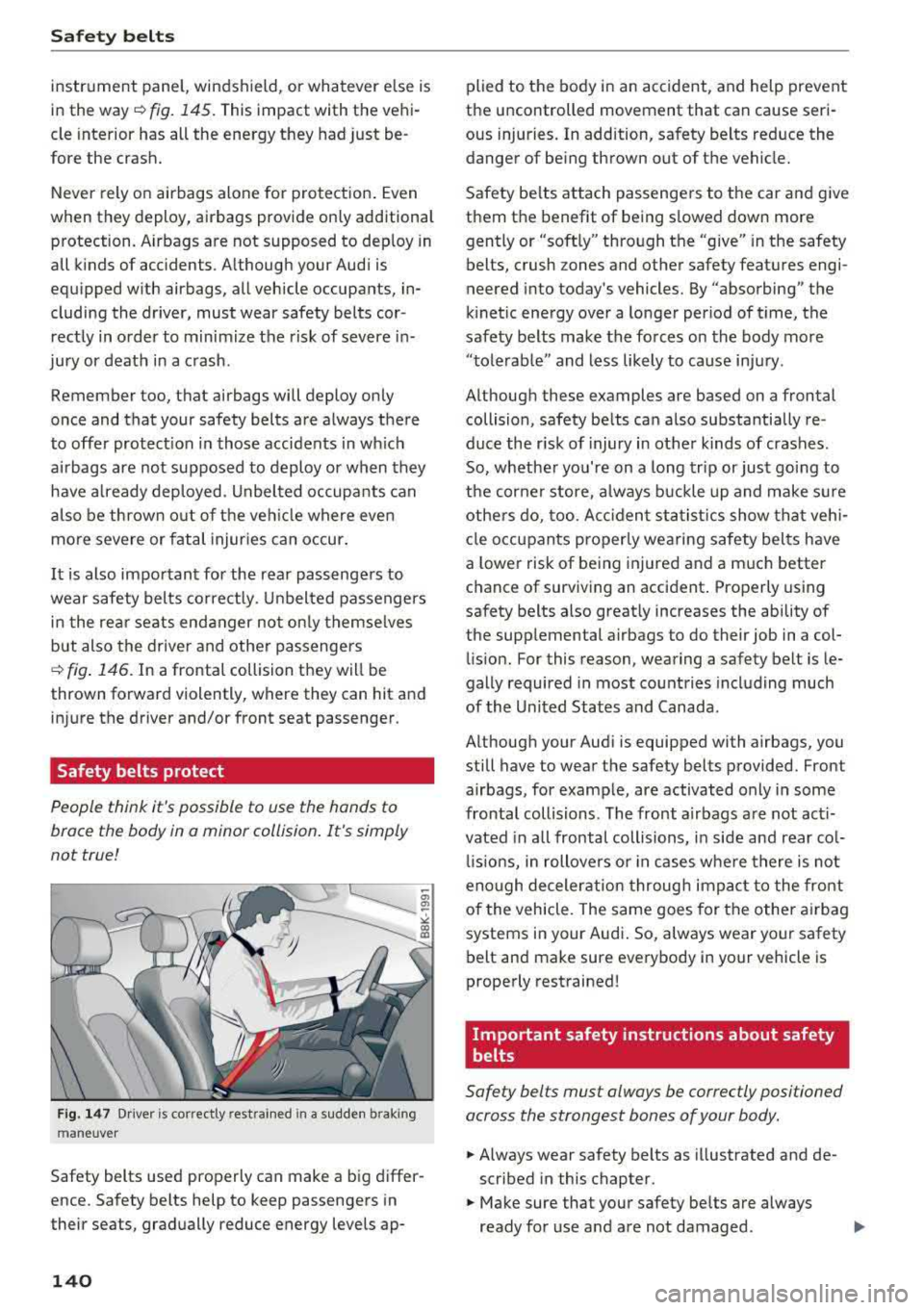
Safety belts protect
People think it's possible to use the hands to
brace the body in a minor collision . It's simply
not true!
F ig . 14 7 Driver is co rrectly restrai ned in a sudde n brak ing
m aneu ver
Safety belts used properly can make a b ig d iffer
ence. Safety belts help to keep passengers in
their seats, gradually reduce energy levels ap-
140
plied to the body in an accident, and help prevent
the uncontrolled movement that can cause seri
ous injuries. In addition, sa fety belts reduce the
danger of being thrown out of the vehicle.
Safety be lts attach passengers to the car and give
them the benefit of being s lowed down more
gently or "soft ly" through the "give" in the safety
belts, crush zones and other safety features engi
neered into today's vehicles. By "absorbing" the
k inet ic energy over a longer per iod of t ime, the
safety belts make the forces on the body more "tole rab le" and less likely to cause inju ry .
Although these examples are based on a frontal
collision, safety be lts ca n also substantially re
duce the r isk o f injury in ot her kinds of crashes .
So, whethe r you're on a long trip or just going to
the cor ne r store, a lways b uckle up and make s ure
othe rs do, too. Ac ciden t st at istic s show that veh i
cl e occupants prope rly wearing safety bel ts have
a lowe r risk of be ing injured and a m uch better
chance of surviving an acc ident . Properly using
safety be lts also great ly increases the ability of
the supp lemental airbags to do their job in a col
li sion. For this reason , wearing a safety belt is le
gally required in most countries including much
of the United States and Canada.
Although your Aud i is equipped with airbags, you
still have to wear the safety belts provided. Front
airbags, for examp le, are activated only in some
frontal collisions. The front airbags are not act i
vated in a ll frontal collisions, in side and rear co l
li sio ns, in rollovers or in cases whe re there is not
eno ugh decelerat ion throug h impa ct to the front
of the vehicle . The same goes for the other a irbag
systems in your Audi. So, always wear your safety
belt and make sure everybody in your vehicle is
properly rest rained!
Important safety instructions about safety
belts
Safety belts must always be correctly positioned
across the strongest bones of your body .
.,. Always wear safety belts as illustrated and de
scribed in this chapter.
.,. Make sure that your safety be lts are always
ready for use a nd a re not damaged .