check engine AUDI A7 2018 Owner's Manual
[x] Cancel search | Manufacturer: AUDI, Model Year: 2018, Model line: A7, Model: AUDI A7 2018Pages: 274, PDF Size: 42.77 MB
Page 200 of 274
Check ing and F illing
Adding engine oil
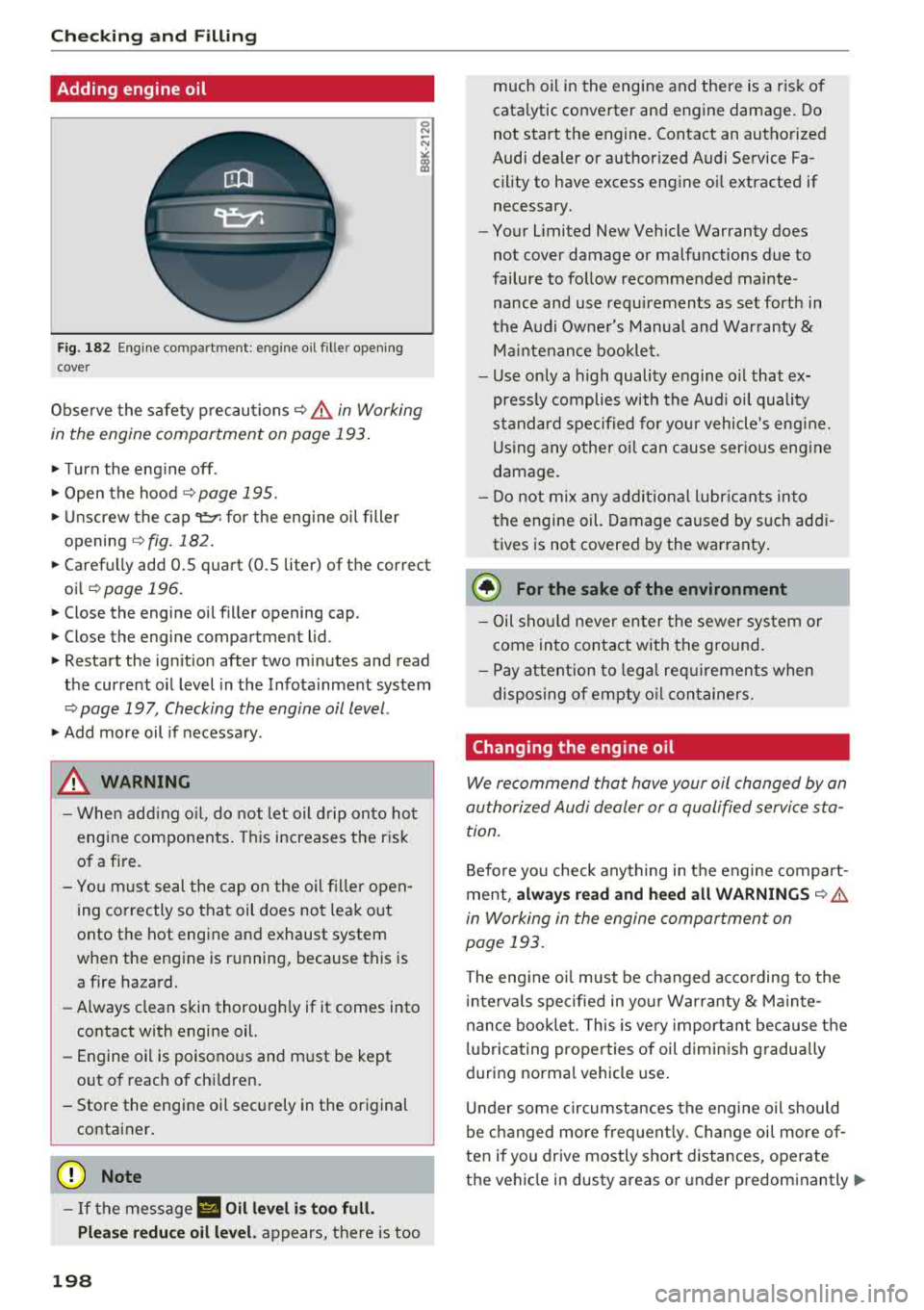
F ig. 182 Engine co mpartment : en gin e oil fille r opening
cove r
Observe the safety precaut ions ¢&. in Working
in the engine comportment on page
193 .
"'Turn the eng ine off.
"' Open the hood ¢ page 195.
"'Unscrew the cap~ for the eng ine oi l filler
opening
¢ fig. 182.
"'Carefu lly add 0.5 quart (0 .5 liter) of the correct
oi l
¢pag e 196.
"'Close the engine oil filler opening cap .
"'Close the engine compartment lid.
"'Restart the ign ition after two mi nutes and read
the current o il level in the Infotainment system
¢ page 197 , Checking the engine oil level .
"'Add more oil if necessa ry .
,& WARNING
- Whe n add ing o il, do not let oil d rip onto hot
engine components . This increases the r is k
of a fire.
- Yo u m ust seal the cap on the oil fi lle r open
ing correctly so that oil does not leak o ut
onto the hot engine and exhaust system
when the eng ine is r unning, because this is
a fire hazard.
- Always clean skin thorough ly if it comes into
contact with engine oil.
- Engine oil is poisono us and must be kept
o ut of reach of chi ld ren.
- Store the engine oi l sec urely in the original
container.
(LlJ) Note
- If the message Ill Oil l evel i s too full.
Plea se redu ce oil le vel.
appears, there is too
198
much oil in the engine and the re is a r isk o f
cata lytic converter and engine damage. Do
not start t he engine. Contact an autho rized
Audi dealer or author ized Audi Service Fa
cility to have excess eng ine o il extracted if
necessary .
- Your L imited New Vehicle Warranty does
not cover damage or ma lfunctions due to
failure to follow recommended mai nte
nance and use requ irements as set fort h in
the A udi Owne r's Manual and War ranty
&
Ma inte nan ce bookle t.
- Use on ly a high quality engine o il that ex
press ly complies with the A ud i oi l quality
s ta ndard spec ified fo r yo ur vehicle 's eng ine.
Us ing any othe r oi l c an cause ser io us eng ine
damage .
- Do not mix any add it io na l lubr ic a nts in to
t he engine oil. Damage ca used by such add i
tives is not covered by the warranty .
@ For the sake of the environment
- Oil sho uld neve r en ter the sewer sys tem or
come in to contact with the g round .
- Pay attent ion to lega l re quir emen ts when
disposing o f emp ty o il conta iners.
Changing the engine oil
We recommend that hove your oil changed by on
authorized Audi dealer or a qualified servi ce sta
tion.
Befo re yo u check anything in t he engine compart
ment,
alway s read and h eed all WARNINGS ¢ &
in Working in the engine comportment on
page
193.
The eng ine o il must be changed according to the
i nte rvals spec ified in yo ur War ranty
& Ma inte
nance boo klet. This is ve ry important because the
l ubricating prope rties of oil diminish gradua lly
during norma l vehicle us e.
Un der some c ircumstances the engine oil should
be c hanged more freq uent ly. Change oi l more of
ten if you drive mostly s hort distances, operate
the ve hicle in dusty areas or under
predominantly ..,.
Page 201 of 274
a co .... N
" N .... 0 00 \,;J '
cle where temperatures remain below freezing
for extended periods.
Detergent additives in the oil will make fresh oil
l ook dark after the engine has been running for a
short time. This is norma l and is not a reason to
change the oil more often than recommended.
Because of the problem of proper disposa l, along
with the special tools and necessary expertise re
quired, we strong ly recommend that you have
your oil changed by an authorized
Audi dealer or
a qualified service station .
If you choose to change your oil yourself, please
note the following important information:
A WARNING
To reduce the risk of personal injury if you
must change the engine oil in your veh icle
yourself:
- Wear eye protection.
- To reduce the risk of burns from hot engine
o il, let the eng ine cool down to the touch.
-
-When removing the oil drain plug with your
fingers, stay as far away as possible. Always
keep your forearm parallel to the ground to
help prevent hot oil from running down your
arm.
- Drain the oil into a container designed for
this purpose, one large enough to hold at
least the total amount of oil in your engine .
- Engine oil is poisonous. Keep it well out of
the reach of children.
- Cont inuous contact w ith used engine oil is
harmful to your sk in. Always protect your
sk in by washing oil off thoroughly w ith soap
and water.
@ Note
Never mix oil addit ives with your engine o il.
These additives can damage your eng ine and
adversely affect your Audi Limited New Vehi
cle Warranty.
Checking and Filling
@) For the sake of the environment
-Before changing your oi l, first make sure
you know where you can properly dispose of
the used oil.
- Always dispose of used engine oi l properly.
Do not dump it on garden soil, wooded
areas, into open streams or down sewage
drains.
- Recycle used engine o il by tak ing it to a used
eng ine oil collection fac ility in your area, or
contact a service station .
Cooling system
Coolant
The engine cooling system is filled wit h a mixture
of purified water and coolant additive at the fac
tory. This coolant must not be not changed.
T he coolant level is monitored through
the . in
dicator light
r=;, page 14. However, we do recom
mend occasionally checking the coolant leve l
manua lly.
If you must add coolant, use a mixture of water
and coolant additive. Mixing the coo lant additive
with distilled water is recommended.
Coolant additive
The coolant additive is made of anti-freezing and
corrosion protection agents. Only use the follow
ing coolant additives. These additives may be
mixed with each other .
Coolant additive Specification
Gl2evo
TL 774 L
Gl2++ TL 774 G
Gl3 TL 774
J
The amount of coolant additive that needs to be
mixed with water depends on the climate where
the vehicle wi ll be operated .
If the coolant addi
tive percentage is too low, the coolant can freeze
and damage the engine.
.,.
199
Page 202 of 274

Checking and Filling
Coolant Freeze protec-
additi ve tion
Warm min. 40% min. -13 °F
regions max. 45% (-25 °C)
Cold min. 50% max. -40
°F
regions max. 55% (-40 °C)
([) Note
- Before the start of winter, have an author
ized Audi dealer or authorized Audi Service
Facility check if the coolant additive in your
vehicle matches the percentage appropriate
for the climate. This is especially important
when driving in colder climates.
- If the appropriate coolant additive is not
available in an emergency, do not add any
other additive. You could damage the en
gine. If this happens, only use water and re store the correct mixture ratio with the
spec ified coolant additive as soon as possi
ble.
- Only refill with new coo lant.
- Radiator sealant must not be mixed w ith
the coo lant .
Adding coolant
F ig. 183 Engine compartment: coolant expans ion tank
cover
Observe the safety precautions~ page 193,
Working in the engine compartment .
Checking the engine coolant level
• Park the vehicle on a leve l surface .
• Switch the ignition off.
• Read the coolan t leve l on the coo la nt expansion
tank
~page 196, fig . 181. The coolant level
must be between the MIN and MAX markings
200
when the engine in cold. When the engine is
warm it can be slightly above the MAX marking .
Adding coolant Requirement: there must be a residual amount of
coolan t in the expansion tan k
~CD -
• Let the engine cool down .
• Place a cloth over the coolant expansion tank
cap and unscrew the cap counterclockw ise
~ & -
... Add coo lant m ixed in the cor rect ratio
~ page 199 up to the MAX marking.
• Make sure that the fluid level remains stab le .
Add more coolant if necessary .
• Close the cap securely.
Coolant loss usually ind icates there is a leak . Im
mediate ly drive your vehicle to an authorized
Audi dealer or authorized Audi Service Fac ility
and have the cooling system inspected. If the
cooling system is not leaking, a loss can come
from the coolant boiling through overheat ing
and being pushed out of the cooling system .
A WARNING
- The cooling system is under pressure. Do
not open the coo lant expansion ta nk cap
when the engine is hot. This increases the
risk o f bur ns.
- The coolan t addi tive and the coolant can be
dangerous to your health. For t his reason,
keep the coolant in the original container
and away from children. There is a risk of
poisoning.
- When working in the engine compartment,
remember that the radiator fan can switch
on even if the ignition is switched off, which
increases the risk of injury.
(D Note
Do not add coolant if the expansion tank is
empty. A ir cou ld enter the cooling system and
damage the engine. If this is the case, do not
continue driving. See an authorized Audi deal
er or authorized Audi Serv ice Facility for assis
tance.
Page 203 of 274
a co ,...,
N
" N ,...,
0 00 <..:l '
N N ~
~ co al
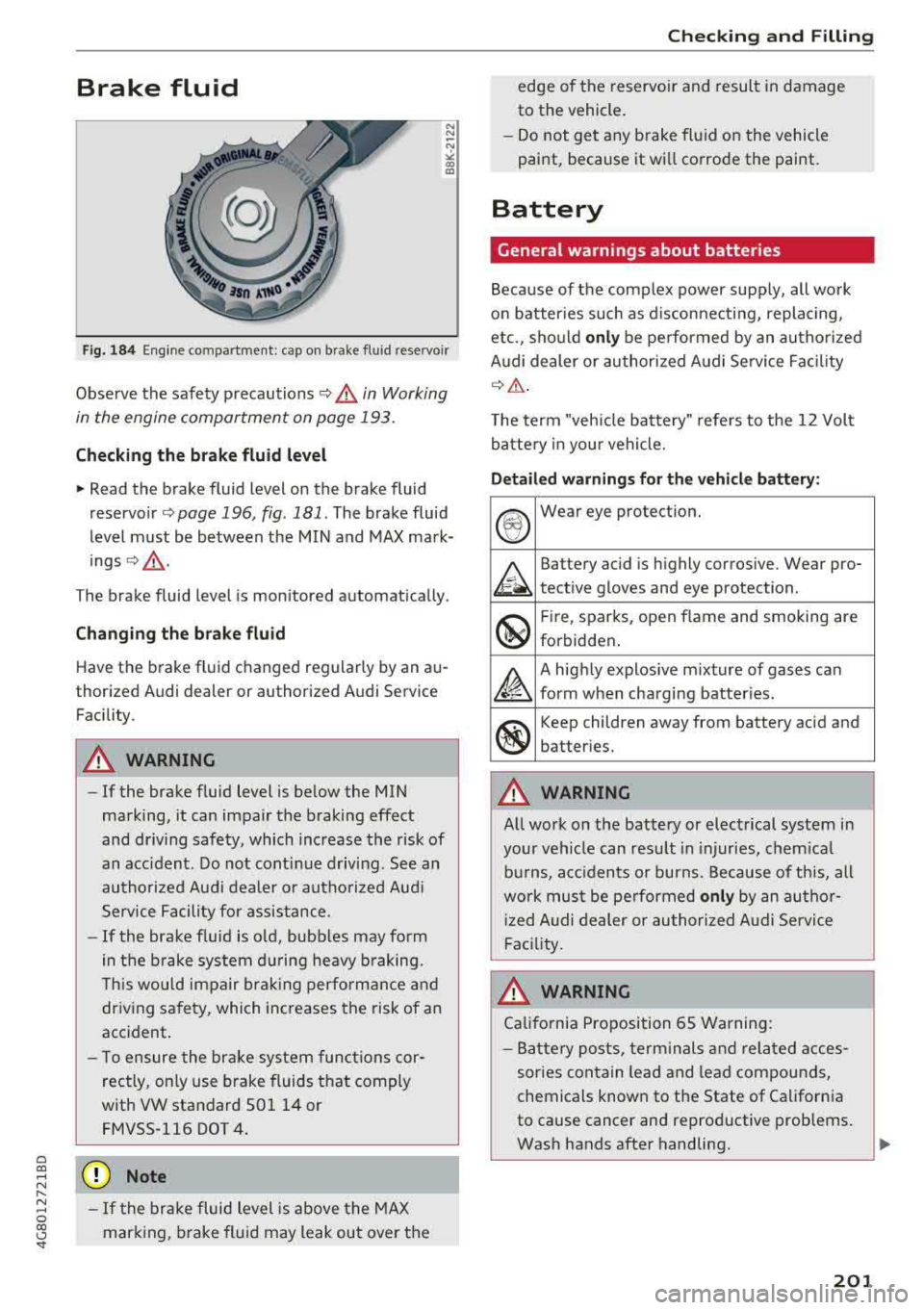
Fig. 184 Eng ine compartment: cap on brake fluid reservoir
Observe the safety precautions ~.&. in Working
in the engine comportment on page 193.
Checking th e brake fluid level
• Read the brake fluid level on the brake fluid
reservo ir
Q page 196, fig. 181. The brake fluid
level must be between the MIN and MAX mark
ings ~,&. .
The brake fluid level is mon itored automat ically.
Chang ing the bra ke flu id
Have the brake fluid changed regularly by an au
thorized Audi dealer or authorized Audi Service
Facility .
A WARNING
-If the brake fluid level is be low the MIN
marking, it can impair the braking effect
and dr iving safety, which increase the risk of
an acc ident. Do not cont inue driv ing . See an
authorized Audi deale r or autho rized Aud i
Service Facility for assist ance .
-If the brake f luid is o ld, bubbles may form
in the brake system d uring heavy b raking.
T his would impair bra king perfo rman ce an d
driving safety, which increases the risk of an
accident.
- T o ensure the bra ke system functions cor
rectly, only use brake fluids that comply
with VW standard 501 14 or FMVSS-116 DOT
4 .
(D Note
- If the brake fluid level is above the MAX
mar king, brake fluid may leak out over the
Chec king and Filling
edge of the reservo ir and result in damage
to the vehicle.
- Do not get any b rake fl uid on the vehicle
paint, because it wi ll co rrode the paint .
Battery
General warnings about batteries
Because of the complex power supp ly, alt work
o n batter ies such as d isconnecting , replacing,
etc., sho uld
onl y be performed by an au tho riz ed
Audi dealer or au thori zed Audi Se rvice Fac ility
Q A .
The term "vehicle battery" refe rs to the 12 Volt
batte ry in you r vehicle.
Detail ed warnings fo r the vehicle battery :
®
Wear eye protection.
A
Battery acid is highly corrosive. Wear pro-
tect ive gloves and eye protection .
@
Fire, sparks, open flame and smoking are
forbidden .
~
A highly explosive mixture of gases can
form w hen cha rging bat ter ies.
®
Keep children away from battery acid and
batter ie s.
A WARNING
A ll work on the battery or electrical system in
your vehicle can result in injuries, chem ica l
burns, acc idents or burns. Because of this, all
wo rk must be pe rformed
only by an au tho r
iz ed Audi dealer or au thor ized A udi Service
F aci lity.
A WARNING
-c....--
Ca lifornia Proposition 65 Warning:
- Battery posts, term inals and rela ted acces
sories contain lead and lead compounds,
chemicals known to the State of California
to cause cancer and reproductive prob lems .
Wash hands afte r handling.
201
Page 204 of 274
Checking and Filling
(D Note
If the vehicle will be parked for long periods
of t ime , protect it against the co ld so that it
will not be destroyed by "freezing"
c::> page 202 .
Vehicle battery
The term "vehicle battery " refers to the 12 Volt
bat tery in your vehicle.
Not running the vehicle for long pe riods of
t ime
If you do not drive your vehicle for several days o r
weeks , electri cal equipment is gr adually scaled
back or switched off . This reduces energy use and
ensures the veh icle w ill be able to start after long
periods of time
c::> page 126 . Some conve nience
functions, s uch as interior lighting or power seat
adj ustment, may not be available under certa in
circumstances. These convenience f unct ions w ill
be ava ilab le aga in once you switch the ignition on
and start the engine .
E ven w hen electrica l equ ipme nt is swi tched off,
the equipment can still d rain the vehicle battery
if the vehicle is not driven for long periods of
time . Deep draining results in a chemical reaction
that destroys the inside of the vehicle battery .
The vehicle battery must be charged every month
t o reduce the risk of this happening
c::> page 202.
Contact an author ized Audi dealer or authorized
Aud i Serv ice Facility for more information .
Winter operati on
Cold weather places higher demands on the vehi
cle battery. This results in reduced start ing abili
ty . Have the vehicle battery checked by an au
thor ized Audi dealer or authorized Audi Service
Facility before the co ld time of year .
202
Charging the vehicle battery
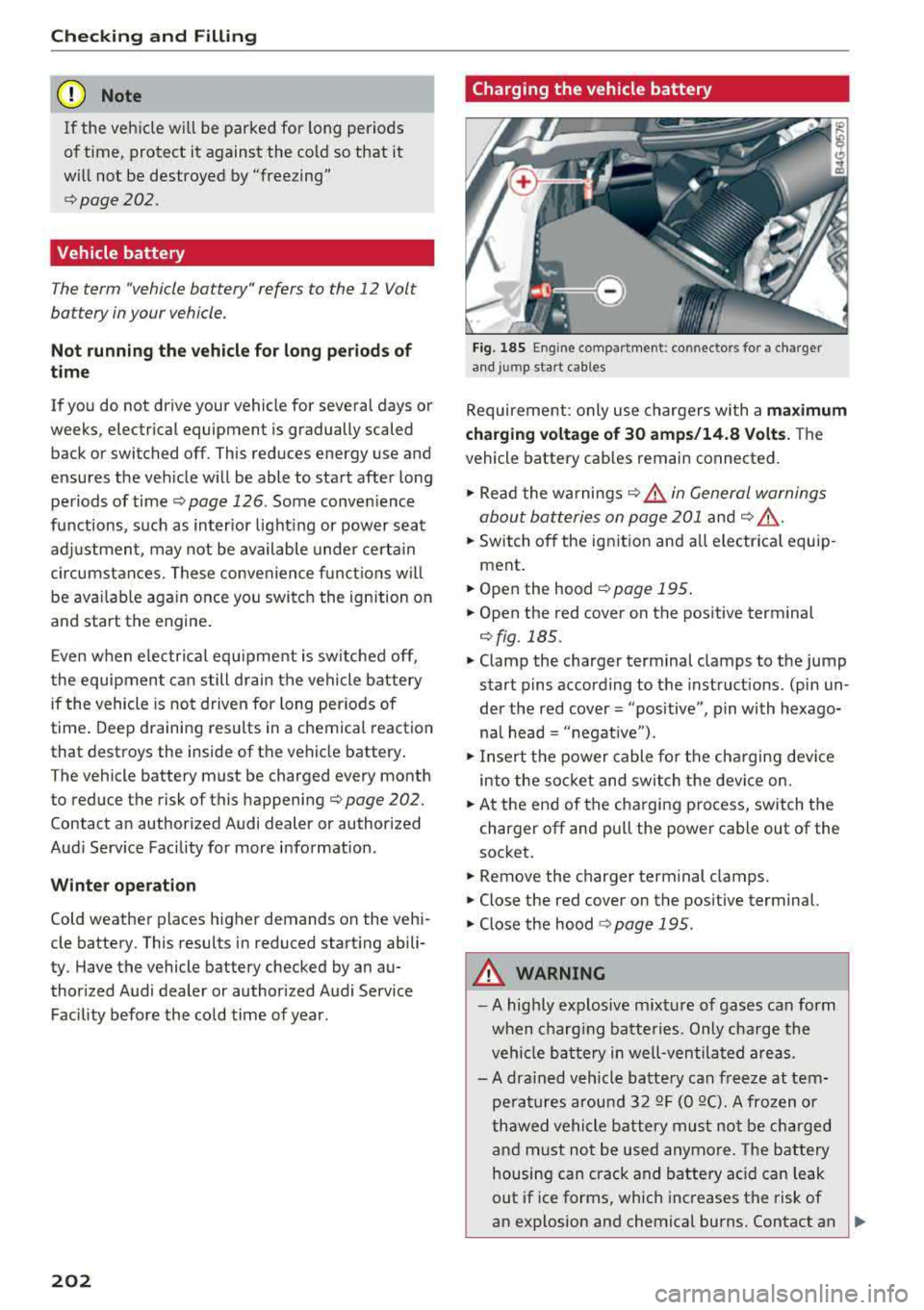
Fig. 18 5 En g in e compartment : co nn ectors fo r a cha rger
a n d jum p start cab les
Requireme nt: only use chargers with a maximum
charging voltage of 30 amp s/14.8 Volts.
The
vehicle battery cab les remain connected.
... Read the wa rnings c::> _& in General warnings
about batteries on page 201
and c::> ,& .
... Switch off the ign it ion and all electrica l equip
ment .
... Open the hood c::> page 195 .
... Open the red cover on the pos itive terminal
c::>fig. 185.
... Clamp the charger terminal clamps to the jump
start p ins accord ing to the instruct ions. (pin un
der the red cover
= " positive ", pin with hexago
nal head= "negat ive ").
... In sert t he power cable fo r th e cha rging dev ice
into the soc ket and switch t he devi ce on.
... At the end of the cha rging process, switch the
charger off and pull the power cable out of the
soc ket .
... Remove the charger terminal clamps.
... Close the red cover on the pos itive terminal.
... Close the hood c::> page 195 .
A WARNING
-A highly explosive m ix ture of gases can form
when charg ing batte ries . Only cha rge the
veh icle b attery in well -ventila ted areas.
- A drained vehicle batte ry can freeze at tem
pe ra tu res around 32
QF (0 QC). A fro zen o r
thawed vehicle battery must no t be charged
a nd must not be used anymore. The battery
housing can c rack and battery ac id can leak
out if ice forms, which increases the risk of
an explosion and chemical burns. Contact an
..,.
Page 205 of 274

a co .... N
" N .... 0 00 \.J '
Service Facility for more information.
- Do not connect or disconnect the charging
cable while charging because this increases
the risk of an exp losion.
(D Tips
- Only charge the vehicle battery through the
connections in the engine compartment.
- Read all of the manufacturer's instructions
for the charger before charging the vehicle
battery.
Windshield washer system
Fig. 186 Engine compa rtment: washer flu id reservo ir cap
M N
-N ~
"' a,
The windshield washer reservoir O contains the
cleaning solution for the windshie ld and the
headlight washer
system* ¢ page 196, fig . 181.
The reservoir capacity can be found in
¢page 254.
To reduce the risk of lime sca le deposits on the
spray nozzles, use clean water with low amounts
of calc ium . A lways add window cleaner to the wa
ter. When the outs ide temperatures are cold, an
anti -freezing agent should be added to the water
so that it does not freeze .
@ Note
-The concentration of anti-freezing agent
must be adjusted to the vehicle operating
cond itions in the respective climate. A con
ce ntration that is too high can lead to vehi
cle damage.
- Never add radiator anti-freeze or other addi
tives to the washer fluid.
Checking and Filling
- Do not use a glass cleaner that contains
paint so lvents, because t his could damage
the paint.
Service interval display
The service interval display detects when your ve
hicle is due for service .
The service interval display works in two stages:
-Inspection or oil change reminder : afte r a cer -
tain distance driven, a message appears in the
instrument cluster display each time the igni
tion is switched on or off. The remaining dis
tance or time is disp layed briefly.
- Inspection or oil change due: if your vehicle
has reached an inspection or oil change interval
or both intervals at the same t ime, the mes
sage
Inspection due! or Oil change due! or Oil
change and inspection due!
appears briefly af
ter switching the ignition on/off .
Checking service intervals
You can check the remaining distance or time un
til the next oil change or next inspection in the
Car menu. To do t his, select: the !CAR !function
button
> (Car)* Systems control button > Service
& control > Service intervals .
Resetting the indicator
An authorized Audi dea ler or a uthorized Audi
Service Facility w ill reset the service interval dis
play after performing service.
If you have ch anged the oi l yourse lf, you must re
set the oil change interval.
T o reset the indicator, select : the
I CAR ! function
button
> (Car)* Systems control button > Service
& control > Service intervals . Turn the control
knob downward to
Reset oil change interval and
press the control knob.
@ Note
-Only reset the oi l change indicator if the oi l
was changed.
- Following the service intervals is critical to
maintaining the service life and value of
your vehicle, especially the engine. Even if
203
Page 228 of 274

Wheels
Displaying tire pressures/temperatures
Applies to: vehicles with tire pressure monitoring system
Requirement: the ign ition must be switched on.
.,. Select : the ICARI function button > Car systems
> Service & control> Tire pressure monitor>
Display tire pressure .
The current tire pressures are shown in green and
yellow numbers in the Infotainment system:
- Green: the current tire pressure and the speci
fied tire pressure are approximately the same.
- Yellow: the current tire pressure is too low
compared to the specified tire pressure.
The specified tire pressure is the last tire pres
sure that was stored
9 page 226 .
Note that the tire pressure also depends on the
temperature of the tire. The tire pressure in
creases as the engine becomes warmer while
driving.
A WARNING
Read and follow the important information
and notes
q page 225.
@ Tips
The tire pressure or temperature are not dis
played in adaptation mode. Dashes --.-- are
shown in place of the pressure and tempera
ture.
CD Tire pressure loss
App lies to: veh icles with tire pressure mon itoring system
Fig. 192 Display : in dic ato r light with a me ssage
226
-
If the (D] indicator light turns on, the pressure in
at least one tire is too low or new sensors were
not adapted:
RE indicator lights turns on after turning the
ignition on
The tire pressure is too low compared to the
specified pressure.
.,. Check and store the tire pressure(s) the next
time it is possible
9 page 226.
RE indicator light turns on while driving
Wheels with new sensors were not adapted or
the tire pressure has reached a critical level com
pared to the specified pressure.
.,. Avoid unnecessary steering and braking maneu-
vers.
.,. Adapt your driving sty le to the situation.
.,. Stop as soon as possible and check the tire(s).
.,. If it is possible to continue driving, see an au-
thorized Audi dealer or authorized Audi Service
Facility immediately and have your tire(s) re
paired or replaced.
A WARNING
Read and follow the important information
and notes ¢
page 225.
Storing new tire pressures
Applies to: vehicles with tire pressure mon itoring system
Correctly stored tire pressure specifications are
necessary for reliable tire pressure monitoring.
.,. Check the tire pressures in all wheels .
-
.,. Correct the tire pressure if necessary. Refer to
the tire pressure Label for the recommended
tire pressure for your vehicle
c> page 215,
fig . 190 .
Only correct the pressure in tires
whose temperature is approximately the same
as the ambient temperature. If the tempera
ture of the tire is higher than the ambient air
temperature, the tire pressure must be in
creased approximately 3 PSI (0,2 bar) above
the value on the sticker .
.,. Switch the ignition on .
.,. Select: !CAR ! function button > Car systems>
Tire pressure monitoring
> Store tire pressure . ..,.
Page 249 of 274

a co .... N
" N .... 0 00 \.J '
General
This chapter is intended for trained emergency
crews and working personnel who have the nec
essary tools and equipment to perform these
operations.
Starting by pushing or
towing
~ Note
Vehicles with an automatic transmission can
not be started by pushing or towing.
Starting with jumper
cables
If necessary, the engine can be started by con
necting it to the battery of another vehicle .
If the engine should fail to start because of a dis
charged or weak battery, the battery can be con
nected to the battery of
another vehicle, using a
pair of jumper cables to start the engine.
Jumper cables
Use only jumper cables of sufficiently large cross
section
to carry the starter current safely. Refer
to the manufacturer's specifications.
Use only jumper cables with
insulated terminal
clamps which are distinctly marked :
plus(+) cable in most cases colored red
minus(-) cable
in most cases colored black.
A WARNING -
Batteries contain electricity, acid, and gas.
Any of these can cause very serious or fatal in
jury. Follow the instructions below for safe
handling of your vehicle's battery .
-Always shield your eyes and avoid leaning
over the battery whenever possible.
-A dead battery can freeze at temperatures
around 32 °F (0 °C) . If the vehicle battery is
frozen, you must thaw it before connecting
the jump start cables. If you do not, this in-
Emergency situations
creases the risk of an explosion and chemi
cal burns. After jump starting the vehicle,
drive to an authorized Audi dealer or author ized Audi Service Facility immediately to
have the vehicle battery checked.
- Do not allow battery acid to contact eyes or
skin . Flush any contacted area with water
immediately.
- Improper use of a booster battery to start a
vehicle may cause an explosion .
- Vehicle batteries generate explosive gases .
Keep sparks, flame and lighted cigarettes
away from batteries.
- Do not try to jump start any vehicle with a
low acid level in the battery .
- The voltage of the booster battery must also
have a 12-volt rating . The capacity (Ah) of
the booster battery should not be lower
than that of the discharged battery. Use of
batteries of different voltage or substantial
ly different "Ah " rating may cause an explo
sion and personal injury.
- Never charge a frozen battery. Gas trapped
in the ice may cause an explosion.
- Never charge or use a battery that has been
frozen. The battery case may have be weak
ened.
- Use of batteries of different voltage or sub
stantially different capacity (Ah) rating may
cause an explosion and injury. The capacity
(Ah) of the booster battery should not be
lower than that of the discharged battery.
- Before you check anything in the engine
compartment, always read and heed all
WARNINGS
c>page 193.
@ Note
- Applying a higher voltage booster battery
will cause expensive damage to sensitive
electronic components, such as control
units, relays, radio, etc.
- There must be no electrical contact between
the vehicles as otherwise current could al
ready start to flow as soon as the positive
( + ) terminals are connected.
247
Page 251 of 274
-Be fore yo u chec k any thing in the engine
compartment, a lways read and heed a ll
WARNINGS
c:::> page 193 .
(D Note
Impro per hook-u p of jum per cables c an r uin
the gene rato r.
-Always connect P OSITIVE( +) to POS ITIV E
( + ), and NEG ATIVE( -) to NEGATI VE( -)
g round post of t he battery manage r contro l
unit.
- Check that a ll sc rew p lugs on t he battery
ce lls are screwed in f irmly . If not, t ighten
plugs p rior to connecting clamp on negative
b attery termi nal.
- Please note t hat the procedure fo r con nect
i ng a jumper cab le as desc ribed above ap
pli es specifica lly to the case of yo ur vehicle
b eing jump starte d. W hen you are giv ing a
ju mp s ta rt to ano ther vehicle , d o
no t con
ne ct t he negative( -) cable to the neg ative
(-) t ermin al on the disch arged b attery @
c:::> fig . 212 . In stead , securely connec t the
n egative ( -) cable to either a solid metal
com ponent that is firm ly bolted to the e n
gine block or to the engine bloc k itsel f. If
the battery that is be ing charged does not
vent to the outs ide, escap ing battery gas
could ignite and ex plode!
Towing with a tow truck
General hints
Your Audi requires special handling for towing .
The follow ing informa tion is to be used by com
mercia l tow tr uck operators who know how to op
e rate the ir equip men t sa fely.
- Never tow your Audi. Towing will cause dam
age to the engine and transmission .
- Never wrap the safety chains or winch cables
around the brake line s.
- To prevent unnecessary damage, your Audi
must be transported with a flatbed tru ck .
a co -To load the vehicle on to the flatbed , use the ,...,
~ towing loop found in the vehicle tools and at-N ,...,
0 00 <.,;) '
tach to the front or rear anchorage
c:::> pag e 249 and c:::>page 250 .
A WARNING
-
A veh icle bei ng towed is not safe for passen-
gers . N ever allow anyone to ride in a vehicle
being towed, for any reason.
Front towing loop
Fig. 213 Front bu mpe r: co ve r
Fig. 214 Front bu mper: i nst all ing the tow ing loop
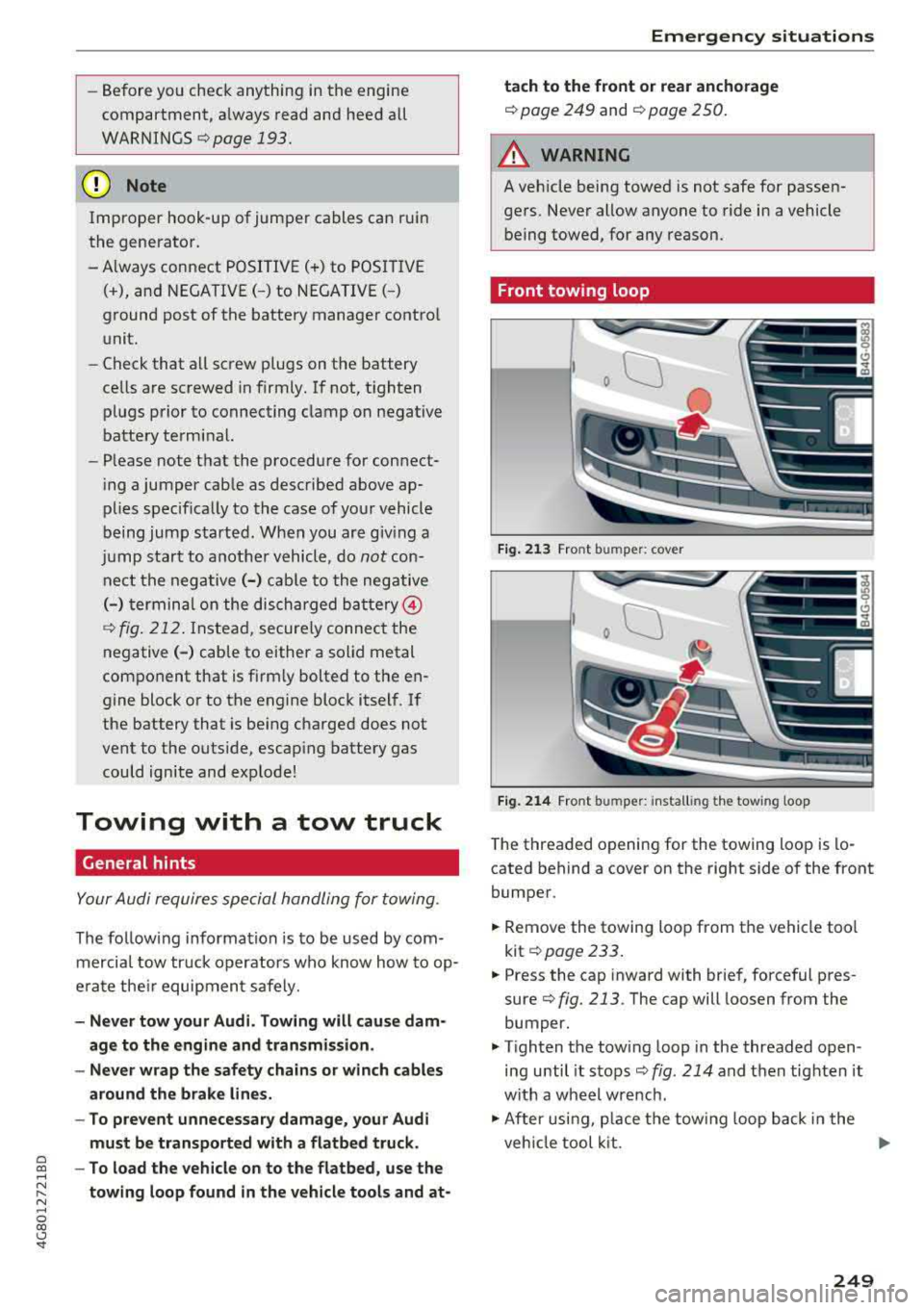
T he t hreaded o pen ing for th e towing loop is lo
cated be hind a cover on the r ight side of the front
bumper .
.,. Remove the towing loo p from the vehi cle too l
k it
c:::> page 2 3 3 .
.,. Press the cap inward with brief, force ful p res
su re
c:::> fig. 213 . The cap will loosen from the
bumper.
.,. T ighten the towing loop in the threaded open
ing until it sto ps
c:::> fig . 214 and then tighten it
w ith a wheel w re nch .
.,. After usi ng, p lace the tow ing loop back i n the
veh icle tool kit.
..,.
249
Page 253 of 274
a co ,...,
N
" N ,...,
0 00 <.,;) '
Lifting with workshop hoist and with floor
jack
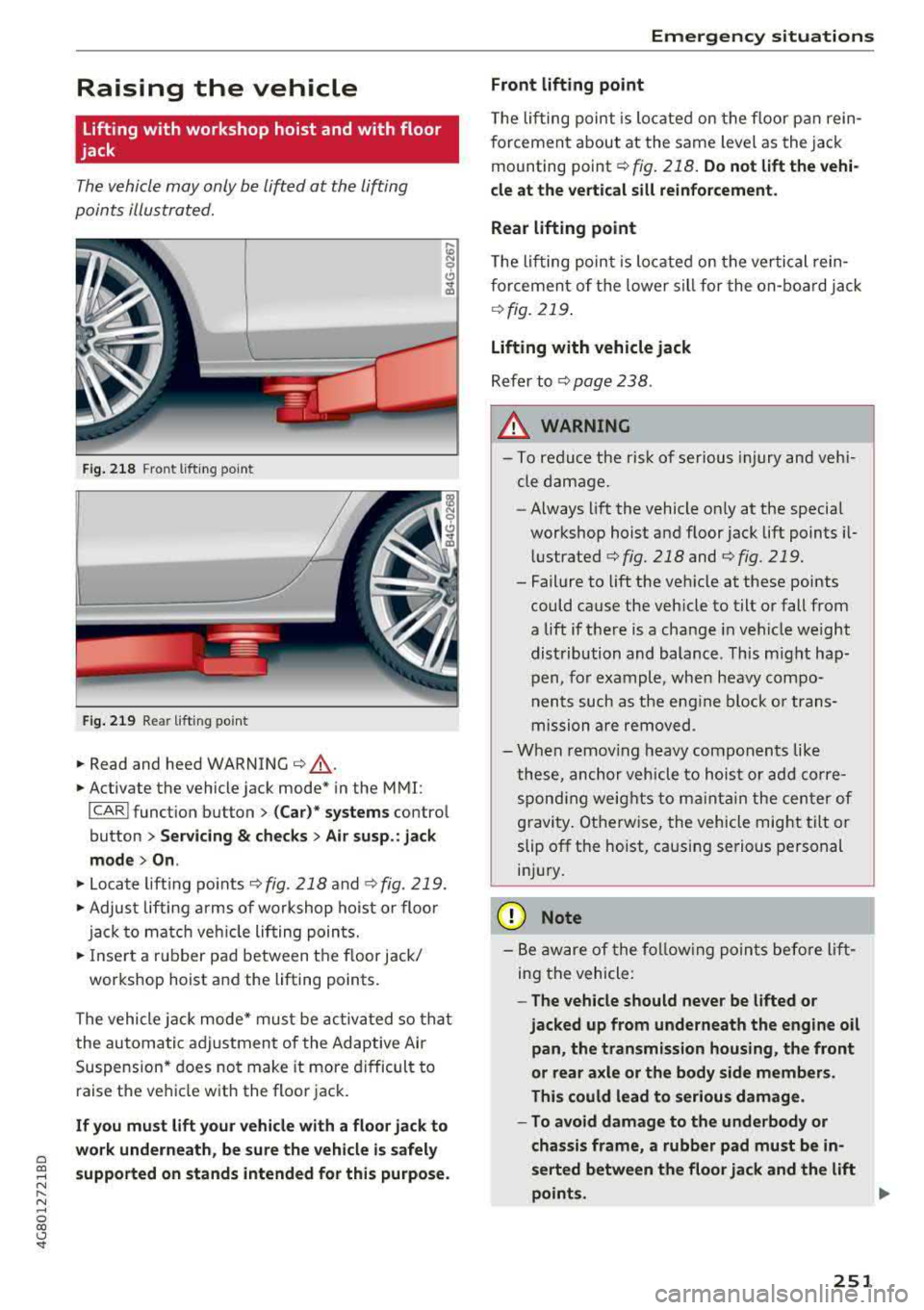
The vehicle may only be lift ed at the lifting
points illus tr at ed.
Fig. 218 Fro nt lift in g poin t
Fig. 219 Re ar lift ing poin t
.,. Read and heed WARNING c::> &, .
.. Activate the veh icle ja ck mode* in the M MI:
I CAR I funct ion button> (Car) * systems contro l
bu tton >
Servicing & checks > Air susp.: jack
mode > On .
.. Loca te lift ing po ints c::> fig . 218 and c::>fig . 219 .
.. Adju st lifting arms of wo rkshop hoist o r floo r
jack t o match vehicle li fting poin ts.
.. In se rt a rubb er pa d between the floor jack/
wor kshop ho ist a nd the lifting points .
T he vehicle ja ck m ode* mus t be activa ted so that
the au tomatic a djustment of the Ad aptive Air
Suspension * does no t make it more difficult to
raise the ve hicle wit h the floor jac k.
If you must lift your vehicle with a floor jack to
work underneath, be sure the vehicle is safely
supported on stands intended for this purpose . Emergency situations
Front lifting point
T he lifting poin t is locate d on the floor p an rein
f o rcement about at the same level as the ja ck
mounting point
c::> fig . 218 . Do not lift the vehi
cle at the vertical sill reinforcement .
Rear lifting point
T he lifting p oin t i s lo cate d on the ve rtic al rei n
f o rceme nt o f th e lower s ill for the on- bo ar d jac k
c::>fig. 219.
Lifting with vehicle jack
Refer to c::> pag e 238 .
A WARNING
- To reduce the r is k of se rious inju ry and veh i
cle dama ge.
-Always lift the vehicle o nly at the specia l
wor kshop h oist a nd f loor jack lift points
il
l ustrated c::> fig. 218 and c::> fig. 219.
-Failure to lift t he ve hicle at these points
could cause t he veh icle to tilt o r fall from
a lift i f th ere is a change in vehicle weight
dist ribution and balance . This might hap
pen, fo r example, when heavy compo
n en ts such as the eng ine block o r trans
missi on a re removed .
- Whe n re mov ing heavy comp onents like
these, an ch or veh icle t o hois t or ad d co rre
spon ding weig hts t o m aintai n the cen ter of
g ravi ty . Ot herw ise, the vehicle mig ht tilt or
slip off t he hoist, caus ing se rio us pe rsonal
i njur y .
(D Note
-Be aw are of the fo llow ing po ints b efor e lift
ing the vehicle:
-The vehicle should never be lifted or
jacked up from underneath the engine oil
pan, the transmission housing, the front
or rear axle or the body side members.
This could lead to serious damage .
-To avoid damage to the underbody or
chassis frame, a rubber pad must be in
serted between the floor jack and the lift
points .
.,.
251