height AUDI A8 2011 User Guide
[x] Cancel search | Manufacturer: AUDI, Model Year: 2011, Model line: A8, Model: AUDI A8 2011Pages: 302, PDF Size: 76.07 MB
Page 144 of 302
142 Safety belts
-The safety belt must lie flat and snug on
the occupant's upper body¢
fig. 145.
Pull on the belt to tighten if necessary.
- The lap belt portion of the safety belt
must be positioned as low as possible
across pelvis and never over the abdo
men . Make sure the belt lies flat and
snug ¢
fig. 145 . Pull on the belt to tight
en if necessary.
- A loose-fitting safety belt can cause seri
ous injuries by shifting its position on
your body from the strong bones to more
vulnerable, soft tissue and cause serious
injury .
- Always read and heed all WARNINGS and
other important information
¢ page 140.
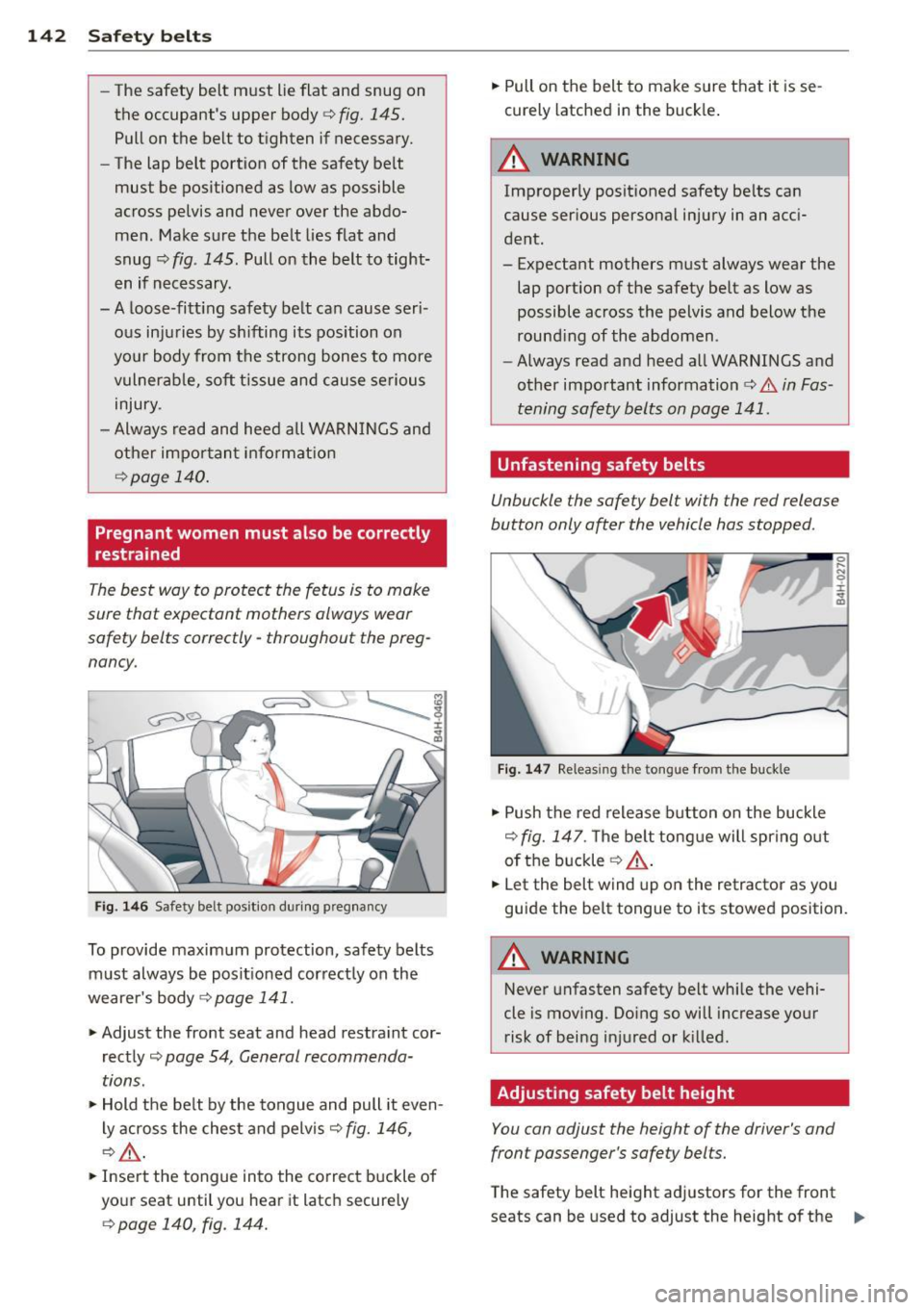
Pregnant women must also be correctly
restrained
The best way to protect the fetus is to mak e
sure that expectant mothers always wear
saf ety belts correctly -throughout the preg
nancy .
Fig. 146 Safety be lt pos it ion during p regnancy
To provide maximum protection, safety belts
must always be positioned correctly on the
wearer's body¢
page 141.
.,. Adjust the front seat and head restraint cor
rectly ¢
page 54, General recommenda
tions .
.,. Hold the belt by the tongue and pull it even
ly
across the chest and pelvis ¢ fig. 146,
¢ ,&. .
.,. Insert the tongue into the correct buckle of
your seat until you hear it latch securely
¢ page 140, fig. 144.
.,. Pull on the belt to make sure that it is se
curely latched in the buckle.
A WARNING
-
Improperly positioned safety belts can
cause serious personal injury in an acci
dent.
- Expectant mothers must always wear the
lap portion of the safety belt as low as
possible across the pelvis and below the rounding of the abdomen .
- Always read and heed all WARNINGS and
other important information¢
A in Fas
tening safety belts on page 141.
Unfastening safety belts
Unbuckle the safety bel t wi th the red release
button only after the vehicle has stopped .
Fig. 147 Releas ing the tong ue from the bu ckle
.,. Push the red release button on the buckle
¢
fig. 147 . The belt tongue will spring out
of the buckle ¢ ,&. .
0 ,._
9 r ... a,
.,. Let the belt wind up on the retractor as you
guide the belt tongue to its stowed position.
A WARNING
Never unfasten safety belt while the vehi
cle is moving . Doing so will increase your
risk of being injured or killed.
Adjusting safety belt height
You can adjust the height of the driver's and
front passenger's safe ty bel ts .
The safety belt height adjusters for the front
seats can be used to adjust the height of the .,..
Page 145 of 302
shoulder portion of the safety belt so that it is
positioned correctly .
Power safety belt h eight adju stment*
You ca n adjust the height of the safety belts
usi ng the multifunc tion b utton on the dr iver
or front passenger seat
c> page 56. The
shoulder portion of the sa fety belt sho uld r un
approximately across the midd le of the
shoulder -
never o ver the nec k c> A in Safety
bel t posi tion on page 141.
A WARNING
Always read and heed all WARNINGS and
other impo rtant informat io n
c> page 140 .
(D Tips
You can also ad just the height of the front
seats to c hange the position of the safety
be lts.
Improperly worn safety belts
Incorrectly posi tioned safety belts con cause
severe injuries.
Wearing safety be lts imprope rly can cause se
rio us injury or death. Safety belts can only
work when they are correct ly positioned on
the body . Improper seating positions reduce
the effect iveness of safety belts and w ill eve n
in crease the r isk of injury and death by mov
in g the safety belt to cr itical a reas of the
body. Imp roper seat ing pos it ions also in
crease the risk of serio us inj ury and de ath
when an airbag deploys a nd strikes an occu
pant who is not in the correct seating posi
tion . A driver is responsib le for the safety of
all vehicle occupants and especially for chi l
dren. Therefore :
~ Never permit anyone to ass ume an inco rrect
s itting position in the veh icle wh ile traveling
c> .,&. .
Sa fety belts 143
A WARNING
Improperly worn safety belts increase the
risk of serious persona l injury and death
whenever a vehicle is being used.
- Always make sure that all vehicle occu-
pants are correc tly restrained and stay in
a co rrect seating position whenever the
veh icle is being used .
- Always read a nd heed all WAR NINGS a nd
other important information
c> poge 140.
Safety belt preten
sioners
How safety belt pretensioners work
In front, side and rear-end collisions above a
particular severi ty and in a rollover, safe ty
belts ore tensioned automatically .
Reve rsible safety belt ten sione rs
The safety belts on the front seats are equip
ped with power reversib le tensioners . The fo l
lowing functions are ava ilab le when the driv
er 's/fro nt passenge r's safety belts are fas
tened :
- Automatic tens ioners: at the start of a drive,
the safety belts automat ica lly adjus t to the
passenger after a certain time period or ve
hicle speed . To switch the automatic ten
sioners off, select the following in the
MMI :
!CARI function button > Car sy ste m s> Vehi
cle settings > Seat s> Driv er's seat or P as
s eng er' s s eat
> Automati c belt ten sioner >
Off.
- I n cer tain dr iv ing s itu ations , the safety belts
may tighten w ith a revers ible tens ion ing
function
c> poge 188.
-The safety be lts may also t ighten wi th th is
reve rsible tensioning function in minor co lli
sions .
Pyrotechnic safety belt pretensioners
The safety belts are equipped with safety belt
p re tensioners. The system is ac tiva ted by sen
sors in fro nt, side and rear -end co llisions of
great severity and in a rollover. This tig htens
1J1>
•
•
Page 163 of 302
Knee airbags
Description of knee airbags
The knee airbag system can provide supple
mental protection to properly restrained
front seat occupants.
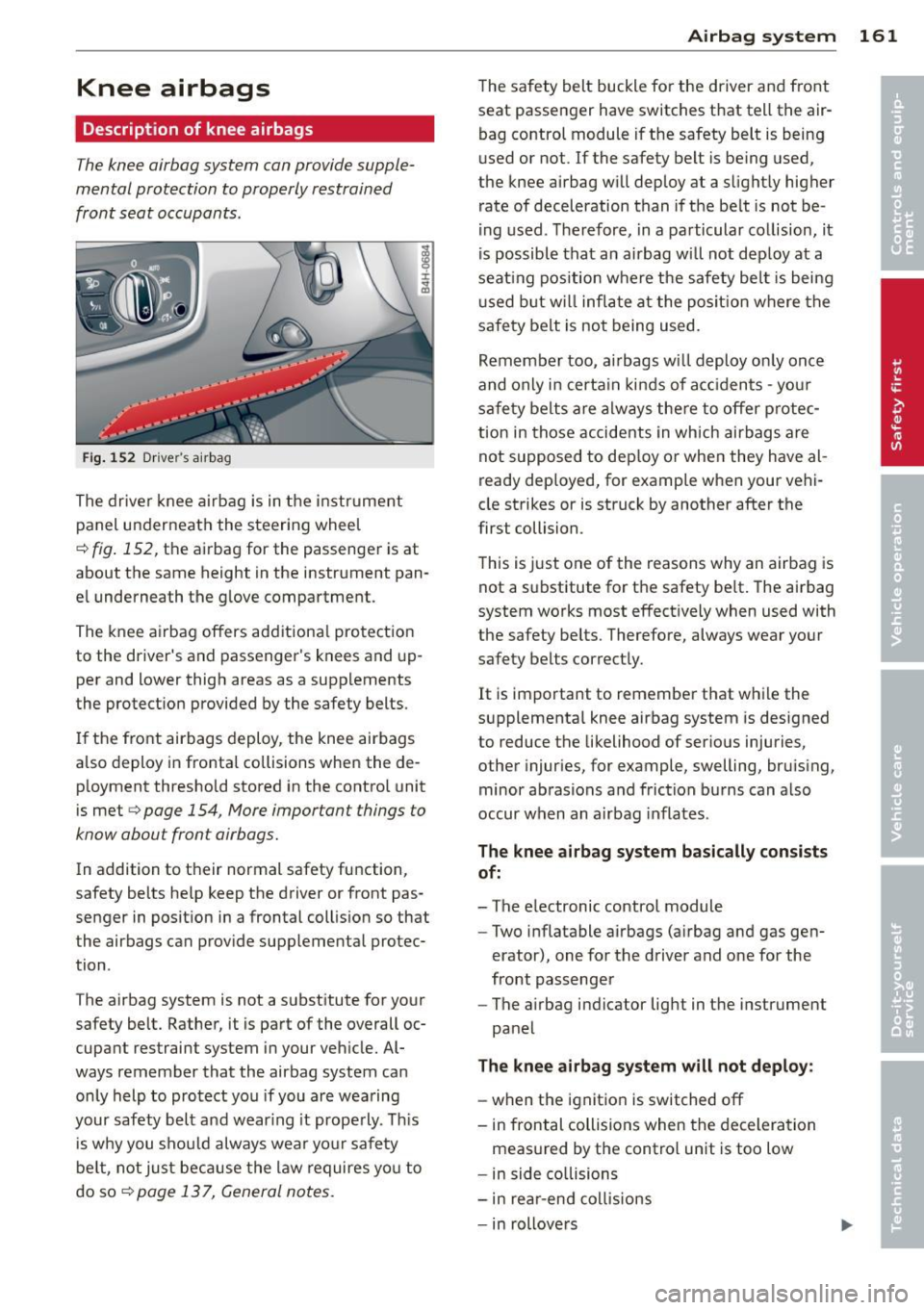
Fi g. 1 52 Driver's a irbag
The drive r knee airbag is in the instr ume nt
panel underneath the steeri ng wheel
¢ fig . 152, th e ai rbag for the passenger is at
about the same height in the instrument pan
e l underneath the g love compartment.
The knee a irbag offers add itiona l pro tect io n
to the driver's and passenger 's knees and up
per and lower thigh areas as a supp lements
the protect ion provided by the safety belts.
If the front airbags deploy, the knee airbags
a lso deploy in frontal collisions when the de
p loyment thresho ld stored in the contro l unit
is met
r::!;> page 154, More important things to
know about front airbags.
In addition to t heir normal safety function,
safety be lts he lp keep the driver or front pas
se nger in posit ion in a frontal coll is ion so that
the airbags ca n prov ide supplemental protec
tion .
T he airbag system is not a s ubst itute for yo ur
safety be lt. Rather, it is part of the overall oc
cupa nt restraint system in your veh icle. Al
ways remember that the airbag system ca n
only help to pro tect you if you are wea ring
your safety belt and wear ing it prope rly. Thi s
i s w hy you sho uld always wea r yo ur safety
be lt, not just because the law requires yo u to
do so
¢ page 137, General notes .
Airbag system 161
The safety belt buckle fo r the driver a nd front
seat passe nger have switches that tell the air
bag control module if th e safety belt is being
u sed or not . If the safety belt is being used,
the knee airbag w ill deploy at a s light ly higher
rate of deceleration t han if t he be lt is not be
i ng used. Therefore, in a pa rticular co llision, it
is possible that an airbag will not dep loy at a
seat ing pos ition w he re t he safety be lt is being
u sed b ut w ill infl ate a t the po sition where the
safety belt is no t being used.
Remember too, a irbags wi ll deploy o nly once
and on ly in certa in kin ds of ac ciden ts -yo ur
sa fe ty belts a re a lw ay s there t o offer p rotec
t ion in those accide nts in which airbags are
not supposed to dep loy o r when they have al
ready dep loyed, for example when your vehi
cle strikes or is struck by another after the
first collision.
This is just one of the reasons why an airbag is
not a s ubstitute fo r th e safety be lt . T he airbag
system works most effect ively when used with
the safety be lts. Therefore, always wea r your
safety belts correct ly.
It is important to remember that while the
supplementa l knee airbag system is designed
to reduce the li kelihood of ser ious injuries ,
other injur ies, for example, swelling, bru is ing,
minor abras ions and frict ion bu rns can a lso
occur when an airbag in flates.
The knee airbag system basically consists
of:
- The electronic control module
- Two inflatable a irbags (a irbag an d gas gen-
erator), one for the d river and one fo r the
front passenge r
- The a irbag indicator lig ht in t he i nstrument
pane l
The knee airbag system will not deploy :
-when the ignit io n is switched off
- in frontal collisions when the de celera tion
meas ured by the contro l unit is too low
- in side co llisions
- in rear-end col lis ions
- in rollove rs
Page 186 of 302
184 Child Safet y
• Push down on the seat cushion so that the
lower anchorages are visib le.
• Pull
off the guidance fixtures from the lower
anchorages.
• Always remove the guidance fixtures and
keep them in a safe place when not in use.
You may find it easier to install child re
straints equipped with hooks attached to
straps without the guidance fixtures in place.
If this is the case, remove the guidance fix
tures by pull ing them
off the anchorages .
H oweve r, the guidance fixtu res can he lp you
to locate the
LATCH ancho rages.
.&_ WARNING
Imprope r use of tether anchorages or low
er anchorages ca n cause serious persona l
injury in a crash .
- Always carefully fo llow the child re
straint manufacturer 's instructions for
proper insta llation and use of child re
straint systems .
- Never use the
LATCH or tethe r anchorag
es to attach safety belts or other kinds of
occupant restraints.
- Child restraint tether attachments and
lower attachments are only des igned to
secure a child restraint t hat has been
equipped to use these anchorages.
- Tether anchorages and lower anchorages
are designed to withstand only those
loads imposed by correctly fitted ch ild
restraints. Under no circumsta nces can
they be used safely for adu lt or chi ld
safety belts o r harnesses.
- Never mou nt more than one ch ild re
stra in t to a sing le tether or to a low er an
c ho rage poin t. Attac hing two chi ld re
st rain ts to a sing le anchor age poi nt can
cause the anchorage to fail and cause se
rious persona l injury in a crash .
0 Note
- Remove the guidan ce fixt ures before
fo ld ing t he rear sea tba ck t o preven t
dam aging the seat c ushion . -
To attach the ch ild restraint sec urely, the
seat must be moved to the farthest rear
posit ion, the seat height set to the low
est position and t he head restraint must
be adjusted to the vertical position
¢page 57.
-If you leave the guidance f ixtures instal
led for several days , they could leave a
mark on the upholstery on the seat cush
ion and back rest in the area that the
guidance fixtures were installed . T he up
holste ry wou ld al so be pe rmanen tly
stretched aro und the gui dance fix tures.
Th is ap plies especia lly to lea ther seats .
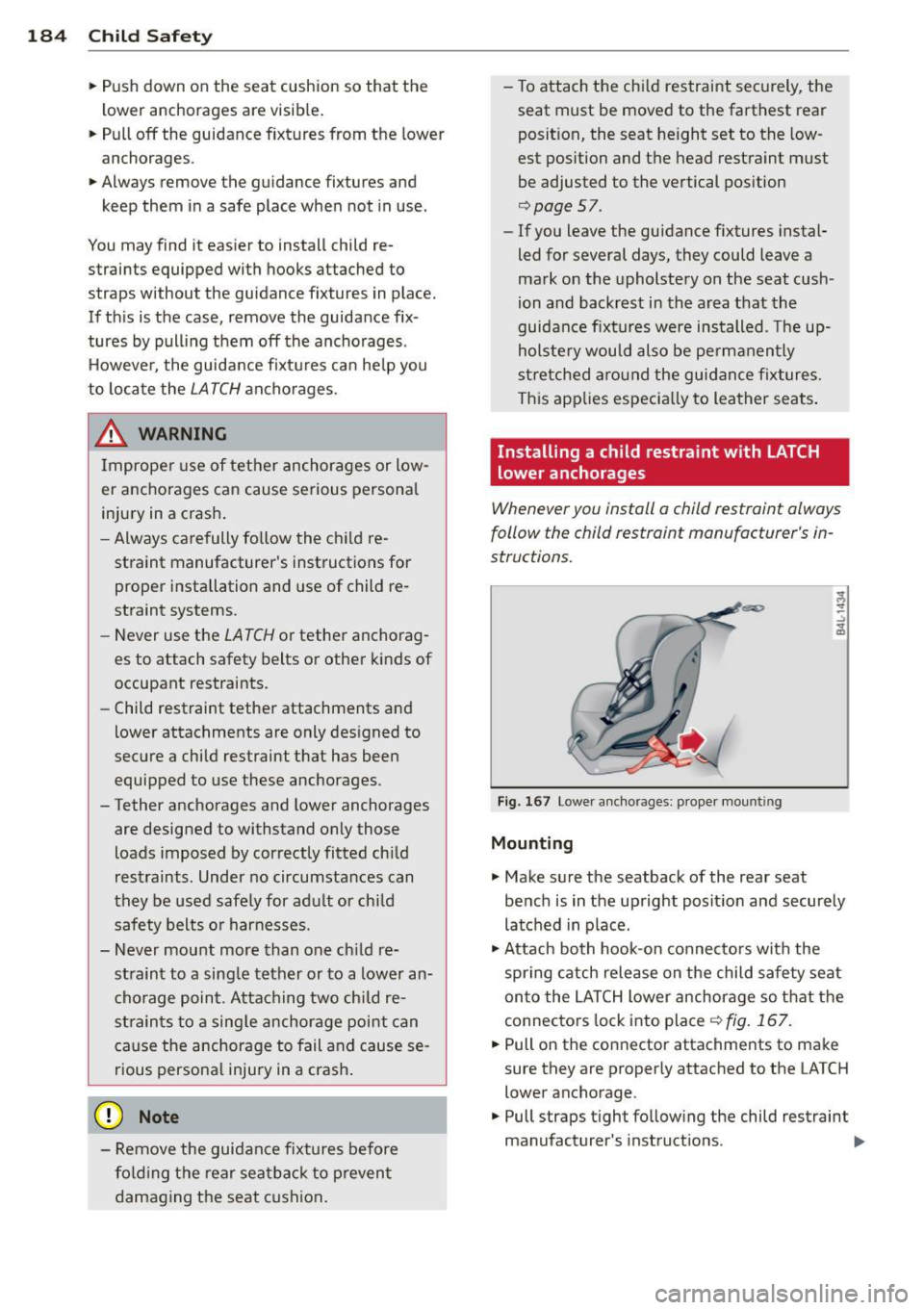
Installing a child restraint with LATCH
lower anchorages
Whenever you install a child restraint always
follow the child restraint manufacturer's in
structions.
F ig. 167 Lowe r a nchorages: proper mount ing
Mounting
• Make sure the seatback of the rear seat
bench is in the upright posit ion and securely
latched in place .
• Attach bo th hook-on connectors with the
spring catch release on the child safety seat
on to the LATCH lower anchorage so that the
connecto rs lock into place
¢ fig. 167.
•Pullon the connector attachments to make
sure they are proper ly attached to the LATCH
lower anchorage .
• Pull straps tight following the child restraint
manufacturer's instruct io ns. .,,.
Page 187 of 302
Releasin g
• Loosen the tension on the straps following
the chi ld restraint manufacturer's instruc
tions .
• Depress the spring catches to release the
anchorage hooks from the lower anchorag
es.
Remember: Use tether straps to help keep the
child restraint firmly in p lace.
A WARNING
Improper use of the LATCH system can in
crease the risk of serious personal injury
and death in an acc ident.
- These anchors were developed only for
child safety seats us ing the "LATCH" sys
tem .
- Never attach other child safety seats,
belts or other objects to these anchors .
- Always make sure that you hear a click
when latching the seat in place. If you do
not hear a click the seat is not secure and
cou ld fly forward and h it the interior of
the vehicle, or be ejected from the vehi cl e.
A WARNING
Imprope r insta llation of chi ld restr aint s
w ill increase the risk of inju ry in an acc i
dent.
- Always fol low the child rest raint sys tem
man ufacturer's instr uctions for proper
installation of the child restraint system
and proper use of tethe r straps as we ll as
the lower anchorages or safety belts in
your vehicle.
- Always read and heed the important in
format ion and WARNINGS about child
safety and the installation of child re
straint systems
q page 169, Child Safe
ty .
(D Note
On veh icles with power adjustable rear
seats* some criter ia must be observed
Child S afety 185
when attaching the ch ild restraint using
the
LATCH system:
- T o attach the chi ld restraint securely, the
seat must be moved to the farthest rear
position, the seat height set to the low
est position and the head restraint must
be adjusted to the vertical pos ition
9page57.
- If a child safety seat is attached to one of
the rear seats, this seat must not be ad
justed using the power controls under
any c ircumstances. The
Entry assistanc e
for this seat must also be deactivated in
the MM I
9 page 60. The child safe ty seat
as well as the rear seat can be damage d
by t he a dju stmen t process.
Tether anchors and tether straps
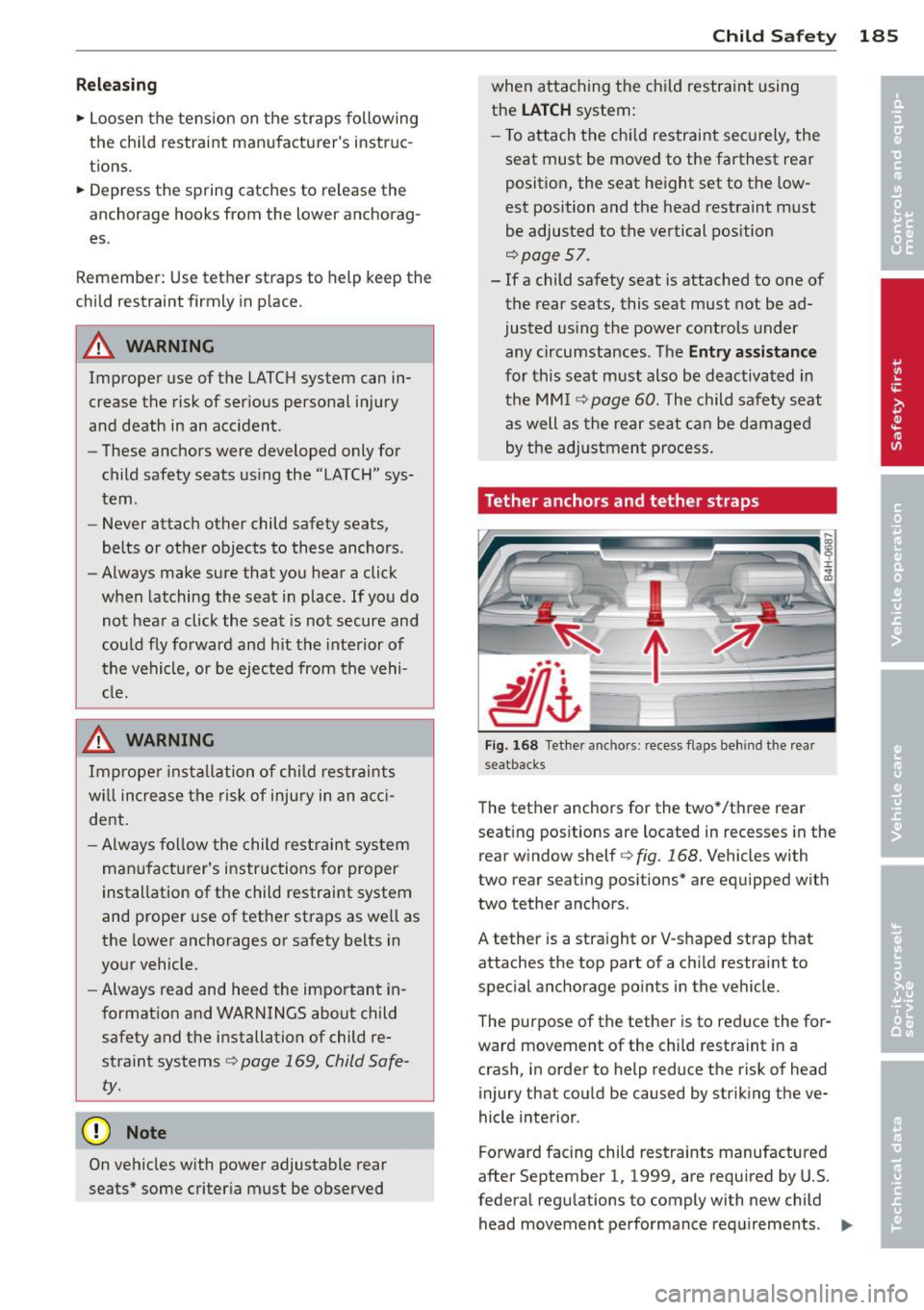
Fig. 168 Tet her anc hor s: recess flaps beh ind t he rea r
seatbacks
The tether anchors for the two * /t hree rear
seat ing pos itions are located in recesses in the
rear window shelf
q fig . 168. Vehicles with
two rear seating positions* are equipped w ith
two tether anchors .
A tether is a stra ight or V-s haped strap that
attaches the top part of a ch ild restraint to
special anchorage points in the vehicle.
The purpose of the tether is to reduce the for
ward movement of the child restraint in a
crash , in order to help reduce the risk of head
injury that could be caused by striking the ve
hicle interior .
Forward facing child restraints manufactured
after September 1, 1999, are requ ired by U.S.
federal regulations to comply with new child head movement performa nce requ irements .
II-
Page 209 of 302
Automatic car wash
The vehicl e can b e washed in almost any
modern automatic car wash .
The vehicle paint is so durable that t he vehicle
can n ormally be washed without p roblems in
a n automatic car wash . H owever, the effect on
the paint depends to a large extent on the de
sig n of the fac ility, the filte ring of the wash
water, the type of wash and care mater ial , etc.
If the pa int h as a dull appearance afte r go ing
through the car wash or is scratched, bring
this to the attention of the operator immedi
ately. If necessary, use a different car wash.
Before going through a ca r wash, be s ure to
take the usual precautions such as clos ing the
windows and power roof. Factor y installed an
tennas m ust not be removed.
If yo u have installed additional accessor ies on
the vehicle -such as spoilers, roof rack, etc. -
it is best to ask the car was h operator if these
should be removed .
When driv ing through an automatic ca r wash,
firs t se lect the
N posit ion and then sw itch the
engine off. If you switch the eng ine off when
N is engaged, the transmission remains in N
for approximate ly 30 m inutes and then Pis
engaged.
F u rther information for automatic gearboxes
~ page 112.
A WARNING
Always read and heed a ll WARNINGS and
other information
¢ page 206.
(D Note
- Fo ld the exterior mir ro rs -flat the re is a
r isk of damaging the exterio r mirrors .
Power folding exterior mirrors must not
be fo lded in or out by hand. Use the pow
er function!
- Compare the track of your vehicle w it h
the distance between the guide ra ils of
the facility- there is a risk of damage to
t h e wheels and tires .
-
Cleaning and protec tion 207
- Compa re the height and w idth of your
vehicle with t he height and width of the
t u nnel at the facility .
Washing the vehicle by hand
A lot of water is needed when washing a vehi
cle by hand.
.,. Before yo u start washing, make s ure you
have read and unders tood the WARNINGS
¢ .&. in General information an page 206.
.,. First soak a ll dried d irt unt il it is soft, then
r inse it off.
.,. As you clean yo ur vehicle, start wit h the roof
and work your way down to t he bottom, us
ing a sponge, a sponge glove or a clean
brush .
.,. Rinse the sponge o r th e sponge g love often,
flushi ng it cl ean ea ch time.
.,. Use spec ial car shampoo only fo r very persis
tent di rt.
.,. Rinse the ca r thorough ly w ith water.
.,. Use a chamo is leather to gently w ipe the ex-
ter ior dry.
Use a separate sponge for cleaning the
whee ls , door sills and othe r regions exposed
to road dirt. In this way, yo u wi ll not scratch
the pa int with coarse particles imbedded in
the sponge the next time you wash the car.
A WARNING
- Do not clean the unde rside of the chas
sis, fenders, wheel covers, or oth er ha rd
to rea ch parts witho ut p rotect ing you r
hands a nd ar ms . You may cut you rsel f on
sha rp-edge d meta l pa rts.
- Always read a nd heed a ll WA RNIN GS and
o ther info rmation
¢ page 206.
@ Note
- Never try to remove dirt, mud or dust if
th e su rface of the ve hicle is dry. Never
use a d ry cloth o r sponge, s in ce th is
co uld scra tch you r vehi cle's pain t or win -
-
dows. .,..
•
•
Page 241 of 302
-Never mount used tires on yo ur vehicle if
you are not sure of their "previous histo
ry." Old used tires may have been dam
aged even though the damage cannot be
seen that can lead to sudden tire failure
and loss of vehicle control.
Glossary of tire and loading terminology
Accessory weight
means the comb ined weight (in excess of
those standard items wh ich may be rep laced)
of automa tic tra nsmission, power steering,
power br akes, power w indows, power sea ts,
radio, and heater, to the ex tent that these
items are avai lab le as factory -installed eq uip
ment (whether installed or not).
Aspect ratio
means the rat io of the height to the w idt h of
the tire in percent . Numbers of 55 o r lower in
d icate a low sidewall fo r improve d steer ing re
sponse and better overall handling on dry
pavement.
Bead
means the pa rt of the t ire t hat is made o f
s teel wires, wrapped o r reinforce d by ply cor ds
and that is shaped to fit the r im.
Bead separation
means a b reakdown of the bond between
com ponents in the bead .
Cord
means the strands forming the plies in the
tire .
Cold tire infl ation pres sure
means the tire pressure recommended by the
vehicle manufacturer for a t ire of a designated
size that has not been dr iven for more than a
couple of miles (kilometers) at low speeds in
the three hour period before the tire pressure
i s measu red or adjusted.
Tire s an d wheel s 239
-If you notice un usua l vibration or if the
veh icle pulls to one side when driv ing, a l
ways stop as soon as it is safe to do so and check the wheels and tires for dam
age.
Curb weight
mea ns the we ight of a motor ve hicle w it h
standard equipment in cl ud ing t he maximum
capacity of fuel, o il, and coolant, ai r cond i
tion ing and addi tional weig ht o f optiona l
equipment .
Extra load tire
means a t ire design to operate at h igher loads
and at higher inflation pressures than the cor
r espondi ng s tan dard tire. Extra load tires may
be identified as "X L", "xl", "EXTRA LOA D", o r
"R F" on the sidewall .
Gross Axle Weight Rating ("GAWR")
means the load-carry ing capac ity of a s ingle
axle system, measured at the tire-ground in
te rfaces .
Gross Vehicle Weight Rating ( "GVWR ")
mea ns the maximum total loaded we ight of
t h e ve hicle.
Groove
means the space between two adjacent tread
ribs.
Load rating (code )
means the maximum load tha t a t ire is rate d
to ca rry for a given inflation press ure. Yo u
may not find this information on all tires be
ca use it is not required by law.
Maximum load rating
me ans the loa d ra ting f or a t ire a t the maxi
mum pe rm issi ble inflat ion pressure for that
ti re .
•
•
...
Page 251 of 302
A WARNING
Sudden tire failure can lead to loss of con
trol, a crash and serious personal injury!
- Never drive a vehicle when the tread on
any tire is worn down to the wear indica
tors.
- Worn tires are a safety hazard, they do
not grip well on wet roads and increase
your risk of "hydroplaning" and loss of
control.
- Always keep chemicals that can cause
tire damage, such as grease, oil, gasoline
and brake fluid away from t ires.
- Tires age even if they are not be ing used
and can fail suddenly, especially at high
speeds . Tir es that are more than 6 years
old can only be used in an emergency
and then with special care and at lower
speeds.
- Never mount used tires on your vehicle if
you are not sure of their" previous histo
ry ." Old used tires may have been dam
aged even though the damage cannot be
seen that can lead to sudden tire failure
and loss of vehicle control.
Tires and wheels 249
New tires and replacing tires and wheels
New tires and wheels have to be broken in .
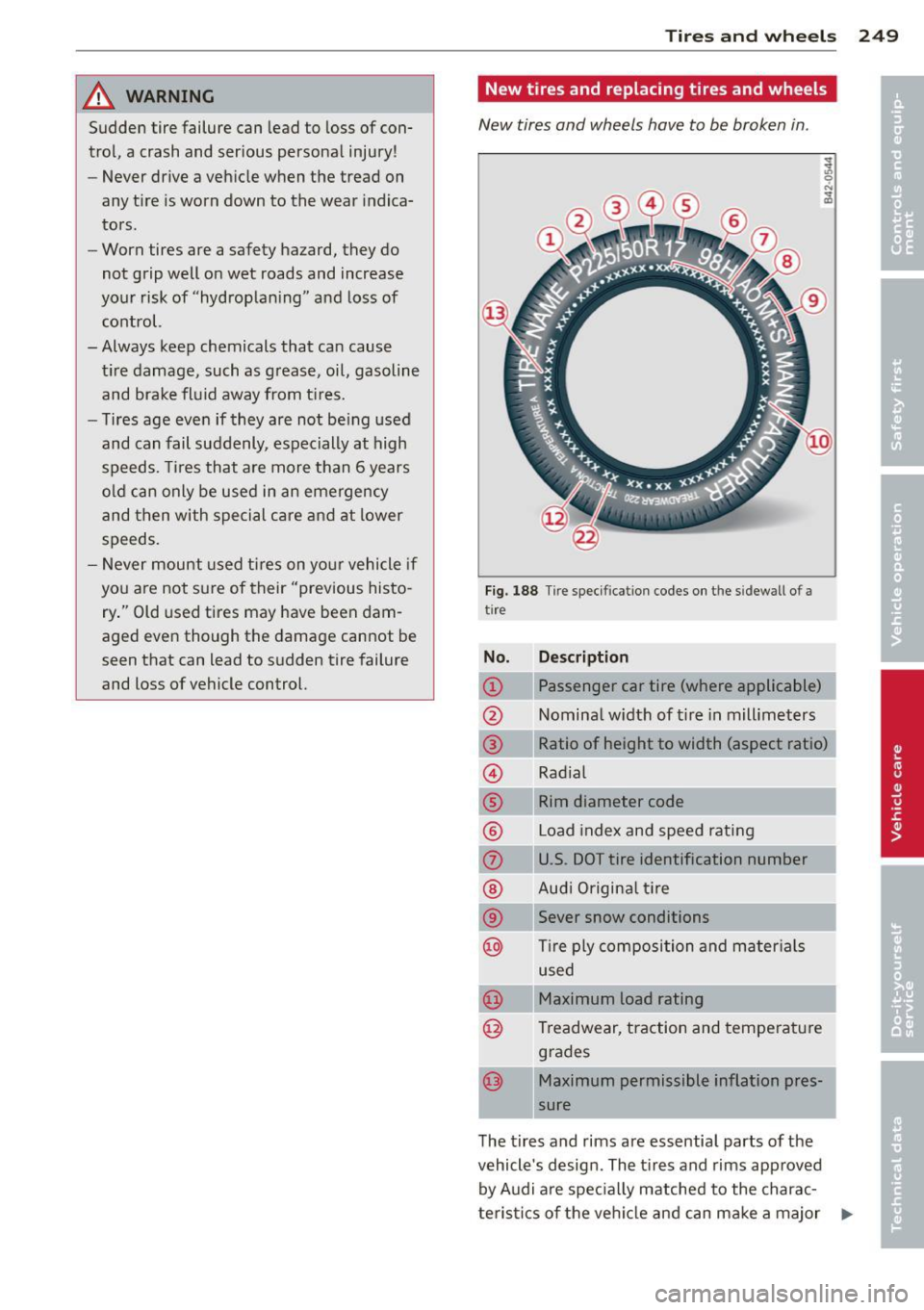
Fig. 188 Tir e specificat ion codes on t he s idewall o f a
tire
No. Description
CD Passenger car tire (where applicable)
@ Nominal w idth of tire in millimeters
® Ratio of height to width (aspect ratio)
© Radial
® Rim diameter code
® Load index and speed rating
(f) U.S. DOT tire identification number
® Audi Origina l tire
® Sever snow conditions
@ T ire ply composition and materials
used
@ Maximum load rating
@ Treadwear, traction and temperature
grades
@ Maximum permissible inflation pres-
sure
The tires and rims are essential parts of the
vehicle's design . The tires and rims approved
by Audi are spec ially matched to the charac
teristics of the vehicle and can make a major .,.
•
Page 252 of 302

250 Tires and wheels
contribution to good road ho lding and safe
handling when in good condition and properly
inflated
¢ ,& .
We recommend that all work on tires and
wheels be performed by an authorized Audi
dealer. They are familiar with recommended
procedures and have the necessary spec ial
too ls and spare parts as well as the proper fa
cilities for disposing of the old tires.
Authorized Audi dealers have the necessary information about technical requ irements for
installing or changing tires and r ims.
Replacing tires and wheels
Tires shou ld be rep laced at least in pairs and
not individually (for example both front tires
or both rear tires together).
Be sure to read and heed the information to
the tire pressure monitoring system*
¢page 256.
Always buy rep lacement radial tires that have
the same specifications as the tires approved
for your vehicle by Audi. Replacement tires
must always have the same load rating speci
fication as the original equipment or approved optional tires listed in the table
¢page 242.
Audi-approved specification t ires are specially
matched to your vehicle and its load limits,
and can contribute to the important road hold
ing, driving characteristics, and safety of the
vehicle. The table(¢
page 242) lists specifica
tions of the tires approved for the Audi mod
els covered by your Owner's Literature .
The tire pressure label located on driver's side
B-pillar (
¢ page 242, fig. 185) lists the speci
fications of the orig inal equipment tires in
stalled on your veh icle at the time it was man
ufactured.
Federal law requires tir e manufacturers to
place standard ized information on the s ide
wall of all tires¢
fig. 188 . This information
identifies and describes the fundamental
characterist ics, the quality grade of the tire
and also provides a tire ident ificat ion number for
safety standard ce rtification and in case of
a reca ll.
Tire specifications
Knowledge of tire specificat ions makes it eas
ier to choose the correct tires. Radial tires
have the tire specifications marked on the
sidewa ll, for examp le:
255/45 R 19 104 H
This conta ins the following information:
P Indicates the t ire is for passenger cars
(where app licab le)
255 Nominal tire width in mm of the tire
from sidewall edge to sidewa ll edge. In
general, the larger the number, the wider
the tire
45 Height/w idth ratio in percent (aspect ra-
t io)
R Tire construction: Radial
19 Rim diameter code (in inches)
104 Loa d rating code
H Speed rat ing letter code
XL (or "xl", "EXTRA LOAD" or "RF") indicates
that the tir e is a "Reinforced" or an "Ext ra
Load" tire
M+S (or "M/S") Indicates that the tire has
some mud and snow capability
The tires could also have the information of
direction of rotation¢
page 238 .
Tire manufacturing date
The manufacturing date is also indicated on
the tire sidewall (possibly on ly on the
inner
side of the wheel):
"DOT ... 2211. .. " means, for example, the tire
was produced in the 22nd week of 2011.
Speed rating (letter code)
The speed rating letter code on the whee ls in
dicates the maximum permissible road speeds
¢ .&. in Winter tires on page 254.
P up to 93 mph (150 km/h)
Q up to 99 mph (158 km/h)
R up to 106 mph (170 km/h)
S up to 110 mph (180 km/h)
Page 257 of 302
chains because t he vehicle will be ex
tremely low. If you do drive with snow
chains on while the vehicle is at this lev
el, the snow chains might severe ly dam
age the wheelhouse and other parts of
the veh icle.
@ Tips
Where snow cha ins are mandatory oncer
tain roads, this normally also applies to ve
hicles with All Wheel Drive.
Wheel bolts
Wheel bolts must always be tightened to the
correct torque .
The design of whee l bolts is matched to the
factory installed r ims. If different rims are fit
ted, the correct wheel bolts with the right length and correctly shaped bolt heads must
be used . This ensures that wheels are fitted
secure ly and that the brake system f unctions
correctly .
In certain circumstances, you may not use
wheel bolts from a d iffe rent vehicle -even if it
i s the same mode l
¢page 285.
A WARNING
Imprope rly tig hte ned or maintained whee l
bolts can be come loose causing loss of
contro l, a co llision and serious persona l in
jury .
- Alw ays keep the w heel bolts and the
th reads in the wheel hubs clea n so the
wheel bolts can turn easily and be prop
er ly tightened .
- Never grease or oil the wheel bo lts and
the threads in the w heel h ubs. They can
become loose wh ile driving if greased or
o iled, even if tightened to the specif ied
torque.
- Only use wheel bolts that belong to the
rim being installed.
- Never use different whee ls bolts on your
vehicle.
- Always maintai n the co rrect tightening
torq ue for the wheel bo lts to reduce the
Tire s an d wheel s 255
risk of a wheel loss. If the tightening tor
que of t he wheel bolts is too low, they
can loosen and come out when the vehi
cle is mov ing. If the tighte ning torque is
too h igh, the wheel bol ts and threads
can be damaged and the whee l can be
come loose.
(I) Note
The specified torque for the whee l bolts is
90 ft lb ( 120 Nm) wi th a tole rance of± 7,4
ft lb(± 10 Nm). Torq ue whee l bolts diago
nally. Afte r cha nging a whee l, the torq ue
must be checked as soon as possible wi th a
torque w rench -prefe rably by an au thor
ized Audi dealer or qualif ied workshop .
Low aspect ratio tires
Your Audi is facto ry-eq uipped with low aspect
ratio tires. These tires have been thoro ughly
tested and been se lected specifically for your
model for their superb performance, road fee l
and handling u nder a variety of driving cond i
tions . Ask your authorized Audi dealer for
more details.
The low aspect ratio of these t ires is ind icated
by a numeral of
55 or less in the tire's size
designation . The numeral rep resents the ratio
of the t ire's sidewall height in relation to its
t read width ex pressed in pe rce ntage. Conven
tiona l tires have a he igh t/w idth ratio of 60 or
more.
The performance of low-aspe ct-ratio tire s is
particularly sensitiv e to improper infla tion
pres sure. It is therefore important that low
a spect ratio tires are inflated to the specified
pre ssure and that the inflation pressure i s
regularly checked and maintained. Tire pre s·
sures should be checked at least once a
month and always befo re a long trip
¢ page 244, Checking tire pressure.
What you can d o to avoid tire and rim
damage
Low aspect ratio tires can be damaged more
easily by impact w it h potholes , curbs, gul lies ..,.
•
•