service AUDI A8 2011 User Guide
[x] Cancel search | Manufacturer: AUDI, Model Year: 2011, Model line: A8, Model: AUDI A8 2011Pages: 302, PDF Size: 76.07 MB
Page 52 of 302
50 Clear vision
Replacing windshield wiper blades
Wiper blades in good condition help keep the
windshield clear .
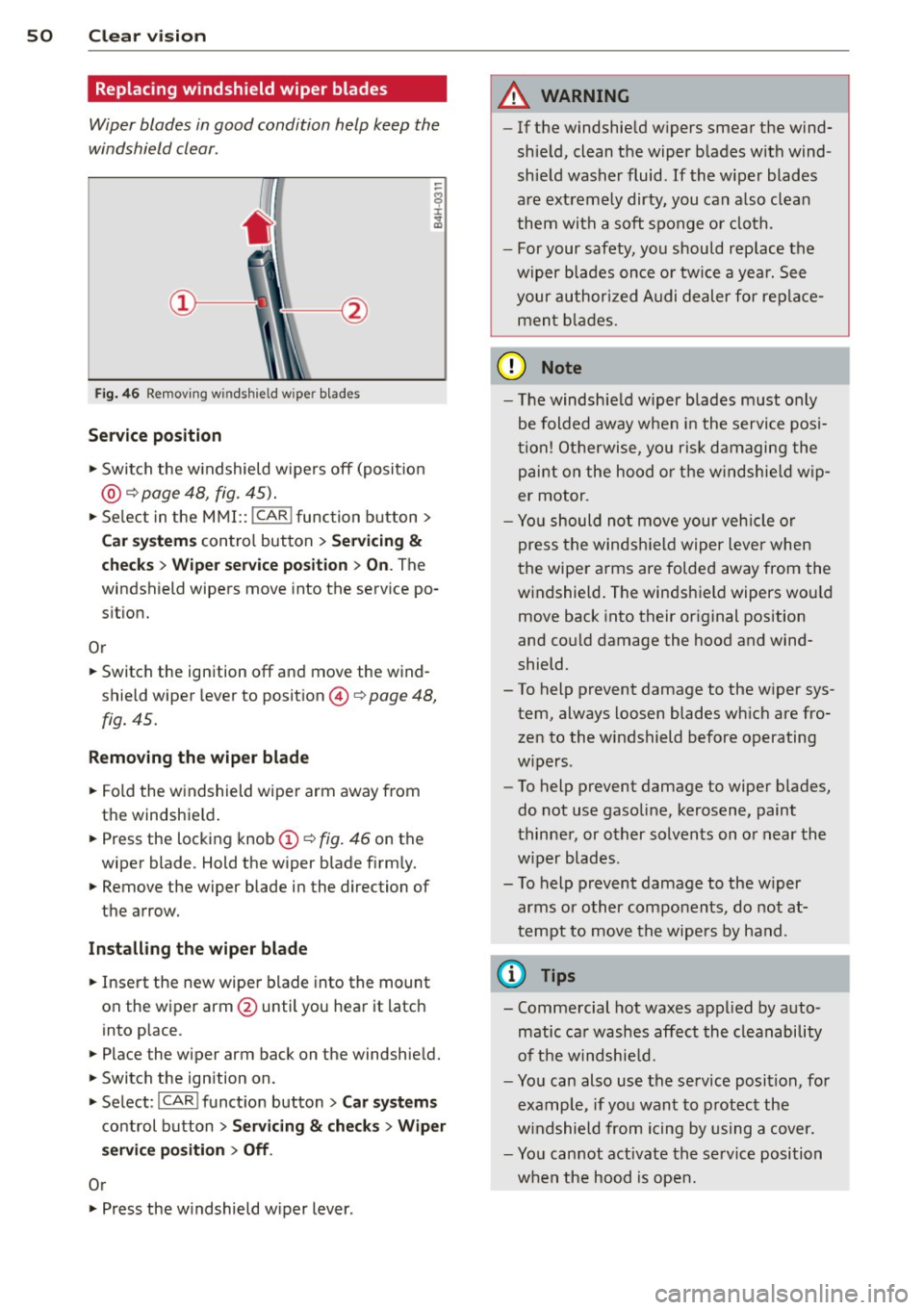
Fig. 46 Remov ing wi nds hield w ipe r blade s
Serv ice p osition
""Switch the windshield wipers off (posit io n
@ ~ page 48, fig . 45).
""Select in the MMI:: !CAR !function button>
Car system s control button > Servici ng &
checks > Wip er se rv ice po sition > On . The
windshield wipers move into the service po
s it ion.
O r
"" Switch the ignition off and move the wind
shield wiper lever to position ©~
page 48,
fig. 45.
R emoving the wip er blad e
""Fold the windshield wiper arm away from
the windshie ld .
"" Press the locking knob
@ ~fig. 46 on the
wiper blade . Hold the wiper blade firm ly.
"" Remove the wiper blade in the direction of
the arrow.
In sta ll ing th e wip er blad e
""Insert the new wiper blade into the mount
on the wiper arm @until you hear it latch
into place .
"" Place the wiper arm back on the windshield.
"" Switch the ignition on .
""Select : ICAR !funct ion button>
Car sy stem s
control button > Servicing & ch eck s > W iper
se rvic e po sition
> Off .
Or
""Press the windshield w iper lever .
A WARNING
-If the windshie ld w ipers smear the wind
sh ie ld, clean the wiper b lades with wind
shie ld washer fluid .
If the wiper blades
are extremely dirty, you can a lso clean
them with a soft sponge o r cloth.
- For your safety, you should replace the
wiper blades once o r twice a year. See
your author ized Audi dealer for replace
men t bla des.
([) Note
-The windshield wiper blades must only
be folded away when in the service posi
tion! Otherwise, you ris k damaging the
paint on the hood o r the windshie ld w ip
er motor.
- Yo u should not move your veh icle or
press the windsh ie ld wiper lever when
t he wipe r arms are folded away from the
w indshield. The windshield wipers wou ld
move back into their or iginal position
and could damage the hood and wind
shield.
- To help prevent damage to the w iper sys
tem, always loosen blades wh ich are fro
zen to the windshield before operating
w ipers .
- To help prevent damage to wiper blades,
do not use gasoline, kerosene, paint
thinne r, or other solvents on o r near the
w iper blades .
- To help prevent damage to the w iper
arms or other components, do not at
tempt to move the wipe rs by hand .
(j) Tips
- Comme rcial hot waxes appl ied by auto
matic ca r washes affect the cleanability
of t he windshie ld.
- You can also use the service position, for
example, if you want to p rotect the
w indshield from icing by using a cover.
- You cannot activate the se rv ice position
when the hood is ope n.
Page 76 of 302
7 4 Warm and cold
Warm and cold Climate controls
Description
The climate control system warms, cools and
adds humidity to the air in the vehicle interior.
It is the most effect ive when the windows and
sunroof* are closed . If the temperature inside
the parked vehicle becomes very warm, open ing the window briefly will speed up the cool
ing process.
I n all heating mode functions except
defrost,
the blower on ly switches to a higher speed
once the engine coolant has reached a certain
temperature.
Condensation from the cooling system can
drip and form a puddle of water under the ve
hicle. This is normal and does not mean there
is a leak.
Pollutant filter
The pollutant filter removes pollutants such
as dust and po llen from the air.
The air pollutants filter must be changed at
the intervals spec ified in you r Warranty
&
Maintenance booklet, so that the air condi
tioner can properly work.
I f you drive your vehicle in an a rea with high
a ir po llution, the filter may need to be
changed more frequent ly than specified in
your Aud i Warranty
& Maintenance booklet. If
in doubt, ask your authorized Audi Service Ad
visor for advice .
Key coded settings
The climate control settings are a utomat ically
stored and assigned to the remote control key
that is in use.
A WARNING
Reduced visibility is dangerous and can
cause accidents. -
- For safe driving it is very important that
all windows be free of ice, snow and con
densation.
- Comp letely familiarize yourself with the
proper use and function of the heating
and ventilation system and especially how to defog and defrost the windows.
- Never use the windshield wiper/washer
system in freez ing weather unt il you
have warmed the windshield first, using
the heating and ventilation system. The
washer solution may freeze on the wind sh ie ld and reduce visib ility.
(D Note
- If you suspect that the air conditioner has been damaged, switch the system
off to avoid further damage and have it
inspected by a qualified dealership.
- Repairs to the Audi air conditioner re
quire special technical knowledge and
special tools. Contact an authorized Aud i
dea ler fo r assistance.
@ For the sake of the environment
By reducing the amount of fuel you use,
you also reduce the amount of pollutants
emitted into the air.
(D Tips
- Keep the air intake s lots (in fro nt of the
w indshield) free from ice, snow and de
bris in order to maintain the proper func
tion of the climate control system.
- T he energy management system may
switch the seat heating* or rear window
defroster off temporari Ly . These systems
are available again as soon as the energy
balance has been restored.
- Air escapes through vents under the rear
window. When placing items of clothing on the luggage compartment cover, en
sure that the openings are not covered.
Page 146 of 302
144 Safety belts
the belt and takes up belt slack c> .& in Service
and disposal of safety belt pretensioner on
pag e
144. Taking up the slack helps to reduce
forward occupant movement during a colli
sion.
_& WARNING
- It is possible for the pretensioners to de
ploy incorrectly .
- The pyrotechnic system can only provide
protection for one collision . If the pyro
technic pretensioners deploy, the preten sioning system must be replaced.
(D Tips
The pyrotechnic safety belt pretensioners can only deploy once .
- The safety belt pretensioners do not de
ploy in minor frontal and side collisions,
in rear-end collisions, in rollovers and in
collisions involving very little impact
force .
-A fine dust is released when the pyro
technic safety belt pretensioners deploy .
This is normal and is not caused by a fire
in the vehicle.
- The relevant safety requirements must
be observed when the vehicle or compo
nents of the system are scrapped . A
qualified dealership is familiar with
these regulations and will be pleased to
pass on the information to you.
- Be sure to observe all safety, environ
mental and other regulations if the vehi
cle or individual parts of the system, par
ticularly the safety belt or airbag, are to be disposed . We recommend you have
your authorized Audi dealer perform this
service for you .
Service and disposal of safety belt
pretension er
The safety belt pretensioners are parts of the
safety belts on your Audi. Installing, remov
ing, servicing or repairing of belt pretension
ers can damage the safety belt system and prevent it from working correctly
in a colli
sion.
There are some important things you have to
know to make sure that the effectiveness of
the system will not be impaired and that dis
carded components do not cause injury or pol
lute the environment.
_& WARNING
Improper care, servicing and repair proce
dures can increase the risk of personal in
jury and death by preventing a safety belt
pretensioner from activating when needed
or activating it unexpectedly :
- The belt pretensioner system can be acti
vated only once . If belt pretensioners
have been activated, the system must be
replaced.
- Never repair, adjust, or change any parts
of the safety belt system.
- Safety belt systems including safety belt
pretensioners cannot be repaired. Spe
cial procedures are required for removal,
installation and disposal of this system.
-For any work on the safety belt system,
we strongly recommend that you see
your authorized Audi dealer or qualified
technician who has an Audi approved re
pair manual, training and special equip
ment necessary.
@ For the sake of the environment
Undeployed airbag modules and preten
sioners might be classified as Perchlorate
Material -special handling may apply, see
www .dtsc.ca.gov/hazardouswaste/per
chlorate. When the vehicle or parts of the restraint system including airbag modules
safety belts with pretensioners are scrap ped, all applicable laws and regulations
must be observed . Your authorized Audi
dealer is familiar with these requirements
and we recommend that you have your
dealer perform this service for you.
Page 161 of 302
airbag system and prevent that system from
working properly in a collision.
There are some important things you have to
know to make sure that the effectiveness of
the system will not be impaired and that dis
carded components do not cause injury or pol
lute the environment.
A WARNING
Improper care, servicing and repair proce
dures can increase the risk of personal in
jury and death by preventing an airbag
from deploying when needed or deploying an airbag unexpectedly:
- Never cover, obstruct, or change the steering wheel horn pad or airbag cover or the instrument panel or modify them
many way .
- Never attach any objects such as cup
holders or telephone mountings to the
surfaces covering the airbag units.
- For cleaning the horn pad or instrument
panel, use only a soft , dry cloth or one
moistened with plain water. Solvents or
cleaners could damage the airbag cover
or change the stiffness or strength of the
material so that the airbag cannot de
ploy and protect properly.
- Never repair, adjust, or change any parts
of the airbag system.
- All work on the steering wheel, instru
ment panel, front seats or electrical sys
tem (including the installation of audio
equipment, cellular telephones and CB
radios, etc .) must be performed by a
qualified technician who has the training
and special equipment necessary .
- For any work on the airbag system, we
strongly recommend that you see your authorized Audi dealer or qualified work
shop.
- Never modify the front bumper or parts
of the vehicle body .
- Always make sure that the side airbag
can inflate without interference:
- Never install seat covers or replace
ment upholstery over the front seat-
Airbag system 159
backs that have not been specifically
approved by Audi.
- Never use additional seat cushions that
cover the areas where the side airbags
inflate.
- Damage to the original seat covers or
to the seam in the area of the side air
bag module must always be repaired
immediately by an authorized Audi
dealer.
- The airbag system can be activated only
once . After an airbag has inflated, it
must be replaced by an authorized Audi
dealer or qualified technician who has
the technical information, training and
special equipment necessary.
- The airbag system can be deployed only
once . After an airbag has been deployed,
it must be replaced with new replace
ment parts designed and approved espe
cially for your Audi model version . Re
placement of complete airbag systems
or airbag components must be per
formed by qualified workshops only.
Make sure that any airbag service action
is entered in your Audi Warranty
& Main
tenance booklet under
AIRBAG REPLACE
MENT RECORD.
- For safety reasons in severe accidents,
the alternator and starter are separated
from the vehicle battery with a pyrotech nic circuit interrupter.
- Work on the pyrotechnic circuit inter rupter must only be performed by a
qualified dealer - risk of an accident!
- If the vehicle or the circuit interrupter
is scrapped, all applicable safety pre
cautions must be followed.
@ For the sake of the environment
Undeployed airbag modules and preten
sioners might be classified as Perchlorate Material - special handling may apply, see
www .dtsc .ca.gov/hazardouswaste/per-
ch lo rate . When the vehicle or parts of the
restraint system including airbag modules
and safety belts with pretensioners are
scrapped, all applicable laws and ..,.
•
•
Page 162 of 302
160 Airbag sys te m
regulations must be obse rved . Your au
thorized A udi dealer is familiar with these
req uirements and we recommend that you
have your dea ler perform this service for
you.
Other things that can affect Advanced
Airbag performance
Changing the vehicle's suspension system can
change the way that the Advanced Airbag Sys
tem performs in a crash. For example, using
tire-rim combinations not approved by Audi,
lowering the vehicle, changing the stiffness of
the suspension, including the springs, suspen
sion struts, shock absorbers etc. can change
the forces that are measured by the a irbag
sensors and sent to the electronic control un it . Some suspension changes can, for exam
p le, increase the force levels measured by the
sensors and make the airbag system deploy in
crashes in w hich it would not dep loy i f the
changes had not been made. Other kinds of
changes may reduce the force levels meas
ured by the sensors and prevent the airbag
from deploying when it should.
The sensors in the safety belt buckle fo r the
driver and front passenger seat tell the elec
tronic control module if the safety belt is
latched or not. If the safety belt is being used,
the front airbag will deploy at a slightly high
er rate of vehicle deceleration than if the safe
ty belt is not being used. Therefore, in a par
ticular co llision, it is poss ible that an a irbag
will not deploy at a seating position whe re the
safety be lt is being used but will inflate at the
position whe re the safety belt is not being
used . It is importan t that nothing interfe re
with the safety belt buckles so that the sen
sors can send the correct information abo ut
safety be lt use to the electron ic contro l unit.
A WARNING
Changing the vehicle 's suspension includ
ing use of unapproved tire-r im combina
tions can change Advanced Airbag pe r
formance and increase the risk of ser ious
personal in jury in a crash. -
Never install suspension components
that do not have the same performance
characteristics as the components origi
nally installed on your vehicle .
- Never use tire-rim combinations that
have not been approved by Audi.
A WARNING .....__ -
Items stored between the safety be lt
b uckle and the ce nter console can cause
the sensors in the buckle to send the
wrong information to the e lectronic con
trol module and prevent the Advanced Air
b ag System from working prope rly.
- Always ma ke sure that nothing can inter
fe re with the safety belt buckles and that
they are not obs truc ted.
@ For the sake of the environment
Undeployed airbag modules and p reten
s ione rs might be classified as Per chlorate
Materia l - specia l hand ling may apply, see
www.dtsc.ca.gov/ha zardouswaste/per
ch lorate. When the vehicle or parts of the
rest raint system including airbag modu les
and safety belts with pretensioners are
scrapped, all applicab le laws and regu la
tions must be observed. Your authorized
Audi dealer is familiar with these require ments and we recommend that you have
your dealer perform this service for you.
Page 200 of 302
198 Driving and en vi ro nment
Catalytic converter
It is very important that your emission con
trol system (catalytic converter) is function
ing properly to ensure that your vehicle is run
ning in an environmentally sound manner .
.. Always use lead-free gasoline¢ page 218,
Fuel supply.
.. Never run the tank down all the way to emp-
ty .
.. Never put too much motor oil in your engine
¢ page 22 7, Adding engine oil 't=r. .
• Never try to push- or tow-star t your veh icle.
The catalytic converter is an eff ic ient "clean
up" device built into the exhaust system of
the vehicle. The catalytic converter burns many of the pollutants in the exhaust gas be
fore they are released into the atmosphere.
The exclusive use of unleaded fuel is critically
important for the l ife of the cata lytic conve rt
e r and proper functioning of the engine.
& WARNING
-
- Do not park o r operate the vehicle in
areas where the hot exhaust system may
come in contact with dry grass, brush,
fuel spill or other material which can cause a fire.
- Do not apply additional undercoating or
rustproofing on or near the exhaust
man ifold, exhaust p ipes, catalytic con
verter or heat shie lds . During driving, the
substance used for undercoating could
overheat and caus e a fire .
@ Note
-Be aware that just one tank filling with
leaded fuel will already seriously de
grade the perfo rmance of the catalytic
conve rter .
- Do not exceed the correct engine oil leve l
¢page 227.
-Do not drive until the fuel tank becomes
completely empty. The eng ine could mis
fire . Un burned f uel could a lso get into the exhaust system and th
is co uld cause
the cata lytic converter to overheat .
- Do not switch
off the ignition while the
vehicle is moving .
- Do not continue to ope rate your veh icle
under these conditions, as otherwise fuel
can reach the catalytic converter. This
cou ld result in overheating of the con
verter, requir ing its replacement .
- To assure efficient operation of the Emis
sion Control System:
- H ave you r vehicle maintained properly
and in accordance w it h the service rec
ommendat ions in your Warranty &
M ain tenance boo klet.
- L ack of prope r maintenance as we ll as
improper use of the vehi cle will impair
the function of the em ission contro l
system and could lead to damage .
@ For the sake of the environment
Even when the Emiss ion Control Sys tem is
operat ing proper ly, the exha ust gas can
have a sul fur -li ke ex haust gas smell under
some operating states . This depends on
the sulfur content of the fuel being used .
Using a different brand of fue l may help,
or f il li ng the tank with lead-free super
grade gasoline .
Avoid damaging the
vehicle
When you are d rivi ng on poor roads, or over
c u rbs, steep ramps, etc., ma ke certai n that
low- ly ing parts s uch as spoilers and exha ust
system parts do not bottom o ut and get dam
aged.
T his is es peci ally true for ve hicles with low
s lung chassis (spor ts chassis)* and fully load
ed vehicles .
Page 202 of 302

200 Driving and en vi ro nm ent
Avoid full throttle
Driving at moderate speeds saves fuel and
improves your mileage .
"'Try and keep well below your car 's maximum
speed.
Accelerating gently reduces fuel consump
tion, engine wear, and does not disturb the
environment. F ue l consumption, exhaust em issions and en
gine noise increase disproportionately at high
speeds. If you drive at approximately three
quarters of top speed, fue l consumption will
be reduced by one half. Never drive faster
than the posted speed limit and weather con
d itions permit .
Reducing unnecessary idling
Even when your car is just idling it burns up
fuel.
"'Shut the engine off when you are not driving
the vehicle .
"'Do not warm up the veh icle by letting the
engine run at idle .
It makes sense to shut
off the e ngine in traff ic
jams, when waiting for trains to pass at ra il
road crossings , or at traff ic lights that have
long wa its on red. Turning the engine
off fo r
just
30-40 seconds saves more fue l than is
burned s tarting the eng ine again .
It takes a long time for the engine to warm up
fully when it is running at idle . Howeve r, wear
and noxious em issions are especially high
when the engine is warming up. So you should
drive away as soon as you start the engine and
avoid running at high rpms while the engine is
still warming up .
([) Note
Do not leave engine idling unattended af
ter starting . If warning lights should come
on to indicate improper operation, they
wou ld go unheeded. Extended idling also
produces heat, which cou ld result in over- heating or other damage to the vehicle or
other property .
Regular maintenance
A badly tuned engine unnecessarily wastes a
lot of fuel.
"' Have your ve hicle serviced at reg ular inter -
vals.
By having your veh icle regu larly serviced by an
Audi dealer he lps to ensure that it runs p rop
erly and economically. The condition of your
vehicle not only affects its sa fety and ability to
hold its value, it also affects
fuel c onsump
tion .
Check your oil e ach time you fill your t ank .
The amount of oil used is related to engine
load and speed .
It is normal for the oil consumption of a new
engine to reach its lowest value after a certa in
mileage has been driven.
You must drive your veh icle about 3,000 m iles
(5,000 kilometers) before you can properly
assess oil consumpt ion.
This also app lies to fue l consumption and en
gine output.
(D Note
- Have your vehicle maintained proper ly
and in accordance with the service rec
ommendations in your Warranty
& Main
tenance booklet. Lack of proper ma inte
nance as well as improper use of the ve
hicle will impair the function of the
em iss ion contro l system and cou ld lead
to damage.
- Do not alter or remove any component of
the Emission Control Sys tem unless ap
proved by the manufacture r.
- Do not alte r or remove any device, such
as heat sh ie lds, switches, ign it ion w ires,
valves, which are designed to protec t
your vehicle's Emission Control System
and other impo rtant vehicle compo
nents .
Page 221 of 302

-Blend must contain not more than 15%
MTBE.
Seasonally adjusted gasoline
Many gasoline grades are blended to perform
espec ially we ll for winter or summer driving.
During seasonal change-over, we suggest that
you fill up at busy gas stat ions where the sea
sonal adjustment is more likely to be made in
time .
(D Note
-Methanol fuels which do not meet these
requirements may cause corrosion and
damage to plastic and rubber compo
nents in the fuel system .
- Do not use fue ls that fail to meet the
specified criter ia in this chapter.
- If you are unable to determine whether
or not a particular fue l blend meets the
specifications, ask your service station or
its fuel supp lier.
- Do not use fuel for which the contents
cannot be identified.
- Fuel system damage and performance
problems resulting from the use of fuels
different from those specified are not
the responsibility of Audi and are not
covered under the New Vehicle or the Emission Control System Warranties.
- If you experience a loss of fuel economy
or driveability and performance prob l ems due to the use of one of these fuel
blends, we recommend that you switch
to unblended fuel.
Gasoline additives
A major concern among many auto manufac
turers is carbon deposit build- up caused by
the type of gasoline you use.
Although gasoline grades differ from one manufacturer to another , they have certain
things in common. All gasoline grades contain
substances that can cause deposits to collect
on vital engine parts, such as fuel injectors
and intake valves. Although most gasoline brands include additives to keep engine and
Fuel supply and filling your fuel tank 219
fuel systems clean, they are not equally effec
tive .
A udi recommends using TOP TIER Detergent
Gasoline. For more info rmation on TOP TIER
Detergent Gasoline, please go to the official
website (www.toptiergas.com).
After an extended period of using inadeq uate
fuels, carbon deposit build-ups can rob your
engine of peak performance.
Q) Note
Damage or malfunction due to poor fue l
quality is not covered by the Aud i New Ve
hicle Limited Warranty.
Fuel tank
Fuel filler neck
The fuel filler neck is located on the right rear
side panel behind the fuel fille r flap.
If the power locking system should fail, you
can still open the flap manually -for deta iled
instruct ions see
¢ page 221 .
You can find the fuel tank capacity of your ve
hicle in
Technical Data ¢ page 282.
The label on the inside of the fuel fi ller flap
tells you the correct fue l for your vehicle. For
more information about fuel specifications,
see
¢ page 218.
Your vehicle fue l tank has an on board refuel
li ng vapor recovery system. This feature helps
to prevent fuel vapors from escaping from the
tank and polluting the environment while you refuel your vehicle . In order to fill the tank
properly while protecting the environment,
please fo llow this refueling procedure careful
ly.
_&. WARNING
Under normal operating conditions, never
carry additional fuel containers in your car.
Gas canisters and other containers used to
transport f uel can be dangero us. Such con
tainers, full or empty, may leak and could
cause a fire in a collis ion. If you must
•
•
Page 228 of 302
226 Check ing and filling
temperatures stay below freezing point for
long periods.
Detergent add it ives in the o il w il l make fresh
oil look dark after the eng ine has been run
ning for a short time . This is norma l and is not
a reason to change the oi l more often than
recommended.
Dam age or ma lf u ncti ons du e to lack of
m ainten ance
It
is essential that you change your oil at the
recommended in tervals using only engine o il
that complies with Audi oi l standard
VW 502 00. You r Limited New Vehicle War
ranty does not cover damage or malfunctions
due to fail ure to fo llow recommended mainte
nance and use requ irements as set forth in
the Audi Owner's Manual and Warranty&
Maintenance book let . Your dealer will have to
deny warranty coverage unless you present to
the dea ler proof in the form of Service or Re
pa ir Orders that all scheduled maintenance
was performed in a t imely manner.
Eng ine oil consumption
The engine in your vehicle depends on an ade
quate amount of oil to lubricate and cool all
of its moving parts.
In order to provide effective lubrication and
cool ing of internal engine components, a ll in
ternal comb ustion eng ines consume a certa in
amount of oil. O il consumption varies from
engine to engine and may change significantly
over the life of the engine. Typica lly, engines
with a specif ied break-in period (see
¢
page 197) consume more oil during the
break-in period than they consume after oil
consumption has stabilized.
Under norma l conditions, the rate of oil con
sumpt ion depends on the quality and viscosity
of the oil, the RPM (revolutions per m inute) at
which the engine is operated, the ambient
temperature and road condit ions . Further fac
tors are the amount of oil d ilution from water
condensat ion or fuel residue and the ox ida
tion level of the oi l. As any engine is subject to wear as mi
leage builds up, the oil consump
tion may increase over time until replacement
of worn components may become necessary.
With a ll these variab les coming into play, no
standard rate of oil consumption can be es
tablished or specified. There is no alternative
to regu lar and frequent check ing of the o il lev
el, see
Note .
If
the yellow engine oil leve l warning symbo l
in the instrument cluster
m lights up, yo u
shou ld check the oil leve l as soon as possib le
¢
page 22 7. Top off the oil at your earliest
convenience ¢
page 22 7.
A WARNING '"---
Before you check anything in the engine
compartment, always read and heed all
WARNINGS¢
A in Working in the engine
comportment on page 222.
(D Note
Driving w ith an insufficient o il level is like
ly to cause severe damage to the engine .
(D Tips
-The oil pressu re warn ing display. is
not an indicator of the oil le vel. Do not
r el y on it . In ste ad, ch eck the oil lev el in
y our engin e at regular inter vals , pref
erably ea ch time you r efu el, and alway s
before going on a long trip .
-If you have t he impression yo ur engine
cons umes ex cessive amoun ts of o il, we
recommend that you consu lt your Aud i
dea ler to have the cause of your concern
properly diagnosed. Keep in mind that
the accurate meas urement of oi l con
sumption requ ires great care and may
take some t ime. Your Audi dea ler has in
structions about how to measure oil con
sumption accurately.
-
Page 230 of 302
228 Check ing and filling
and ad versely a ffect yo ur New Vehicl e
W arrant y.
@) For the sake of the environment
- Under no circums tances can the oil come
in contact with the sewage network o r
the soil.
- Observe and follow lega l regu lations
when disposing of empty oil containers .
Changing the engine oil
We recommend that have your oil changed by
an authorized Audi dealer or a qualified serv
ice station.
Before you check anything in the engine com
partment,
a lw ays rea d an d h eed all WARN
INGS c::> .& in Working in the engine compart
ment on page 222.
The engine oil must be changed accord ing to
the intervals specified in your Warranty
&
Maintenance book let. This is very important
because the lubricating properties of oil di
minish gradua lly during normal vehicle use .
Under some ci rcumstances the engine oi l
should be changed more frequently. Change
oil more often if you drive most ly short dis
tances, operate the vehicle in dusty areas or under predominantly stop-and-go traffic con
ditions, or have your vehicle where tempera
tures remain below freezing for extended pe
riods .
Detergent addit ives in the oil w ill make fresh
oil look dark after the eng ine has been run
n ing for a short time. This is normal and is not
a reason to change the oil more often than recommended.
Because of the problem of proper disposal,
along w ith the special tools and necessary ex
pertise required , we strongly recommend that
you have your o il changed by an authori zed
A udi de ale r or a q ual ified servi ce station.
If you choo se to c hang e y our oi l your self,
please note the followi ng important informa
tion :
A WARNING
To reduce the risk of personal injury if you
must change the eng ine oil in your vehicle
yourself:
- Wear eye protect ion.
- To reduce the risk of burns from hot en- gine oil, let the engine cool down to the
touch.
- When removing the o il dra in plug with
your fingers, stay as far away as possible.
Always keep your forearm parallel to the
ground to help p revent hot oil from run
n ing down you r arm.
- Dra in the oil into a container designed
for this purpose, one large enough to
hold at least the total amount of oil in
your engine.
- Engine oil is poisonous. Keep it we ll out
of the rea ch of childre n.
- Continuous contact with used eng ine o il
is harmful to your sk in. Always protect
your skin by washing oil off tho roughly
with soap and wate r.
@ Note
Never mix oil additives with your engine
oi l. These additives can damage your en
g ine and adversely affect you r A ud i Limit
ed New Veh icle War ranty.
@ For the sake of the environment
- Before changing your oil, first make su re
you know where you can prope rly dispose
o f the used oil.
- Always dispose of used eng ine oi l proper
ly. Do not dump it on garden soil, wood
ed areas, into open streams or down
sewage drains.
- Recycle used engi ne oil by taking it to a
used engine oil collection facility in you r
area, or contact a service station.