service AUDI A8 2011 Owner's Manual
[x] Cancel search | Manufacturer: AUDI, Model Year: 2011, Model line: A8, Model: AUDI A8 2011Pages: 302, PDF Size: 76.07 MB
Page 235 of 302
@ For the sake of the environment
Because of the problem of proper disposa l
of brake fl uid as we ll as the special tools
requ ired and the necessary expert ise, we
recommend that you have t he brake fluid
changed by your author ized Audi dealer .
Battery
General information
Under normal operating conditions, the bat
tery in your Audi does not need any mainte
nance. With
high outside temperatures or
long daily dr ive s we recommend that you have
the electro lyte level checked by a service fa
cility . The electrolyte level shou ld a lso be
checked each time the battery is charged
¢ page 235.
Have the battery checked when you take your
ve hicle in for service . Yo u are well adv ised to
replace a battery that is older than 5 yea rs .
W ith certa in types of a irbag deployment, t he
b attery is d isconnected from the vehicle elec
tr ica l system for safety reasons¢.&.
in Re
pair, care and disposal of the airbags on
page 159.
Disconnecting the battery terminals
Some vehicle functions (power w indow regu
lators , for example) are lost if the battery ter
m inals a re d isconnected. These func tions have
to be re lea rned after the batte ry term inals a re
connected agai n. T o prevent this , the bat tery
should only be d isconnec ted from the vehicle
e lec tric al system when absolu tely necessa ry
for repairs .
Vehicles not driven for long periods
If you do not drive you r vehicle over a period
of severa l days or weeks, elec trical compo
nen ts are gr adually cut b ack o r swi tched off .
This redu ces energy cons umption and main
tains starting capab ility over a longer per io d
¢ page 195.
Be aw are tha t when you unlock yo ur vehicle ,
some of the conven ien ce f unct ions may no t
Checkin g and fillin g 233
opera te , such as the Conven ience key*, the re
mote control or the power seat adjustment .
T he convenience functions will be ava ilab le
again when you switch on the ign ition and
start the eng ine.
Winter operat ion
D uring the w inte r mon ths, bat tery capacity
tends to dec rease as temperatures drop . This
is beca use more power is a lso consumed wh ile
starting, and the headlights, rear window de
fogger, etc., are used more often.
Avoid unnecessary powe r consum ptio n, pa r
ticu lar ly in city traffic or when traveling only
short distances. Let your autho riz ed Audi
dealer check the capacity of the vehicle bat
te ry before w inter sets in¢
page 235 . A well
c h arged battery will not on ly prevent s tarti ng
problems w hen the weather is cold, but wi ll
also last longer.
(D Tips
If you r vehicle is left s tandi ng for seve ral
weeks at extremely low temperatures, the
vehicle ba ttery s hould be removed an d
s to red w here i t w ill not fr eeze . T his w ill
p revent it from be in g damaged and having
to be replaced.
Working on the battery
Be especially careful when working on or near
the bat tery.
T he battery is lo cated in the l uggage compa rt
ment unde r the floo r. B efo re you che ck a ny
thi ng in the luggage com partmen t,
read and
heed all WARNINGS
¢ .&, .
Alw ays heed t he safety warning s, when work
ing on the vehicle b atte ry or the vehicle e lec -
t rical system to prevent i njury. .,..
•
•
Page 250 of 302
248 Tires and wheels
Tire service life
The service life of tires depends on a lot of
different things including proper installation
and balancing, correct tire pressure and driv·
ing style.
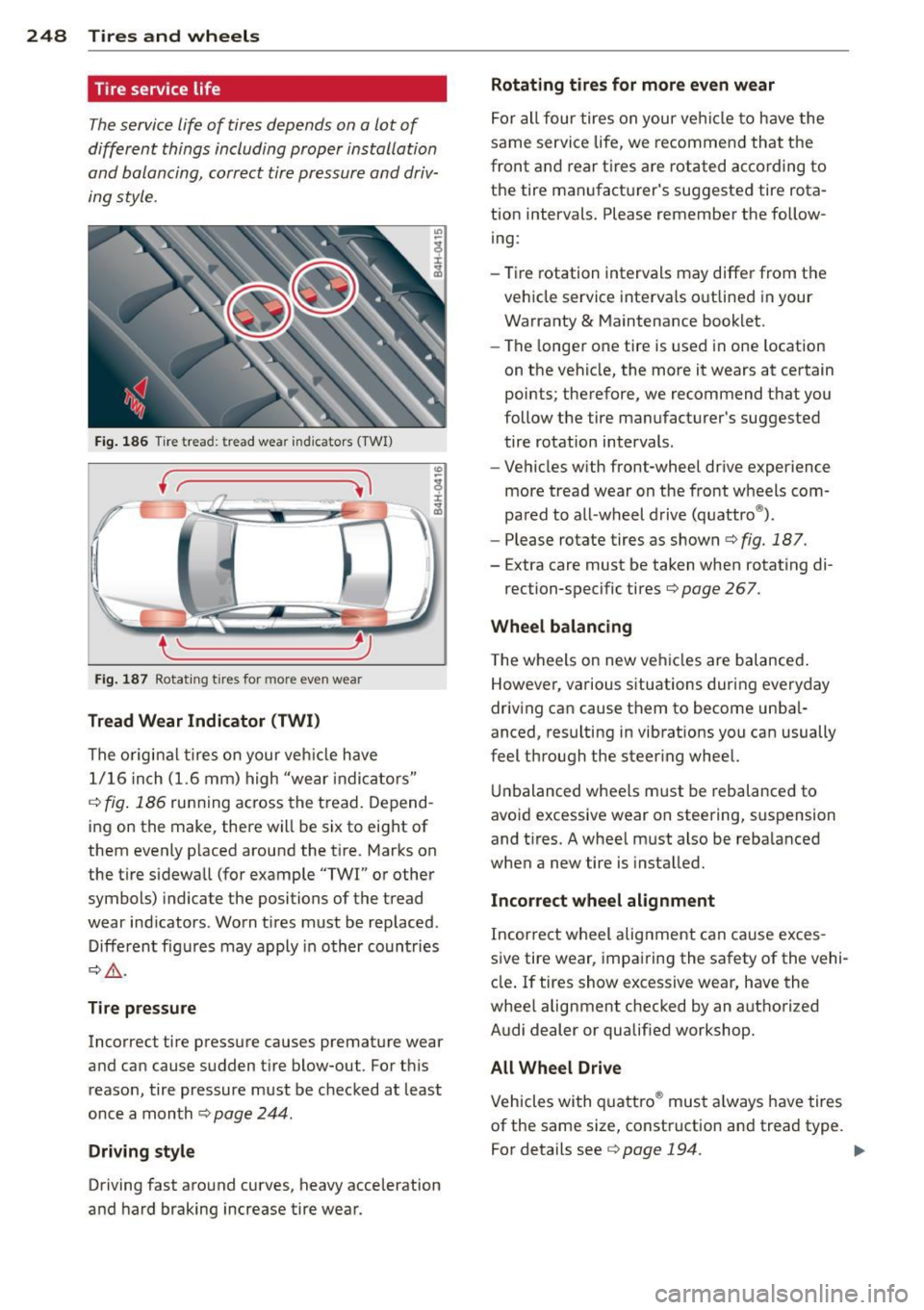
F ig. 1 86 Tire tread: tread wea r ind icators (TWI)
( r------ ,1
\ ...__ _____ ____,.
F ig. 1 87 Rotat ing t ires for more ev en wea r
Tread Wear Indicator (TWI)
The origi na l t ires on your veh icle have
1/16 inch (1.6 mm) high "wear indicators"
c::> fig . 186 running across the tread. Depend ·
i ng on the make, there will be six to eight of
them evenly p laced around the t ire. Marks on
the tire sidewa ll (for example "TWI" or other
symbols) indicate the positions of the tread
wear ind icators . Worn t ires must be replaced .
Different fig ures may apply in o ther countries
c::> & .
Tire p ressure
Incorrect tire pressure causes premature wear
a nd can cause sudden t ire blow-out. For th is
reason, tire pressure must be checked at least
once a month
c::> page 244 .
Driving style
Driving fast aro und curves, heavy acce leration
and hard braking increase tire wear.
Rotating tires for more even wear
F o r all four tires on your ve hicl e to h ave the
same service life, we recommen d that the
front and rear t ires are rotated according to
the tire manufact urer's suggested tire rota·
tion intervals. Please remember the follow
ing :
- Tire rotation intervals may differ from the
vehicle service inte rva ls o utlined in your
Warranty
& Maintenance booklet .
- The longer one tire is used in one location
on the vehicle, the more it wears at certain
points; therefore, we recommend that y ou
follow the tire manufacturer's suggested
tire rotation intervals .
- Veh icles w ith front-wheel dr ive experience
more tread wear on the fro nt w heels com·
pa red to all-wheel drive (quattro ®).
- Please rotate tires as shown
c::> fig. 187.
-Extra care must be taken when rotating di·
rection-specific tires
c::> page 267 .
Wheel balancing
The wheels on new ve hicles are balanced .
However, various situations during eve ryday
driving can cause them to become unba l·
anced, resulting in vibrat ions you can usually
feel t hrough the steer ing wheel.
Un balanced whee ls must be rebalanced to
avoid excessive wear on steering, suspension
and t ires. A whee l m ust also be reba lanced
when a new tire is insta lled.
Incorrect wheel alignment
Incor rect wheel alig nment can cause exces
sive tire wear, impai ring the safety of the veh i·
de . If tires show excessive wear, have the
whee l alignment checked by an authorized
Audi dealer or qualif ied workshop .
All Wheel Drive
Vehicles with q uattro ® mus t always have tires
of the same size, construction and tread type .
For details see
c::> page 194 . ..,.
Page 269 of 302

and the hub. R emove a ll dirt from these
su rfaces before remo unt ing the wheel.
Tires with unidirectional tread design
Tires with unidirectional tread de sign must be
mounted with their tread pattern pointed in
the right direction.
Using a spare tire with a tread pattern
intended for use in a specific direction
When using a spa re tire w ith a tread patte rn
inte nded for use in a specific direction, please
note t he following:
- T he direction o f rotation is marked by an a r
r ow on the side of the tire.
- If the spare tire has to be install ed in the in
correct di rection, use the sp are tire only
temporar ily since the t ire will not be a ble to
achieve its optimum pe rformance character
ist ics with regard to aquaplaning, noise and
wear.
- We recommend that you pay particular at
tent ion to this fact during wet weat he r and
t h at you adjust your speed to matc h road
condit ions .
- Replace the flat tire w ith a new one and
have it installed on your ve hicle as soon as
poss ib le to restore the hand ling advantages
of a uni direct io na l ti re .
Notes on wheel changing
Pl ease rea d the information ¢ page 2 49, New
t ires and repl acing tires and wheels
if you are
goi ng to use a s pare t ire which is differen t
from the tires on your ve hicle.
Afte r you cha nge a tire:
- Check the tire pressure on the spare imme
diately after installation .
- Have the wheel bolt tightening torque
checked with a torque wrench as soon as
possible by your authorized Audi dealer or
a qualified service station .
- With steel and alloy wheel rims, the wheel
bolts are correctly tightened at a torque of
90 ft lb (120 Nm). What do I do now? 267
-
If you notice that the wheel bolts are cor
roded and difficult to turn while changing
a tire , they should be replaced before you
check the t ightening torque.
- Replace the flat ti re with a new one and
have it installed on your vehicle as soon as
possible. Remount the wheel cover.
Until then , drive with extra care and at re
duced speeds.
A WARNING
- I f you are g oing to eq uip your vehicle
wit h tires o r rims which differ from those
which were factory installed, then be sure to read the information
¢ pag e 249,
N ew tires and replacing tires and
w heels.
- Always ma ke sure t he damag ed wheel o r
e ven a fla t tire an d the jack a nd tool ki t
a re prope rly se cu red in t he luggage co m
p art me nt and a re not loo se in the pas
senger compartment .
- I n an a ccide nt or sudde n maneuver they
could fly forward, injuring anyone in the
veh icle.
- Always s tore da mage d wheel, j ack and
t oo ls se curely in the lugg age comp art
men t. Othe rwise, in an accident o r su d
den maneuver they co uld f ly forwa rd,
causing inju ry to passengers in the veh i
cle.
- Do not use commerc ia lly available t ire
sealants. Othe rwise, the electrical com
ponents of the tire pressure mon itor ing
system * will no lo nger work p roperly and
the sensor for the tire p ress ure monito r
i n g sys tem * will have to be re placed by a
qua lified wor kshop. •
•
Page 276 of 302
2 7 4 Emergency situations
@ Tips
-The discharged battery must be properly
connected to the vehicle's electrical sys
tem. When jump starting or charging the
battery, never connect the negative
ground cable to the battery negative
post because the battery manager sys
tem must be able to detect the battery 's
state of charge. Always connect the neg
ative g round cable to the negative
ground post of the battery manager con
trol unit .
Use of jumper cables
Make sure to connect the jumper coble
clomps in exactly the order described below!
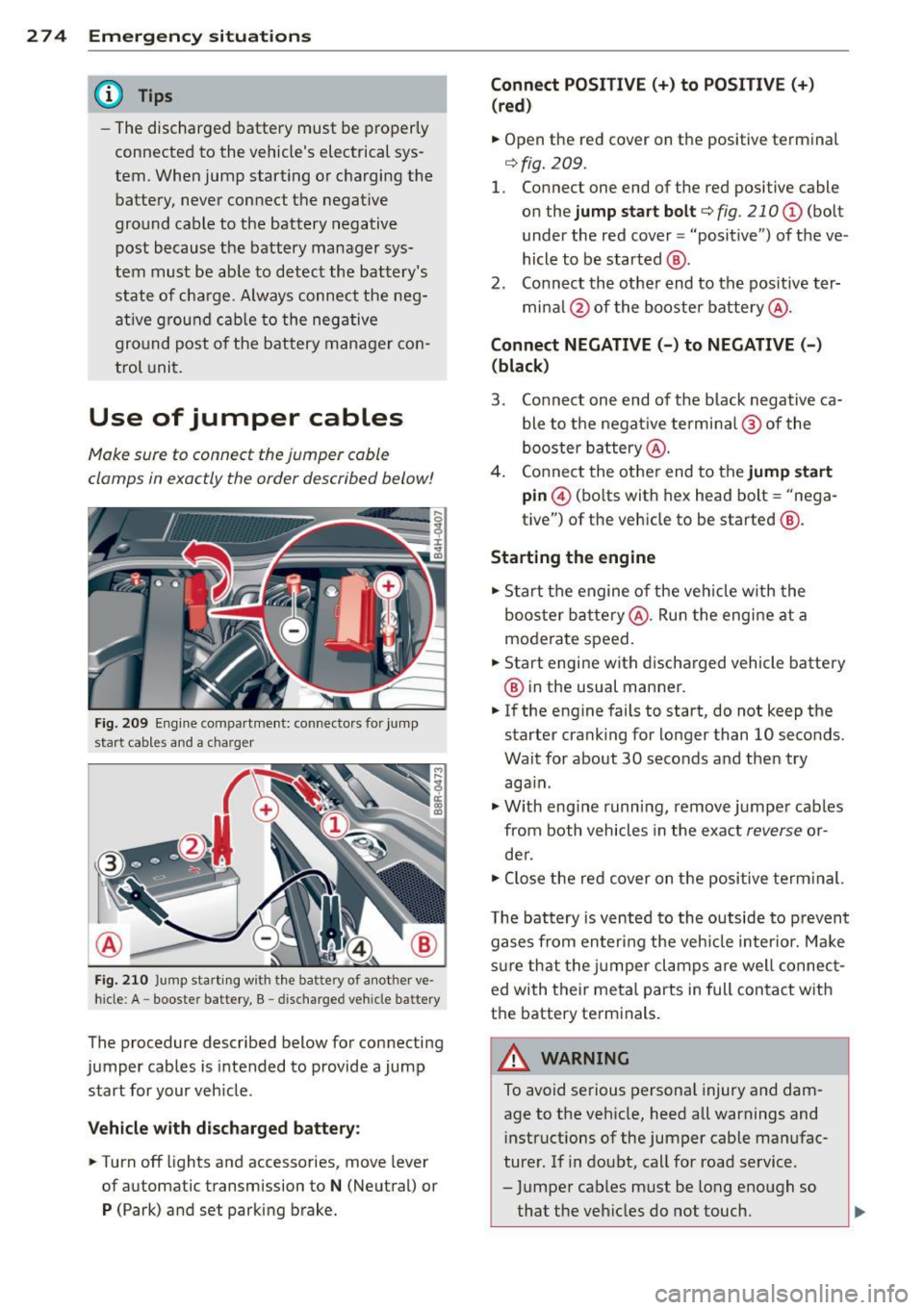
Fig . 209 Engine compartme nt: connecto rs for jump
start cab les and a charger
Fig. 210 Jump starting w ith the battery of another ve
h icle: A - boos ter battery, B - discharged veh icle battery
The procedure described below for connecting
jumper cables is intended to provide a jump
start for your veh icle.
Vehicle with discharged battery :
.. Turn off lights and accessories, move lever
of automatic transmission to
N (Neutral) or
P (Park) and set parking brake.
Connect POSITIVE(+) to POSITIVE(+)
(red)
.. Open the red cover on the positive terminal
¢fig. 209 .
1. Connect one end of the red positive cable
on the
jump start bolt ¢ fig. 210@ (bolt
under the red cover = "positive") of the ve
hicle to be started @.
2 . Connect the other end to the positive ter-
mi nal @of the booster battery@.
Connect NEGATIVE (-) to NEGATIVE (-)
(black)
3. Connect one end of the black negative ca
ble to the negat ive terminal @ of the
booster battery @.
4. Connect the other end to the
jump start
pin © (bolts with hex head bolt= "nega
tive") of the vehicle to be started @.
Starting the engine
.. Start the engine of the veh icle w ith the
booster battery @. Ru n the engine at a
moderate speed .
.. Start engine with discharged vehicle battery
@ in the usual manner .
.. If the engine fails to start, do not keep the
starter crank ing for longer than 10 seconds.
Wait for about 30 seconds and then try aga in .
.,. With engine running, remove jumper cables
from both vehicles in the exact
reverse or
de r .
.. Close the red cover on the positive term inal.
T he battery is vented to the outside to prevent
gases from entering the vehicle inter ior. Make
s ur e that the jumper clamps are well connect
ed with their meta l parts in full contact with
the battery terminals.
_& WARNING
To avoid se rious personal injury and dam
age to the vehicle, heed all warnings and
in structions of the jumper cable manufac
turer. If in doubt, call for road service .
- Jumper cables must be long enough so
that the veh icles do not touch.
-
Page 285 of 302
Consumer Information
Warranty coverages
Your Audi is covered by the following war
ranties :
- New Vehicle Limited Warranty
- Limited Warranty Against Corrosion Perfo-
ration
- Emissions Control System Warranty
- Emissions Performance Warranty
- California Emissions Control Warranty (USA
vehicles only)
- California Emissions Performance Warranty
(USA vehicles only)
Detailed information regarding yo ur warran
ties can be found in your
Warranty & Mainte
nance booklet .
Operating your vehicle
outside the U.S.A. or
Canada
Government regulations in the United States
and Canada require that automobiles meet
specific emission regulations and safety
standards. Therefore, veh icles built for the
U.S.A. and Canada differ from vehicles sold in
other countries .
I f you p lan to take your vehicle outside the
continental limits of the United States or Can
ada, there is the possibility that
- unleaded fuels for vehicles with cata lytic
converter may not be available;
- fuel may have a considerably lower octane
rating . Improper fuel may cause engine
damage;
- service may be inadequate due to lack of
proper service facilities, tools or testing
equipment;
- replacement parts may not be readily availa
ble.
- Navigation systems for vehicles built for the
U.S.A. and Canada will not necessari ly work
in Europe, and may not work in other coun
tries outside North America .
Consumer Information 283
@ Note
Audi cannot be responsible for mechanical
damage that could result from inadequate
fuel, serv ice or parts availab ility.
Audi Service Repair
Manuals and Literature
Audi Offic ial Factory Service Manuals and Lit
erature are published as soon as possible after
model introduct ion. Service manuals and lit
erat ure are available to order from the Audi
T echnical Literature Ordering Center at:
www.audi.techliterature.com
Maintenance
' General
Your vehicle has been designed to help keep
maintenance requirements to a m inimum.
However, a certain amount of regular mainte
nance is still necessary to assure your vehicle's
safety, economy and reliability . For detailed
vehicle maintenance consult your Warranty
&
Maintenance booklet.
Under difficult operating conditions , for ex
ample at extremely low outside temperatures,
in very dusty regions, when towing a tra iler
very frequently, etc., some serv ice work
shou ld be pe rformed between the intervals
specified. This applies particularly to:
- oil changes, and
- cleaning or replacing the air filter.
® For the sake of the environment
By regularly maintaining your veh icle, you
help make sure that emission standards
are maintained, thus min imiz ing adverse
effects on the environment .
Important considerations for you and
your vehicle
The increasing use of electronics, sophisticat
ed fuel injection and emission contro l sys-
tems, and the genera lly increasing technica l ..,_
•
•
Page 289 of 302

A
A/C (automatic climate control) .... .. .. 75
Accessories .. ... .. .. ..... ... .. .. .. . 285
Adaptive a ir suspension/sport .. .. .. .. . 106
adaptive cruise control Stop-and-go traffic . . . . . . . . . . . . . . . . . 89
Adapt ive cruise control ................ 86
C lean ing sensors/cameras ........... 208
Messages . . . . . . . . . . . . . . . . . . . . . . . . . 93
Request for drive r in tervention .. .. .. .. 90
Adapt ive Light (defective) ... .. .. .. ... . 21
Adding Engine coolant ........ ... ... ... ... 230
Eng ine oi l .. .. ........... .. .. .. ... 227
W indshield washer fluid ... .. .. .. .. . 236
Addit ives
Engine oi l .. .... .. .... ... .. .. .. ... 227
Adjustab le steer ing colum n ............ 78
Ad justing
A ir distribution (automatic climate con-
trol) . . . . . . . . . . . . . . . . . . . . . . . . . . . . . . 76
Front seats . . . . . . . . . . . . . . . . . . . . . . . . 54
I nstrument illum inat ion . ..... .... ... 47
S teer ing colum n .......... .. .. .. .. .. 78
Temperatu re (automat ic climate co ntrol) 76
Airbag system . . . . . . . . . . . . . . . . . 145, 164
Advanced A irbag System ............ 149
Advanced Airbag System components . 152
Ca re . .... .. ................. .. ... 158
C hi ldren . .. .. ........... .. .. .. ... 170
Ch ild restra ints .................... 171
Components (front airbags) . ... .. .. . 152
Danger of fitting a child seat on the front
passenger seat . . . . . . . . . . . . . . . . . . . . 147
Disposal . . . . . . . . . . . . . . . . . . . . . . . . . 158
Front airbags . . . . . . . . . . . . . . . . 149, 150
H ow do the front airbags work? ... .. . 154
H ow many airbags does my vehicle
have? ... ..... ........... ...... .. 152
H ow the Advanced Airbag System com -
po nents work together ............. 153
I mportan t safety instructions on the
knee airbag system .... ... .. .. .. .. . 162
Important things to know .... .. .. .. . 145
Knee airbags ............. .... .. ... 161
Mon itoring . . . . . . . . . . . . . . . . . . . . . . . 156
PASSENGER AIR BAG OFF light .. .. .. . 156
Inde x 287
Repairs ... .. .... ... .. .. ..... ... .. 158
Safety instructions . .. ... .... ... .. .. 158
S ide a irbags ... .. .. . .. ... .... ... .. 163
S ide curtain airbags ................ 166
Warning/ind icator lights ............ . 18
Warning/Indicator lights ........... 156
We ight-sensing mat ... .. ..... ... .. 170
When must the system be inspected? 156
Aircraft Transporting your vehicle ........... 277
A lloy wheels . . . . . . . . . . . . . . . . . . . . . . . 211
All Wheel Drive . . . . . . . . . . . . . . . . . . . . . 194
Winter tires . .. .. .... ........... .. 253
Ambience lighting ..... ............. . 46
Anti-freeze
refer to Engine coolan t ...... ... .. .. 229
Anti- lock b raking system ............ . 190
Warning/ind icator lights .......... .. . 19
Anti-slip regulation ............. .... 190
Anti -theft systems
E lectronic immob ilizer .. .. ..... ... .. . 30
Audi braking guard
refer to b ra ki ng g uard .............. . 86
Audi drive select
refer to drive select 106
Audi Service Repair Manuals and Litera-
ture .............................. 283
A UTO
A utomat ic climate control ............ 75
A utomatic head lights .. .. ..... ... .. . 43
Auto Lock . . . . . . . . . . . . . . . . . . . . . . . . . . 31
Automat ic belt retractor . . . . . . . . . . . . . 140
A utomat ic car wash .... ........... .. 207
Automat ic climate control
Air vents . . . . . . . . . . . . . . . . . . . . . . . . . . 76
Automat ic recircu lation .............. 77
Operation . .. .. .. .... ............. . 75
Setup ............................ 77
synchronizing . . . . . . . . . . . . . . . . . . . . . . 76
Automat ic transm iss ion (t iptro nic) . .... 112
Emergency mode . .. ............... 115
K ick-down . .. .. .. ... ............ .. 115
Manua l shift ing . . . . . . . . . . . . . . . . . . . 115
Parking lock eme rgency release .. .. .. 116
Se lector lever positions . .. ..... ... .. 112
Automat ic w ipers ......... ........... 48
Auto Safety Hotline ................. 135
•
•
Page 297 of 302
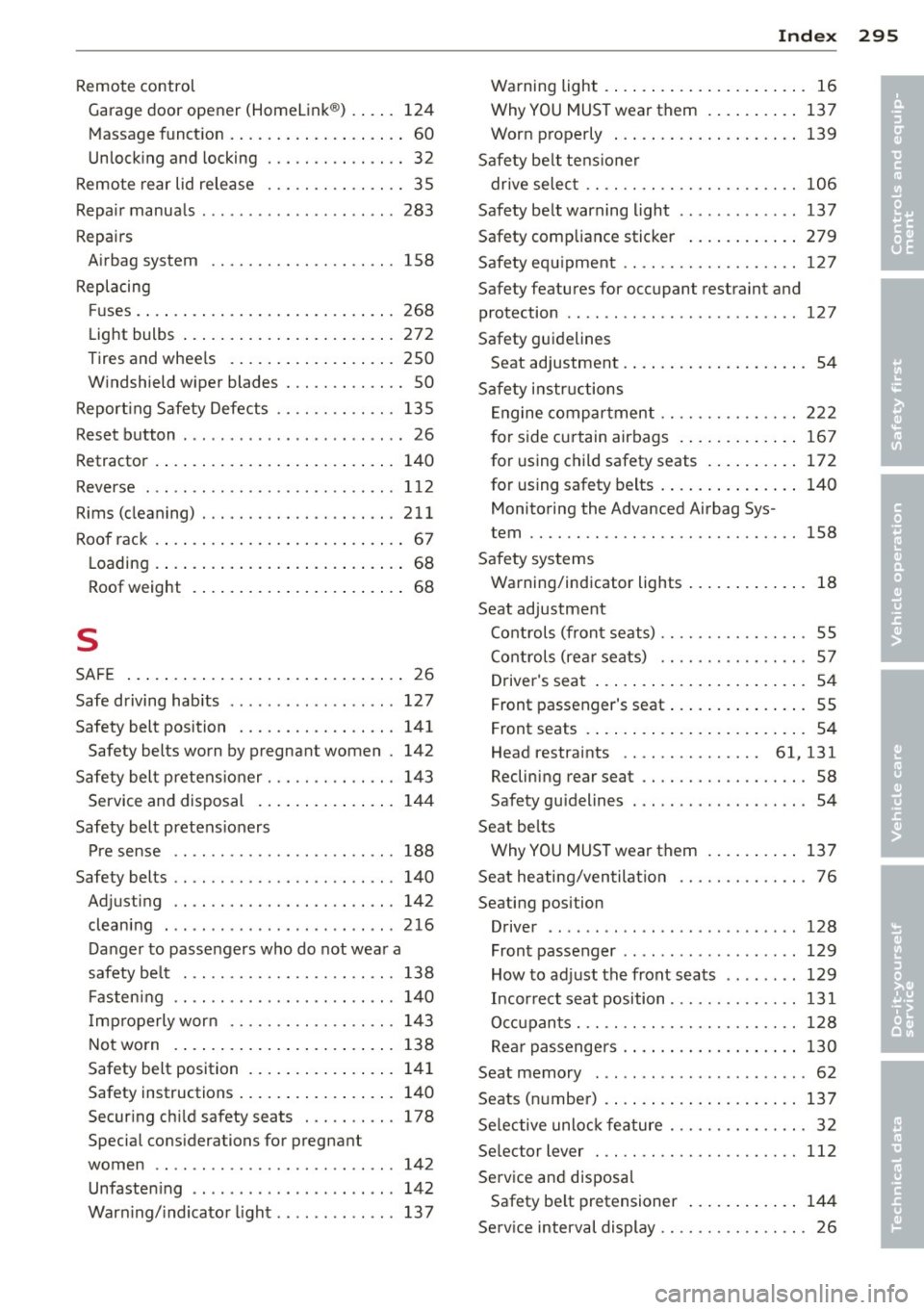
Remote control Garag e door open er (Homelink ®) .. .. . 124
Massage funct ion . . . . . . . . . . . . . . . . . . . 60
Unlock ing and locking ........... .. .. 32
Remote rear lid release ............... 35
Repair manuals ................... .. 283
Repairs Airbag system .................... 158
Replacing Fu ses . ..... .. .. ... ..... ... .. .. ... 268
Light bulbs ... ... ..... ... .. .. .. ... 272
Tires and whee ls . ..... ... .. .. .. .. . 250
Windshield wiper blades ... .. .. .. .. .. 50
Report ing Safety Defects .......... .. . 135
Reset button . . . . . . . . . . . . . . . . . . . . . . . . 26
Retractor . . . . . . . . . . . . . . . . . . . . . . . . . . 140
Reverse . .. .. ........ ......... .. .. . 112
R ims (cleaning) ..................... 211
Roof rack .... .... ...... ... .. .. .. .... 67
L oading .... .. .... .... ... .. .. .. .... 68
Roof weight . . . . . . . . . . . . . . . . . . . . . . . 68
s
SAFE . .. .. .. ... .. .. ..... ... .. .. .... 26
Safe driving hab its ...... ... .. .. .. .. . 127
Safety belt position ........ .. .. .. .. . 141
Safety belts worn by pregnant women . 142
Safety belt pretens ioner . . . . . . . . . . . . . . 143
Service and disposal . . . . . . . . . . . . . . . 1 44
Safety belt pretens ioners
P re sense . . . . . . . . . . . . . . . . . . . . . . . . 188
Safety belts . . . . . . . . . . . . . . . . . . . . . . . . 140
Adjusting .. .. .. ............ ... .. . 142
cleaning ......................... 216
D anger to passengers who do not wea r a
safety be lt . .. .. ......... .. .. .. .. . 138
F asten ing .. ............. .... .. ... 1 40
I mproperly wor n .................. 14 3
N ot wo rn . .... .. ..... ... .. .. .. ... 138
Safety belt position .... ... .. .. .. .. . 14 1
Safety instructions ..... ... .. .. .. .. . 140
Secur ing child safety seats . .. .. .. .. . 178
Special considerations for pregnant
women .. ... ............. ... ... .. 142
Unfasten ing .... ............ ... ... 142
War ning/ indicato r light .. .. .. .. .. .. . 137
Inde x 295
Warning light . ...... .. .. ..... ... .. . 16
Why YOU MUST wea r them ...... .. .. 137
Worn properly ... .. . .. ..... ... .. .. 139
Safety be lt tens ioner
drive selec t .. .. .. ................. 106
Safety be lt warning light ............ . 137
Safety compliance sticker ..... ... .. .. 279
Safe ty eq uipme nt .. ............. .... 12 7
Safety features for occupant restraint and
protection . . . . . . . . . . . . . . . . . . . . . . . . . 12 7
Safety gui delines
Seat adjustment . . . . . . . . . . . . . . . . . . . . 54
Safety instr uctions
E ngine compar tment ........... .... 2 22
f or side cu rtain airbags . ..... ... .. .. 167
for using child safety seats ... ... .. .. 172
for using safety belts . . . . . . . . . . . . . . . 140
Monito ring the Advanced Airbag Sys-
tem ............................. 158
Safety sys tems
Warning/ind icator lights ..... ... .. .. . 18
Seat adjustment Co ntrols (front seats) . . . . . . . . . . . . . . . . 55
C o ntrols (re ar seats) ........... .. .. . 57
Drive r's sea t . . . . . . . . . . . . . . . . . . . . . . . 54
F ront passenger's seat . . . . . . . . . . . . . . . 55
Front seats . . . . . . . . . . . . . . . . . . . . . . . . 54
Head restraints . . . . . . . . . . . . . . . 61, 131
Reclining rear seat .... ............. . 58
Safety gu idelines . ... ... .... ... .. .. . 54
Seat belts Why YOU MUST wea r them ... ... .. .. 137
Seat heating/ventila tion . . . . . . . . . . . . . . 76
Seating position Driver ....... .... ........... ..... 128
Front passenger ... ........... .... . 129
How to ad just the front seats ........ 129
Incor re ct sea t position .......... .. .. 131
Oc cupan ts . .. .. .. .. . .. .......... .. 128
Rear passengers .. .. .. ...... ... .. .. 130
Seat memory . . . . . . . . . . . . . . . . . . . . . . . 62
Seats (n umber) . ... .. .. ... ..... ... .. 137
Se lective unlo ck feature . . . . . . . . . . . . . . . 32
Se lector lever . . . . . . . . . . . . . . . . . . . . . . 112
Service and disposa l
Safety be lt pretensioner . . . . . . . . . . . . 144
Se rv ice interval display .. ......... .. .. . 26
•
•