ignition AUDI A8 2011 Repair Manual
[x] Cancel search | Manufacturer: AUDI, Model Year: 2011, Model line: A8, Model: AUDI A8 2011Pages: 302, PDF Size: 76.07 MB
Page 229 of 302

Checking the engine oil level
Fig . 178 D is p lay: o il level indica tor
Park your vehicle on a level surface.
• Shut the engine off when i t is wa rm.
• Swi tch on ly the ignition back on .
• Wait approximately two minutes .
• Se lect :
I CAR I funct ion button > C ar sys tem s
cont rol button > Se rvicing & c heck s > Oil
le ve l.
• Check the oil level in the display¢ fig. 178 .
Add engine oil if the bar of the oil level indi
cator is near "min " ¢
page 22 7.
Depending on the way the veh icle is driven
and the operating conditions, oil consumpt ion
can be up to 1/2 quart per 600 m iles (0 .S liter
per 1 ,000 km) . Consumption may be h igher
within the first 3,000 miles (S,000 km) .
@ Tips
The oil level indicator in the MMI Display is
only an informat ion d isp lay . If the oil leve l
is low, a minimum o il warning appears in
t he ins trumen t cluste r. Add oi l
¢
page 22 7 . If the hood h as been opened,
the current oil level is shown in the instru
ment cluster the next time the ignition is
sw itched on.
Checkin g and fillin g 22 7
Adding engine oil 'i=:1:
Fig. 179 Eng in e compa rtm en t: co ve r on the engine oi l
filler n eck
Before you check anything in the eng ine com
partment ,
alw ays re ad and he ed all WARN
INGS
c:> &, in Working in the engine compart
ment on page 222 .
• Unscrew the cap~ to the eng .i ne o il filling
hole
c:> fig . 179.
• Carefully top off with the appropriate oil in
0.S liter doses .
• Check the oil level again after two minutes
¢ page 22 7.
• Top off the oil aga in, if necessary .
• Screw the cap back on the filling hole .
A WARNING
-Wh ile topping off, the oil must not come
in contact w ith hot engine parts -fi re
hazard!
- The oi l filler cap must be p roperly se
cured to prevent oil from being sprayed
on the hot engine and exhaust system
when the engine is runni ng -fire ha zard!
- I f your s kin has come in contact with the
engine o il, you must subse quently
cleanse it thoroughly.
(D Note
- Check the oil level using the MMI. If the
message
Please reduce oil level appe ars,
c ontact yo ur a uth ori zed Aud i dea ler o r
ot her qualified workshop to have excess
oil extracted if necessary.
- Audi d oes not re commend the u se of oil
additi ves. The y m ay dama ge the engine
1111-
Page 231 of 302
Engine cooling system
Coolant
The engine coolant performs two functions: it
keeps the engine from overheating and it pro
te cts the engine from freezing in the winter .
The cooling system is sealed and generally re
qu ires little attention .
The cooling system has been filled at the fac
tory with a permanent coolant which does not need to be changed. The coolant consists of a
mixture of water and the manufacturer's gly
col-based coolan t additive G12++ ant ifreeze
with a nticorrosion add itives (50% fo r USA
models; 60% for Canad ian models). This mix
ture bot h assu res the ne ces sary frost protec
tion and protects metal components in the
engine's cooling system from corrosion and
scaling. It also raises the bo ili ng po int of t he
coolant.
D o not red uce the concentration of the coo l
ant in the summe r by adding plain water .
The
proportion of coolant addit ive must be at
least 50% but not mo re than 60 %
to main
tain antifree ze protection and cooling efficien
cy. If the coolant frost protect ion is too low,
the coolant could freeze and damage the veh i
cle heating and eng ine cooling system .
For year-round driving, antifree ze is added at
the factory for temperatures down to:
- -3 1°F (-35°C)USA
- -4 0 ° F ( - 4 0 °C) Canada.
You can mix t he G12 ++ cool ant ad ditive with
o ther addit ives (G1 2+ or G1 2). Alway s check
w ith your author ized Audi dealer.
& WARNING
Before yo u check any thing in the engine
compartment, always read and hee d all
W AR NIN GS
Q .&. in Working in the engine
compartment on page 222.
(D Note
- Before win ter se ts in , have the coolan t
checked to see if the coolant addit ive i n
Checkin g and fillin g 229
your vehicle is sufficient to meet the cli
mate conditions . This is especia lly impor
tant if you live in a reg ion where t he win
ter is extreme ly co ld. If necessary, in
crease t he p ropo rtion of coo lant add itive
t o 60% .
- Whe n add ing coolant additive to your
cooling system , remember :
- W e re co mme nd usin g only cool ant ad
dit ive G 12++ (check t he labe l) for your
vehi cle. This coolan t addi tive is ava ila
b le at a uthorized Audi dea le rs . Othe r
types of ant ifreeze can significant ly re
d uce co rrosi on protection. The res ult
i n g corrosion can ca use a loss of co ol
ant and ser io us eng ine damage .
- Do not add any type of rad iator leak seal
ant to you r vehicle's eng ine c oolant .
Add ing radiator repair fl uid may adverse
ly affect t he f unction and performance of
yo ur cooling sys tem and co uld resu lt i n
damage not covered by yo ur New Ve hicle
Li mi ted Warran ty.
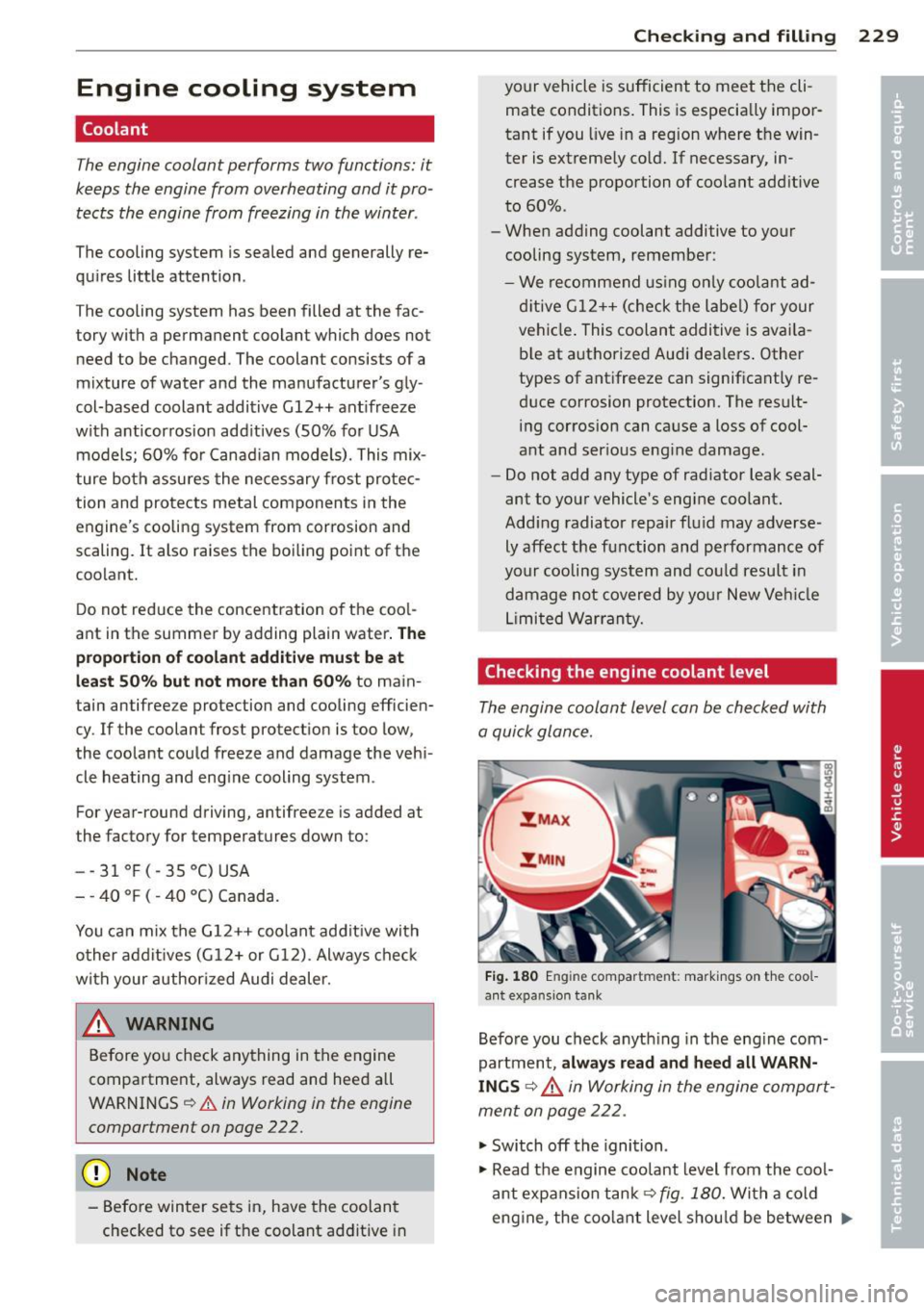
Checking the engine coolant level
The engine coolant level can be chec ked with
a quick glan ce.
:!, MAX
% MIN
Fig. 180 En gin e compar tment: mark ings on t he coo l
a n t expa nsion tank
Befo re you check a nyth ing in the eng ine com
partment,
always read and heed all WARN
INGS ¢.&, in Working in the engine compart
men t on page
222 .
"' Switch off the ignition .
"' Read the engine coo lant level from the coo l
ant expa nsion tank
Qfig . 180. Wit h a co ld
eng ine , the coo lant level s hou ld be between
1JJ>-
Page 233 of 302

A WARNING
-=
-The cooling system is under pressure and
can get very hot . Reduce the risk of
scald ing from hot coolant by following
these steps .
- Turn
off the engine and a llow it to cool
down.
- Protect your face, hands and arms from
escaping fluid and steam by covering
the cap with a large, thick rag.
- Turn the cap slowly and very carefully in a counter-clockwise direction while
applying light, downward pressure on
the top of the cap.
- To avoid being burned, do not spi ll an
tifreeze or coolant on the exhaust sys
tem or hot engine parts. Under certa in
conditions, the ethylene glycol in en
g ine coolant can catch fire.
- Antifreeze is poisonous. Always store an
t ifreeze in its original container and well
out of the reach of children.
- If you drain the coolant, it must be
caught and safely stored in a proper con
tainer clearly marked "poison".
(D Note
- Coolant pollutes the env ironment and
could cause an engine fire. Excess cool
ant w ill be forced out through the pres
sure relief valve in the cap when the en
gine becomes hot.
- If, in an emergency, only water can be
added, the correct ratio between water
and antifreeze
Q page 229 must be re
stored as soon as possible.
@ For the sake of the environment
Drained coolant should not be reused. Al
ways dispose of used coolant while obse rv
ing all environmental regulations.
Checkin g and fillin g
Radiator fan
The radiator fan switches on automatically by
itself .
The rad iator fan is dr iven by the engine via the
V-belt. The viscous clutch regulates the speed
of the fan according to the temperature of the
coolant .
An auxiliary electric radiator fan* switches on
and
off depending on coolant temperature
and other vehicle operat ing cond it ions .
After you switch the engine
off, the aux iliary
fan can continue running for up to 10 minutes - even with the ignition
off. It can even switch
on again later by itself
Q &., if
- the temperature of the engine coo lant rises
due to the heat build-up from the engine in
the engine compartment, or
- the engine compartment heats up because the vehicle is parked in intense sunlight.
A WARNING
- To reduce the risk of personal in jury nev
er touch the radiator fan .
- The auxiliary electric fan is temperature
controlled and can switch on suddenly
even when the engine is not running.
- The auxiliary radiator fan sw itches on au
tomatically when the engine coolant reaches a certa in temperature and w ill
continue to ru n until the coolant temper
ature drops.
231
•
•
Page 237 of 302

_& WARNING
California Proposition 65 Warning:
- Battery posts, terminals and related ac
cessories contain lead and lead com
pounds, chemicals known to the State of
California to cause cancer and reproduc
t ive p roblems. Wash hands afte r han
dling.
(D Note
- Do not d isconnect the vehicle battery
when the ignition is on or when the en
gine is running, otherwise, you will dam
age electron ic components in the elect ri
c al system.
- If your vehicle is going to stand for a
l ong pe riod of time wi thout bei ng d riven,
protect the battery from "freezing", oth
erwise it wil l be damaged and w ill then
have to be replaced.
Battery charging
Starting the engine requires a well charged
battery.
F ig . 182 Eng ine compartment : connecto rs for a cha rg
er and jump sta rt cab les
Alway s read and h eed all WARNINGS be low
¢ &. and
¢&. in Working on the ba ttery on
page 234.
• Switch off the ignit ion and a ll electrica l con
s u mers.
• Make sure the are a is well vent ilated when
you charge the battery.
• Open the engine hood
¢page 222.
• Remove the cover @ by press ing on the ar
row ¢
fig. 182.
Checkin g and fillin g 235
• Open the cover @on the pos itive termina l.
• Connect the charge r co nnectors according to
the instruct ions to the
jump sta rt bolts.
(Bo lts under the red cover= "positive", Bo lts
w ith hex head= "negative").
• On ly now plug the mains lead for the charg
ing equ ipment into the wall outlet and turn
iton ¢_& .
• Make sure the charging rate is not over
30 amp s/14.8 V olt .
• W hen the battery is fully charged: T urn the
charging equipment off and remove the
mains lead from the wall out let.
• Now remove the clamps for the charging
equipment.
• Close the red cover on the positive pole.
• Close the hood ¢
page 223.
A discharged battery can freeze at tempera
tures of only 32 F
0 (0 °C). Allow a frozen bat
tery to thaw completely before attempting to
charge it ¢ Ii::,. . However, we recommend not
us ing a thawed batte ry aga in because the bat
te ry casing can be c racked due to i ce fo rma
t ion and can leak ba ttery a cid.
Battery charging (Maximum charging rate
of 30 amps /14.8 Volt )
When charg ing at low vo ltages (e.g. wi th a
trickl e charger ), the batte ry cables do no t
have to be dis conne cted firs t. T he bat tery
caps should
not be opened when charg ing a
batte ry .
It is no t necessa ry to remove the battery from
t he luggage compartmen t, a nd it is a lso not
necessary to d isconnect the cab les.
Fast charging the battery (charging rate
above 14 .8 Volts)
Fo r tec hni cal re asons do not use a battery
c h arger that uses voltage g reater than 14.8
Volts to charge yo ur vehicle's battery.
A WARNING
Charging a battery can be dangero us.
- Always follow the operating instructions
provided by the battery charger manu
facturer when charging your battery.
Page 259 of 302

remain continuously illuminated. This se
quence will continue upon subsequent vehicle
start-ups as long as the malfunction exists.
When the malfunction indicator is illuminat
ed, the system may not be able to detect or
signal low tire pressure as intended . TPMS
malfunct ions may occur for a variety of rea
sons, including the installation of replace ment or alternate tires or wheels on the vehi
cle that prevent the TPMS from functioning
properly . Always check the TPMS malfunct ion
tellta le after replacing one or more t ires or
wheels on your vehicle to ensure that the re
placement or alternate tires and wheels allow
the TPMS to continue to function properly.
Tire pressure indicator appears
Applies to vehicles: with tire pressure monitoring system
The tire pressure indicator in the instrument
cluster informs you if the tire pressure is too
low or if there is a system malfunction.
Fig. 189 Display : underinflatio n warning
Fig. 190 Display: System malfu nctio n
Using the ABS sensors, the tire pressure moni
toring system compares the tire tread circum
ference and vibration characteristics of the in
dividual tires . If the pressure decreases in one
or more tires, this is indicated in the instru-
Tires and wheels 257
ment cluster with a warning symbol [I) and a
message
r::!) fig. 189.
The tire pressure monitoring system must be
reset via MMI each t ime the pressures are ad
justed (e.g. when switching between partial
and full load pressure) or after changing or re
placing a tire on your vehicle
r::!) page 258. You
can find the recommended tire pressures for
your vehicle on the label on driver's side 8-pil
lar
r::!) page 242 .
Tire tread circumference and vibration charac
teristics can change and cause a tire pressure
warning if:
- the tire pressure in one or more tires is too
low,
- the tire has structural damage,
- the tir e pressure was changed, wheels rotat-
ed or replaced but the TPMS was not reset
r::!) page 258 .
Warning symbols
[I) Loss of pressure in at least one tire co& .
Check the tire or tires and replace or repa ir if
necessary. The indicator light
[I) in the instru
ment cluster also illuminates
r::!) page 11.
Check/correct the pressures of all four tires
and resetTPMS via MMI.
lli§ffl (Tire Pressure Monitoring System) Tire
pressure! System malfunction.
If llilffl appears after switching the ignition
on or while driving co
fig. 190 and the indica
tor light
[I) in the instrument cluster blinks
for approximately one minute and then stays
on, there is a system malfunction . See your
authorized Audi dea ler as soon as possible .
A WARNING
-If the tire pressure indicator appears in
the instrument cluster display , one or
more of your tires is significant ly under
inflated . Reduce your speed immediately
and avoid any hard steering or braking
maneuvers. Stop as soon as possible and
check the tires and their pressures . In
flate the tire pressure to the proper pres-
sure as indicated on the vehicle's tire .,.
Page 260 of 302

258 Tires and wheels
pressure label~ page 242 . Driving on a
significantly under-inflated tire causes
the tire to overheat and can lead to tire
failure. Under-inflation also is likely to
impair the vehicle's handling and stop
ping ability.
- The driver is responsible for maintaining
the correct tire pressures. You must
check the tire pressures regularly.
- Under certain cond itions (such as a spor
ty driving style, winter condit ions or un
paved roads), the pressure monitor indi
cator may be delayed.
- Ask your author ized Audi dealer if run
flat tires may be used on your veh icle.
Your vehicle registration becomes invalid
if you use these tires when not permit
ted. Damage to your vehicle or accidents
cou ld also result.
(D Tips
- The tire pressure monitoring system
stops working when there is an ESP/ABS
malfunction.
- Using snow chains may result in a system
malfunction.
- To ensure a proper TPMS function use
AUDI Original Tires which are marked
with "AO" or "RO" on the tire sidewall.
~p age 249.
- The tire pressure monitoring system on
your Audi was syntonized using tires with
the "AO" or "RO" identification. We rec
ommend using these tires.
Reset tire pressure monitoring system
App lies to vehicles: with tire pressure monitoring system
If the tire pressure is adjusted, wheels are ro
tated or changed, the TPMS must be reset via
MMI .
.. Switch on the ignition .
.. Se lect in the MMI: !CAR !function button>
Car systems contro l button > Servicing &
checks > Tire pressure monitoring > Store
tire pressures > Yes, store now.
(D Tips
Before resetting the TPMS, the current
pressures of all four tires must correspond
to the specif ied values. Adjust the tire
pressure and reset the pressure in the tire
pressure monitoring system according to
the load you are carrying~ page 242.
- Do not store the tire pressures if you are
dr iving with snow chains. Otherwise, a
system malfunction may occur.
Page 271 of 302
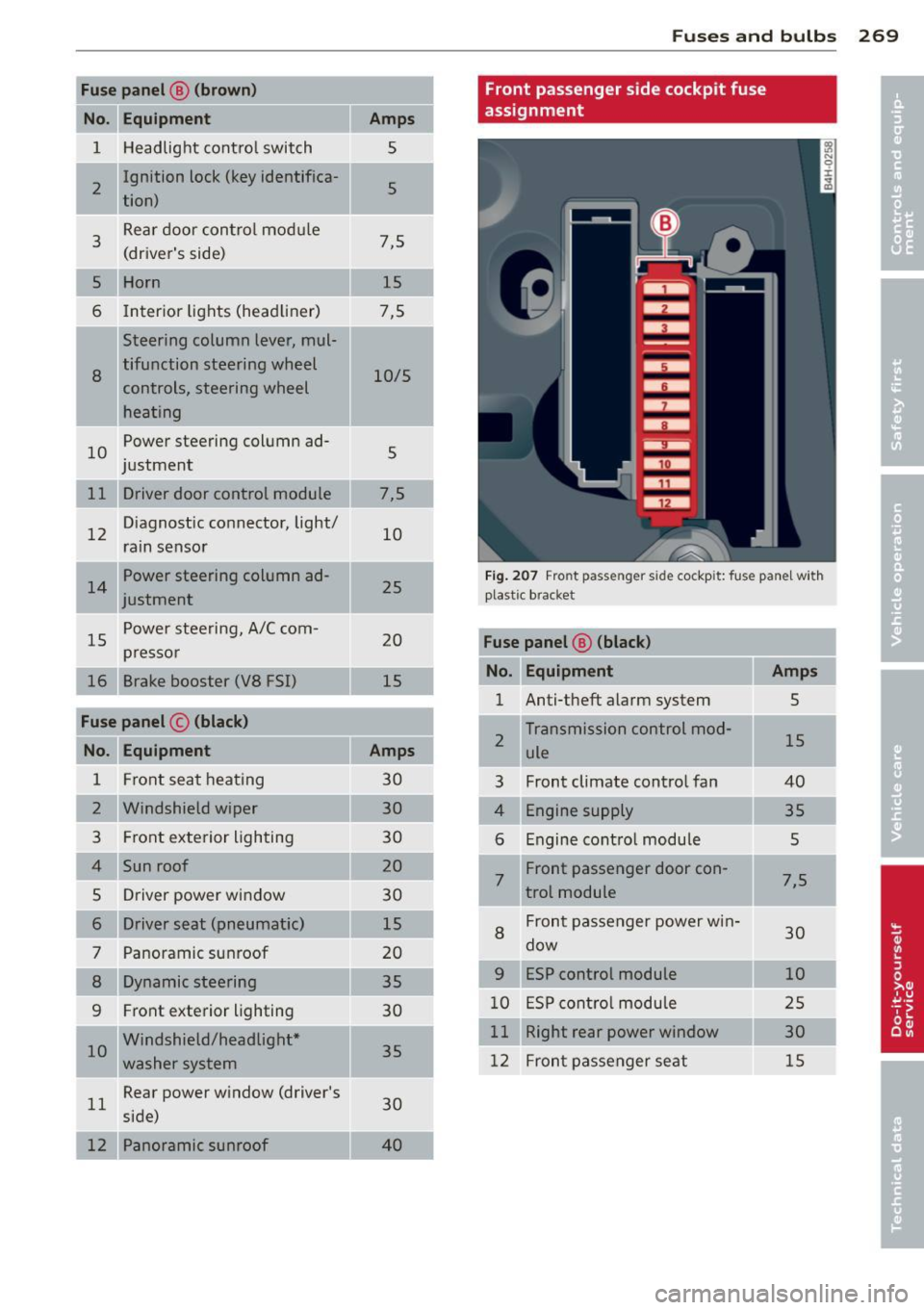
Fuse panel@ (brown)
No. Equ ipment
1 H eadlight contro l switch
I 2
Ignition lock (key identifica-
tion)
3
Rear door control mod ule
(driver's side)
5 Horn
6 Interior lights (head liner)
Steering column lever, mul-
8
tifunction steering wheel
controls, steering wheel
heating
10
Power steering column ad-
j ustment
11 Driver door control module
12
D iagnostic co nnector, light/
rain sensor
Power steering column ad-
justment
15
P ower stee ring, A/C com-
pr esso r
16 Brake booster (VS FSI)
Fuse panel © (black )
No. Equipment
1 F ront seat heating
2 Windshield wiper
3 Fr ont exterior lighting
4 Sun roof
5 Dr iver power window
6 Driver seat (pneumatic)
7 Panoramic sunroof
8 Dynamic steering
9 Fr
ont exterior lighting
I 10
Windshield/headlight *
washe r system
11
Rear power w indow (driver's
side)
12 Panoramic sunroof
Amp s
5
5
7,5 15
7,5
10/5
5
7,5 10
25
20
15
Amps
30 30
30
20
30
15
20 35
30
35
30
4 0
Fu se s and bulb s 269
Front passenger side cockpit fuse
assignment
Fi g. 2 07 Fro nt passe nger s id e co ckpit: f use pa nel w it h
plast ic brac ket
Fuse panel ® (black)
No . Equipment Amps
1 Anti-theft alarm system 5
2
Transmission control mod-
15 ule
3 Front climate control fan 40
4
Engine supply 35
6
Engine cont ro l module 5
7
Front passenger door con-7,5
t rot module
8
Fron t passe nger power w in-
30 dow
9 ESP control module 10
1 0
E S P cont ro l modu le 2 5
11
Right rear power window 30
12
Fron t passe nger seat 15
Page 281 of 302

General information Explanation of
technical data
Som e of t he technical data listed in this man
ual requires further explanation .
The technical data for your vehicle is listed in
the charts starting on
Q page 282 . This sec
tion provides general information, notes and restr ictions wh ich app ly to this data.
Vehicle identification
The key data is given on the vehicle identifi ca
tion number (V IN) plate and the vehicle data
sti cker .
Fig. 21 8 Vehicle Ident ificat io n Num ber (V lN) p la te: lo
cation o n dri ver"s s ide dash pa nel
Fi g. 2 19 The ve hicle ident ificat ion label -inside the
l u ggage co mpartme nt
The Vehicle Identification Number (VlN)
is located on the d river's side so tha t it is v is i
b le from the outside through the windshield
Q fig . 218. You can also d isplay the Vehicle
Identification N umber of your vehicle in the
MMI. Select: Function button
ICAR I > Car sys
tems
> VIN number .
General inform ation 2 79
The vehicle identification label
is located in the l uggage comp artment in the
spare whee l we ll.
T he label
~ fig. 219 shows th e fo llow ing vehi
cl e data :
(D Product ion cont ro l No .
@ Vehicle identific ation No.
@ Type code number
© Type designat ion/e ngine o utput in K ilo-
wat ts
® Engine and transm ission code letter
® Pa int No./lnterior
0 Optio nal eq uipmen t No.'s
Vehicle data 2 to 7 are a lso fo und in your War
ranty
& Mai nte nance booklet.
The safety compliance sticker
is your assurance that your new vehicle com
plies wi th all applicab le Fede ral Motor Vehicle
Safety Standards which were in effect at the
time t he ve hicle was manufactur ed . You can
find this sticke r o n the left doo r jamb.
It
shows the m onth and ye ar of pro duction and
t h e ve hicle ident ifi cat io n number of yo ur vehi
cle (perforation) as well as the G ross Vehicle
Weight Rating (GVW R) and the Gross Axle
Weight Rating (GAWR).
The high voltage warning label
i s lo cated on the lock ca rrie r.
The spark ignition system complies with
the Canadian standard ICES-002.
Weights
Gross Vehicle Weight Rating
T he Gro ss Vehicle Weigh t Rat ing (GVWR), and
the Gross Axle We igh t Ra tin g (GAWR) for
fron t and rear are listed on a sticker on the
l eft door jamb .
T he Gro ss Vehicle Weigh t Rat ing incl udes the
weight o f the bas ic vehicle plus f ull fuel t ank,
oi l and coo lant, p lus maximum load, which in
cludes passen ger we ight (150 lbs/68 kg per ..,.
Page 286 of 302

28 4 Con sum er Inf orm ati on
comp lexity of today's automobi les, have
steadi ly reduced the scope of maintenance
and repairs which can be carried out by vehicle
owners.
Also, s afety an d e nvir onm ent al con
cerns place very strict limits on the nature of repairs and adjustments to engine and trans
miss ion pa rts which an owner can perform .
Maintenance, adjustments and repa irs usua lly
require special tools, testing devices and oth
er equipment avai lab le to specially trained
workshop personnel in order to assure proper
performance, reliab ility and safety of the vehi
cle and its many systems .
Improper ma intenance, adjustments and re
pa irs can impair the operation and reliab ility
of your vehicle and even void your vehicle war ranty. Therefo re , proof of servici ng in accord
ance w it h the ma intenance sched ule may be a
condition for upholding a possible warranty
claim made within the warran ty period .
Above all, operational safety can be adve rsely
affected, c reating unnecessary risks for you
and your passengers.
If in doubt about any servicing, have it done
by your author ized Audi dealer or any other
p roperly equipped and qualified wor kshop .
We strong ly urge you to give your authorized
Audi dealer the opportunity to perform all
schedu led maintenance and necessary repairs .
Your dea ler has the facilities, original parts
and tra ined spec ialists to keep your vehicle
running properly .
Performing lim it e d m aint en anc e y ourself
The following pages describe a limited num
ber of procedures which can be performed on
you r vehicle with ordinary too ls, shou ld the
need arise and trained personnel be unavaila
ble. Before performing any of these proce
dures, always thoroughly read all of the app li
cable text and carefully follow the instruc
tions given. Always rigorously obse rve the
WARNINGS p rovided.
B efore you ch eck anything in th e engine
compartm ent, alw ay s re ad an d hee d all WARNINGS
¢ & a
nd ¢ & in Working in the
engine comportment on page
222 .
A WARNING
--Serious personal injury may occur as a re-
sult of improperly performed mainte
nance, adjustments or repa irs.
- Always be extremely careful when work
ing on the vehicle. Always follow com
monly accepted safety pract ices and gen
eral common sense. Never r isk personal
in ju ry.
- Do not attempt any of the maintenance,
checks or repairs descr ibed o n the fol
lowing pages if you are not fu lly fam iliar
with these or other procedures with re spect to the ve hicl e, or are uncerta in how
to proceed .
- Do not do any work withou t the proper
too ls and equipment . Have the necessary
work done by your authorized A udi deal
er or anothe r properly equipped and
qualified workshop.
- The engine compar tment o f any motor
vehicle is a potentially hazardous area. Never reach into the area around or
touch the rad iator fan. It is temperature
control led and can switch on suddenly -
even when the engine is off . The radiator
fan switches on automatically when the
coo lant reaches a ce rtain temperature
and will cont inue to ru n until the coo lant
tempera ture drops.
- Always sw itch off the ignition before any
one gets under the vehicle.
- Always support your veh icle with safety
s tands if it is necessary to work under
neath the vehicle. The j ack s upp lied with
the vehicle is not adequate for this pur
pose and cou ld co llapse causing serio us
pe rsonal injury .
- If you must work underneath the vehicle
wit h the wheels on the ground, a lways
make sure the vehicle is on leve l ground,
that the wheels are a lways secure ly
blocked and that the engine cannot be
started .
Page 291 of 302
How do I properly install a child safety
seat in my vehicle? .............. .. . 172
Infant seats . . . . . . . . . . . . . . . . . . . . . . 17 4
Installing .. ............. .... .. ... 178
Installing a child restraint us in g the
LATCH system ..................... 184
LATCH system .... .. ... ... .. .. .. .. . 184
Lower anchorages ............... .. 182
Mounting and releasing the anchorage
hook .... .. ................. .. ... 184
Safety instructions ............ .. .. . 172
Clean ing and protection ......... .. .. . 206
A lcantara (synthet ic suede) .......... 215
Cooler ... .. ................. .. ... 216
Engine compartment ............... 216
Exhaust tail pipes ............ ... .. . 212
Fabrics and fabric coverings . ... .. .. . 212
Instrument panel ............ ... .. . 213
Interior . . . . . . . . . . . . . . . . . . . . . . . . . . 212
Leather . . . . . . . . . . . . . . . . . . . . . . . . . . 214
MMI display/controls ............... 212
Plastic and vinyl ................. .. 210
Plastic parts ..... .. ... ... .. .. .. .. . 213
Safety belts . . . . . . . . . . . . . . . . . . . . . . 216
tr im strips . ............. .. .. .. .. . 210
Trim strips . ............. .... .. ... 209
Climate controls . . . . . . . . . . . . . . . . . . . . . 7 4
Clock ....... .. ................ ..... 26
Closing Panoramic sunroof ........ .. .. .. .. .. 41
Sliding/tilting sunroof ............... 40
Sun shade (panoramic sunroof) ... .. .. 42
Cold tire inflation pressure ... .. .. .. .. . 242
Coming home ............. .... .. .. .. 45
Compact spare tire .................. 261
Compartments .... .. ... ... .. .. .. .. .. 70
Compass in the mirror ......... ... .. .. 52
Compliance .. .. ........... .. .. .. ... 286
Consumer Information . . . . . . . . . . 135, 283
Consumption (fuel) . . . . . . . . . . . . . . . . . . 24
Contacting NHTSA .................. 135
Convenience key .............. ... .... 33
Starting the engine ................. 79
Stopping the engine (START ENGINE
STOP button) . . . . . . . . . . . . . . . . . . . . . . 80
Switching the ignition on ............ 79
Unlocking and locking vehicle ........ . 33
Index 289
Convertib le child safety seats
Convertible locking retractor 17S
Activating . .. .. .. ................. 180
Deact ivating . .. .. .... ........... .. 181
Using to secure a child safety seat 1.78, 180
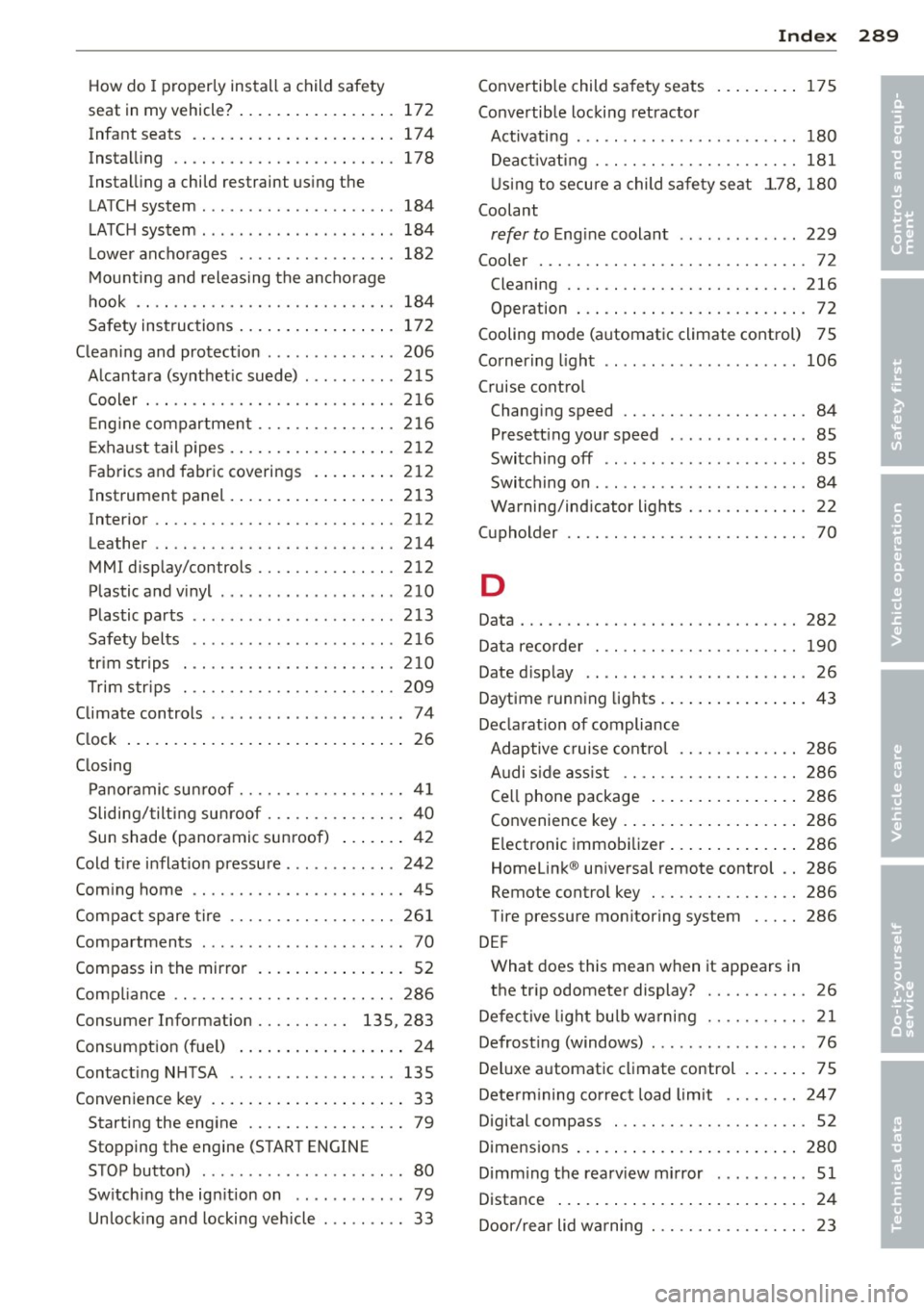
Coolant
refer to Engine coolant ............. 229
Cooler ....... .. .. .... ............. . 72
Cleaning .. .. .. .. .. ............... 216
Operation . . . . . . . . . . . . . . . . . . . . . . . . . 72
Cooling mode (automatic climate control) 75
Cornering light ........... .......... 106
Cruise control Changing speed .. .................. 84
Presetting your speed ............... 85
Switching off .. .. .. . .. ... .... ..... . 85
Switching on . . . . . . . . . . . . . . . . . . . . . . . 84
Warning/ind icator lights ............ . 22
(upholder .. .. .. .. ................. . 70
D
Data .............................. 282
Data recorder . .. .. .. .. ........... .. 190
Date display .. .. .. ... ... ...... ..... . 26
Daytime running lights .............. .. 43
Declaration of compliance Adaptive cruise control ............. 286
Audi s ide ass ist .. ............. .... 286
Cell phone package . . . . . . . . . . . . . . . . 286
Convenience key .. .. .............. . 286
Electronic immobilizer .............. 286
Homelink ® universal remote control .. 286
Remote control key ... ......... .. .. 286
Tire pressure monitoring system ..... 286
DEF What does this mean when it appears in
the trip odometer display? ........... 26
Defective light bulb warning ........... 21
Defrosting (windows) .. .. ... .... ..... . 76
Deluxe automatic climate control ..... .. 75
Determining correct load limit ........ 247
Digital compass . . . . . . . . . . . . . . . . . . . . . 52
Dimensions ....... .. . .............. 280
Dimming the rearview mirror .......... 51
Distance ....... .... ................ 24
Door/rear lid warning ... ............. . 23
•
•